


The Volokh Conspiracy

Mostly law professors | Sometimes contrarian | Often libertarian | Always independent | Est. 2002

The Volokh Conspiracy

Free Speech

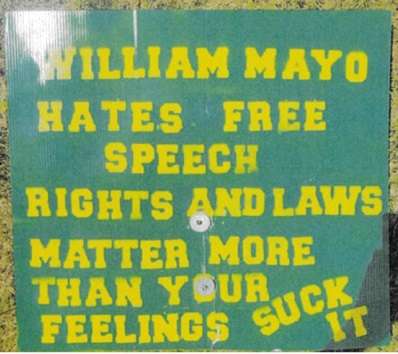
Vulgar Signs Condemning City Official, ~1200 Feet from Official's Home, Constitutionally Protected

|

One of the signs (from the court opinion).


Some excerpts from today's long decision by Judge Stacey D. Neumann in Roussel v. Mayo (D. Me.):

Plaintiff Joseph F. Roussel sued the city manager of Old Town, Maine, various Old Town police officers, and the Piscataquis County Sheriff for allegedly violating his First Amendment rights. This case began as a disagreement over the masking policy at the Old Town City Hall during the COVID-19 pandemic. But it developed into an acrimonious dispute, and the situation deteriorated further when Mr. Roussel did two things that are the subject of this Order: First, while passing by the city manager's lakefront house on his friend's boat, Mr. Roussel shouted expletives at the city manager. Second, Mr. Roussel posted strongly worded and expletive-laden signs on the side of the private road leading to the city manager's house. In response, the city manager enlisted Piscataquis County Sheriff Robert Young to serve Mr. Roussel with a cease harassment notice.

The court largely allowed Roussel's First Amendment claim to go forward:

Mr. Roussel was with his friends—who lived in the area—on their boat on Schoodic Lake, in Lake View Plantation, Maine. As they happened to pass by a particular house on the lakeshore, one of Mr. Roussel's friends told him that Mr. Mayo lived there. Mr. Roussel saw two people seated on the porch near the lakeshore at Mr. Mayo's home, and he assumed that one of them was Mr. Mayo. Mr. Roussel shouted at the people on Mr. Mayo's porch, "fuck you, try trespassing me from here you tyrant piece of shit," referencing the City Hall trespass warning from the previous fall [related to the disagreement about masks].

Mr. Mayo was, in fact, sitting on his porch with a friend when Mr. Roussel passed by Mr. Mayo heard someone shouting at him but did not recognize who it was….

A week later, … Mr. Roussel drove to Lake View Plantation to meet with friends who lived there. Mr. Roussel spoke with them about posting signs on the roads nearby. After he left his friends' house, he posted … signs near Mr. Mayo's home, along Hancock Road and Railroad Bed Road. The signs displayed the following language in all capital letters:

Read More

Higher Education

On the Politics of University Autonomy

My new paper thinking through the political calculus of independent universities

|

Public and private universities are currently being scrutinized by politicians and political activists in ways that they have not been in many years. Moreover, government officials at both the state and federal level are intervening in the internal affairs of universities in ways that are nearly unprecedented.

These political interventions were predictable (indeed, I was among those predicting them), but they pose extraordinary challenges to traditional ways in which universities have operated and to the future of higher education in America. The normative and public policy questions surrounding greater political supervision of universities are difficult and real.

In a new paper I take a more empirical and positive political theory approach to our current situation. There is an extensive literature on the politics of "independent" government institutions, from the judiciary to bureaucracies to central banks to international organizations. The conceptual apparatus and logic of those models can be turned toward thinking about the political conditions and political boundaries of university autonomy from government interventions.

This paper on "The Bounded Independence of American Universities" is, I believe, the first effort to develop an empirical model of university independence. It emphasizes that the lessons from other contexts apply to universities as well. No matter how normatively attractive an independent judiciary or an independent university might be, institutional independence is a political construct and must be maintained through political effort. And "independent" institutions are always politically vulnerable to being rendered less independent if they become too politically costly. Strategic university leaders should recognize that university autonomy is politically contingent and cannot simply be assumed. Unfortunately, university faculty and administrators have become forgetful that university independence, like judicial independence, rests on political foundations.

From the abstract:

State universities are agents of the state. As such, they are subject to the same political dynamics as other state institutions. There are normative reasons for preferring that some state institutions enjoy a substantial degree of independence from ordinary political forces, but there are significant political challenges to achieving such independence. Universities are no different. Achieving and preserving some degree of independence from political control for universities is an ongoing political task, and the independence of universities from political influence and intervention is bounded and contingent.

And from the conclusion:

The fact that university autonomy is politically bounded and conditional does not mean that independence is not real. It just means that there are limits. Those limits are not themselves fixed, but they are not necessarily under the control of the university. Universities can do what they can to demonstrate their societal value. They can persuade critical stakeholders that continued autonomy is important to generating that societal value. Like all agents, they must convince their principals that they are faithful agents whose interests largely align with those of the principals and who exercise their discretion in a prudential fashion. They must cultivate allies who share an interest in the relative autonomy of universities and can exert political pressure on their behalf. The conditions for university autonomy must be cultivated over time, and sometimes the terms of institutional independence have to be renegotiated to better conform to the political environment within which universities operate.

Read the whole thing here.

Free Speech

Kash Patel Awarded $100K Compensatory + $100K Punitive Damages Default Judgment in Libel Suit Against Substacker Jim Stewartson (Filed in 2023)

|

Back in June 2023, now-FBI-Director Kash Patel sued Jim Stewartson for libel, alleging that Stewartson had falsely claimed that Patel "attempted to overthrow the government," "planned 1/6," was "guilty of sedition," was a "Kremlin asset," and paid people to "lie to congress"; some of the allegations were also about Patel's Kash Foundation. Stewartson didn't appear to defend himself, so eventually, in March 2025, Patel moved for default judgment.Yesterday, Judge Andrew Gordon (D. Nev.) granted the motion:

As a result of the entry of default [triggered by Stewartson's failure to defend himself], "the factual allegations of the complaint, except those relating to the amount of damages, [are] taken as true." Stewartson's statements are defamatory as to Kashyap Patel. And the complaint alleges that at least one of these statements was impliedly directed at the Kash Foundation, Inc. and "directly and proximately caused the Kash Foundation significant damages …." Thus, liability is established.

The plaintiffs' motion offers scant evidence of harm or damages to either plaintiff. Even if damages are presumed, there must be some evidence to support a monetary award. The plaintiffs' expert report offers only conclusory statements about reputational damage and lost Foundation donors, with almost no reference to specific instances to support those. For example, the reports states that Mr. Patel's "image has been deeply hurt by the defamation accusing him of working against the government, corruption, and crime. Apart from the business already lost, this impacts future opportunities and relationships." But the report offers no examples of "business already lost" and how Mr. Patel's image was hurt by the defamatory statements themselves, as opposed to the myriad non-defamatory attacks Mr. Patel has suffered as a result of being a public figure.

To the contrary, after the defamatory statements, Mr. Patel was confirmed by the United States Senate as Director of the F.B.I. Clearly his reputation was not significantly sullied by the defamatory statements. Thus, minimal, if any, reputational rehabilitation damages are needed.

Nevertheless, Stewartson's statements were defamatory and caused presumed damages. Falsely stating as fact that a public figure "attempted to overthrow the government," planned the January 6 insurrection, was a "Kremlin asset," and paid people to "lie to [C]ongress" inflicts real injuries, personally and professionally. I award Mr. Patel $100,000 in compensatory damages.

Read More

Free Speech

Alleged "QAnon John"'s Libel Lawsuit Against Anti-Defamation League Settles, ADL Removes Page with Accusations

|

I wrote last year about Judge Reed O'Connor's opinion in Sabal v. Anti-Defamation League (N.D. Tex.), which declined to dismiss the lawsuit. Friday, the case settled; the Backgrounder: QAnon page and the Lone Star Report page seems to now have Sabal's name removed, and the Glossary of Extremism and Hate entry for Sabal has apparently been deleted. Here's an excerpt from last year's opinion:

Plaintiff John Sabal started his own business, The Patriot Voice, to organize conservative political events. The purpose of these events is to showcase "pertinent and dynamic speakers, whose messages are timely and relevant." These events also "feature speakers of every color and creed, including those of the Jewish faith." … Sabal contends that ADL defamed him….

The first ADL publication at issue is entitled, "Backgrounder: QAnon" (the "Backgrounder"). The Backgrounder includes two references to Sabal. The first states that "several aspects of QAnon lore mirror longstanding antisemitic tropes, and multiple QAnon influencers, including … QAnon John (John Sabal) have been known to peddle antisemitic beliefs." [The Backgrounder specifically refers to "the antisemitic trope of blood libel, the false theory that Jews murder Christian children for ritualistic purposes." -EV] The second states that "[i]n October 2021, several elected officials and candidates spoke at the Patriot Double Down conference hosted in Las Vegas, Nevada by antisemitic QAnon influencer John Sabal (QAnon John)." The words "spoke at the Patriot Double Down conference" link to an article published by the Arizona Mirror reporting on "some extremely antisemitic imagery," such as visuals of Hitler and the Star of David superimposed against a picture of the 9/11 attacks….

Read More

Religion and the Law

Religious Hiring and Church Autonomy

Does the church-autonomy doctrine extend to hiring decisions outside the ministerial exception?

|

Can a religious group legally fire a non-minister employee (like a secretary or janitor) for violating the group's beliefs about sex or marriage? As I've explained, this is an urgent question likely to reach the Supreme Court soon. And the most straightforward answer is to apply the plain text of Title VII's religious exemption—which says religious groups may limit employment to individuals who adhere to their particular religious beliefs, observances, or practices.

But Title VII's religious exemption won't resolve the question entirely. That's because employees can sue under state law, and some states have recently gutted their state-law religious exemptions. Thus, as I explain in my article, Religious Hiring Beyond the Ministerial Exception, courts will eventually have to decide if religious hiring decisions are also protected by the Constitution.

My article analyzes three potential constitutional protections: (1) the church-autonomy doctrine, (2) the freedom of expressive association, and (3) the Free Exercise Clause. Today, I'll focus on the first: church autonomy.

The Scope of Church Autonomy

Church autonomy is a hot topic. Multiple appellate judges have gone out of their way to write about it. Justices Alito and Thomas have, too. What is it?

Read More

Where Are the October And November Sitting Calendars?

Last year, the calendars were posted by the end of July.

|

As of August 5, 2025, the Supreme Court has not yet posted the argument calendars for the October and November sittings.

For OT 2024, the October and November calendars were posted on July 26, 2024.

For OT 2023, the October calendar was posted on July 14, 2023.

The Court is behind schedule.

The Justices are so busy with the emergency docket, perhaps they are neglecting the merits docket!

Free Speech

Finding That Defendant Had Yanked on Israeli Flag Plaintiff Had Tied Around Neck, Choking Her, Leads to 3-Yard Stay-Away Order Against Defendant

|

From Monday's decision by Judge Trevor McFadden (D.D.C.) in Sumrall v. Ali:

Plaintiff Kimmara Sumrall and Defendant Janine Ali frequently attend protests about the war in Gaza. The problem is that they are on opposite sides. Last fall, Sumrall proudly displayed her Jewish heritage at a protest by tying an Israeli flag around her neck. She alleges that Ali approached her from behind and yanked it, choking her. "If speech provokes wrongful acts on the part of hecklers, the government must deal with those wrongful acts directly." Sumrall asks for a modest stay-away order against Ali so that she feels comfortable continuing to attend pro-Israel protests and counter-protests. The Court grants her preliminary injunction request….

Sumrall has shown that she is likely to succeed on the merits of her 42 U.S.C. § 1981 claim. The statute declares:

"All persons within the jurisdiction of the United States shall have the same right in every State and Territory to make and enforce contracts, to sue, be parties, give evidence, and to the full and equal benefit of all laws and proceedings for the security of persons and property as is enjoyed by white citizens …." …

The parties contest (1) whether Ali purposefully discriminated against Sumrall and (2) whether that action deprived her of the "equal benefit of all laws" "for the security of persons." Neither side questions whether Sumrall is part of a racial minority within the meaning of the statute. See Shaare Tefila Congregation v. Cobb (1987) (holding that Jews are a racial minority protected by § 1981). The Court takes each dispute in turn.

Read More

Civil Procedure

Sharp Words from Judge in Google AI Copyright Case

|

From today's Order Amending Case Schedule by Judge Eumi Lee (N.D. Cal.) in In re Google Generative AI Copyright Litigation:

The parties in this case have helped themselves to more judicial resources than necessary, given the experienced counsel representing each side. Lawyers should vigorously advocate on their client's behalf. But lawyers should also be problem-solvers. Unfortunately, a good deal of the problem-solving work in this case has been shifted to the Court. The latest example of this trend is the parties' inability to compromise on a reasonable extension of the case schedule. See Mot. to Extend, ECF No. 173. The Court did not need six briefs to decide whether to amend the case schedule, but that is what the Court received. See ECF Nos. 173, 182, 189, 193, 195-1, 196. Having reviewed all these papers, the Court GRANTS the motion in part, albeit reluctantly.

Read More

Free Speech

TRO Orders Removal of Allegations of DMCA Takedown Fraud and of Forged Court Order Submission—but …

... there had seemingly indeed been suspicious DMCA takedown requests targeting criticism of plaintiffs, though it's not clear whether they were submitted with the plaintiffs' approval.

|

The Complaint in Goldstone Financial Group, LLC v. FinanceScam.com alleges that defendant was "actively engaged in a targeted false and defamatory campaign against Plaintiffs, as well as other financial industry professionals. Under the guise of journalism, FinanceScam floods the internet with Artificial Intelligence (AI)-generated defamatory content incorporating Plaintiffs' federally registered trademarks, which it then charges its victims to remove." Here are details on one part of the allegedly defamatory content:

  1. On information and belief, in May of 2025 FinanceScam escalated its campaign against Plaintiffs by beginning to falsely assert that "Anthony Pellegrino and his Reputation Managers are blatantly committing serious crimes in trying to censor information on Google." These accusations are false, disturbing, and are actively and irreparably damaging Goldstone's business and Mr. Pellegrino's reputation.
  2. FinanceScam's false criminal accusations against Plaintiffs fall into the "4 methods" it accuses "Reputation Management companies" of using to improperly remove content from the Network.
  3. "Forging a Court Order." First, FinanceScam falsely asserts that on "13th April, 17th April and 28th April" Mr. Pellegrino "and his reputation managers" "sent a Forged Court Order to our Hosting Company AlexHost), hoping to con them into thinking that a US Court has declared content published at FinanceScam.com and IntelligenceLine.com as Defamatory": [Screenshot of the alleged forged order.]
  4. "Using Fake DMCA Notice" and "Hacking our Website." Second, under the heading "Fake Copyright Takedown Notices by Anthony Pellegrino", FinanceScam falsely claims "Anthony Pellegrino paid hackers to hack [Network websites] and remove his negatiev [sic] content . . . . While most were removed after hacking, some remained. To remove the remaining articles from Google Search, he asked the reputation agencies to file fraudulent copyright takedown notices." …

On the strength of this complaint and the motion for a TRO, Judge Sunil Harjani (N.D. Ill.) ordered the removal of the allegations:

Read More

The Collapse of Consent

Can "Consent of the Governed" Sustain a Fractured Society?

|

On the latest episode of Legal Spirits, I speak with legal scholar Steve Smith (University of San Diego) about a foundational principle of American law and politics: "the consent of the governed."

That phrase, which goes back to the Declaration of Independence, has long served as a central justification for our constitutional order. Our government is legitimate, we tell ourselves, because, as a free people, we have agreed to it. But in a society that is politically polarized, can consent still do the work that is required of it? Can we continue to ground legal and political authority in a story that fewer and fewer Americans believe?

Drawing on his new paper, The Collapse of Consent, Steve and I explore how the idea of consent has shifted over time—from a condition that limited a government that was itself based on God-given or natural rights to a secular source of legitimacy that stands on its own. Consent was always a legal fiction, Steve argues--but it's no longer as "truish" as it once was, in a time of cultural fragmentation and institutional mistrust.

Steve and I also talk about some intellectual trends that have contributed to the breakdown in the concept of consent, including the rise of critical and identitarian theories in the academy and polarization in political life. We also ask what might come next. Is technocracy the new paradigm? Integralism?

You can listen to the full episode here.

Politics

Center for Individual Rights Looking for Individual Rights Litigator

|

I've long followed and much admired CIR's work; Rosenberger v. Rector (free speech) and U.S. v. Morrison (federalism) are two prominent examples over the years, but you can see some of their other cases here. I've also just recently joined their Board of Directors. They're hiring, and I thought I'd pass along the details:

Washington, DC (Preferred) or Hybrid Wanted:

Litigators with 3-5 years of experience who want to channel their talent, skills, and passion into protecting individual rights from government abuse.

About CIR:

CIR is a premier, nonprofit public interest law firm dedicated to defending individual liberties against state and federal government abuses. With nine Supreme Court appearances and many other landmark victories in our storied history, we continue to select cases strategically to establish enduring constitutional precedents with broad applications while also influencing public policy and a wider cultural discourse.

After 36 years, CIR is accelerating the growth of our operations and tightly aligned team. We are committed to the principle that America's founding documents and post-Civil War amendments represent the fullest realization of Enlightenment ideals—with a charter of limited and divided government and other protections for individual rights that are the envy of the world.

Our proud public mission is to establish landmark precedents to strengthen and restore these individual rights essential for a free and flourishing society. In sum, CIR team members are principled, zealous advocates committed to restoring that constitutional charter and its attendant benefits.

Are you ready for more meaningful work?

About the Role

CIR seeks Individual Rights Litigators with 3-5 years of active litigation experience (including any judicial clerkships) to help incubate, execute, and win major landmark victories that defend, expand, and entrench individual liberties.

CIR's ideal candidates will demonstrate:

Read More

Guns

Restricting Open Carry of Guns Constitutional if Concealed Carry Allowed

|

From Friday's decision by Judge William Smith (D.R.I.) in O'Neil v. Neronha:

[W]hile Bruen held that the Second Amendment's plain text protects "carrying handguns publicly for self-defense," it did not go so far as to declare that the text requires open carry. See Baird v. Bonta, 709 F. Supp. 3d 1091, 1125 (E.D. Cal. 2023).

But the Court need not dive too deeply into this question because, even assuming the text covers open carry, Defendants' application of the Firearms Act to regulate Plaintiffs' manner of public carry is within the Nation's historical tradition of regulation…. [In Bruen], the Supreme Court concluded that "[t]he historical evidence from antebellum America does demonstrate that the manner of public carry was subject to reasonable regulation." And it drew that conclusion, in part, from its finding that historically, "States could lawfully eliminate one kind of public carry—concealed carry—so long as they left open the option to carry openly." The Firearms Act, through its permitting structure, does just this, albeit in reverse: it regulates Plaintiffs' manner of public carry in that it limits their right to open carry but leaves unaffected their right to concealed carry.

Plaintiffs make much of the fact that the Act's permitting structure reverses common historical regulations allowing open carry and limiting concealed carry. But the Second Amendment is not "a law trapped in amber." U.S. v. Rahimi (2024). Per the Supreme Court's direction in Rahimi, "[a] court must ascertain whether the new law is 'relevantly similar' to laws that our tradition is understood to permit, 'apply[ing] faithfully the balance struck by the founding generation to modern circumstances.'" In doing so, the Court concludes that Defendants' application of the Act's permitting structure to Plaintiffs is relevantly similar to historical regulations, and thus consistent with the Second Amendment.

Read More

Free Speech

Court Rejects Subpoena Request from Turkey Seeking Records on Gülen Movement Member, Allegedly for Turkish Financial Crime Prosecution

"[T]he sheer breadth of the discovery sought in Türkiye's Application, considered in light of the colorable allegations of political motivation presented in support of Turkyolu's motion, weighs heavily against the Application at this time."

|

A short excerpt from Friday's long decision by Judge John Cronan (S.D.N.Y.) in In re Application of the Republic of Türkiye:

Cevdet Turkyolu, a member of the faith-based Gülen movement, is one of several targets of a Turkish money-laundering investigation and insider-trading prosecution. Pursuant to an application under 28 U.S.C. § 1782 that the Court approved late last year, the Republic of Türkiye served subpoenas on two American banks seeking financial records and other documents pertaining to Turkyolu and four others that Türkiye claims will advance those criminal matters. The banks later produced a number of records, which Türkiye then provided in support of another (currently pending) discovery application under Section 1782.

Turkyolu now moves to quash both subpoenas and to vacate the Court's prior Order granting Türkiye's application. According to Turkyolu, Türkiye's application does not represent a bona fide attempt to seek evidence relevant to the criminal matters involving him, but is instead part of a years-long campaign of harassment and retaliation against the Turkish government's political enemies and the Gülen movement in particular. For that reason, Turkyolu says, Türkiye's application cannot satisfy Section 1782's requirement that the discovery sought be "for use" in a foreign proceeding. And even setting that issue aside, Turkyolu maintains that Türkiye's application is unduly intrusive and made in bad faith, justifying denial of the application on discretionary grounds. Turkyolu also contends that Türkiye did not serve the subpoenas in compliance with Federal Rule of Civil Procedure 45, presenting an independent basis to quash.

For the following reasons, the Court agrees that Türkiye failed to comply with Rule 45 in serving the subpoenas and that the materials submitted by Türkiye in support of its application—a three-page declaration and a copy of a 2017 insider-trading indictment—do not adequately support its request for discovery in light of Turkyolu's colorable allegations of improper motive. The Court therefore grants Turkyolu's motion to quash the subpoenas, vacates its prior Order granting Türkiye's application, and directs the parties to submit supplemental briefing addressing the appropriate remedy regarding the documents that Türkiye has already obtained pursuant to the quashed subpoenas….

The court offers many arguments in support of its conclusion, but here's an excerpt as to just one:

Read More

Privacy

No Foreign Employment Advantages Exception to Confidentiality of Adoption Records—Not Even for Opera Singers

|

From a 2017 case that I just came across, Petition to Unseal Record of Adoption of Robert (written by Surrogate Rita Mella):

Petitioner contends that, if, as he hopes, he can establish, by means of [his late father] Robert's pre-adoption birth certificate, that the birthplace of Robert's biological father was Italy, he and his two adult children would be able to obtain Italian citizenship and thus citizenship in the European Union, which would serve to advance their respective careers, in particular, that of his daughter, an opera singer.  {Petitioner states: "I am recognized for my expertise as an international employment lawyer" and "have need to travel and temporarily reside in Italy (and elsewhere in Europe) for business and professional reasons." … [P]etitioner's counsel averred: "The most direct beneficiary will be petitioner's daughter … who is pursuing a career as a professional opera singer. There are far more opportunities for opera singers, and substantially more opera houses, in Italy and other European Union countries, than in the United States."} …

Read More

Free Speech

Another Reminder: Plaintiffs' Lawyers Ought to Warn Clients That Their Cases Will Be Publicly Available

|

From Judge Valerie Caproni (S.D.N.Y.) Tuesday in Hooks v. Bridgestreet Global Hospitality:

[O]n October 2, 2019, the parties informed the Court that they reached an agreement in principle, and this case was dismissed with prejudice …. [O]n July 18, 2025, Plaintiff moved to seal the public docket and associated filings in the case, as the "record contains sensitive personal information, including references to medical history and allegations of racial discrimination, which continue to cause reputational harm and professional hardship" ….

Plaintiff … argu[es] that the presumption of public access is outweighed by the following factors: the case was resolved without a finding of liability; the filings contain sensitive personal and medical information; the continued public availability of the record has caused harm to Plaintiff's employment prospects; there is no ongoing public interest in the contents of the file; and Plaintiff asked his former counsel to have the case sealed and relied on counsel's representations that the case would be closed ….

A brief excerpt from the plaintiff's declaration in support of the motion to seal the case file:

In 2018, I filed a civil rights action against my former employer …. Based on an arbitration clause in the onboarding paperwork, the Court compelled the matter to private arbitration. I had believed that the arbitration process would limit public visibility of the record, but later learned the docket remained accessible….

While the intent of the lawsuit was accountability, I did not anticipate that these documents would remain publicly available through court databases and search engines.

Read More

More


