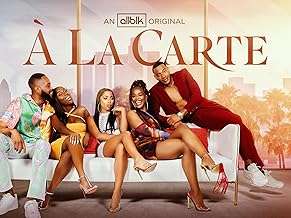
Poster for A La Carte on Amazon. (Poster for <a href="https://www.amazon.com/A-La-Carte/dp/B09YJ4SKG7/ref=sr_1_1?sr=8-1">the show on Amazon</a>.)
The complaint alleges the following. On October 1, 2021, Plaintiff received an invitation to audition for a role in Dijon Talton's directorial debut, entitled A La Carte. According to the audition notes, A La Carte was to be a "a scripted, dramedy series about the Black millennial dating experience and one girl's … 'liberal' approach to sex and dating." The series was to air on ALLBLK, a subscription entertainment service operated by AMC Networks and dedicated to streaming content featuring Black talent. On October 29, 2021, Defendants extended an offer to Plaintiff for a lead role in the show.
Plaintiff's talent agents negotiated on her behalf that she was to be dressed in either nonsee-through lingerie or non-see-through bra and underwear when shooting simulated sex scenes, and that she would not be filmed in any way that would show full frontal or rear nudity.
On November 3, 2021, ALC Productions' attorney emailed Plaintiffs representatives "the agreement for [Plaintiffs] employment in the series A La Carte." In the months to follow, this document, the "Talent Agreement," would undergo various edits and revisions. However, the key provisions regarding nudity, simulated sex scenes, and compensation remained virtually untouched from the November 3 original version.
On the second day of filming, Plaintiffs partner for the simulated sex scenes had been replaced overnight with an actor whom she had never met and Plaintiff met the on-set intimacy coordinator for the first time, who. supervises and choreographs simulated sex scenes, ensures closed sets, remains on hand to robe actors after filming, and serves as the set medic. Immediately after meeting the intimacy coordinator, Plaintiff filmed her first simulated sex scene for A La Carte. She was scripted to "have sex" on a bar with her new scene partner. The intimacy coordinator did not run through any choreography prior to the filming of this scene, nor did she ensure that Plaintiffs new scene partner had undergone a physical examination to prevent against the transmission of venereal disease. She also did not ensure the set was closed.
From an opinion by Judge Steve Jones (N.D. Ga.) in Lenord v. Racetrac, Inc., decided a year ago but just recently posted on Westlaw:
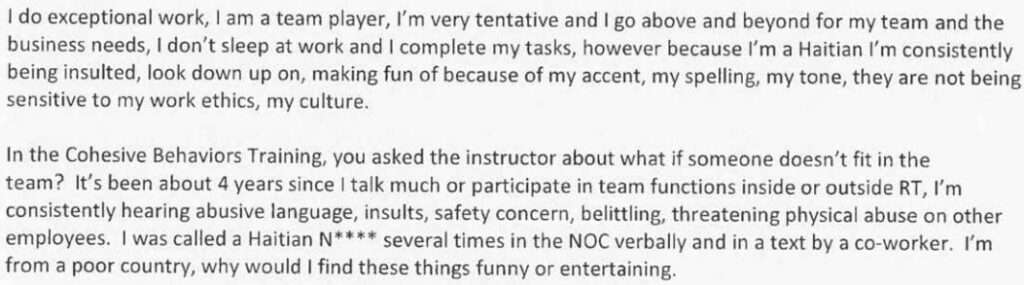
To support his discrimination complaint, Plaintiff referred specifically to a white teammate who, in his words, had called him a "Haitian N****" several times the year before, in 2019. At his deposition, however, Plaintiff admitted that his teammate had called him "Haitian Ninja," not "Haitian Nigger," as his email stated. A text message produced during discovery provides some context—after completing a work task, the white teammate texted Plaintiff: "Excellent. Just the way I like it. Flying under the radar. Just call me a Haitian Ninja in training."
Notably, in an unsent email draft, Plaintiff had originally used the word "Ninja" rather than the elliptical term "N****." But for some reason he changed the wording in the email sent to Fitzhugh and Campbell. Fitzhugh expressed frustration with Plaintiff's portrayal of events but confided to HR that "it really might just be a foundational language barrier." …
I'm blogging this week about my new book Natural Property Rights, published with Cambridge University Press and available for purchase now digitally and in hardbound version, at a variety of bookstores. Yesterday, I summarized the book's normative theory. I also promised readers that, for the rest of this week, I would explain how that theory applies to property through the prism of a 1L property course.
Before starting, let me explain in a little more detail two points I made yesterday. First, in a natural law framework, a natural property right isn't a sweeping right of autonomy. When people want to establish rights in relation to particular ownable resources, they need to satisfy two requirements: They must put the resources to morally-productive uses, and they need to communicate to their neighbors their property claims reasonably clearly. Even then, the rights are subject to two provisos: one for cases of necessity, and another when proprietors' claims leave neighbors with insufficient access to resources like the ones covered by those claims.
Second, that right supplies some but not complete guidance to legislators, judges, and other public officials, for evaluating how just particular property laws are. Rights focus the discretion lawmakers exercise when they set laws—somewhat, but not completely. Many natural lawyers describe that discretion as "determination" (a term associated with St. Thomas Aquinas). Legal philosophers like to illustrate that discretion with speed limits. Although legislators exercise a lot of discretion when they set speed limits, in all of those exercises they're trying to coordinate the rights of drivers to travel where they want, with the rights of drivers, cyclists, and pedestrians to be secure in their persons and property. A natural property right supplies about the same guidance for conventional property laws.
The New York court weighing President Trump's appeal of a roughly $500 million civil-fraud judgment typically acts swiftly and unanimously, with many of its decisions coming within weeks after hearing arguments.
Trump's experience stands out as an unusual exception.
A five-justice panel has yet to render a decision nearly a year after taking up the case, leaving him and his business in limbo. Behind the scenes, members of the panel have been divided, and three of them have been writing opinions, according to people familiar with the matter. It couldn't be determined how they are split. Justices do occasionally shift their positions, and the number of opinions could change, the people said.
A spokesman for the New York state court system said it doesn't comment on pending litigation. A spokesman for Trump's legal team said, "It is time for the New York Courts to step in and end this witch hunt once and for all."
…
The panel hearing the Trump appeal includes four judges appointed by Democratic governors and one Republican appointee, David Friedman, who is regarded as among the most conservative of the court's 21 members. The court's presiding justice, Renwick, also on the panel, is viewed as a stalwart liberal who has an institutional interest in seeking consensus and guarding the court's reputation.
The United States Supreme Court has taken measures to prevent leaks. But what about the New York intermediate state appellate court?
There is obviously only one remedy for this leak. But I repeat myself.
Law students around the country will be starting classes over the next few weeks. Back in 2018, I wrote a post offering advice to entering students, which I updated in 2019, 2022, 2023, and last year. I tried to focus on points that I rarely, if ever, see made in other pieces of this type. I think my original suggestions remain relevant today. So I reprint my advice from earlier posts largely unaltered, with the addition of incremental edits and updates:
1. Think carefully about what kind of law you want to practice.
Law is a profession with relatively high income and social status. Yet studies repeatedly show that many lawyers are deeply unhappy, a higher percentage than in most other professions. One reason for this is that many of them hate the work they do. It doesn't necessarily have to be that way. There are lots of different types of legal careers out there, and it's likely that one of them will be a good fit for you. A person who would be miserable working for a large "Biglaw" firm might be happy as a public interest lawyer or a family law practitioner, and so on. But to take advantage of this diversity, you need to start considering what type of legal career best fits your needs and interests.
There are many ways to find out about potential options. But one place to start is to talk to the career services office at your school, which should have information about a range of possibilities. Many also often have databases of alumni working in various types of legal careers. Talking to these people can give you a sense of what life as a practitioner in Field X is really like.
This advice applies not just to what you do in school, narrowly defined, but what you do in the summer, as well. Law students typically get summer jobs at firms or other potential future employers. Apply widely, and look for organizations that might be good employers, or at least introduce you to areas of law that might be crucial for your future career.
The summer clerk job I took at the Institute for Justice after my first year in law school, was a key step towards becoming a property scholar, and helped lead me to write two books and numerous articles about takings. Spending a summer at a public interest firm might change your life, too!
Regardless, don't just "go with the flow" in terms of choosing what kind of legal career you want to pursue. The jobs that many of your classmates want may be terrible for you (and vice versa). Keep in mind, also, that you likely have a wider range of options now than you will in five or ten years, when it may be much harder to switch to a very different field from the one you have been working in since graduation.
2. Get to know as many of your classmates and professors as you reasonably can.
Law is a "people" business. Connections are extremely important. No matter how brilliant a legal thinker you may be, it's hard to get ahead as a lawyer purely by working alone at your desk - even with the help of AI and other modern tech. Many of your law school classmates could turn out to be useful connections down the road. This is obviously true at big-name national schools whose alumni routinely become judges, powerful government officials, and partners at major firms. But it's also true at schools whose reputation is more regional or local in nature. If you plan to make a career in that area yourself, many of your classmates could turn out to be useful contacts.
The same holds true for professors, many of whom have extensive connections in their respective fields. They are sometimes harder to get to know than students. But the effort is often worth it, anyway. And many of them are actually more than eager to talk about their work.
This is one front on which I didn't do very well when I was in law school, myself. Nonetheless, I still suggest you do as I say, not as I actually did. You will be better off if you learn from my mistakes than if you repeat them.
3. Think about whether what you plan to do is right and just.
Law presents more serious moral dilemmas than many other professions. What lawyers do can often cost innocent people their liberty, their property, or even their lives. It can also save all three. Lawyers have played key roles in almost every major advance for liberty and justice in American history, including the establishment of the Constitution, the antislavery movement, the civil rights movement and many others. But they have also been among the major perpetrators of most of the great injustices in our history, as well.
Robert Cover's classic book Justice Accused - a work that made a big impression on me when I was a law student - describes how some of the greatest judges and legal minds of antebellum America became complicit in the perpetuation of slavery. While we have made great progress since that time, the legal system is not as far removed from the days of the Fugitive Slave Acts as we might like to think. There are still grave injustices in the system, and lawyers whose work has the effect of perpetuating and exacerbating them. We even still have lawyers who do such things as come up with dubious rationales for deporting literal escaped slaves back to places where they are likely to face further oppression. The present administration is coming up with even more dubious rationales for doing things like using the Alien Enemies Act of 1798 (previously used only in wartime) to deport people who have not broken any laws to imprisonment, without any due process. The latter is just one of several dramatic examples of how we are now engaged in a struggle over the future of justice and the rule of law in this country.
Law school is the right time to start working to ensure that the career you pursue is at least morally defensible. You don't necessarily have a moral obligation to devote your career to doing good. But you should at least avoid exacerbating evil. And it's easier to do that if you think carefully about the issues involved now (when you still have a wide range of options), than if you wait until you are already enmeshed in a job that involves perpetrating injustice. At that point, it may be too late - both for you and (even more importantly) for the people who may be harmed.
4. Legal knowledge isn't as different from other kinds of knowledge as you might think.
Students often ask me how best to study for law school classes. My answer is that there isn't one way that's best for everyone. You probably know what works for you far better than I do.
In law school, you are likely to be bombarded with all sorts of complex methods of studying and outlining cases. Advocates of each will often tell you theirs is the One True Path to law school success. Some students really do find these methods useful.
But I would urge you to consider the possibility that you can study for law school classes by using…. much the same methods as you used to study other subjects in the past. If you were successful in social science and humanities classes as an undergraduate, the methods that worked there are likely to carry over.
I know because that's largely what I did as a law student myself. I did the reading, identified key points, and didn't bother with complicated outlines or spend money on study guides. If I did badly in a class, it wasn't for lack of more complex study methods (usually, I either got lazy or just had a bad day on the final exam). And I've seen plenty of other people succeed with similar approaches. You can save a lot of time and aggravation (and some money) that way. And that time, energy, and money can be better devoted to other purposes - including advancing your studies and your career in other ways!
Ultimately, when reading a legal decision (or any assignment), you need to 1) identify the key issues, and 2) understand why they are important. With rare exceptions, the case in question was likely included in the reading because it highlights some rule, standard, or issue that has a broader significance. If you know what that is and why it matters, much of your work is done. The same goes for most other kinds of assigned reading: they are probably there because the professor thinks they elucidate some broadly important point. Figure out what it is, and you will be in good shape.
These days, there is much discussion about the extent to which students should rely on AI to help them study. I don't have any definitive answer to that question. But, ideally, AI can augment your reading, writing, and analytical skills, but doesn't fully replace them. You should also be wary of its tendencies to hallucinate information. Use its output, but verify for accuracy. And, as with other study aids, the use of AI to study law need not be much different than its proper use for other subjects.
The experience of remote learning during the Covid-19 pandemic has highlighted the importance of Point 2 above. The loss of much in-person contact was a serious problem, one we would do well to avoid repeating.
I don't think I need to dwell on how recent events have reinforced the significance of Point 3. Suffice to say there are many recent examples of lawyers facilitating both good and evil. Even if you don't maximize the former, you should at least avoid contributing to the latter.
Some excerpts from today's long Fifth Circuit decision in Spectrum WT v. Wendler, written by Judge Leslie Southwick and joined by Judges James Dennis, which I think reaches the correct result (see the bottom of the post for my brief analysis):
Spectrum WT is an LGBT+ student organization at West Texas A&M University. It was in the last stages of organizing a drag show on campus when University President Walter Wendler canceled the show. The plaintiffs, Spectrum WT and two of its student-officers, sought a preliminary injunction on the grounds their free speech rights were violated. The district court denied the injunction, partly based on a holding that the First Amendment did not apply to the drag show. We REVERSE.
The court concluded that the First Amendment protects drag shows like it protects other theatrical productions:
We start with a Supreme Court opinion stating that "a narrow, succinctly articulable message is not a condition of constitutional protection" for expressive conduct…. Other Supreme Court opinions also have held that conduct within certain expressive settings and media is protected. For example, "live drama" implicates the First Amendment, given that "theater usually is the acting out—or singing out—of the written word, and frequently mixes speech with live action or conduct." Southeastern Promotions, Ltd. v. Conrad (1975). Films are no different. Joseph Burstyn, Inc. v. Wilson (1952). Violent video games also fall under First Amendment doctrine. Brown v. Ent. Merchs. Ass'n (2011)….
Having set out the relevant principles, we now examine the plaintiffs' intended drag show. It would have included costumed performers with stage names, occurred on a stage, and mixed the spoken and sung word with the show's physical components while songs played in the background. Cf. Southeastern Promotions (describing a production of Hair as protected expression)…. In the present dispute, it is evident that a message in support of LGBT+ rights was intended, which is a far clearer message than some of the examples of art identified in Hurley as protected by the First Amendment….
Whether conduct is communicative is [also] explained in part by societal and temporal context. A drag show can communicate a message of solidarity and support for the LGBT+ community. Drag shows—with performers dancing and speaking to music on stage in clothing associated with the opposite gender—mark a deliberate and theatrical subversion of gender-based expectations and signify support for those who feel burdened by such expectations….
The court then concluded that Legacy Hall was a "designated public forum"—government property voluntarily opened up for public access—and that speech there was protected against content-based speech restriction as much as in traditional public fora, such as parks. And the court concluded the drag show ban was a forbidden content-based restriction:
For those interested in reading more about the subject, here's a post of mine from January:
The term "doxing" is not well defined, but is often used broadly to refer to publicly disclosing a person's name, photograph, address, phone number, employer name, and the like, in connection with some express or implied condemnation of the person. The concern is that such disclosure can instigate or facilitate violence or vandalism targeting the person, or the sending of threats, or the sending of insulting messages, or economic retaliation (often through the person's employer). Different states have different rules dealing with such matters, and they generally define "doxing" differently, both as to what information is covered, who is protected against such disclosure, what (if any) specific purposes on the discloser's part must be shown to lead to liability, and more.
In any case, in thinking about the subject (and especially the questions that aren't limited to information such as social security numbers, bank account numbers, and the like), I came up with a set of hypotheticals that I hoped might be helpful. If any of you are interested in this, I'd love to hear your thoughts about which, if any, of these situations should lead to, say, criminal or civil liability (and, briefly, why). One can of course think that none should lead to liability—at least unless the allegations are false and therefore libelous, or are part of a criminal conspiracy involving the speaker, or involve some other factual feature not included in the hypothetical—or one can think that all should, or one can come to some conclusion in between.
Some doxing rules might not involve criminal or civil liability, and might not be subject to First Amendment restraints: For instance, a private university might restrict such speech by its students (especially about other students, staff, or faculty), or a social media platform might restrict such speech on the platform, or a newspaper might set up editorial policies about what kinds of material it publishes. But for purposes of this comment thread, I thought it would be good to focus on criminal or civil liability.
Speech on matters of public concern is the heartland of the First Amendment. The principle that public issues should be debated freely has long been woven into the very fabric of who we are as a Nation. Without it, our democracy stands on shaky ground. It should alarm all Americans when the Government retaliates against individuals or organizations for engaging in constitutionally protected public debate. And that alarm should ring even louder when the Government retaliates against those engaged in newsgathering and reporting.
This case presents a straightforward First Amendment violation. Media Matters for America is a nonprofit media company that is over two decades old. In November 2023, it ran a story reporting that as a result of Elon Musk's acquisition of Twitter (now "X"), advertisements on the social media platform were appearing next to antisemitic posts and other offensive content. Mr. Musk immediately promised to file "a thermonuclear lawsuit against Media Matters." And he followed through. In the weeks and months that followed, X Corp. and its subsidiaries sued Media Matters all over the world, at least until a federal district court preliminarily enjoined this aggressive litigation strategy. Meanwhile, seemingly at the behest of Steven Miller, the current White House Deputy Chief of Staff, the Missouri and Texas Attorneys General issued civil investigative demands (CIDs) to Media Matters, both of which were preliminarily enjoined in this Court as likely being retaliatory in violation of the First Amendment.
But these court victories did not end the fight for Media Matters. Now the Federal Trade Commission (FTC) has taken up the cause. After Andrew Ferguson took on his new role as the Chairman of the FTC, the agency issued a sweeping CID to Media Matters, purportedly to investigate an advertiser boycott concerning social media platforms. That CID should have come as no surprise.
Before President Trump selected him to head the FTC, Mr. Ferguson appeared on Steve Bannon's podcast, where he said that it is "really important that the FTC take investigative steps in the new administration under President Trump" because "progressives" and others who are "fighting "disinformation" were "not going to give up just because of the election." One of his supporters, Mike Davis, who urged President Trump to nominate him to the role, made several public comments about Media Matters, including that Mr. Musk should "nuke" the media company. And after taking the reins, Chairman Ferguson brought on several senior staffers at the FTC who previously made public comments about Media Matters.
Media Matters brought this lawsuit to challenge the FTC's CID, alleging that it is retaliatory in violation of the First Amendment and that it is overbroad in violation of the Fourth and First Amendments. Before the Court is a motion seeking preliminary injunctive relief from the CID. The Court agrees that a preliminary injunction is warranted….
From Doe v. Jewell, decided Friday by Fifth Circuit Judge Patrick Higginbotham, joined by Judges Don Willett and James Ho:
Parents of a pre-kindergarten student bring claims under 42 U.S.C. § 1983 against April Jewell, a school principal, for failure to respond to sexual molestation of their daughter by a faculty member. The district court denied Jewell's motion to dismiss on the basis of qualified immunity finding that she failed her duty to protect the student. We AFFIRM….
Jane [Doe] brings two claims: (A) that her Fourteenth Amendment right to bodily integrity was violated by Jewell's failure to supervise; and (B) that Jewell's conduct constituted arbitrary and conscience-shocking executive action….
As to bodily integrity and failure to supervise, the panel set forth the Fifth Circuit rule:
A supervisory school official can be held personally liable for a subordinate's violation of "an elementary or secondary school student's constitutional right to bodily integrity in physical sexual abuse cases." Three hurdles await putative plaintiffs:
(1) the defendant learned of facts or a pattern of inappropriate sexual behavior by a subordinate pointing plainly toward the conclusion that the subordinate was sexually abusing the student;
(2) the defendant demonstrated deliberate indifference toward the constitutional rights of the student by failing to take action that was obviously necessary to prevent or stop the abuse; and
(3) such failure caused a constitutional injury to the student….
Doe v. Taylor Indep. Sch. Dist. (5th Cir. 1994) (en banc).
On August 5, I wrote about a temporary restraining order in Goldstone Financial Group, LLC v. FinanceScam.com that ordered the removal of posts alleging that Goldstone Financial Group and its CEO Anthony Pellegrino had engaged in deceptive attempts to try to vanish material about them from Internet searches.
I explained that there had indeed been seemingly deceptive attempts to vanish such material about Goldstone and Pellegrino, though they denied that the attempts came from them, or were authorized by them. Now it turns out that someone submitted yet another deindexing request to Google, asking Google to remove various pages about Goldstone and Pellegrino from search results. That request was based on the Complaint that Goldstone and Pellegrino had filed, and it sought the deindexing not just of posts on FinanceScam.com but also from various government sites:
https://brokercheck.finra.org/individual/summary/5900843 (a Financial Industry Regulatory Authority page containing records of various proceedings related to Michael Pellegrino, who appears to have also been involved in the matter listed in item 5 below).
A page uploaded to squarespace.com, URL too long to include here (a Florida state court order related to the settlement of a lawsuit in which Goldstone was one of the defendants).
The first Trump Administration substantially reshaped the federal courts. Will the second Trump Administration be equally effective or influential on the composition of the judiciary? The jury is still out. Even setting aside the Supreme Court--where President Trump made three appointments in a single term--it is looking like there will be significantly fewer opportunities to influence the balance and composition of the federal courts.
At present, there are more Republican than Democratic nominees on the federal circuit courts of appeal, but there are Republican majorities on only six of thirteen circuits. There are also more Democratic than Republican appointees on district courts, as one would expect given that a Democratic president was making judicial appointments the past four years.
How much influence President Trump will have on the composition of the federal courts will largely depend on the extent to which eligible judges elect to take senior status or retire, thereby creating vacancies for Trump to fill. As I noted in May and July, it appears that some number of judges are more reluctant to take this step than one might have expected.
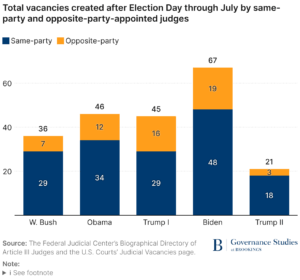
Russell Wheeler at the Brookings Institution notes that, to date, there are fewer vacancies for Trump to fill than one would usually expect during the early part of a Presidential term. Specifically, Wheeler suggests there have been fewer strategic retirements by Republican appointed judges than one might expect.
Note, however, that any reluctance by Republican appointees to step down or take senior status does not directly affect the extent to which President Trump will influence the balance of the federal courts during his second term. Shifting the balance of the courts generally, and specific circuit courts in particular, will depend upon whether Trump has the opportunity to fill seats currently held by Democratic appointees. (The creation of new court seats, as has been recommended by the Judicial Conference, could also have an impact, particularly on district courts, but this appears unlikely before 2028.)
Wheeler echoes the speculation that some Republican judges may be reluctant to create vacancies because they do not want to be replaced by a Trump appointee, whether because of their concerns about Trump himself, his attitude about the courts, or the sort of nomination he would make. Comments by administration officials and proxies suggesting that Trump is likely to emphasize different criteria in his second term than he did during his first may feed into this, though (with the exception of the Emil Bove nomination, which provoked substantial controversy), Trump's judicial picks so far this term have been quite strong and quite consistent with the pattern we saw during the first term.
There is another factor that may affect Trump's ability to influence the composition of the courts that is rarely discussed: the length of judicial service is increasing. Insofar as longevity is increasing, it should not surprise us that more judges are deciding to serve longer than they might have in the past. In addition, insofar as recent administrations, and the Trump Administration in particular, have increasingly tapped younger judicial nominees, we would expect them to serve longer as well.
In my view, strategic behavior by judges may help explain the relative lack of judicial vacancies for Trump to fill--and I have heard this concern expressed by some judges--but other factors likely play a role as well.
supporting Netchoice's challenge to the Louisiana social media age verification law. Netchoice is a trade association representing many tech companies, including Amazon, eBay, Google, Meta, Netflix, PayPal, and X.
NetChoice submitted Dr. Bean's expert report to Defendants, along with the original sources on which he allegedly relied. While the original sources NetChoice produced exist, the substance of Dr. Bean's report is fake. None of the 17 articles in Dr. Bean's reference list exists, and his report never cites the actual sources NetChoice provided to Defendants. More, none of the 12 quotations that Dr. Bean's report attributes to various authors and articles exists (even in the original sources provided to Defendants).
A cursory comparison between Dr. Bean's report and the disclosed original sources would have alerted NetChoice that something is amiss. In fact, just reading Dr. Bean's report would have done so. His reference list makes no sense, (a) citing website links that are dead or lead to entirely unrelated sources and (b) citing volume and page numbers in publications that are easily confirmed to be wrong. And his report itself is strangely formatted, not least because, well, it looks and reads like a print-out from artificial intelligence (AI).
Dr. Bean's report bears all the telltale signs of AI hallucinations: completely fabricated sources and quotations that appear to be based on a survey of real authors and real sources. See, e.g., Brandon Fierro, Short circuit court: AI hallucinations in legal filings and how to avoid making headlines, Reuters (Aug. 4, 2025 8:27 AM), t.ly/inw31. It is difficult to escape the irony of a NetChoice expert submitting an expert report based on non-existent authorities and quotations. Yet here lies NetChoice—a loud proponent of "free expression" and "AI's Transformative Power"—attempting to rely on such a report and such an expert in this litigation.
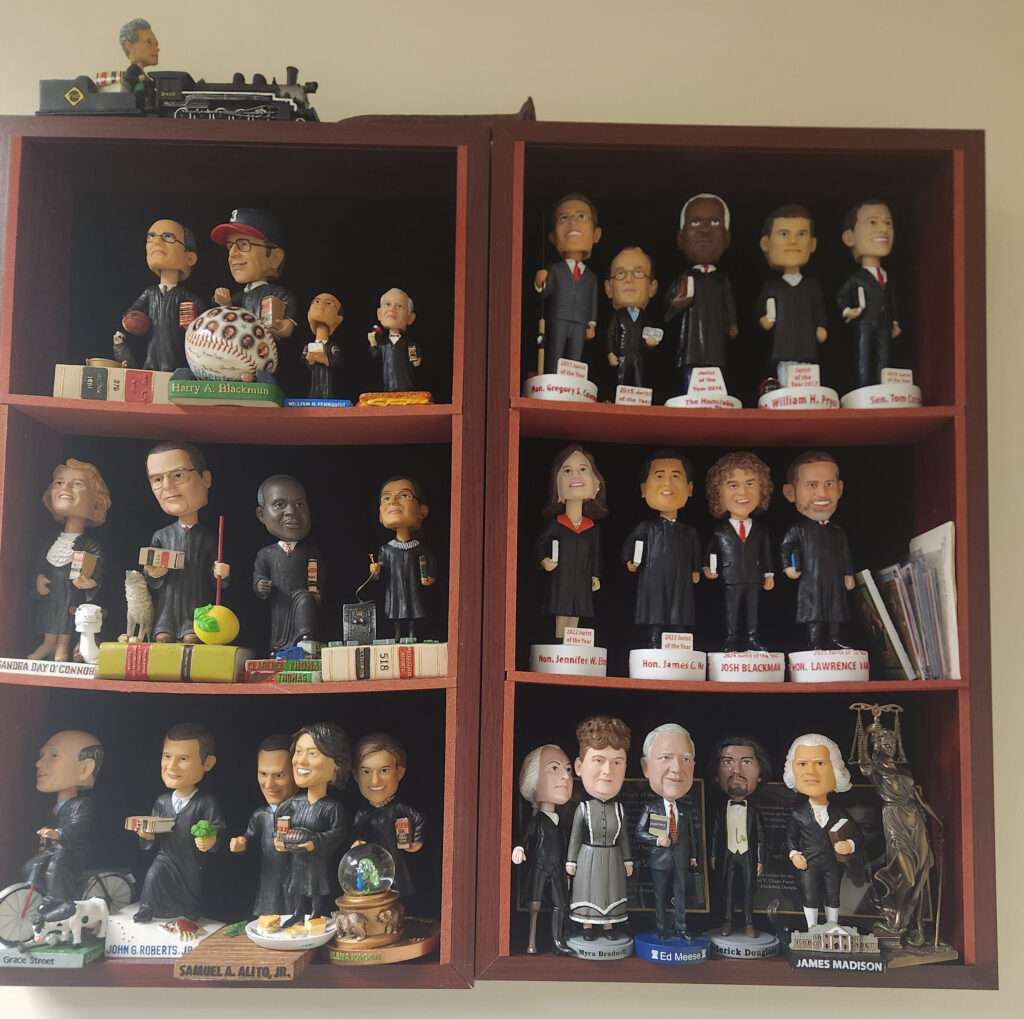
For nearly two decades, I have been collecting Supreme Court and other bobbleheads. I proudly displayed my collection in two cases mounted to the wall in my office. Notice how I used the past tense. Here is how the cases appeared a few months ago.
On Friday, I visited my office for the first time in several weeks. When I opened the door, I saw it. One of the two cases had fallen off the wall. More than a dozen bobbleheads fell to the floor. They were shattered, broken, and decapitated. This was like a reign of terror for bobbleheads.
The anchors on the wall were still holding. But the brackets on the back of the case were attached by screws, and those screws fell out. My guess is that the case simply became too heavy for those screws. The last bobblehead I added was Justice Kagan's new bobblehead. This was the straw that broke the camel's back. The only remedy for this injustice, of course, is for Justice Kagan to resign. But I repeat myself.
Thank you, Eugene! This week, I'm blogging about a scholarly project long in the works. Earlier this summer, I published a book, Natural Property Rights, with Cambridge University Press. If readers are interested in the book, it's available for purchasedigitally and in hardbound version, at a variety of bookstores, and it can be accessed through any library with a subscription to Cambridge UP's digital platform. Cambridge UP will also release a (cheaper) paperback version in 2026.
In my blogging this week, I am going to try to interest lawyers, law students, and nonlawyers in Natural Property Rights. That strategy may seem unorthodox, because the book is obviously relevant to philosophers and property law scholars. But I bet there are a lot more VC readers in the groups I'm targeting than the ones I'm not. And, I've already made my pitch to the scholars, in an introduction and a reply to a dozen scholars in a 2023 symposium previewing Natural Property Rights in the Texas A&M Journal of Property Law.
More than that, I hope that my posts this week are timely! This week and next, U.S. law schools are opening back up for business. At some of those schools, professors will be teaching, and students will be taking, the standard first-year Property course. My posts this week will be organized around the main topics in a 1L Property course. Today, I'll summarize Natural Property Rights's main themes; in each of the next four posts, I'll cover several of the topics covered in a 1L course.
The institution of property has deep connections to natural law and natural rights. Many U.S. state constitutions take for granted that (I'm using Virginia's constitution as an example) "the means of acquiring and possessing property" is an "inherent right." John Locke made property the centerpiece of his natural rights theory of government. And many sources in American property law reflect those connections. I'll say more tomorrow about Pierson v. Post, the "fox case." In that case, the court opinion and the dissent consulted Locke and the best-known natural law treatises—by Justinian, Grotius, Pufendorf, and others—to settle what someone needs to do to capture a wild fox and appropriate it.
I'm delighted to report that Prof. Eric Claeys (George Mason, Antonin Scalia School of Law) will be guest-blogging this week about his new book, Natural Property Rights. Here's the publisher's summary:
Natural Property Rights presents a novel theory of property based on individual, pre-political rights. The book argues that a just system of property protects people's rights to use resources and also orders those rights consistent with natural law and the public welfare.
Drawing on influential property theorists such as Grotius, Locke, Blackstone, and early American statesmen and judges, as well as recent work in in normative and analytical philosophy, the book shows how natural rights guide political and legal reasoning about property law. It examines how natural rights justify the most familiar institutions in property, including public property, ownership, the system of estates and future interests, leases, servitudes, mortgages, police regulation, and eminent domain. Thought-provoking and comprehensive, the book challenges leading contemporary justifications for property and shows how property both secures individual freedom and serves the common good.
On Friday, in Chamber of Commerce v.Lierman,the U.S. Court of Appeals for the Fourth Circuit concluded that Maryland's law barring internet advertisers from disclosing the costs of Maryland's internet advertising tax to their customers, or passing through those costs, violates the First Amendment. Judge Richardson wrote for the court, joined by Judges Floyd and Heytens.
Judge Richardson's opinion begins:
In 1765, the British Parliament imposed a novel tax on the fledgling colonies in North America. The Stamp Act was reviled because it taxed most everything written on paper, from playing cards to newspapers. This not only cost people money but jeopardized their ability to speak on matters of public concern. John Adams roused Massachusetts against the tax, calling it an "enormous Engine . . . for battering down all the Rights and Liberties of America." 1 The Adams Papers 263 (L.H. Butterfield ed., 1961). Thousands of citizens protested when the dreaded stamps arrived in Charleston harbor, besieging the stamp officers in Fort Johnson for nine days. D.D. Wallace, Constitutional History of South Carolina From 1725 To 1775 at 32–33 (1899). And across the colonies, outrage about the tax prompted the colonists to begin developing the arguments that would later form the Declaration of Independence. See generally Daniel Dulany, Considerations on the Propriety of Imposing Taxes in the British Colonies (1765). In more ways than one, the Stamp Act and other taxes like it ignited revolution.
Two and a half centuries later, the State of Maryland imposed another tax—not on those who print pamphlets but their internet-age successors. This tax applies to the money made by advertising on the internet. But as some things have changed, others have remained the same. It is no less true today than centuries ago that "the power to tax involves the power to destroy." M'Culloch v. Maryland, 17 U.S. (4 Wheat) 316, 431 (1819). And complaining about taxes remains a grand American political tradition.
Perhaps fearing such complaints, Maryland paired its tax with another rule. Companies that make money advertising on the internet must not only pay the tax but avoid 3 telling their customers how it affects pricing: No line items, no surcharges, no fees. If companies pass on the cost of the tax, they must do so in silence—keeping customers in the dark about why prices have gone up and thereby insulating Maryland from political responsibility.
That provision is the subject of this appeal. Plaintiffs, a group of trade associations, challenge Maryland's rule on grounds that it abridges their freedom to speak. They say Maryland has no reason, other than insulating themselves from criticism and political accountability, to forbid them to explain the tax to their customers. We agree. As much today as 250 years ago, criticizing the government—for taxes or anything else—is important discourse in a democratic society. The First Amendment forbids Maryland to suppress it.
Key to the court's analysis is its conclusion that, in operation, the Maryland law regulates speech--what companies tell their customers about the prices they charge--more than conduct. The court does not resolve whether the law regulates purely commercial speech, but concludes that such an analysis is unnecessary because the law could not survive intermediate scrutiny.
The opinion concludes:
The states are free to make controversial policy. That is part of our federalist bargain. See Gregory v. Ashcroft, 501 U.S. 452, 458 (1991). But with that freedom comes constraint. States may not forbid regulated parties to talk about their regulations unless they withstand First Amendment scrutiny. Maryland's pass-through provision does not.
Last week, Thomas Edsall penned a column for the New York Times, "The Supreme Court Has Finally Found a President It Likes," arguing that the Supreme Court's conservative majority "has become a key enabler of President Trump's agenda." The column repeated (albeit in somewhat exaggerated form) common critiques of how the Supreme Court has handled requests for extraordinary relief from the Trump Administration, and in the process painted quite a distorted picture of the Court and its actions. (For my prior take on these questions, see here and here.)
Harvard law professor Jack Goldsmith, in his latest Executive Functions post, "Sense and Nonsense about the Supreme Court Interim Orders," takes aim at the Edsall piece, and some of its most severe distortions. As Goldsmith notes, Edsall frames his entire piece with Adam Bonica's claim that the Supreme Court is in "open conflict with the lower courts," siding with the Trump Administration in 93.7 percent of cases while district courts ruled against the administration 94.3 percent of cases. Nonsense.
"There are many things wrong with these numbers," Goldsmith notes. For starters, Bonica cherry-picks numbers, looking at different time periods and sets of cases to calculate the numbers. Further, Bonica takes no account of the fact that neither set of cases is neutral; both are the result of strategic choices by the litigants. As Goldsmith notes, the Trump Administration has only sought Supreme Court review of a small fraction of adverse district court orders.
[T]he Supreme Court is ruling only on cases where the Solicitor General thinks (among other variables) that the lower court reasoning is relatively weak. When Bonica says that the Supreme Court "reverses almost automatically," he is ignoring the crucial fact that the Court sees only a fraction of lower court rulings, and then only ones that are skewed for likely government success.
The real percentage of district court orders reversed by the Supreme Court remains in single digits. "This is not open conflict."
If one wants to fairly assess the extent to which the Supreme Court is at odds with lower courts, one also has to account for forum shopping in the district courts. Just as the Trump Administration is carefully choosing which orders to challenge, those challenging the Trump Administration have been very selective about where to file suit. Thus it is no accident that the vast majority of nationwide injunctions entered against the administration were issued from just five judicial districts. Writes Goldsmith:
Bonica and the New York Times are committing a variant of the empirical analysis sin of "testing on the dependent variable": they draw sweeping conclusions from a subset of cases that is small, highly unrepresentative, and unexplained.
Things do not get better when Edsall tries to attribute the Supreme Court's behavior to an unprincipled and inconsistent application of unitary executive theory. As Goldsmith notes, Edsall uncritically swallows Professor Joseph Fishkin's (false) claim that President Trump is the first President to try and fire the head of an independent agency.
We are not in uncharted waters. And the Trump administration is not "the only modern president to really try" to fire heads of independent agencies. The Biden administration did so too, and first. The Biden administration did not, as Fishkin says, "respect[] the laws Congress passed in this area." As I wrote in the Times in May: "Mr. Biden extended the Supreme Court's unitaryexecutive case law to fire the statutorily protected commissioner of the Social Security Administration." Biden also fired other for-cause-protected agency members in disregard of congressional statutes and in reliance on Supreme Court unitary executive decisions.
Edsall's discussion of the unitary executive theory is also a bit confused insofar as he applies it to the debate over nationwide injunctions in cases that concern the scope of executive power, and the scope of courts' equitable authority, and do not directly implicate the extent to which the Executive Branch is unitary. The extent to which executive power (whatever its scope) must ultimately be subject to the President's direction and control has relatively little to do with whether district courts have the equitable power to issue universal injunctions and grant relief to parties not before the court.
In his Executive Functions essay, Goldsmith also addresses the claims that the Court is enabling the Trump Administration "to do destructive things" and should do more to explain its interim orders. On the first point, Goldsmith thinks "it is too early to say where the Court will come down on the scope of the president's unitary executive powers in Trump 2.0," and notes that some decisions (such as Braidwood) do not fit the pattern, but also acknowledges that some of the Court's decisions have "enabled Trump to change the reality on the ground in the executive branch in ways that will not be easily reversible, if at all, no matter what the Court does later." I largely agree, though I do not fault the Court for this so much as I fault Congress, as it is legislative inaction and obeisance, more than anything in the judiciary, that is empowering the Trump Administration.
On whether the Court should do more to explain its interim orders, I largely agree with Goldsmith's take, which is more nuanced than that presented by Edsall.
There is nothing illegitimate or new about the Court not explaining interim orders, even important ones. Interim orders are not final judgments. They resolve the "interim status of the law" during the months or years of adjudication in a case until final disposition by the Supreme Court. More explanation on interim rulings can help the Court convince the public that it is properly applying law to fact (though the explanations of its application of the interim order test often fail to persuade simply because the test is so indeterminate).
But I doubt the critics would be pleased with the more elaborate explanation for rulings they do not like. And there are tradeoffs. Mainly: the more the Justices write, the more they prematurely lock themselves in on the merits down the road, and the more they handcuff the lower courts via vertical precedent.
Edsall's column might have been better had he considered the views of a wider range of academics and commentators (and perhaps considered that a survey of like-minded views from academic echo chambers is not always the best way to reach an informed judgment). Though to be fair, I was among those from whom Edsall solicited input before writing the column. I noted some of the above points, directed him to my prior writing on the subject, and (at his request) recommended that he reach out to others like Goldsmith to inform his take on the subject. Edsall may not have found my comments persuasive, or my recommendations helpful, but taking account of them might have helped him avoid some of the mistakes and misrepresentations in his column.
UPDATE: Over at Election Law Blog, Professor Richard Pildes notes the Edsall article embraces a "flatly wrong" and "disturbingly incorrect" claim made by Bonica about how the Court has approached the unitary executive theory in recent years. Notes Pildes, "the Roberts Court has had a clear commitment on the unitary executive branch theory for many years and it's been consistent about that – for better or worse."