The Volokh Conspiracy

Mostly law professors | Sometimes contrarian | Often libertarian | Always independent | Est. 2002

The Volokh Conspiracy

Immigration

Trump's Harmful and Illegal Plan to Gut H-1B Visas by Imposing $100,000 Fees

The plan violates the relevant visa law. If allowed to stand, it would significantly harm productivity and innovation.

|

The president recently issued an executive "proclamation" imposing a $100,000 fee on applications for H-1B visas. This would effectively end most such visas, which are used by tech firms and research institutions to hire immigrant workers and researchers with a variety of specialized skills. My Cato Institute colleague David Bier, a leading immigration policy expert, has a helpful summary of the policy and the harm it is likely to cause, if not struck down by courts:

President Trump is imposing a $100,000 fee to obtain an H-1B visa—the primary visa for skilled foreign workers. To be clear, this $100,000 fee is in addition to the salary, lawyer fees, and other costs of hiring an H-1B worker. This fee would effectively end the H-1B visa category by making it prohibitive for most businesses to hire H-1B workers. This would force leading technology companies out of the United States, reduce demand for US workers, reduce innovation, have severe second-order economic effects, and lower the supply of goods and services in everything from IT and education to manufacturing and medicine.

H-1B visa holders are extremely valuable contributors to research and innovation, and some have gone on to be world-leading scientists and industry leaders, making truly massive advances.

Defenders of the visa fee argue that, if these workers are so great, then it will be worth it for employers to pay the $100,000 price to get them. But a fee that high likely exceeds the average expected profit from one worker during the time he or she is going to work for the sponsoring employer.  There are individuals who produce much more than that, but such extraordinary success is hard to predict in advance. As I have argued previously, this is one of many reasons to avoid immigration restrictions and other government restrictions on labor mobility. In any large group of new workers, there are likely to be a few extraordinary innovators and entrepreneurs, but government planners cannot identify them in advance, and should not try. "Ordinary" workers are still useful, and the extraordinary minority who go far beyond the ordinary will become evident once given a chance. Keeping them out harms migrants and natives, alike, depriving both groups of the benefits of  scientific and entrepreneurial breakthroughs.

H-1B workers, it is argued, drive down wages for natives who compete with them. But, by that reasoning, any new entrants into the work force are bad for existing workers. The truth is that benefits to the overall economy and society far outweigh any detriment to direct competitors. We readily see this when it comes to new native workers entering the work force, and the same logic applies here. We should reject the zero-sum game "lump of labor" fallacy that assumes there is a fixed pot of labor opportunities. A dynamic economy helps new and old workers prosper together, bolstered by growth and innovation.  This is why deportations destroy more jobs for US citizens than they create, and the same is likely to be true for keeping out H-1B visa holders.

As David Bier notes, the new $100,000 fee is likely illegal, because the statutes authorizing H-1B fees only allow for fees to recoup administrative costs and some other types of expenses. They certainly don't authorize anything remotely resembling a $100,000 fee.

Trump is trying to get around these constraints by relying on  8 U.S.C. Section 1182(f), which gives the president the authority to "bar the entry of any aliens or of any class of aliens into the United States" whose admission he finds "would be detrimental to the interests of the United States." This is the same provision used to impose the anti-Muslim "travel ban" upheld by the Supreme Court in its badly flawed ruling in Trump v. Hawaii (2018).

But it is far from clear that Section 1182(f) and Trump v. Hawaii give the president a blank check to exclude any potential immigrants for any reasons he wants, or to impose any fees he wants. In 2020, as David Bier also notes, Trump tried to impose a similar ban on new H-1B visas, but a federal district court ruled against the ban. As the court pointed out, " there must be some measure of constraint on Presidential authority in the domestic
sphere in order not to render the executive an entirely monarchical power in the immigration context, an area within clear legislative prerogative."

The Supreme Court has repeatedly indicated that immigration is an area of legislative power. If so, there must be at least some constraint on how far it can be delegated to the executive.

In an article published in June, I advocated a nondelegation challenge to Trump's sweeping new travel ban barring all or most immigration from numerous nations. If Section 1182(f) really does give the president unlimited authority to impose massive fees on visa applications, overriding all other statutes, the same reasoning applies here.

in the same article, I also responded to arguments that the executive branch has inherent authority to impose immigration restrictions:

Prominent Founding Fathers such as James Madison and Thomas Jefferson rejected the notion that the federal government possessed any general power to restrict immigration. The Supreme Court only held otherwise in the Chinese Exclusion Case in 1889…. But if this governmental power does indeed exist – as longstanding Supreme Court precedent holds – the most plausible place for it is Congress. In the 1889 Chinese Exclusion Case – that upheld the deeply racist Chinese Exclusion Act of 1882 – the Supreme Court stated that the authority belongs to "the legislative department…"

[A] few academics have argued that immigration power is actually an inherent executive power. Supreme Court Justice Clarence Thomas has suggested the same in a solo opinion joined by any other justice…. But this executive power theory makes little sense. If the president possesses inherent, virtually unlimited power to exclude non-citizens, there would be no need for the many congressional statutes that grant him some degree of authority to do so, going all the way back to the Alien Enemies Act of 1798, a wartime authority that Trump has been (illegally) trying to use to facilitate peacetime deportations without due process.

Under the inherent executive power theory, all such laws would become superfluous. The president could just exclude any immigrants he wants without any need for legislative authority. Indeed, there would be no need for Section 1182(f), either….

Since 1889, the Supreme Court has indicated that immigration restriction is a legislative power on several other occasions. For example, in Fiallo v. Bell (1977), the Court noted it "has repeatedly emphasized that over no conceivable subject is the legislative power of Congress more complete than it is over the admission of aliens."  Such "complete" legislative power is incompatible with giving the executive a blank check to impose fees and restrictions.

I don't claim the current H-1B system is ideal. But improving it would make the visas easier to get and more flexible (e.g. - by making it easier for visa holders to switch employers). Trump's new policy would effectively gut them entirely.


David Kopel Makes the Oxford English Dictionary Examples

|

From the usage examples for the word Hitlerist; the quote is from David's post Data on Mass Murder by Government in the 20th Century:

2022
Although the party had explicitly Stalinist and Hitlerist roots, the deaths are not assigned to either ideology.
Newstex Blogs: Volokh Conspiracy (Nexis) 9 November

Big time! Reason also makes it with an example of "puppycide" (in an article by Radley Balko):

2006
When the speaker mentions that the government also slaughtered two dogs during the siege, eyes light up, the indifferent get angry, and skeptics come around. Puppycide, apparently, goes too far.
Reason Magazine

Just to be clear, these weren't the first examples; puppycide, for instance, goes back to 1865.

Would A Subsidy To Encourage Young Men and Women To Marry Be Constitutional?

The government would offer a graduated subsidy, based on the age of the mother, to marry under the age of 30, with the goal of promoting natural child conception.

|

One of Charlie Kirk's primary platforms was to encourage young men and women to get married early and have babies. The New York Times recounted one of his final messages:

At a young women's leadership conference this summer, Mr. Kirk warned women about waiting too long to get married. He argued that their chances of finding a life partner dropped if they were still single by the time they turned 30 — a message he reiterated on Fox News just days before his death.

"I would also tell young ladies: You can always go back to your career later," he said early last week, adding "that there is a window where you primarily should pursue marriage and having children. And that is a beautiful thing."

This proposal ginned up an idea. What if the government tried to subsidize men and women to get married young, with the goal of promoting natural child conception? The subsidy would not be available to older opposite-sex couples. The subsidy would also not be available to same-sex couples, regardless of their age, who could not naturally conceive a child within that marriage. Call it the Charlie Kirk Family Bonus.

If a woman under the age of 21 gets married to a man, there is a subsidy of $100; at the age of 22, a subsidy of $90; at the age of 23, $80; and so on. Once the wife reaches the age of 30, the subsidy drops to $0. The exact dollar amounts can be adjusted. The important point is that state is using subsidies to expressing its preference for natural child conception within a marriage.

Would such a regime be constitutional? Let's walk through the analysis.

First, this law would impose an age-based classification, which is generally reviewed with rational basis scrutiny (see Skrmetti). The fact that women over the age of thirty are ineligible for the subsidy would pass muster. The state can rationally conclude that older women are less likely to be able to conceive naturally. The law would easily satisfy this deferential standard. But that is not the end of the analysis.

Second, does this law impose a classification on the basis of sex? (I'll get to sexual orientation later.) Well in a sense, no. Married couples with one man and one woman are eligible. This law does not treat men different from women. Indeed, the couple would jointly receive the subsidy. It's true that people who do not get married would never receive the benefit. But there are many benefits--tax and otherwise--that are afforded to married couples. I think a law that favors married couples over unmarried people would be reviewed with rational basis scrutiny.

Still, for the sake of argument, I will presume this law imposes a sex classification. This sort of law is reviewed with intermediate scrutiny standard. Under VMI, would the state have an "exceedingly persuasive" justification to offer these graduated subsidies? I think it is fairly well established that as a woman gets older, her ability to reproduce decreases. Don't take my word for it. The American College of Obstetricians and Gynecologists explains "A woman's peak reproductive years are between the late teens and late 20s. By age 30, fertility (the ability to get pregnant) starts to decline." (Men, by contrast, have higher fertility rates at older ages.)

A likely response is that women above the age of thirty can be aided in conception through various forms of IVF or fertility treatment. But here, the state is encouraging natural child conception, not the more expensive and less effective artificial means. The state may also conclude that IVF creates a false sense of security, whereby women can postpone conception till much later, only to find the process is difficult or unsuccessful. I think the state could also reject IVF from a moral perspective, in that it necessarily entails the destruction of many fertilized embryos. Certainly under Dobbs, the state can make that judgment. Couples can also adopt, but the state may determine that the primary interest is in promoting new lives.

Is this law promoting an important interest? The state could cite the crisis of underpopulation, and argue that it needs to promote conception to sustain the social fabric and economy of the polity.

What about the substantial relationship? Here, there is a very close relationship between the means (young couples marrying) and the ends (natural conception). Not all young couples will be able to have children, for a host of reasons. But encouraging opposite-sex marriage is the traditional means of encouraging responsible procreation. I think this graduated subsidy regime would pass muster under intermediate scrutiny.

Third, does this law impose a classification on the basis of sexual orientation? On its face, the answer is no. The law doesn't purport to define what marriage is or say anything at all about homosexuality. Rather, the law applies to a man and a woman who chose to get married by a certain age. Nothing stops a gay man from marrying a woman, and nothing stops a lesbian from marrying a man. This sort of arrangement happened throughout much of history. But I'll resume for the sake of argument that this law imposes a classification on the basis of sexual orientation. Would such a classification be reviewed under a rational basis or an intermediate scrutiny standard? Neither Obergefell nor Lawrence settled this issue. And I'm not sure it matters. I think this law survives scrutiny under the VMI test as described above.

Fourth, what about the substantive due process analysis from Obergefell? This law would not violate the square holding from Obergefell. Same-sex couples would still receive marriage licenses. But Obergefell seems to have gone further:

There is no difference between same- and opposite-sex couples with respect to this principle. Yet by virtue of their exclusion from that institution, same-sex couples are denied the constellation of benefits that the States have linked to marriage.

Pavan v. Smith (2017) ruled that the state must issue a birth certificate with the name of the mother's wife, just as the state would list the name of the mother's husband. People forget that Pavan was decided on (gasp!) the shadow docket through a summary reversal. Justice Gorsuch, Thomas, and Alito dissented here. I suspect this case might come out differently today.

Would the baby bonus be within the "constellation of benefits" of marriage? Yes and no. Only some married couples can receive it. The subsidy is only available to opposite-sex couples, but more precisely, the subsidy is only available to young opposite-sex couples. And the state has a fairly weighty interest to limit the availability of the subsidy. Women in opposite-sex marriages above the age of thirty are categorically ineligible for the subsidy. In this regard, gay couples are not singled out for disfavored treatment. By contrast, in Pavan, listing a name on a birth certificate has no consequences, beyond the recognition of a same-sex marriage. And in Windsor, all gay couples were denied the tax benefits. Windsor rejected "moral disapproval" as a justification for DOMA, but that decision did not address the state's interest in promoting natural child conception.

Wouldn't the baby bonus "demean" or deny the "dignity" of same-sex couples who are not eligible? Again, the law also does not apply to women over the age of thirty, writ large. This law is not premised on "moral disapproval" of gay couples, but instead, is designed as a way to promote natural conception within marriage.

Chief Justice Roberts stated the issue plainly in his Obergefell dissent:

The premises supporting this concept of marriage are so fundamental that they rarely require articulation. The human race must procreate to survive. Procreation occurs through sexual relations between a man and a woman. When sexual relations result in the conception of a child, that child's prospects are generally better if the mother and father stay together rather than going their separate ways. Therefore, for the good of children and society, sexual relations that can lead to procreation should occur only between a man and a woman committed to a lasting bond.

Wait a minute, you might ask. Didn't the Obergefell majority reject the "procreation" justification for traditional marriage laws?

People often ask me whether Obergefell would be overruled. I think the answer is no, for the stare decisis reasons that Justice Alito identified in Dobbs. But I am skeptical the Court would extend Obergefell to new contexts. This sort of conception-subsidy would be such a new context.

This post is mostly a thought experiment. I'm curious to see what others think.

Federalism

Video of Education Law and Policy Panel on "Federal Efforts to Combat Antisemitism: Restoring Campus Civil Rights or Infringing Academic Freedom?"

I was one of the participants.

|

NA

Below is a video of the panel on "Federal Efforts to Combat Antisemitism: Restoring Campus Civil Rights or Infringing Academic Freedom?" from the recent Education Law and Policy Conference, co-sponsored by the Federalist Society and the Defense of Freedom Institute. I was one of the participants. The others were Tyler Coward (Lead Counsel, Government Affairs, Foundation for Individual Rights and Expression (FIRE)), Ken Marcus (Chairman & Founder, Brandeis Center), and  Sarah Perry (Vice President & Legal Fellow, Defending Education). Carlos Muniz, Chief Justice of the Florida Supreme Court, moderated.

Not surprisingly, Tyler Coward and I were much more critical of the the Trump Administration's policies than Perry and Marcus. In my view, much of what is being done under the pretext of combatting campus anti-Semitism is actually undermining freedom of speech and academic freedom, and also illegally seeking federal control over state and private universities. But there were more areas of agreement. For example, we all agreed that the federal government cannot properly seek control over university curricula (Perry even said the Trump Administration's efforts to do so at Harvard gave her "apoplexy") and that campus protests that devolve into violence and disruption must be banned, and are subject to punishment. Though in my view, not all of the latter qualify as anti-Semitic, and some are properly addressed by state and local law, rather than federal enforcement.

We also all agree that Jews are among the groups protected by Title VI (the federal law banning racial and "national origin" discrimination in educational institutions receiving federal funding). This position was once controversial, but has gained widespread cross-ideological acceptance more recently. On the other hand, Marcus and I differed over whether the very broad IHRA definition of anti-Semitism is the right one to apply in this context. In my view- as applied to anti-discrimination law, that definition creates dangers similar to those of overbroad definitions of racism and sexism, traditionally decried by conservatives and libertarians.


I have previously written about campus anti-Israel protests here and about far-left versions of anti-Semitism here (discussing, among other things, how they differ from right-wing/nationalist anti-Semitism).

Free Speech

Judge Strikes Trump's Complaint in Libel Lawsuit Against N.Y. Times

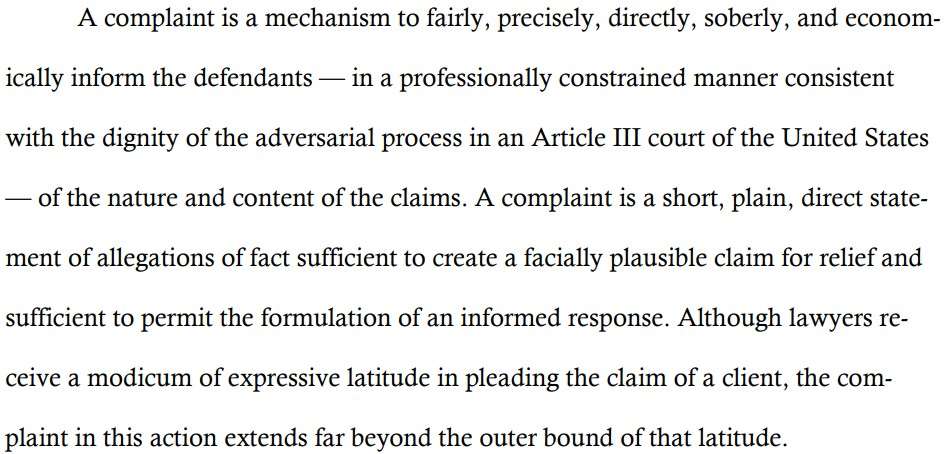
"The complaint continues ... with much more, persistently alleged in abundant, florid, and enervating detail." "[A] complaint is not a public forum for vituperation and invective—not a protected platform to rage against an adversary. A complaint is not a megaphone for public relations or a podium for a passionate oration at a political rally or the functional equivalent of the Hyde Park Speakers' Corner."

|

From today's order by Judge Steven Merryday (M.D. Fla.) in Trump v. N.Y. Times Co.:

As every member of the bar of every federal court knows (or is presumed to know), Rule 8(a), Federal Rules of Civil Procedure, requires that a complaint include "a short and plain statement of the claim showing that the pleader is entitled to relief." Rule 8(e)(1) helpfully adds that "[e]ach averment of a pleading shall be simple, concise, and direct." Some pleadings are necessarily longer than others. The difference likely depends on the number of parties and claims, the complexity of the governing facts, and the duration and scope of pertinent events. But both a shorter pleading and a longer pleading must comprise "simple, concise, and direct" allegations that offer a "short and plain statement of the claim." Rule 8 governs every pleading in a federal court, regardless of the amount in controversy, the identity of the parties, the skill or reputation of the counsel, the urgency or importance (real or imagined) of the dispute, or any public interest at issue in the dispute.

In this action, a prominent American citizen (perhaps the most prominent American citizen) alleges defamation by a prominent American newspaper publisher (perhaps the most prominent American newspaper publisher) and by several other corporate and natural persons. Alleging only two simple counts of defamation, the complaint consumes eighty-five pages. Count I appears on page eighty, and Count II appears on page eighty-three. Pages one through seventy-nine, plus part of page eighty, present allegations common to both counts and to all defendants. Each count alleges a claim against each defendant and, apparently, each claim seeks the same remedy against each defendant.

Even under the most generous and lenient application of Rule 8, the complaint is decidedly improper and impermissible. The pleader initially alleges an electoral victory by President Trump "in historic fashion"—by "trouncing" the opponent—and alludes to "persistent election interference from the legacy media, led most notoriously by the New York Times." The pleader alludes to "the halcyon days" of the newspaper but complains that the newspaper has become a "fullthroated mouthpiece of the Democrat party," which allegedly resulted in the "deranged endorsement" of President Trump's principal opponent in the most recent presidential election. The reader of the complaint must labor through allegations, such as "a new journalistic low for the hopelessly compromised and tarnished 'Gray Lady.'" The reader must endure an allegation of "the desperate need to defame with a partisan spear rather than report with an authentic looking glass" and an allegation that "the false narrative about 'The Apprentice' was just the tip of Defendants' melting iceberg of falsehoods." Similarly, in one of many, often repetitive, and laudatory (toward President Trump) but superfluous allegations, the pleader states, "'The Apprentice' represented the cultural magnitude of President Trump's singular brilliance, which captured the [Z]eitgeist of our time."

Read More

Free Speech

Sealing and Malawi

|

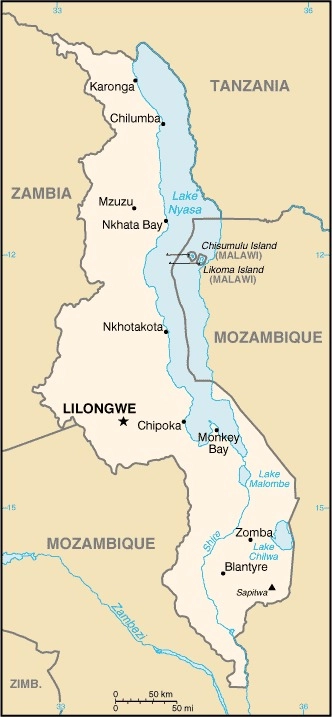
(Map from the CIA Factbook.)


From Republic of Malawi v. Columbia Gem House, decided Wednesday by Judge David Estudillo (W.D. Wash.):

On April 11, 2025, Plaintiff filed an application to conduct discovery for use in contemplated foreign criminal and civil proceedings pursuant to 28 U.S.C. § 1782. Shortly thereafter, the Clerk's Office sealed this case, based upon guidance provided to Clerk's office employees that cases of this nature should generally be opened under seal. On May 23, 2025, the Court granted Plaintiff's application….

Plaintiff argues the Court should unseal this case in its entirety because there is no compelling reason to maintain the seal. Plaintiff contends there is no confidential information in any of the Court filings and argues the presumption of access to judicial records should therefore prevail….

In general, "compelling reasons" sufficient to outweigh the public's interest in disclosure and justify sealing court records exist when such "court files might have become a vehicle for improper purposes," such as the use of records to gratify private spite, promote public scandal, circulate libelous statements, or release trade secrets. However, "[t]he mere fact that the production of records may lead to a litigant's embarrassment, incrimination, or exposure to further litigation will not, without more, compel the court to seal its records."

Here, Defendants argue Plaintiff will "use and misconstrue the Court's records and orders to perpetuate an ongoing false scandal" to advance the re-election prospects of politicians in Malawi. Defendants contend the scandal allegedly perpetuated by the Malawian government threatens the future of their business and the livelihood of their employees. Defendants argue the government of Malawi has been using false accusations against them "to whip up public scandal" for years, and have recently resurrected these allegations in the run up to Malawi's 2025 presidential election. Defendants argue Plaintiff has already used and misconstrued the Court's rulings for political purposes, citing an article published on a Malawian news website that quotes from the Court's sealed order granting Plaintiff's application to conduct discovery pursuant to 28 U.S.C. § 1782. {Plaintiff and Plaintiff's counsel both deny sharing the Court's order with any third parties.}

Read More

The First Liberty Institute Is A Defender Of The Jewish People

Unfortunately, FLI is being lumped in with another group that made an unfair and uninformed attack on Rebecca Taibleson's rabbi.

|

The fallout from Rebecca Taibleson's nomination continues. I was very critical of an attack from a particular conservative group which focused on the rabbi that married Taibleson. That attack was distinct from a letter signed by about fifty other conservative groups, including the First Liberty Institute (FLI). Unfortunately, FLI is being lumped in with the organization that focused on Rebecca's rabbi, and it has been suggested that FLI favors a religious test, and is hostile to Jewish people.

I can speak from experience that such a charge is absolutely unfounded. I have worked with FLI for more than a decade. In 2016, a group of poultry activists sued a Chabad Rabbi in California on the eve of the Jewish New Year. The Rabbi, preoccupied with other tasks, did not respond to the suit. A federal judge issued an Ex Parte TRO that prohibited the Rabbi from performing an important ritual that involves chickens. I found out about the case, and stayed up all night preparing an amicus brief, arguing that the poultry group could not establish diversity jurisdiction because the amount in controversy was less than $75,000. At the same time, First Liberty Institute swooped in and prepared a representation for the Rabbi in about twenty-four hours. With little notice, they presented oral arguments over the phone. When no one else was willing to defend this Rabbi, FLI stepped up to the plate. I wrote about the case in the Los Angeles Times.

More recently, a group of Jewish people in a Houston neighborhood began holding services in a home. Over time, more and more people started to attend this small, friendly minyan. It was called Heimish, which means homey. Some neighbors began to complain about the noise, and the City of Houston threatened to take a zoning enforcement action. FLI once again stepped up to the plate, and the City of Houston backed down.

Just last month, FLI secured a victory for a Jewish student at (of all places) the University of Wisconsin. The student requested on campus housing in walking distance to a synagogue, so she could walk to Shabbat services. After receiving a letter from FLI, the University acquiesced. There are many more cases: a property dispute for a Chabad in Long Island, harassment of a Rabbi in Boca Raton, a Jewish prayer group in Hawaii, a Rabbi in Beverly Hills, and many more.

Every year I speak at First Liberty's annual conference, which usually runs over the weekend. For the past few years, I have brought shabbat candles, challah, and grape juice so my family can celebrate Shabbat. This past year, the FLI staff volunteered to coordinate everything, and brought all of the things needed to celebrate. It was such a thoughtful gesture, for which I was grateful. Indeed, my kids led a mini shabbat service for many people in attendance, who had never had that experience. It was beautiful.

I could go on.

Whenever conservatives oppose a Republican-appointed judge, we have the equivalent of a family feud. It's not ideal, but sometimes these issues need to be ventilated publicly, as Senator Cruz explained. But I think we need to be careful about unfairly assigning blame to those groups that speak out.

Politics

A Night in Jerusalem

History and a city at war.

|

On a late summer night Jerusalem casts a magic spell. The first day of autumn is less than a week away but the daytime temperature is close to 90 degrees Fahrenheit, and the sun is relentless. Then the cool breeze of evening comes and it's like the soft touch of a cat's whiskers.

Jerusalem is a city that needs to be seen on three levels. The street is a cacophony of cars of course but also the thrust and parry of conversation in the cafes on Bethlehem Road. Viewed from above, from the YMCA tower, say, an elegant art deco structure designed by the same architect who built New York's Empire State Building, the city looks like a forest of stone. The walls of the Old City, the domes and spires of church, mosque, and synagogue, the graves of the Mount of Olives, the ubiquitous construction cranes ("Israel's national bird," as the joke goes) and the slabs of limestone that line the buildings they help to erect, the separation wall between Israel and the Palestinian territories.

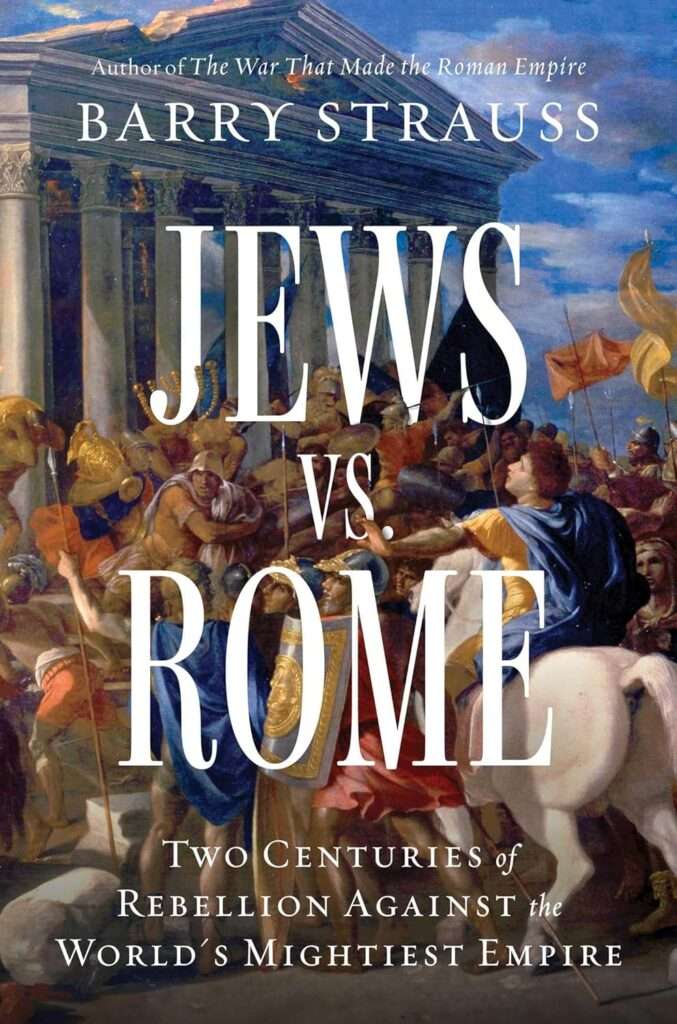
But as a historian, I am drawn to what lies underneath Jerusalem. It is not difficult to find mementoes of the Great Revolt of 66-70 in which the Romans laid siege to the city, captured it and destroyed the whole town, including the Second Temple. I write about that revolt, and two other Jewish revolts against Rome, in my new book, Jews vs. Rome: Two Centuries of Rebellion Against the World's Mightiest Empire (Simon & Schuster, 2025). The death throes of Jerusalem come alive under the streets of the Old City.

Read More

Politics

The Heritage Guide to the Constitution Editorial Process and Editorial Board

|

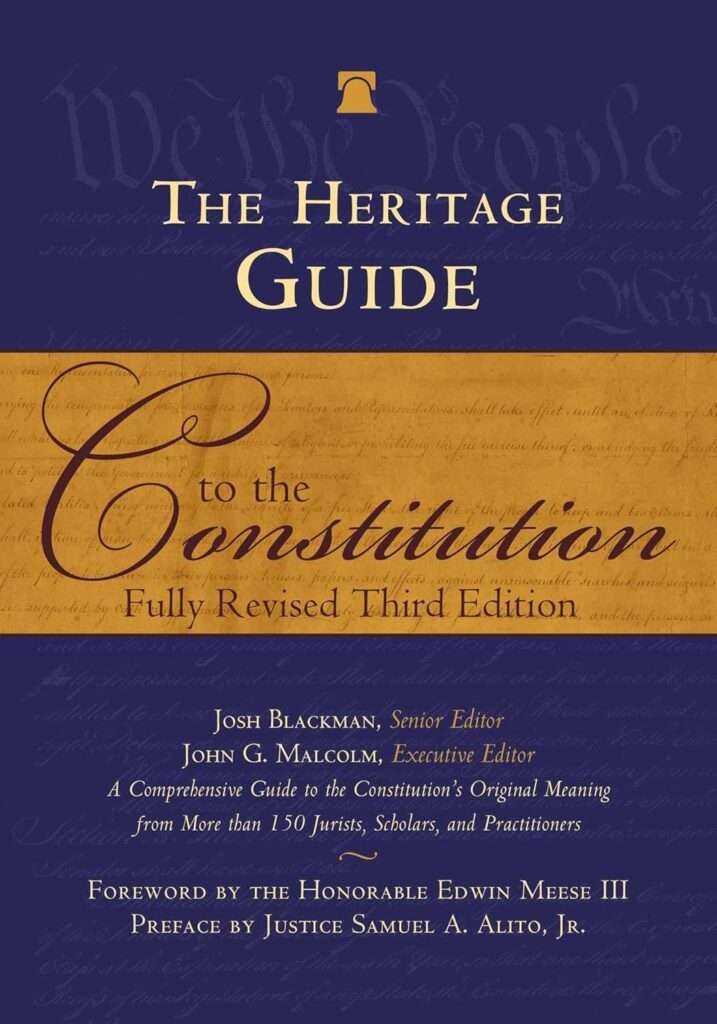
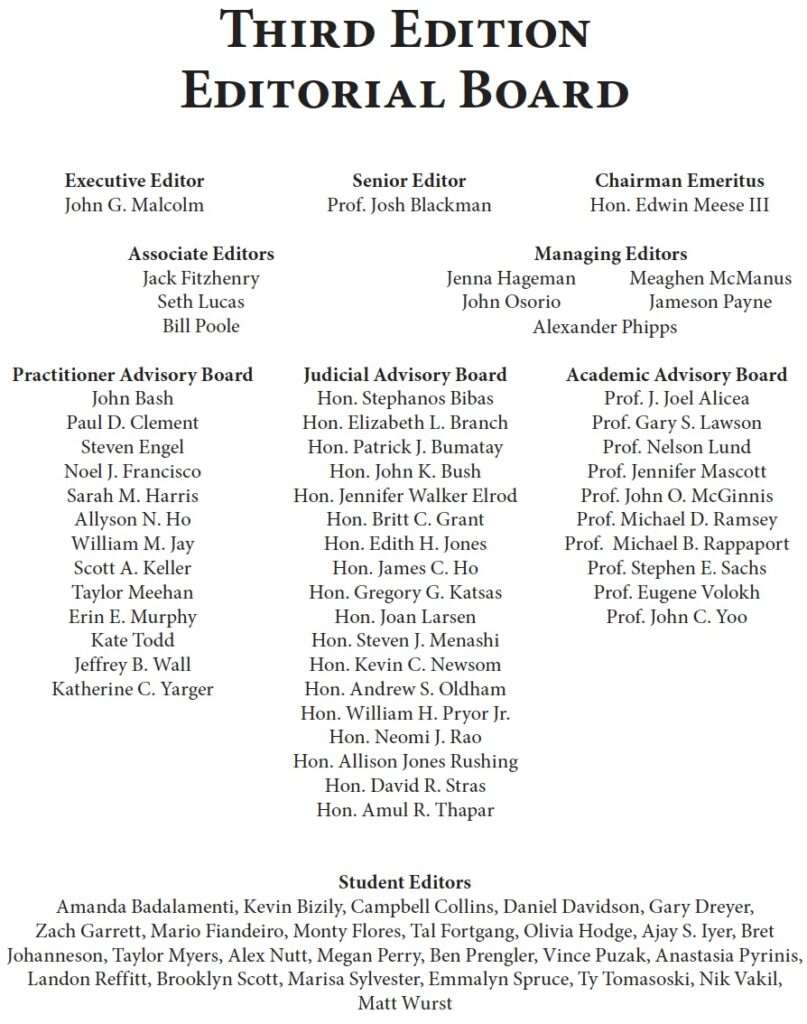
The Heritage Guide to the Constitution was a collaborative effort of more than 150 authors, who were advised by a practitioner, judicial, and academic boards. My co-author John Malcolm and I described the process in our editors' note:

Due to the size of this project, we established a fairly rigorous process to ensure that essays of the highest quality were reviewed, edited, and revised in a timely fashion. Josh Blackman served as the Senior Editor and John G. Malcolm served as the Executive Editor. Our editors at Heritage included Seth Lucas, Jack Fitzhenry, Jenna Hageman, Meaghen McManus, John Osorio, Jameson Payne, and Alexander Phipps. We were also fortunate to have student editors who served on the Harvard Journal of Law & Public Policy, NYU Journal of Law & Liberty, Georgetown Journal of Law & Public Policy, and Texas Review of Law & Politics, as well as the Heritage Foundation intern program. We also assembled three external advisory boards. The Judicial Advisory Board included eighteen federal circuit courts of appeals judges, the Practitioner Advisory Board included thirteen Supreme Court advocates, and the Academic Advisory Board included ten law professors. All of the editors and advisors are listed on the masthead.

The publication process went through six rigorous phases. Phase 1 began in early 2022. Over the course of a year, every essay from the second edition was carefully scrutinized by our internal and external reviewers. During this process, we invited back authors to revise their essays and also invited many new authors to join the project. Moreover, we subdivided some essays that covered several clauses, thus creating more opportunities for new authors. We tried to develop a mix of senior professors, junior scholars, practitioners with relevant experience, and distinguished jurists. In Phase 2, authors were asked to deliver the first draft of their revised essays by the middle of 2023. We provided the authors with detailed guidelines to ensure that the essays were roughly uniform in structure and style and provided the proper focus on originalism. We are grateful to the authors for following our standards.

In Phase 3, throughout late 2023 and 2024, the substance of the first drafts was carefully reviewed by Blackman, Malcolm, and our internal editors at Heritage. Each essay was also referred to our external board for a double-blind review: Reviewers did not know the identity of the authors, and the authors did not know the identity of the reviewers of their respective essays. The external reviewers provided line edits, suggestions to add or remove material, and broader comments.

In Phase 4, during 2024, feedback was provided to the authors in an anonymized fashion so that they did not know who provided the comments. We are again thankful to the authors for considering and implementing many of our proposed edits.

Phase 5 began in mid-2024. Here, the essays were closely proofread, cite-checked, and bluebooked by Bill Poole, Heritage Senior Editor extraordinaire. External sources were digitized and archived to ensure citation accuracy.

Phase 6 commenced in 2025 as the essays were finalized and prepared for publication. We exerted our best efforts to catch all possible errors but still take responsibility for any mistakes that may have slipped through the process. The final text spanned approximately 500,000 words—more than fifty times the length of the Constitution and amendments. The complete Guide was delivered to the publisher in July 2025.

Here are the distinguished members of our editorial board:

See The Entire Constitution At The National Archives

The Constitution, the "Fifth Page," and all 27 Amendments are on display.

|

I have visited the Rotunda at the National Archives many times. On permanent display are the Declaration of Independence, the four pages of the Constitution, and the Bill of Rights. At this point, the Declaration is so faded, it is nearly impossible to read. Same for the Bill of Rights. Thankfully, the Constitution was better preserved. Every time I walk into the room, I am overcome by a sense of awe and wonder. I devote my life to teaching these documents, but it is a very different sensation to see them in person.

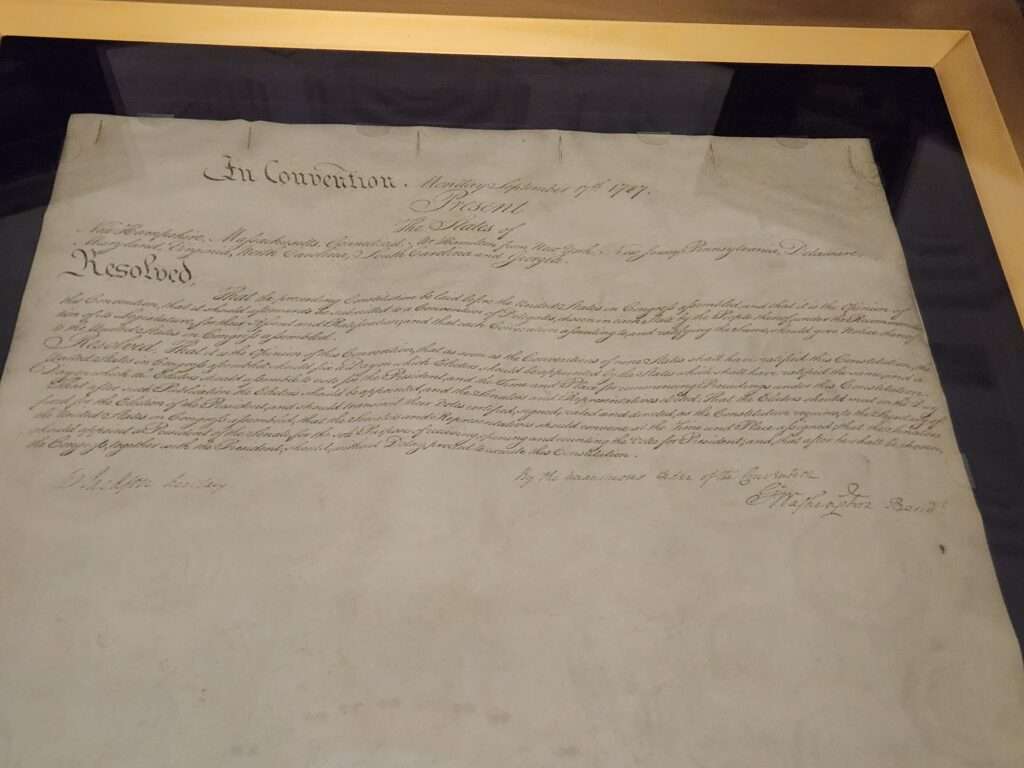
For the next month, the National Archives has put together a very special presentation: the "fifth page" of the Constitution is on display, along with all twenty-seven amendments. Today, I visited the Archives, and thoroughly enjoyed the new exhibit. The photographs, alas, are not good. The lighting creates a glare on the glass cases, which made them even more difficult to see.

The "fifth page" provided instructions to the states of how to ratify the Constitution. I labored about whether to include this text in the Heritage Guide to the Constitution. I ultimately decided not to, as it was not part of the ratified document, even though it was signed by George Washington, the President of the Convention.

I was struck by how large the proposed Eleventh Amendment was. The piece of parchment was nearly the size of the Bill of Rights.

Read More

More