Ted Cruz Insists That James Comey's '86' Meant 'Kill,' Citing Nonexistent Mob Movies
Despite his avowed commitment to the First Amendment, the senator seems unfazed by the attempt to imprison the former FBI director for constitutionally protected speech.
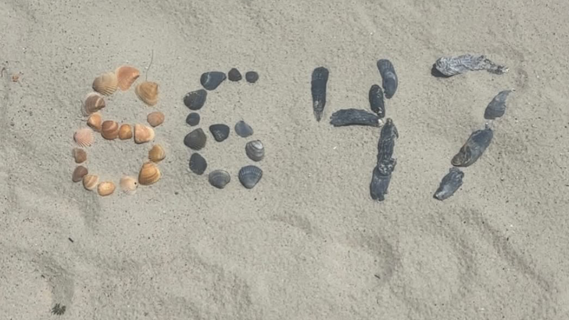
"I don't think I've ever seen a head of the FBI or former head of the FBI calling for killing a president," Sen. Ted Cruz (R–Texas) said during a recent appearance on Real Time With Bill Maher. As you may have surmised, Cruz was referring to the photograph at the center of federal charges against former FBI Director James Comey, which showed seashells arranged in the sand to form the numerical slogan "86 47"—a ubiquitous expression of opposition to President Donald Trump. When Comey posted that picture on Instagram in May 2025, federal prosecutors aver in pursuit of Trump's personal vendetta against a longtime nemesis, he was publicly threatening to assassinate the president.
"I don't know if that case will go anywhere or not," Cruz said before lending credence to Trump's risible interpretation of the seashells. "To '86' someone is not to get rid of them," Cruz told Maher. "It's to kill them." Maher vigorously contested that point, and for good reason. Although the number can refer to murder, that is by no means the most common usage of the term. Nor is that the only challenge that the government faces in trying to prove that Comey is guilty of the two felonies alleged in the indictment.
Comey's trial is currently scheduled to begin in February. To convict him, the government has to prove, at a minimum, that he "consciously disregarded a substantial risk that his communications would be viewed as threatening violence." Under the Supreme Court's 2023 ruling in Counterman v. Colorado, that is the constitutionally required standard for convicting someone of making a "true threat." And at least one of the charges against Comey requires more: proof that he wanted people to understand the seashell picture as a threat to assassinate Trump.
That's a tall order, as Cruz implicitly conceded when he said he did not know whether the case "will go anywhere." But the case fails even without considering Comey's state of mind because, contrary to what Cruz asserted and the indictment says, "a reasonable recipient who is familiar with the circumstances" would not interpret Comey's message as "a serious expression of an intent to do harm to the President of the United States."
The government's claim to the contrary defies common usage. "The ordinary meaning of '86' does not connote violence," Comey's lawyers note in a motion to dismiss. According to Merriam-Webster, eighty-six "is slang meaning 'to throw out,' 'to get rid of,' or to 'refuse service to.'" The term "comes from 1930s soda-counter slang meaning that an item was sold out." By the 1950s, Americans were using eighty-six "as a verb, at first meaning 'to refuse to serve a customer,' later coming to mean 'to get rid of; to throw out,' and still later coming to mean 'shut out' or 'rejected.'"
Most relevant in this context, "combining '86' with a numerical shorthand for a President's term of office is a particularly common slogan of political opposition," Comey's lawyers say. "Merchandise featuring such phrases is widespread, and prominent commentators and public figures have routinely used such phrases."
Merchandise such as T-shirts and stickers "featuring '86 44,' '86 45,' '86 46,' and '86 47' slogans"—referring, respectively, to Barack Obama, Trump during his first term, Joe Biden, and Trump during his current term—"is widely available at large online retailers like Amazon and has been purchased thousands of times," the motion memorandum notes. "In the months leading up to Mr. Comey's post, '86 47' flags, signs, and apparel were regularly displayed at protests around the country."
Against all of that evidence, Cruz offered his recollection of films he has seen. Based on "every mob movie I've ever watched," he told Maher, it is clear that eighty-six means kill.
Maher disagreed. "I've watched all the mob movies too," he said. "They don't say 'eighty-six.' They say 'whack' a guy. They say 'he's gone; he sleeps with the fishes.' That thing—'did you take care of that thing?' They don't say, 'Yeah, we eighty-sixed him.'"
Who is right? "A search of scripts from the American Film Institute's top 10 gangster films shows no instance of the phrase being used" in reference to murder, ABC News reported in April. And for what it's worth, ChatGPT says, "I haven't been able to substantiate a single example from a recognizable mob movie in which '86' unambiguously means kill."
Federal investigators tried hard to find evidence that Comey would or should have understood eighty-six to mean kill. They ran AI queries, combed investigative files, searched transcripts of organized crime cases, and interviewed former FBI agents. Notably, that effort continued after Comey was indicted, at which point prosecutors, according to the Justice Department's manual, already should have gathered "admissible evidence" that "probably" would be "sufficient" to obtain a conviction. Five days after the indictment, Attorney General Todd Blanche insisted that prosecutors did indeed have such evidence—a claim belied by their ongoing, increasingly desperate attempt to support their reading of Comey's message.
The strongest evidence that prosecutors could find came from a post-indictment telephone interview with Salvatore "Sammy the Bull" Gravano, a cooperating witness in United States v. John Gambino, who "stated his belief that Mr. Comey had to know what the term '86' meant 'as it related to killing someone.'" You would not expect that term to show up in legal or investigative records, Gravano said, because "members of organized crime families refrained from using terms such as '86' that were commonly used in day-to-day business in the presence of law enforcement officers."
Otherwise, prosecutors came up short. One former FBI agent, who "had worked organized crime cases in New York and was specifically assigned to the FBI squad that investigated the Gambino crime family," reported that he "was familiar with the term '86' and used it and heard others use it throughout his life." He "never understood the term '86' to mean to kill." He "did not recall any instances in which he heard organized crime subjects or sources use '86' to mean to kill someone."
Another retired agent, who "had worked organized crime cases in New York for
a 'very long time,'" could not recall "any instance where '86' was used in the organized crime context to mean 'kill.'" He "understood the term to be used by organized crime to mean 'get rid of things.'"
Reinforcing those accounts, Comey's lawyers submitted a declaration from John Gleeson, a former federal judge and assistant U.S. attorney in the Eastern District of New York who had decades of experience with organized crime cases. Gleeson encountered Comey when they were both federal prosecutors in New York City, working in separate districts, but says they have never been friends.
"Mr. Comey and I are not friends and never were," Gleeson writes. "Though he and I used the same evidence, including the recorded conversations and cooperating witnesses described below, we competed with each other and had disagreements regarding prosecutorial strategy, including a serious disagreement regarding a multi-defendant murder case that had to be resolved at the highest levels of the Justice Department. To my knowledge, I have not been in Mr. Comey's presence or communicated with him since 1993."
Gleeson addresses the point raised by Gravano: that gangsters would avoid using their usual lingo in any context where their words might be documented. "The recorded conversations relevant to the words used by mafia members to refer to murder are bug recordings, not wiretaps," Gleeson writes. "The reason: mobsters assume their phone conversations are recorded, and as a result they are almost always circumspect, and generally refrain from discussing any serious crime in a telephone call. Bug recordings, on the other hand, are the product of surreptitiously placed microphones in locations where the targets of investigation feel free to speak openly with one another about their activities."
Here is Gleeson's conclusion based on that evidence: "The claim that '86' is mafia jargon for 'kill' is preposterous. If it weren't made in the context of seeking to deprive a man of his liberty, it would be laughable. I have never come into contact with a single recorded conversation where a mafia member uses '86' in any way, shape, or form, let alone to refer to killing or murder. Nor have I come into contact with any such reference to '86' in my thousands of hours of debriefings and conversations with cooperating witnesses in mafia cases. In short, in my expert opinion, there is literally no support for the central allegation on which the case rests."
In their response to Comey's motion, federal prosecutors make little effort to gainsay his argument that they are misinterpreting eighty-six. Instead, they mainly argue that the question of whether his message qualifies as a true threat should be answered by a jury after a trial. "Whether a recipient of Comey's message could objectively understand it as a threat is an inherently factbound question," they say. "A jury must decide the true threat question."
That argument could prevail, Anna Bower, Eric Columbus, and Molly Roberts say in a recent Lawfare essay. "As comical as the prosecution's case appears, it may well go to trial," they write, noting that the definition of a true threat depends on context, which requires fact finding. "If the government's case is as weak as it appears to be," they say, "Comey will have subsequent chances to defeat it." He can "move for a judgment of acquittal at the close of the government's case," for example, arguing that "no rational juror could find, on the basis of the evidence presented at trial, that his post constituted a true threat."
Bower et al. make it clear where they stand on the merits of the case: "The Comey prosecution appears to be—to put it mildly—utterly lacking in merit. It is difficult to imagine that it will lead to a conviction. Whether Comey can end it before a jury is sworn in, however, is far from certain."
A trial, of course, would add to the price that Comey is already paying for earning a prominent spot on the president's enemies list. "There's an old saying in the law: The process is the punishment," Bower et al. write. "Trump would almost certainly delight in seeing Comey behind bars. But forcing Comey to sit in court while a prosecutor presents a felony case to a jury—as weak a presentation as it's likely to be—might be enough to make the president's day."
That reality makes Cruz's position on the case all the more disgraceful. To his credit, Cruz has not hesitated to condemn other attempts by the Trump administration to punish people for constitutionally protected speech—in particular, its abuse of the Federal Communications Commission to target Trump critics such as Jimmy Kimmel. But Maher gave Cruz an opportunity to say something about the First Amendment implications of the attempt to imprison Comey over an Instagram photo, and Cruz responded by criticizing Comey's "astonishing" and "disgusting" numerical rhetoric.
Maher introduced the discussion of Comey's case by noting that the senator is the author of a book called Justice Corrupted: How the Left Weaponized Our Legal System. Instead of showing that his opposition to such abuse and his commitment to freedom of speech are rooted in principle, Cruz echoed Trump's dubious understanding of eighty-six, citing unidentified and seemingly nonexistent movies to back it up.
It is hard to tell whether Cruz was sincerely offended by Comey's Instagram post or is simply pandering to the MAGA crowd. But either way, he reinforced the foolhardy idea that freedom of speech is worth defending only when you like the speaker and agree with his message.