

He Spent 30 Days in Jail for Calling a Judge 'Cocksucker.' Pennsylvania's High Court Vacated His Sentence.
The single, vulgar comment didn't obstruct the court proceedings enough to support a criminal contempt conviction, the court ruled.
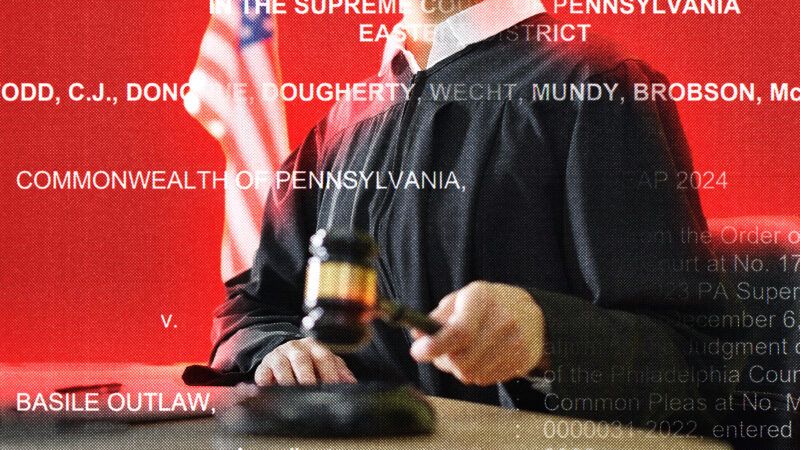
The Pennsylvania Supreme Court has vacated the criminal contempt conviction of a courtroom spectator who spent 30 days in jail for calling a county judge a "cocksucker."
In a majority opinion published on October 29, the Pennsylvania Supreme Court ruled that a single vulgar insult directed at a judge from a courtroom gallery, while a breach of decorum, did not create an obstruction to the administration of justice necessary to uphold a criminal contempt conviction.
In June 2022, Basile Outlaw was seated in the gallery of the courtroom of Philadelphia County Court of Common Pleas Judge Roxanne E. Covington when he stood up and announced, "The judge is a cocksucker," in response to Covington's ruling against a motion by the defendant, an acquaintance of Outlaw's.
"What did you say?" Covington responded.
"Never mind, I'm leaving," Outlaw said and exited the courtroom, according to court documents.
Outlaw later returned to Covington's courtroom, where he was taken into custody for criminal contempt. At a sentencing hearing, Outlaw said he had returned to Covington's courtroom to apologize and said he regretted his outburst. Outlaw was sentenced to 30 days in jail, all of which he served.
Outlaw appealed this conviction, but the Pennsylvania Superior Court upheld it in December 2023, finding that his conduct significantly disrupted the court hearing, as well as prejudiced the court's authority because his comment "demonstrated his disrespect for the court and its command of the courtroom."
Outlaw appealed again to the Pennsylvania Supreme Court, asking it to consider whether "a single act of profane name-calling directed at the judge constitute[s] direct criminal contempt when it did not in any way, let alone any significant way, obstruct the proceedings."
The Pennsylvania Office of Attorney General (OAG) argued in favor of upholding Outlaw's conviction, writing that to let such openly defiant and abusive conduct stand "is to degrade judicial authority in the eyes of the public, thereby obstructing the administration of justice."
However, the Pennsylvania Supreme Court was guided by a previous decision finding that it did not amount to obstruction when a man representing himself in a custody dispute said the trial judge was "such a fucking asshole."
"Both comments fall well below the expected standard of courtroom decorum, and both contemnors made their comments in response to judicial rulings with which they disagreed," Pennsylvania Supreme Court Justice David Wecht wrote in the majority opinion. And in both cases, Wecht continued, the outbursts only caused "transient delays" that amounted to the judge asking, "What did you say?"
The court was not persuaded by the OAG's attempts to distinguish between the two cases by arguing that Outlaw's outburst was more offensive, and thus more disruptive.
"While we will not endeavor to rank the various obscenities discussed here in order of offensiveness, we do not believe that calling a judge a 'fucking asshole' 'create[s] the impression that the public is free to disregard a judge's orders and rules of courtroom decorum' any more or less than calling a judge a 'cocksucker' would," Wecht wrote.
Although judges have nearly unfettered authority to set rules in their courtrooms, that power is not unlimited, as imperious judges in other cases have found. In October, the U.S. Circuit Court of Appeals for the 8th Circuit ruled that a Missouri judge who locked two children in jail cells because he was frustrated with their behavior was not immune from the civil rights lawsuit that followed. The 8th Circuit found that the children had committed no jailable offense, and so the judge had violated their clearly established Fourth Amendment right to be free from unreasonable searches and seizures.
Judges have also threatened newspapers with contempt for publishing sealed materials, such as when a Florida judge threatened the South Florida Sun Sentinel for revealing bureaucratic errors in the lead-up to the mass shooting at Marjory Stoneman Douglas High School.



