

The Volokh Conspiracy
Mostly law professors | Sometimes contrarian | Often libertarian | Always independent
Analyzing Indictment of James Comey for "86 47" Post
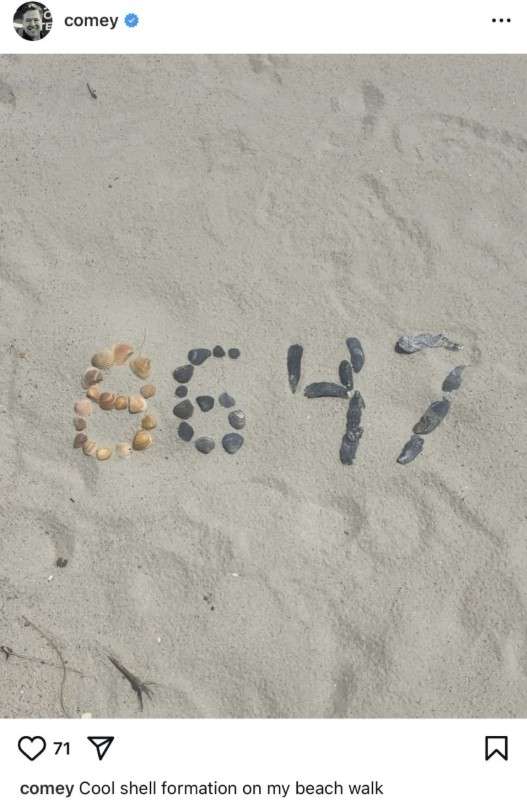
From today's indictment:
On or about May 15, 2025, in the Eastern District of North Carolina, the defendant, JAMES BRIEN COMEY JR, did knowingly and willfully make a threat to take the life of, and to inflict bodily harm upon, the President of the United States, in that he publicly posted a photograph on the internet social media site Instagram which depicted seashells arranged in a pattern making out "86 47", which a reasonable recipient who is familiar with the circumstances would interpret as a serious expression of an intent to do harm to the President of the United States.
In violation of Title 18, United States Code, Section 871(a).
A second count also alleges this violated the federal interstate threats statute, 18 U.S.C. § 875(c).
I think this prosecution is unjustified, and will get thrown out. Let me quickly analyze why.
Threats: To "eighty-six" someone is, to quote the Oxford English Dictionary, "to eject or debar (a person) from premises; to reject or abandon; (in earliest use) to refuse to serve (a customer)." (In context, "47" means Trump, who is now the 47th president.) Here are the examples the OED gives:
1942 'Eighty-six' is the trade term for refusing to serve a patron any more liquor… If the patron begins trying out airplane spins on innocent neighbors, for example, he is through. He is 'eighty-sixed'. Times Herald (Washington, D.C.) …
1959 'Eighty-sixed some square bankers from the temple'..eighty-sixed means evicted. Observer …
1963 I'll have you eighty-sixed out of this bar. J. Rechy, City of Night.
1968 On the evening of July 22, Mr. Mailer was filming a dream sequence at the house of Alfonso Ossorio in East Hampton, when Mr. Smith came into the house. 'He told me, "You're 86'd",' Mr. Smith recalled yesterday. This is a barroom phrase that means 'you're banned in here'. New York Times.
1980 Most of the program was devoted to the lessons in campaign management that could be learned from Presidential races, real and fictional (A scene was shown from the movie 'The Candidate', in which the media adviser said to Robert Redford, 'O.K., now, for starters, we got to cut your hair and eighty-six the sideburns'). New Yorker
Absent further context, the term can't be reasonably seen as a threat of violence. Of course, with the right context, very many things could be seen as threats of violence. If someone comes to my house waving a gun, saying "I'm going to 86 you" (or a lot of other things), that might well be seen as a threat of violence; but I know of no such context that would lead Comey's tweet to be reasonably interpreted that way.
And First Amendment law recognizes that the First Amendment exception for "true threats" only extends to statements that really would be reasonably understood as threats. To quote Counterman v. Colorado (2023),
The "true" in that term ["true threats"] distinguishes what is at issue from jests, "hyperbole," or other statements that when taken in context do not convey a real possibility that violence will follow (say, "I am going to kill you for showing up late"). True threats are "serious expression[s]" conveying that a speaker means to "commit an act of unlawful violence."
And to punish a statement as a threat, the government "must show that the defendant consciously disregarded a substantial risk that his communications would be viewed as threatening violence."
Nothing in Comey's statement can be reasonably understood as conveying that he means to kill Trump. Rather, its reasonably understood meaning is that Comey wants Trump removed, for instance through impeachment or (as with President Nixon) resignation under threat of impeachment.
Indeed, even some facially threatening statements (and, again, "86 47" isn't facially threatening) have been found not to be true threats when the context shows that they shouldn't be reasonably understood as genuinely threatening. The classic example is Watts v. U.S. (1969) (emphasis added):
The incident which led to petitioner's arrest occurred on August 27, 1966, during a public rally on the Washington Monument grounds. The crowd present broke up into small discussion groups and petitioner joined a gathering scheduled to discuss police brutality. Most of those in the group were quite young, either in their teens or early twenties. Petitioner, who himself was 18 years old, entered into the discussion after one member of the group suggested that the young people present should get more education before expressing their views.
According to an investigator for the Army Counter Intelligence Corps who was present, petitioner responded: "They always holler at us to get an education. And now I have already received my draft classification as 1-A and I have got to report for my physical this Monday coming. I am not going. If they ever make me carry a rifle the first man I want to get in my sights is L. B. J." "They are not going to make me kill my black brothers." …
We do not believe that the kind of political hyperbole indulged in by petitioner fits within that statutory term ["threat"]. For we must interpret the language Congress chose "against the background of a profound national commitment to the principle that debate on public issues should be uninhibited, robust, and wide-open, and that it may well include vehement, caustic, and sometimes unpleasantly sharp attacks on government and public officials."
The language of the political arena, like the language used in labor disputes, is often vituperative, abusive, and inexact. We agree with petitioner that his only offense here was "a kind of very crude offensive method of stating a political opposition to the President." Taken in context, and regarding the expressly conditional nature of the statement and the reaction of the listeners, we do not see how it could be interpreted otherwise.
The Court therefore overturned a jury verdict convicting Watts. As the Court has held in cases such as Bose Corp. v. Consumers Union (1983), courts reviewing judgments based on speech need to review them independently, rather than by deferring to the factfinder's interpretation of ambiguous language. In particular, such independent judicial review is required in threats cases (see, e.g., In re George T. (2004)).
Likewise, a court considering a motion to dismiss an indictment (which I expect Comey will file) should conclude that, as a matter of law, Comey's statements weren't a punishable threat, either. (See, e.g., State v. Metzinger (Mo. Ct. App. 2015) for an example of a court dismissing a threat indictment on such grounds.)
Solicitation: Now perhaps some might agree that Comey didn't mean to say that he would kill Trump, but that he was urging others to kill Trump. But that too strikes me as wrong: He likely was urging something, but that something appears in context to be political opposition to Trump that would lead to his removal.
In U.S. v. Hansen (2023), the Court recognized that the First Amendment doesn't protect solicitation of crime, but explained that "Criminal solicitation is the intentional encouragement of an unlawful act," citing the Model Penal Code, which defines solicitation as:
- "A person is guilty of solicitation to commit a crime if"
- "with the purpose of promoting or facilitating its commission"
- "he commands, encourages or requests another person"
- "to engage in specific conduct that would constitute such crime."
If a mob boss tells a subordinate to "86" someone, and it's clear that this means to shoot rather than to throw out of a bar, that might well be solicitation. But I'm pretty sure that there's no proof beyond a reasonable doubt that Comey posted to the world a photo of seashells arranged in "86 47" with the purpose of promoting an assassination of the President.
And of course, perhaps for this very reason, the indictment doesn't even allege solicitation. It alleges a threat—and, again, it is not reasonable to interpret Comey's post as a true threat.




