

A pound of rubles = a dollar. A joke from the 1990s, as I recall, which came to mind because of the ruble's recent slide. (To be fair, the ruble was worth much less then than now; according to Wikipedia, "The ruble's exchange rate versus the U.S. dollar depreciated significantly from $1 = 125 RUR in January 1992 to approximately $1 = 6,000 RUR when the currency was redenominated in 1998.")
The Volokh Conspiracy
Mostly law professors | Sometimes contrarian | Often libertarian | Always independent | Est. 2002

An Interesting Professional Speech Case from 10 Years Ago, Involving Speech About Dead Bodies
I just ran across it for the first time, so I thought I'd pass it along; it's Schoeller v. Bd. of Reg. (Mass. 2012) (opinion by Justice Fernande Duffy):
[T]he Board of Registration of Funeral Directors and Embalmers … permanently revok[ed] Troy J. Schoeller's licenses to do business in the Commonwealth as a funeral director and embalmer … after Schoeller made comments to a newspaper reporter about his experiences in the embalming profession and those comments were later published as part of an article about Schoeller.
Schoeller did not reveal any confidential or private information about any deceased person or bereaved family members whom he had served. Rather, the board found that Schoeller had violated an ethical regulation prohibiting an embalmer from "comment[ing] on the condition of any dead human body entrusted to his or her care," 239 Code Mass. Regs. § 3.13(7) (1998), and that he had used unprofessional language in his descriptions of dead bodies. By doing so, the board concluded, Schoeller had "engaged in gross misconduct and unprofessional conduct which undermines the integrity of the profession." …
The conduct at issue here occurred in late 2006, when a newspaper reporter sought to interview Schoeller about a retail clothing store Schoeller had opened in the Allston section of Boston…. Among the topics discussed that evening was Schoeller's work as an embalmer, and Schoeller made statements describing certain of his experiences. Approximately one week later, the newspaper published an article about Schoeller that included his comments about embalming[, including:]
Thoughts on the War in Ukraine: The turning of the tide?
The "sanctions" appear to be working, and we could be witnessing a very significant moment for this war, and for the history of warfare
[NB: UPDATE at 02/28/22 330 PM at End of Post]
When Russian troops entered Ukraine last Thursday, it was hard not to feel an overwhelming sense of doom and gloom. There were, it seemed to me, two possible outcomes, both terrible: Either the Russians would steamroll over the Ukrainian resistance, occupy Kyiv, install a puppet government, throw Zelensky and his associates in jail (or worse), and leave; or, the Ukrainian resistance would be more formidable than expected, and there would be a horrific, bloody carnage that would, inevitably, end in a Russian victory by virtue of their vastly superior force, at the cost of tens or hundreds of thousands of casualties.
But I hadn't foreseen the third possibility: that the Allies could deploy a weapon powerful enough to force Putin to reconsider the wisdom of what he was doing and bring him to the negotiating table. But that is what seems to be happening.
As I write this, the two sides are meeting at the Belarus-Ukraine border to explore whether some kind of negotiated settlement is possible. What is noteworthy - remarkable, even, - is that it was the Russians who instigated the negotiations, inviting Zelensky to come to the table. On Day Four of the invasion.
That does not look, to me, like the move of someone who believes he is in a strong position, with the situation well in hand. It looks even less like that when, after Zelensky refuses to come to Belarus, Putin compromises, and agrees that the two sides can hold their meeting at the border.
If you saw that coming on Thursday morning, you're a lot smarter than I am.
Perhaps it will turn out to be all bluff and bother. But it feels, to me, like the tide has perhaps already started to turn. After four days. What happened?
Can't Litigate Copyright and Libel Case With Allegedly Infringed Photo and Allegedly Libelous Article Sealed
From Jacobs v. Journal Publishing Co., decided Wednesday by Magistrate Judge Steven Yarbrough (D.N.M.):
After Plaintiffs' indictment for white collar crimes, the Albuquerque Journal published an online article (the "Jacobs article") about the events. Plaintiffs allege that the material in the article was defamatory and placed them in a false light. Included in this material is a photograph (the "Cannes photograph") that depicts Plaintiffs in front of two yachts. Plaintiffs claim that this copyrighted photograph was "stolen from a frame in their home" after Defendants Nichole Perez and James Thompson trespassed onto Plaintiffs' property. Other newspapers and internet sources such as the Singapore [Straits] Times and the Sri Lanka Royal Turf Club Facebook site then used the Cannes photograph.
Plaintiffs filed for a temporary restraining order or preliminary injunction to remove the Jacobs article from the internet and take other steps to prevent the ongoing distribution of the Cannes photograph. Plaintiffs then sought to seal the exhibits attached to this motion, which included the Cannes photograph and the Jacobs article. I temporarily ordered the documents sealed pending further briefing on the merits of the issue from all parties….
Plaintiffs seek to seal the exhibits attached to Doc. 2, which contain either the copyrighted Cannes photograph, the allegedly defamatory Jacobs article, or both. In analyzing this matter, I begin—as a court must—with the presumption that the public should have access to these records.
Discrimination Between Muslim Prisoners' Kufis and Jewish Prisoners' Yarmulkes Is Unconstitutional
[UPDATE: Comments now work.]
From Moore v. Washington, decided Wednesday by Judge George Caram Steeh (E.D. Mich.):
Plaintiff John Patrick Moore, II is in the custody of the Michigan Department of Corrections ("MDOC")…. Moore is a devout, practicing Sunni Muslim who alleges violations of his religious rights due to MDOC policies that limit his ability to wear a kufi in the prison. {The MDOC changed their policy in February 2021 and now permits male Muslims to always wear a kufi.} …
The magistrate judge found that existing legal precedent would have given officials ample warning that prohibiting Muslim prisoners from wearing their kufi at all times would violate their constitutional rights. In reaching this conclusion, the court looked to Sixth Circuit caselaw which holds that the Free Exercise Clause of the First Amendment prohibits prison regulations that infringe on prisoners' sincerely held beliefs "without any valid penological justification."
Harlan Institute-Ashbrook Virtual Supreme Court Round of 8
The top 8 teams of HS Students presented oral argument in NYS Rifle & Pistol Association v. Bruen
The topic for the 10th Annual Harlan Institute-Ashbrook Virtual Supreme Court competition is NYS Rifle & Pistol Association v. Bruen. This past weekend, the top eight teams of high school students presented oral arguments. Truly, these high school students could compete in any law school moot court competition, and in some federal courts of appeals. The Round of 4 will be held in two weeks.
Round of 8 Match #1
Round of 8 Match #2
Round of 8 Match #3
Round of 8 Match #4
The Trials of Rasmea Odeh, Part One -- Joining the PFLP
A Palestinian woman was convicted of a terrorist bombing in Jerusalem and served ten years in an Israeli prison. Then she lied her way into the United States.
Many thanks to Eugene for giving me an opportunity to blog about my new book, The Trials of Rasmea Odeh. It is the story of a Palestinian woman who faced two wrenching trials in her lifetime, over forty years apart. The first trial was for the bombing of a Jerusalem supermarket in 1969, which took the lives of two Hebrew University students. She was convicted in that case, partly on the basis of a coerced confession, and sentenced to life in prison. Odeh was released after ten years in a prisoner exchange with the PFLP. She immigrated to the United States in 1996 and became a naturalized citizen in 2005, both times falsely denying that she had ever been convicted of a crime or imprisoned (as well as other false denials on the visa and citizenship applications).
Rasmea Odeh was born in 1947 in the village of Lifta, on the outskirts of Jerusalem. Her family was evacuated to Ramallah in early 1948, shortly before the fighting began between the nascent state of Israel and Arab and Palestinian forces. As refugees, the Odeh family lived for a time in a tent, eventually becoming prosperous enough to buy a house in nearby al-Birah.
Odeh grew up in the West Bank, which was then under Jordanian rule. According to a 1980 interview she gave to a Lebanese journalist, she began attending Communist Party meetings, which were illegal under Jordanian law, as a young teenager.
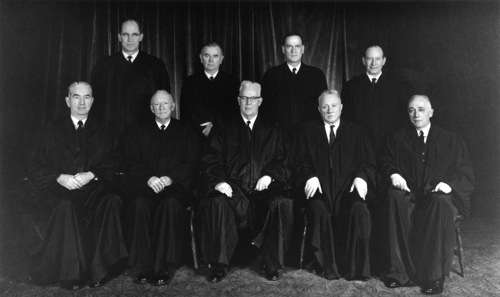
Today in Supreme Court History: February 28, 1966
Law & Contemporary Problems Symposium on "Sex in Law" Publishes Disputed Article
Some student editors had resigned from the journal due to the inclusion of an "anti-trans" article by philosopher Kathleen Stock.
The journal Law & Contemporary Problems has published its first issue of 2022, an interdisciplinary symposium on "Sex in Law." Among the contributions to the symposium is an article by philosopher Kathleen Stock, "The Importance of Referring to Human Sex in Language." In this article, Stock argues that "abandoning orthodox biology-based understandings of 'woman,' 'man,' 'girl' and 'boy' deprives language-users with immensely valuable tools to analyse and explain the material and social world. Meanwhile, any supposed gains are partial and uncertain." The inclusion of this article prompted some student editors of the journal to resign, as covered in this post.
The full symposium presents articles from a range of normative and disciplinary perspectives, addressing contemporary questions about how questions of sex, gender, and sexuality are and should be addressed in the law. In addition to Stock, contributors include Edward Schiappa, Joshua D. Safer, Anne B. Goldstein, Richard Chused, Anthony Michael Kreis, Wickliffe Shreve, Joanna Harper, June Carbone, and Madeleine Pape.
As a result of the controversy, no student editors are listed on the journal's masthead for this issue. Instead is the following statement:
As a general matter, student staff members of the journal Law & Contemporary Problems (L&CP) do not select articles for the symposium issues in its volumes. As L&CP is organized and operates, issue proposals are approved by the journal's faculty board and article selections are made by the special editors. The student role is typically to produce the issues once articles have been finalized by the authors and special editors. In the case of this issue, 85-1: Sex in Law, no articles have been read, edited, or reviewed by any L&CP student staff editors or executive board members acting in their official capacities as journal members. Over the summer of 2021, eight 3L students resigned from the journal and the remainder of the 3L membership voted not to have student members contribute to this symposium in their official capacities; these decisions were in response to the inclusion of Kathleen Stock's essay and the faculty board's rejection of the student executive board's request for use of a style guide on uniform language for the issue which the student executive board's membership considered necessary to avoid harm to the transgender community.
The issue's foreword, by Professors Doriane Coleman and Kimberly Krawiec (who were the editors of this issue), also addresses the controversy. They write:
We want to close with an expression of gratitude to the students who helped edit this volume after a number of editors and journal members resigned from the board or refused to work on it, for reasons explained in their statement on the masthead page. This includes the research assistants of individual authors, who did work that would normally have been completed by the student board, as well as Duke Law students who volunteered their time without pay or institutional credit to produce the rest. Among the latter, we especially want to recognize Meredith Criner who acted as de facto editor-in-chief even as she also did a lot of the below-the-line work normally reserved for junior members of the student board.
Guest Posts on "The Trials of Rasmea Odeh: How a Palestinian Guerrilla Gained and Lost U.S. Citizenship"
I'm delighted to report that Prof. Steven Lubet (Northwestern) will be guest-blogging about this new book of his:
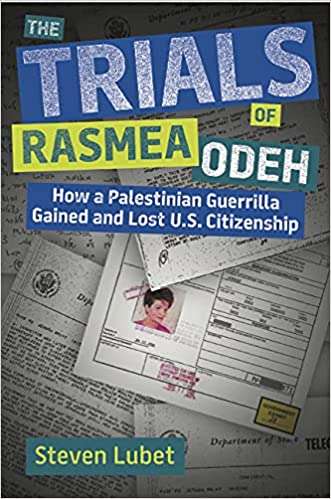
Here's the publisher's summary:
On February 21, 1969, a bomb exploded in the largest supermarket in Jerusalem. The blast killed two and injured many more, triggering an intense search for the terrorists behind the plot. Israeli security forces quickly apprehended, tortured, tried, and eventually convicted twenty-one-year-old Palestinian Rasmea Odeh for murder. Twenty-five years later, however, Odeh was not serving a life sentence in an Israeli prison but instead starting a new life in the United States, first in Detroit and later in Chicago, eventually becoming a naturalized citizen and working as a community organizer. Her arrest by U.S. federal authorities in 2013 on charges of unlawful procurement of citizenship and subsequent trial ignited defenders and detractors, even as the facts of the case, the previous conviction, and those of Odeh's life were obscured or ignored.
Based on extensive research, The Trials of Rasmea Odeh separates fact from fiction as it follows the remarkable twists of this story, even―or especially―where those facts subvert one political narrative or another. The result is that rare book that is both an extraordinary achievement of scholarly research and a gripping, accessible, and engaging narrative, making it an invaluable resource for discussion of the issues of citizenship, statehood, and the limits of legality this story engages.
And some blurbs:
Three Russian War Songs in Honor of the Ukrainians
Perhaps ironically, the tragedy and courage of the Ukrainians puts me in mind of Russian songs about soldiers and soldiering. I can't think of any great modern American songs about this (I'm not speaking here of anti-war songs, powerful as they might be), and I don't know Ukrainian. But Russians have produced some superb ones, perhaps in part because World War II left such a broader and deeper mark on Russia than on America.
At the same time, I expect that many patriotic Ukrainians are in the same boat as I am, and remember, say, Bulat Okudzhava's Russian-language songs more than whatever Ukrainian songs about war that there might be. The fact—even though Putin has asserted it, it's still a fact—is that Ukrainians and Russians are indeed in many ways one people with a history that is shared much more than divided. Okudzhava was singing about Ukrainian soldiers, of whom millions fought against the Nazis (though some number fought on the other side as well) as much about the Russians. Okudzhava himself, who fought in the war, was Georgian, as it happens.
In any event, a few songs for our few readers who understand Russian:
[1.] Bulat Okudzhava's "Farewell to Poland":
Today in Supreme Court History: February 27, 1901
2/27/1901: Champion v. Ames argued.
National injunctions and the APA appear in an argument at the Court
Aaron Nielson has a fascinating post at the Notice and Comment blog on Arizona v. City and County of San Francisco, California, a case the Supreme Court heard argument in earlier this week. Professor Nielson describes two arguments made by the Deputy Solicitor General, arguing on behalf of the United States. I want to call attention to the first one, which is a rejection of national/nationwide/universal injunctions, on grounds of both equity principles and Article III, and even in APA cases. It is excellent that the Department of Justice is continuing to hold this line (which can be traced back, I think, through every administration to that of President George W. Bush). You can read this on page 49 of the transcript.
If readers want to go further on what "set aside" means in the Administrative Procedure Act, I highly recommend John Harrison's piece in the Yale Journal on Regulation's Bulletin called "Section 706 of the Administrative Procedure Act Does Not Call for Universal Injunctions or Other Universal Remedies." You can also find a precis of Professor Harrison's argument here.
Thoughts from an American About the Invasion of Ukraine
Many people have e-mailed me to ask whether I still have family in Ukraine, so I thought I'd post briefly to say that, fortunately, no-one we're close to is still there. I was born in Kiev, as was my mother, and my father's family moved there when he was young. But we left in 1975 (when I was seven), and haven't really stayed connected.
I also don't have any real sentimental link there. To the extent I have a cultural link to that part of the world, it's to Russia, because Russian is my native language; indeed, I don't speak Ukrainian, and I don't recall even ever hearing Ukrainian spoken—Kiev was a highly Russified city at the time. I grew up with considerable connections to Russian culture, because of my parents' deep connection that culture, but none at all to the Ukrainians.
Ethnically, I'm Jewish (Jewish was an ethnicity in the old country), so if I were to have any felt connections to an ethnic group, it wouldn't be to Ukrainians. But in any event, my "mystic chords of memory" link me to my non-forefathers in America, not to anyone over there. (You might have noticed that I call the city of my birth the Russian-derived Kiev, not the Ukrainian-derived Kyiv, partly because that's how I grew up thinking about it, and partly because that's the traditional English-language term; we, which is to say we Americans, say Russia, Moscow, and Ukraine, not Rossiya, Moskva, and Ookraina—likewise with Kiev.)
I therefore approach this as an American, not a Ukrainian-American or a Russian-American or even a Jewish American. But as an American, my heart goes out to the Ukrainians, the victims of what appears to be a senseless, unjustified attack by a dictator on a flawed but basically free and democratic country. In the annals of human history, this will not go down as one of the great atrocities; the Putin-Hitler rhetoric strikes me as ridiculously overstated (though, who knows, it's early days yet). Nor is Putin a Stalin or a Lenin, and, thankfully, the Russia of today is not the USSR of 1938 or even 1970 or 1980. And the reality is that powerful countries invading their feeble neighbors, for no better reason that to grab territory or enforce obedience, is pretty much the norm of human history; the attempt (however imperfectly successful) to reject that norm over the last several decades has been the marked exception.
But even putting things into perspective, Putin's actions strike me as inexcusable, and I very much hope that they will backfire. And while I would not have faulted the Ukrainians for accepting the inevitable and surrendering (just to use one indicator of what they're facing, the Russian active military is five times the size of the Ukrainian), I am deeply moved by the gallantry of the resistance we've seen so far.
In any event, I appreciate that all this is pretty banal, which is why my first inclination wasn't to write about it. My views on the subject are probably no different, and certainly no better informed, than those of millions of others. But some people had, as I said, written to me to express their sympathies, and I thought I'd write this in response.
Ukraine's Glory and Freedom Have Not Yet Perished
That happens to be the opening line of Ukraine's national anthem.
See here for the whole text, though I'm not wild about the translation of the remaining lines.
UPDATE: Thanks to my father Vladimir, who speaks Ukrainian, I have this translation of the first paragraph and the refrain:
Ukraine's glory and freedom have not yet perished
Upon us, young brothers, fate will yet smile
Like dew in the sun, our enemies will vanish,
And we will be masters of our own land.We will lay down our bodies and souls for our freedom
And we will show, brothers, that we are heirs to the Cossacks.
Federal Court Strikes Down Racial Balancing Policy Resulting in Discrimination Against Asian Applicants at Prominent Virginia Public School
The new admissions policy at Thomas Jefferson High School for Science and Technology did not explicitly discriminate based on race. But the court found it was intended to reduce the number of Asian students admitted, in order to increase the percentage of students from other groups.

Yesterday, in Coalition for TJ v. Fairfax County School Board, a federal district court ruled that a new admissions policy at the Thomas Jefferson High School for Science and Technology, in Fairfax, Virginia is unconstitutional, because it discriminates against Asian-American applicants. Thomas Jefferson (known as "TJ") is one of the nation's most prestigious selective public schools. While the new policy does not explicitly discriminate on the basis of race, federal district court Judge Claude Hilton found that the evidence shows it was motivated by a desire on the part of Fairfax County school officials to reduce the percentage of Asian-American students in order to make the student body more demographically representative of the county population.
As I have explained in previous writings about this case (see here, here, and here), the issue arises from longstanding Supreme Court precedent holding that a facially neutral policy can qualify as unconstitutional racial discrimination if there is evidence that favoring some racial groups at the expense of others was part of the government's motive, and the defendants cannot prove they would have enacted the policy even in the absence of those discriminatory motivations. That is exactly what happened here. The Washington Post has a helpful summary of the ruling:
A federal judge ruled Friday that a new admissions system for Thomas Jefferson High School for Science and Technology, a prestigious magnet program in Fairfax, discriminates against Asian American applicants and must end
U.S. District Judge Claude Hilton concluded that an effort to boost African American and Latino representation at TJ, as the school is known, constitutes an illegal act of "racial balancing…"
Hilton wrote that "emails and text messages between Board members and high-ranking FCPS officials leave no material dispute that, at least in part, the purpose of the Board's admissions overhaul was to change the racial makeup to TJ to the detriment of Asian-Americans…."
In 2021, the first year the admissions changes took effect, officials at TJ enrolled the most diverse class in recent memory. The TJ Class of 2025 includes far more Black, Hispanic and low-income students than any class in recent memory. But Asian American representation dropped from roughly 70 percent to around 50 percent of the class.
The changes were controversial from the start; they inspired two swift lawsuits…..
[Judge Hilton] wrote that throughout the revision process, Fairfax school board members and the superintendent made clear that their goal was "to have TJ reflect the demographics of the surrounding area, described primarily in racial terms." Hilton wrote that this aim amounts to "racial balancing for its own sake," and as such is "patently unconstitutional."
He pointed to text messages and emails exchanged between school board members and some of the highest-ranking school officials in the Fairfax district. These communications, he wrote, prove that the school system's goal was always to decrease the percentage of Asian American students enrolled at TJ — to increase the number of Black and Hispanic students.
"The discussion of TJ admissions was infected with talk of racial balancing from its inception," Hilton wrote.
As the court explains, the new admissions policy ensured that most admissions slots were allocated by a system that limited the number of students admitted from any given middle school, thereby reducing the number of people who could be admitted from schools with relatively large Asian-American populations. Judge Hilton also went over the extensive evidence indicating that "racial balancing" was the most significant motive underlying the new policy.
He does not, however, mention evidence that some decision-makers were also motivated by bias against Asian-American students, such as claims that having too many of them would damage TJ's "culture," negative stereotypes about Asian-American parents and students, and state legislator Mark Keam's fulminations about the "unethical ways" Asian-American parents "push their kids into [TJ]," when those parents are "not even going to stay in America," but instead are "using [TJ] to get into Ivy League schools and then go back to their home country." Keam's sentiments are relevant because, as Judge Hilton found, Fairfax County school officials were influenced in part by pressure from the state government.
Since the Coalition for TJ case began, the Supreme Court decided to hear two cases challenging racial preferences in higher education. One of them - a lawsuit against Harvard University - involves discrimination against Asian-Americans, much like the TJ case does. I wrote about these cases in articles published by the Boston Globe and NBC.
But the TJ case addresses a number of issues that are distinct from those in the new Supreme Court cases. One is that the admissions policy in the TJ litigation doesn't explicitly discriminate on the basis of race, but is a facially neutral program motivated by racial considerations. While such pretextual discrimination cases have a long history, this would be the first ruling of this kind against a policy intended to promote affirmative action or racial balancing. Another distinction is that this case involves K-12 education, rather than university admissions.
If, as many observers expect, the Supreme Court rules against Harvard's policy, university and public school officials might seek out less explicit ways to reduce the number of Asian-American students in order to promote what they regard as the proper representation of other racial and ethnic groups. The TJ case could set an important precedent about how courts should deal with such policies.
At least for the moment, TJ's new admissions policy has been invalidated. Judge Hilton's ruling is a decision on summary judgment, meaning that the facts are so clearly in the plaintiffs' favor, that no trial was necessary.
But the Fairfax County School Board is likely to appeal the decision to the US Court of Appeals for the Fourth Circuit. The case could even eventually end up in the Supreme Court.
NOTE: My wife, Alison Somin is one of the Pacific Legal Foundation public interest lawyers representing the plaintiffs in the TJ case. As links in one of my previous posts about this case demonstrate, I have been writing about these sorts of issues since long before Alison began working at PLF, and my views are much the same as they were before she did so.
Public Records Requests Related to School "Diversity/Equity/Inclusion" Programs
An interesting new Pennsylvania administrative decision on the subject.
Too detailed for me to go into detail here, but check it out if you're interested in the subject: Scheinler v. S. Lehigh Sch. Dist., decided last week by the Pennsylvania Office of Open Records. The request covered matters such as:
All Records discussing whether it is reasonable, necessary, appropriate, advisable, or acceptable to label an SLSD student as "oppressed" or as an " "oppressor" based on the color of their skin or their race.
All Records relating to how SLSD defines, may define, uses, or interprets the terms "diversity," "equity," and "inclusion" (in their various forms) ….
All Records relating to the operation, findings, requests to, and recommendations of the "Equity" sub-committee ….
All Records confirming, disconfirming, acknowledging, or otherwise discussing whether there is systemic racism within SLSD in violation of Title VI of the Civil Rights Act of 1964 or the Equal Protection Clause of the Fourteenth Amendment to the Constitution of the United States of America.
All Records relating to potential or planned changes to SLSD curriculum based on, relating to, or reflecting any aspect of CRT/DEI, including, without limitation, preliminary drafts or discussions of any such changes, by whom they were created, and why….
Keep in mind, of course, that public records laws differ from state to state, and that the federal FOIA generally applies just to federal agencies.
KBJ's HS Yearbook: "I want to go into law and eventually have a judicial appointment"
Mission Accomplished.
The New York Times reports on Judge Ketanji Brown Jackson's high school experience. And we learn what she wrote in her yearbook. The past few years have taught us that a high school yearbook is one of the most important elements of any confirmation process.
Jackson wrote:
I want to go into law and eventually have a judicial appointment.
As the saying goes, mission accomplished.
Judge Jackson is the daughter of former public school teachers, a proven consensus builder, an accomplished lawyer, and a distinguished jurist. I was proud to make this call. pic.twitter.com/R9RhwT57DR
— President Biden (@POTUS) February 25, 2022
For those curious, in 2014, I collected the yearbook photos of other Justices. I have in my collection the yearbooks of Chief Justice Rehnquist, Justice Scalia, and Justice Ginsburg.




