The Volokh Conspiracy

Mostly law professors | Sometimes contrarian | Often libertarian | Always independent | Est. 2002

The Volokh Conspiracy

Climate Change

Will the Supreme Court Consider the Social Cost of Carbon?

Not a single judge on the U.S. Court of Appeals for the Fifth Circuit sought to reconsider a stay of a district court opinion barring consideration of the Biden Administration's social cost of carbon estimates.

|

Earlier this year, a federal district court in Louisiana enjoined federal agencies from relying upon or considering estimates of the costs of greenhouse gas emissions -- the so-called "Social Cost of Carbon -- developed by an interagency working group. The opinion was a bit of a mess, and was soon stayed by a panel of the U.S. Court of Appeals for the Fifth Circuit.

Unhappy with the stay, Louisiana and the other states that brought the initial suit filed a petition for rehearing en banc. Today that petition was denied in a brief order, which noted that "no member of the panel or judge in regular active service requested that the court be polled on rehearing en banc." In other words, not even one judge on the Fifth Circuit thought the question merited further review.

Undaunted by the latest order, Louisiana Attorney General Jeff Landry proclaimed he will file a petition for certiorari. The underlying case would not appear cert-worthy, particularly as the administrative law questions presented are rather straight-forward and uncontroversial. Universal challenges to agency consideration of the Social Cost of Carbon are premature and beyond the jurisdiction of federal courts unless and until such estimates are relied upon by an agency taking a distinct, discrete action that causes a justiciable injury.

The one wrinkle is that there is another case challenging the Biden Administration's Social Cost of Carbon pending in the U.S. Court of Appeals for the Eighth Circuit. In the unlikely event that the Eighth Circuit reaches a different conclusion about the viability of such suits, then Supreme Court review might be possible.

Judge Sutton on National Injunctions

|

In Arizona v. Biden, a Sixth Circuit decision earlier this week, there's a concurrence by Judge Sutton regarding national injunctions (also called "nationwide injunctions" and "universal injunctions"). The concurrence begins on page 18 here, but it's so good, that I'm simply going to block quote the entire thing:

SUTTON, Chief Judge, concurring. What we have said so far, as I see it, should be taken with a grain of adjudicative salt. Imperatives of speed in decisionmaking—less than a week since the last brief was filed—do not always translate into accuracy in decisionmaking.

The district court's remedy—universally enjoining the National Government from enforcing the Guidance in any State in the country—also likely exceeded its authority. I do not take issue with the court's decision to extend the remedy beyond the Southern District of Ohio as to the three state claimants. When "exercising its equity powers," a district court "may command persons properly before it to cease or perform acts outside its territorial jurisdiction." Steele v. Bulova Watch Co., 344 U.S. 280, 289 (1952). But it is one thing to honor a federal court judgment issued in favor of, say, Arizona by the Southern District of Ohio anywhere in the country. It is quite another to do so for the 47 States that did not participate in the lawsuit. I am not the first to question nationwide (or universal) injunctions (or remedies) that bar the federal government from enforcing a law or regulation anywhere and against anyone. See, e.g., Trump v. Hawaii, 138 S. Ct. 2392, 2424–29 (2018) (Thomas J., concurring); Dep't of Homeland Sec. v. New York, 140 S. Ct. 599, 599–601 (2020) (mem.) (Gorsuch, J., concurring); CASA de Md., Inc. v. Trump, 971 F.3d 220, 256–63 (4th Cir. 2020) (vacated on other grounds); Samuel Bray, Multiple Chancellors: Reforming the National Injunction, 131 Harv. L. Rev. 417, 457–82 (2017).

I meet this concept with considerable skepticism. Article III grants the "judicial Power," which extends only to specified "Cases" and "Controversies." U.S. Const., art. III, § 2. Standing limitations, a prohibition on advisory opinions, distinctions between judgments and opinions all grow out of this language and the history behind it.

The same is true of remedies, which emerge from a federal court's equitable power. A valid Article III remedy "operate[s] with respect to specific parties," not with respect to a law "in the abstract." California v. Texas, 141 S. Ct. 2104, 2115 (2021) (quotation omitted). That is why courts generally grant relief in a party-specific and injury-focused manner. See Gill v. Whitford, 138 S. Ct. 1916, 1934 (2018). In this same way, we do not remove—"erase"—from legislative codes unconstitutional provisions. Jonathan Mitchell, The Writ–of–Erasure Fallacy, 104 Va. L. Rev. 933, 1016–17 (2018). We merely refuse to enforce them in a case, thereby exercising "the negative power to disregard an unconstitutional enactment." Massachusetts v. Mellon, 262 U.S. 447, 488 (1923). After a court has remedied a claimant's injury, it is fair to ask what controversy remains for a court to adjudicate or remedy.

Call them what you will—nationwide injunctions or universal remedies—they seem to take the judicial power beyond its traditionally understood uses, permitting district courts to order the government to act or refrain from acting toward nonparties in the case. The law already has a mechanism for applying a judgment to third parties. That is the role of class actions, and Civil Rule 23 carefully lays out the procedures for permitting a district court to bind nonparties to an action. Nationwide injunctions sometimes give States victories they did not earn and sometimes give States victories they do not want. They always sidestep Rule 23's requirements.

Such injunctions create practical problems too. The effect of them is to prevent the National Government from enforcing a rule or executive order without (potentially) having to prevail in all 94 district courts and all 12 regional courts of appeals. They incentivize forum shopping. They short-circuit the decisonmaking benefits of having different courts weigh in on vexing questions of law and allowing the best ideas to percolate to the top. They lead to rushes to judgment. And all of this loads more and more carriage on the emergency dockets of the federal courts, a necessary feature of any hierarchical court system but one designed for occasional, not incessant, demands for relief.

At a minimum, a district court should think twice—and perhaps twice again—before granting universal anti-enforcement injunctions against the federal government. Even if it turns out that the three States in this case are entitled to relief, it is difficult to see why an injunction applicable only to them would not do the trick.

The States' contrary arguments are unconvincing. The Administrative Procedure Act, it is true, says that a reviewing court may "hold unlawful and set aside" agency actions that violate the law. 5 U.S.C. § 706(2). But that raises a question; it does not answer it. The question is whether Congress meant to upset the bedrock practice of case-by-case judgments with respect to the parties in each case or create a new and far-reaching power through this unremarkable language. We presume that statutes conform to longstanding remedial principles. Nken v. Holder, 556 U.S. 418, 433 (2009); Weinberger v. Romero-Barcelo, 456 U.S. 305, 320 (1982). And it is far from clear that Congress intended to make such a sweeping change. Compare Bray, supra, at 438 n.121; and John Harrison, Section 706 of the Administrative Procedure Act Does Not Call for Universal Injunctions or Other Universal Remedies, 37 Yale J. Reg. Bull. 37, 41–47 (2020); with Mila Sohoni, The Power to Vacate a Rule, 88 Geo. Wash. L. Rev. 1121, 1191–92 (2020). Use of the "setting aside" language does not seem to tell us one way or another whether to nullify illegal administrative action or not to enforce it in the case with the named litigants. For that reason, I would be inclined to stand by the long-understood view of equity—that courts issue judgments that bind the parties in each case over whom they have personal jurisdiction.

The district court separately feared that a narrower injunction "would create a patchwork immigration enforcement system," R.44 at 78, instead of a "comprehensive and unified" one, Arizona v. United States, 567 U.S. 387, 401 (2012). But that justification lacks a limiting principle and would make nationwide injunctions the rule rather than the exception with respect to all actions of federal agencies. That is especially troubling in the domain of immigration law, where the federal Legislative and Executive Branches, not the Judicial Branch, are the key drivers of national policy.

What of the district court's and States' fears that "aliens that DHS illegally fails to arrest or remove can travel" anywhere, making universal relief necessary to "fully redress the States' injuries"? R.34 at 40. That argument, again, would permit a nationwide injunction for any immigration-related claim by any one State. No less importantly, the States have not offered any evidence to back up the point or to concretely illustrate its consequences. Even if this alleged injury were not speculative, it is doubtful that a nationwide remedy was the narrowest way to cure it. Relatedly, the district court worried that the Guidance could not "be applied on a state-by-state basis." R.44 at 78. But that is initially the National Government's problem, not ours, and it indeed acknowledged that severed policy enforcement remains a feasible alternative.

All in all, nationwide injunctions have not been good for the rule of law. Left unchecked, such nationwide injunctions have become a springing easement on the customary deliberative process for dealing with issues of national importance. The sooner they are confined to discrete settings or eliminated root and branch the better.

Thoughts on Vega v. Tekoh, the Pending Miranda Case Before SCOTUS: The Precedent Question

Part One of a series.

|

Next week, the Supreme Court will hear argument in Vega v. Tekoh, a case about Miranda rights.  I flagged a super-interesting historian's amicus brief in the case last week, and I wanted to offer some broader thoughts.  I plan to break down my thoughts into a few posts.  In this post, I wanted to start with the first question in Tekoh as a matter of precedent.  If you take the Court's seriously, which way do the cases take you?

You'll recall, from my prior post, that this is the case asking if a plaintiff has a civil remedy against an officer under 42 U.S.C. 1983 for obtaining a statement inadmissible under Miranda that was later admitted.  The case raises two issues.  First, is a civil remedy available in such circumstances? Second, who can be sued if this happens?

In this post, I want to explain why I think that, as a matter of precedent, the Ninth Circuit got it right.  Under the Court's caselaw, the wrongful admission of a statement made in violation of Miranda violates a person's Fifth Amendment rights and should be actionable under 42 U.S.C. 1983.  In future posts, I hope to take on other aspects of the case, such as the causation question.

On to the analysis. As a matter of precedent, it seems to me that the first question has a clear answer that was provided correctly in Judge Eric Miller's typically excellent opinion for the Ninth Circuit below.  The logical chain runs like this:

  1. Chavez v. Martinez indicates through its various opinions that the Miranda violation is complete when a statement is wrongly admitted in violation of Miranda's rules;
  2. Dickerson v. United States holds that Miranda is a constitutional rule, not some sort of supervisory decision; and
  3. 42 U.S.C. 1983 provides that a person who "causes to be subjected, any citizen of the United States or other person within the jurisdiction thereof to the deprivation of any rights, privileges, or immunities secured by the Constitution and laws, shall be liable to the party injured in an action at law."

Put those three steps together, and there's a constitutional cause of action for a wrongful admission of a statement.

As I understand the officer's argument, especially in the newly-filed reply brief, the main counter is to challenge point 2, that Miranda is a constitutional rule. At least, sort of.  Vega treats Miranda as both a constitutional decision and not part of the constitution at all. Miranda is a constitutional decision in the sense that Dickerson said it was, and it applied in Dickerson, which involved a motion to suppress. But Miranda is not part of the constitution at all other than that, in the officer's view, because there are a lot of decisions, especially pre-Dickerson, calling Miranda "prophylactic."

In Vega's view, a "prophylactic" rule is assumed to be a rule that isn't actually part of the constitution at all, as compared to a rule required by the constitution to protect the underlying constitutional right. So you end up, in Vega's telling, with Miranda being both a constitutional decision and not part of the constitution at the same time. Miranda ends up as a rule of evidence for constitutional purposes, but not something that can support a civil suit for constitutional purposes.

To me this seems a pretty odd position.  It's constitutional law as quantum physics: Miranda becomes like light, which is both a wave and a particle.  Of course, I get the subtext.  If the current Supreme Court had decided Dickerson anew, a majority of the current Court very well might have gone the other way and said Miranda was merely a supervisory powers case that can be nullified by legislation.  As a tactical matter, then, an argument that doesn't make much sense here might very well work: If you don't think Miranda was on solid ground, then maybe a weird argument that limits it is more appealing than a good argument that doesn't.  So I get that.

But as a matter of precedent, it seems to me that Dickerson said what Dickerson said. Unless you want to overturn Dickerson, which Vega isn't asking the Court to do, you have to treat it as the constitutional decision it said it was.  And it seems to me that Dickerson ultimately rejected the underlying premises of Vega's argument, and a lot of what Vega is arguing was settled the other way by Dickerson.

Vega presents a different picture, of course.  Vega tries to make post-Dickerson caselaw look inconsistent with the natural reading of Dickerson.  For example, Vega suggests that the Court treated Miranda as "prophylactic" even after Dickerson in cases like Chavez and Patane. Putting aside the debate over just what "prophylactic" means (and here's a very good article by David Strauss on how useless a term that is), I don't think it's right to suggest that the Court treated Miranda rules as not part of the Fifth Amendment after Dickerson.

Here's what happened, it seems to me.  Following Dickerson, Justices Thomas and Scalia, the two Dickerson dissenters, continued writing Miranda opinions using the basic framing of their Dickerson dissent.  In some of the cases, there were five votes for the results Justices Thomas and Scalia reached.  Presumably, Chief Justice Rehnquist assigned Justice Thomas to try to write the majority opinion in those cases.  But Justice Thomas didn't get a majority.  So he ended up wring a plurality opinion in Patane, joined by Rehnquist and Scalia, as well as a judgment of the Court in Chavez joined in relevant part only by Rehnquist.

Vega's reply brief relies a lot on those Thomas opinions.  They get treated as authoritative guides to the true meaning of Dickerson, and thus the true meaning of Miranda.  But from the standpoint of precedent, it seems to me, they're just the views of three Justices that didn't command a majority of the Court.  And given that their language often echoes the Dickerson dissent, they seem like puzzling guides to understand the majority opinion in Dickerson.

In his reply brief, Vega suggests that the fact that Chief Justice Rehnquist signed to to these opinions post-Dickerson is meaningful because, although Justices Scalia and Thomas dissented in Dickerson, Chief Justice Rehnquist wrote the Dickerson majority opinion. "Any doubt about what the Court meant in Dickerson is resolved," Vega says, "by how its author—Chief Justice Rehnquist—subsequently treated Miranda in Chavez." By joining the opinion in Chavez that said Miranda was prophylactic, Vega says, Rehnquist must have signaled the true meaning of Dickerson: "There is no reason to credit Tekoh's interpretation of Dickerson over Chief Justice Rehnquist's."

But c'mon. Majority opinions of the Supreme Court are not the property of their individual authors.  They do not have secret meanings later uncovered by what their authors individually later said or signed on to. The opinions have to stand on their own.  That's particularly relevant here given that claims have been made that Chief Justice Rehnquist didn't really mean what he said in Dickerson.  I don't know if that accusation is true.  But whether it is true or false, Rehnquist's later actions can't somehow undo what the Opinion of the Court he authored in Dickerson actually said or means.

If you take precedent seriously, it seems to me, Dickerson answered the first question of Tekoh in Tekoh's favor.

Full disclosure: I have previously discussed this case with counsel for Tekoh, although of course all views here are entirely my own.


A Remarkable Outbreak of Antisemitism at NYU Law School

|

NYU Law's chapter of Students for Justice in Palestine circulated a statement that, besides casually endorsing the murder of Israeli civilians, argued that "framing is everything and the Zionist grip on the media is omnipresent" and also referenced the "Islamophobic, Zionist-funded US and Western media."

Let's be clear--criticism of Israel, no matter how harsh, isn't necessarily antisemitic. And there are marginal cases where harsh criticism of Israel is skirting the borderlines of antisemitism, sufficient at least to give the critic plausible deniability.

This is not one of those cases. First, the objectionable language noted above is not criticism of Israel, it's criticism of the "Zionist" media in the US and the West.

Second, the clearest, most obvious form of antisemitism that tries to obscure itself behind antizionism is when one can substitute the word "Zionist" for the word "Jew," and one is left with an obvious, longstanding antisemitic trope.

The SJP statement falls exactly into that category. Anyone who knows anything about the modern history of antisemitism knows that Jewish control of the media is about as clear as antisemitic trope as there is. "Controlling the media" is even listed as one of the most prominent "antisemitic canards" in Wikipedia's entry on that topic.

If you are unfamiliar with this trope and doubt my account of it, maybe David Duke's statements can help educate you. For example: "There is a problem in America with a very strong, powerful tribal group that dominates our media…" And "Wow, I think this whole Trump University case, really, if we exploit it, can really expose the entire Jewish manipulation of the American media." Sometimes Duke, like NYU Law's SJP, somewhat more subtly refers to "Zionist control" of the media.

Finding an SJP chapter mimicking classic Nazi-style antisemitism is, unfortunately, not a surprise, as this is the sort of thing SJP has become known for. What's remarkable instead is the reaction of other student organizations.

You might think that students at NYU Law, once a haven for Jews excluded from the likes of Harvard by anti-Jewish quotas, and whose students are oh-so-sensitive to any real or perceived slight to any minority group, might have risen as one to denounce SJP's antisemitic rhetoric. You would be wrong; very wrong.

Aaron Sibarium reports in the Washington Free Beacon:

Over the next 24 hours, 11 student groups wrote to the law school's all-student listserv to express their support for the statement: the Black Allied Law Students Association, the Middle Eastern Law Students Association, the Muslim Law Students Association, the South Asian Law Students Association, the Disability Allied Law Students Association, the National Lawyers Guild, the Women of Color Collective, the Coalition on Law & Representation, the NYU Review of Law and Social Change, and Ending the Prison Industrial Complex.

When Jewish students protested the pile-on, they encountered a torrent of vitriol. "Quiet, you baby," replied Michael Stamos, a first-year student at the law school. Helen Campbell, a third-year student, ridiculed the suggestion that Students for Justice in Palestine should condemn attacks on Israeli civilians. After all, she wrote, "you don't condemn an earthquake or a lethal outbreak of flu."

Every student who signed on to SJP's statement is responsible for at least negligently endorsing  antisemitism, under the "known or should have known" standard. Those who should have known, but either did not read the SJP statement carefully or somehow missed the antisemitic implications of the Jews/Zionists-own-and-control the media shtick, should publicly withdraw their endorsement.

And if I were an employer interviewing NYU students, I might very well ask any student who belongs to any of the organizations that signed on to SJP's antisemitism why they stayed in that organization.

UPDATE: Michael Orey, spokesperson for NYU Law, sent this to me on behalf of the law school:

NYU and NYU Law vehemently reject and condemn anti-Semitism; it has no place in our community. Several complaints have been filed in connection with recent dialogue among law students on a listserv. They are being investigated in accordance with the Law School's policies and procedures for such matters. Any complaint of anti-Semitism submitted by a student will be investigated and, where appropriate, subject to discipline in accordance with the University's Non-Discrimination and Anti-Harassment Policy and Complaint Procedures for Students, as is the case for student complaints of discrimination or harassment on any other ground prohibited by that policy.

Also, Dean Trevor Morrison sent the following email to NYU Law students on Tuesday.

Dear Students,

The Law School is aware of the debate that has been taking place on our student listserv over issues relating to Israel and Palestine. Statements made by individual students and student groups in that forum (and other settings) are their own; they do not speak for the Law School. NYU Law is committed to free discourse, debate, and dissent, even though the vigorous exchange of ideas may include statements that some find challenging, offensive, or painful.

Of course, NYU Law condemns as immoral the intentional killing of civilians. That includes but is not limited to the recent attacks in Israel. Tragically, there is too much such violence around the world for the Law School ever to respond to all of it. At the same time, NYU Law does not take institutional positions on broader issues of public concern like the Israel-Palestine conflict in general. As students and others voice their own views on such issues, it is important to bear in mind that everyone in the NYU community is required to abide by NYU's Non-Discrimination and Anti-Harassment Policy. Students who believe they have been subject to violations of this policy are encouraged to report it to NYU's Bias Response Line or the Law School's Office of Student Affairs. The Law School has received such reports in recent days and will be investigating them as required by our policies. Therefore, we do not expect to offer any further public commentary on the matter.

For what it's worth, I think it's a mistake to make the controversy a matter of discrimination or harassment policy. Rather, the essence of the problem is that some NYU  law students (1) dehumanize Israelis to the point where they think murdering them for no reason other than that they exist is ok; and (2) either don't understand why stating that "Zionists" control the media is antisemitic, or do understand and think that spreading racism is okay so long as it's for the greater good of Palestinian nationalism. This is a problem regardless of whether the students in question violated NYU policy, and it may also be a problem to find that political opinion, no matter how noxious, violates NYU policy.

My suspicion is that if there had been a similar outbreak of any other sort of racism at NYU, the law school administration would have thought that it had a duty not (simply?) to investigate or punish, but to educate. Some education is clearly warranted.

Free Speech

No Pretrial Injunction in Libel Lawsuit Brought by Prehired

|

From Judge Troy Nunley's decision yesterday in Prehired, LLC v. Provins (E.D. Cal.):

Plaintiff is involved in the business of training and mentoring workers as to how to obtain a better job at a higher pay. Plaintiff markets its services through website and social media sites such as LinkedIn. Plaintiff charges a fee for its services; however, no fee is charged before a client obtains a job or completes the program.

On or about October 14, 2020, Plaintiff and Defendant signed a membership agreement, and Defendant thereafter completed his membership program without incident or complaint. Plaintiff and Defendant subsequently entered into negotiations for Defendant to assist Plaintiff with marketing its business and training its clients. [A deal was made but was later terminated. -EV]

According to Plaintiff, after the parties ended the MTT Partner Service Agreement, Defendant initiated a "campaign to damage the … business and to benefit his own business." [Details below. -EV] … Plaintiff alleges that in the short period following Defendant's statements, multiple clients and potential clients have cancelled sales calls and meetings, cancelled executed contracts, and decided to not complete pending contracts with Plaintiff. Plaintiff states many of these clients and potential clients have specifically referenced Defendant's statements as their basis for withdrawing their business.

As a result of Defendant's statements Plaintiff alleges it has lost a contract worth $20,000 and contractual partners whose work resulted in substantial revenue—including a partner who was expected to provide $2 million in revenue to Plaintiff.

Read More

Free Speech

Satanic Temple Loses Libel Lawsuit

|

From a 2021 decision by Judge Richard Jones (W.D. Wash.) in United Federation of Churches, LLC d/b/a The Satanic Temple v. Johnson, just reaffirmed yesterday on denial of a motion for reconsideration:

[According to the Complaint,] Plaintiff United Federation of Churches, LLC ("The Satanic Temple") is a religious organization. As such, its mission is to "encourage benevolence and empathy among all people, reject tyrannical authority, advocate practical common sense and justice, and be directed by the human conscience to undertake noble pursuits guided by the individual will." To that end, it espouses "seven fundamental tenets." Among them are beliefs such as, "[o]ne's body is inviolable, subject to one's own will alone," and "[o]ne should take care never to distort scientific facts to fit one's beliefs."

Two former members posted material "suggest[ing] that the Washington Chapter [of the Temple] had supported 'ableism, misogyny, and racism,' transphobia, and police brutality" and levying allegedly "false claims that [The Satanic Temple] leadership is cozy with the alt-right, are white supremacists, [and] are generally insufficiently leftist." The Temple sued for libel, but the court dismissed the claim:

Read More

Ukraine

New Globe and Mail Article on How and Why Canada Should Open its Doors to More Ukrainian and Russian Refugees

I coauthored it with Canadian immigration policy expert Sabine El-Chidiac.

|

Ukrainian refugees. Przemsyl, Poland.


The Globe and Mail, one of Canada's leading papers, just published my op ed (coauthored with Canadian immigration policy expert Sabine El-Chidiac of the Institute for Liberal Studies) on how Canada can "do good and do well" by opening its doors more widely to Ukrainian and Russian refugees. As we note, Canada's policy in this field has been significantly better than that of the United States. But it, too, can do more:

Russian President Vladimir Putin's war of aggression against Ukraine has forced more than 4.5 million people to flee that country, in one of the largest refugee crises since the Second World War. At the same time, many thousands of Russians are also trying to flee Mr. Putin's increasing oppression, which has included a near-total shutdown of independent media and new laws that criminalize calling the conflict in Ukraine a war or invasion.

So Canada and other Western nations have moral and pragmatic reasons to do more to open their doors to Ukrainian and Russian migrants alike….

The moral case is obvious: it is wrong to turn away people facing indiscriminate bombing and shelling, and – in some areas – the prospect of prolonged occupation by Russian forces. Canada has a long, if imperfect, history of welcoming refugees escaping oppression and war, including Russians, Hungarians and others fleeing Soviet communism. Today's Ukrainian and Russian refugees are no less worthy of consideration….

Canada's government has already taken important steps to welcome Ukrainian refugees, such as allowing them to stay in the country for up to three years (which can potentially be extended), and offering work permits. More recently, Ottawa announced additional measures for those coming through this temporary program including targeted charter flights, short-term income support and temporary hotel accommodations for up to two weeks. But while Canadian policy on Ukrainian refugees is ahead of that of the United States in many respects, more can be done, including making legal residency status and work permits permanent, creating a distinct pathway to permanent residency for Ukrainians who wish to stay here permanently and offering the full slate of services extended to refugees….

Canada should also facilitate a rapid expansion of private-sponsorship Ukrainian refugee programs….

While Canada and other countries have done much to help Ukrainian migrants, virtually nothing has been done to assist the many thousands of Russians fleeing Vladimir Putin's ever-accelerating repression. This neglect is both unjust and strategically short-sighted.

Indeed, opening Western doors to Russian migrants would also help secure victory for liberal democracy in the "war of ideas" against Mr. Putin's authoritarian nationalism and can "drain Putin's brain" by denying him the skilled labour he needs for his war machine. It would be a powerful signal of liberalism's superiority over Putinism, and a counter to Kremlin propaganda to the effect that Western nations are enemies of the Russian people, not just the regime. During the Cold War, Canada and the U.S. welcomed refugees from communism in part for this very reason.

I made a similar case regarding US and European Union policy in my March 8 New York Times article on this topic. In that article, I addressed a number of counterarguments we could not cover in the Globe and Mail piece, because of the latter's tighter word limits. For example,  I responded to claims that accepting Russians and Ukrainians would create espionage and security risks, and that doing so would be unjust because the US and other Western nations have been less open to refugees from other conflicts and oppressive regimes.

I Can No Longer Rely On Uber

Uber is no longer a viable product for me.

|

Prior to the pandemic, I more-or-less stopped driving, and relied entirely on Uber. I would Uber to and from work. I would Uber to and from the airport. When I was visiting a mid-size or large city, I would not rent a car, but instead use Uber. I spent an obscene amount of money on Uber every month, but deemed the expenditure worthwhile. I was able to recover hours each week that I could use to work.

During the pandemic, my Uber usage sharply crashed to zero. I still used Uber Eats for food delivery, so I was actually able to maintain my Diamond status. But I didn't set foot in a rideshare vehicle until the Summer of 2021. Still, my usage was light because I didn't really have anywhere to go.

More recently, I've re-emerged into a post-pandemic world. Yet, I've found Uber increasingly unreliable. Consistently, I am not able to find rides, and when I can, the fares are surged. For example, in the past, I would spend about $35 for a trip to the airport during rush hour, and would wait about 5 minutes. This morning, Uber told me the fare to the airport would be about $150! And there was an estimated wait time of 17 minutes! Who knows if a driver would ever show up. I decided to drive myself to the airport. A few weeks ago I was in Dallas. I had easily secured an Uber from DFW to my hotel around 10:00 p.m. But the following morning, I needed an Uber to take me about 3 miles to a restaurant for breakfast. The fare was about $80, and it took nearly 15 minutes to get a ride!

Uber is no longer a viable product for me. I cannot rely on it. Perhaps the Uber business model was never sustainable. Maybe the pandemic, combined with spiking fuel prices, accelerated the demise of rideshare. Who knows. But going forward, I will go back to driving myself and renting cars.

A Murdochized internet?

Episode 402 of the Cyberlaw Podcast

|

The theme of this episode of the Cyberlaw Podcast is, "Be careful what you wish for."  The wish for techlash regulation is still growing around the world.  Mark MacCarthy  takes us through a week's worth of regulatory enthusiasm.  Canada is planning to force Google and Facebook to pay Canadian news media for links. It sounds simple, but arriving at the right price – and the right recipients -- will require a hefty dose of discretionary government intervention. Meanwhile, South Korea's effort to regulate Google's Android app store policies, which also sounds like a simple undertaking, is quickly devolving into an elaborate effort at price regulation. The movement continues, Mark notes, even in China, which once seemed to be moderating its hostility to tech platforms; yet the Chinese government just announced algorithm compliance audits for TenCent and ByteDance.

Nobody is weeping for Big Tech, but anybody who thinks this kind of thing will really hurt the tech giants has never studied the history of AT&T – or of Rupert Murdoch for that matter. Incumbent tech companies have the resources to protect themselves from undue regulatory burdens – and to make sure competitors will be crushed by them. The one missing chapter in a story of gradual mutual accommodation between Big Tech and Big Government, I argue, is a Rupert Murdoch figure – someone who will use his platform unabashedly to curry favor not from the left but from the right. It's an unfilled niche, and a profitable one: even a moderately conservative Big Tech company is likely to find all the close regulatory calls being made in its favor as soon as the GOP takes power. If you think that's unlikely, you missed the last week of tech news. Elon Musk, whose entire business empire is built on government spending, is already toying with occupying a Silicon Valley version of the Rupert Murdoch niche. His acquisition of nearly 10% of Twitter is an opening gambit that is likely to make him a conservative(ish) antidote to Silicon Valley's political monoculture. Recent complaints that the internet is becoming politically splintered are wildly off the mark today, but they may yet come true.

Nick Weaver brings us back to earth with a review of the FBI's successful (for now) takedown of the Cyclops Blink botnet – a Russian cyber weapon that was disabled before it could be fired. Nick reminds us that the operation was only made possible by a change in search and seizure procedures that the Electronic Frontier Foundation (EFF) and friends condemned as outrageous just a decade ago. In addition, he reports, Western law enforcement last week broke the Hydra dark market. In more good news, Nick takes us through the ways in which bitcoin's traceability has enabled authorities to bust child sex rings around the globe.

Nick also brings us This Week in Bad News for Surveillance Software: FinFisher is bankrupt. The EU is investigating Israeli surveillance software on its ministers' phones; and Google has banned apps that use particularly intrusive data collection tools, the latter having been outed by Nick's colleagues at the International Computer Science Institute.

Finally, Europe is building a vast network to do face recognition across the continent. I celebrate the likely defeat of ideologues who've been trying to toxify face recognition for years. And I note that one of my last campaigns at the Department of Homeland Security (DHS) was a series of international agreements that lock European law enforcement into sharing of such data with the United States. Defending those agreements, of course, should be a high priority for the State Department's on-again off-again (and now on again) cyber bureau.

Download the 402nd Episode (mp3

You can subscribe to The Cyberlaw Podcast using iTunes, Google Play, Spotify, Pocket Casts, or our RSS feed. As always, The Cyberlaw Podcast is open to feedback. Be sure to engage with @stewartbaker on Twitter. Send your questions, comments, and suggestions for topics or interviewees to CyberlawPodcast@steptoe.com. Remember: If your suggested guest appears on the show, we will send you a highly coveted Cyberlaw Podcast mug!

The views expressed in this podcast are those of the speakers and do not reflect the opinions of their institutions, clients, friends, families, or pets.

Free Speech

Anti-Israel Advocacy at University Doesn't Create Illegal "Hostile Environment" for Israeli Citizens or Jews

The same logic, of course, would apply to criticism of other countries and governments, such as China, Russia, the Palestinian government, and more.

|

From Judge Mark Hornak's decision two weeks ago in Newman v. Point Park Univ. (W.D. Pa.), which I think reaches the correct result:

Plaintiff Channa Newman is a Jewish, Israeli, and Czech woman born in 1942 who is employed as a professor by Defendant, Point Park University, a post-secondary education institution located in downtown Pittsburgh. Plaintiff has worked at Point Park as a professor and at times as a Department Chair since 1964. Plaintiff's Amended Complaint consists of 19 counts encompassing 628 paragraphs over 75 pages and asserts an array of statutory discrimination, retaliation, and hostile work environment claims against Defendant, alleging that Defendant discriminated, retaliated, and harassed Plaintiff on the basis of her religion, race/national origin, sex, and age.

The overall dispute between Plaintiff and Defendant originated in what appears to have been at times a heated set of academic and philosophical contentions between Plaintiff and other faculty members at the University—and Plaintiff broadly alleges that this dispute has infiltrated Defendant's administration, the administration's decision making, and the student body….

The court allowed plaintiff to proceed with her discrimination and retaliation claims, but rejected her hostile environment claim:

[Plaintiff alleges] a hostile work environment due to Dr. Ross's and Dr. Hines's viewpoints or disagreements with Plaintiff on contentious geopolitical issues in the course of their academic roles at the University, leading to what Plaintiff describes as "shunning" or "evasion," as these allegations are a focus of Defendant's Motion…. [But plaintiff does not show] that Drs. Ross or Hines or the student body held their viewpoints on these contentious issues to cause hostility directed toward Plaintiff or had and advocated discriminatory views to harm Plaintiff specifically….

Read More

Criminal Defense Lawyers, This Is For You: A Model Motion to Suppress on Internet Content Preservation

A draft motion to litigate the claims suggested by my recent law review article.

|

I recently wrote a law review article, The Fourth Amendment Limits of Internet Content Preservation, 65 St. Louis University Law Journal 753 (2021), on the widespread practice of governments directing Internet providers to copy and store contents of Internet accounts without probable cause or even reasonable suspicion just in case they later develop probable cause to get access to the contents with a warrant.  This practice, known as "preservation," happens to hundreds of thousands of Internet accounts every year.  In the article, I explain why I think current preservation practices are mostly unconstitutional. Preservation is a Fourth Amendment seizure, and it should ordinarily require probable cause.

My article naturally points to a Fourth Amendment claim that I think criminal defense lawyers should be making.  And it's an argument I have been suggesting to criminal defense lawyers for years.  But defense lawyers haven't taken me up on the suggestion; the issue has generally remained unlitigated.

To help make the argument easier for defense lawyers to make, I decided to write a model motion to suppress.  It's my own take on what criminal defense counsel should be arguing to best litigate the Fourth Amendment limits on preservation.  You can read the model motion in .pdf format here: Preservation Draft Motion April 2022.pdf.   Alternatively, if you are a lawyer who is interested in filing the motion, you can download the draft motion in Microsoft Word format (so you can edit it, format it, and the like) here: Preservation Draft Motion April 2022.docx.

I expect to tinker with the model motion over time in response to suggestions or future court rulings.  But my hope is that the existence of the draft motion will make it easier for defense lawyers to raise this issue.  The arguments in the motion are primarily legal, not factual, so defense lawyers should only have to make minor changes to the motion to use it in their cases.

As the cover page of the motion explains, the motion is potentially useful whenever the government is seeking to use contents obtained from a client's Internet account.  When that is the case, defense counsel should ask the government if the warrant used to obtain the contents was preceded by preservation under 18 U.S.C. § 2703(f)— and if so, on what date the preservation request was made.  The brief can be filed if preservation occurred, with the date preservation occurred and the date the warrant was served filled in where noted in the brief.

Finally, if criminal defense lawyers out there have ideas on how I can spread the word about this model motion, please let me know (email is orin at berkeley dot edu). My hope is that the model motion can lead to real motions being filed, and that can lead to rulings on this question that develops Fourth Amendment law accordingly.

Erwin Griswold On The Importance Of Time Limits For Law School Exam

In the New York Times v. U.S., the parties filed briefs under severe constraints.

|

On June 30, 1971, the Supreme Court decided New York Times v. United States. The so-called Pentagon Papers cases was rushed through the Courts. Justice Harlan's dissent lays out the chronology:

Both the Court of Appeals for the Second Circuit and the Court of Appeals for the District of Columbia Circuit rendered judgment on June 23. The New York Times' petition for certiorari, its motion for accelerated consideration thereof, and its application for interim relief were filed in this Court on June 24 at about 11 a.m. The application of the United States for interim relief in the Post case was also filed here on June 24 at about 7:15 p.m. This Court's order setting a hearing before us on June 26 at 11 a.m., a course which I joined only to avoid the possibility of even more peremptory action by the Court, was issued less than 24 hours before. The record in the Post case was filed with the Clerk shortly before 1 p.m. on June 25; the record in the Times case did not arrive until 7 or 8 o'clock that same night. The briefs of the parties were received less than two hours before argument on June 26.

During oral argument, Solicitor General Erwin Griswold--the former Dean of Harvard Law School--weighed in on the compressed briefing schedule:

The items filed by the Post and the Times, I do not believe are marked top secret, but they are marked in-camera in the caption of the items. I repeat, all three have also filed regular briefs except not printed, only the American Civil Liberties Union seem to have the resources to produce a printed brief for this case. I am told that the law students of today are indignantly opposed to final examinations because they say that no lawyer has asked to work under such pressure that he has to get things out in three or four hours. I can only say that I think it's perhaps fortunate that Mr. [William] Glendon and Mr. [Alexander] Bickel and I went to law school under an earlier dispensation.

Agreed. All law students should learn to deal with tough time constraints.

Vladimir Putin

The Case for Pursuing the Issue of Russian War Crimes in Ukraine - Even Though Putin is Highly Unlikely to Ever be Tried and Punished

Putin and other Russian leaders are likely guilty of massive war crimes. And there is real, though limited, value to pursuing the issue.

|

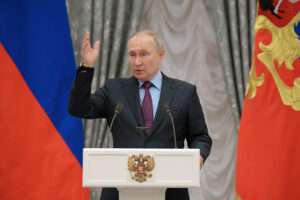
Russian leader Vladimir Putin. (Newscom)


President Biden is among the many Western leaders who have denounced Vladimir Putin as a war criminal because of the atrocities Russian forces have committed in their war of aggression against Ukraine. There is good reason for that condemnation. Putin and other Russian leaders are clearly guilty of horrific war crimes, on a massive scale. But it is also true that it's likely to be difficult or impossible to prosecute them, barring a regime change in Russia. War crimes proceedings might still have some real, but limited value, however.

Proof of war crimes is overwhelming. In addition to the murder of civilians, mass deportations, and rampant pillaging committed by Russian troops, there is the fundamental fact that Putin's decision to launch the war in the first place was a crime of enormous proportions. I summarized the reasons why on the day before the invasion began:

The law is simple. There are few, if any, more fundamental violations of international law than seizing other nations' territory by force for the purpose of annexing it or ruling through a puppet regime. The United Nations Charter specifically forbids "the threat or use of force against the territorial integrity or political independence of any State." That description fits Russia's assault on Ukraine to a T.

The charge of waging wars of aggression was also one of the main accusations brought against the Nazi defendants in the Nuremberg trials; the Nuremberg tribunal ruled that starting a war of aggression is "the supreme international crime." Putin's rationales for seizing Crimea in 2014 and later the Donbass region of Eastern Ukraine are very similar to those Hitler offered for his attacks on Poland and Czechoslovakia: the supposed need to protect co-ethnic populations facing largely trumped-up threats (ethnic German minorities in Poland and the Sudetenland in Hitler's case; Russian-speaking populations in Ukraine in Putin's case)…

If Putin now tries to take more of Ukraine, it will just be an expansion of his government's already grossly illegal aggression. The  best historical analogy would be Hitler's shift from taking the Sudetenland (the part of Czechoslovakia with a large German population) in 1938 to occupying all of Czechoslovakia in 1939.

Later in the same post, I also explained why Russia's aggression cannot be defended on moral grounds that could potentially justify engaging in illegal action.

Several Nuremberg defendants got the death penalty at least in part because of their role in planning and executing wars of aggression. Putin and his high-level collaborators are  guilty of the same type of crime. I do not claim that Putin and his minions are as bad as the Nazis  overall. So far, at least, they have not committed genocide and mass murder on anything like the same scale. But they are comparable when it comes to the crime of initiating a war of aggression, one that has no remotely plausible legal or moral justification.

If you reject the death penalty on principle, you at least have good reason for concluding that Putin and other high-ranking Russian officials responsible for the war deserve whatever you think is the most severe permissible punishment. Perhaps life imprisonment without parole, for example.

Some of the atrocities committed by Russian forces in Ukraine may be the rogue actions of ill-disciplined units acting on their own. But others - especially the mass executions and deportations of civilians - are systematic enough that they are likely the result of orders from on high, probably all the way from the Kremlin. Forcible displacement of civilians - the most clearly centralized Russian atrocity - is a war crime under a range of different international laws.

Even when it comes to crimes committed by soldiers acting on their own, high-level commanders may be responsible if they failed to take proper action to curb them. As the US Supreme Court ruled in the 1946 case of In re Yamashita (reviewing the trial of a Japanese World War II general whose men had committed horrific atrocities against Filipino civilians), a military commander has "a duty to take such appropriate measures as are within his power to control the troops under his command for the prevention of the specified acts which are violations of the law of war and which are likely to attend the occupation of hostile territory by an uncontrolled soldiery." If a commander fails to take such appropriate measures,"he may be charged with personal responsibility for his failure to take such measures when violations result."

The court cited various provisions of the Hague Conventions and the Geneva Convention as justification for its ruling. Russia, of course, is a signatory to these agreements. It seems pretty obvious that Putin and other Russian commanders have done little, if anything, to prevent atrocities by their forces. They are therefore likely guilty on the same basis as General Yamashita was convicted.

Admittedly, not everyone agrees that the conviction of Yamashita was just. Supreme Court Justice Robert Murphy wrote a forceful dissent arguing that he was denied proper due process. Some also argue that Yamashita was not really in a position to prevent the atrocities his troops committed.  But few doubt the basic principle that high-level commanders have at least some duty to prevent war crimes by their men.

Despite the strong - and growing - evidence against Putin and other Russian leaders, the odds against trying and convicting them for war crimes are long. So long as Putin and his minions remain in power, any such trial and punishment will be virtually impossible. For obvious reasons, Putin will never agree to such a thing.

But there is still value to pursuing the war crimes issue, including by investigating offenses and laying the groundwork for potential indictments and trials. First, there is some chance, even if small, that Putin will lose power if the war goes badly enough for him. History - including Russian history - has plenty of examples of despots who lost their grip on power after defeat in war.

Second, even if it turns out to be impossible to try and punish Putin, the same may not be true of other Russian officials and military personnel. Ukraine has taken many Russian prisoners, and some of them may be perpetrators of war crimes. Other Russian officials and military officers could potentially be arrested and detained if they travel beyond Russia's borders in the future. For that very reason, they might choose to avoid such travel. But that denial itself functions as a modest (though far from properly proportional) form of retribution.

Finally, emphasis on the war crimes issue can help maintain opposition to Putin's war in the West, and continue to mobilize international opinion against it. The criminal nature of the enterprise is one of the reasons (though certainly not the only reason) why the war has drawn so much international opposition, and turned Russia into a near-pariah state.

None of these admittedly modest gains will be anywhere near as satisfying as a Nuremberg-style tribunal in which Putin and other high-ranking Russian officials get tried, convicted, and punished. Sadly, such proceedings are usually only possible if the regime in question is overthrown. But we should not let the best be the enemy of the good - even the modestly good.

More