The Volokh Conspiracy

Mostly law professors | Sometimes contrarian | Often libertarian | Always independent | Est. 2002

The Volokh Conspiracy

Free Speech

Law Requiring Sex Offenders to Report All New Online IDs to Government May Well Violate First Amendment

So holds a federal appellate court.

|

From today's Second Circuit opinion in Cornelio v. Connecticut, written by Judge Steven Menashi and joined by Judge Dennis Jacobs and District Judge John Cronan:

[Connecticut law requires that] a registered sex offender must notify the DESPP when he creates a new email address, instant messenger address, or other internet communication identifier…. Assuming intermediate scrutiny is the appropriate standard of review, we conclude that the disclosure requirement plausibly fails intermediate scrutiny and therefore Cornelio has stated a First Amendment claim….

[T]he disclosure requirement burdens protected speech and therefore triggers heightened scrutiny….

First, the disclosure requirement burdens a registrant's "ability and willingness to speak on the Internet." The disclosure requirement obliges a registrant to notify the DESPP each time he creates a new "electronic mail address, instant message address or other similar Internet communication identifier." … In addition to the administrative burden that [this] imposes on online communications, any error in compliance can result in a class D felony punishable by up to five years in prison and a $5,000 fine. In this way, the disclosure requirement plausibly deters registrants from engaging in protected online speech.

Read More

Religion and the Law

Courts Struggle to Articulate the Limits of Church Autonomy

They know there are limits—but what are they?

|

This continues a blog series about my new paper, "The Limits of Church Autonomy." My first post (here) introduces the idea of church autonomy. At a high level of generality, church autonomy principles are well settled in the caselaw. And for a core of church autonomy issues (such as the "ministerial exception" cases regarding the employment of ministers), the structure of analysis is increasingly sophisticated.

But there remain a considerable array of issues that are unsettled and hotly debated. The one I want to focus on here is the search for subject matter limits on church autonomy. Courts recognize the value of church autonomy protections for religious institutions but also recognize that not everything done by or within a religious institution can be protected. Yet courts so far have struggled to articulate the limits of church autonomy.

Church autonomy usually functions as a defense to legal claims asserted against religious institutions. The courts widely share a sensible intuition that crimes and some subset of torts are not generally subject to a church-autonomy defense. As the Second Circuit put it, "The minister struck on the head by a falling gargoyle as he is about to enter the church may have an actionable claim"—that is, a claim not subject to church-autonomy defenses. But at the same time, the courts agree that there is a set of torts—notably defamation—that can be defeated by a church autonomy defense. The courts have yet to supply a clear dividing line between those tort (and tort-like) matters that are covered by church autonomy and those that are not.

Read More

Free Speech

California Bill Aimed at Gun Advertising That Supposedly Targets Children

|

The bill, AB 2571, is discussed here; the discussion is of a proposed narrower version of the bill (the official, broader, draft is here). I just testified this morning against the bill; I was limited to two minutes, so the oral testimony had to hit just the main points (I expect to put together some more detailed written testimony later):

I think even the bill as proposed to be amended would be unconstitutional, for three reasons.

[1.] It would cover fully protected political speech, not just commercial advertising. A gun magazine publisher, for instance—or a gun advocacy group that publishes a magazine—would likely be covered as a "firearm industry member," because it was formed to advocate for use or ownership of guns, might endorse specific products in product reviews, and might carry advertising for guns. That publisher or advocacy group would be forbidden from using cartoon characters even in its fully protected political advertising urging gun ownership.

[2.] Even as to commercial advertising, the law is unconstitutionally vague: It covers any ads that are "attractive to minors," even if they are equally attractive to legal adult buyers. And the specific examples don't resolve the vagueness problem: They are only listed as examples, prefixed with the phrase "including, but not limited to."

[3.] And the law also covers constitutionally protected commercial advertising, such as the use of caricatures of minors or cartoon characters in ads that are clearly targeted at adults who lawfully buy guns that their children could use for legal hunting or target shooting. Indeed, California law expressly allows parents to have their children use guns this way under parental supervision. Parents may well wish to buy guns for their children to use for these purposes.

Here are the relevant excerpts from the proposal:

Read More

Free Speech

Public Records Law vs. First Amendment Rights of University Animal Experiment Review Committee

|

From a preliminary injunction decision by Judge Richard Jones (W.D. Wash.) in Sullivan v. Univ. of Washington (with PETA as intervenors; earlier coverage here):

The Institutional Animal Care and Use Committee ("IACUC") at the University of Washington monitors animal research conducted at the university. The committee "approves and monitors all proposed projects that include vertebrates or cephalopods" to "ensur[e] that animals receive the care, treatment and respect they deserve as critical components of biomedical research to find cures for diseases and conditions that afflict both humans and animals."

The IACUC hosts monthly public meetings, where members of the public may speak. Some members of the public hope to end the University of Washington's animal research outright. Their comments vary, from referring to researchers as "sadistic" to comparing the university and IACUC to Auschwitz and Nazis. On other occasions, "individuals associated with animal research" at the university have even received "harassing emails, letters and voice messages, some including threatening language." See also Dkt. # 4 ¶¶ 6-7 (picketing outside of researcher's private home, kidnapping of pets), Dkt. # 5 ¶¶ 7-8 (calling animal researchers "vile [expletive] humans" and saying "I'm going to do what is necessary to stop animal research").

Given the hostility, IACUC members are anonymous, currently "identified only by initials online and in [the committee's] publicly posted meeting minutes." Yet opponents of animal research seek to obtain certain documents from the university that would end that anonymity.

People for the Ethical Treatment of Animals ("PETA") is an organization that seeks to "expos[e] the cruelty of animal tests" to "ensure their imminent end." On June 24, 2021, a PETA representative made a request for public records under Washington's Public Records Act. Specifically, the representative requested the "appointment letters" of IACUC members for the period from January 1, 2014 to the present. Those letters contain personal identifying information of the committee members: names, email addresses, titles, department affiliations, and more….

Read More

Religion and the Law

What Is Church Autonomy?

A primer on a religious liberty issue that went from a backwater to a hot topic in the last decade.

|

Thanks to Eugene and coconspirators for having me here this week writing about my recent work on church autonomy law. I have a new paper (forthcoming in the Notre Dame Law Review) about the limits of the church autonomy doctrine—responding, in part, to areas of confusion that have arisen in lower courts applying church autonomy doctrine. I'll use some future blog posts this week to get into those issues. Before getting into that, I want to step back to reflect on what's going on in the field of "church autonomy doctrine" and how this issue has risen in significance in the last decade.

The "church autonomy doctrine" is a legal principle of protection for the internal self-governance of religious organizations. (You can find a longer version of this explanation, with more citations, in the law review article.) Church autonomy doctrine protects religious institutions from state control, ensuring that religious organizations can control their own beliefs and internal affairs, or ensuring that the state does not establish a religion. The basics are fairly intuitive: Americans don't want the state telling religious bodies whom it can or can't retain as a minister, rabbi, or imam, or endorsing the theological distinctives of one side of a church split when the competing factions disagree about what counts as the "true" form of a given faith.

The church autonomy doctrine applies to all religious institutions, not just churches. While it could be termed "religious autonomy" (or more precisely, autonomy for religious institutions), "church autonomy" remains the most used term in the courts for the body of law that has developed about the internal affairs of religious organizations.

Read More

Free Speech

Virginia S. Ct. Declines to Unseal Allegations of Misconduct Against a Virginia Judge

The allegations had been filed in an appendix to a petition the judge filed in the state supreme court, challenging her suspension by the state Judicial Inquiry and Review Commission; but the court concludes they are nonetheless not records open to the public.

|

Some backstory, from WRIC (ABC-8) (Dean Mirshahi):

Judge Adrianne Bennett, the former chairwoman of Virginia's Parole Board, was suspended from the bench last year amid an intensifying scandal over the board's handling of certain cases.

Bennett left the board to become a Virginia Beach Juvenile and Domestic Relations District Court judge, but she was indefinitely suspended by a panel tasked with investigating claims of judicial misconduct nearly a year to the day after she was sworn in….

She was suspended … on April 13, 2021, … but is listed as a Virginia Beach Juvenile and Domestic Relations District Court presiding judge on the court's website.

From Thursday's Virginia Supreme Court decision in In re Bennett (a per curiam endorsed by Chief Justice Bernard Goodwyn, Justices Cleo Powell and Stephen McCullough, and Senior Justice LeRoy Millette):

On May 20, 2021, Judge Adrianne L. Bennett petitioned this Court under its original jurisdiction for writs of mandamus and prohibition in connection with a matter that was then pending before the Judicial Inquiry and Review Commission (JIRC). We denied the petition one day later, and ordered the record of the case sealed, including the order disposing of Judge Bennett's petition and sealing the proceedings. On July 8, 2021, Lee BHM Corporation, publisher of the Richmond-Times Dispatch ("the Publisher"), filed a "Petition for Leave to Intervene and Motion to Vacate Order Sealing a Sealing Order." …

[T]he same qualified right of access to proceedings and records that the [U.S. Supreme] Court has recognized in criminal cases should also be recognized in "civil trials and to their related proceedings and records." …

The present case was unprecedented because it concerned a request for judicial relief against a proceeding that is statutorily protected from disclosure to the public. Thus, the request to seal the proceedings in our Court was also unprecedented. Our review of the records prompts us to revisit our order sealing the records of the mandamus proceeding and to exercise our authority to unseal this order as requested by the Publisher. Orders from this Court have long been accessible to the public. In addition, in the interest of openness and transparency, we further unseal the remainder of the case sua sponte, with the exception of attachments to the petition for a writ of mandamus. Mandamus proceedings have a long tradition of openness. We see no reason to seal the petition and other pleadings.

We reach a different conclusion with respect to the attachments filed with the mandamus petition. Those attachments are records of a then pending proceeding before the Judicial Inquiry and Review Commission. By law, records of proceedings before the Commission are kept confidential. The statute begins with the command that "[a]ll papers filed with and proceedings before the Commission … shall be confidential and shall not be divulged." The statute contains some limited exceptions to this mandate of confidentiality, but none apply here…. The General Assembly, as the policymaking branch of our government, has determined that such records should be kept confidential.

Read More

Ross Ulbricht

Why does Google hate mothers?

Episode 404 of the Cyberlaw Podcast

|

This week in Silicon Valley bias: Google is planning to tell enterprise users of its word processor that words like "motherboard" and "landlord" are insufficiently inclusive for use in polite company. We won't actually be forbidden to use those words. Yet. Though that future has apparently already arrived in Mountain View, where at least one source says that "mainboard" is the only acceptable term for the electronics that used to honor the women who raised us. In another blow for freedom, as it's now defined in the Valley, Twitter will suppress all climate ads that contradict the views a panel of government-appointed scientist-politicos. Apparently suppressing talk that contradicted CDC scientist-politicians worked so well that Twitter is rushing to double down, presumably under the slogan, "You'll pry these red pencils from our cold, dead fingers, Elon!"

In other cyber news, Megan Stifel sums up the last week of cyberwar news: It was a lot like the week before. We're still waiting – nervously -- for Russian hackers to lift their eyes from the near target in Ukraine and focus on far targets in the West. The Five Eyes security agencies are doing their best to make sure US critical infrastructure is ready. Well, except for US cloud providers, who were exempted from the definition of really critical infrastructure in the Obama administration and successfully fought off any change in their status for the better part of a decade. Sultan Meghji and I support Congressional efforts to recognize the criticality of securing cloud providers, but it is a heavy lift, especially among Republicans.

Is DJI sabotaging Ukraine's drone fleet, presumably at China's behest? The evidence is hardly airtight, but Ukraine is understandably not taking any chances, as it moves to more expensive drones sourced from the U.S. and elsewhere. Jamil Jaffer delivers a heartfelt plea to American hobbyists to do the same.

A group of former security officials are warning that pending antitrust bills could cause national security problems by handing advantages to Chinese tech companies. POLITICO responds with a hit piece claiming (with evidence ranging from plausible to laughable) that they are influenced by their ties to Silicon Valley. I'm pretty cynical about Silicon Valley's effort to hide behind the national security interests they've mostly dismissed for the last decade, but I end up agreeing with Jamil that the antitrust bills should be amended to allow national security to moderate the trustbusters' zeal. 

Sultan and I review some of the week's stories about Artificial Intelligence (AI). We complain that a promising War on the Rocks piece about China's Plans for AI and Cognitive Warfare failed to deliver the goods. We were intrigued by a new way of imperceptibly hacking AI by corrupting its datasets. And we were interested in the story but put off by the dime-store Marxism in an MIT Technology Review story that explains how AI dataset labeling is providing a bare living for dispossessed Venezuelans.

Has Steve Ballmer been sneaking onto Microsoft's Redmond campus and whispering dreams of world domination and ruthless tactics into Satya Nadella's ear? Sultan and I think that may be the most plausible explanation for Microsoft's greedy and boneheaded demand that the federal government pay extra for a crucial security feature. 

Finally, in short hits:

Download the 404th Episode (mp3) 

You can subscribe to The Cyberlaw Podcast using iTunes, Google Play, Spotify, Pocket Casts, or our RSS feed. As always, The Cyberlaw Podcast is open to feedback. Be sure to engage with @stewartbaker on Twitter. Send your questions, comments, and suggestions for topics or interviewees to CyberlawPodcast@steptoe.com. Remember: If your suggested guest appears on the show, we will send you a highly coveted Cyberlaw Podcast mug!

The views expressed in this podcast are those of the speakers and do not reflect the opinions of their institutions, clients, friends, families, or pets.

4/26 edit: "ads" in place of "talk" after cite check.


Don't Push A Pencil Through Lemon, Slice It In Half!

Will the Supreme Court finally overrule the Lemon test?

|

In the five decades since Lemon v. Kurtzman, there have been more puns about lemons that I could ever count. Perhaps the best barb came in Justice Scalia's Lamb's Chapel concurrence:

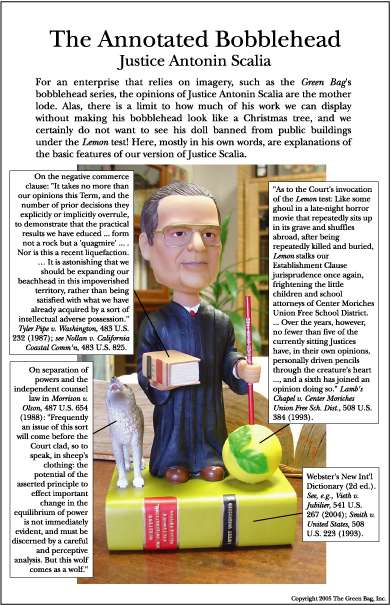
As to the Court's invocation of the Lemon test: Like some ghoul in a late night horror movie that repeatedly sits up in its grave and shuffles abroad, after being repeatedly killed and buried, Lemon stalks our Establishment Clause jurisprudence once again, frightening thelittle children and school attorneys of Center Moriches Union Free School District. Its most recent burial, only last Term, was, to be sure, not fully six feet under: our decision in Lee v. Weisman, 505 U. S. ----, ---- (1992) (slip op., at 7), conspicuously avoided using the supposed "test" but also declined the invitation to repudiate it. Over the years, however, no fewer than five of the currently sitting Justices have, in their own opinions, personally driven pencils through the creature's heart (the author of today's opinion repeatedly), and a sixth has joined an opinion doing so.

Indeed, the Justice Scalia bobblehead depicts him shoving a pencil through a lemon.

Today during oral argument in Kennedy v. Bremerton School District, Paul Clement riffed on Scalia's dissent, and improved on it! Enjoy this colloquy between Clement and Justice Kavanaugh:

JUSTICE KAVANAUGH: Okay. And then, to pick up on Justice Gorsuch, the Lemon endorsement test, that has not been applied by this Court in several decades in cases like Van Orden, Town of Greece, American Legion. At least I've said I don't think there is such a test in our case law anymore, the Lemon endorsement test, correct?

MR. CLEMENT: Sure, but it's a --it --it's a stubborn --it's a stubborn fruit, and I don't think just pushing a pencil through it has done the trick. I mean, you really have to slice it in half and make clear to everybody--

Will Justice Kavanaugh merely jab another pencil into the stubborn fruit? And Justice Barrett? Or will they slice it in half, and make lemonade out of lemons? (Hopefully the last Lemon pun I'll have to make.)

Paper Submission Opportunity on "Due Process Deficits in Regulatory Enforcement and Adjudication"

The symposium is sponsored by Pacific Legal Foundation’s Center for the Separation of Powers, The Center for Growth and Opportunity, and the George Mason University Law and Economics Center.

|

I am posting the following opportunity, which may be of interest to legal scholars, political scientists, economists, and others working on issues of due process, regulation, and administrative law:

Pacific Legal Foundation's Center for the Separation of Powers, The Center for Growth and Opportunity, and George Mason University's Law & Economics Center seek papers for a research roundtable on due process deficits in regulatory agencies' enforcement and adjudication practices, to be held in October 2022, at the Scalia Law School.

A constellation of distinct but interrelated due process deficits has arisen as the regulatory state has grown larger and gradually supplanted courts' traditional role in resolving disputes. Among the most important of these deficits are lack of notice to affected persons, delay or denial of access to court, lack of impartial adjudicators, agency failure to respond promptly to allegations of wrongdoing, disproportionate and unfair penalties, and lack of democratic accountability. Many regulatory agencies employ practices that skirt the most basic due process protections. These deficits not only have adverse legal effects and raise serious Rule of Law concerns, they also often bring significant economic concerns from lack of predictability, inefficiencies associated with underinformed regulators, and inadequately reasoned or arbitrarily identified compliance costs.

Research Roundtable

Completed paper drafts are due by October 1, 2022, but need not be in polished or publishable form. Authors will present their papers at a research roundtable co-hosted by PLF, CGO, and LEC. Each paper author will be expected to formally comment on others' papers, and a set of separate expert commentators will also be present at the research roundtable to provide critical feedback on the drafts. The roundtable is tentatively scheduled for October 28, 2022, in Arlington, Virginia, at the Antonin Scalia Law School at George Mason University and will provide authors the opportunity to get feedback from other legal and academic experts. We will cover the cost of hotel accommodation and reasonable travel expenses to the roundtable.

Authors of winning proposals/papers will get a $2500 honorarium.

For more details about the symposium and the submission process, see here and here. Proposals should be submitted by May 1, as described more fully here. Proposals submitted after that day may be considered, if there is still space available.

NOTE: I am a law professor at George Mason University, and my wife Alison works for the Pacific Legal Foundation and is one of the organizers of this event. Thus, I have obvious connections to the organizations running the symposium. But I do not have any involvement in selecting the paper proposals for it. So please don't send your submissions to me. Instead, submit as indicated at the site linked above.

2nd Amendment

My Washington Post Article on Gun Rights and Property Rights

It explains why laws requiring private property owners to allow guns on their land are an affront to property rights, and violate the Takings Clause of the Fifth Amendment.

|

Illustration: Lex Villena; Patryk Kosmider

Earlier today, the Washington Post published my article on "'Gun-at-Work Laws' Violate the Property Rights of Business Owners." Here is an excerpt:

Iowa is the latest state to consider prohibiting private property owners from banning guns on land they own. Sometimes called "parking-lot laws" or "gun-at-work laws," many such statutes tell property owners they can't prevent people from storing their guns in a locked car while they work their shift (or attend church or seek help at a nonprofit counseling center). In some cases, the laws allow them to bring the guns inside. Iowa would become the 25th state with such a law….

These laws do not defend constitutional rights. I support strong Second Amendment rights to keep and bear arms, but the amendment constrains only the government. It does not require private individuals to own guns or allow them on their land — just as the First Amendment does not require private owners to allow speech they disapprove of on their property. To mandate that Americans accept guns on their property represents an unacceptable infringement of their property rights, and also violates the Fifth Amendment of the Constitution….

Scholars and courts have long recognized that the right to exclude people and objects of which they disapprove is a central element of property owners' rights. Indeed, the Supreme Court recently reaffirmed, in a decision that forbade California from giving union organizers a "right to take access" to an agricultural employer's property — three hours a day, 120 days a year — that "[t]he right to exclude is "one of the most treasured" rights of property ownership." True originalist constitutionalism would embrace a strong view of Second Amendment rights while also defending the rights of business owners to keep guns off their property, if they so choose….

In addition to undermining property rights, many mandatory gun-access laws may also violate the Takings Clause of the Fifth Amendment. That argument leans on last year's 6-3 ruling in Cedar Point Nursery v. Hassid — the one that concluded California could not let union organizers have temporary access to agricultural businesses…

in Cedar Point, the court held that "a physical appropriation is a taking whether it is permanent or temporary." As Duke Law School professor Joseph Blocher has pointed out, in the case of gun-at-work laws — like union-organizer regulation — the government requires property owners to accept occupation of their land by people (armed gun owners) the owners would prefer to keep out…

Sadly, the imposition of mandatory gun-access laws on property owners is part of a more general recent turn against private property rights by many conservatives. Consider, for instance, the widespread right-wing support for the use of eminent domain to build President Donald Trump's border wall, advocacy of laws forcing social media firms to host speech they object to, and legislation barring private owners from imposing coronavirus vaccination requirements as a condition of entry on their land….

The left, of course, has its own long-standing dubious anti-property tendencies. Among other things, many support "NIMBY" zoning restrictions and harmful uses of eminent domain. But that in no way excuses the growing bad behavior of the right.

The article is in part adapted from an earlier, longer essay I wrote on this issue for the Duke University Center for Firearms Law.

Free Speech

Prof. Michael Dorf (Cornell) on Florida's Repeal of Disney's Special Government District

|

I put up some tentative thoughts on the subject Friday, and Prof. Dorf (DorfOnLaw) did as well today. He leans in favor of concluding that the repeal is unconstitutional (because it is in retaliation for Disney's political activity), but agrees that this is a difficult question. If you're interested in the controversy, you should definitely check out Prof. Dorf's post; here's an excerpt, responding to my argument that the retaliation here is not just against Disney as corporation, but as Disney operating a local government:

[I]n some respects Disney is a local government. So let's try to construct an analogy that's a bit different from the ones Professor Volokh gives—in which government officials lose their special privileges (like a member of Congress losing the chairmanship of a committee) in response to political statements or actions out of step with leadership.

Read More

Free Speech

Pseudonymous Lawsuit by Police Officer Over His Placement on "Exculpatory Evidence List"

|

I filed a motion to unseal and oppose pseudonymity last week in Doe v. Town of Lisbon (thanks to my students Ireland Larsen, Matthew Veldman, Erin Yonchak for their work on it), and I thought readers might find it interesting. The backstory, from a 2020 N.H. Supreme Court decision (see also this February post):

The [New Hampshire] DOJ currently maintains a list of police officers who have engaged in misconduct reflecting negatively on their credibility or trustworthiness. The list, formerly known as the "Laurie List," is now called the EES [Exculpatory Evidence Schedule]. See State v. Laurie (N.H. 1995) (overturning a defendant's murder conviction because the State failed to disclose certain employment records of a testifying detective that "reflect[ed] negatively on the detective's character and credibility").

The EES list is public, and is also used by defense lawyers to challenge the officers' credibility on the stand, which I take it makes the officers on the list far less employable. Police officers or ex-police-officers therefore often sue to have their name removed from the EES, and state trial courts have allowed such lawsuits to proceed under seal. (I doubt that's permissible, but that's a separate matter.) In this case, the plaintiff police officer included federal constitutional claims as well as state law claims in his filing, so the Town of Lisbon removed the case to federal court, where it's now proceeding pseudonymously instead of under seal. Here is the rationale for sealing from Doe's motion to seal in state court, which I expect will be the argument he will for pseudonymity as well:

The Plaintiff is concerned that publicly having his name as plaintiff will undercut any relief obtained in this matter, and will further jeopardize his ability to obtain future employment in the criminal justice and policing field—even if he is fully vindicated in this matter….

The plaintiffs' interest in having this lawsuit be filed under seal, while his Constitutional rights are vindicated, is a compelling interest that outweighs the right of the public's right of access to this litigation's docket.

In the motion—which is in some ways similar to that in the Ohio Supreme Court police officer pseudonymous libel lawsuit case, Olthaus [M.R.] v. Niesen—I argue that plaintiff shouldn't be allowed to proceed pseudonymously, and I also ask the court to unseal the unredacted version of the state court record (the redactions basically being the plaintiff's name, so that's connected to the pseudonymity):

Read More

Academic Freedom

Academic Freedom Alliance Letter to St. Olaf College

Religion and philosophy professor removed from directing a scholarly center for inviting Peter Singer to give a public lecture.

|

The Academic Freedom Alliance released a public letter to St. Olaf College  calling on the college to reaffirm the academic freedom of religion and philosophy professor Edmund Santurri.

Santurri has long served as the director of the Institute for Freedom and Community at St. Olaf. The Institute encourages inquiry and debate into contemporary political and social issues and seeks to present "diverse ideas" to the campus community on controversial issues relating to politics, markets, and society. As part of its programming, the Institute sponsors public lectures, and in recent years it has hosted lectures by a range of speakers, including David Brooks, Glenn Loury, Alice Dreger, Michael Sandel, Bari Weiss, and Bryan Caplan. Unsurprisingly, such speakers discussing such topics sometimes generate controversy on college campuses, and controversies have sometimes swirled around the Institute.

In the spring of 2022, such a controversy took a troubling turn. The Institute invited Princeton philosopher Peter Singer to give a public lecture on his views regarding contemporary moral philosophy. Singer is a controversial figure, and some students launched a petition calling for a boycott of his talk at St. Olaf. Several offices on campus set out emails to students distancing themselves from Singer's views, but the talk took place without disruption or cancellation.

Nonetheless, in apparent response to the Singer invitation, the president of St. Olaf College suddenly removed Santurri from his position as director of the Institute. Santurri had just recently been reappointed as director, and was in the middle of a two-year term in the position. His appointment as director included salary support and a teaching reduction.

The president of St. Olaf College has sent a very clear message to its faculty that there are limits on free inquiry on that college's campus and that the College will not tolerate speakers whose ideas are offensive to influential campus stakeholders. Like other college presidents, the president at St. Olaf has recognized that he can avoid disinvitation controversies if he simply prevents invitations from being sent to heterodox speakers in the first place. Professors who do not toe the party line will not be allowed to be in a position to invite speakers to campus. When the leading moral philosophers of the world are not welcome on your campus, you have an intellectual freedom problem.

From the AFA letter:

I write on behalf of the Academic Freedom Alliance to protest his premature removal from the directorship of the Institute. No member of the faculty is entitled to hold such an administrative position, but it is a grievous assault on the intellectual climate of the college for the director of a scholarly center to be precipitously dismissed from his post because the intellectual activities of the center offend members of the campus community.

. . . . Far from advancing the mission of the Institute, this decision to rescind Professor Santurri's appointment instead turns its back on that mission and announces that the Institute will not be allowed to expose students and faculty to a diverse range of ideas about politics and society but will instead be sharply constrained so that it does not challenge campus orthodoxies.

Read the whole thing here.

Religion and the Law

Fraud Prosecution for Specific False Statements About Meat Claimed to Be Halal Allowed,

though laws generally banning mislabeling food as “halal” (or “kosher”) violate the Establishment Clause.

|

I just came across this interesting (and, I think, correct) 2015 decision by Chief Judge Linda Reade (N.D. Iowa) in U.S. v. Aossey:

On December 5, 2014, a grand jury returned a 92 count Indictment (docket no. 6) charging Defendants with [among other things] … making false statements on export certificates … [and] wire fraud ….

Defendants argue that "the government's attempt to mandate truthful statements in foreign export documents regarding Halal slaughter is prohibited by the Establishment Clause." …

In Commack Self–Service Kosher Meats, Inc. v. Weiss (2d Cir. 2002), the Second Circuit found that the kosher fraud statutes violated the Establishment Clause because they had a primary effect of advancing and inhibiting religion and created an excessive government entanglement with religion. The New York statutes "define[d] 'kosher' as 'prepared in accordance with orthodox Hebrew religious requirements,' mandate[d] adherence to those requirements, or [were] integral to the State's enforcement of such requirements." The Second Circuit held that the statutes required the government to "interpret 'kosher' as synonymous with the views of one branch, those of Orthodox Judaism" and, as a result, "the State has effectively aligned itself with one side of an internal debate within Judaism." The Second Circuit concluded that such statutes "excessively entangle the State of New York and religion, and therefore run afoul of the Establishment Clause." …

Read More

Free Speech

Viewpoint-Based Enforcement of "No Advertising Policy" as to Public Comments Likely Violates First Amendment

"As Plaintiffs point out, both Black Voices Matter and Francis Howell Families are organizations with viewpoints on board actions, and both organizations call for policy changes, but Defendants only ban references to Francis Howell Families during the patron comment period."

|

From Judge Stephen Clark (E.D. Mo.) in Brooks v. Francis Howell School Dist., decided Thursday; seems correct to me:

Through a political action committee, Plaintiffs frequently oppose the actions of their local, elected school board, particularly on issues of curriculum. While speaking during the public-comment portion of board meetings, Plaintiffs mention the PAC—Francis Howell Families—and point the board to the trove of detailed information on the PAC's website, www.francishowellfamilies.org.

Invoking its no-advertising policy, the board has banned Plaintiffs from mentioning at board meetings "Francis Howell Families" or its website, telling them they "will be immediately stopped," cutting the microphone while one Plaintiff spoke, and threatening to permanently ban them from speaking at meetings. Insofar as the board allows other organizations, which support the board, freer reign at meetings, Plaintiffs challenge the board's actions as viewpoint discrimination….

Read More

More