
Thursday Open Thread
What's on your mind?

Mostly law professors | Sometimes contrarian | Often libertarian | Always independent | Est. 2002
What's on your mind?
As I suggested Friday and yesterday, Supreme Court precedent is unclear on whether Florida's dissolving the special government district that Florida had created for Disney in the 1960s violates the First Amendment. On one hand, the dissolution appears to be retaliation for Disney's prominent opposition to the Florida law that restricts "classroom instruction by school personnel or third parties on sexual orientation or gender identity … in kindergarten through grade 3 or in a manner that is not age appropriate or developmentally appropriate for students in accordance with state standards"; government retaliation for a person's or corporation's speech is often unconstitutional. On the other hand, the dissolution is the withdrawal of specially legislatively granted governmental power, not a generally available benefit or contracting opportunity, and that may well be constitutional.
Lawyer Adam Schulman, however, points out that the precedent in the Eleventh Circuit—the federal appellate court in charge of, among other things, Florida cases—is very much against any First Amendment challenge.
In 2011, the Alabama Legislature barred payroll deductions "of any contribution to an organization that uses any portion of those contributions for political activity." A union (the Alabama Education Association) sued, claiming the statute violated the First Amendment "the subjective motivations of the lawmakers in passing the Act were to retaliate against AEA for its political speech on education policy. No, said the court in In re Hubbard (11th Cir. 2015):
[A]s a matter of law, the First Amendment does not support the kind of claim AEA makes here: a challenge to an otherwise constitutional statute based on the subjective motivations of the lawmakers who passed it.
Regulation, Rights, and Policy
If you are interested in arms law, you might enjoy the new textbook Firearms Law and the Second Amendment: Regulation, Rights, and Policy. The third edition, from Aspen Publishing, came out several months ago. It is coauthored by Nicholas J. Johnson (Fordham), George A. Mocsary (Wyoming), E. Gregory Wallace (Campbell), Donald Kilmer (Lincoln), and me (Denver).
Our inspiration for the textbook, whose first edition appeared in 2012, was Rutgers law professor Ruth Bader Ginsburg and her textbook Constitutional Aspects of Sex Discrimination. What law students learn depends on what professors can teach. Teaching depends on what textbooks exist. Although some professors do collect or write their own materials for class, most of what gets taught in law school is from textbooks. Only if a textbook on women's rights existed could women's rights be broadly studied in law school.
By 1971 there were professors who were interested in women's rights but were far from expert on the subject. They could teach it only if someone else wrote a textbook. They had neither the time nor inclination to determine which cases and materials were most important, collect and edit them, and then organize them into an orderly narrative. So Ginsburg did it all for them. She also provided her own analysis.
Now, the same process is happening for the Second Amendment. Since 2012, Firearms Law has been spurring the creation of Second Amendment classes at law schools; every year more law students learn how to incorporate the right to keep and bear arms into their legal practice. Some of those students will become criminal defense lawyers and others prosecutors. Some will become business and regulation lawyers who represent retailers or manufacturers, and others will work for regulatory agencies. More than a few will eventually become lawmakers, judges, or other leading government officers. Unlike in past generations, the new generation of lawyers includes members who are already well-educated about the right to keep and bear arms and gun control laws.
Six decades ago, a young Stephen Breyer clerked for Justice Goldberg on a very, very different Supreme Court.
Today the Supreme Court decided Cummings v. Premier Rehab Keller. The case concerned whether damages for emotional distress are available in suits brought under the Rehabilitation Act. The Court split 6-3. The majority, per Chief Justice Roberts, says no. The dissent, per Justice Breyer, says yes. I don't have much to say about the specific nuances of contract law. But I did chuckle when Justice Breyer included a very personal citation:
As a Member of this Court noted in respect to the CivilRights Act of 1964, Congress' antidiscrimination laws seek "the vindication of human dignity and not mere economics." Heart of Atlanta Motel, Inc. v. United States, 379 U. S. 241, 291 (1964) (Goldberg, J., concurring). Quoting the Senate Commerce Committee, Justice Goldberg observed:
"'Discrimination is not simply dollars and cents, hamburgers and movies; it is the humiliation, frustration, and embarrassment that a person must surely feel when he is told that he is unacceptable as a member of the public because of his race or color. It is equally the inability to explain to a child that regardless of education, civility, courtesy, and morality he will be denied the right to enjoy equal treatment, even though he be a citizen of the United States and may well be called upon to lay down his life to assure this Nation continues.'" Id., at 292 (quoting S. Rep. No. 872, 88th Cong., 2d Sess., 16 (1964)).
It is difficult to believe that prospective funding recipients would be unaware that intentional discrimination based on race, sex, age, or disability is particularly likely to cause emotional suffering.
Heart of Atlanta Motel was decided during the October 1964 Term. And, during that time, a young Stephen Breyer clerked for Justice Arthur Goldberg. I think it safe to say that Breyer worked on that landmark decision. There were only two law clerks for each Justice at the time, and the case was decided two months after it was argued. It is remarkable how much the Court has changed in the six decades since Breyer clerked. I doubt Heart of Atlanta would be unanimous today. And we should never lose sight of the fact that Breyer later took Goldberg's seat. And Breyer's clerk, KBJ, will take his seat.
Speaking of which, yesterday Chief Justice Roberts gave an emotional farewell to Justice Breyer. (C-SPAN has the recording.) Roberts began:
As many of you may know, Justice Breyer has announced his retirement from the Court effective when we rise for the summer recess. That means that the oral argument we concluded will be the last we hear with Justice Breyer on the bench.
Ehh… Not only is John Roberts content to rewrite the acts of Congress. Now he is taking it upon himself to rewrite the handiwork by members of the Judiciary! Justice Breyer did not announce his retirement when the Court rises for the recess. His statement was premised on several nested conditionals:
"I intend this decision to take effect when the Court rises for the summer recess this year (typically late June or early July) assuming that by then my successor has been nominated and confirmed.
Perhaps Roberts is taking the OLC view that since Judge Jackson was confirmed to fill a vacancy that does not yet exist, and was commissioned, Breyer is now deemed to have retired. Or something to that effect. In any event, I think now Breyer is more or less stuck with stepping down, given the Chief's poignant farewell. Unless Breyer pulls a Tom Brady!
In Houston, about 5% of passengers wore masks. In DCA, about 20% are wearing masks.
Last week I was at the airport, and in the air, when the mask mandate was vacated and lifted. On Sunday, I took a flight from Houston. By my count, about 5% of the passengers in the terminal were wearing masks. On Tuesday, I flew back home from Washington National. By my count, about 20% of the passengers are wearing masks. Virtually all of the pilots and flight attendants were unmasked. The only people consistently masked were airport employees.
At this point, in the absence of a mandate, passengers wearing masks are doing so by choice. Yet, most of those masking up were wearing cloth masks. We have known since at least January that cloth masks are relatively ineffective against Omicron. They provide minimal filtering of the air you breath in, and because of the loose fit, are poor at blocking whatever you exhale. Moreover, people do not keep their cloth masks free from moisture, further decreasing their usefulness. Paper masks are marginally better, since they are disposable. But again provide minimal filtering, and often have poor fits. Starting in January, I had switched to wearing N95 masks exclusively. If I was wearing a mask, I wanted to wear something that would actually provide protection against the new variant.
Gary Leff from View From The Wing asks why passengers are sticking with the ineffective cloth masks, even in the absence of the mandate:
What I didn't understand was that a majority of people who were wearing masks were wearing either cloth or medical masks. I understand why people don't wear masks. And I understand why people choose to wear them when they are no longer required – to protect themselves – but I do not understand the choice to wear a cloth mask, which doesn't provide that protection.
Those who are critical of the mask mandate's end point out that masks protect the people around you from you, if you're infected, and the infectious period of Covid-19 prior to showing symptoms. Cloth masks didn't help with this. Medical masks likely do little against current variants. But better masks do help.
Perhaps cost is a factor. Though I think people who can afford to fly generally are able to purchase better masks, if they so choose Discomfort may also be a factor, as N95 masks may be tougher to breathe in. (I found the N95 pouch variants yielded the least amount of fog on my glasses.) But on balance, I don't understand why passenger who voluntarily wear masks are sticking with cloth masks.
I think these same questions exist for people wearing masks in other contexts where they are not mandated: why stick with cloth masks that are not effective against Omicron?
Some doctrinal tools to appropriately limit church autonomy.
This continues a blog series about my new paper, "The Limits of Church Autonomy." You can find Post 1 here, Post 2 here, and Post 3 here.
Both church autonomy and accountability are important principles. The problem in the current law is that the courts are unclear on how to avoid allowing one to swallow up the other. This section proposes some analytical revisions that would help to clean up what has become a doctrinal mess. In terms of doctrine, the shifts suggested here are modest and can be done without any change by the Supreme Court.
Religious conduct
The starting point is that church autonomy protects religious conduct. There has been confusion about whether conduct has to be based on religious belief, or whether reasons are needed at all for church conduct to receive church autonomy protection. Particularly in the employment cases, courts (including the Supreme Court) have frequently said that there need be no showing that particular conduct is religiously motivated. But in other cases, courts have said that only when the challenged action is religious is it protected.
4/28/2015: Obergefell v. Hodges argued.
A public school banned a "homosexuality is a sin" T-shirt on the grounds that it mentions "sex."
From today's decision by Judge Waverly D. Crenshaw, Jr. (M.D. Tenn.) in B.A.P. v. Overton County Bd. of Ed.:
When B.A.P. arrived in Henson's classroom on August 25, 2020, she was wearing a shirt stating, "homosexuality is a sin - 1 Corinthians 6:9-10." This shirt "express[ed] [B.A.P.'s] political viewpoint founded upon her religious beliefs," including her belief "in the Biblical mandate to spread the Gospel of Jesus Christ."
Henson told B.A.P. to report to the principal's office, and she complied. Principal Melton read from the school handbook and told B.A.P. that her shirt violated the dress code because it was "sexually connotative." … Melton told B.A.P. that she would not be released from the office unless she changed her shirt. Melton then instructed B.A.P. to call her parents and request a change of clothing …. B.A.P.'s father, Richard Penkoski, … asked Melton for clarification on his interpretation of the dress code. Melton read from the dress code and clarified that B.A.P.'s shirt might be sexually connotative because the word "homosexuality" on her shirt included the word "sex." Melton told Penkoski that B.A.P. would be forced to go home if she did not change her shirt, and the call ended. B.A.P.'s stepmother came to the school and took her home, and B.A.P. was marked "absent" for the day. "At all material times," Melton and Henson demanded that B.A.P. not wear the shirt to school again.
Plaintiffs maintain that B.A.P.'s shirt was consistent with an established practice of openly acknowledging issues of sexuality in the classroom setting. Specifically, Henson's classroom displayed what appears to be a standard 8.5x11 piece of printer paper affixed to a cabinet near the corner bearing the colors of the rainbow and the words, "diverse, inclusive, accepting, welcoming, safe space, for everyone." Plaintiffs characterize this image as "pro-homosexual." …
From New Hampshire Judicial Ethics Opinion 2017-ACJE-01, decided in 2017 but just posted on Westlaw:
QUESTION PRESENTED:
Does the Code of Judicial Conduct prohibit judges from hosting podcasts or radio shows devoted to sports or other matters that have little to do with the courts, the law or the legal profession?
FACTS PRESENTED:
The judge has been asked to host a podcast, devoted to professional football, the New England Patriots and predictions for the games ahead. The podcast will be sponsored by a local commercial radio station. Although the podcast will not ordinarily touch on legal issues, there may be some discussion about NFL rulings, calls on the field and disciplinary actions.
Greg Lukianoff (President of FIRE) and Prof. Nadine Strossen (former President of the ACLU) have an excellent post on this subject; here's the beginning, though it's worth reading in its entirety:
Given the recent panic over what Elon Musk buying Twitter may mean for hate speech regulation on the platform, I thought it would be important to explain that arguments for hate speech codes are deeply flawed. As we have previously argued in this series, hate speech laws have proven to backfire in predictable and unpredictable ways. In this and the next entry, we'll be addressing oft-cited arguments that hate speech laws would have prevented historical atrocities.
Assertion: The rise of Hitler and Nazism in Germany is an instructive example of why we should censor hateful and extremist speech.
Greg Lukianoff: Richard Delgado, an early champion of speech codes and now more famous as a founding scholar in the field of Critical Race Theory, cites the Rwandan genocide (more on this in the next entry), along with Weimar Germany, as cautionary tales against free-speech purism. The problem is that neither historical precedent supports the idea that speech restraints could have prevented a genocide.
As I explained in my review of Eric Berkowitz's excellent book, "Dangerous Ideas: A Brief History of Censorship in the West, from the Ancients to Fake News," Weimar Germany had laws banning hateful speech (particularly hateful speech directed at Jews), and top Nazis including Joseph Goebbels, Theodor Fritsch and Julius Streicher actually were sentenced to prison time for violating them. The efforts of the Weimar Republic to suppress the speech of the Nazis are so well known in academic circles that one professor has described the idea that speech restrictions would have stopped the Nazis as "the Weimar Fallacy."
From Judge Naomi Reice Buchwald (S.D.N.Y.) in today's opinion in Filsoof v. Cole:
As the Court's rulings demonstrate, these [discovery] motions would have been unnecessary if counsel had conducted themselves in a more professional manner. The inclusion of any kernel of a meritorious argument in the briefing was in danger of being obscured by the amount of irrelevant invective. Indeed, the constant bombardment of the Court with such irrelevant invective makes defendant's frequent refrain about the imposition on counsel's time and his client's resources ring hollow. P
For an earlier admonition from Judge Buchwald in the same case, see here.
So holds the Eighth Circuit, even though a state trial court had indeed enjoined the Christian Action League's mailings under that law.
From Christian Action League of Minn. v. Freeman, decided last week by the Eighth Circuit, in an opinion by Judge Jonathan Kobes, joined by Judge Raymond Gruender:
Minnesota Statute § 609.748(2) allows victims to obtain restraining orders against their harassers…. CAL is a non-profit run by Ann Redding that opposes pornography and sexual exploitation. Its roughly 150 members advocate against sexually oriented publications. One of those publications was City Pages, a Minneapolis newspaper owned by the Star Tribune. Since 2010, CAL has publicly opposed companies that advertise in City Pages. CAL's members believe that, since City Pages runs advertisements for sexually oriented businesses, companies that advertise in City Pages are tacitly endorsing those businesses. CAL primarily advocates through postcards, letters, and emails directed at City Pages' advertisers.
R. Leigh Frost is a lawyer who advertised her firm in City Pages. After Redding noticed one of Frost's advertisements, she sent Frost a postcard asking her to stop buying ad space. The card said, "Porn tears families apart. City Pages promotes strip clubs and porn. As a woman, are you ok with that?" Not long after, Frost's firm received an email and another postcard expressing the same sentiment.
Despite Frost asking CAL to stop contacting her, she received yet another postcard about a week later. Fed up with CAL's messages, Frost filed a petition for a harassment restraining order (HRO) under Minnesota Statute § 609.748(2), which provides that "[a] person who is a victim of harassment … may seek a restraining order." Among other things, it defines harassment as "repeated incidents of intrusive or unwanted acts, words, or gestures that have a substantial adverse effect or are intended to have a substantial adverse effect on the safety, security, or privacy of another, regardless of the relationship between the actor and the intended target." The day after Frost filed her petition, a state court judge issued an HRO against CAL. A few months later, the parties settled and the state court vacated the HRO.
CAL sued Mike Freeman, the Hennepin County Attorney, seeking "declaratory relief and a permanent injunction prohibiting Freeman from prosecuting any HRO under the Statute." The Eighth Circuit concluded that CAL's speech is clearly protected by the statute—and thus that any future HROs barring repetition of CAL's speech would be unconstitutional—but also held that this was so clear (despite the state court's having issued an HRO in the past) that CAL lacked standing and thus no formal declaratory judgment or injunction would be issued:
I blogged about this controversy Friday, and then quoted Prof. Michael Dorf's and an experienced appellate lawyer's take on Monday. Another lawyer, Dilan Esper, had a Twitter thread pointing to Kensington Volunteer Fire Department v. Montgomery County (4th Cir. 2012), which suggests that the legislature's motivation for repealing the special government district run by Disney (which seems to be disapproval of Disney's speech) is irrelevant:
A group of local volunteer fire and rescue departments ("LFRDs") and several of their former administrative employees … brought suit … contending that Defendants eliminated part of Plaintiffs' funding in retaliation for Plaintiffs' opposition to legislation supported by Defendants.
The district court dismissed Plaintiffs' complaint, declining to inquire into Defendants' alleged illicit motive behind an otherwise facially valid budgetary enactment … We affirm.
The district court's decision relied on U.S. v. O'Brien (1968), in which the Supreme Court declined to "strike down an otherwise constitutional statute on the basis of an alleged illicit legislative motive."
O'Brien considered a First Amendment challenge to a federal statute that penalized the destruction of draft cards. Noting that the law did not facially abridge speech, the Court rejected an argument that the law was nonetheless unconstitutional because its purpose was to suppress free speech. The Court warned that it was a "hazardous matter" to inquire into legislative motives because "[w]hat motivates one legislator to make a speech about a statute is not necessarily what motivates scores of others to enact it, and the stakes are sufficiently high for us to eschew guesswork." Accordingly, the Court "decline[d] to void [legislation] essentially on the ground that it is unwise legislation which Congress had the undoubted power to enact and which could be reenacted in its exact form if the same or another legislator made a 'wiser' speech about it." …
As Plaintiffs concede, the budget is facially valid. And in alleging that Defendants retaliated against them by eliminating funding for the LFRD administrative positions, Plaintiffs challenge Defendants' legislative action. Plaintiffs, however, rely for support on cases in which the alleged retaliation was accomplished via executive action….
In trying economic times, and in response to the loss of $14.1 million in projected revenue following the defeat of the ambulance fee legislation, the County passed a budget that called for difficult cuts felt by many. As the district court concluded "there is no doubt that Defendants had the authority to pass the budget savings plan, and it appears to be a thoroughly ordinary cost savings measure." Confronted with such a facially constitutional budgetary enactment, O'Brien instructs that we not strike it down "on the basis of an alleged illicit legislative motive,"
I appreciate Mr. Esper's argument (which goes into this in considerable detail, and also discusses some possible distinctions between this case and Kensington); but I'm just not sure that First Amendment law really does preclude inquiries into legislative intent. Consider this summary of the law from Reed v. Town of Gilbert (2015):
A study of the Second Amendment during the pandemic cases.
The Texas Review of Law & Politics has published my new article, The "Essential" Second Amendment. Here is the abstract:
Constitutional litigation over the Second Amendment has followed a familiar pattern. In the decade since Heller and McDonald, countless cases have turned on a foundational question: how much danger does the weapon pose? But in 2020, the courts were suddenly presented with a novel constitutional question: how much danger does obtaining the weapon pose? During the COVID-19 pandemic, state and local governments enacted complete prohibitions on the acquisition of firearms. Willing buyers were ready to comply with all extant gun-control regulations. But these governments shuttered firearm stores completely. These policies were adopted not to stop the sale of guns but to stop the spread of the novel coronavirus. In short order, these governments deemed the Second Amendment as "non-essential." The ability to purchase firearms was treated no differently than the ability to purchase other conveniences. Still, the practices in the overwhelming majority of the states reflected what should be a basic tenet of constitutional law: enumerated fundamental constitutional rights must be "essential" rights. And the state cannot impose an absolute and arbitrary prohibition on the exercise of the essential Second Amendment.
This Article proceeds in four parts. Part I considers what the word "essential" really means. Part II undertakes a fifty-state survey of restrictions imposed on the right to keep and bear arms during the pandemic. Part III analyzes another metric to decide whether the right to keep and bear arms is essential: the people. During the COVID-19 pandemic, gun sales surged. In times of civil unrest, millions of Americans viewed the acquisition of firearms as essential. Part IV revisits two district court decisions that upheld restrictions on the right to keep and bear arms during the pandemic. These cases followed the framework Chief Justice Roberts established in South Bay Pentecostal Church v. Newsom. These courts should have followed the framework Justice Kavanaugh established in Calvary Chapel v. Sisolak and that was formally adopted by the Court in Roman Catholic Diocese of Brooklyn v. Cuomo. If any businesses are treated as essential, firearm stores must presumptively be afforded that same status. The right to keep and bear arms ought to be afforded "most-favored status." And the state must justify its decision to deprive people of their right to keep and bear arms.
The COVID-19 pandemic has illustrated once again that in times of crisis, the government will forcibly separate the people and their arms. The people must be vigilant to protect this essential right.
I began writing this piece shortly after the pandemic began. More than two years later, some of these cases are still pending in the courts.
I also commend the other articles in this excellent volume of TROLP, including a very timely article by Alyson M. Cox and O. Carter Snead who reject an incrementalist approach to overturning Roe.
Church autonomy coexists with state responsibility, as a matter of history and theory.
This continues a blog series about my new paper, "The Limits of Church Autonomy." My first post (here) introduces the idea of church autonomy. The second (here) describes areas of confusion among lower courts in articulating the limits of church autonomy.
Some critics think that the courts are confused because they're engaged in a hopeless mission. They would say that church autonomy doctrine is just inherently in tension with the rule of law—that the doctrine places religious institutions above the law. This critique has a theoretical component—that the high-level theories of church autonomy are incompatible with the existence of any kind of accountability for wrongdoing in churches.
This post is really a response to this high-level theory critique. I think it's possible to protect the internal affairs of religious institutions without protecting anything and everything done within a church. In my paper, I make the case that church autonomy coexists alongside a principle of accountability for religious institutions. The goal is not just to show that accountability is a worthy objective. It is also to argue that autonomy and accountability ought to go together even on the very strongest forms of church autonomy. And it is to show that both have been deeply intertwined as a matter of theory and of history. (The paper also suggests ways to operationalize the accountability principle in doctrine that courts can apply—a subject that will have to wait for the next post.)
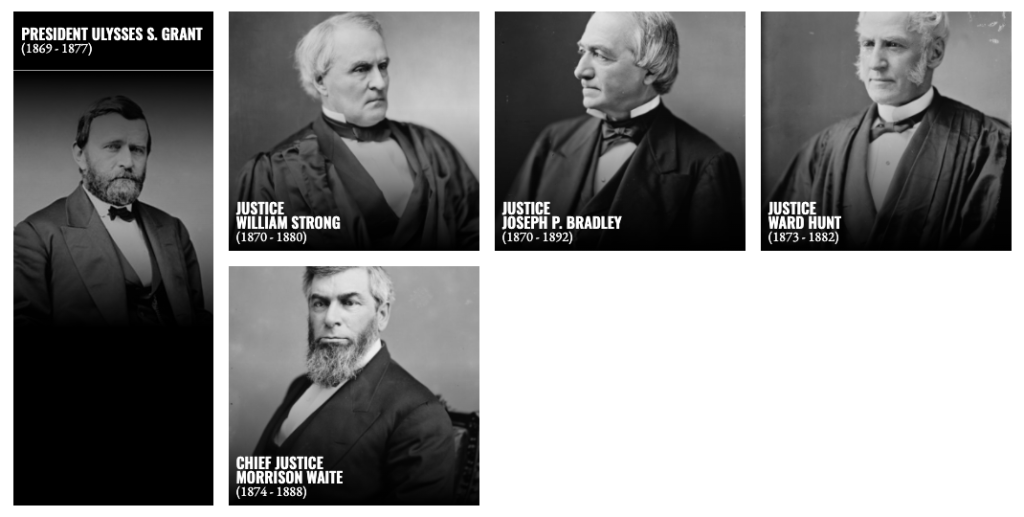
4/27/1822: President Ulysses S. Grant's birthday. He would appoint four Justices to the Supreme Court: Chief Justice Waite, Justice Strong, Justice Bradley, and Justice Hunt.
Understanding the equipment early Americans had to possess
In the colonial period and the Early Republic, laws required members of the public to possess certain arms and accoutrements. This post provides a glossary of all such items that are mentioned in any mandatory arming statute from the settlement of Virginia in 1607 through 1800.
This post is based on David B. Kopel & Joseph G.S. Greenlee, The Second Amendment Rights of Young Adults, 43 Southern Illinois University Law Journal 495, 510-26 (2019). All the citations are contained therein.
While all of the items below were required for militiamen (typically, able-bodied males 16-60, although age limits varied), they were also often required for some persons not in the militia: female heads of households, males over the militia age limit, and males with occupational exemptions from militia service (e.g. Harvard professors). Persons not in the militia were expected to participate in armed defense of the local community in cases of necessity.
English spelling did not begin to become standardized until the late eighteenth century, so readers who examine the original sources will find that the statutes spell many of the words below in diverse ways.
The militia statutes required possession of arms (e.g., guns, swords), ammunition, and also equipment for arms—including repair, maintenance, carrying, storage, and home manufacture. The most common term for the other items was accoutrements: "Generally defined as a soldier's personal equipment excepting clothes and weapons."These would include "cartridge boxes, pouches, belts, scabbards, canteens, knapsacks, powder horns, etc." They are necessarily part of the Second Amendment right, since they are necessary to the use of arms. In the same sense, "the freedom of the press" is not just about owning printing presses, but also includes the relevant accessories, such as printing ink, ink magazines, moveable type, etc., and indeed the entire system of gathering, publishing, and distributing periodicals, pamphlets, and books.
I'm having flashbacks to NFIB and Bostock. Has there been a leak?
On Tuesday, the Wall Street Journal Editorial Board published a piece titled, "Abortion and the Supreme Court: This is the moment for the Justices to turn the issue over to the voters." The conclusion of the essay is bold. The Editorial Board expressly called on the Supreme Court to overrule Roe.
Far better for the Court to leave the thicket of abortion regulation and return the issue to the states. A political uproar would ensue, but then voters would decide on abortion policy through elections—starting in November. . . . In Dobbs the Court can say that such a profound moral question should be decided by the people, not by nine unelected judges.
I see a shift in the Editorial Board's position. In July 2018--shortly after Justice Kennedy announced his retirement--the WSJ published an editorial titled "The Abortion Scare Campaign: Why Roe v. Wade and same-sex marriage are likely to survive after Kennedy."In no uncertain terms, the WSJ predicted that the nominee--who was most likely to be Justice Kavanaugh--would not overrule Roe:
The liberal line is always that Roe hangs by a judicial thread, and one more conservative Justice will doom it. Yet Roe still stands after nearly five decades. Our guess is that this will be true even if President Trump nominates another Justice Gorsuch. The reason is the power of stare decisis, or precedent, and how conservatives view the role of the Court in supporting the credibility of the law. . . .
A post-Kennedy Court is likely not to overturn Roe and its successors but it will probably uphold more state restrictions. This won't please some social conservatives, but it would put U.S. law close to where American public opinion is—keeping abortion legal but making it rarer than it now is. . . .
No one on Mr. Trump's list of nominees will claim to want to overturn Roe—and not because they are lying. In their caution and deference to precedent, they will be showing proper conservative respect for the law and the reputation of the Court.
In four years, the WSJ has gone from "the post-Kennedy Court will not overrule Roe" to "the post-Kennedy Court should overrule Roe." I am not certain why this change occurred, but I suspect the WSJ can sense which way the political winds are blowing. Abortion has been effectively illegal in Texas since September, and the world hasn't stopped. And at this point, a decision upholding Roe would lead to a massive fracturing of the conservative movement. (I wrote about this potential schism in what turned out to be an influential post.) In any event, I commend the WSJ for this shift in position.
Yet, other parts of the editorial left me concerned. Indeed, while reading the piece, I had flashbacks to NFIB v. Sebelius and Bostock. In both cases, rumors began to swirl that a conservative Justice was going to vote with the left. And, in both cases, there was a sustained public relations campaign on the right to shore up the wavering Justice. And, in neither case did those efforts work. I wrote about the Obamacare leaks in my first book, Unprecedented, and I wrote about potential leaks in Bostock here. Back to the present.
The WSJ editorial on Dobbs begins with a lengthy discussion of a "ferocious lobbying campaign." But there is nothing new here. Really, there is a hodgepodge of agitations from pro-choice groups. We are five months from oral arguments. Why write something now? As I read the first few paragraphs, I thought, okay they are setting up something far more important. Then we get to a section break with three asterisks. The editorial sketches out, at a very high level, what is going on behind the scenes.
All of this [i.e., the "ferocious lobbying campaign"] is aimed at swaying the Justices to step back from overturning Roe and Planned Parenthood v. Casey because the political backlash against the Court will be ferocious. The particular targets are Justices Barrett and Brett Kavanaugh, the two newest Justices.
Judging from the Dec. 1 oral argument in Dobbs, the three liberal Justices would bar the Mississippi law that bans abortion after 15 weeks as a violation of Roe and Casey. Justices Thomas, Neil Gorsuch and Samuel Alito are likely votes to sustain the law and overturn both precedents. Justices Kavanaugh and Barrett seemed, in their questioning, to side with the three conservatives.
Mind you, these are the judges on Trump's list that the WSJ assured us would never, ever vote to overrule Roe. But now we get to the antagonist of the piece:
But Chief Justice John Roberts tried during the oral argument to find a middle way. He appeared to want to sustain the Mississippi law on grounds that it doesn't violate Casey's test of whether there is an "undue burden" on the ability to obtain an abortion.
For reasons discussed on this blog and elsewhere, such a ruling would be pure sophistry. Anyone who joins such an opinion should hide their head in an N95 paper bag. But for the Chief, law no longer matters. Once you swallow the blue pill, and hold that a penalty is a tax, there is no escaping the bottomless pit.
Yet, the WSJ is worried that Roberts may "turn" one of his newest colleagues:
If [Roberts] pulls another Justice to his side, he could write the plurality opinion that controls in a 6-3 decision. If he can't, then Justice Thomas would assign the opinion and the vote could be 5-4. Our guess is that Justice Alito would then get the assignment.
The Justices first declare their votes on a case during their private conference after oral argument, but they can change their mind. That's what the Chief did in the ObamaCare case in 2012, much to the dismay of the other conservatives. He may be trying to turn another Justice now.
Roberts "may" be trying to turn "another" (singular) Justice now? What do you say, WSJ? This seems like very, very specific information. Has there been a leak? And which (singular) colleague is Roberts trying to turn?
The Journal concludes:
We hope [Roberts] doesn't succeed—for the good of the Court and the country. The Chief's middle ground might be explainable with some legal dexterity, but it would prolong the Court's abortion agony. Critics on the left would still lambaste the Court for letting Mississippi's law stand. And states would soon pass more laws with even narrower restrictions that would eventually force the Justices to overturn Roe and Casey or say the precedents stand on solid ground.
. . . .
This is how the American system is supposed to work, as the late Justice Antonin Scalia often wrote. After a series of elections, abortion law will sort itself out democratically. That had started to happen before the Supreme Court intervened in Roe, embittering the abortion debate and damaging the Court.
In Dobbs the Court can say that such a profound moral question should be decided by the people, not by nine unelected judges.
Since Dobbs was argued, I have been waiting for this sort of editorial in the Journal. Indeed, at an event last week, someone asked me about Dobbs. I said something to the effect of, "everything is quiet now, and I haven't seen any evidence of leaks." Now we have evidence. If there are other similar pieces in National Review and related outlets, we can have more faith that knowledge has leaked out.
Perhaps I am over-reacting. I've done it before. But the Bostock and NFIB flashbacks are quite strong now. There is still plenty of time between now and the end of June. Indeed, we are somewhat ahead of schedule. The leaks from NFIB began at the end of May.
Celebrate your independence with a subscription to Reason magazine, your most trusted source of honest, insightful news and analysis.




