Thursday Open Thread
What's on your mind?

Mostly law professors | Sometimes contrarian | Often libertarian | Always independent | Est. 2002
What's on your mind?
cutting back on what seemed like a categorical prohibition on anti-libel injunctions from a 1978 Pennsylvania Supreme Court case.
Constantakis v. Bryan Advisory Services, LLC, decided today by the Pennsylvania Superior Court (Judges John Bender, Alice Beck Dubow, and James Gardner Colins), involved a dispute between financial advisors (who had a financial company called VAM) and a parent financial company (BAS) with which they had been affiliated:
[The plaintiffs] learned that Mr. Bryan [of BAS] filed [Uniform Termination Notices for Securities Industry Registration ("Form U5")] accusing [them] of unspecified SEC violations. The Form U5s contain allegations that [plaintiffs] actually sent out the protype [sic] invoices with intent to defraud clients. Mr. Bryan also filed an Investment Adviser Public Disclosure ("IAPD") concerning [one of the plaintiffs]. The IAPD explains that a termination is disclosed when the IAR was discharged after allegations were made that accused the IAR "of violating investment-related statutes, regulations, rules or industry standards of conduct; fraud or the wrongful taking of property…." The IAPD … contains essentially the same allegations as the Form U5s. Like the Form U5, the IAPD is publicly available.
BAS and Mr. Bryan blocked VAM's ability to access any of its client accounts and left VAM [the plaintiffs' company] without a platform on which to operate, effectively halting the ability of [plaintiffs] to provide direct financial services and fulfill fiduciary obligations to clients. Additionally, BAS and Mr. Bryan wrote letters to VAM's clients informing them that it had terminated the employment of [plaintiffs]….
Plaintiffs sued and got a preliminary injunction; in the trial court's words:
During the hearing, despite having several months to investigate the allegations contained in the Form U5s and the IAPD, this court found that [defendants] failed to present any evidence that [plaintiffs] violated any investment-related statutes, regulations, rules, and/or industry standards of conduct. Additionally, this court found that, even if the VAM prototype invoices were sent out to BAS clients prior to the filing of the Form U5s and IAPD report, [defendants] failed to demonstrate that [plaintiffs] had anything to do with the alleged event….
The [court granted] injunctions enjoin[ing] [defendants] from making false, unsubstantiated, and defamatory statements about [plaintiffs]. This court further ordered that the defamatory language in the Form U5s and IAPD be expunged, and required [defendants] to file neutral, amended Form U5s … as well as a neutral, amended IAPD ….
In Willing v. Mazzacone (1978), the Pennsylvania Supreme Court had seemed to categorically bar anti-libel injunctions (applying Article 1, Section 7 of the Pennsylvania Constitution), but the appellate court read that decision more narrowly:
And why that is, at this point, an important question - maybe the only important question - emerging from the recent Dobbs leak
[Updated/corrected 5/7/2022]
Here's what we know about Leakgate: Justice Alito's draft "Opinion of the Court" in the Dobbs case, as published by Politico, is genuine. It was the first draft to be circulated; it is labelled "1st Draft," and it is the Court's custom to circulate drafts of majority opinions before other drafts - dissents, concurrences - are circulated. The Alito draft was dated February 10, 2022 (and, one may assume, it was distributed to the other Justices on that day), which is about two months after the Court heard oral argument in the case. If it were adopted by a majority of the Court and issued in this form, it would overrule Roe and Casey.
From those facts, we now know, inferentially, some things that we didn't know before the leak. First, that the Court has decided the case in Mississippi's favor. We know that because that's how "opinions of the Court" get assigned to individual Justices: the Justices vote on the preferred outcome in the case (Mississippi wins/Dobbs wins), and the senior Justice voting with the majority then assigns the task of writing the "opinion of the Court" in support of that judgment to one of the Justices in the majority (including, possibly him/herself). So the draft opinion's preferred outcome - Mississippi wins - must be the preferred outcome of the Court majority.
Now, if some Court insider had told me all of this a week ago, I would not have been terribly surprised. Bombshell news this is not. That the Court would decide the case in Mississippi's favor? Widely anticipated. That the first draft of a majority opinion, written by Justice Alito, would declare that both Roe and Casey are overruled? Also not unexpected; a number of the Justices (including Justice Alito) have consistently expressed that view any number of times in prior cases. Read More
Some years ago, Paul Alan Levy (Public Citizen) and I wrote extensively about "Dozens of suspicious court cases, with missing defendants, aim at getting web pages taken down or deindexed." (Deindexing means hiding from Google search results.) Eventually, a federal court concluded there was "fraud on the Court" in one of the cases (Smith v. Garcia); Richart Ruddie, who ran several "reputation management companies" (including at least RIR1984 LLC and SEO Profile Defender Network LLC) agreed to pay $71,000 in sanctions.
A few months ago, though, someone (it's impossible to tell for sure who) asked Google to deindex Paul Alan Levy's motion for sanctions, which lays out some of the evidence related to all this:
What the Alito draft tells us about a possible future for same-sex marriage.
When I was a college senior researching the origins of Griswold v. Connecticut (1965), there was a story making the rounds that one of Justice Scalia's clerks had walked into his chambers and asked the Justice, "What are you going to do about Roe v. Wade?" Scalia was said to have replied: "Roe? That's easy. The real question is, 'What are we going to do about Griswold?'" That summer the rumor proved accurate in at least one respect. Justice Scalia penned a concurrence in Webster v. Reproductive Health Services (1989), arguing forcefully that Roe should be overruled.
What Scalia would have done about Griswold was always a far more theoretical question. States were not falling over each other to ban condoms, IUDs, or the pill. The penumbras-and-emanations test was widely mocked, but the 1987 Supreme Court hearings of Robert Bork had demonstrated that the result in Griswold could not be seriously questioned by a nominee.
Now that the reversal of Roe appears imminent, the question of what the Supreme Court will do next arises once more. Attention is focused mostly on the precedents involving gay rights, like Obergefell v. Hodges (2015), the same-sex marriage decision, and Lawrence v. Texas (2003), which recognized a right of private adult sexual intimacy. These involve matters, like abortion, not specified in the text of the Constitution.
While there are many such "unenumerated" constitutional rights--like those to rear and educate a child, to live with relatives, to resist forced sterilization and medical treatment, and to marry a person of a different race--doubts expressed about their continued vitality seem designed mainly to save Roe by warning of the theoretical consequences of overruling it. There is no significant constituency or movement clamoring to suppress these rights and there is no serious prospect the Court will do so.
On its face, the draft majority opinion in Dobbs disclaims any intent to undermine existing unenumerated rights beyond the abortion precedents of Roe and Planned Parenthood v. Casey (1992).
The Solicitor General warns that overruling [Roe and Casey] would "threaten the Court's precedents holding that the Due Process Clause protects other rights." [Listing Obergefell, Lawrence, and Griswold]. That is not correct… And to ensure our decision is not misunderstood or mischaracterized, we emphasize that our decision concerns the constitutional right to abortion and no other right. Nothing in the opinion should be understood to cast doubt on precedents that do not concern abortion.
Draft op. at 62. Many have fretted that the author of the Dobbs draft, Justice Alito, is not to be trusted because he dissented strongly in Obergefell. But Alito is not writing for himself here. Indeed, this passage seems to have been written with an eye on keeping the majority from splintering into discordant concurrences. A harder and purer opinion might not get the signatures of Justices Barrett, Kavanaugh, or Gorsuch. This consideration should ease genuine concerns about aggressive use of the decision immediately to undermine rights to same-sex marriage and private sexual conduct.
Moreover, to justify cabining its decision in this way, the draft opinion points to what it terms a "sharp" and "critical moral distinction" between abortion and all of the other unenumerated rights: abortion "destroys" a "potential life." Draft op. at 32. Even very strong opponents of same-sex marriage grasp this distinction. With a notable exception, few of the amici siding with Mississippi called Obergefell or Lawrence into question.
The possible risks to Obergefell and Lawrence do not really come from overruling Roe, which is why Dobbs does not present an immediate or direct threat to them as precedents. Instead, the long-term perils emanate from two other sources. The first and deepest is the determined resistance of a certain subset of religious conservatives. Unlike with abortion, however, the vast majority of Americans have moved on.
The second risk is what we might come to call the Dobbsian mode of substantive constitutional-rights analysis (which is really a redux of Washington v. Glucksberg (1997)). Tell us, the draft opinion instructs, where are these specific rights in the text? Don't give us talk of "liberty," for that means too many things to too many people. If you can't do that, where are affirmative protections for such specific rights in the granular history and traditions of the nation before the dawn of the 21st century? In other words, the draft opinion offers very little in principle that secures a right to gay marriage or homosexual sex. Gone are paeans to autonomy, dignity, and the mystery of the universe. That sort of judicial rhetoric will go the way of penumbras and emanations. In the Dobbsian world, "new" rights don't stand a chance.
On the other hand, for those who support constitutional protection of same-sex marriage, the Dobbs draft salvages some important elements of stare decisis analysis. It would allow a future Court to write an opinion concluding reluctantly that, even if it was wrong (provided it was not "egregiously wrong"), Obergefell must be preserved because so many gay couples and the families they lead have concretely depended upon it for long-term planning. And Lawrence must be preserved because, if they can marry, same-sex couples must also be allowed to have sex.
Atlantic writer Jerusalem Demsas argues that blue states can't give "refuge" to people fleeing abortion restrictions if they don't cut back on zoning restrictions that lead to sky-high housing costs.

In a recent article, Atlantic writer Jerusalem Demsas explains why blue states that want to give refuge to people fleeing abortion restrictions enacted by red states if Roe v. Wade gets overruled, must cut back on zoning restrictions that drive up the cost of housing. They should embrace the "YIMBY" ("yes in my backyard") movement:
For much of American history, freedom from an oppressive legal system could be found by picking up and leaving. During the Great Migration, millions of Black Americans abandoned the Jim Crow South for the North, Midwest, and West; at a smaller scale, LGBTQ people have long fled communities where they felt unwelcome for liberal cities. On some level, Americans—with our unique system of federalism—have always voted with our feet.
The ability to move is especially important at this moment, as the Supreme Court seems poised to overturn Roe v. Wade, empowering state governments to determine the abortion rights of millions. If abortion does indeed become a state-level issue, it will join a host of other civil rights and benefits that depend on location….
Blue-state politicians know that they can largely define how well rights are protected within their borders and, in the case of abortion, have promised to ensure ongoing access….
What blue-state politicians are not doing is ensuring that people in other states can find refuge in Democratic states. For decades now, what was once commonplace—Americans moving from state to state—has been made exceedingly difficult, largely because of cost-of-living concerns. Declining rates of interstate mobility show that many Americans are stuck where they are, consigned to the political decisions of governments they may profoundly oppose, without an escape valve. Low-income Americans have also been forced out of expensive, typically blue states to less expensive, typically red ones, where their access to basic government protections may be nonexistent, but at least the average home price doesn't exceed $600,000….
In a federal system, access to housing undergirds access to many of the civil rights Democrats claim they want to protect. If the price tag for those rights is $3,200 a month, that tells me all I need to know…..
Declining interstate mobility is not all about housing costs. But on this issue, states have immense power to make a difference. Contrary to the dictum that "all housing politics is local," local authorities always serve at the pleasure of their state government. The U.S. Constitution makes no mention of local government power, leaving it up to the states to distribute authority.
None of the underlying dynamics driving up the cost of living is unknown or even really contestable. Experts have been sounding the alarm for decades that escalating rents and home prices are the results of laws limiting the supply of affordable housing. Across the nation, including in the states governed by Newsom, Hochul, and Lamont, localities enforce exclusionary zoning policies that make it difficult or even illegal to build affordable housing such as small single-family homes, duplexes, and apartment buildings.
I highlighted this issue in my own earlier post on foot voting and abortion. I hope other liberals will heed Demsas' call. As discussed in my previous post, migration may be less necessary to escape abortion restrictions than some other harmful state-government policies, because there are a variety of potential alternatives to having an abortion clinic nearby, such as contraception, mail-order abortion pills, and traveling to get an abortion in an another state. But to the extent that having abortion services nearby is vital for some women, they can more easily find it if pro-choice blue states make it easier for the poor and lower-middle class to migrate there.
As Demsas notes - and I have repeatedly emphasized in previous writings (including an article in the Atlantic)- zoning restrictions also cut off lower-income people from a wide range of other rights and opportunities they might otherwise enjoy, including jobs and education. Fixing this problem should be a high priority for both right and left, as experts across the political spectrum have come to recognize. But it's especially urgent if you are a political liberal who thinks the blue state social model is valuable and therefore should be available to more people - especially to more of the poor and disadvantaged. Blue jurisdictions tend to have the most severe exclusionary zoning, and this is one of the main reasons why they have been losing population to red states like Texas and Florida.
Demsas also rightly points out that high housing costs caused by zoning undercuts blue states' openness to immigrants and refugees:
The inhospitality of rich, liberal states to the poor and working classes is a problem at the international level as well. During the recent Afghan-refugee crisis, resettlements to coastal areas foundered on the lack of available affordable housing. When the State Department released a list of cities with potential homes for refugees, it left off America's largest progressive cities: New York, San Francisco, Los Angeles, Seattle, and Washington, D.C. Refugees are actually not welcome here, it seems.
I made the same point in a 2019 post, building on earlier pieces by NY Times columnist Farhad Manjoo and my George Mason University colleague, economist Tyler Cowen.
High housing costs are not the only blue-state policy that blocks foot voting by the poor. Occupational licensing (also a problem in many red states), restrictive labor regulations, high state tax rates are additional culprits. But exclusionary zoning has particularly massive effects, that likely outweigh other factors.
Over the last few years, a number of blue jurisdictions have begun to address this problem. But much more needs to be done. If you want to be pro-choice and pro-immigrant, you should also be pro-YIMBY.
How it differs from past SCOTUS leaks and why it poses such a threat
Over at First Things today, I argue that the leak of the Dobbs draft opinion differs from past SCOTUS leaks and poses a much greater threat to the institution. I also venture some thoughts on who might have done it:
In disclosing the draft opinion now, rather than in February when it circulated, the leaker presumably means to do one of two things. First, the leaker might hope that public pressure will intimidate one or more of the justices and affect the outcome of the case. Possibly, the leaker is a conservative clerk trying to keep Alito's majority intact, on the theory that it would be too embarrassing for a justice to change his or her mind in these circumstances. More likely, though, the leaker is a progressive who hopes an angry public reaction will make a member of Alito's majority reconsider.
Alternatively, the leaker might know that Justice Alito's majority is solid and that trying to change anyone's mind is useless. In that case, the leaker's goal likely would be, quite simply, to wreck the Court as an institution—because that is what a leak like this accomplishes. It's not a matter of letting daylight in upon magic and destroying the oracular mystique of the Court. The justices need to trust one another to deliberate effectively. They need to know that drafts can be revised and improved. They need to know, most of all, that they can do their work without external interference, at least until they release their decisions, which citizens are then free to praise or condemn.
Past leaks from law clerks typically have come after the Court has issued a decision. They often seem explained by desires to set the record straight for history or, perhaps, to demonstrate the leaker's own significance (which, as a former clerk, I can attest to be typically little). If they come before a decision, leaks are usually spare and vague, hints at a likely vote tally or outcome. Such leaks do little to change the day-to-day workings of the Court.
But the leak of an entire draft opinion in the middle of deliberations in a vitally important case suggests something very different, a desire either to bully or destroy the Court as an effective institution. After this episode, justices will feel less secure about the confidentiality of their deliberations and think twice about what they put in drafts. The work of the Court will inevitably suffer. That is what makes this leak so damaging, however one feels about the ultimate issue at stake.
Interested readers can find the whole post here.
In the forthcoming Oxford Handbook of Christianity and Law, Paul Miller and I are contributing a chapter on "Christianity and Equity." We've just posted a substantially revised version of the chapter. The new version has less coverage of Aristotle, but it adds a section on equity in the Hebrew Bible, has a bit more on canon law and the Magisterial Reformation, and has new sections on the early modern Chancery and post-seventeenth-century developments. You can read the new version here.
One thing we found but were not able to include was this amazing quotation from John Wesley about the decadent equity pleading of the eighteenth century:
A bill in chancery was originally a simple letter or petition to the chancellor. It grew bulky and complex for no good reason, until finally it reached the form in which countless students of equity in law schools have had to learn about it?the division into nine parts, the telling of the same story three times over, the charge of some "confederacy" on the part of perhaps quite innocent, and possibly even friendly, defendants. We do not draw bills in equity like that nowadays. It was a bill of the old kind about which John Wesley wrote in 1745: "I called on the Solicitor I had employed in the suit lately commenced against me in chancery, and here I first saw that foul monster, a Chancery Bill. A scroll it was of 42 pages in large folio to tell a story which needed not to have taken up forty lines, and stuffed with such stupid senseless improbable lies, many of them, too, quite foreign to the question, as I believe would have cost the compiler his life in any Heathen Court either of Greece or Rome, and this is equity in a Christian country."
The quote is in Charles P. Megan, "In Chancery," 13 ABA J. 106, 107 (1927).
Very likely no, if the clerk is domiciled in D.C. or Maryland (and pretty likely no if in Virginia), if the stated factual background is accurate.
@WillChamberlain, "Senior Counsel at @The_IAP, the @Article3Project, and @UnsilencedOrg," tweeted the name of a law clerk at the Supreme Court and said that, "in my humble opinion, she's the most likely person to have leaked the draft Supreme Court opinion in Dobbs, purporting to overturn Roe v. Wade." He wrote, in the second tweet in the thread,
I have no inside information. This thread is speculation, based almost entirely on publicly available information. I could easily be wrong.
And then in follow-on tweets in the thread, he pointed to her various credentials, publications, past jobs, and a family member's connection with Josh Gerstein, one of the Politico reporters who broke the story of the leaked draft. Say Chamberlain is mistaken; could the clerk successfully sue him for libel? (Note that I think that public accusations based on such conjecture are dangerous and unfair, especially when there's an investigation that is likely to be comprehensive and effective, and that will likely identify the culprit much more reliably; but I'm dealing here with the legal issue, not the ethical one.)
The answer is that this is very likely not libel, if the clerk is domiciled in D.C. or Maryland (and pretty likely not if the clerk is domiciled in Virginia), and if all the factual assertions about the publications, credentials, and connections are accurate. Here is the classic formulation of the legal rule, from the Restatement (Second) of Torts § 566:
5/5/1992: The 27th Amendment is ratified. It was initially proposed in 1789.
No law, varying the compensation for the services of the Senators and Representatives, shall take effect, until an election of Representatives shall have intervened.
The Supreme Court leak continues to defy any rational explanation. A conservative leak to hold five would backfire. A liberal leak to break apart the majority would backfire. The leak hurts conservatives and hurts liberals alike. But then again, why presume the leaker was rational--or at least rational, as I understand it. Perhaps the thinking was different.
The leaker may have been channeling Publius Decius Mus, who wrote the infamous essay, The Flight 93 Election.
2016 is the Flight 93 election: charge the cockpit or you die. You may die anyway. You—or the leader of your party—may make it into the cockpit and not know how to fly or land the plane. There are no guarantees.
Except one: if you don't try, death is certain. To compound the metaphor: a Hillary Clinton presidency is Russian Roulette with a semi-auto. With Trump, at least you can spin the cylinder and take your chances.
Whoever decided to leak this document no longer cared about the outcome in Dobbs. Nor did this person worry about harming the Supreme Court itself. Institutional damage was a feature, and not a bug of the leak. Rather, the goal may have been to destroy the Supreme Court as we know it in order to (hopefully) save the nation.
Update: Elizabeth Warren's tweet captures my sentiment:
Right-wing extremists have hijacked the Supreme Court of the United States. We must #ExpandTheCourt to rebalance it and defend our basic rights, including the constitutional right to an abortion.
— Elizabeth Warren (@ewarren) May 4, 2022
Various experts, including co-blogger Josh Blackman and myself, discuss whether the draft opinion would threaten other constitutional rights, if adopted by the Court.
Politico has published an insta-symposium where various legal commentators discuss the issue of whether Justice Samuel Alito's draft Supreme Court opinion overruling Roe v. Wade would also imperil other prominent precedents protecting individual rights, particularly those involving contraception, same-sex marriage, and anti-sodomy laws.
Contributors include co-blogger Josh Blackman, Prof. Mary Ann Case (University of Chicago), Prof. Mary Zeigler (Harvard), former US Attorney General Alberto Gonzales, and others. The contributions are divided between two different URLs. See here and here.
There is a wide range of views among the participants. Here is my contribution:
While such concerns [about the fate of same-sex marriage, contraception, and anti-sodomy laws] are understandable, they are overblown.
Alito's draft opinion relies on precedent holding that the Due Process Clause of the Fourteenth Amendment only protects substantive rights that are 'deeply rooted' in history. It can be argued that these other rights also lack 'deep' roots. But Alito also emphasizes that Roe is "fundamentally different" from precedents involving "intimate sexual relations, contraception, and marriage," because abortion arguably involves destruction of innocent "fetal life." This crucial difference is the main reason why Roe continues to draw vastly more opposition than these other rulings.
In addition, decisions protecting same-sex marriage and intimate sexual relations need not rely on the Due Process Clause alone. Laws discriminating against same-sex relationships also violate the Equal Protection Clause because they discriminate on the basis of sex. Just two years ago, the Supreme Court ruled that discrimination against gays and lesbians qualifies as sex discrimination under the Civil Rights Act of 1964, in a decision written by conservative Justice Neil Gorsuch, and joined by Chief Justice John Roberts. Much the same reasoning applies in the constitutional context.
Furthermore, history shows that major Supreme Court decisions protecting rights only get reversed if there is a powerful movement seeking that outcome, such as the pro-life movement in the case of Roe. By contrast, there is no longer a strong movement seeking abolition of same-sex marriage (conservative politicians rarely advocate abolition anymore, perhaps because same-sex marriage now has overwhelming public support), and even less appetite for banning contraception (which is supported by some 90% of Americans), or bringing back anti-sodomy laws.
A ruling reversing Roe v. Wade might make judicial recognition of new 'substantive due process' rights less likely. But it is unlikely to threaten major existing rights that enjoy far broader support than abortion. [highlighting added by Politico].
Interestingly, Josh Blackman reaches much the same conclusion for some of the same reasons. It's a comparatively rare point of agreement between us!
The answer to this important question is highly uncertain. I tentatively predict a significant, but still modest, increase in abortion-driven migration.
If Roe v. Wade gets overruled, as now seems increasingly likely, will Americans "vote with their feet" for states that protect abortion rights? That's a question I've often been asked in recent months, perhaps because I have written extensively about foot voting, including a book on the subject. In this post, I try to address it. But I warn that I don't have any definitive answer. The key reason why is that we have no recent American precedent for abortion restrictions as severe as those likely to come into effect in some red states. My tentative judgment is that such foot voting will indeed occur, but probably only on a modest scale. But I could easily turn out to be wrong about that.
In one sense, the answer to the question of whether will people will vote with their feet for pro-choice states is obviously "yes." In a diverse nation with over 330 million people, it is inevitable there will be some who value abortion rights so much they are willing to move away from a state that significantly restricts them. But the more significant question is how many people will move because of such concerns? Will it be a flood or just a trickle?
On that question, it's difficult to come up with any kind of definitive answer. The reason why is that, thanks to Roe, we have had only relatively modest variation in abortion regulation between states over the last 50 years. At the very least, we haven't seen anything like the recent Texas and Oklahoma laws banning nearly all abortions more than six weeks into a pregnancy. The Texas law, of course, has been in effect for several months now. But that isn't enough time to tell us much about the impact on migration patterns.
So far, there is little evidence that abortion restrictions drive interstate migration. To the contrary, many of the states that have gained the most migrants in recent years are ones that tightened abortion laws since 2010, most notably Texas and Florida. Such issues as job opportunities, housing costs, and taxes seem much more significant to foot voters than abortion. But the combination of the end of Roe and the new wave of draconian abortion laws could potentially change that.
There is a big difference between a state where a legal abortion is incrementally more difficult to obtain, and one where it becomes almost impossible for most women to get one in-state. The latter situation could generate a lot more foot voting than the former.
There is a long history of people voting with their feet to escape oppression of various kinds. Notable historical examples include blacks fleeing the Jim Crow-era South, Mormons fleeing to Utah, and gays and lesbians moving to relatively more tolerant jurisdictions. Severe abortion restrictions may also be a kind of oppression that women might flee in the same way.
I'm a believer in the "my body, my choice" principle. Indeed, I would take it much further than most! I therefore agree that the vast bulk of abortion restrictions are unjust. But that does not, by itself, tell us how many people fear them enough to vote with their feet to escape them.
A key reason to think that the number of abortion-driven migrants will be modest is that there are often relatively low-cost substitutes for access to an abortion provider within your own state. The most obvious is contraception. For women who want to avoid unwanted pregnancies, this is an obvious option, and one that can be purchased at most drugstores and supermarkets (though, of course, I recognize that some of the most potent contraceptives are harder to acquire than that).
There is also the option of mail-order abortion pills. "Medication abortions" already account for some 54% of all US abortions, and that percentage could well increase in a post-Roe world. Conservative states could try to suppress mail-order abortion pills. But enforcing such bans is likely to be extremely difficult. I doubt a "War on Abortion Pills" will be much more successful than the War on Drugs. It might even be less effective, in as much as states that ban such pills are often likely to have neighbors that do not.
Finally, blue and purple states are likely to continue to have liberal abortion laws, regardless of what the Supreme Court says. Many are taking steps to make it easier for non-residents to obtain abortions there, if their home states forbid it. During the lengthy era when Ireland banned abortion, while Britain did not, every year many thousands of Irish women went to the UK to get abortions. A similar trend could emerge in a post-Roe US. As far as I know there was little abortion-driven migration from Ireland to the UK during that period. But I welcome correction from experts on Ireland!
Conservative states could try to enact laws banning residents from seeking abortions out-of-state. But such laws are vulnerable to legal challenge on various grounds, including the Dormant Commerce Clause (which bars state interference with interstate economic transactions), and the right to travel. Even if restrictions survive legal challenges, they may prove difficult to enforce, especially in the face of resistance and noncooperation by authorities in destination states (which are likely to be blue pro-choice jurisdictions).
For large numbers of women, one or more of the above options is likely to prove more attractive than a permanent move to a state with more liberal abortion laws. That's especially true if the latter state is less appealing than their former home in other ways, such as job opportunities or housing costs.
Many of the above options are actually forms of what I have called private-sector foot voting. One advantage of such strategies is that people can often use them without having to permanently migrate and in some cases (such as using contraception) without having to do much traveling of any kind.
I don't claim these alternatives are perfect substitutes for abortion in every case. For example, contraception obviously doesn't help in cases of rape, or situations where a woman needs an abortion to protect against a health risk that only becomes evident after the pregnancy has begun. But the alternatives are likely to be effective in a high percentage of situations, which in turn is likely to greatly reduce the amount of abortion-driven migration.
By contrast, there were few if any substitutes for foot voting when it came to the kinds of oppression that have historically led to large-scale interstate migration. Most obviously, Jim Crow-era southern blacks had no good way of avoiding the impact of segregation (except those few who could "pass" for white). In jurisdictions with strongly homophobic policies, gays and lesbians had little opportunity to avoid rampant discrimination, except by remaining in "the closet" - a choice with fairly obvious severe drawbacks.
Today, much foot voting is driven by housing costs, job opportunities, and tax rates. Texas's relative advantages on these three dimensions are the big reasons why it has been the biggest net gainer of population from internal migration within the US, over the last decade. Notice that all of these are issues that are hard to avoid by means short of exit.
If zoning restrictions make housing unaffordable in your area, it's hard to find cheap alternatives, except by leaving or being homeless. If taxes are too high, the main alternative to leaving is some form of tax evasion or black market work (both of which have serious dangers and drawbacks). Ditto if restrictive policies severely limit the availability of job opportunities, though the most desirable workers could still beat the odds, and thus have less reason to move.
It's also possible that abortion restrictions will lead some people to move not because they want to access abortion themselves, but simply because of moral abhorrence at living in a jurisdiction that restricts women's liberty in this way. By the same token, some pro-lifers might, out of moral considerations, seek to leave states that continue to have liberal abortion policies. I'm sure there will be a few cases of both kinds. But probably very few.
Historically, migration driven by moral abhorrence of policies that have little or no effect on the would-be migrants or their families is rare. Such cases, it should be noted, are different from ones where people migrate because persecution prevents them personally from living according to their religious or moral principles, as in the case of Jews fleeing forced conversion in Spain.
For these reasons, my best guess is that the end of Roe (assuming it happens) will lead to a substantial increase in abortion-driven migration compared to the preexisting baseline, but still only a relatively small amount of movement in absolute terms. It will be vastly smaller than, say, the 20th century Great Migration of African-Americans to the north, or even than recent movement of people to states with better housing and job opportunities.
But I admit I could be wrong about that. It's possible that women value the option of having an abortion more than the above suggests, and that many see it as greatly superior to the available alternatives, even if the latter might seem cheaper and easier than migration.
The situation might also change if blue states with liberal abortion policies became more attractive to migrants in other ways, most notably by cutting back on zoning restrictions that currently make housing in many blue areas prohibitively expensive for would-be working class and lower-middle class migrants. Some have begun to liberalize zoning policy, and that trend could continue to spread. The cause of zoning reform might even get a boost from abortion rights advocates. In a post-Roe world, to be truly pro-choice you should also be pro-YIMBY!
If the Supreme Court overrules Roe, there will be much greater interstate variation in abortion policy than at any time since 1973. Whether and to what extent that leads people to vote with their feet against restrictive jurisdictions remains to be seen.
No, argues an amicus brief filed on my behalf in the pending Supreme Court affirmative action litigation.
Some highlights of the brief, authored by Cory Liu:
Harvard and UNC's race-conscious admissions policies divide applicants into the following categories for purposes of determining eligibility for race-based
advantages in the admissions process: (1) Asian; (2) Native Hawaiian or Pacific Islander; (3) Hispanic; (4) White; (5) African American; and (6) Native American.As Professor David Bernstein has shown, these racial and ethnic categories were created in the mid-1970s by federal bureaucrats whose only goal was to unify the racial and ethnic categories federal agencies used for recordkeeping. David E. Bernstein, The Modern American Law of Race, 94 S. CAL. L. REV. 171, 197–200 (2021); see also DAVID E. BERNSTEIN, CLASSIFIED: THE UNTOLD STORY OF RACIAL CLASSIFICATION IN AMERICA (forthcoming 2022). The categories came about in a haphazard manner without any input from anthropologists, sociologists, ethnologists, or other experts.
The bureaucrats who created the categories expressly warned that they "should not be interpreted as being scientific or anthropological in nature, nor should they be viewed as determinants for eligibility for participation in any Federal program." 43 Fed. Reg. 19,260, 19,269 (May 4, 1978).
There was never even a hint in the development of the categories that they were established for achieving educationally beneficial diversity in higher education. See Hugh Davis Graham, The Origins of Official Minority Designation, in THE NEW RACE QUESTION: HOW THE CENSUS COUNTS MULTIRACIAL INDIVIDUALS 289 (Joel Perlmann & Mary C. Waters eds., 2002)….
Harvard and UNC's racial and ethnic categories match the categories adopted by federal agencies, including the Department of Education. Whatever value the categories may have in allowing for consistency in data collection, they lump together members of very diverse groups into arbitrary categories. As Michael Omi and Howard Winant, two of the leading sociologists of race in the United States, point out: "These racial categories are rife with inconsistencies and lack parallel construction. Only one category is specifically racial, only one is cultural, and only one relies on a notion of affiliation or community recognition." MICHAEL OMI & HOWARD WINANT, RACIAL FORMATION IN THE UNITED STATES 122 (3d ed. 2015); see also PETER H. SCHUCK, DIVERSITY IN AMERICA: KEEPING GOVERNMENT AT A SAFE DISTANCE 164 (2003) (describing the racial categories as "almost comically arbitrary").
Harvard and UNC cannot explain why they use these particular racial and ethnic categories in their admissions policies….
Given the unduly broad nature of the "Asian" category, it is no surprise that only a minority of people assigned to that category identify as "Asian" or "Asian American." See JANELLE WONG ET AL., ASIAN AMERICAN POLITICAL PARTICIPATION: EMERGING CONSTITUENTS AND THEIR POLITICAL IDENTITIES 162 (2011) (finding that less than 40% of Indian, Chinese, and Filipino respondents identified as "Asian" or "Asian-American," even as a secondary identity)….
The question of who counts as "Hispanic" has continually befuddled federal and state authorities. See, e.g., Marinelli Constr. Corp. v. State, 613 N.Y.S.2d 1000, 1002 (N.Y. App. Div. 1994) (denying Hispanic status to a person of Italian-Argentine descent); Major Concrete Constr., Inc. v. Erie Cty., 521 N.Y.S.2d 959, 960 (NY. App. Div. 1987) (denying Hispanic status to a person with one Mexican grandparent); In re Rothschild-Lynn Legal & Fin. Servs., SBA No. MSBE94-10-13-46, 1995 WL 542398, at *3–4 (Apr. 12, 1995) (granting Hispanic status to a Sephardic Jew whose ancestors had fled Spain centuries earlier); In re DCS Elecs., Inc., SBA No. MSBE-91-10-4-26, 1992 WL 558961, at *4 (May 8, 1992) (recounting agency's conclusion that someone with "blond hair and light skin" was not Hispanic); In re Kist Corp., 99 F.C.C.2d 201, 216–17, 248 (1983) (granting partial minority credit for Hispanic status to a person with one Cuban grandparent); In re Storer Broad. Co., 87 F.C.C.2d 190, 191–93 (1981) (accepting Sephardic Jewish heritage as evidence of Hispanic status); In re Lone Cypress Radio Assocs., Inc., 7 FCC Rcd. 4403, 1992 WL 690184, at *5 (1992) (concluding that while being one-fourth Hispanic is enough to classify someone as Hispanic, being one-eighth Hispanic is not); Participation by Disadvantaged Business Enterprise in Department of Transportation Programs, 62 Fed. Reg. 29,548, 29,550 (May 30, 1997) (reaffirming Department of Transportation decision to classify "persons of European Spanish and Portuguese origin" as Hispanic, even though the latter group is not of Spanish origin or culture)….
There is a tremendous amount of ethnic, cultural, linguistic, and religious diversity within the category of people that Harvard and UNC classify as white…. The category includes, among others, Welsh, Norwegians, Greeks, Moroccans, Chaldeans, Afghans, Iranians, and North African Berbers. To place people descended from all these groups into one category is inconsistent with the goal of achieving genuine educational diversity….
Neither Harvard nor UNC has explained why a white Catholic of Spanish descent, classified as Hispanic, gets an admissions preference for contributing to educational diversity, but a dark-skinned Muslim of Arab descent, an Egyptian Copt, a Hungarian Roma, a Bosnian refugee, a Scandinavian Laplander, a Siberian Tatar, or a Bobover Hasid—all classified as "white"—do not. Similarly, it is hard to see how diversity is better accomplished by admitting an additional "Hispanic" student of Mexican ancestry over an equally or better qualified student whose parents immigrated from Turkmenistan, who would be the only Turkman in the entire student body, because the Turkman is arbitrarily classified as "white."…
A descendant of American slaves who grew up in a working-class, majority-black neighborhood in Milwaukee does not contribute to diversity in the same way as a child of an African diplomat, nor as a black-identified applicant with multiracial ancestry who grew up in an overwhelmingly white small town in Montana…. Yet they all fall into the same diversity category at Harvard and UNC….
Similarly, the experiences of a Navajo Indian who grew up on the tribe's reservation in Arizona are quite different from those of a person with one-sixty-fourth Cherokee ancestry and a European surname whose appearance and life are indistinguishable from his "white" neighbors' except that he has inherited tribal membership….
The racial and ethnic categories that Harvard, UNC, and universities across the country use in their admissions policies were created by executive-branch bureaucrats who specifically warned that they were not scientific or anthropological in nature and should not be used to determine eligibility for benefits in race conscious policies. The categories are imprecise, over and underinclusive, and are not narrowly tailored to achieve educationally beneficial diversity.
Note that the brief does not address the issue of whether a different version of affirmative action for "diversity" purposes could past constitutional muster, nor whether affirmative action programs based on values other than "diversity" may be constitutional. The brief only addresses the notion that basing affirmative action justified by educational diversity on categories created for entirely different purposes and not meant to reflect any sociological or anthropological reality cannot pass strict scrutiny.
Last week, the Open Markets Institute called on the FCC, the FTC, and the DOJ to block Musk from buying Twitter:
Yesterday Twitter's board agreed to sell the corporation to Elon Musk, the owner of Tesla and SpaceX. The Open Markets Institute believes the deal poses a number of immediate and direct threats to American democracy and free speech. Open Markets also believes the deal violates existing law, and that the Federal Communications Commission (FCC), the Department of Justice (DOJ), and the Federal Trade Commission (FTC) have ample authority to block it.
The most obvious problem is that the deal would give to a single man – one who already wields immense political and economic power – direct control over one of world's most important platforms for public communications and debate. As has been true from the Founding, the American people have an absolute right to ensure the full openness and neutrality of all essential public infrastructure. Specific to communications, we see this in Article I, Section 8 of the Constitution, in the Telegraph acts of 1860 and 1866, the Mann-Elkins Act of 1910, the Communications Act of 1934, and many other federal and state laws. Americans have also repeatedly used our antitrust laws to prevent concentrations of power over communications, speech, debate, and news.
Yesterday's deal also violates the law at a more technical level. Mr. Musk already controls one of the most important internet platforms in the world – in the form of the satellite communications system Starlink. Since the late 19thCentury, the U.S. government has routinely acted to prevent mergers between existing essential platforms. Most recently, the DOJ in 2017 attempted to block AT&T's takeover of Time-Warner (an effort which failed because the DOJ filed a poor case, as OMI made clear at the time). This means that just as we would now expect the U.S. government to block a takeover of Twitter by Google, Facebook, Comcast, or Verizon, the same rules apply to the owners of Starlink.
Let's be clear. Elon Musk's effort to buy Twitter is not the only threat to free communications and debate in the United States. The size, scope, and business models of Facebook, Google, and Amazon also pose a wide variety of often extreme threats to American democracy and the basic rights of citizens. That's why law enforcers and Congress should view this deal as an opportunity to firmly reestablish clear bans on any manipulation of communications by essential platforms, and to eliminate all business models that rely on such manipulation.
Finally, as Open Markets made clear in this article in the Washington Monthly, it's past time for the FCC to get serious about regulating Starlink to ensure that this vital and increasingly important Internet platform serves the public interest only.
The following day, FCC Commissioner Brendan Carr responded,
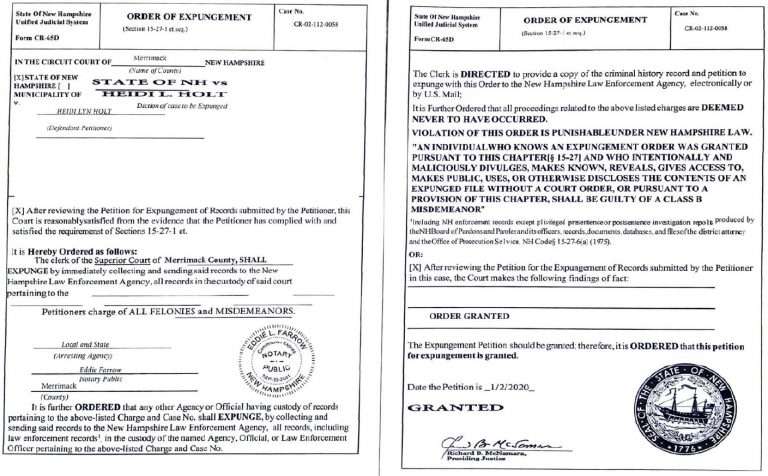
Last week, Google received a Digital Millennium Copyright Act request, apparently aimed at deindexing (i.e., vanishing from Google search results) something that I had posted. The request, labeled as coming from "Concord Litho" stated,
This specific website has posted legal paperwork about me with private information which they copied off the internet without permission.
It listed as "original URLs" https://www.newsbreak.com/news/2154080759697/arrest-of-heidi-l-holt-for-tampering-with-public-records-or-information-and-forgery and https://reason.com/volokh/2021/02/03/n-h-prosecution-for-forgery-aimed-at-getting-newspaper-articles-and-government-record-vanished-from-google-search-results/. And it stated that the "allegedly infringing URL[]" was
https://d2eehagpk5cl65.cloudfront.net/img/q60/uploads/2021/02/HoltSubmission-768x476.jpg.
It's not clear to me if this was indeed just an attempt to deindex the JPG, which is an image of an apparently forged expungement order, or was also aimed (even if inartfully) at deindexing the articles that wrote about the arrest and prosecution that stemmed from that order (including one that I wrote). In any case, here's that article of mine, which gives some backstory for this new attempt:
Any response must go in the normal reply brief.
So the First Circuit reaffirmed today in an order in Doe v. MIT, No. 22-1056:
Per the federal rules of appellate procedure, a party's response to the argument of an amicus is contained within its reply brief. To the extent appellant seeks relief, such as an extension of time to file his reply brief or leave to file an oversized brief, that request is denied without prejudice to renewal with the specific relief requested.
The analysis might be different in state courts that allow amicus briefs to be filed after the reply brief; but in federal court, this makes sense.
(Disclosure: The amicus brief involved was my own; I filed a brief in support of neither party, shortly after the appellant's counsel filed their brief, and the appellant's counsel wanted to respond to the part of my brief—to be fair, a large part—that is contrary to their position. I plan to blog about the amicus brief itself soon.)
The leaked opinion places the public "on notice . . . regarding this Court’s misgivings about" Roe.
In Janus v. AFSCME (2018), the Supreme Court overruled Abood v. Detroit Bd. of Ed. (1977). Justice Alito's majority opinion ruled that the principles of stare decisis did not justify retaining Abood. One aspect of his decision has some relevance for the present moment. In Janus, Justice Alito addressed reliance interests. Specifically, he wrote that the unions should have been on notice that Abood was on the chopping block. After all, recent decisions like Knox, Harris, and (in a way) Friedrichs chipped away at Abood.
Justice Alito wrote:
For another, Abood does not provide "a clear or easily applicable standard, so arguments for reliance based on its clarity are misplaced." South Dakota v. Wayfair, Inc., ante, at 20; see supra, at 38–41.
This is especially so because public-sector unions have been on notice for years regarding this Court's misgivings about Abood. In Knox, decided in 2012, we described Abood as a First Amendment "anomaly." 567 U. S., at 311. Two years later in Harris, we were asked to overrule Abood, and while we found it unnecessary to take that step, we cataloged Abood's many weaknesses. In 2015, we granted a petition for certiorari asking us to review a decision that sustained an agency-fee arrangement under Abood. Friedrichs v. California Teachers Assn., 576 U. S. ___. After exhaustive briefing and argument on the question whether Abood should be overruled, we affirmed the decision below by an equally divided vote. 578 U. S. ___ (2016) (per curiam). During this period of time, any public-sector union seeking an agency-fee provision in a collective-bargaining agreement must have understood that the constitutionality of such a provision was uncertain.
This passage from Janus, which does not appear in Justice Alito's draft opinion, does have some relevance for Dobbs. (And remember, the Chief Justice assigned Alito to write Dobbs.) In 2020, June Medical placed everyone on notice that five members of the Supreme Court had "misgivings" about Roe. Justice Barrett's confirmation no doubt expanded those "misgivings." And now, in light of the leaked opinion, we know that five members of the Supreme Court were willing to overrule Roe altogether. In light of Janus, those who facilitate abortion should understand that their potential constitutional defenses are "uncertain."
Seth Barrett Tillman, my frequent co-author, makes this point on a different level. He writes that in-house counsel now have a duty to provide timely legal advice in light of the leaked draft opinion.
The leak of the draft Supreme Court opinion in Dobbs v. Jackson Women's Health Organization did not overrule Roe. But counsel cannot blind him/herself to what the whole world now knows—that there is a substantial likelihood that Roe will be overturned. . . . More importantly, counsel should also put their clients on notice in regard to the risk of retrospective liability for acts committed while Roe was still in effect. The period of time we are now in may be such a period, particularly as the Dobbs leak has warned one-and-all of likely legal change. . . . In these circumstances, counsel should forewarn clients that their continuing to provide all or some abortion services going forward might lead to liability or, more likely, additional liability—civil and/or criminal—in states that have enacted statutes restricting the provision of abortion services.
We are all on notice.
Celebrate your independence with a subscription to Reason magazine, your most trusted source of honest, insightful news and analysis.