The Volokh Conspiracy

Mostly law professors | Sometimes contrarian | Often libertarian | Always independent | Est. 2002

The Volokh Conspiracy

Crime

Today in Supreme Court History: May 26, 1868

|

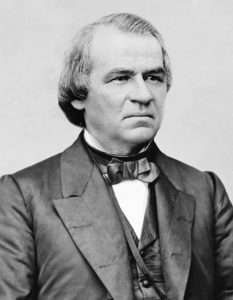
5/26/1868: Senate acquitted President Andrew Johnson and adjourned as court of impeachment. Chief Justice Chase presided over that trial. Johnson is one of four presidents that did not appoint any Supreme Court Justices. The others are William Henry Harrison, Zachary Taylor, and Jimmy Carter.

President Andrew Johnson

Free Speech

Court Preliminarily Enjoins New York's Limits on Unauthorized Practice of Law,

as applied to "program that would train non-lawyers to give [free] legal advice to low-income New Yorkers who face debt collection actions" about how to "fill out checkboxes on a one-page answer form provided by the State."

|

From Judge Paul Crotty's decision yesterday in Upsolve, Inc. v. James (S.D.N.Y.); not sure that this will survive on appeal (as the court notes, appellate courts have upheld such limits on nonlawyers' giving people legal advice [UPDATE 9/9/25: it was just reversed on appeal]), but it seems important and much worth following:

"The orderly functioning of our judicial system and the protection of our citizens require that legal advice should be offered only by those who possess the requisite qualifications and authorization for the practice of law. At the same time, one of the most fundamental principles of our system of government prohibits any restraint on a citizen's right to disseminate his views on important public issues." Dacey v. New York Cty. Lawyers' Ass'n (2d Cir. 1969). Sometimes these two principles conflict, and one must yield to the other.

This case exemplifies that conflict. Plaintiffs—a non-profit organization and a non-lawyer individual—seek to encroach upon a small part of what has heretofore been the exclusive domain of members of the Bar. Plaintiffs have crafted a program that would train non-lawyers to give legal advice to low-income New Yorkers who face debt collection actions. Specifically, Plaintiffs want to help those New Yorkers fill out checkboxes on a one-page answer form provided by the State, in the hopes that more people will avoid defaulting outright in such actions. The legal advice would be free and confined to helping clients complete the State's one-page form.

Plaintiffs' proposal faces one problem: by giving legal advice as non-lawyers, their activities would constitute the unauthorized practice of law ("UPL") under several New York statutes. They risk being sued by the Defendant in this case, the New York State Attorney General. Thus, Plaintiffs seek an injunction that prevents the Attorney General from enforcing the UPL rules against them.

The Court concludes a preliminary injunction is warranted. The UPL rules cannot be applied to Plaintiffs' program because the First Amendment protects their legal advice as speech, and the UPL rules are not narrowly tailored to satisfy strict scrutiny in this context. Further, the balance of equities favors an injunction because Plaintiffs' program would help alleviate an avalanche of unanswered debt collection cases, while mitigating the risk of consumer or ethical harm. And enjoining enforcement against Plaintiffs alone, whose activities are carefully limited to out-of-court advice, will not threaten the overall regulatory exclusivity of the legal profession….

Read More

"In Defense of the LSAT"

|

From Clayton Kozinski (Newsweek); seems quite right to me. An excerpt:

[S]tudies have consistently shown that LSAT performance is the single strongest predictor of academic success in law school….

Criticisms of the LSAT largely echo criticisms of standardized tests more generally.

Essentially, they boil down to the claim that the LSAT does not objectively measure ability because children from wealthy backgrounds can more easily afford elite prep courses and personalized tutoring.

It certainly seems unfair that such a significant portion of the admissions criteria favors the wealthy. But even critics of the LSAT concede that the same is true of nearly every other component of the admissions process. The wealthy can hire tutors to improve their GPA and snag better recommenders. And they can pack in more extracurriculars because they are less distracted by resource requirements.

In fact, by one reckoning, the poor benefit significantly from the fact that the LSAT is such a heavily weighted portion of the application calculus. Rather than hiring a cavalcade of tutors for each class or making time for a mountain of extracurriculars, limited resources can be focused on a single, highly important test. Moreover, the Law School Admission Council (LSAC) periodically analyzes various methods of LSAT preparation. LSAC's data show that among the most effective is the organization's own $99 prep material. Sure, that's an expense, but it's hardly out of reach for most applicants. And sure enough, LSAC—which administers the LSAT—notes that doing away with the test has been shown to work against minorities and the economically disadvantaged.

LSAT opponents know all this. So why do they still single out the LSAT?

Free Speech

Ohio Court of Appeals Adopts "Discovery Rule" in Libel Case Involving a Forged E-Mail

|

From Weidman v. Hildebrant, decided Monday by the Ohio Court of Appeals (Twelfth District), in an opinion by Judge Robert Hendrickson, joined by Judges Mike Powell and Robin Piper III (for more, see this Cincinnati Enquirer [Scott Wartman] article):

This action involves the defamation of [Thomas] Weidman, a Sycamore Township trustee, by [Christopher] Hildebrant, a Cincinnati real estate developer. In 2011, Hildebrant was facilitating the sale of property owned by SDI Foods, Inc. to Sycamore Township, for which he would receive a consulting fee from both parties if the sale was successful. Hildebrant claims Weidman and Stanford Roberts, the individual who negotiated the sale for SDI, each repeatedly sought a kickback from Hildebrant's consulting fee after the sale occurred.

In response to the pressure he felt from Weidman and Roberts, Hildebrant created a fictitious gmail account under the name tweidman12@gmail.com and, on December 20, 2011, sent an email to himself from the tweidman12@gmail.com account (the "2011 email"). The 2011 email portrayed Weidman as having received illicit payments and demanding bribes in exchange for his support of several real estate developments in Sycamore Township. On December 20, 2011, after creating and sending the 2011 email to himself from the tweidman12@gmail.com account, Hildebrant forwarded the email to Roberts. Hildebrant hoped that the email would demonstrate to Roberts that he did not have any money left to pay Roberts a bribe as Weidman had also demanded payment.

Read More

Politics

No Religious Exemption from Paying Taxes

The case involved a person who objected to his tax money being "used to facilitate abortion," but the principle applies to objections for any reason.

|

So the Ninth Circuit (Judges Marsha Berzon and Morgan Christen and District Judge Frederic Block (E.D.N.Y.)) held Monday in U.S. v. Bowman:

Appellant Michael Bowman appeals his conviction on four counts of willful failure to file a tax return …. Bowman argues that the Religious Freedom Restoration Act … required the dismissal of the operative indictment against him because of his religious belief that he must not contribute money used to facilitate abortions….

Both this Circuit and the United States Supreme Court have repeatedly rejected the proposition that a taxpayer may withhold tax money owed because taxes support expenditures the taxpayer finds objectionable: "Because the broad public interest in maintaining a sound tax system is of such a high order, religious belief in conflict with the payment of taxes affords no basis for resisting the tax." United States v. Lee (1982); Hernandez v. Comm'r (1989) ("[E]ven a substantial burden would be justified by the 'broad public interest in maintaining a sound tax system,' free of 'myriad exceptions flowing from a wide variety of religious beliefs.'") (citing Lee).

Read More

Free Speech

Coach Can't Be Fired Just for Publicly Criticizing School's "Diversity, Equity, Inclusion" Turn, But Can Be …

fired for doing so in a way that includes a "personal ... attack on [the superintendent's] integrity.

|

From Flynn v. Forrest, decided Monday by Judge Indira Talwani (D. Mass.):

Plaintiff David Flynn, the former Dedham high school football coach, brings this action against Defendants Michael Welch, Jim Forrest, and Stephen Traister for violation of his First Amendment rights. He alleges that Defendants' decision not to renew his coaching contract was based explicitly on his statements to members of the school committee and several concerned community members about his daughter's middle school social studies curriculum. Defendants move for summary judgment…

The following facts are drawn from the summary judgment record and are construed in the light most favorable to Flynn, the non-moving party.

Welch is the superintendent of Dedham public schools. Forrest is the principal of Dedham high school, and Traister is the athletic director.

Flynn is a Dedham resident, and between 2011 and 2019, he was the head football coach for Dedham high school…. That same fall, Flynn's two children were enrolled in the Dedham public schools.  His daughter was in seventh grade at Dedham middle school…. [Flynn and his wife had objections to the school curriculum and a teacher's behavior, and aired them with Welch, but didn't get what they saw as an adequate response.] Flynn [then] sent an email to several members of the Dedham school committee, as well as his family and friends. A member of the school committee forwarded the email to Welch.

In the … email, Flynn expressed his belief that Welch had called the meeting only to be able to say that he had listened to the Flynns, not to try to keep the Flynns' children in the Dedham public schools. Flynn came away with the impression that Welch and Dedham public schools "seem[ed] to be supporting the BLM movement." Flynn summed up his meeting with Welch as follows:

  • [Welch] supports BLM
  • He thinks Dedham is "Astronomically White"
  • He allows politics in the classroom
  • He thinks every employee of the schools need to be taught how to care for, communicate with and understand the lives of people from all races/cultures.
  • He has a goal to [hire] more "non-white" teachers
  • He did not care that my daughter is scared when she sees the BLM logo in her class
  • He did not care that I expressed how much it hurts me to have to remove my children from the schools I attended in the town I grew up in
  • He did not care that his teachers are indoctrinating 12 year old children
  • He did not care that the Middle School Principal lied to us twice
  • He did not care that the school system still has not provided important information on the new controversial classes they are pushing on our kids
  • He doesn't care about the people in this town.

He concluded that Welch was "not willing to compromise" and that "if the teacher [taught] the course objectively and remove[d] the BLM logo from the class, people w[ould] soon get over the fact that the class was purposely created without notifying parents and without having a visible course curriculum, syllabus and learning objective."

Read More

Madison Cawthorn and the Mischief Rule

|

Eugene has a post on today's decision by the Fourth Circuit (per Judge Heytens) on Rep. Madison Cawthorn's challenge to the disqualification litigation. I wanted to highlight one point. After giving a close textual read to the 1872 Amnesty Act, and concluding that it does not provide a blanket future amnesty to all insurrectionists, Judge Heytens turns to historical context. And the context to which he appeals, though he doesn't use the word, is manifestly the mischief. The relevant pages of the opinion are 24-26, and here's a quote:

the available evidence suggests that the Congress that enacted the 1872 Amnesty Act was, understandably, laser-focused on the then-pressing problems posed by the hordes of former Confederates seeking forgiveness. See Gerard N. Magliocca, Amnesty and Section Three of the Fourteenth Amendment, 36 Const. Comment. 87, 111-21 (2021).

If you want to read more about the mischief rule, there's an article on that.

Linda Greenhouse Lives in a Bizarro World on Dobbs

To Greenhouse, overruling Roe is an act of "judicial activism" and "raw power."

|

I read Linda Greenhouse's latest guest essay about Dobbs so you don't have to. For Greenhouse, overruling Roe is an act of "judicial activism" and "raw power." Of course, Greenhouse is channeling Justice White's dissent that charged the Roe majority with engaging in "raw judicial power." But now, restoring this divisive issue to the political branches is itself activism. Greenhouse is living in a bizarro world where everything is backwards.

Indeed, Greenhouse channels Abraham Lincoln's "House Divided" speech, exactly backwards!

In 13 states, post-Roe anti-abortion laws will spring to life when the 1973 decision is overturned or soon after, and states are, like Oklahoma, passing new laws designed to take advantage of the opening the court is likely about to provide. Does Justice Alito know who said, "I believe this government cannot endure, permanently half slave and half free"? It was Abraham Lincoln, in his "House Divided" speech of 1858.

Lincoln was well aware of a Supreme Court decision that tried to resolve a contentious issue through judicial fiat. Of course, I speak of Dred Scott. Roe, like Dred Scott before it, asserted the power to unite the nation behind a single position. And Casey purported to "call[] the contending sides of a national controversy to end their national division by accepting a common mandate rooted in the Constitution." These decisions utterly failed in that task. Lincoln understood all-too-well that the unelected judiciary should not be in the position of settling these matters. If our house is divided, five unelected lawyers cannot unite it.

I can do no better than quote from Justice Scalia's Casey dissent:

There is a poignant aspect to today's opinion. Its length, and what might be called its epic tone, suggest that its authors believe they are bringing to an end a troublesome era in the history of our Nation and of our Court. "It is the dimension" of authority, they say, to "cal[l] the contending sides of national controversy to end their national division by accepting a common mandate rooted in the Constitution." Ante, at 867.

There comes vividly to mind a portrait by Emanuel Leutze that hangs in the Harvard Law School: Roger Brooke Taney, painted in 1859, the 82d year of his life, the 24th of his Chief Justiceship, the second after his opinion in Dred Scott. He is all in black, sitting in a shadowed red armchair, left hand resting upon a pad of paper in his lap, right hand hanging limply, almost lifelessly, beside the inner arm of the chair. He sits facing the viewer and staring straight out. There seems to be on his face, and in his deep-set eyes, an expression of profound sadness and disillusionment. Perhaps he always looked that way, even when dwelling upon the happiest of thoughts. But those of us who know how the lustre of his great Chief Justiceship came to be eclipsed by Dred Scott cannot help believing that he had that case--its already apparent consequences for the Court and its soon-to-be-played-out consequences for the Nation--burning on his mind. I expect that two years earlier he, too, had thought himself "call[ing] the contending sides of national controversy to end their national division by accepting a common mandate rooted in the Constitution."

It is no more realistic for us in this litigation, than it was for him in that, to think that an issue of the sort they both involved--an issue involving life and death, freedom and subjugation--can be "speedily and finally settled" by the Supreme Court, as President James Buchanan in his inaugural address said the issue of slavery in the territories would be. See Inaugural Addresses of the Presidents of the United States, S. Doc. No. 101-10, p. 126 (1989). Quite to the contrary, by foreclosing all democratic outlet for the deep passions this issue arouses, by banishing the issue from the political forum that gives all participants, even the losers, the satisfaction of a fair hearing and an honest fight, by continuing the imposition of a rigid national rule instead of allowing for regional differences, the Court merely prolongs and intensifies the anguish.

We should get out of this area, where we have no right to be, and where we do neither ourselves nor the country any good by remaining.

The Court should get out of this area. Lincoln would agree.

Free Speech

No Pseudonymity or Sealing in "Campaign" by "Serial Litigator" "to Conceal His Litigation History"

"Plaintiff's behavior may make it more difficult for other courts (and the public) to find his litigation history, which could act to conceal future vexatious litigation or behavior."

|

From Del Nero v. Allstate Ins. Co., decided yesterday by Magistrate Judge Cam Ferenbach (D. Nev.); for more on other such requests by the same litigant (some of which have prevailed), see here and here; for more on pseudonymity in litigation generally, see here:

I previously ordered that plaintiff's motion to seal, which contained highly personal information, could remain sealed, but denied his request to seal this entire case and replace the caption with John Doe (this case has been closed for twenty years). Plaintiff has now filed four additional motions to seal this case, which I liberally construe as motions to reconsider my prior Order…. In his sealed motion for judicial notice, he asks the Court to take judicial notice that other courts have sealed his cases. In his next motion, he asks that his motion for judicial notice be sealed because the other courts sealed the orders. In his third sealed motion he offers additional arguments for why this entire case should be sealed. In his fourth sealed motion he provides an updated address which he asks to be sealed.

Plaintiff alleges that he participates in California's Safe at Home program which protects crime victims by providing a substitute address for public records in California. Plaintiff alleges that under the California Rules of Civil Procedure, he should be allowed to retroactively change his name in this case to the pseudonym John Doe. As I outlined in my previous Order, plaintiff is no stranger to litigation, and his new sealed motions highlight the sheer number of duplicative cases he has filed across the country. This instant long-closed case ended with a dismissal of costs awarded to the defendants for plaintiff's failure to participate in this case.

{At least one court has noted that Del Nero has utilize[d] various aliases including Darren Del Nero, Darren Chaker, Darren Chaker-Del Nero, and David Hunter" in past litigation.} …

Read More

Elections

Fourth Circuit Opinion on the Madison Cawthorn Disqualification Litigation

|

From Cawthorn v. Amalfi, decided today by the Fourth Circuit (Judge Toby Heytens, joined by Judge James Wynn):

{In January 2022, shortly after the North Carolina state legislature redrew its congressional districts, a group of voters in Representative Madison Cawthorn's district filed such a challenge. According to the voters, Representative Cawthorn encouraged the violent mob that disrupted the peaceful transition of power by invading the United States Capitol on January 6, 2021, and that encouragement constituted "insurrection" and disqualifies Representative Cawthorn for further service in Congress.

Seeking to stop the challenge process from going forward, Representative Cawthorn sued the members of the state board of elections in federal district court. The complaint raises four discrete theories for enjoining the state administrative proceeding, specifically that it: (1) impermissibly burdens Representative Cawthorn's First Amendment right to run for political office; (2) places the burden of proof on Representative Cawthorn in violation of the Due Process Clause; (3) usurps Congress's power under Article I, Section 5 of the Constitution to be "the Judge of the … Qualifications of its own Members"; and (4) violates the 1872 Amnesty Act.}

In 1868—three years after the end of "the late wicked Rebellion"—the Constitution was amended to disqualify from future federal or state office certain public officials "who … shall have engaged in insurrection or rebellion against" the United States "or given aid and comfort to the enemies thereof." Four years later, Congress exercised its constitutional authority to "remove such disabilit[ies]" by enacting legislation lifting the "political disabilities imposed by" Section 3 of the Fourteenth Amendment "from all persons whomsoever" with the exception of certain high-ranking federal officers who had joined the Confederacy.

The issue currently before us is whether that same 1872 legislation also prospectively lifted the constitutional disqualification for all future rebels or insurrectionists, no matter their conduct. To ask such a question is nearly to answer it. Consistent with the statutory text and context, we hold that the 1872 Amnesty Act removed the Fourteenth Amendment's eligibility bar only for those whose constitutionally wrongful acts occurred before its enactment. Accordingly, we reverse the district court's grant of injunctive relief and remand for further proceedings [including potentially dealing with Rep. Cawthorn's other objections -EV].

Read More

Privacy

Mothers' Lawsuits Claiming Univ. of Pittsburgh Medical Center Interfered with Parental Rights Can Go Forward

The claims arise out of “UPMC’s purported disclosure of their confidential medical information to [child protection authorities] for the purpose of targeting them with highly intrusive, humiliating and coercive child abuse investigations starting before taking their newborn babies home from UPMC’s hospitals shortly after childbirth.”

|

From Harrington v. UPMC, decided Friday by Judge W. Scott Hardy (W.D. Pa.):

Plaintiffs Cherell Harrington and Deserae Cook filed a Complaint in Civil Action in the Court of Common Pleas of Allegheny County, Pennsylvania, on behalf of themselves and two putative classes, alleging various claims against the University of Pittsburgh Medical Center ("UPMC") and Allegheny County via its Office of Children, Youth and Families ("AC-CYF") arising out of UPMC's purported disclosure of their confidential medical information to AC-CYF for the purpose of targeting them with highly intrusive, humiliating and coercive child abuse investigations starting before taking their newborn babies home from UPMC's hospitals shortly after childbirth….

At this stage of the case, the factual allegations set forth in the Amended Complaint must be taken as true and viewed in the light most favorable to Plaintiffs. These allegations are recounted as follows….

Harrington is the mother of three children and until the birth of her third child had never been accused of abusing or mistreating her children in any way. She was admitted to UPMC's Magee Women's Hospital … on November 29, 2017, and gave birth to her third child, a son, who was born healthy via caesarean section the same day.

Upon her admission to the hospital, Magee employees collected Harrington's urine and tested it for drugs without her knowledge, consent, or any medical reason. The urine sample taken from Harrington came back "unconfirmed positive" for marijuana, further stating, in part, that "[t]he results are to be used only for medical purposes. Unconfirmed screening results must not be used for non-medical purposes (e.g., employment testing, legal testing)," and "the tests…are not definitive. Until definitive testing confirms any result, the result should be regarded as provisional and uncertain." Magee personnel likewise administered a drug test to Harrington's newborn son without Harrington's knowledge or consent. The newborn's test results were negative for all illicit drugs.

Read More

Lash on Roe and the Thirteenth Amendment

"This essay explores the history behind the adoption of the Thirteenth Amendment and conclude the pro-Roe reading of the Thirteenth Amendment is incorrect."

|

Professor Kurt Lash wrote a timely essay that analyzes Roe and the Thirteenth Amendment. Here is the abstract:

The current debates over Roe v. Wade as a substantive due process right have prompted a number of scholars to investigate alternative sources for a constitutional right to abortion. One approach argues that the Thirteenth Amendment's prohibition on "slavery" and "involuntary servitude" prohibits the government from denying women the right to terminate a pregnancy. Scholars making this argument concede that the right to abortion was not the expected application of the Thirteenth Amendment, but insist that a forced continued pregnancy falls within the original meaning of the Amendment's terms.

This essay explores the history behind the adoption of the Thirteenth Amendment and conclude the pro-Roe reading of the Thirteenth Amendment is incorrect. The original meaning of the Thirteenth Amendment is defined by the text upon which it was based and defended: The 1787 Northwest Ordinance. The framers of the Amendment intentionally used this text precisely because it was well known and had a narrow historical meaning. As used in the Ordinance, the terms "slavery and involuntary servitude" referred to a specific and legally codified "private economical relation" between a "master" and a "servant." Under slavery--the most severe form of "involuntary servitude"--both the women and the unborn child were considered property equally subject to dismemberment or destruction. The Thirteenth Amendment applied the prohibitions of the Ordinance throughout the United States and forever abolished the idea that one could hold "property in man." However, nothing in the Amendment (or the Ordinance) affects laws restricting the termination of a pregnancy—laws that were common throughout antebellum America.

This issue was not addressed during oral argument, and was only given superficial treatment in the briefing. I don't expect the Thirteenth Amendment to play much of a role in the final published opinion.

Politics

Court Can't Resolve Dispute Stemming from Rabbis' Condemning Use of Competing Kosher Certifier

|

From Nassau County (N.Y.) Justice Randy Sue Marber's decision last week in Chimichurri Chicken Corp. v. Vaad Hakashrus of the Five Towns Far Rockaway (see also this New York Post [Lisa Fickenscher] article about the filing of the lawsuit [UPDATE: link fixed]):

The Plaintiff operates a restaurant in Cedarhurst, Nassau County, called "Chimichurri Charcoal Chicken." The Defendant is a New York State Religious Corporation also located in Cedarhurst. The Defendant was founded to certify, according to its standards, retail companies and commercial companies that cater to the Jewish consumer within the area of Long Island colloquially known as the "Five Towns," which includes Cedarhurst, as Kosher.

According to the Complaint, Plaintiff, beginning in or about November 2015, was awarded and thereafter maintained a Kosher Certification from the Defendant, reflecting Plaintiff's compliance with Kosher standards developed by Defendant. Defendant provided Plaintiff with this Kosher Certification in exchange for a fee. On or about July 5, 2020, Plaintiff sent a letter to Defendant stating that it would no longer be using it for Kosher Certification, electing instead to use a newly formed entity, non-party Mehadrin of the Five Towns ….

Plaintiff's rationale in switching Kosher certifiers was that Defendant only provided Kosher certifications for Ashkenazi Orthodox Jews. Plaintiff had noticed that there was an influx, into the Five Towns area, of Spanish/Portuguese Sephardic Orthodox Jews. Plaintiff wished its Kosher certification to be accepted by as many potential customers as possible, so it switched to Mehadrin, which provided Kosher certifications for Ashkenazi and Sephardic Jews.

Following the Plaintiff's termination of its relationship with the Defendant, Defendant published … a letter dated July 9, 2020 … from 53 Rabbonim (Rabbis) addressed to the Five Towns and Far Rockaway community, which reads as follows:

Read More

But was the sex viewpoint-neutral?

Episode 408 of the Cyberlaw Podcast

|

This week's Cyberlaw Podcast covers efforts to get the Supreme Court to overturn the Texas law that treats social media platforms like common carriers and prohibits them from discriminating based on viewpoint when they take posts down. I predict that the Court won't override the appellate decision staying an unpersuasive district court opinion. Mark MacCarthy and I both think that the transparency requirements in the Texas law are defensible, but Mark questions whether viewpoint neutrality is sufficiently precise for a law that trenches on the platforms' free speech rights. I cite a story that probably tells us more about content moderation in real life than ten Supreme Court amicus briefs – the tale of an OnlyFans performer who got her Instagram account restored by using alternative dispute resolution on Instagram staff: "We met up and like I f***ed a couple of them and I was able to get my account back like two or three times," she said. Really, that explains so much.

Meanwhile, Jane Bambauer unpacks the Justice Department's new policy for charging cases under the Computer Fraud and Abuse Act. It's a generally sensible extension of some positions the Department has taken in the Supreme Court, including refusing to prosecute good faith security research or to allow companies to create felonies by writing use restrictions into their terms of service. Unless they also write those restrictions into cease and desist letters, I point out. Weirdly, the Justice Department will treat violations of such letters as potential felonies.

Mark gives a rundown of the new, Democrat-dominated Federal Trade Commission's first policy announcement – a surprisingly uncontroversial warning that the commission will pursue educational tech companies for violations of the Children's' Online Privacy Protection Act.

Maury Shenk explains the recent United Kingdom Attorney General speech on international law and cyber conflict.

Mark celebrates the demise of Department of Homeland Security's widely unlamented Disinformation Governance Board.

Should we be shocked when law enforcement officials create fake accounts to investigate crime on social media?  The Intercept is, of course. Perhaps equally predictably, I'm not. Jane offers some reasons to be cautious – and remarks on the irony that the same people who don't want the police on social media probably resonate to the New York Attorney General's claim that she'll investigate social media companies, apparently for not responding like cops to the Buffalo shooting.

Is it "game over" for humans worried about Artificial Intelligence (AI) competition? Maury explains how Google Deep Mind's new generalist AI works and why we may have a few years left.

Jane and I manage to disagree about whether federal safety regulators should be investigating Tesla's fatal autopilot accidents. Jane has logic and statistics on her side, so I resort to emotion and name-calling.

Finally, Maury and I puzzle over why Western readers should be shocked (as we're clearly meant to be) by China's requiring that social media posts include the poster's location or by India's insistence on a "know your customer" rule for cloud service providers and VPN operators.

Download the 408th Episode (mp3)

You can subscribe to The Cyberlaw Podcast using iTunes, Google Play, Spotify, Pocket Casts, or our RSS feed. As always, The Cyberlaw Podcast is open to feedback. Be sure to engage with @stewartbaker on Twitter. Send your questions, comments, and suggestions for topics or interviewees to CyberlawPodcast@steptoe.com. Remember: If your suggested guest appears on the show, we will send you a highly coveted Cyberlaw Podcast mug!

The views expressed in this podcast are those of the speakers and do not reflect the opinions of their institutions, clients, friends, families, or pets.

Free Speech

$300K Settlement in Libel Lawsuit Over Allegations of "Stalking and Harassing" American Mensa Official

|

Further evidence that libel lawsuits, though not easy to win, can indeed sometimes yield substantial recovery; for the details on the deal, which I assume is being paid for by Mensa's liability insurance company, see here. Here's a summary of the undisputed facts, to give a sense of the underlying claim (in Levine v. American Mensa Ltd.):

(1) Mr. Levine was a member of American Mensa for thirty years up until 2008, when he was expelled from the organization. Mr. Levine objected to his expulsion from membership as unfair and unjustified.

(2) Since his expulsion in 2008, Mr. Levine has attended many of the yearly Mensa Annual Gatherings which occur in different cities across the United States.

(3) The events of this lawsuit relate primarily, but not exclusively, to the Mensa Annual Gathering that occurred at the JW Marriott Hotel in Indianapolis, Indiana in July 2018.

(4) During the week of July 4, 2018, Mr. Levine contends that authorized representatives of Mensa, including its Chairwoman LaRae Bakerink published statements, both written and oral, accusing Mr. Levine of "verbally abusing" multiple members, and of "stalking" and "harassing" a Mensa leader, staff and members during the 2018 AG.

Read More

More