From Judge Frank Volk's decision yesterday in Gibson v. Goldston (S.D. W. Va.), which is now on appeal (for more, see In re Goldston(W. Va. 2021)):
On September 18, 2018, Mr. Gibson appeared before Family Court Judge Louise Goldston in his divorce action. Judge Goldston granted the parties' divorce and adopted their property settlement agreement.
On September 26, 2019, Kyle Lusk, the attorney for Mr. Gibson's soon-to-be-ex-wife, filed a Petition for Contempt, alleging defects in the property disbursement. On March 4, 2020, a hearing was held on this contempt petition. Judge Goldston sua sponte halted the hearing, requested Mr. Gibson's home address, and ordered the parties to reconvene at Mr. Gibson's home in ten minutes without explanation as to why the home visit was necessary.
On the approximately ten-minute drive from the courthouse to Mr. Gibson's home, Mr. Gibson and his girlfriend, Sharon Masual, researched how to move to disqualify Judge Goldston. Upon arrival at the home, Mr. Gibson and Ms. Masual began video recording. Mr. Gibson then immediately approached Judge Goldston and moved to disqualify her on the grounds she had become a potential witness. Judge Goldston denied the motion as untimely.
Mr. Gibson informed Judge Goldston that she was not going inside his house without a search warrant; she replied, "oh, yes, I will." Judge Goldston continued, "let me in that house or [the bailiff] is going to arrest you for being in direct contempt of court." Judge Goldston admitted to threatening Mr. Gibson with arrest if he refused to allow her and others into his home. Additionally, Bailiff McPeake testified that he witnessed Judge Goldston threaten Mr. Gibson with arrest, and that as a sworn, on-duty police officer with arrest powers, he would have been obliged to effect the arrest.
A student expelled from Kansas City Art Institute for retweeting sexual art won their appeal Tuesday …. KCAI reversed the expulsion decision against student Ash Mikkelsen after a demand from the Foundation for Individual Rights and Expression.
Mikkelsen retweeted sexually explicit Japanese-style cartoons, known as hentai, on their personal, pseudonymous Twitter account. Allegedly, the art institute investigated Mikkelsen for sexual harassment in response to the complaint of another student, who found the account and told administrators about the images. Though Mikkelsen did not tag anyone from the university community in their Twitter posts or send messages related to the account to anyone, KCAI expelled Mikkelsen for their artistic expression—and banned them from ever re-enrolling….
KCAI attempted to justify investigating and then expelling Mikkelsen for non-Title IX hostile environment sexual harassment under its Student Code of Conduct. However, KCAI does not define sexual harassment under that code. It's patently unfair and unlawful to punish students under indefinite disciplinary standards. Moreover, Mikkelsen's retweets don't come anywhere close to meeting the legal definition of sexual harassment.
I don't agree with everything in the AP Stylebook, but I think this guidance is sound (and I think it's generally useful for prominent media organizations to offer such suggestions to writers):
The Stylebook's weapons entry offers guidance on terms including semi-automatic rifle, assault rifle, assault weapon, military-style rifle and modern sporting rifle. pic.twitter.com/RvNrZp1lu2
This case arises out of a dispute between Plaintiffs and Defendants over Plaintiffs' construction of Defendants' home, which Defendants allege was defective.
Plaintiff Schumacher Homes is "one of the largest residential, custom home builders in the United States" and is licensed as a general contractor in North Carolina…. Defendants Keith and Dianna Buchanan are married residents of McDowell County, North Carolina, who contracted with Plaintiffs to build a home, and now allege that the home Plaintiffs built for them was faulty.
To spread the word of Plaintiffs' alleged faulty construction, Defendants set up the website "schumachervictims.com" and communicated with Plaintiffs' former, existing, and prospective customers. Plaintiff Richards Smothers characterized this as a "smear campaign," but Defendant Keith Buchanan "vehemently den[ied] that [he] has communicated anything other than the truth in [his] representations about Schumacher Homes." In response, Plaintiffs filed suit before this Court seeking damages and injunctive relief, and moved for a Temporary Restraining Order … and Preliminary Injunction, asking this Court to enjoin Defendants from continuing their alleged "smear campaign." In their Complaint, Plaintiffs alleged commercial disparagement, tortious interference with prospective economic advantage and with contract, and other causes of action. This Court granted Plaintiff's motion in part and enjoined Defendants from unsolicited electronic communications with Plaintiffs' customers; however, the Court denied the other preliminary relief sought by Plaintiffs….
But defendants also brought counterclaims related to the alleged defects in the home; plaintiffs moved to compel arbitration, under the arbitration provision of the builder-homeowner contract; and the court denied plaintiffs' motion:
The Court finds that Plaintiffs defaulted on their right to compel arbitration by bringing the claims in their complaint in this tribunal and by seeking, and obtaining, a preliminary injunction against Defendants. Bringing claims before this Court and obtaining a binding legal order constituted substantial use of this Court's "litigation machinery." Permitting Plaintiffs to proceed with their claims against Defendants in this Court while simultaneously litigating against Defendants before an arbitrator, as Plaintiffs seek to do, would constitute further substantial use of this Court's "litigation machinery."
It's Eugene Volokh, The Law of Pseudonymous Litigation, 73 Hastings L.J. 1353 (2022); I hope it's a useful resource for judges, lawyers, professors, students, and even pro se litigants.
I've tried to make it both analytical (setting forth in detail the key policy arguments and the key internal doctrinal structures) and descriptive (citing decisions from courts, especially but not only federal courts, all over the country). It's not particularly normative: I don't offer a bottom line as to when pseudonymity should be allowed and when it shouldn't be. But in my experience, the analytical and descriptive often tends to be more practically useful than the normative, plus I really am torn about the normative in many ways here.
As a general matter, the Supreme Court never passes a chance to favorably cite an opinion by Chief Justice Marshall. Bonus points for citing Marbury or McCulloch. Indeed, Trump v. Vance invoked Marshall's decision opinion in United States v. Burr over and over and over again. It must be nice to have John Marshall on your side--except, apparently, for Indian law.
The Great Chief Justice has something of a mixed record with respect to Indians. If there is ever a reason to cancel Chief Justice Marshall, it would be for his decision in Johnson v. McIntosh (1823). In that case, Marshall referred to Native Americans as "fierce savages." Still, perhaps Marshall redeemed himself in Worcester v. Georgia (1832), in which he ruled for the tribes.
How, then, should the modern Court treat Marshall? In Oklahoma v. Castro-Huerta, Justice Gorsuch's dissent embraces Worcester-era Marshall, and rejects McIntosh-era Marshall:
In 1831, Georgia arrested Samuel Worcester, a white missionary, for preaching to the Cherokee on tribal lands without a license. Really, the prosecution was a show of force—an attempt by the State to demonstrate its authority over tribal lands. Speaking for this Court, Chief Justice Marshall refused to endorse Georgia's ploy because the State enjoyed no lawful right to govern the territory of a separate sovereign. See Worcester v. Georgia, 6 Pet. 515, 561 (1832). The Court's decision was deeply unpopular, and both Georgia and President Jackson flouted it. But in time, Worcester came to be recognized as one of this Court's finer hours. The decision established a foundational rule that would persist for over 200 years: Native American Tribes retain their sovereignty unless and until Congress ordains otherwise. Worcester proved that, even in the "[c]ourts of the conqueror," the rule of law meant something.Johnson's Lessee v. McIntosh, 8 Wheat. 543, 588 (1823).
Where this Court once stood firm, today it wilts.
The majority opinion, per Justice Kavanaugh, argues that Marshall was wrong in Worcester:
In the early years of the Republic, the Federal Government sometimes treated Indian country as separate from state territory—in the same way that, for example, New Jersey is separate from New York. Most prominently, in the 1832 decision in Worcester v. Georgia, 6 Pet. 515, 561, this Court held that Georgia state law had no force in the Cherokee Nation because the Cherokee Nation "is a distinct community occupying its own territory."
But the "general notion drawn from Chief Justice Marshall's opinion in Worcester v. Georgia" "has yielded to closer analysis."Organized Village of Kake v. Egan, 369U. S. 60, 72 (1962) [(Frankfurter, J.)]. "By 1880 the Court no longer viewed reservations as distinct nations." Ibid. Since the latter half of the 1800s, the Court has consistently and explicitly held that Indian reservations are "part of the surrounding State"and subject to the State's jurisdiction "except as forbidden by federal law." Ibid
It must have pained Chief Justice Roberts to reach this conclusion: on the one hand, Marshall said Indian tribes were separate from state territory; on the other hand, more than a century of precedent cuts in the opposite direction.
Justice Kavanaugh responds to the dissent that Worcester has been abrogated.
On the first question, as explained above, this Court has repeatedly ruled that Indian country is part of a State, not separate from a State. By contrast, the dissent lifts up the 1832 decision in Worcester v. Georgia as a proper exposition of Indian law. But this Court long ago made clear that Worcester rested on a mistaken understanding of the relationship between Indian country and the States. The Court has stated that the "general notion drawn from Chief Justice Marshall's opinion in Worcester v. Georgia" "has yielded to closer analysis": "By 1880 the Court no longer viewed reservations as distinct nations. On the contrary, it was said that a reservation was in many cases a part of the surrounding State or Territory, and subject to its jurisdiction except as forbidden by federal law." Organized Village of Kake, 369 U. S., at 72.
I've noticed this is a common technique in Kavanaugh opinions. At the outset of the opinion, he lays out precedent in a neutral fashion, and then repeat those passages, almost verbatim, to respond to the dissent.
Gorsuch closes with Justice Story's praise of Worcester, with ample citations to Justice Breyer's article:
In the 1830s, this Court struggled to keep our Nation's promises to the Cherokee. Justice Story celebrated the decision in Worcester: "'[T]hanks be to God, the Court can wash [its] hands clean of the iniquity of oppressing the Indians and disregarding their rights.'" Breyer 420. "'The Court had done its duty,'" even if Georgia refused to do its own. Ibid. Today, the tables turn. Oklahoma's courts exercised the fortitude to stand athwart their own State's lawless disregard of the Cherokee's sovereignty. Now, at the bidding of Oklahoma's executive branch, this Court unravels those lower-court decisions, defies Congress's statutes requiring tribal consent, offers its own consent in place of the Tribe's, and allows Oklahoma to intrude on a feature of tribal sovereignty recognized since the founding.One can only hope the political branches and future courts will do their duty to honor this Nation's promises even as we have failed today to do our own.
In the past, I found the Court's Indian docket fairly boring. But if nothing else, Gorsuch has made it entertaining.
In Oklahoma v. Castro-Huerta, the majority and dissent vigorously disagreed about the scope and meaning of federal Indian law. In particular, Justices Kavanaugh and Gorsuch contested how certain precedents, construed over the course of two centuries, should be read. Indeed, the majority and dissent bickered about what those cases actually held. One of the artifices used in these debates was the line between holding and dicta. Indeed, one of my first scholarly articles (which I never published) was on this topic. Needless to say, I am not persuaded this distinction is particularly meaningful. Rather, labeling something as dicta is a convenient way for a judge to minimize the import of unhelpful precedent.
Let's walk through the many dicta claims in Castro-Huerta
First, Justice Kavanaugh argued that the reenactment canon does not apply to dicta. In other words, Congress should not be understood to ratify statements from judicial decisions that are dicta.
On a different tack, Castro-Huerta invokes the reenactment canon. Castro-Huerta points out that, in 1948, Congress recodified the General Crimes Act. Two years before that recodification, this Court suggested in dicta that States lack jurisdiction over crimes committed by non-Indians against Indians in Indian country. See Williams v. United States, 327 U. S. 711, 714 (1946). Castro-Huerta contends that the 1948 Congress therefore intended to ratify the Williams dicta. Castro-Huerta's reenactment-canon argument is misplaced. First of all, the reenactment canon does not override clear statutory language of the kind present in the General Crimes Act. See BP p.l.c. v. Mayor and City Council of Baltimore, 593 U. S. ___, ___ (2021) (slip op., at 11).In addition, the canon does not apply to dicta. See Jama v. Immigration and Customs Enforcement, 543 U. S. 335, 349, 351, n. 12 (2005). The Court's statements in Williams were pure dicta. Indeed, the Williams dicta did not even purport to interpret the text of the General Crimes Act. Dicta that does not analyze the relevant statutory provision cannot be said to have resolved the statute's meaning.
I don't think the Court had ever before categorically said that the reenactment canon does not apply to dicta. I don't see anything in Scalia/Garner on that point. Footnote 12 from JAMA provides:
The additional dicta cited by the dissent, post, at 710, do not lend any additional weight to the argument that Congress ratified a settled judicial construction. Dictum settles nothing, even in the court that utters it.
That is sort of close, but not exactly. The see signal is holding a lot of weight.
Second, the Court further rejects any relevance of the Williams dicta:
For many reasons, then, we cannot conclude that Congress, by recodifying the entire Federal Criminal Code in 1948, silently ratified a few sentences of dicta from Williams. The reenactment canon does not apply in this case. Third, Castro-Huerta contends that the Court has repeated the 1946 Williams dicta on several subsequent occasions. But the Court's dicta, even if repeated, does not constitute precedent and does not alter the plain text of the General Crimes Act, which was the law passed by Congress and signed by the President.
Third, Kavanaugh refuses to rely on "scattered dicta" about a question that was not very important untilMcGirt.
Until the Court's decision in McGirt two years ago, this question likewise did not matter much in Oklahoma. Most everyone in Oklahoma previously understood that the State included almost no Indian country. McGirt, 590 U. S., at ___–___ (ROBERTS, C. J., dissenting) (slip op., at 31–32). But after McGirt, about 43% of Oklahoma—including Tulsa—is now considered Indian country. Therefore, the question of whether the State of Oklahoma retains concurrent jurisdiction to prosecute non-Indian on Indian crimes in Indian country has suddenly assumed immense importance. The jurisdictional question has now been called.In light of the newfound significance of the question, it is necessary and appropriate for this Court to take its first hard look at the text and structure of the General Crimes Act, rather than relying on scattered dicta about a question that, until now, was relatively insignificant in the real world.
Fourth, Justice Gorsuch tries to limit the reach of the majority opinion by labeling Justice Kavanaugh's handiwork as dicta!
In a Nation governed by the rule of law, not men (or willful judges), only Congress may withdraw this Nation's treaty promises or revise its written laws. See McGirt v. Oklahoma, 591 U. S. ___, ___ (2020) (slip op., at 7). Even on its own terms, too, the Court's discussion of the treaty turns out to be dicta. . . .
In the course of its dicta on the treaty, the Court highlights still two other irrelevant facts—that the Cherokee engaged in treaties with the Confederacy during the Civil War and that "Congress abolished treaty making with the Indian nations in 1871." . . . .
So, once more, the Court's discussion of the Oklahoma Enabling Act turns out to be dicta future litigants are free to correct. Much correction is warranted.
Fifth, Justice Kavanaugh explains that Justice Gorsuch's characterizations are not accurate:
The dissent characterizes the Court's opinion in several ways that are not accurate. Post, at 38−41. For example, the dissent suggests that States may not exercise jurisdiction over crimes committed by Indians against non-Indians in Indian country—the reverse of the scenario in this case. To reiterate, we do not take a position on that question.
The Court states this position more clearly in a footnote:
Furthermore, this case does not involve the converse situation of a State's prosecution of crimes committed by an Indian against a non-Indian in Indian country. We express no view on state jurisdiction over a criminal case of that kind.
Finally, and unrelatedly, the Court explains that the legislature's great expectations cannot override the meaning of a text:
The fundamental problem with Castro-Huerta's implicit intent argument is that the text of the General Crimes Act says no such thing. Congress expresses its intentions through statutory text passed by both Houses and signed by the President (or passed over a Presidential veto). As this Court has repeatedly stated, the text of a law controls over purported legislative intentions unmoored from any statutory text. The Court may not "replace the actual text with speculation as to Congress' intent." Magwood v. Patterson, 561 U. S. 320, 334 (2010). Rather, the Court "will presume more modestly" that "the legislature says what it means and means what it says." Henson v. Santander Consumer USA Inc., 582 U. S. 79, ___ (2017) (slip op., at 10) (internal quotation marks and alterations omitted); see, e.g., McGirt, 591 U. S., at ___ (slip op., at 12) ("[W]ishes are not laws"); Virginia Uranium, Inc. v. Warren, 587 U. S. ___, ___ (2019) (lead opinion) (slip op., at 14) (The Supremacy Clause cannot "be deployed" "to elevate abstract and unenacted legislative desires above state law"); Alexander v. Sandoval, 532 U. S. 275, 287–288 (2001) (The Court does not give "dispositive weight to the expectations that the enacting Congress had formed in light of the contemporary legal context," because we "begin (and find that we can end) our search for Congress's intent with . . . text and structure" (internal quotation marks omitted)); Central Bank of Denver, N. A. v. First Interstate Bank of Denver, N. A., 511 U. S. 164, 173 (1994) ("[T]he text of the statute controls our decision").
There is an important, recent precedent of the Supreme Court that is not cited in this passage. Can you guess which one? I'll give you a hint.
I've now finished reading Oklahoma v. Castro-Huerta. I'll say this much: I found Justice Gorsuch's dissent here far more persuasive than I found his majority opinion in McGirt. Yet, if McGirt had come out the other way, there probably would have been no need for the Court to decide Castro-Huerta. With that observation out of the way, my primary reaction to this case is woah: Justice Kavanaugh and Justice Gorsuch reside in different realms. If you read the majority opinion, you see a fairly straightforward case that applies longstanding federal law. If you read the dissent, five unelected Judges have revived the Trail of Tears. Truly, the rhetoric in this case is startling.
Here is how Justice Kavanaugh describes the dissent:
From start to finish, the dissent employs extraordinary rhetoric in articulating its deeply held policy views about what Indian law should be.
Really, this sentence could make for a fun game of Gorsuch madlibs. Fill in the blank!
From start to finish, the [Gorsuch] dissent employs extraordinary rhetoric in articulating its deeply held policy views about what _____ law should be.
And generally, "madlibs" describes how progressives feel when reading a Gorsuch dissent (except on Indian law).
Kavanaugh continues, and accuses Gorsuch of legislating from the bench.
The dissent goes so far as to draft a proposed statute for Congress. But this Court's proper role under Article III of the Constitution is to declare what the law is, not what we think the law should be. The dissent's views about the jurisdictional question presented in this case are contrary to this Court's precedents and to the laws enacted by Congress.
If you're curious, here is Gorsuch's proposed statute:
Nor must Congress stand by as this Court sows needless confusion across the country. Even the Court acknowledges that Congress can undo its decision and preempt state authority at any time. Ante, at 6. And Congress could do exactly that with a simple amendment to Public Law 280. It might say: A State lacks criminal jurisdiction over crimes by or against Indians in Indian Country, unless the State complies with the procedures to obtain tribal consent outlined in 25 U. S. C. § 1321, and, where necessary, amends its constitution or statutes pursuant to 25 U. S. C. § 1324.
Plus Gorsuch cites Justice Ginsburg's Ledbetter dissent, urging Congress to change the law!
But thanks to this Court's egregious misappropriation of legislative authority, "the ball is back in Congress' court." Ledbetter v. Goodyear Tire & Rubber Co., 550
U. S. 618, 661 (2007) (Ginsburg, J., dissenting).
Not to be outdone, Gorsuch fires back that the majority is behaving like a legislature!
If the Court's ruling today sounds like a legislative committee report touting the benefits of some newly proposed bill, that's because it is exactly that. And given that a nine-member court is a poor substitute for the people's elected representatives, it is no surprise that the Court's cost-benefit analysis is radically incomplete. The Court's decision is not a judicial interpretation of the law's meaning; it is the pastiche of a legislative process.
Gorsuch accuses the majority of cowardice:
Where this Court once stood firm, today it wilts. . . . Where our predecessors refused to participate in one State's unlawful power grab at the expense of the Cherokee, today's Court accedes to another's. . . . Today, the tables turn. Oklahoma's courts exercised the fortitude to stand athwart their own State's lawless disregard of the Cherokee's sovereignty. Now, at the bidding of Oklahoma's executive branch, this Court unravels those lower-court decisions, defies Congress's statutes requiring tribal consent, offers its own consent in place of the Tribe's, and allows Oklahoma to intrude on a feature of tribal sovereignty recognized since the founding.One can only hope the political branches and future courts will do their duty to honor this Nation's promises even as we have failed today to do our own.
Gorsuch compares the majority to oracles:
Today the Court rules for Oklahoma. In doing so, the Court announces that, when it comes to crimes by non-Indians against tribal members within tribal reservations, Oklahoma may "exercise jurisdiction." Ante, at 4. But this declaration comes as if by oracle, without any sense of the history recounted above and unattached to any colorable legal authority. Truly, a more ahistorical and mistaken statement of Indian law would be hard to fathom. The source of the Court's error is foundational.
Gorsuch whips out the "five unelected judges" line--and paternalistic unelected judges, at that:
Start with the assertion that allowing state prosecutions in cases like ours will "help" Indians. The old paternalist overtones are hard to ignore. Yes, under the laws Congress has ordained Oklahoma may acquire jurisdiction over crimes by or against tribal members only with tribal consent. But to date, the Cherokee have misguidedly shown no interest in state jurisdiction. Thanks to their misjudgment, they have rendered themselves "second-class citizens." Ante, at 20. So, the argument goes, five unelected judges in Washington must now make the "right" choice for the Tribe. To state the Court's staggering argument should be enough to refute it.
And Gorsuch dumps the majority opinion into the Indian Law "anticanon."
The Court may choose to disregard our precedents, but it does not purport to overrule a single one. As a result, today's decision surely marks an embarrassing new entry into the anticanon of Indian law. But its mistakes need not—and should not—be repeated.
I checked--this was the first usage of the term "anticanon" in a Supreme Court opinion. Brett Kavanaugh, meet Roger Taney.
Finally, one of the most unexpected parts of Gorsuch's opinions is this passage:
Once more, Oklahoma could have responded to this development by asking Congress for state-specific legislation authorizing it to exercise criminal jurisdiction on tribal lands, as Kansas and various other States have done. The State could have employed the procedures of Public Law 280 to amend its own laws and obtain tribal consent. Instead, Oklahoma responded with a mediaandlitigationcampaign seeking to portray reservations within its State—where federal and tribal authorities may prosecute crimes by and against tribal members and Oklahoma can pursue cases involving only non-Indians—as lawless dystopias. See Brief for Cherokee Nation et al. as Amici Curiae 18 (Cherokee Brief ) ("The State's tale of a criminal dystopia ineastern Oklahoma is just that: A tale"). That effort culminated in this case.
Gorsuch faults Oklahoma for mounting a "litigation campaign." Or, stated differently, prisoners sought to vacate their state-imposed convictions, and Oklahoma appealed those cases to the Supreme Court. Granted, Oklahoma retained a vey prominent appellate advocate, but such representation is par for the course with such complex litigation. But more unexpected, Gorsuch faults the state for waging a "media . . . campaign." That is, using the Freedom of Speech to affect popular opinion about the case. Has a Justice ever before faulted a litigant--state or otherwise--for engaging in a media campaign? Now, I'll grant Gorsuch the fact that the Wall Street Journal took an exceptionally keen interest in McGirt. I lost count of the number of house editorials on the case. And I'm sure Oklahoma used some media relations firms to help promote the case. But why is a Justice criticizing that process?
What a vicious case.
Oklahoma, are you O.K.?
I am already dreading whatever comes from Cherokee Nation v. Brackeen, the ICWA case, next term. Gorsuch will be torn between the Scylla of Indian sovereignty and Charybdis of limited federal power. It's going to be ugly.
An interesting (and quite detailed) article Tuesday in PressGazette (Alfie Davis), an English publication focused on the media; here's a short excerpt:
A change to the Russian Criminal Code, which criminalises the dissemination of "false information" about the Russian military, was passed in March—eight days after the invasion of Ukraine.
Under the law, journalists must comply with official military descriptions of the conflict describing it not as a "war" but a "special military operation."
Those deemed to have abused their "official position"—including journalists—by passing "deliberately false information" off as "reliable reports" face a ₽3m (£20,600) to ₽5m (£34,000) fine, ten years in prison or compulsory labour. Should these supposed falsehoods be about the Russian military, jail time rises to a maximum of 15 years.
Since the law was passed, more than 30 independent Russian media outlets have been forced to shut down including Meduza, The Moscow Times, TV Rain, Znack and The Bell.
Leading independent newspaper Novaya Gazeta, edited by 2021 Nobel Peace Prize winner Dmitry Muratov, suspended operations following repeated warnings from Roskomnadzor, the Russian media regulator, while Echo of Moscow, one of Russia's few independent radio stations, was taken off air during prime time.
In today's Wall Street Journal, J.B. Heaton and Professor Todd Henderson argue that Twitter's lawsuit against Elon Musk, seeking to force him to follow through with his offer to buy the company, is unlikely to prevail. They write:
The merger agreement in this case could be read in a way that permits a court to order Mr. Musk to buy Twitter—he and two entities he controls agreed they would "not oppose" such an order—through a remedy known as "specific performance." Although litigation is always uncertain, it is hard to imagine a court would force the purchase of a $44 billion corporation.
Specific performance is used fleetingly, and for good reason. . . .
Delaware courts have rarely ordered specific performance in merger agreements.
Professor Stephen Bainbridge (incidentally an occasional co-author of Professor Henderson), disagrees. In an earlier post, Professor Bainbridge explained why Musk is unlikely to be able to walk away from the deal. In a second post today, he disagrees with the Heaton-Henderson analysis, pointing out that specific performance is less rare than Heaton and Henderson suggest and reiterating his view that Twitter has a "strong case."
Professor Bainbridge writes:
The number of cases in which Delaware courts have been asked to grant specific performance of a merger agreement is relatively small, but the percentage of those cases in which Delaware courts have granted specific performance against a buyer wrongfully seeking to renege is relatively high . . .
specific performance clauses of the sort at issue here are routine and parties anticipate--apparently correctly--that Delaware courts will enforce them.
Further, Professor Bainbridge notes, the agreement between Musk and Twitter includes a reverse-breakup fee that could cost Musk quite a bit if he refuses to follow through on the deal. Such provisions, imposing a form of liquidated damages, are "presumptively valid" in Delaware courts. Further, Professor Bainbridge adds, it is not as if this was not an agreement between sophisticated parties, well-represented by counsel.
Whomever is right, this is a case to watch -- certainly one for the casebooks of the future.
UPDATE: Henderson and Heaton respond to Bainbridge here.
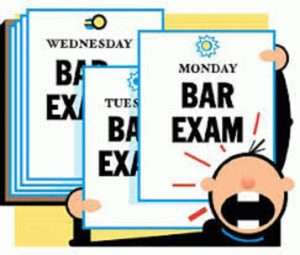
The famous columnist and Yale Law School professor points out that the case made against other standardized tests, such as the LSAT, also applies to bar exams.
In a recent article in Bloomberg, prominent columnist and Yale Law School Professor Stephen Carter makes the case for abolishing the the bar exam as a requirement for admission to the legal profession. As he points out, the arguments usually advanced for abolishing the LSAT as a requirement for admission to law school also apply to requiring passing the bar exam as a precondition for entering the legal profession:
Should law school applicants still have to take the LSAT? A proposal by a committee of the American Bar Association would eliminate the longstanding rule that accredited law schools must require prospective students to take a "valid and reliable test" as part of the application process. If the LSAT is axed, maybe the bar exam should be next.
The recommendation to eliminate the admissions testing requirement comes amidst cascading charges that reliance on the Law School Admission Test hurtsminorityapplicants. The proposition is sharply contested by many friends of diversity…. Some find it stigmatizing to be told they can't do as well on the test as White applicants. But given that the case against the test appears to have persuaded the wordily named Council of the ABA's Section of Legal Education and Admissions to the Bar, let's assume for the sake of argument that the LSAT does indeed represent an unfair barrier to entry to the legal profession.
Why doesn't the same argument apply to the bar examination?
I'm serious.
Except in Wisconsin, nobody can practice law without passing the bar examination. Some states — California is the most prominent — require even lawyers who are licensed elsewhere to pass an examination if they want to move into the jurisdiction. Such rules function as classic barriers to entry, easily manipulated to keep the supply of lawyers low.
Moreover, the ABA admits that minority bar examination passage rates continue to lag. A 2021 study found that a rising percentage of non-White students at a law school is correlated with a reduction in the school's bar passage rate. Hmmm. If the LSAT is a problem because of its supposed effect on diversity, maybe the bar examination should join it in the waste bin. Or the exam could be optional, leaving employers to decide whether they want to require it.
The barrier to entry, even minority entry, might be justified if we could point to the vital public purpose the bar examination serves. That's harder than one might suppose….
Don't get me wrong. I'm not against standardized testing in every circumstance. For example, I'd support a plan under which the bar authorities would follow the medical profession in requiring a certification process before members can market themselves as specialists in particular fields. But there's no persuasive justification for forcing graduates of accredited law schools to jump through yet another hoop before they're allowed to practice their trade.
I've been on the anti-bar exam bandwagon for many years now. I first made the case for abolition back in 2009, along with a "modest proposal" for reform in case abolition turns out to be politically infeasible. I am pleased to welcome Prof. Carter to the small, but hopefully growing, Bar the Bar Exam movement! His eloquence and stature in the legal world might enable him to win more people over to the cause than I ever could.
He is absolutely right that the case against the LSAT also applies to bar exams. Carter is also right to point out that if bar exam passage had real value in predicting a lawyer's competence, employers could just adopt the requirement voluntarily. I made a similar argument back in 2010. Indeed, abolition of the bar exam requirement could incentivize both bar associations and other groups to create voluntary certification systems that measure lawyer quality much better than current bar exams do (the latter are mostly just tests of memorization).
The comparison with the LSAT actually understates the case for bar exam abolition. I don't have a strong view on whether the LSAT should be retained. But it does serve one useful function that bar exams do not. The LSAT gives law school admissions offices a common metric for evaluating applicants from hundreds of different undergraduate institutions, with widely divergent majors. It's hard to say whether an applicant who graduated with a 3.5 GPA from as a physics major from Podunk University really has comparable credentials to a person who got the same GPA as a political science major from Big State U. But if they both got the same LSAT score, that makes it more likely their abilities are similar.
The LSAT might also make it easier for graduates of lesser-known institutions to compete with those who attended the Ivy League or other similar elite schools. If a Podunk grad got a higher LSAT score than a Harvard grad, that might be a good reason to pick the former over the latter, even if you normally would assign less weight to a Podunk degree than a Harvard one. Absent standardized testing, admissions officers will more often fall back on using school prestige as a proxy for applicant quality. That may be appealing if you're an elite college graduate (like me!). But not so much if you want to provide more opportunity to people who didn't attend such institutions - in some cases simply because they didn't fully mature and start working hard on academics until after high school.
None of this necessarily proves that law schools should retain the LSAT as an admissions requirement. It's possible that admissions offices should instead find better ways to assess applicants' undergraduate credentials, ones that rely less on crude proxies. Even if a standardized test of some kind should be used, the LSAT may not be the right one.
But these kinds of issues do provide potential rationales for the LSAT that do not apply to bar exams. Few if any legal employers use bar exam scores as a proxy for quality. Indeed, most states don't even make the scores available to test takers. If there are employers who believe that passing a memorization test really is a valuable credential, they have lots of other options, including just creating a simpler and easier to take memorization test of their own.
If employers want to ensure that the lawyer they hire reaches some minimal threshold of intellectual ability or conscientiousness, that should be readily evident from their law school grades and other previous academic record. The bar exam adds little, if anything, to these credentials.
And, as I have pointed out before, the bar exam is not a good indicator of the test taker's competence in handling legal issues. Most of the thousands of petty rules tested are ones most lawyers never actually use when they practice law. Indeed, the vast majority of current practicing lawyers - including those at the very pinnacle of the profession - probably couldn't pass their state's bar exam again if they had to take it without studying. If the exam really did test knowledge that is essential for every lawyer to know, that would be a terrible scandal. But virtually all lawyers know it doesn't. Instead, it's primarily a barrier to entry into the profession, keeping out people who are bad at memorization, or unable to take the time and effort to memorize many thousands of petty rules that you can then forget soon after taking the exam.
In sum, I hope more people with join Stephen Carter and myself in advocating abolition of the bar exam. But, if you're still not convinced, perhaps you might consider my "modest proposal" for reform:
Members of bar exam boards… and presidents and other high officials of state bar associations should be required to take and pass the bar exam every year by getting the same passing score that they require of ordinary test takers. Any who fail to pass should be immediately dismissed from their positions, and their failure publicly announced…. And they should be barred from ever holding those positions again until - you guessed it - they take and pass the exam.
After all, if the bar exam covers material that any practicing lawyer should know, then surely the lawyers who lead the state bar and administer the bar exam system itself should be required to know it. If they don't, how can they possibly be qualified for the offices they hold? Surely it's no excuse to say that they knew it back when they themselves took the test, but have since forgotten. How could any client rely on a lawyer who is ignorant of basic professional knowledge, even if he may have known it years ago?
Of course, few if any bar exam officials or state bar leaders could pass the bar exam without extensive additional study (some might fail even with it). That's because, as anyone who has taken a bar exam knows, they test knowledge of thousands of arcane legal rules that only a tiny minority of practicing lawyers ever use. This material isn't on the exam because you can't be a competent lawyer if you don't know it. It's there so as to make it more difficult to pass, thereby diminishing competition for current bar association members…. Effectively, bar exams screen out potential lawyers who are bad at memorization or who don't have the time and money to take a bar prep course or spend weeks on exam preparation.
My proposed reform wouldn't fully solve this problem. But it could greatly diminish it. If bar exam board members and bar association leaders were required to take and pass the exam every year, they would have strong incentives to reduce the amount of petty trivia that is tested. After all, anything they include on the exam is something they themselves will have to memorize! As prominent practicing lawyers, however, they presumably are already familiar with those laws that are so basic that any attorney has to know them; by limiting the exam to those rules, they can minimize their own preparation time. In this way, the material tested on bar exams might be limited to the relatively narrow range of legal rules that the average practicing lawyer really does need to know.
Our new Journal of Free Speech Law is faculty-edited, but we'd love to have help from students with proofreading and bluebooking. (We may also need some help with cite-checking, though so far we're having faculty have their own research assistants do that.) We publish both electronically and in print, and our first articles should be out in late July.
If you'd like to join our existing team of Production Editors (this is the title we give, on our site and in our print issues), please e-mail me at volokh@law.ucla.edu. In particular, we'll need several people who can work on our symposium articles over the next several weeks.
As you might gather from the job description, one thing we need is attention to detail. If your mind just absorbs information from written text, and doesn't bother you by alerting you to typos, then this will be a frustrating task for you. On the other hand, if errors just jump off the page at you as you read, you'd be perfect.
I realize that this is not like a normal law review: It will likely involve both less work and less responsibility. On the other hand, you'll get to read what we hope will be very interesting scholarship, participate in the process of publishing it (plus see your name in print on the masthead), and further practice your proofreading skills.
Just to be clear, as with other law reviews, we're looking for volunteers, though we hope that the students who participate will find this professionally valuable.
From Magistrate Judge Edwin Torres's Report and Recommendation in U.S. v. Stevens(S.D. Fla.) recommending denial of defendant's motion to dismiss, just adopted yesterday by Judge Darrin Gayles:
This case involves a religious psychic trying to break a family curse by "cleaning" "dirty" money. Far-fetched as that might be, the Government has chosen to make a federal case out of it. And not just any federal case; a criminal wire fraud and money laundering case against the self-professed psychic, Defendant Stevens. Defendant squarely takes aim at the government's indictment, however, as an assault on a wide range of religious evangelism for profit in America, despite the fact that such profit-making enterprises are now ubiquitous. Defendant fancies herself as a religious prophet and follower who believes in her psychic abilities and carried through on her promises. Defendant thus challenges the legal validity of the indictment and argues that it represents selective prosecution on the government's part in favor of one type of religious activism while trying to criminalize her own unique beliefs.
It is undoubtedly true that millions of religious faithful, in reliance on messages communicated by wire and mail through channels of interstate commerce, contribute millions (if not billions) of dollars to religious institutions and enterprises (non-profit entities that do not pay taxes on those millions) on the belief that, directly or indirectly, their efforts will prove to be fruitful and worthwhile. After all, if one believes in God, one may also believe that religious prophets are worth investing in as symbols or agents of one's God who do God's work here on earth.
A humanist or atheist, however, would see things very differently. They would say that anyone who buys that religious message with monetary strings attached is foolish or gullible or naïve. They would say that one who contributes money to a religious prophet, in the hope that God will be more merciful towards them or bestow upon them some favor or benefit, has been defrauded.
Ordinarily, especially in our country where the First Amendment is sacrosanct in its protection for those who exercise or believe in religion, the government is not supposed to come down on one side or the other of this fundamental debate. So what makes this case different? Has the government arguably come down on the side of a non-believer by seeking to criminalize a non-traditional religious-based practice even though religious profiteering by established religions are purportedly carried out every day?
From Golden Gate Land Holdings LLC v. Direct Action Everywhere, decided today (correctly, I think) by the California Court of Appeal (Presiding Justice Jim Humes, joined by Justice Sandra Margulies and S.F. Superior Court Judge Mary Wiss):
Golden Gate, which operates a horse racing track in Berkeley, filed this suit against Direct Action, an animal rights organization, and four individual defendants who are not parties to this appeal. The complaint's general allegations asserted that the four individuals, who were "affiliated with [Direct Action]," "climbed over [a] fence surrounding the horse racing track at [Golden Gate Fields (GGF)], trespassing on the GGF property," "lit incendiary devices that sent purple smoke into the air," "[lay] down directly on the racing track," and "connected their arms using PVC piping to make it difficult, if not impossible, for them to be physically removed." The "trespassers remained on the track for several hours," preventing scheduled horse races from taking place. Eventually, "the trespassers were removed by the police" and "criminally charged."
The complaint included two causes of action: one for trespass, and the other for intentional interference with prospective economic relations, in that the trespass "proximately caused [Golden Gate] to incur economic harm." The complaint also sought to "enjoin[] Defendants, their agents, officers, directors, employees, and those acting in aid of or in concert with them from trespassing on GGF."
Allegations tying Direct Action to the trespass asserted that the defendants were affiliated with each other and liable under various theories of relationship liability. Specifically, the complaint alleged that "each of the defendants … was … the agent, co-conspirator, aider and abettor, employee, representative, co-venturer, and/or alter ego of each and every other defendant, and in doing the thing hereinafter mentioned was acting within the course and scope of his, her, or its authority as such agent, co-conspirator, aider and abettor, employee, co-venturer, partner, and representative, and with the permission and consent of such other defendants." The complaint did not specify the circumstances upon which Direct Action's alleged vicarious liability was based.
The majority reads the statute broadly, and holds it's unconstitutionally overbroad; the dissent would read it more narrowly, as limited to constitutionally unprotected solicitation of specific criminal conduct.
From today's Tenth Circuit decision in U.S. v. Hernandez-Calvillo, written by Judge Nancy Moritz and joined by Judge Scott Matheson.
This appeal involves the constitutionality of a federal immigration statute that makes it a crime to encourage or induce a noncitizen to reside in the United States, knowing or recklessly disregarding that such residence violates the law…. We [conclude that] Section 1324(a)(1)(A)(iv)'s plain language targets protected speech, and neither the government's nor the dissent's proposed limiting construction finds support in the statute's text or surrounding context. And when properly construed, the statute criminalizes a substantial amount of constitutionally protected speech, creating a real danger that the statute will chill First Amendment expression….
Subsection (A)(iv), the provision challenged as overbroad here, makes it a crime to "encourage[] or induce[] an alien to come to, enter, or reside in the United States, knowing or in reckless disregard of the fact that such coming to, entry, or residence is or will be in violation of law." …
The government maintains that … the statute does not use the words encourage and induce in their ordinary sense; instead, the government asserts, it uses them as synonyms for the criminal-law concepts of facilitation (also known as aiding or abetting) and solicitation. In other words, the government reads subsection (A)(iv) as targeting those who facilitate or solicit others to engage in certain illegal immigration activity—specifically, unlawfully "com[ing] to, enter[ing], or resid[ing] in the United States." [But the court disagreed, for reasons I generally omit here. -EV] … The ordinary meanings of encourage and induce encompass both conduct and speech, and nothing in the statutory language or surrounding context suggests that Congress gave those terms a narrower meaning akin to the criminal-law concepts of facilitation and solicitation….
Our conclusion that subsection (A)(iv) reaches at least some speech does not end the analysis, of course, because the First Amendment does not protect all kinds of speech. Indeed, the Supreme Court has long recognized several "narrowly limited" categories of unprotected speech, "the prevention and punishment of which … raise [no] [c]onstitutional problem." These categories include "obscenity, defamation, fraud, incitement, and speech integral to criminal conduct." The government invokes the last category, arguing that any speech covered by subsection (A)(iv) is unprotected because it is "integral to criminal conduct."
The inquiring full-time judge asks if it is ethically permissible to serve on the board of directors of the New York Civil Liberties Union (NYCLU). As the organization's website explains:
Our mission is to defend and promote the fundamental principles and values embodied in the Bill of Rights, the U.S. Constitution, and the New York Constitution, including freedom of speech and religion, and the right to privacy, equality and due process of law, with particular attention to the pervasive and persistent harms of racism. The NYCLU works toward its mission by advocating for all New Yorkers to have equal access to opportunities and the equal ability to participate in government decisions that affect them. This includes planning and development decisions, which historically have excluded or intentionally discriminated against Black, Indigenous, and Latinx New Yorkers.
To advance this mission, the NYCLU "works in the courts as a public-interest law firm, bringing constitutional test cases in state and federal court" and engages in "[l]egislative advocacy" as part of an "interdisciplinary approach to protecting civil liberties, which also includes litigation, community organizing, and communications."
Reviving Rationality is something of a sequel to their prior book on cost-benefit analysis, Retaking Rationality: How Cost-Benefit Analysis Can Better Protect the Environment and Our Health. In the first book (which I also reviewed), Livermore and Revesz made the case for cost-benefit analysis as a tool of progressive government. In Reviving Rationality, they note how the Obama Administration (largely) followed their advice and critique the Trump Administration for abandoning principled cost-benefit analysis in regulatory policy.
Here is a taste of my review:
Under Trump, Livermore and Revesz argue, "what is called cost–benefit analysis in a Republican administration is all but unrecognizable." CBA was no longer a tool to ensure policymakers were aware of potential regulatory consequences, but a game in which analyses were to be twisted and spun to support predetermined policy conclusions.
The result, in their view, was not simply the adoption of incoherent and harmful policies, but an assault on longstanding "norms in the American system of governance that have constrained and informed agency decision making." That, in turn, demoralized the federal workforce. What is needed now, they argue, is an effort to "double‐down" on the Obama administration's approach and go "even further to integrate cost–benefit analysis with a progressive regulatory agenda."
Much of Reviving Rationality is devoted to critiquing the Trump administration for its ill‐grounded and poorly executed deregulatory initiatives. According to the authors, many Trump actions were undertaken with insufficient analytical grounding and without regard for relevant legal constraints and procedural requirements. As a consequence, the administration lost early and often when its actions were challenged in federal court. The Environmental Protection Agency, in particular, suffered numerous early defeats in court and ultimately accomplished little in the way of lasting change, deregulatory or otherwise.
The authors' detailed critiques of several specific Trump administration initiatives are forcefully presented and often compelling. Some of their broader claims about the role of regulatory review and CBA are less powerful and are less likely to persuade those who do not share their progressive outlook and regulatory sympathies. It is one thing to excoriate the Trump administration for its disregard of the legal and administrative norms governing regulatory agency activity. It is another to brush aside concerns for aggregate regulatory burdens or suggest that ex ante cost–benefit assessments should be the central focus of regulatory policy.
And here is how my review concludes:
At its best, Reviving Rationality identifies the potential value of sensible CBA and identifies many of the foibles of CBAs gone wrong. Livermore and Revesz's detailed analyses of several Trump administration regulatory actions are insightful, even if one thinks they occasionally overstate their case.
At times, the authors seem to suggest CBA has more to offer than is actually realistic, and they too readily accept the argument that net economic benefits suggest there is a market failure that government must correct. They nonetheless offer hope that serious CBA can constrain at least some regulatory excess within progressive administrations. (Indeed, it is a shame, at this point, that neither author has been tapped to lead Biden's OIRA.)
While Reviving Rationality might not convince CBA's fiercest critics, it is an important entry in the relevant literature. It firmly establishes Livermore and Revesz as the leading progressive advocates of cost–benefit analysis.