The Volokh Conspiracy

Mostly law professors | Sometimes contrarian | Often libertarian | Always independent | Est. 2002

The Volokh Conspiracy

Free Speech

Schoolteachers' First Amendment Rights to Publicly Criticize Transgender Pronoun Policies,

including saying "I will not affirm that a biological boy can be a girl and vice versa."

|

From the Virginia Supreme Court's decision in Loudoun County School Bd. v. Cross last August, but for some reason just posted on Westlaw in the last day or two; it mostly defers to the trial court's judgment, but also has some more to say about employee speech rights more broadly:

Cross has worked in Loudoun County Public Schools as an elementary school physical education teacher for eight years…. [T]he School Board is considering whether to adopt Policy 8040, "Rights of Transgender Students and Gender-Expansive Students" ("transgender policy"). If adopted, the transgender policy will: (1) allow students to use a name different than their legal name; (2) allow students to use gender pronouns different from those corresponding to their biological sex; (3) require school staff to use students' chosen name and gender pronouns; and (4) allow students to use school facilities and participate in extra-curricular activities consistent with their chosen gender identity. Cross' complaint asserted that, based on scientific evidence regarding gender and child development, his philosophical views on the rights of parents and educators, and his Christian religious beliefs, he objects to (1) the idea that someone can be transgender, (2) treating children as transgender, and, accordingly, (3) numerous aspects of the transgender policy.

Cross learned the Board would be considering whether to adopt the transgender policy during its May 25, 2021 meeting. He registered to speak during the meeting's public comment period and delivered the following statement:

My name is Tanner Cross. And I am speaking out of love for those who suffer with gender dysphoria. 60 Minutes, this past Sunday, interviewed over 30 young people who transitioned. But they felt led astray because lack of pushback, or how easy it was to make physical changes to their bodies in just 3 months. They are now de-transitioning. It is not my intention to hurt anyone. But there are certain truths that we must face when ready. We condemn school policies like 8040 and 8035 because it will damage children, defile the holy image of God. I love all of my students, but I will never lie to them regardless of the consequences. I'm a teacher but I serve God first. And I will not affirm that a biological boy can be a girl and vice versa because it is against my religion. It's lying to a child. It's abuse to a child. And it's sinning against our God.

The next day, Cross alleged, he fulfilled his teaching duties as usual. That evening, however, a supervisor asked to speak with Cross the next morning. When they met, the supervisor informed Cross he was being placed on administrative leave with pay. As an explanation for this decision, Cross received a letter from Assistant Superintendent Sebastian stating Cross was under investigation for allegations he engaged in conduct that had a disruptive impact on the operations of Leesburg Elementary. The letter also informed Cross that, absent permission from Leesburg Elementary principal, Shawn Lacey, he was banned from Loudoun County Public Schools property and events. Later that day, an email was sent to "all Leesburg Elementary parents and staff" informing them of Cross' suspension….

Read More

Religion and the Law

Maine May Mandate Vaccines for Health Care Workers with No Religious Exemption (but with Medical Exemption)

|

So Judge Jon Levy (D. Me.) held today in Lowe v. Mills. An excerpt:

In this case, the amended complaint and the properly considered documents,  information, and facts before me show that the purpose of requiring COVID-19 vaccinations for healthcare workers is solely to protect public health. Exempting individuals whose health will be threatened if they receive a COVID-19 vaccine is an essential, constituent part of a reasoned public health response to the COVID-19 pandemic. It does not express or suggest a discriminatory bias against religion.

In the context of the COVID-19 vaccine mandate, the medical exemption is rightly viewed as an essential facet of the vaccine's core purpose of protecting the health of patients and healthcare workers, including those who, for bona fide medical reasons, cannot be safely vaccinated. In addition, the vaccine mandate places an equal burden on all secular beliefs unrelated to protecting public health—for example, philosophical or politically-based objections to state-mandated vaccination requirements—to the same extent that it burdens religious beliefs.

Thus, the medical exemption available as to all mandatory vaccines required by Maine law does not reflect a value judgment unfairly favoring secular interests over religious interests. As an integral part of the vaccine requirement itself, the medical exemption for healthcare workers does not undermine the vaccine mandate's general applicability. The amended complaint does not plead any facts that plausibly support the conclusion that the COVID-19 vaccine mandate is not generally applicable. Because the COVID-19 vaccine mandate is both neutral and generally applicable, rational basis review applies.

The court also concludes that the mandate doesn't violate Title VII's duty of reasonable accommodation of religious objections; I may have more to say about that in a later post.

False Advertising Claim Over Allegations That "Michael" Included Tracks by Jackson Imitator Can Proceed

Commercial advertising for fully protected speech is treated as "commercial speech," and can be restricted on a strict liability basis if it misleads consumers (at least in this sort of situation).

|

From today's unanimous decision of the California Supreme Court in Serova v. Sony Music Entm't, written by Justice Martin Jenkins:

Plaintiff Vera Serova purchased Michael, an album of music billed as Michael Jackson's first posthumous release. The album's back promised "9 previously unreleased vocal tracks performed by" the pop superstar, but Serova now thinks some of these tracks, the so-called Cascio tracks, feature a Jackson imitator. She asserts Michael's marketers misled her and violated two California consumer protection laws, the unfair competition law and the Consumers Legal Remedies Act, by misrepresenting the vocalist on the Cascio tracks through the album's packaging and in a promotional video….

[The lower court held that, e]ven if the statements about Jackson's contributions were false, …. the First Amendment requires classifying them as noncommercial speech, a classification that would offer the statements greater protection from government regulation and, per the parties' agreement, put them beyond the reach of the consumer protection laws Serova invokes. The album marketers' statements were, in the court's view, noncommercial, because they "were directly connected to music that itself enjoyed full protection under the First Amendment" and "concerned a publicly disputed issue about which [the speaker] had no personal knowledge."

We disagree and reverse. The album-back statement and video were commercial advertising meant to sell a product, and generally there "can be no constitutional objection to the suppression of commercial messages that do not accurately inform the public." We recognize artistic works such as albums, in some instances, enjoy robust First Amendment protections, but that does not turn all marketing of such works into noncommercial speech, and it does not do so in this case. Additionally, a seller's purported lack of knowledge of falsity does not tell us whether that seller's speech is commercial or noncommercial, and commercial speech does not shed its commercial nature simply because a seller makes a statement without knowledge or that is hard to verify. The First Amendment has long coexisted with no-fault false advertising laws….

To be sure, sometimes commercial advertising for noncommercial speech—"noncommercial speech" here meaning speech such as books, films, or music, which isn't "commercial speech" for First Amendment purposes even though it's sold in commerce—is indeed assimilated to noncommercial speech. For instance, the First Amendment protects, notwithstanding state "right of publicity" laws, an author's right to publish and sell an unauthorized biography, and that includes the right to use the subject's name in ads or covers for the biography. But the court distinguished that situation thus:

Read More

Free Speech

Parts of the Mar-A-Lago Search Warrant Affidavit Will Be Unsealed

|

From today's court order:

THIS CAUSE is before the Court on motions to unseal the search warrant materials, including the probable cause affidavit, that were filed by the Media-Intervenors. ECF Nos. 4, 6, 9, 20, 22, 23, 30-33. Today I held a hearing on the motions. As I ruled from the bench at the conclusion of the hearing, I find that on the present record the Government has not met its burden of showing that the entire affidavit should remain sealed.

It is ORDERED that by noon EST on Thursday, August 25, 2022, the Government shall file under seal its proposed redactions along with a legal memorandum setting forth the justification for the proposed redactions. It is FURTHER ORDERED that ECF No. 57 shall be unsealed by the Clerk of Court.

Here's ECF No. 57, which isn't terribly exciting. You can also read the government's argument against unsealing the probable cause affidavit, and the media intervenors' argument in favor of unsealing it (though perhaps with redactions).

The En Banc Fifth Circuit Sharply Divides On Personal Jurisdiction and the Fifth Amendment

The Court's originalists (Ho, Elrod, and Oldham) disagree on the original meaning of the Due Process of Law.

|

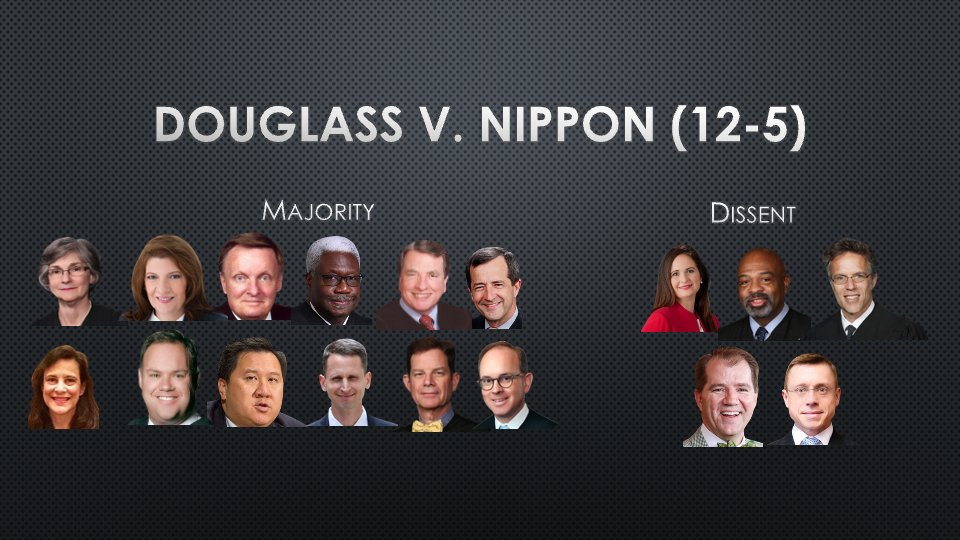
After the Supreme Court, the Fifth Circuit is the most fascinating court in the land. The Fifth Circuit gets lots of bad publicity for its conservative bent, but as I explained my address, the conservatives are not monolithically conservative. Case in point Stephen Douglass (no, not that Stephen Douglas) v. Nippon Yusen Kabushiki Kaishai. This dispute arose from a collision in foreign waters. A foreign corporation was sued for violating federal law in federal court. The question presented is whether the same rules that govern personal jurisdiction under the Due Process Clause of the Fourteenth Amendment apply to personal jurisdiction under the Due Process Clause of the Fifth Amendment.

The en banc court split 12-5. The majority opinion was written by Judge Jones, and was joined by Chief Judge Richman and Judges Smith, Stewart, Dennis, Southwick, Haynes, Costa, Ho, Duncan, Engelhardt, and Wilson. In dissent were Judges Elrod, Graves, Higginson, Willett, and Oldham. This case does not fall along ideological lines. Not at all. At least on the Fifth Circuit, the views on personal jurisdiction are heterodox. But beyond these right-left divides, the court's prominent originalists disagreed over how to interpret the Fifth Amendment.


The majority opinion by Judge Jones states the issue:

The Fifth Amendment due process standard governs the personal jurisdiction inquiry in this lawsuit raising federal claims in federal court. The en banc dispute centers on whether the Fifth Amendment standard mirrors the "minimum contacts" and "fair play and substantial justice" principles underlying the Fourteenth Amendment personal jurisdiction inquiry.

The majority opinion by Judge Jones followed precedent governing the Due Process Clause of the Fourteenth Amendment, and held that the foreign corporation was not "at home" in the United States. Specifically, the majority held that the same test applies for both the Fifth and Fourteenth Amendments:

We reject the plaintiffs' theory and hold that the Fifth Amendment due process test for personal jurisdiction requires the same "minimum contacts" with the United States as the Fourteenth Amendment requires with a state. Both Due Process Clauses use the same language and serve the same purpose, protecting individual liberty by guaranteeing limits on personal jurisdiction. Every court that has considered this point agrees that the standards mirror each other. The plaintiffs' rule-centric argument, that importing the Fourteenth Amendment standards into the Fifth Amendment context renders Rule 4(k)(2) a nullity, is unpersuasive and wrong.

Judge Elrod wrote the principal dissent, which was joined by Judges Graves and Willet in full, and by Judges Higginson and Oldham in part (starting at p. 39). Judge Elrod writes that the Supreme Court has "reserved" the question of whether the Due Process Clause of the Fifth Amendment may have a different meaning that the Due Process Clause of the Fourteenth Amendment with respect to personal jurisdiction.

Elrod posits that the meaning of "due process of law" is different in the Fifth and Fourteenth Amendments. That is, there was "linguistic drift" between 1791 and 1868. Here, she cites citing recent scholarship from Max Crema and Larry Solum, Steve Sachs, and others.

Read More

Campus Free Speech

Can University-Run Social Media Accounts Block You?

An interesting new addition to the flurry of lawsuits over the First Amendment implications of social media

|

The question of whether then-President Donald Trump could block people on Twitter focused a lot more attention on a curious little world of how politicians behave on social media. In our brave new world, government officials have social media accounts, as do governmental entities. Government officials and governmental entities are bound by the First Amendment. Blocking people on Twitter mostly raises questions about social media etiquette, but courts are increasingly being asked whether it also raises questions about constitutional law.

The Knight First Amendment Institute sued Donald Trump for blocking people on Twitter, arguing that the reply thread to his @RealDonaldTrump account had become a designated public forum and posting in that virtual space was protected by the First Amendment. Eventually they won in the Second Circuit. Other courts have similarly found that when government officials use social media accounts as a tool of office, they are constitutionally limited in how they exclude people from that virtual space (though not if they keep their public business out of their private social media account).

Since state universities are also governmental actors, and state universities maintain social media accounts, it was only a matter of time before these questions intersected with campus speech disputes.

Bruce Gilley is a political science professor at Portland State University. In the past few years he has become a fairly controversial figure, initially as a result of publishing a scholarly article making the case for colonialism.

He has now filed suit against the communications manager of the University of Oregon Division of Equity and Inclusion for blocking him on Twitter. The Division of Equity and Inclusion is a center on the University of Oregon campus, and it has an official Twitter account.

In his complaint, brought by the Institute for Free Speech, Gilley alleges:

Oregon's flagship state university has a Division of Equity and Inclusion ("Division"), whose communication manager, Tova Stabin, posts content on the topics of diversity, equity, and inclusion on the social media platform Twitter, using the Division's official account. She recently posted a "Racism Interrupter" prompt, which was open to comments by other Twitter users. But when Bruce Gilley posted "all men are created equal," Tova Stabin blocked him from the Equity Division's Twitter account, because he promotes a colorblind viewpoint with which she, and her employer, disagree. Stabin's blocking constitutes impermissible viewpoint discrimination, and it violates the First Amendment.

Moreover,

On July 5, 2022, after Bruce Gilley filed a public records request for the policy utilized by VPEI to block Twitter users, the University of Oregon informed him that there was no written policy and that the "staff member that administers the VPEI Twitter account and social media has the autonomy to manage the accounts and uses professional judgment when deciding to block users."

And thus,

In both cases, the University of Oregon has created the @UOEquity Twitter account to engage with the public and to solicit feedback. Its purpose is to interact with the public and to foster exchange. That is a public forum. Defendant Stabin was and is a state actor acting in the course and scope of her employment when she blocked, and continues to block, Bruce Gilley from the @UOEquity account. Defendant Stabin acted in a viewpoint discriminatory manner when she blocked Bruce Gilley from the @UOEquity Twitter account.

Defendant Stabin has a pattern and practice of blocking Twitter users from the @UOEquity Twitter account who express viewpoints she disagrees with, including viewpoints that are critical of the ideology of diversity, equity, and inclusion or the Division. Defendant Stabin, by blocking Gilley, also failed to implement a narrowly tailored content-neutral time, place, and manner restriction.

Should be interesting.

Free Speech

Media Intervenors' Argument Supporting Unsealing Mar-A-Lago Search Warrant Affidavit

The search warrant and some related materials have been unsealed—but the affidavit is where the details on the justifications for the search would be, and the government has argued this has to remain secret, at least for now.

|

Monday, I blogged the government's argument against unsealing the affidavit, and said I'd blog the reply to it when it was filed; here is the bulk of the principal reply:

The government and the Media Intervenors agree that the public has a "clear and powerful interest" in understanding the unprecedented investigation into former President Donald J. Trump's handling of classified records. They also agree that the common-law right of access applies to the search warrant materials currently under seal. They further agree that the law required release of the search warrant and property receipt, which the Court has now done, and that the cover sheets for the search warrant application, the government's motion to seal, and the Court's sealing order should be unsealed immediately as well, all with only minor redactions. And they agree that the government may be able to make a sufficient showing of a compelling interest authorizing it to maintain under seal some details of the investigation while it remains ongoing.

The government, however, has taken the position that the affidavit of probable cause must remain under seal in its entirety, despite the presumption of access, with little explanation as to how release would harm the ongoing investigation, and even though many details of the investigation are already public. In the government's view, the necessary redactions "would be so extensive as to render the document devoid of content that would meaningfully enhance the public's understanding of these events." This runs counter to the presumption of public access, which requires the disclosure of as much information as possible. The affidavit of probable cause should be released to the public, with only those redactions that are necessary to protect a compelling interest articulated by the government.

THE PUBLIC'S "CLEAR AND POWERFUL INTEREST" IN THE SEARCH WARRANT RECORDS EXTENDS TO THE AFFIDAVIT OF PROBABLE CAUSE.

As Attorney General Merrick Garland aptly wrote when he was Chief Judge of the D.C. Circuit:

Read More

Politics

Mask Mandate Doesn't Violate the First Amendment Right to Engage in Symbolic Expression

|

From a decision last week by the Washington Court of Appeals in Sehmel v. Shah, written by Judge Lisa Worswick, joined by Acting Chief Judge Anne Cruser and agreed with on this point by Judge Bernard Veljacic:

Appellants argue that the act of not wearing a mask communicates a political message, and is therefore entitled to the protections of the First Amendment. We disagree.

Although the First Amendment forbids restrictions on speech, federal case law has long recognized that the First Amendment protects more than the "spoken or written word." "'Speech' includes nonverbal conduct if the conduct is 'sufficiently imbued with elements of communication.'"

In deciding whether conduct may constitute speech, thereby implicating the First Amendment, courts examine whether (1) the person intended to convey a message, and (2) whether it was likely that a person who viewed the conduct would understand the message. The United States Supreme Court rejected the idea that any conduct may be labeled as speech whenever the person engaging in the conduct intends to express or communicate an idea. The expression must be "overwhelmingly apparent" and not simply a kernel of expression. The fact that "'explanatory speech is necessary is strong evidence that the conduct at issue … is not so inherently expressive that it warrants protection' as symbolic speech" [indirectly quoting Rumsfeld v. FAIR (2006)].

Read More

Religion and the Law

The Increasingly Dangerous Variants of the "Most-Favored-Nation" Theory of Religious Liberty, Part IV: Easy Paths to Strict Scrutiny

|

Let's move on to other variants. One looks at whether a law has any exceptions at all, and, if religious reasons are not among those exceptions, automatically applies strict scrutiny. It was proposed by Justice Kavanaugh in his dissent in Calvary Chapel Dayton Valley v. Sisolak, and possibly embraced by the Court in Roman Catholic Diocese of Brooklyn v. Cuomo. Call this MFN-3.

Yet another is to ask whether government fails to pursue an interest with uncompromising zeal, as the Court did in Tandon and its other Covid decisions. If so, and there is no religious exemption, strict scrutiny applies. Call this MFN-4.

Roberts's opinion for the Court in Fulton v. Philadelphia scrutinizes a law that has always been applied uniformly and declares that, because he discerns a formal power somewhere that could grant exemptions, the regulation lacks general applicability and so triggers strict scrutiny. Call this MFN-5.

The first five variants all expand the set of laws that are subject to strict scrutiny. None of them logically entails anything about what courts should do when applying that scrutiny. It is in principle possible for that scrutiny to be applied in a sensible way, giving appropriate weight to the state's interests. However, MFN-2 typically distorts the application of strict scrutiny after triggering it. When the court asks whether the state's interest is compelling, that inquiry is impaired, because the court is already committed to a misunderstanding of the pertinent interest.

Read More

Politics

Vogue on KBJ and ACB

Contrast how the fashion magazine treats the two newest members of the Supreme Court.

|

The September issue of Vogue Magazine is a big deal. In the past, the publisher would boast of how loud a "thud" it made when dropped off a coffee table. The cover of the September 2022 issue announces Serena Williams' retirement. And inside the issue is a profile of the newest member of the Court, titled The Grace and Promise of Justice Ketanji Brown Jackson. Legendary photographer Annie Leibovitz (who just finished snapping the Zelenskys in Ukraine) took two pictures of Justice Jackson. Both shots are taken at the Lincoln Memorial at dawn.

In the first shot, Jackson is seen in front of the reflecting pool, wearing an "Aliétte coat." In the second shot, Jackson is leaning against a column with Lincoln in the background, wearing an "Oscar de la Renta coat and dress."

(I understand there is some dissatisfaction that a white photographer (Leibovitz) took the shots of Jackson.)

For those curious, Justice Amy Coney Barrett did not receive a glowing profile in Vogue. Nor did the magazine send Leibovitz to South Bend. Indeed, the first article in Vogue about Barrett is titled. "Does Amy Coney Barrett Believe Life Begins at Fertilization?" The photo is not the most flattering.

In the wake of Dobbs, I've written a lot about judicial courage. The five members of the majority knew full well that their vote would ostracize them from elite society for the rest of their lives. Had any of them changed their vote, and saved Roe, they would be feted as saviors. A glossy spread in Vogue. Honorary degrees. Grand Marshall at the Rose Bowl parade (an honor Justice O'Connor received). But by sticking to their guns, and the law, they will receive none of these accolades. Good. Really, good riddance to these progressive efforts to manipulate the Justices. The Greenhouse Effect is long gone.

Which brings me back to Justice Jackson. We often speak of the cult of celebrity Justices. This obsession affected Justice Ginsburg's judgment, and likely dissuaded her from retiring. Judges, even those on the left, should resist the siren call of becoming pop icons. Yet, in this glamorous photo shoot, Justice Jackson models couture clothing. I know this was not her intent, but Jackson has become an unofficial spokesperson for Oscar De La Renta and Aliétte. Fame can quickly go to a person's head. And it never ends well for anyone, especially judges.

Finally, was the Lincoln Monument closed to the public for this shoot? Even with an early morning shoot run, there is usually someone on your left.

"'Holographic Conversational' AI Lets Dead Speak at Funerals"

|

From AV Magazine (Darron Kirkby):

[Start-up] StoryFile creates a digital clone of the subject by using 20 synchronised cameras to record them answering a series of questions. The footage is then processed, with clips tagged and used to train an artificial intelligence (AI) that can provide responses to questions in natural language.

One of the first users of the technology was Marina Smith MBE—the mother of StoryFile's chief executive Dr Stephen Smith—who died in June at the age of 87. In January, Smith, the co-founder of the UK's National Holocaust Centre and Museum, chose topics she thought her friends and family would want to ask about at her funeral. She then spent several hours over a two-day period recording two-minute video answers to 75 from a database of 250,000 potential questions, using a webcam and her computer.

At her funeral, Smith addressed her friends and family through a pre-recorded video about her life and spirituality. She was also able to answer questions from her loved ones during the memorial service, with the hologram creating the illusion of a real-time conversation.

Not the sort of thing I'd really want at a loved one's funeral, and the Smiths (both mother and son) may have been unusually interested in the technology. Still, others might disagree; and I can imagine that, once the software gets good enough, people might want to occasionally "talk" to their dead friends or family members—or perhaps have their children get to know their ancestors this way.

Administrative Law

The Good, the Bad, and the Ugly of Jarkesy v. SEC

Assessing an aggressive Fifth Circuit opinion declaring Securities & Exchange Commission proceedings unconstituional.

|

Earlier this year, in Jarkesy v. SEC, a divided panel of the U.S. Court of Appeals for the Fifth Circuit held that Securities and Exchange Commission's enforcement proceedings are unconstitutional on three separate grounds. Judge Elrod wrote for the panel, joined by Judge Oldham. Judge Davis dissented. Last month, the SEC filed a petition for en banc review.

The Jarkesy opinion brought cheers from some quarters, dismay from others. Even Jon Stewart had an opinion on it.

Yesterday I participated in a webinar on Jarkesy for the Federalist Society's Regulatory Transparency Project, and I thought it was worth a quick post to summarize my views on the good, bad, and ugly parts of the opinion.

The background of hte case is  that the SEC brought an enforcement action against Jarkesy and Patriot28, alleging that they had committed securities fraud. The SEC pursued the action not in federal court, but in an administrative proceeding in front of an Administrative Law Judge (ALJ), who concluded that the defendants had, in fact, committed fraud. The SEC affirmed this conclusion and rejected Jarkesy's constitutional challenges to the SEC proceedings, prompting Jarkesy to seek review before the Fifth Circuit.

Here is how the Judge Elrod summarized the case and the issues presented in the intro to the opinion:

Congress has given the Securities and Exchange Commission substantial power to enforce the nation's securities laws. It often acts as both prosecutor and judge, and its decisions have broad consequences for personal liberty and property. But the Constitution constrains the SEC's powers by protecting individual rights and the prerogatives of the other branches of government. This case is about the nature and extent of those constraints in securities fraud cases in which the SEC seeks penalties.

The SEC brought an enforcement action within the agency against Petitioners for securities fraud. An SEC administrative law judge adjudged Petitioners liable and ordered various remedies, and the SEC affirmed on appeal over several constitutional arguments that Petitioners raised. Petitioners raise those same arguments before this court. We hold that: (1) the SEC's in-house adjudication of Petitioners' case violated their Seventh Amendment right to a jury trial; (2) Congress unconstitutionally delegated legislative power to the SEC by failing to provide an intelligible principle by which the SEC would exercise the delegated power, in violation of Article I's vesting of "all" legislative power in Congress; and (3) statutory removal restrictions on SEC ALJs violate the Take Care Clause of Article II. Because the agency proceedings below were unconstitutional, we GRANT the petition for review, VACATE the decision of the SEC, and REMAND for further proceedings consistent with this opinion.

As indicated by the title of this post, there are parts of the Jarkesy opinion that I like, and there are others that I do not. So herewith are what I see as the good, the bad, and the ugly parts of the opinion.

First the "good". The Fifth Circuit's conclusion that the statutory limitation on the removal of SEC ALJs is unconstitutional is the strongest part of the opinion. The Supreme Court has made explicit that this is an open question, and relevant Supreme Court caselaw makes the conclusion that limiting removal of SEC ALJs is unconstitutional hard to resist. In Lucia the Court concluded that SEC ALJs are "officers" under Article II (albeit inferior officers), and in Free Enterprise Fund v. PCAOB the Court held that double-for-cause removal restrictions violate Article II. From this, the Fifth Circuit's conclusion easily follows.

The strongest counter-argument is that ALJs, unlike other inferior officers, do not exercise the sort of power that must be subject to presidential control, but this argument rests on the sort of functional analysis we have not seen in an majority opinion from the Supreme Court on appointment and removal in quite some time, and it is almost certainly a loser on the current court. On this point it is telling that the SEC hardly contests this holding in its petition for en banc review.

That "bad" part of the opinion, in my view, is the court's holding that the SEC's decision to adjudicate the case before an agency ALJ violated Jarkesy's Seventh Amendment right to a jury trial. I say this not because I am unsympathetic to the result, but because I think the Fifth Circuit's holding cuts against applicable Supreme Court precedent on the applicability of the Seventh Amendment to agency proceedings involving "public rights."

As a matter of first principles, the idea that the Seventh Amendment allows the government to prosecute individuals (albeit civilly) and subject them to substantial monetary and other penalties without affording them the right to a jury seems hard to credit, and Judge Elrod's opinion is persuasive on that point (perhaps, in no small part, because this is a subject on which she's written at least two law review articles).

The problem is that the Supreme Court said this was okay in Atlas Roofing v. OSHRC, and the Fifth Circuit's arguments that Atlas Roofing has been abrogated (by cases such as Granfinanciera v. Nordberg) or otherwise does not apply are thoroughly unconvincing. So while I would prefer a rule that prevents agencies from subjecting folks like Jarkesy to administrative proceedings of this sort, relevant precedent cuts the other way. And while it's certainly possible that the Supreme Court may revisit these prior cases to prevent the violation of Seventh Amendment rights in administrative proceedings, I think it's bad from circuit courts to effectively usurp that authority, as I think the Fifth Circuit did here.

That brings us to the "ugly": The Fifth Circuit's nondelegation holding. This part of the decision is almost certainly wrong, and I was quite surprised to read it. Here's how that portion of the opinion begins:

Petitioners next argue that Congress unconstitutionally delegated legislative power to the SEC when it gave the SEC the unfettered authority to choose whether to bring enforcement actions in Article III courts or within the agency. Because Congress gave the SEC a significant legislative power by failing to provide it with an intelligible principle to guide its use of the delegated power, we agree with Petitioners.

Set aside that the Supreme Court has turned away every opportunity to enforce the nondelegation doctrine in over eighty years. Assume that there are five votes on the Supreme Court to enforce the requirement that Congress articulate an "intelligible principle" when delegating what would otherwise be legislative power to agencies. Even with these concessions, this part of the opinion is still a confused mess.

Here's the problem: The delegated power at issue is the SEC's authority to make case-by-case decisions about how to enforce the securities laws against individual regulated entities. This is not legislative power. This is the sort of prosecutorial discretion that lies at the core of executive authority. And because this is not legislative power, no "intelligible principle" is required.

The Fifth Circuit tries to parry this objection by claiming that power is "legislative" if it has "the purpose and affect of altering the legal rights, duties and relations of persons." But this doesn't do the work the Fifth Circuit wants it to. Jarkesy's rights in an Article III court and in an administrative proceeding are what they are under the Constitution and relevant statutes. The SEC did not alter these rights. It merely chose how to enforce the laws Congress enacted.

Were the Fifth Circuit correct, it would be an unconstitutional delegation of power when Congress allows agencies (or any executive official, for that matter) the choice of proceeding civilly or criminally against a regulated entity for related conduct. This choice, much like the choice between an Article III court and agency proceeding, affects what rights the defendant may raise. Among other things, the finder of fact may not draw a negative inference from a defendant's invocation of the Fifth Amendment right against self-incrimination in a criminal proceeding, but can in a civil proceeding. And don't even get me started on how the Fifth Circuit's holding would make an absolute hash of immigration enforcement.

The point here is that The Fifth Circuit makes a fundamental category error when it characterizes the power at issue -- the power to choose which method of enforcement to use in a given case involving a given regulated entity -- as a legislative one. It is not, and the Fifth Circuit blundered when concluding otherwise.

As noted above, the SEC has filed an en banc petition in this case, so the panel opinion may not be the last word on these questions. Stay tuned to see whether the full court opts to clean up the mistaken parts of the opinion, or whether it saves these questions for the Supreme Court.


Law & Government

"Leung, Like the Villainous Deacon in the Movie Night of the Hunter, Was Back!"

An "inappropriate editorial statement[]" struck from a lawsuit alleging school sexual abuse, together with many other "immaterial and impertinent" statements.

|

From Chief Judge F. Dennis Saylor IV in McLeod v. Fessenden School (D. Mass.):

This case concerns alleged acts of sexual abuse and molestation of a student by her teacher. According to the complaint, some of the abuse occurred during a summer program at The Fessenden School…. The complaint, exclusive of exhibits, is 152 pages long; it names 49 defendants and purports to assert 65 counts. Portions of it read more like a tabloid story than a legal pleading, and large sections of it are obviously irrelevant and improper. Defendants have moved to strike various portions of the complaint under Fed. R. Civ. P. 12(f)….

Pursuant to Fed. R. Civ. P. 12(f), the court may strike from a pleading "any redundant, immaterial, impertinent, or scandalous matter." Rule 12(f) specifically gives the court discretion as to whether or not to strike a particular matter, although motions to strike are generally disfavored.

The challenged portions of the complaint contain substantial amounts of attorney argument, inadmissible opinion, legal conclusions, and irrelevant allegations. Such statements, at a minimum, are immaterial because they have "no essential or important relationship to the claim for relief or the defenses being pleaded" and are impertinent because they "do not pertain, and are not necessary, to the issues in question." They will accordingly be struck….

Read More

Climate Change

Third Circuit Rejects Oil Company Efforts to Remove Climate Claims to Federal Court

Five Circuits have considered, and rejected, fossil fuel efforts to get state-law tort and nuisance claims removed to federal court. Will their luck change in the Supreme Court?

|

Today the U.S. Court of Appeals for the Third Circuit decided Hoboken v. Chevron, rejecting the oil company defendants' efforts to remove state-law-based climate change claims to federal court. The opinion by Judge Stephanos Bibas is short and to the point, and makes quick work of the oil company efforts to derail climate change-based tort claims filed in state court.

Judge Bibas' opinion begins:

Our federal system trusts state courts to hear most cases—even big, important ones that raise federal defenses. Plaintiffs choose which claims to file, in which court, and under which law. Defendants may prefer federal court, but they may not remove their cases to federal court unless federal laws let them. Here, they do not.

Oil companies ask us to hear two sweeping climate-change suits. But the plaintiffs filed those suits in state court based only on state tort law. And there is no federal hook that lets defendants remove them to federal court. So we will affirm the District Courts' orders sending them back.

In his opinion, Judge Bibas swiftly and soundly dispatches the oil companies' three arguments for removal: 1) that tort claims based upon climate change actually arise under federal law either because they are "inherently federal" or because they necessarily raise substantial federal issues justifying removal; 2) that the claims relate to oil production on the Outer Continental Shelf, and 3) that the oil companies were acting under federal officers.

There is a logic to the argument that issues like climate change should be handled at the federal level, as opposed to in state-law-based litigation in state courts. I am sympathetic to that argument. Yet that is a choice to be made by Congress, not the courts. As Judge Bibas concludes:

Climate change is an important problem with national and global implications. But federal courts cannot hear cases just because they are important. The Constitution restricts us to resolving claims that are about federal law or that Congress has expressly authorized us to hear. These claims check neither box. So we cannot hear them.

In reaching this conclusion, the Third Circuit joined the First, Fourth, Ninth and Tenth Circuits in rejecting the oil company removal claims. (Another case is pending in the U.S. Court of Appeals for the Eighth Circuit.)

The one case in which the oil companies have fared better was in the U.S. Court of Appeals for the Second Circuit, but in that case the question was not removal but straight preemption. New York filed its claim in federal court int eh first instance, and the oil companies sought to have the suit dismissed on preemption grounds. The Second Circuit accepted these arguments (quite wrongly, in my view), but they concerned a slightly different question. I critique the Second Circuit opinion and explain why state-law-based climate claims are neither displaced or preempted by federal law in this article just published as part of a symposium on nuisance litigation in the Journal of Law, Economics, and Policy.

Despite their poor record in the circuit courts, the oil company defendants are seeking Supreme Court review. Over the summer, they petitioned for certiorari in Suncor Energy (U.S.A.) v. Board of County Commissioners of Boulder County (the case from the Tenth Circuit). In the petition for certiorari, which is supported by multiple business groups, the oil companies attempt to argue that there is a circuit split between the Second Circuit and the various circuits to have rejected removal. This argument seems like a stretch to me. Five circuits have considered the arguments for removal, and all five have rejected the claims (in opinions joined by judges from across the political spectrum). This would thus seem to be a poor candidate for Supreme Court review. We will see this fall whether the justices agree.

Free Speech

Religious Speech on or with Government Property

Some brief thoughts on the Kennedy v. Bremerton School District case from several weeks ago.

|

It took me a while to wrap my head around all the details in this case, but I finally did that while editing it down for the 2022 Supplement to my First Amendment and Related Statutes casebook. Here's my summary of the legal background, followed by excerpts from the relevant opinions (which are still long, unfortunately):

[a.] Summary

[1.] The Court takes the view that some government funding flowing to religious uses violates the Establishment Clause (see Part XII.A.1.b); that restraint has narrowed over time, but for a while it was quite broad. Given this, the Court has had to consider whether this principle prohibits private speakers from using government property or programs in ways that lead government funding to flow to those speakers' religious speech.

Widmar v. Vincent, 454 U.S. 263 (1981), Board of Ed. v. Mergens, 496 U.S. 226 (1990), Lamb's Chapel v. Center Moriches Union Free School Dist., 508 U.S. 384 (1993), Rosenberger v. Rector (1995) (p. 872), and Good News Club v. Milford Central School, 533 U.S. 98 (2001), all said "no": They held that religious groups (mostly K–12 or college student groups) were constitutionally entitled to equal access to government property and government funding programs, and shouldn't be excluded by the Establishment Clause from such funding.

[2.] For a time, the Court took the view that government speech could violate the Establishment Clause by endorsing religion (see Part XI.D). The Court thus likewise had to consider whether private religious speech on government property or using government funding violated this no-endorsement principle.

The cases cited above likewise said "no." Mergens, for instance, reasoned that, "The proposition that schools do not endorse everything they fail to censor is not complicated," and students could be expected to understand it. Likewise, in Capitol Square Review & Advisory Bd. v. Pinette, 515 U.S. 753 (1995), the Court held that religious speakers were entitled to equal access to public fora (including when the government chose to let groups place unattended signs or displays on public property), despite the concern that some passersby might perceive religious speech in a public forum as being endorsed by the government.

[3.] Finally, the Court takes the view that some government speech can psychologically coerce people into engaging in religious practice (see Part XI.E). Given this, the Court has had to consider what should be done when government employees who are speaking (or so they say) in their private capacities say or do things that might be psychologically coercive.

Read More

Religion and the Law

No Immediate Appeal of Denial of Church Autonomy Defense in Intra-Church Libel Case

A dispute about alleged forgery of letters related to the appointment of a Bishop in the Russian Orthodox Church Outside Russia leads to an important appellate procedure case in the Second Circuit.

|

From Belya v. Kapral, decided today by the Second Circuit, in an opinion by Judge Denny Chin, joined by Judges Raymond Lohier and Beth Robinson:

In this case, plaintiff-appellee Alexander Belya sued defendants-appellants—individuals and entities affiliated with the Russian Orthodox Church Outside Russia ("ROCOR" …)—for defamation, contending that they defamed him when they publicly accused him of forging a series of letters relating to his appointment as the Bishop of Miami.

Defendants moved to dismiss based on the "church autonomy doctrine," arguing that Belya's suit would impermissibly involve the courts in matters of faith, doctrine, and internal church government. The district court denied the motion. Defendants then filed a motion for reconsideration and a motion to limit discovery to the issue of whether the church autonomy doctrine applied or otherwise to stay proceedings. The district court denied those motions as well. Defendants appeal from the three interlocutory rulings.

Appellate jurisdiction typically requires either a final judgment, 28 U.S.C. § 1291, or a certified interlocutory appeal, 28 U.S.C. § 1292(b). The district court denied Defendants' motions without entering a final judgment (the case is pending in the district court, although proceedings have been stayed) and declined to certify an interlocutory appeal. Defendants argue that we have appellate jurisdiction based on the collateral order doctrine, which allows for appellate review of an interlocutory order if the ruling (1) is conclusive; (2) resolves important questions separate from the merits; and (3) is effectively unreviewable on appeal after a final judgment is entered.

We hold that the collateral order doctrine does not apply in the circumstances here. We therefore dismiss this appeal….

Belya served as a ROCOR priest in the Czech Republic and Slovakia before moving to the United States eleven years ago. He served in the United States as a ROCOR priest until September 14, 2019, when he was suspended pending an investigation into the matters discussed below.

Read More

Originalism

Sunstein Challenges Originalists on Bolling v. Sharpe (Updated)

If the Supreme Court was correct in Dobbs, was it wrong in Bolling?

|

In a lengthy guest post at Ius & Iustitium (aka the "common good constitutionalism" blog), Harvard law professor Cass Sunstein argues that Bolling v. Sharpe, in which the Supreme Court held that racial segregation of public schools in the District of Columbia violated the Due Process clause of the Fifth Amendment, cannot be reconciled with originalism, particularly not as embraced in the Supreme Court's recent Dobbs decision.

Here is how Professor Sunstein's post begins:

Uh oh.

For constitutional theory, Bolling v. Sharpe has always been a bit of a puzzle, but it is suddenly much more than that. In Bolling, the Supreme Court held that the Due Process Clause of the Fifth Amendment forbids Congress from segregating the schools in the District of Columbia. That holding is important in itself. Actually, it is much more than important in itself, because it is the source of the broad idea that the national government may not engage in racial discrimination. But Bolling is important as the foundation of an even broader idea, which is that principles of equal protection generally apply to the national government. Because the Equal Protection Clause can be found in the Fourteenth Amendment, and not the Fifth, we have to do considerable work to generate a theory to make sense of Bolling. In Bolling, the Court itself offered some of the essential ingredients of such a theory (as we shall see).

In Dobbs v. Jackson Women's Health Center, the Court cut the legs out from under Bolling. In essence, the Court held that to qualify for protection under the Due Process Clause of the Fourteenth Amendment, a litigant must show that the relevant right is "deeply rooted in this Nation's history and tradition" and "implicit in the concept of ordered liberty." It is exceedingly hard to show that a right to be free from segregation qualifies under this test – not least because segregation was required by the Black Codes, enacted throughout the South in the 1860s, and because the Supreme Court upheld segregation in 1896 and did not strike it down until 1954 (under the Equal Protection Clause). Racial segregation was both practice and permissible for about a century. Insofar as we are speaking of the Due Process Clause of the Fifth Amendment, the idea of a right to be free from racial segregation stands, under the Dobbs approach, on very shaky ground. In fact it is worse than that. For the approach in Bolling, Dobbs is an earthquake.

(footnotes omitted.)

And here is how Sunstein concludes:

My conclusion is that under the approach that commands a majority on the current Court, Bolling was wrongly decided; the question is not even a difficult one. Under that approach, discrimination on the basis of race and sex, or on any other ground, is subject to rational basis review (at most) – and under prevailing standards, must generally be upheld. If that is an unacceptable conclusion (and I believe that it is), it is a strong point for some version of Bolling and against the approach in Dobbs, at least under one view about how to choose a theory of constitutional interpretation.

I suspect some originalist scholars might have thoughts on this.

UPDATE: In United States v. Vaello Madero, Justice Thomas made the case that the Fourteenth Amendment's Citizenship Clause prohibits the federal government from discriminating on the basis of race. Professor Sunstein rejects the Citizenship Clause argument, but it is worth noting nonetheless as an originalist argument for the result in Bolling that does not rest on Due Process.

More