


The Volokh Conspiracy
Mostly law professors | Sometimes contrarian | Often libertarian | Always independent | Est. 2002

No Pseudonymization of Criminal Defendants in Court Opinions in California
In People v. Gregor, decided on Aug. 12 by the California Court of Appeal (Justice Elena Duarte joined by Justices Jonathan Renner and Peter Krause), the defendant, a naturalized citizen, "pleaded guilty to a felony sex offense that was later reduced to a misdemeanor and dismissed after early termination of probation":
In April 2011, pursuant to a plea agreement, defendant pleaded guilty to felony contacting a minor with the intent to commit a sexual offense (§ 288.4, subd. (b); count 2), and no contest to misdemeanor contact with a minor with the intent to commit a sex offense (§ 288.4, subd. (a)(1); count 3). Sentencing was delayed for one year. If defendant successfully completed a sexual integrity program, count 2 was to be dismissed.
This restricted his ability to sponsor family members for visas, which led him to ask to have his guilty plea withdrawn altogether:
After he was informed he was not able to sponsor his father for a family visa due to this conviction, defendant filed the instant motion pursuant to Penal Code section 1473.7 and sought to withdraw his plea claiming he was unable to meaningfully understand, defend against, or knowingly accept the adverse immigration consequences of his conviction. The trial court denied the motion; defendant appealed.
I skip here that substantive question, a matter I haven't at all studied, and focus on the pseudonymization question:
We first explain why we deny defendant's request to refer to him by his initials in this opinion. Defendant bases his argument on California Rules of Court, rule 8.90(b)(10) and (11). Rule 8.90(b)(10) is a "catch-all" provision that allows the court to use first name or initials "in other circumstances in which personal privacy interests support not using the person's name." Rule 8.90(b)(11) provides for the use of initials of "[p]ersons in other circumstances in which use of that person's full name would defeat the objective of anonymity for a person identified in (1)-(10)."
Today in Supreme Court History: August 22, 1998
8/22/1998: On August 22, 1998, Barry Black led a Ku Klux Klan rally in Carroll County, Virginia. The Supreme Court considered the constitutionality of his prosecution for cross burning in Virginia v. Black (20030.
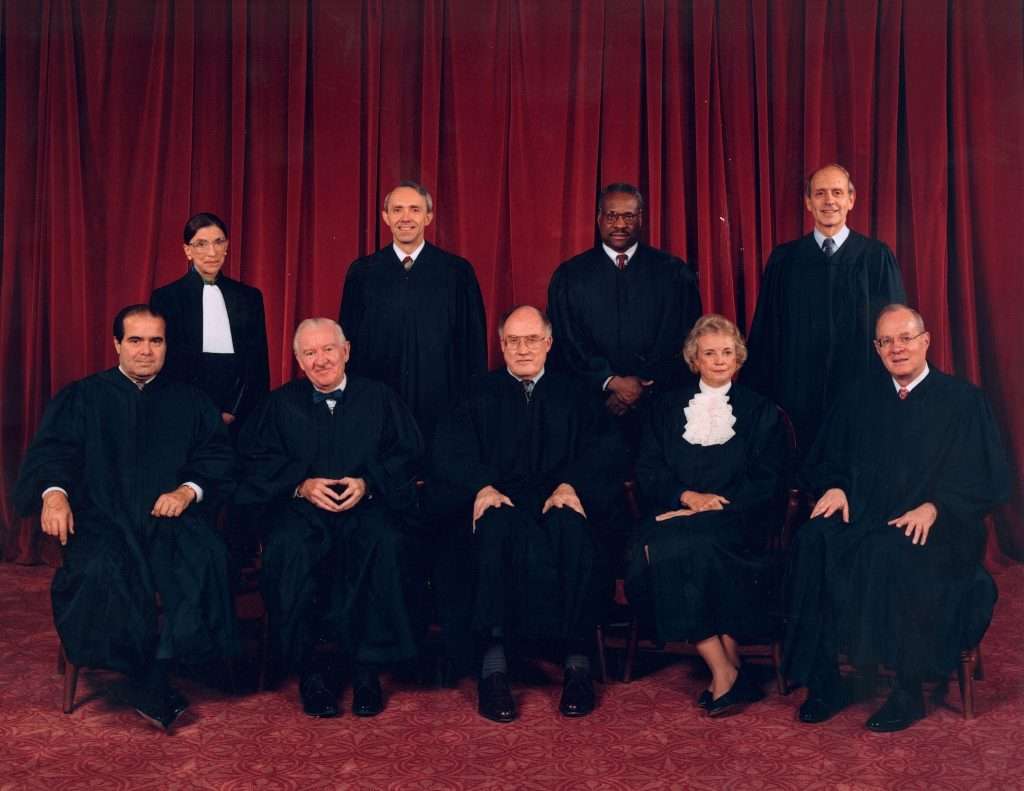
Originalism and the "Major Questions" Doctrine
Originalist legal scholars Mike Ramsey and Mike Rappaport debate whether the major questions doctrine - an important theory underlying several recent Supreme Court decisions - can be squared with originalism or not.

The "major questions" doctrine is a rule of statutory interpretation that requires Congress to "speak clearly when authorizing an [executive branch] agency to exercise powers of "vast 'economic and political significance.'" If such a broad delegation of power isn't clear, the doctrine requires courts to rule against the executive's claims that it has the authority in question.
For a long time, the major questions doctrine was a relatively obscure rule of interest mainly to experts in statutory interpretation, and lawyers litigating cases where it might come up. Only occasionally would it affect the outcome of a prominent case. But over the last year, the Supreme Court has relied on it in three major cases: the eviction moratorium decision, the OSHA large-employer vaccine mandate case, and West Virginia v. EPA. This has made the rule a focus of controversy, with critics arguing that it is a flawed doctrine misused by the conservative justices on the Supreme Court.
At the Originalism Blog (to which both are regular contributors), prominent originalist legal scholars Mike Ramsey and Mike Rappaport recently debated the issue of whether the major questions doctrine is consistent with constitutional originalism. Ramsey believes that it is, while Rappaport is skeptical.
Here's Ramsey:
I was initially skeptical of the major questions doctrine (MQD), as deployed by the Supreme Court in West Virginia v. EPA – basically for the reasons expressed by Chad Squitieri, Tom Merrill and Jonathan Adler. But with everyone ganging up on the MQD, my contrarian instinct pushes me the other way. So here is a tentative defense.
First, I assume that the Constitution's original meaning contains some reasonably strong version of the nondelegation doctrine, that is, that Congress cannot delegate important legislative matters to the President (or administrative agencies) as a result of Article I, Section 1's vesting of "all legislative Powers" in Congress…..
Second, I assume that the line between permissible and impermissible delegations is so difficult to define and apply that, except in extreme cases, the nondelegation rule is basically nonjusticiable, as held by the Supreme Court (per Justice Scalia) in the Whitman case… I'm not sure that's right, but I'm assuming it for purposes of the argument.
Third, I assume that Congress will often enact broad statutes in which the extent of the intended delegation is uncertain. (I'm pretty confident that's true).
Now for the argument:
The Court has a common and longstanding practice of developing clear statement rules (whether actually called by that name or not), by which the Court avoids an expansive reading of a statute unless Congress is clear in directing the expansive reading. For example, a clear statement is needed before a statute is read to interfere with a state's internal governance (Gregory v. Ashcroft), to apply to purely local activity (Bond v. US), to apply extraterritorially (Morrison v. National Australia Bank), or to impose criminal penalties (the rule of lenity).
Probably the earliest version in US federal law is the "Charming Betsy" rule, requiring a clear statement before a statute is read to violate international law. (The rule takes its name from Chief Justice Marshall's decision in Murray v. The Charming Betsy(1804)…). Specifically Marshall wrote in Charming Betsy: "an act of Congress ought never to be construed to violate the law of nations if any other possible construction remains."
I'm not sure that's good enough for a strict textualist, but as an originalist matter that's a pretty strong practice. (Also, for what it's worth, Justice Scalia endorsed most or all of the modern clear statement rules).
In my view, these rules aren't really about finding the true meaning of the statutory text. I doubt, for example, we can assume that, absent a clear statement, Congress doesn't want to violate international law, interfere with states' internal governance or create criminal penalties. Rather, these are rules of judicial restraint, avoiding a broad reading of a statute where the meaning is uncertain and there are severe costs to the court erroneously reading the statute broadly…..
Thus, the fact that the MQD applies a clear statement rule instead of applying close textual analysis isn't novel or contrary to originalism. To be consistent with historical practice, though, this particular clear statement rule needs to protect against some substantial negative effect of overreading a statute. For the MQD, I think that argument can be made, if one accepts the assumptions posited at the outset of this post. Nondelegation is an important constitutional value, assuring that the people's representatives in Congress make legislative decisions through a deliberative and accountable process. But since the Court can't enforce nondelegation directly and delegating statutes are often ambiguous as to their scope, there's a substantial risk courts will err in reading statutes too broadly, allowing too much delegation to the President or the agencies.
Ramsey's argument here is similar to that advanced by Supreme Court Justice Neil Gorsuch, who has also argued in several opinions that the major questions doctrine is best understood as a tool for enforcing nondelegation. For example, in his concurring opinion in Gundy v. United States (2019), Gorsuch notes that "[a]lthough it is nominally a canon of statutory construction, we apply the major questions doctrine in service of the constitutional rule that Congress may not divest itself of its legislative power by transferring that power to an executive agency."
Here's Rappaport's response:
Before discussing Mike [Ramsey's] view, let me state my basic objection to the MQD: It neither enforces the Constitution nor applies ordinary methods of statutory interpretation. Thus, it seems like a made up interpretive method for achieving a change in the law that the majority desires.
Mike's defense is based on his view that "The Court has a common and longstanding practice of developing clear statement rules." Even assuming that is true, I do not think that a longstanding practice establishes that something is originalist. For quite some time, at least until recent terms, the Supreme Court has been interpreting the Constitution and even statutes from an nonoriginalist perspective, but that does not make such nonoriginalism originalist. That Justice O'Connor announced a federalism canon in 1991 (or the Court applied similar ones in other cases from that time period) hardly provides support for the originalist bona fides of the canon.
Mike claims that this practice goes back to at least Chief Justice Marshall in the Charming Betsy (1804) and Talbott v. Seemen (1801), which required a clear statement before a statute is read to violate international law. But I am skeptical. Marshall may have applied the rule but did he "develop" it as Mike claims? At that time, the law often employed interpretive rules that sought to make different bodies of law cohere with one another. For example, statutes were interpreted in accord with the common law. I would be surprised if such a rule did not also apply to statutes and international law.
This is a key point. There is a strong argument for applying existing interpretive rules to statutes enacted in the shadow of such rules. This is original methods for statutory interpretation. It is quite another thing to make up interpretive rules after the enactment. That is nonoriginalism.
Another justification for the Charming Betsy rule is that it accords with the presumed intent of the Congress. That justification won't work for the MQD, since many of these statutes were passed during a period of broad delegation to agencies, when Congress appeared to desire broad delegations and certainly understood delegations would be read in that way. Mike doubts that the Charming Betsy rule can be justified as the presumed intent of Congress. But I am not so sure of that either. While Mike may be right that the present day Congress may not care so much about modern international law, I am less certain that the early Congress would have been willing to ignore international law when the U.S. was a much weaker nation and much more beholden to international law protections….
To be frank, I wish the MQD could be justified. It would certainly make things easier from the perspective of limiting delegations. But "wishing does not make it so."
Both Mikes make good points. But I largely agree with Ramsey. Indeed, I would go further. Even if nondelegation is justiciable, at least in some cases, the major questions doctrine can be justified as an additional tool for enforcing it, in situations where direct enforcement is infeasible for some reason (either because it is intrinsically impossible, or because judges just aren't willing to do it). In this way, MQD, like other "clear statement" rules can be seen as a second-best tool for enforcing constitutional constraints on government power that, in an ideal world, would get stronger protection.
I think Rappaport fails to effectively respond to this rationale for MQD. Even if it is not the ideal rule, it may be better than the available alternatives in a world where nondelegation is inadequately enforced.
I would add that, while both Mikes implicitly assume that constitutional originalists must also apply originalist principles to statutory interpretation, I am not convinced that is necessarily true. It may be so for those I refer to as "intrinsic originalists," who believe that originalism is inherently the only legitimate method of legal interpretation. But this is not true for what I call "instrumental originalists" - those whose support for originalism is based on the view that originalism leads to better consequences than other methodologies would. An instrumental originalist might conclude that, while constitutional originalism leads to better consequences than other constitutional theories, statutory originalism isn't necessarily superior in the same way to all of its rivals.
Rappaport (as described in his excellent book Originalism and the Good Constitution, coauthored, with John McGinnis) is an instrumental originalist. So too am I. That means we cannot presumptively reject nonoroginalist methods of statutory interpretation. For us, it is possible that MQD can be justified even if it is not originalist. That's especially true if it is a useful tool for enforcing constitutional rules that do have an originalist justification.
As Ramsey recognizes, his rationale for MQD (and Justice Gorsuch's and mine!) only works if nondelegation rules impose genuine limitations on congressional power to transfer authority to the executive. If the Constitution imposes few or no constraints on delegation, then MQD cannot be justified as a tool for enforcing those (by assumption, nonexistent) restrictions.
The extent to which there are constitutional limits to congressional delegations of power to the executive is a much-disputed issue. Though I generally think there are some significant limits, I won't try to defend that position here.
Even if MQD is a sound rule, that doesn't necessarily mean the Court applied it correctly in any given case. I have previously argued that it did so justifiably in the eviction moratorium and vaccine mandate rulings. West Virginia v. EPA strikes me as an at least somewhat closer case.
Federal Court Rules Against Florida Law Banning "Woke" Workplace Training
The court ruled - correctly - that the law violates the First Amendment.
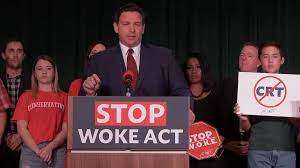
Last week, a US federal district court ruled that a key element of Florida's recently enacted "Stop Woke Act" is unconstitutional, because it violates the Free Speech Clause of the First Amendment. The relevant part of the act bars employers from requiring workers to attend trainings or engage in any other "activity" that involves promotion of any of a long list of prohibited ideas.
As Judge Mark Walker of the Northern District of Florida notes in his opinion, this is part of a pattern in which Florida has enacted a series of laws that violate the free speech rights of private organizations on the pretext that doing so somehow prevents them from undermining freedom of speech themselves:
In the popular television series Stranger Things, the "upside down" describes a parallel dimension containing a distorted version of our world…. Recently, Florida has seemed like a First Amendment upside down. Normally, the First Amendment bars the state from burdening speech, while private actors may burden speech freely. But in Florida, the First Amendment apparently bars private actors from burdening speech, while the state may burden speech freely. Compare NetChoice, LLC v. Moody, 546 F. Supp. 3d 1082, 1084 (N.D. Fla. 2021), with § 760.10(8)(a)–(b), Fla. Stat.
Now, like the heroine in Stranger Things, this Court is once again asked to pull Florida back from the upside down. Before this Court is a motion for a preliminary injunction, asking this Court to enjoin a host of Government officials from enforcing portions of the Individual Freedom Act—a law that prohibits employers from endorsing any of eight concepts during any mandatory employment activity. Because the challenged provision of the Act is a naked viewpoint-based regulation on speech that does not pass strict scrutiny, Plaintiffs' motion for a preliminary injunction…. is GRANTED in part.
The earlier case Judge Walker refers to is the litigation against Florida's social media law, which bars social media firms from engaging in most content moderation on their sites. That law was recently blocked, on First Amendment grounds, in a decision issued by the US Court of Appeals for the Eleventh Circuit, and authored by Judge Kevin Newsom, a conservative Trump appointee. In May, the US Supreme Court reinstated a lower court injunction against a similar Texas law.
The "Stop Woke Act" has similar problems. It bars mandatory workplace trainings and other required activities that advance a wide range of concepts:
(a) Subjecting any individual, as a condition of employment, membership, certification, licensing, credentialing, or passing an examination, to training, instruction, or any other required activity that espouses, promotes, advances, inculcates, or compels such individual to believe any of the following concepts constitutes discrimination based on race, color, sex, or national origin under this section:
1. Members of one race, color, sex, or national origin are morally superior to members of another race, color, sex, or national origin.
2. An individual, by virtue of his or her race, color, sex, or national origin, is inherently racist, sexist, or oppressive, whether consciously or unconsciously.
3. An individual's moral character or status as either privileged or oppressed is necessarily determined by his or her race, color, sex, or national origin.
4. Members of one race, color, sex, or national origin cannot and should not attempt to treat others without respect to race, color, sex, or national origin.
5. An individual, by virtue of his or her race, color, sex, or national origin, bears responsibility for, or should be discriminated against or receive adverse treatment because of, actions committed in the past by other members of the same race, color, sex, or national origin.
6. An individual, by virtue of his or her race, color, sex, or national origin, should be discriminated against or receive adverse treatment to achieve diversity, equity, or inclusion.
7. An individual, by virtue of his or her race, color, sex, or national origin, bears personal responsibility for and must feel guilt, anguish, or other forms of psychological distress because of actions, in which the individual played no part, committed in the past by other members of the same race, color, sex, or national origin.
8. Such virtues as merit, excellence, hard work, fairness, neutrality, objectivity, and racial colorblindness are racist or sexist, or were created by members of a particular race, color, sex, or national origin to oppress members of another race, color, sex, or national origin.
(b) Paragraph (a) may not be construed to prohibit discussion of the concepts listed therein as part of a course of training or instruction, provided such training or instruction is given in an objective manner without endorsement of the concepts.
Point 4 on this list is especially broad, as it appears to ban virtually any training involving advocacy of affirmative action on the basis of race, ethnicity or sex. I am no fan of such racial and ethnic preferences. But advocacy of them is pretty obviously legitimate discourse on an important issue.
Ironically, point 4 may even ban employee training sessions that promote conservative views opposed to accommodation of transgender individuals. After all, such positions almost unavoidably involve advocacy of the idea that people "should not attempt to treat others without respect to…sex." Rather, they necessarily require treating transgender people in accordance with their biological sex when it comes to such matters as deciding which bathrooms they are allowed to use.
Judge Walker effectively explains why these provisions of the law necessarily target speech, and thereby violate the First Amendment. They are not merely regulations of conduct:
To start—though trainings are admittedly at the center of this case—the IFA does far more than ban mandatory trainings. It bars "any . . . required activity" at which the eight forbidden "concepts" are discussed and endorsed. § 760.10(8)(a), Fla. Stat. (emphasis added). Conceivably, that includes trainings, phone calls, assignments, discussions—anything that is required and endorses the concepts.
More to the point, the IFA does not ban all mandatory employee trainings. Nor does it ban mandatory trainings addressing certain concepts. No, the IFA only prohibits trainings that endorse the covered concepts. Indeed, the IFA grants employers free rein to hold mandatory trainings addressing any of the eight concepts so long as those trainings condemn or take no position on those concepts.
Take that idea further. Because the IFA covers any required activity, an employer could require every employee to read Woke, Inc., Inside Corporate America's Social Justice Scam but could not require employees to read The Color of Law. Worse still, a nonprofit corporation devoted to promoting the idea that white privilege exists could not hold a required meeting at which it endorses the concept of white privilege. But a nonprofit holding the opposite view could freely hold meetings criticizing the concept of white privilege.
The bottom line is that the only way to determine whether the IFA bars a mandatory activity is to look to the viewpoint expressed at that activity—to look at speech. Plainly, the IFA regulates speech.
Not only does the law target speech; it singles out speech that advocates particular viewpoints on disputed issues, while giving more favorable treatment to speech that supports the opposite positions. Such targeting is a blatant violation of the First Amendment.
Perhaps the strongest possible defense of this part of the Stop Woke Act is by way of analogy to sexual harassment law. Under the Supreme Court's interpretation of Title VII of the Civil Rights Act of 1964, harassment - including that based solely on speech - is illegal, so long as it creates a "hostile environment" based on sex, that is "severe or pervasive." Florida's reliance on this analogy is another example of conservative efforts to appropriate anti-discrimination law for their own purposes. If free speech can be restricted in order to protect employees against sexual harassment, why not to protect "anti-woke" employees from workplace trainings that advocate positions they dislike?
Personally, I think sexual harassment law has gone too far in restricting speech, and some of it is unconstitutional. Co-blogger Eugene Volokh has written extensively on this point. But, as Judge Walker explains, the Anti-Woke Act goes even further than sexual harassment law does, and thus is unconstitutional even if the former is not:
Title VII does not regulate speech. Rather, it targets conduct—discriminating "with respect to . . . compensation, terms, conditions, or privileges of employment"—and only incidentally burdens speech. 42 U.S.C. § 2000e-2(a)(1); see Wisconsin v. Mitchell, 508 U.S. 476, 487 (1993) (calling Title VII "a permissible content-neutral regulation of conduct")…. That prohibition on conduct includes a bar on "requiring people to work in a discriminatorily hostile or abusive environment." Harris v. Forklift Sys., Inc., 510 U.S. 17, 21 (1993). In turn, to be sure, it can be mostly speech that creates this environment, but only when such speech is both objectively and subjectively offensive and when it is sufficiently severe or pervasive.
This "severity or pervasiveness" requirement—"that is, a requirement that the conduct objectively and subjectively creates a hostile environment or substantially interferes with an individual's work"—provides "shelter for core protected speech." DeJohn v. Temple Univ., 537 F.3d 301, 317–18 (3d Cir. 2008).
The IFA is the inverse. It targets speech—endorsing any of eight concepts—and only incidentally burdens conduct. Even the slightest endorsement of any of the eight concepts at any required employment activity violates the statute; the IFA requires no evidence that the statement be even subjectively offensive. Nor does the IFA require that the statement create a severely or pervasively hostile work environment. Thus, the IFA, by design, "provides no shelter for core protected speech…"
In drawing this distinction, this Court need not identify the line at which an antidiscrimination law crosses from incidentally burdening speech to directly restricting speech; the IFA sits comfortably on the direct-restriction side of that line and Title VII sits comfortably on the incidental-burden side. Thus, whether the IFA passes constitutional scrutiny has no bearing on whether Title VII passes constitutional scrutiny.
Litigation over this issue is likely to continue. The state will almost certainly appeal Judge Walker's ruling. But I would be surprised if the state ultimately prevailed. The targeting of speech here is too blatant for courts to overlook.
Conservatives who cheer on the Florida law should consider what liberal states - or, for that matter, a Democratic-controlled Congress - could do if allowed to engage in similar regulation. The same powers that Florida uses to target "woke" employer speech can just as easily be used against conservative employers. For example, it could be used to ban any required workplace training or "activities" that involve advocacy or promotion of any ideas that might be considered racist, sexist, culturally "appropriative," or otherwise offensive to left-liberal sensibilities. If you think courts should rule that kind of left-wing regulation unconstitutional, the same goes for the Stop Woke Act.
Today in Supreme Court History: August 21, 1798
8/21/1798: Justice James Wilson dies.
Court Upholds Injunction Barring Distribution of Material Recorded at National Abortion Federation Conference
The defendants, the court held, had "knowingly, voluntarily, and intelligently waived any First Amendment rights in disclosing the information they obtained at the NAF conferences" by agreeing to that as a condition of being admitted to the conference.
In National Abortion Fed'n v. Center for Medical Progress, decided Friday, the Ninth Circuit (Judges Sidney Thomas, Margaret McKeown, and Richard Clifton) upheld the constitutionality of a permanent injunction that ordered the Center for Medical Progress and David Daleiden not to distribute material that they had recorded at NAF conferences:
The Supreme Court has held that First Amendment rights may be waived upon clear and convincing evidence that the waiver is knowing, voluntary, and intelligent. Janus v. AFSCME (2018). Defendants knowingly, voluntarily, and intelligently waived any First Amendment rights in disclosing the information they obtained at the NAF conferences by signing the agreements with NAF. Daleiden voluntarily signed the agreements, and testified that he was familiar with the contents. The agreements unambiguously prohibited him from making records, disclosing recordings, and from disclosing any information he received from NAF. His waiver of First Amendment rights was demonstrated by clear and convincing evidence….
I think this is likely correct, for reasons discussed here and here. Here's a portion of an earlier District Court decision quoting the specific nondisclosures agreements:
Ramaswamy, Ho, and Goldman
A surprising (to me) controversy.
In Woke, Inc.: Inside Corporate America's Social Justice Scam, lawyer and businessman Vivek Ramaswamy talks about his internship at Goldman Sachs—an internship that he starts by saying was coveted because Goldman was "the most elite financial institution in America." "You didn't join Goldman as a summer intern for the $1,500-per-week paycheck, though that wasn't bad. Or for the possibility of a $65,000-a-year full-time offer for a 100-plus-hour-a-week job. You did it for the privilege of saying: 'I work at Goldman Sachs.'" But he soured on Goldman, in part because of things like the following incident:
The hallmark event at Goldman Sachs the summer I worked there wasn't a poker tournament on a lavish boat cruise followed by a debauched night of clubbing, as it had been at the more edgy firm where I'd worked the prior summer. Rather, it was "service day"—a day that involved dressing up in a T-shirt and shorts and then dedicating time to serving the community. Back in 2006, that involved planting trees in a garden in Harlem. The co-head of the group at the time was supposed to lead the way.
I welcomed the prospect of a full day spent at a park away from Goldman's cloistered offices. Yet when I showed up at the park in Harlem, very few of my colleagues seemed interested in … well, planting trees. The full-time analysts shared office gossip with the summer analysts. The vice presidents one-upped each other with war stories about investment deals. And, of course, the head of the group was nowhere to be found.
The "Good Ship Fifth Circuit" Denies En Banc Review in Sambrano v. United Airlines
Judge Smith dissents from the denial of rehearing, and Judge Ho concurs.
In February, a divided panel of the Fifth Circuit decided Sambrano v. United Airlines. This case involved the airline's requirement that employees get vaccinated. Judges Elrod and Oldham held that a federal court could issue a preliminary injunction in a Title VII case. Judge Smith dissented, very vigorously. I wrote about the case here.
Judge Smith was deeply perturbed that the majority chose not to publish its opinion. He called on the Fifth Circuit to grant rehearing en banc, but recognized that review was less likely since the panel opinion was unpublished. He wrote:
The fact that an opinion is unpublished furnishes just another reason to vote to deny en banc scrutiny. But by today's ruling, the Good Ship Fifth Circuit is afire. We need all hands on deck.
On the Fifth Circuit, it takes nine hands to grant review. But Smith only got four. By a vote of 13-4. the en banc court denied en banc. Smith was joined by Judges Higginson, Costa, and Willett. Judge Smith wrote a dissent that explains why the panel opinion troubled him so much. There is some history here.
First, Judge Smith highlights the fact that the majority "discarded" an opinion he wrote in 1989:
And [the panel] resurrects a forty-nine-year-old Fifth Circuit decision that the Supreme Court long ago relegated to the dustbin 4—while discarding a more recent decision that has been cited about three hundred times.5
4 Drew v. Liberty Mut. Ins. Co., 480 F.2d 69 (5th Cir. 1973).
5 White v. Carlucci, 862 F.2d 1209 (5th Cir. 1989) (Smith, J., joined by Politz and King, JJ.).
Here, Judge Smith goes out of his way to stress that he wrote Carlucci--something I did not realize when I read the panel opinion. And this case was released barely two years into Smith's tenure.
Second, Judge Smith flashes back to a Fifth Circuit rule change from 1996.
For reasons that I won't take the time to explain, this court decided that unpublished opinions released in or after 1996 would not be precedential.20 It makes some sense not to clutter reporting services with routine opinions that decide nothing new and affect only the immediate parties.
Judge Smith, however, opposed that rule change. And he wasn't alone.
That change generated considerable discussion. Along with a few other judges, I opposed that amendment even though, by then, all other circuits had chosen that path. We detractors warned, inter alia, that it would be too easy for any given panel majority to avoid the consequences of its decision—regardless of its importance—merely by adding the customary "do-not-publish" footnote. That way, a panel would feel comfortable declaring the winner without worrying about how doing so might affect future cases. Or, for much the same reason, a panelist might condition his or her concurrence on making the opinion unpublished.
It is rare for judges to air internal debates about rule changes. The most recent example I can recall is when Judge Willett referred to an internal court policy on en banc review of interim rulings. Though, this 1996 change is quite old. I'd wager that most of Judge Smith's current clerks were in diapers when President Clinton was re-elected.
Now, Judge Smith charges that Judges Elrod and Oldham exploited the loophole created by the 1996 rule change:
Our concern was prescient. As I say in my panel dissent, the "obvious result" of the majority's decision is to foster today's "'Blue Plate Special' cause" without committing to sweeping legal changes that may not always produce the same outcomes.21 This "'one and done' method of decision-making"22 is made possible only by abusing the availability of unpublished opinions―a device that the full court has now fully validated by denying re-hearing.
Third, now Judge Smith worries that other rogue panels can avoid en banc review by marking the opinion as unpublished:
And by a lopsided vote, the en banc court declines to lift a finger. After today, a future panel that wishes to use the "one and done" method of decisionmaking can feel more secure in thinking there will be no consequences.
Judge Smith concludes:
Although I am confident that my colleagues have good reasons for voting, overwhelmingly, not to vacate the panel opinion and rehear this case en banc, we have squandered an opportunity to recommit to principled decisionmaking.
This result replaces the rule of law with the rule of whim. I respect-fully dissent.
Yet, the Good Ship Fifth Circuit whimsically floats on.
Judge Ho wrote a concurrence to the denial of rehearing. (And for those keeping track, Judge Ho clerked for Judge Smith!) Judge Ho agrees with the panel opinion:
To millions of people of faith—including the members of the Supreme Court—it's painfully obvious that there's no way to calculate damages to compensate for the loss of one's soul.
Judge Ho also addressed a broader issue, that transcends the specifics of this case. Historically, conservatives have tended to favor the cause of corporations over the plight of employees. But in recent years, that trend has reversed as corporations have focused less on shareholder value and more on progressive politics. We are starting to see conservatives seek to use the power of the state to constrain companies that trample on traditional values. Sambrano is an illustration of that new dynamic: a corporation forced its employees to get vaccinated, while diminishing those who sought religious exemptions. (And, with some hindsight, we now know that the two-dose vaccines without a booster shot provided scant protection.)
Judge Ho speaks to these dynamics. He warns that more companies are trampling on religious beliefs--an injury that the panel majority deemed irreparable.
If the dissent is right, and this case is indeed pathbreaking, it's important to understand why. What's new here is not the law, but the behavior of industry. Historically, corporations typically focus on increasing shareholder value—not on imposing certain cultural values on others. But that is rapidly changing. began by imagining a hypothetical employer who doesn't care how productive an employee you might be—he insists that you abandon certain religious beliefs he finds offensive, whether it's abortion, marriage, sexuality, gender, or something else. But here's the thing: What was once hypothetical is now rapidly becoming reality. Examples of this abound. . . . So this case may be the first, but I suspect it will not be the last.
And, in such cases, injunctive relief will become a more common remedy.
My point today is less ambitious: We know what this new corporate trend is doing to employees. It's violating the religious convictions of workers across the country. And in cases like this, the injuries are irreparable. So unlike the dissent, I'm grateful that our court is taking the action it is today. And unlike the dissent, I don't think our circuit will be alone, as cases like this inevitably multiply across the country, assuming corporate trends persist. But if our circuit turns out to be alone in its defense of religious liberty, I'll be grateful for our actions today all the same.
Judge Ho references Vivek Ramaswamy's book, Woke, Inc. Ramaswamy had worked at Goldman Sachs, where he learned of the "Golden Rule" from a colleague:
He laughed and demurred: "Look, just do what the boss says." Then he quipped back: "You ever heard of the Golden Rule?"
"Treat others like you want to be treated?" I asked.
"Wrong," he said. "He who has the gold makes the rules."
I called it "the Goldman Rule." I learned something valuable that summer after all.
The Goldman Rule no longer has a monopoly on the right.
In the past, I have used Judge Jones as the lodestar of the Fifth Circuit's conservatism. And Judge Smith is not far behind. What is the conservative outcome in this case? Ruling for a multinational corporation and against the worker? Or ruling for a Title VII claimant? With so-called woke capitalism, the lines begin to blur.
Today in Supreme Court History: August 20, 1866
8/20/1866: President Andrew Johnson proclaims an "end to insurrection in the United States."
Libel and Presumed Damages in the Internet Age
[UPDATE 12/19/2023: The Kansas Supreme Court affirmed the Court of Appeals decision and declined, on stare decisis grounds, to overturn Gobin v. Globe Publishing Co. (Kan. 1982).]
From Marcus v. Swanson, decided today by the Kansas Court of Appeals, in an opinion by Judge Gordon Atcheson, joined by Presiding Judge Stephen Hill:
In this case, we must apply defamation law crafted 40 years ago to a decidedly 21st century set of facts. A plastic surgeon [Swanson] asserted that a "review" a disgruntled former patient [Marcus] posted on an internet site falsely impugned his professional reputation. A jury sitting in Johnson County District Court agreed and entered a $15,000 verdict for the physician. The district court set aside the verdict because the physician, who continued to maintain a full schedule of patients, did not prove any actual harm to his reputation as a result of the post—a necessary component for a successful defamation claim under Kansas law.
Under the First Amendment, a state may allow prevailing plaintiffs to recover "presumed damages" even in the absence of specific proof of harm to reputation, especially when it comes to speech on matters of private concern. Generally speaking, this happens under the "libel per se" doctrine, which in most states allows plaintiffs to recover such presumed damages if the statements fall within some specific categories that are seen as especially harmful, including allegations of incompetence or misconduct in one's profession. (Note that the parties in this case agreed that this speech was on a matter of private concern, though the defendant could have argued that public consumer complaints are on matters of public concern, as many courts have indeed held.)
But Kansas law has rejected this principle as a matter of state law, see Gobin v. Globe Publishing Co. (Kan. 1982), and the majority held that this was binding here:
North Carolina State Supreme Court Makes a Bold Move
The court declares that legislators elected in gerrymandered districts cannot fully exercise the powers of their office
The North Carolina state supreme court likes to play with fire.
Just a few months ago some Republicans were talking about the possibility of impeaching members of that court as it deliberated on whether to strike down legislative maps drawn after the 2020 census as unconstitutional partisan gerrymanders. The court eventually split along partisan lines to strike down the Republican drawn maps, and the case is now before the U.S. Supreme Court.
Today the state court again split along partisan lines in another extraordinary case. The electoral map that the state legislature had drawn after the 2010 census had previously been declared unconstitutional due to racial gerrymanders, but legislators were allowed to be elected and serve out their terms until a new map could be approved. The court today declared that those legislators had only limited authority given the flawed maps and some legislative tasks they were not allowed to perform. Specifically, the majority determined that the legislature was barred from proposing some constitutional amendments. Although the case was remanded back to the trial court for further proceedings, the clear implication is that the state constitutional amendment that had been proposed by that legislature and ratified by the voters that had empowered the legislature to adopt a voter ID law is invalid.
The principles of popular sovereignty and democratic self-rule as embodied in article I, sections 2 and 3 mean that individuals can only exercise the sovereign power that the people have transmitted to the legislature if they validly hold legislative office. The constitution defines and structures the processes by which individuals assume offices that permit them to exercise sovereign power, and sovereign power can only be lawfully exercised by individuals who have come into office through the processes established by the constitution for that very purpose. Burke v. Elliott (NC 1844). The legitimacy of any individual officer's claim to exercise sovereign power depends upon the legitimacy of the process by which that individual came to assume the office to which sovereign power has been delegated.
Consistent with the principles of popular sovereignty and democratic self-rule, only the people can change the way sovereign power is allocated and exercised within North Carolina's system of government. And, through their constitution, the people assigned the General Assembly a vital role in the amendment process. Specifically, the constitution authorizes the General Assembly to initiate the process of enacting constitutional amendments by "adopt[ing] an act submitting the propos[ed] [constitutional amendments] to the qualified voters of the State for their ratification or rejection," provided that "three-fifths of all the members of each house shall adopt [the] act." is undisputed that three-fifths of the members of each house adopted acts submitting the proposals to add the Voter ID and Tax Cap Amendments to the North Carolina Constitution, and that a majority of voters ratified both amendments in 2018. The sole question before us is whether the legislators who passed the bills submitting these two amendments to the voters could validly exercise the authority conferred upon the legislature by the people in article XIII, section 4.
The court lays out a new test for determining whether a constitutional amendment proposed by a legislature and ratified by the voters should nonetheless be struck down as constitutionally invalid.
Thus, when the votes of legislators elected due to an unconstitutional gerrymander could have been decisive in enacting a bill proposing a constitutional amendment, courts must assess whether there is a substantial risk that the challenged amendment will (1) immunize legislators from democratic accountability; (2) perpetuate the ongoing exclusion of a category of voters from the political process; or (3) intentionally discriminate against a particular category of citizens who were also discriminated against in the political process leading to the legislators' election. If any of these factors are present, then the balance of equities requires the court to invalidate the challenged amendment. If these factors are not present—or if the legislators elected due to an unconstitutional gerrymander were not so numerous as to be potentially decisive in the vote to put a proposed amendment to the people—the challenged amendment must be left in place.
The majority concludes,
"We should ever be mindful that the Constitution to a great extent is the rudder to keep the ship of state from off the rocks and reefs." Hinton v. Lacy (NC 1927). Although the questions raised in this appeal are novel, the answers can be found in the principles that are the foundation of North Carolina's system of government as expressed in multiple provisions of the North Carolina Constitution, the people's fundamental law. The people have reserved to themselves the power to amend or replace these principles and provisions. While they have assigned the legislature a role in the amendment process, the potentially transformative consequences of amendments that could change basic tenets of our constitutional system of government warrant heightened scrutiny of amendments enacted through a process that required the participation of legislators whose claim to represent the people's will has been disputed. Consistent with these constitutional principles and provisions, we conclude that acts proposing constitutional amendments passed by a legislature composed of a substantial number of legislators elected from unconstitutionally racially gerrymandered legislative districts, after the unlawfulness of those districts has been conclusively established, are not automatically shielded by application of the de facto officer doctrine.
The three justices in dissent practically begged the U.S. Supreme Court to overturn this case as a potential violation of the republican guarantee clause of the U.S. Constitution.
Breathtaking. Will be interesting to see what comes next.
The opinion can be found here. I have already edited the case for the companion site to the Howard Gillman, Mark Graber, and Keith Whittington American Constitutionalism casebook. Happy to share it for anyone interested.
Ninth Circuit Sends the Hawaii Concealed Carry Challenge Back Down to District Court
The en banc panel majority (seven judges) ordered today, in Young v. Hawaii:
The Supreme Court vacated the judgment of this Court, 992 F.3d 765, and has remanded this case to us "for further consideration in light of New York State Rifle & Pistol Assn., Inc. v. Bruen, 597 U.S. ___ (2022)," Young v. Hawaii, 2022 WL 2347578, at *1 (U.S. 2022). We vacate the judgment of the district court and remand this case to the district court for further proceedings pursuant to the Supreme Court order.
Judge Diarmuid O'Scannlain, joined by Judges Consuelo Callahan, Sandra Ikuta, and Ryan Nelson, dissented, arguing that the Ninth Circuit should have resolved the question itself:
I respectfully dissent from our failure to resolve the straightforward legal issues presented by this case. The Supreme Court has vacated the judgment of this Court and remanded this case to us "for further consideration in light of New York State Rifle & Pistol Association v. Bruen, 597 U.S. __ (2022)." But today, we decline to give further consideration to the question presented to us and we decline even to deal with it.
This case presents the following question: in light of the Supreme Court's decision in Bruen, does Hawaii's "may-issue" permitting scheme violate the Second Amendment right of a responsible law-abiding citizen to carry a firearm for self-defense outside of the home? Bruen held unconstitutional a "may-issue" permitting scheme for public carry of handguns, much like the law challenged in this case. So, after Bruen, the question before us is simple. Nevertheless, our Court today declines to answer it. In refusing to do so, our Court delays the resolution of this case, wastes judicial resources, and fails to provide guidance to the lower courts of our Circuit. As a judge of this Court, I feel obliged to offer such guidance, even if a majority of my colleagues does not….
George Young wishes to carry a firearm for personal self-defense in the State of Hawaii. He twice in 2011 applied for a license to carry a handgun, either concealed or openly. His application was denied each time by the County of Hawaii's Chief of Police, Harry Kubojiri, because Young failed to satisfy the requirements set forth in section 134-9 of the Hawaii Revised Statutes ("H.R.S.").
Short Circuit: A Roundup of Recent Federal Court Decisions
Collisions, allisions, and grand jury witnesses.
Please enjoy the latest edition of Short Circuit, a weekly feature written by a bunch of people at the Institute for Justice.
Friends, do you like tacos? What about late at night, perhaps after an adult beverage? If so, you should be just as hopping mad as we are about the city of Denver's recent ban on food trucks in Lower Downtown. Though ostensibly enacted with the goal of reducing crime, a 2012 IJ study found that the presence of food trucks actually reduces crime by providing extra eyes on the street. Smells like protectionism for brick-and-mortar restaurants to us. While a letter from IJ convinced the city to partially repeal the ban, IJ won't rest until the senseless ban is totally repealed. Click here to learn more.
- Pro tip from the D.C. Circuit: If you're trying to intervene in a case on the grounds that an existing party doesn't adequately represent your interests and the appellate court invites you to show up at oral argument to represent your own interests, you say yes.
- Can the government forbid employees of the Administrative Office of the United States Courts from engaging in off-hours partisan activity in order to preserve the judiciary's reputation for impartiality? D.C. Circuit (over a dissent): The only way for Administrative Office employees' activities to affect the judiciary's reputation would be if the public knew the Administrative Office existed in the first place, which is . . . contestable.
- Maine officials: The dormant Commerce Clause doesn't apply to marijuana because Congress has outlawed interstate commerce in marijuana. First Circuit (over a dissent): I don't know if you guys have noticed, but there's a pretty big interstate market in marijuana anyway, so the doctrine still applies.
- Second Circuit: For a job applicant to be entitled to an ADA-mandated accommodation on an employment exam, the applicant must show he's qualified to do the job he's applying for, not just that he's qualified to take the exam.
- Bribe-danglers worldwide beware! As this Second Circuit opinion illustrates, if you, as a non-citizen based wholly outside of the U.S., orchestrate the bribing of foreign officials, also outside the U.S., the United States may nonetheless bring you to trial some 15 years later, after which only slightly more than half of your convictions will be thrown out on appeal.
- Pennsylvania woman shops for pet stairs from an online gift company. Unbeknownst to her, the company is allowing a third-party marketer to snoop on her shopping activity. Yikes! She says that's illegal wiretapping. District Court: Give me a break, case dismissed. Third Circuit: Not so fast. The Pennsylvania statute may indeed be broad enough to reach this case. Remanded for more factfinding.
- Jersey City passes an ordinance encouraging short-term rentals, and investors take up the city's invitation by buying properties to rent out short-term. But when the hotel industry gets upset and the mayor's relationship with Airbnb sours, the city changes course and significantly restricts short-term rentals. The investors cry foul and say the about-face violates several constitutional provisions, including the Takings Clause. Third Circuit: Courts aren't in the business of second-guessing zoning laws, so all your claims fail. Concurrence: Modern "regulatory-takings doctrine is a mess," and rather than using a fuzzy multifactor test courts should just ask whether the government has "taken a property right and pressed it into public use."
- Delaware and Hoboken, NJ sue oil companies, alleging they committed various state-law torts for their role in causing climate change. Oil companies: Whoa, these are claims with national and global ramifications, and they belong in federal court. Third Circuit: We agree with our sister circuits that, although climate-change suits are a big deal, these are still just state-law claims, so to state court they shall go.
- Trans woman housed in a Fairfax County, Va. prison alleges she was mistreated and denied proper hormone treatments. She sues, principally claiming the prison violated the Americans with Disabilities Act by failing to accommodate her disability arising from gender dysphoria. District Court: Gender dysphoria isn't a disability under the ADA, which excludes "gender identity disorders not resulting from physical impairments." Fourth Circuit: The contemporary medical understanding of gender dysphoria isn't a "gender identity disorder," especially because excluding gender dysphoria from the ADA would likely be unconstitutional discrimination against trans people. So the claim can go forward. Dissent: "My view here is not in any way a value judgment on . . . those with gender dysphoria," but it is clearly a condition Congress meant to exclude from the ADA in 1990.
- Emmitsburg, Md. postal employee is fired and then brings discrimination claims against USPS. District Court: All claims dismissed and case closed. But wait! One claim is dismissed without prejudice, yet the court is silent about whether the plaintiff can amend the complaint. Fourth Circuit: Before we get to the merits, we need to take this en banc to decide whether this odd duck is a final judgment that can even be appealed. We unanimously reject our old case-by-case finality standard and adopt a bright-line rule that a dismissal of all claims is final unless the district court expressly grants leave to amend. Even so, a reminder to district courts and lawyers: you really should "clarify the finality of an order before" anyone "knock[s] on this Court's door."
- Supervising a 50-year-old school desegregation order, the Fifth Circuit concludes that the district court correctly found that the Saint Martin Parish, La. school board has done a pretty lousy job by just about any metric of remedying de jure segregation. But the district court nevertheless exceeded its discretion when it ordered the closure of a predominantly white elementary school as a remedy.
- In which the Fifth Circuit determines that Sealed Appellee was not a John Doe. Tough luck, Sealed Appellant.
- Last November, the Fifth Circuit denied qualified immunity in a case involving the unconstitutional arrest of a journalist for the "crime" of asking public officials questions about things that had not yet been made public. At the time, a forthcoming dissent was promised. At long last, it has arrived, and Judge Ho, concurring in his original panel opinion, is singularly unimpressed. (IJ filed an amicus brief in this case.)
- This week, courtesy of the Fifth Circuit, your editor learned the difference between a collision (an impact with a moving object) and an allision (an impact with a stationary object).
- Accomplished high-schooler in Cleveland, Miss. is on track to graduate second in her class. Salutatorian! But in the lead-up to her senior year, a federal judge enforces a 50-year-old desegregation consent decree and orders Cleveland's two high schools to consolidate. Following the consolidation (and much back-and-forth about credits on transcript), the would-be salutatorian ends up ranked third in her class, not second. A due process violation? Fifth Circuit: No. Students lack a due process interest in their class rank.
- A Play in One Act.
Institute for Justice Employee 1: "Hey colleague, do you have time to summarize some cases for tomorrow's Short Circuit?"
IJ Employee 2: "Greetings friend. I'm on the road today, but I could do one or two in the morning."
IJ Employee 1: "Well, technically, this 104-page series of opinions from the en banc Fifth Circuit counts as 'one case,' so . . ." [chortles]
IJ Employee 2: "Don't be an energy vampire, Paul. But I'll grant you this: Judge Elrod's deep-dive dissent on whether the Fifth Amendment's Due Process Clause has anything to do with personal jurisdiction? Looks like an interesting read."
(Ed.: Sam is just being a big baby, but he's right about the Elrod dissent.)
- Friends, sometimes a super-cool decision comes down on a Friday after this humble newsletter has been sent off for proofreading. So it is with this super-cool decision from last Friday, in which the Sixth Circuit holds that a federal employee's use of false testimony and forged documents to secure an indictment from a state grand jury does not fall into the "discretionary-function exception" to the Federal Tort Claims Act. We regret that friend of IJ @danielahorwitz was unjustly denied a week's worth of forwarding this newsletter to friends and family.
- In which the Seventh Circuit reminds the owners of a Southern Illinois coal mine that uncaptured methane gas may be vacuum-siphoned off from adjoining land under the well-known doctrine of "I drink your milkshake."
- Under an 1854 treaty, Indian lands within four Ojibwe Indian reservations in Wisconsin are immune from property taxes. But wait! Does the treaty still apply to lands which, though owned today by Ojibwe tribal members, were sold by past tribal owners to non-Indians before coming back into tribal ownership? Seventh Circuit: It surely does.
- Kansas City, Mo.'s affirmative action program for minority- and woman-owned businesses encourages their participation in city contracts and subcontracts. The City added a personal-net-worth limitation in 2018, limiting participation to those businesses whose owners' net worth is $1.32 mil and below. Eighth Circuit: The program, as a whole, is probably constitutional, so the City needn't provide separate evidence for the personal-net-worth limitation.
- When Arkansas uses the power of the state to kill people, it proceeds in several steps. First, it administers a sedative called midazolam. Then it checks to see if the person is conscious. If so, more sedative. Next, it paralyzes them with a drug called vecuronium bromide. Finally, it administers potassium chloride to stop the heart. Inmates scheduled to die: The sedative doesn't suppress pain for a vast majority of people, meaning that remaining drugs the state uses to kill us will cause severe pain. Eighth Circuit: Scientists differ, so who are we to say whether the drugs violate the Eighth Amendment? Concurrence: The decision is correct under our precedent, but it's an impossible bar. Prisoners must show a scientific consensus about the effect of drug dosages that will never ethically be tested on humans.
- Vermonter visiting California pulls up to a DUI checkpoint where he's asked for his license. He declines and is arrested, despite his offer to take a breathalyzer. Ninth Circuit: The officers' demand to see his license did not render the checkpoint unconstitutional.
- Ninth Circuit: Longtime green-card holder cannot be deported for dissuading his victims from reporting his crimes. Dissent: "My colleagues in the majority should be embarrassed. Perhaps not for their wrong decision today—to err is human, after all, even for those in robes. But they should be troubled by our court's jaw-dropping, always-increasing, epic collection of immigration gaffes. The fact that they are not, but rather charge on heedlessly in this case, is itself perhaps a clue as to why the trainwreck continues."
- Tenth Circuit: The plain-view exception is not a plain-feel exception. DEA agent conducted an illegal search when he felt around in a Greyhound passenger's open backpack in an "exploratory manner." The resulting "bundle" of meth should be suppressed, unless the district court finds on remand that defendant's incriminating statements removed the taint of the illegal search.
- Can an arrestee (separate from a pre-trial detainee) bring an excessive force claim under the Fourteenth Amendment? Tenth Circuit: Sorry, he can't. The Fourteenth Amendment just incorporated the Fourth Amendment. He needed to expressly bring his claim under the Fourth. Dissent: His complaint "needed only to plead factual allegations that would create a constitutional violation," which he did.
- The Attorney General may allow otherwise-removable aliens to stay in the county if they've been in the U.S. for at least 10 years. Government: Right now, only two things can stop the clock on accruing those 10 years. Please add a third. Tenth Circuit: No. The statute is clear, and we won't pretend it's not.
- Oglethorpe County, Ga. man is taken hostage and forced, at gunpoint, to drive his loaded logging truck into a sea of seven officers. The officers opened fire, some with rifles, knowing the man was a hostage. The man sued. Eleventh Circuit: The officers reasonably believed they were at risk, and there's no clearly established law saying officers can never shoot an innocent person. Qualified immunity granted.
- To be clear, in the Eleventh Circuit, murder and attempted murder are crimes of violence.
- While the government cannot keep you from divulging information learned before testifying at a grand jury, it can, without violating the Free Speech Clause, prohibit you from disclosing information you learned by virtue of being a grand jury witness. Or so says the Eleventh Circuit.
- And in en banc news, the Fifth Circuit will not reconsider its earlier ruling granting a preliminary injunction against a United Airlines policy that required all employees to either be vaccinated against COVID-19 or placed on indefinite unpaid leave. Judge Jerry Smith dissents from denial, raising concerns that the original panel issued its original opinion unpublished specifically to reduce the chances of an en banc grant.
When Chasidy Decker found herself priced out of the roaring traditional real estate market in Boise, Idaho, she found a way to continue living in the area she calls home: She bought a beautiful tiny home she arranged to park on Meridian homeowner Robert Calacal's private property for modest rent. But something unexpected got in the way of what should have been a win for everybody: the government. Meridian code enforcement threatened Chasidy and Robert with fines and jail time if she didn't leave her only home. This week, Chasidy and Robert, represented by IJ, are challenging Meridian's irrational and arbitrary ban on tiny homes on wheels for violating the Idaho Constitution. Click here to learn more.
"Saudi Doctoral Student Gets 34 Years in Prison For Tweets"
The AP reports:
A Saudi court has sentenced a doctoral student to 34 years in prison for spreading "[allegedly false] rumors" and retweeting dissidents, according to court documents obtained Thursday, a decision that has drawn growing global condemnation.
Activists and lawyers consider the sentence against Salma al-Shehab, a mother of two and a researcher at Leeds University in Britain, shocking even by Saudi standards of justice….
Al-Shehab was detained during a family vacation in January 2021 just days before she planned to return to the United Kingdom ….
Judges accused al-Shehab of "disturbing public order" and "destabilizing the social fabric" — claims stemming solely from her social media activity, according to an official charge sheet….
The Increasingly Dangerous Variants of the "Most-Favored-Nation" Theory of Religious Liberty, Part V: The Abuse of Strict Scrutiny
I will conclude this series of posts by considering the variants of MFN that affect the way strict scrutiny is applied. MFN-6, ubiquitous in the Covid cases, makes strict scrutiny impossible to satisfy, by treating as equivalents regulated actions that are radically different in their effects on the pertinent state interests. MFN-7, proposed by Alito in Little Sisters of the Poor v. Pennsylvania and possibly embraced by the Court in Fulton v. Philadelphia, sweeps away the state interest more summarily, by declaring that however urgent it may be, it cannot possibly be compelling if the state has allowed exceptions to it.
Tandon says that "whether two activities are comparable for purposes of the Free Exercise Clause must be judged against the asserted government interest that justifies the regulation at issue." This judgment is distorted if the Court systematically misperceives the comparative burden on government interests, minimizing the damage to the pertinent interest when a religious exemption is sought. This of course distorts what Tandon contemplates, by deeming similar two activities that are not similar in their effect on the asserted government interest—as Justice Kagan put it, requiring "that the State equally treat apples and watermelons."
This move, which we will call MFN-6, has been ubiquitous in the Covid cases. In response to church capacity limits during Covid lockdowns, it became the position of a majority of the Court as soon as Barrett replaced Ginsburg. With respect to vaccines, where religious exemptions could create a public health disaster, it only commands three votes so far.
MFN-6 is a mutated version of MFN-2, and is often a consequence of its application. One may understand it as a complication of a preexisting pathology. MFN-2 misconstrues the coverage of a statute, in order to find exceptions where there are none. MFN-6 similarly misconstrues the statutory scheme, here failing to perceive the sought exemption's damage to the government interest. They have in common a failure to understand what government is doing and why it is doing it.
Today in Supreme Court History: August 19, 1937
Thursday Open Thread
What's on your mind?




