
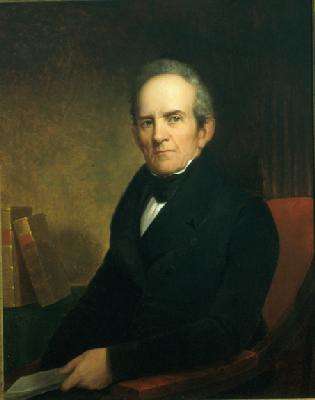
9/1/1823: Justice Smith Thompson takes judicial oath.

Mostly law professors | Sometimes contrarian | Often libertarian | Always independent | Est. 2002

9/1/1823: Justice Smith Thompson takes judicial oath.
What's on your mind?
Garland's dilemma.
After nearly seven years of Trumpamania, I have become immune to stories that Trump will be indicted. Yet, the most recent DOJ filing suggests that there is a roadmap to indict Trump for (among other charges) obstruction of the investigation.
In the past, I have considered Garland's choice about whether to indict Trump for insurrection based on January 6. Seth Barrett Tillman and I wrote an article on this issue. But the Mar-A-Lago allegations are different. These charges concern conduct that arose after Trump left the White House, and there is no obvious constitutional defense (if Nixon v. GSA is on point).
Still, Merrick Garland faces a dilemma. If DOJ indicts Trump, then Trump may see the presidency as his (literal) get-out-of-jail free card. And the prosecution of Trump could galvanize his supporters, leading to his re-election. On January 20, 2025, Trump could order the Attorney General to dismiss the prosecution (assuming his AG gets confirmed). And, he could pardon himself. (Brian Kalt, please call your office.) Perversely, the decision to indict Trump could pave the way for Trump never being convicted of this offense.
And, of course, a self-pardon would not affect a conviction in Fulton County, Georgia. Though, I think the President could not be incarcerated during his time in office.
To indict or not to indict? That is the question.
New York City erects an expansive "sensitive" place in Midtown Manhattan.
Heller explained that public carry could be restricted in so-called "sensitive" places. And Bruen reaffirmed that limitation. Just in case anyone forgot, Justice Kavanaugh's concurrence block-quoted the worst passage from Justice Scalia's majority opinion. Bruen did not have occasion to define a "sensitive" place. But one specific locale popped up during oral argument.
Justice Barrett asked about banning guns in Times Square on New Year's Eve:
JUSTICE BARRETT: I mean, I guess it's about the level of generality, all these questions that Justice Kagan's asking you or that the Chief asked you, if -- if you concede, as I think the historical record requires you to, that states did outlaw guns in sensitive places, can't we just say Times Square on New Year's Eve is a sensitive place? Because now we've seen, you know, people are on top of each other, we've -- we've had experience with violence, so we're making a judgment, it's a sensitive place.
Paul Clement countered that restrictions on guns for New Year's Eve would be more akin to a time-place-manner restriction:
MR. CLEMENT: So here -- here's what I would suggest, that the right way to think about limiting guns in Times Square on New Year's Eve is not as a sensitive place but as a time, place, and manner restriction. And that might be a perfectly reasonable time, place, and manner restriction, but I don't think that's -- the sensitive places doctrine, as I understood it, from -- and, obviously, it's a brief reference in the Heller decision, so I -- I may not fully understand it -- but I understood that those were certain places where they were just no weapon zones all of the time because of the nature of that institution. And I think it's probably worth thinking about rallies and Times Square, that there may be restrictions, but they would be done --
Barbara Underwood, the New York Solicitor General, hinted that it would not be enough to ban guns only on New Year's Eve, because the area is so congested.
MS. UNDERWOOD:Well, essentially . . . it would be very hard in the first instance . . . to specify in advance all the places that ought properly to be understood as sensitive. So it sounds like a very convenient alternative, but, for example, we were talking about Times Square on New Year's Eve.
Times Square on -- when the theater district -- when -- when -- when commerce is in full swing, Times Square almost every night is shoulder-to-shoulder people. So then you -- you end up having a very big difficulty in specifying what all the places are that have the characteristics that should make them sensitive.
To no one's surprise, New York City has banned public carry in Times Square 24 hours a day, 365 days a year. And Times Square is not defined how I remember it--roughly a five-block sweep, bordered between Seventh Avenue and Broadway. Wikipedia confirms my understanding:
Times Square is a major commercial intersection, tourist destination, entertainment hub, and neighborhood in Midtown Manhattan, New York City. It is formed by the junction of Broadway, Seventh Avenue, and 42nd Street. Together with adjacent Duffy Square, Times Square is a bowtie-shaped space five blocks long between 42nd and 47th Streets.
Soon enough, this Wikipedia page will be scrubbed, so I took a screenshot. Truth must conform to progressive orthodoxies.
No, New York has selected the area from Ninth to Sixth Avenues, and from 53rd to 40th Streets--a total of three-dozen blocks.
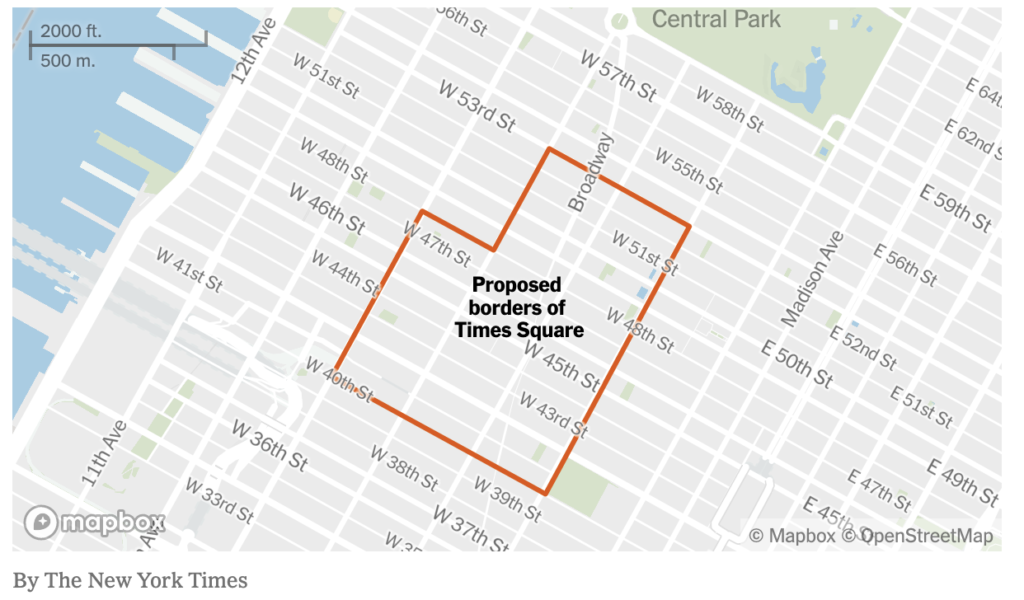
The New York Times provides some more info:
In a statement, the police department said that Times Square was "not just a few streets with bright lights and video screens. It's a unique, dense, complex space, and the area designated in our rules and the proposed bill reflects that reality."
At a City Council hearing on Tuesday, Robert Barrows, the executive director of the police department's legal operations and projects, said that the area would be marked by signs that warn pedestrians that the area is a "gun free zone."
What about people who live in this area? They will be able to carry. And if you are in a vehicle, you can drive through the area, but your gun must be carried in a locked container and unloaded, and you cannot stop. (Sounds a lot like the rule at issue in New York State Rifle Pistol Association v. New York City). It will be very hard to get cross-town with those rules in effect.
We still do not know if the "campus" of New York University will be a "sensitive" place.
There will be litigation. Maybe the Supreme Court will still care about New York in a few years.
As best as I can tell, the City has mirrored the closings for--you guessed it!--New Year's Eve, though the gun boundary stops at 51st Street rather than 59th Street (Central Park South). For those who care, Trump Tower (on 57th Street) is outside of Times Square.
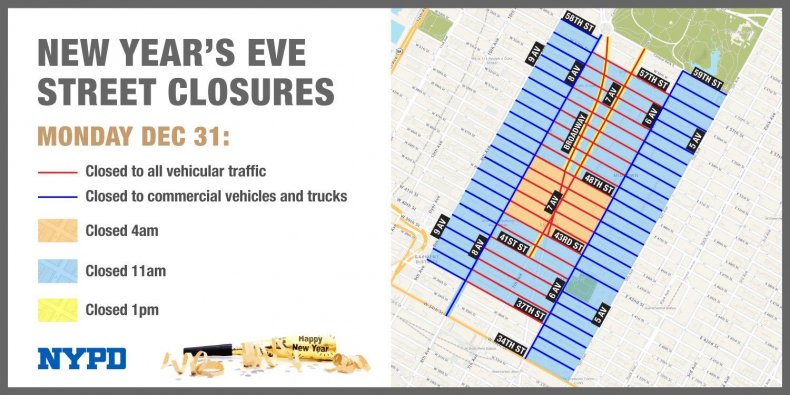
It's like T.G.I. McScratchy's Goodtime Foodrinkery, where every night is New Year's Eve!
I grew up in New York City, but never once went to Times Square for the ball drop. That was something only tourists did--much like going to the top of the Empire State Building (still never been!). However, I was in Times Square on December 31, 2013. The American Association of Law Schools held the annual meeting at the Midtown Hilton. But the Marriott Marquis offered a member rate on New Year's Eve! I couldn't believe it, so I booked it. The window in my room offered a very obstructed view of Broadway. And no, you couldn't wait in the lobby bar. All those seats sold for a premium. But around 11:45, I went outside and stood on the street. I couldn't quite see the ball drop, but I got the experience. Then I quickly rushed back into my warm hotel room. Fun fact: that evening, Circuit Justice Sotomayor issued an emergency stay on the shadow docket to protect the Little Sisters of the Poor from the contraceptive mandate. However, Sotomayor did not issue an emergency stay in the Utah same-sex marriage litigation. There was a flurry of activity that night! And at midnight, Sotomayor dropped the ball! I wrote all about the evening here, and in my second book Unraveled.
Learn about all the important developments in the last year
I am delighted to announce the publication of the free, online 2022 Supplement for the law school textbook Firearms Law and the Second Amendment: Regulation, Rights, and Policy (Third Edition). My coauthors on the Supplement and the third edition of the textbook are Nicholas J. Johnson, George A. Mocsary, E. Gregory Wallace, and Donald Kilmer.
The Supplement is 175 pages, and covers developments since the summer of 2021, when the textbook entered final production. The Supplement begins with 98 pages on the Supreme Court's June 2022 decision in New York State Rifle & Pistol Association v. Bruen. Most of that material is the Bruen opinion, plus the three concurrences, and the dissent, all in full. Our version may be a little easier on the eyes than the slip opinion on the Court's website, or versions on other sites, since we take the liberty of removing some parallel cites (e.g., to Lawyer's Ed. 2d), and we make some adjustments to the Court's idiosyncratic abbreviation style (e.g., we use "U.S" instead of "U. S.").
More importantly, we also provide a six-page explanation of the "Bruen Rules," such as Bruen's instructions on how to draw analogies from historic gun control laws to modern ones, and on Bruen's permissible limits on the right to bear arms.
In the usual pattern for textbook supplements, there are many short summaries of important new cases, statutes, and so on. Some topics that receive extended treatment include:
We hope you find the Supplement useful!
Here's the exact quote:
Do you realize the bullet out of an AR-15 travels five times as rapidly as a bullet shot out of any other gun …?
The muzzle velocity of an AR-15 (which is to say, the speed at which the bullet travels when it leaves the rifle) is about 3300 feet per second (here's an anti-AR-15 Washington Monthly article confirming that). Other rifles have muzzle velocities in the same general range, 2500-4000 feet per second or so according to this list, or 2700-3150 in this list (PDF p. 45), though the velocity is also influenced in some measure by barrel length. If the AR-15 bullets are faster than most rifles (not "any other" rifles), they're only slightly faster.
8/31/1995: Students at Santa Fe Independent School District voted to allow a student to say a prayer at football games. In Santa Fe Independent School Dist. v. Doe (2000), the Supreme Court declared this prayer unconstitutional.
"In January 2020, you called for 'an involuntary evaluation' of President Trump, and you said, 'I am beginning to believe a mental health hold ... will become inevitable.' That same month, you publicly suggested that President Trump, Rudolph Giuliani and Alan Dershowitz had a 'shared psychosis.'"
Lee v. Yale Univ., decided today by Judge Sarah Merriam (D. Conn.), was brought by Dr. Bandy Lee, a volunteer (uncompensated) clinical professor in the Yale School of Medicine's Law and Psychiatry Division. (This volunteer service required her to "participate in four hours of student-related, teaching, or supervisory activities per week. These activities could be satisfied through teaching a course, lectures, through advising students in connection with their thesis preparation, supervising residents, participating in seminars and grand rounds, engaging in scholarly activity, participating in department administration, and other activities.") She was fired on Sept. 4, 2020 for the following reasons:
[T]he review committee … consider[ed] whether the Department could offer you a continuing teaching role …. The key question in our minds was whether you had the clinical judgment and professionalism to teach trainees key aspects of their profession. Your diagnostic impressions of President Trump and several other public figures and your recommendations for treating President Trump played a role in our discussion. This was not because of the political content of your speech. As you know, the Department and the University publicly defended your academic freedom and your right to express your opinions as a citizen. As detailed below, the Committee's concern was what your diagnoses and treatment recommendations said about your clinical abilities and professionalism.
Since 2017, you have taken the position that you have a "duty to warn" the public that President Trump presents a threat to public safety. The duty to warn derives from the Tarasoff decision and subsequent legal developments, and it applies to clinicians in a treatment relationship with a potentially dangerous person. It has never been applied outside that context. In public comments, you said that President Trump was incapacitated by a psychiatric disorder, and you identified symptoms such as aggressive speech, sexual misconduct, incitement to violence, belief in conspiracies, declining cognitive functioning, and neurological deficits. Initially, you did not identify the disorder causing these supposed symptoms. In December 2019, you said publicly that President Trump exhibited a "pattern of delusions," was "lacking rational decisionmaking capacity," and had "definitive signs of severe pathology" that required "an advanced level of care." In January 2020, you called for "an involuntary evaluation" of President Trump, and you said, "I am beginning to believe a mental health hold … will become inevitable." That same month, you publicly suggested that President Trump, Rudolph Giuliani and Alan Dershowitz had a "shared psychosis."
I very much enjoyed participating in this Federalist-Society-organized webinar, together with Prof. Brian Soucek (UC Davis). As is common for such Federalist Society programs, the panelists were chosen to present different views (though I think it's fair to say that Prof. Soucek and I agree on some things as well as disagree on others), and were not chosen exclusively from within the Federalist Society: Prof. Soucek is generally not at all a Federalist, to my knowledge.
I hope you find it as interesting as I did! Here's the blurb:
In recent years, universities have increasingly required 'diversity statements' from faculty seeking jobs, tenure, or promotion. But statements describing faculty's contributions to diversity, equity, and inclusion are also increasingly under attack. Criticisms first made in tweets and blog posts have expanded into prominent opinion pieces and, more recently, law review articles. These attacks are having an effect. Within universities, faculty-wide resolutions for and against mandatory diversity statements have been called and academic freedom committees have been asked to intervene. Outside universities, lawyers are recruiting plaintiffs to challenge diversity statement requirements in court.
Watch our experts in a discussion on Professor Brian Soucek's recent article in the UC Davis Law Review about these diversity statements fleshing out the criticisms and developing a framework to address if universities can require diversity statements without violating either the Constitution or academic freedom.
You can also read Prof. Soucek's full article. As to my views, I was delighted to see a commenter write,
the FCA's requirement that leaders "abide by a Statement of Faith, which includes the belief that sexual relations should be limited within the context of a marriage between a man and a woman" -- so holds a Ninth Circuit's panel.
From Fellowship of Christian Athletes v. San Jose Unified School Dist., decided yesterday by the Ninth Circuit, in an opinion by Judge Kenneth Lee joined by Judge Danielle Forrest (it's on a preliminary injunction, so this is technically based on a finding of likelihood of success on the merits, but the panel majority seems pretty firm on the subject):
The Fellowship of Christian Athletes (FCA) requires students serving in leadership roles to abide by a Statement of Faith, which includes the belief that sexual relations should be limited within the context of a marriage between a man and a woman. The San Jose Unified School District … revoked FCA's status as an official student club at its high schools, claiming that FCA's religious pledge requirement violates the School District's non-discrimination policy….
The School District engaged in selective enforcement of its own non-discrimination policy, penalizing FCA while looking the other way with other student groups. For example, the School District blessed student clubs whose constitutions limited membership based on gender identity or ethnicity, despite the school's policies barring such restricted membership. The government cannot set double standards to the detriment of religious groups only….
We apply strict scrutiny to government regulations that burden religious exercise unless those laws are neutral and generally applicable. A law is not neutral and generally applicable if it is selectively enforced against religious entities but not comparable secular entities. "[W]hether two activities are comparable for purposes of the Free Exercise Clause must be judged against the asserted government interest that justifies the regulation at issue." … Finally, the "Government fails to act neutrally when it proceeds in a manner intolerant of religious beliefs or restricts practices because of their religious nature."
Under strict scrutiny, the government can prevail only if it shows that its restrictions on religion "are justified by a compelling interest and [are] narrowly tailored to advance that interest." Given that high bar, the defendants do not argue that their policies can pass muster under strict scrutiny; rather, they contend that strict scrutiny does not apply at all because their policies are neutral and generally applicable.
But the record before us shows that the School District's non-discrimination policies have been, and continue to be, selectively enforced against FCA. Other secular student groups maintain facially discriminatory membership criteria but enjoy ASB recognition. In short, the School District targeted FCA because of its religious-based views about marriage and sexuality, and not merely because of its alleged violation of non-discrimination policies….
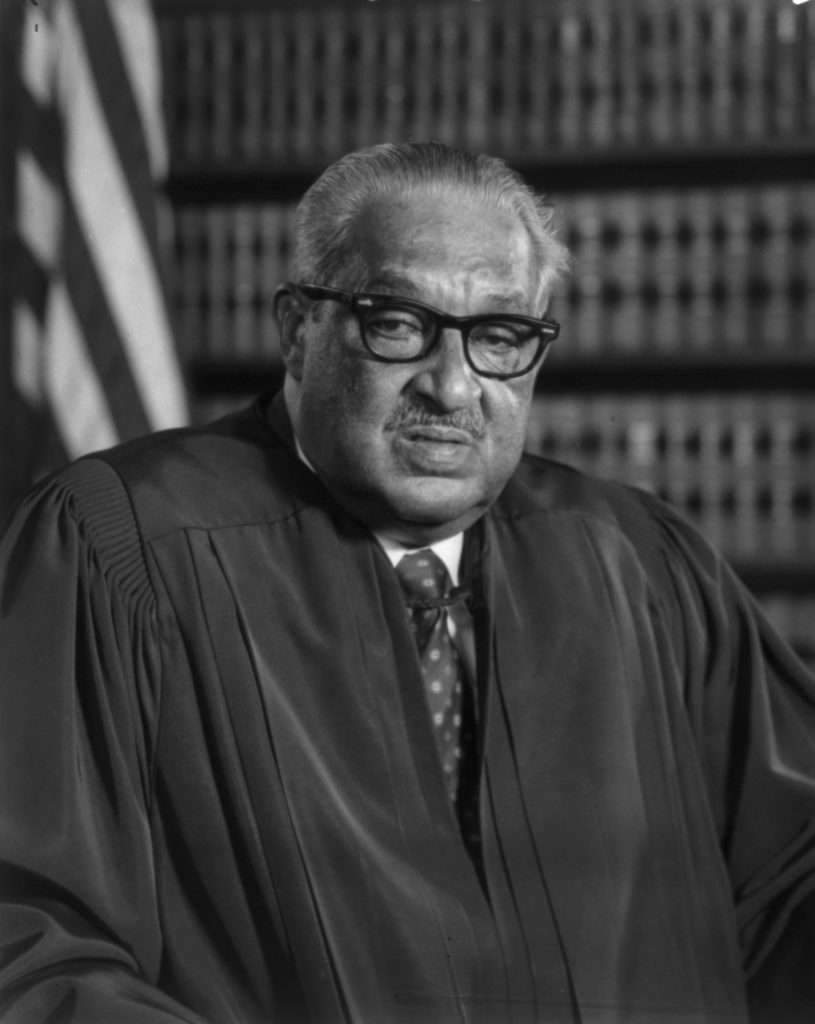
8/30/1967: Justice Thurgood Marshall takes the oath.
Any recommendations for SF and fantasy books? Please post them here. There'll be later posts asking for suggestions about other genres and other media (and see the post several weeks ago on recommendations for TV series).
Please also focus on things that you expect even people who love the genres might have missed.
UPDATE (see end of post): Perhaps this is just an example of the "chilling effect," where a law deters even behavior that it may not actually cover (perhaps in part because of how the law's own backers had initially described it).
So NBC New York reports, discussing how stores are beginning to comply with this law, enacted last Fall:
1. "[W]hipped cream charger" shall mean a steel cylinder or cartridge filled with nitrous oxide (N2O) that is used as a whipping agent in a whipped cream dispenser.
2. No … business … shall sell or offer for sale a whipped cream charger to any person under the age of twenty-one.
3. Any … business within the state selling, offering for sale, or distributing whipped cream chargers shall require proof of legal age prior to allowing an individual to purchase or receive a shipment of whipped cream chargers. Such identification need not be required of any individual who reasonably appears to be at least twenty-five years of age, provided, however, that such appearance shall not constitute a defense in any proceeding alleging the sale or distribution of whipped cream chargers to an individual under twenty-one years of age.
4. Any … business … that violates the provisions of this section shall be subject to a civil penalty of not more than two hundred fifty dollars for an initial offense and not more than five hundred dollars for the second and each subsequent offense.
The rationale, from the Senate sponsor, Joseph P. Addabbo:
Fourth post in the symposium on the National Constitution Center "Restoring the Guardrails of Democracy" project. David French presents the Team Conservative Report.
Bear with me for a moment, but to understand the conservative case for preserving the guardrails of democracy, one has to understand the M1 Abrams main battle tank. Introduced in 1980, it was the most powerful land warfare vehicle ever devised by the mind and industry of man. In 2022 it is still unmatched on the battlefield.
But it's not quite the same M1. It's had gun upgrades, armor upgrades, and targeting upgrades (to name just a few of the improvements over more than 40 years of service). There was the M1, the M1A1, the M1A2, and now the M1A2 SEP. It's still the same tank. It even looks much the same. But it's substantially better—built to withstand the challenges of modern war.
And so it is with the Constitution and American democracy. First, there was Democracy One, the original document that was, at the time, a remarkable advance for democracy and human rights, but it was flawed. It permitted slavery. Its most potent human rights protections—the guarantees of the individual liberty in the Bill of Rights—didn't apply to the states. So the system was unstable. It was not going to age well.
And it didn't. The nation ripped itself apart in the Civil War, and the victorious Union created Democracy Two, with a substantially updated Constitution that, over time, extended the Bill of Rights to protect individual liberty from every organ of American government. But still, it wasn't enough. Black Americans continued to confront the "badges and incidents of slavery" in the form of a brutal system of racial oppression that depended on both public and private discrimination.
So along came Democracy Three, the post-Civil Rights era. The power of that state expanded dramatically. The government began to touch virtually every aspect of commercial life. The administrative state grew until it became the most potent branch of government. And while the United States is absolutely more just than it was—and citizens enjoy a greater degree of legal equality than in any previous iteration of the American experiment—the strains are beginning to show.
Congress, intended to be the most powerful branch of government, is now the weakest. Campaign finance reforms that were intended to empower the grassroots and disempower the wealthy elite have backfired. Radicalized small-dollar donors drive the financial bus. Progressive reforms that were designed to give power to the people through primaries have sidelined political parties. Now small minorities of activist primary voters exercise disproportionate power and further polarize our politics.
Taken together, these developments mean that the United States is less democratic where it needs the voice of the people, and more democratic where it needs the voice of the parties. And so the American constitutional main battle tank needs another overhaul–but not one as dramatic as the first two. Let's call ours Democracy 3.1.
Our conservative reforms are designed to revitalize Congress. Revival of the nondelegation doctrine and the reversal of the Chevron doctrine would together deter Congress from punting more power to the presidency. War powers reform would prevent the president both declaring and waging war. Filibuster reform would preserve procedural safeguards against bare majorities passing sweeping legislation while acknowledging that the present Filibuster standard paralyzes Congress. We also want a legislative veto, so that Congress can block executive branch lawmaking, even without the president's consent.
Critically, we also propose making it easier to amend the Constitution. The barrier is simply too high for meaningful constitutional reform.
Each of these reforms would make the United States more democratic, mainly by revitalizing Congress, the most democratic branch of the federal government. But lest anyone think we conservatives have become too enamored by the voice of the people, there are places where we also want less democracy, especially in party politics.
We propose eliminating individual campaign contribution limits. Every single effort to micromanage political expenditures hasn't just failed, it's backfired. No one can get money out of politics, but we can distort the ways in which it flows into the system. And presently money flows through radicalized small donors who are mobilized through alarmist rhetoric and captivated by celebrity.
Small dollar donations also undermine the power of parties. Give a political celebrity an email list, and they can build a movement. We want stronger parties. We want smoke-filled rooms. And if we can't have smoke-filled rooms, we want party conventions. If we can't have party conventions, we want tighter requirements for party primary voting.
The goal is to give voters and leaders a sense of institutional responsibility. We love American democracy, but not every institution in America needs to be democratic. We accept the power of accountable leadership in the military, the academy, and in corporate America. We need accountable leadership in our political parties as well.
Any discussion of American democracy should also include a discussion of American education. School choice is a vital value. Schools should compete for students, and within that spirit of competition there's a role for revamped curriculum. Our curricular culture wars are inherently oppositional. Does defeating CRT prepare our students to counter the economic and military challenge of a rising China?
A commitment to school choice allows for creativity, for new ways of teaching history and for different emphases in the STEM fields. Why do we mandate algebra and geometry, but not statistics and coding? That's an argument worth having—one that's far more impactful and interesting than whether a school's diversity PowerPoints are too problematic.
Finally, we want to make election day great again. The well-meaning desire to make voting easier has turned election day into election season, and perversely has put a premium on mobilization over persuasion. Now there's a focus on "banking" votes, and the presumption is that "your" voters are your voters, and the challenge is finding and collecting all your people.
But new information surfaces on candidates all the time. How many early voters in 2016 wished they had a second bite at the apple after, say, the Access Hollywood Tape or James Comey's letter announcing that the FBI was reopening the Clinton email investigation? Moreover, election day is an important communal civic event.
Even an election weekend would be preferable to an election season, and we can make election day a national holiday to help those who have difficult work schedules. We know that we won't go back to a single election day, but deadlines can and do concentrate the mind. Let's restore the sense of communal civic participation and make sure that we're all operating with the same access to information when we vote.
Not one of our reforms is as consequential as the Civil War Amendments or the Civil Rights Act. But even modest changes can make a profound difference if they're precisely targeted at the problems that are causing systemic breakdown. We've long enjoyed the benefits of the world's best constitutional system, but it still needs an upgrade.
We don't need a revolution. To return to the M1 analogy at the start. We don't need to scrap our tank. We just need the next iteration of the same basic system that has made the United States of America the most powerful and prosperous democracy in the history of the world.
Why does catfishing happen and how do we stop it?
Many people were fascinated (and horrified) earlier this year when watching the Netflix documentary "The Tinder Swindler", about which I commented here. While the phenomenon of catfishing brings its share of sympathy, victim-blaming continues to abound, and few perpetrators end up bearing the consequences of their actions.
On the fifth episode (Apple Podcasts link here) of our "Strangers on the Internet" podcast--our first-ever guest episode--my co-host Michelle Lange and I spoke to two catfishing victims that saw their lives upended by heartless narcissists. One of them, British former teaching assistant Anna Rowe, wants to see legal change after she and many others became serially abused by (as it happens) a lawyer. Our other guest, Jennifer, is a former academic who had her fourth child with a man whose own employees did not know he was leading a double life for years. We explore questions such as how to detect catfish and what justice and closure look like years down the line.
Bonus: For those interested in further readings regarding love on the Interwebs, here is a roundup of recent articles that caught my attention.
Third post in the symposium on the National Constitution Center "Restoring the Guardrails of Democracy" project. Walter Olson presents the Team Libertarian Report.
The events leading up to Inauguration Day 2021 posed a stress test for America's republican institutions, and we need to be ready should more such tests follow. In particular, proposals to overhaul the nation's electoral institutions should be judged in the light of the lessons of that brush with constitutional extremity. Reforms that shore up what we now can see as critical weaknesses deserve high priority; reforms irrelevant to these dangers might well go to the back burner, if not be set aside for now; and proposals that would actually create new risks of constitutional crisis are unlikely to be right for the moment.
Thus argues my contribution to the Team Libertarian paper (which you can also read on SSRN) on elections and the democratic succession of power. Later in this post I'll summarize the other two sections, written by contributors Clark Neily and Ilya Somin.
Many institutions performed well under the stress of the weeks leading up to the 2021 transfer of power, including the courts, the state governments, nearly all local election authorities, the Electoral College and its participants, and most of the U.S. Senate as well as the Vice President. Key cabinet departments also pushed back against improper suggestions from the rogue White House.
Ironically or not, the institutions that proved wobbly under stress, White House aside, included one of those with the strongest claim on majoritarian legitimacy: the U.S. House of Representatives, in which 139 of 435 members, an outright majority of the 212-member Republican caucus, voted to support spurious challenges to Biden's electoral slates. Behind these was an unlovely fact: a majority of the GOP base had in fact been willing to tag along with Trump's claims of a stolen election, and the House, as the assembly most in touch with public passions, reflected this. While elite misconduct can endanger the democratic succession of power, so can populist anger and mass delusion.
I won't try to summarize each and every one of our prescriptions, but here are some highlights:
I think classical liberals and libertarians can play a constructive role in a conversation about guardrails given our particular attachment to the rule of law, constitutionalism, checks and balances, and limitations on government power in general. By instinct, we understand and fear how a government is likely to start behaving once its top officials know that voters cannot turn them out of office.
I'll turn now to summarizing the other two sections of the report, by Cato colleague Clark Neily on the role of the jury and Volokh Conspirator (and George Mason lawprof) Ilya Somin on the benefits of choice between governments.
The right to trial by jury was often hailed as the palladium of Anglo-American liberties; it's enshrined in the Sixth and Seventh Amendments, and relates closely to other Constitutional provisions on criminal procedure. As the Founders knew, oppressive regimes have used criminal law and prosecution throughout history to target enemies and exert social control, and they meant for the citizen jury to serve as a key guardrail against that abuse.
Yet, says Clark Neily, America has allowed the institution of the jury to decay to a point of near extinction in favor of an informal and opaque administrative system of plea bargaining. That is bad news for criminal justice, and may bear some relation to America's extraordinarily high rates of incarceration. And it also erodes a line of defense that will be critically needed should American political life take a turn toward the authoritarian and government administrators intensify use of criminalization and prosecution as a purposeful tool against opposition. In heedlessly allowing this institution to decay, we also lose an important instrument of popular voice in government; earlier generations understood that jury service was an important means by which the public participated directly in the public business.
Ilya Somin champions a fundamental human right that deserves a place alongside the ballot box and the jury box as protectors of liberty: the right to exit.
When people choose which jurisdiction to live in within a federal system, they vote, in effect, with their feet. In fact, for most individual citizens, this is by far the most powerful way they can alter the laws and policies they live under. It almost never happens that they can make such a change by casting a vote (notwithstanding the one-vote margin just seen in an election in my county) nor are they likely to influence enough neighbors to change the outcome of even a single election for a single office.
Because foot voters can make a genuine change in their conditions of governance by moving residence, they have at least some incentive to inform themselves carefully about the differences – an incentive that ballot voters, alas, often lack.
The possibility of exit, Somin argues, operates as a crucial check on the tendency of political institutions to overreach themselves. In America, it is closely tied to principles of federalism and decentralization that are important to the country's hopes for preserving political stability despite sharp differences in local culture. Although not every issue can be handled at a local level, decentralization of policy makes it more likely that the varied populations of New York, Arkansas, Vermont and Utah can each live under a set of policies relatively well suited to the preferences of each group. Despite worries in some quarters about ideological sorting, Somin sees reasons to think that polarization might also decline if we wisely lowered the stakes of national Red-Blue politics by curtailing the policy ambitions of the federal government.
Second post in the symposium on the National Constitution Center "Restoring the Guardrails of Democracy" project. Edward Foley outlines the Team Progressive Report.
The acute crisis confronting American democracy right now is caused by a movement within one of the nation's two major political parties. This movement is appropriately called "election denialism"—meaning that its adherents are willing to deny the lawfully determined outcome of an election if their candidate is the one who lost. The election denialist movement within the Republican Party, led by former president Donald Trump, is seeking to gain control over the institutions and procedures that determine the outcome of future elections. If election denialists prevail in this effort at taking control, self-government—whether one calls it "republicanism" or "democracy"—will no longer be possible. Ultimately, self-government depends on the lawfully determined winners of elections taking office based on those electoral results, and election denialism strikes at the heart of that most basic premise.
The effort to protect the Republic from election denialism should not be viewed as a partisan endeavor. Liz Cheney, among others, is correct when she exclaims that safeguarding the Constitution and its commitment to a "republican form of government" will require Democrats, Republicans, and independents of good will to join forces. As our contribution to the NCC Guardrails of Democracy project explained, democracy protection requires reforms along three dimensions. First, and most immediately, there needs to be revisions to the rules that govern the declaration of winners in presidential elections. Second, there needs to be structural reforms to the nation's electoral processes to prevent election denialists winning races even when a majority of the electorate would prefer other candidates. Third, there needs to be carefully tailored adjustments, consistent with the First Amendment, that deter election denialists from spreading intentional falsehoods about election results. What follows is an overview of these three points.
Electoral Count Act Reform. The good news is that a bipartisan group of Senators, led by Susan Collins and Joe Manchin, have developed a revision to the dangerously antiquated Electoral Count Act of 1887, which was exploited for partisan purposes on January 6, 2021 (among other recent presidential elections). Indeed, the exploitation of this outdated and convoluted statute by election denialist allies of Trump is what set the stage for the insurrectionary riot at the Capitol that delayed the counting of the electoral votes in the 2020 election. The Collins-Manchin bill, while not perfect (what legislative endeavor ever is?), would fix the flaws in the 1887 law and significantly reduce the risk of election denialists negating the lawful winner of a future presidential election. The Collins-Manchin bill does this by requiring Congress to accept whatever the courts determine to be the true outcome of the presidential election in each state according to the applicable law when the ballots are cast. Even if election denialist officials in a state attempt to subvert the true result, Congress must abide by what the courts say and not whatever any election denialists do. The prospects for the Collins-Manchin bill passing Congress are good, given the level of bipartisan support it already has received in the Senate. But until the bill is enacted in the law, presidential elections remain dangerously vulnerable to subversion at the hands of election denialists. Thus, doing whatever it takes to get the Collins-Manchin bill across the legislative finish line must remain the most urgent electoral priority.
Securing the Will of Electoral Majorities. Just because an election denialist candidate wins a partisan primary and then goes on to win the general election, it does not mean that the election denialist is the candidate most preferred by a majority of the electorate. This point is not well-understood, but it needs to be to avoid election denialists holding office even when a majority of voters would prefer someone else. Right now, election denialists are able to exploit the features of the nation's prevailing electoral system that enable candidates opposed by a majority of voters to win partisan primaries, often with less than a majority of votes in the primary, and then win the November general election because the plurality-winner rule in November prevents meaningful competition from anyone other than the nominee of the opposing major party. Altering the structure of electoral competition, so that the will of the majority can prevail, needs to be a top priority in order to counteract the threat of election denialism prevailing even when a majority of voters do not want it to.
A few pending midterm races illustrate this point. In Arizona, election denialist Kari Lake narrowly won the Republican primary with 48%, less than a majority. Her main competitor, Karrin Taylor Robson, was not an election denialist, and perhaps might have won the GOP nomination if a runoff or "instant runoff" using ranked-choice voting had been used to identify the majority preference of the state's GOP voters. In any event, Taylor Robson likely would be more preferred by a majority of all the state's voters—those voting in the November general election—than the election denialist Lake. This presumption is based on the common-sense observation that virtually all the state's Democrats would prefer non-denialist Taylor Robson to denialist Lake. Therefore, although a majority of the state's November voters might prefer the Democratic nominee Katie Hobbs to either Republican, Taylor Robson or Lake, it is also possible that in this closely divided state a majority of the November voters this year would prefer either Republican to Hobbs. But if Hobbs doesn't win, Democratic voters would rather have Taylor Robson than Lake, and given that almost half Republican voters also preferred Taylor Robson to Lake, it seems undoubtedly true that a majority of all the state's voters would want Taylor Robson rather than Lake to become the state's governor.
Yet, given the nature of the electoral system, the November race will be just Lake versus Hobbs, with Taylor Robson eliminated in the partisan primary. Lake thus might beat Hobbs and become Arizona's governor, even though a majority of Arizona voters in November would prefer Taylor Robson over Lake. This is how the majority of the state's voters' actual preference can be defeated in the existing electoral system, and this is what must change to prevent election denialists from taking office even though a majority of voters would favor a different outcome.
Other midterm races illustrate the same point. Election denialist J.D. Vance won the Republican primary for Ohio's U.S. Senate seat with less than a third of the votes, 32.2%, beating among other candidates non-denialist Matt Dolan (who came in third with 23.3%). Vance might win the November election against Democratic nominee Tim Ryan, even though a majority of Ohio's November voters might prefer non-denialist Dolan to Vance. Again, the partisan primary knocked Dolan out of contention even though he would be the candidate that the majority of November voters would most prefer. Something similar could also be true in North Carolina's U.S. Senate election. There, election denialist Ted Budd won the GOP primary, beating non-denialist (and former governor) Pat McCrory. Budd might beat Democratic nominee Cheri Beasley in November, even though a majority of November's voters in the state likely would prefer McCrory to Budd.
In this way, election denialists can come to power after the November elections, in governorships and U.S. Senate seats among other major offices, even though November voters in all these states would have preferred a non-denialist alternative, who got boxed out by the partisan primary. It is imperative to change this anti-majority feature of the prevailing electoral system, and it is possible to do so through a version of ranked-choice voting that conforms to majority-maximizing electoral principles. Known as Round-Robin Voting, because it resembles a round-robin sports tournament in which each competitor faces one-on-one against every other competitor, this version of ranked-choice voting would prevent election denialists from winning office whenever they are not the candidate most preferred by a majority of all the voters in the electorate. If we want to safeguard democracy from election denialism, we need to pursue this reform (among others).
Combatting the Spread of Intentional Falsehoods about Election Results. What is most brazen about the so-called "Big Lie"—that the 2020 presidential election was stolen from Trump and that Joe Biden was not the rightful winner pursuant to the rules for conducting the election—was that at least some of the leading perpetrators of this Big Lie knew it to be false but spread the falsehood anyway. Rudy Giuliani, Trump's lead lawyer for contesting the outcome of the 2020 election, admitted that they had no evidence to support claims they were making. Others, including Trump himself, also surely must have known the Big Lie was false if, as Attorney General Bill Barr observed, they were maintaining a connection to reality; only by being utterly detached from, or in defiance of, reality would it be possible to claim, as Trump and his supporters have, that Trump would have won the election were it not for massive fraud inflating Biden's vote totals beyond the ballots cast for him by valid voters.
The First Amendment's freedoms of expression are essential elements to self-government. But the First Amendment historically has never been understood to protect the "knowing lie," and even the U.S. Supreme Court's recent case involving the false claim of being a Medal of Honor recipient does not go so far as to protect all intentional falsehoods from well-tailored and well-justified statutes aimed precisely to protect the political process from deliberately destructive disinformation. Although the idea of using criminal prosecutions to counteract intentionally false election denialism must proceed with great caution, it is necessary to restore a political culture that causes professionals like Rudy Giuliani to exercise an appropriate measure of self-restraint in their public discourse about adverse election outcomes. Going forward, no one should think they are entitled to spread intentional untruths like the Big Lie with impunity; as has become abundantly clear since 2020, this kind of deliberate dishonesty about who really won the election does grave damage to the capacity of the country to conduct elections as a core component of republican self-government, and consistent with the First Amendment the Republic is entitled in the interest of self-preservation to take carefully drawn steps to protect itself from this kind of damage.
Additionally, social media companies have no First Amendment right to simultaneously elevate intentional falsehoods on their platforms and remain immune from the liability that intentional falsehoods cause. No other type of publisher who exercises control over what they publish is entitled to such absolute immunity from their publication choices. Under the famous New York Times v. Sullivan standard, newspapers are liable under defamation law for the intentional falsehoods they print. So too are TV and cable broadcasters, for the intentional falsehoods they disseminate. The same should be true for social media companies—unless those social media companies exercise no control over the content of the expression that flows through their platforms, in which case then the companies should be immunized from liability in the same way that an old-fashioned telephone company would be. But as long as social media companies wish to profit from amplifying some messages over others, then they should be liable under defamation (and, where applicable, other forms of tort law) for the damages that their amplification of intentional falsehoods cause.
The Synergy of These Three Steps. Pursuing these three dimensions of reform cannot guarantee that American democracy will withstand the serious threat it currently faces from election denialism. Unfortunately, there can be no such guarantee if a majority of Americans actually become converted to the election denialism cause. But, thankfully, election denialism has not taken hold among the public to this extent, at least not yet. Thus, as long as election denialism remains a minority rather than majority position among the American electorate as a whole, these three dimensions of reform—especially if undertaken in combination, so that they can reinforce each other's effectiveness—can go a long way to safeguarding the right of self-government that, since the Declaration of Independence itself, has been the nation's foundational principle.
First post in the Volokh Conspiracy symposium on the NCC "Restoring the Guardrails of Democracy" project.
In the wake of the 2020 election, the National Constitution Center launched its "Restoring the Guardrails of Democracy" initiative. We commissioned three teams—conservative, libertarian, and progressive—to identify potential reforms to address current threats to American democracy and strengthen its institutional guardrails. Team Conservative included Sarah Isgur, Jonah Goldberg, and David French—all of The Dispatch. Team Libertarian included Clark Neily and Walter Olson of the Cato Institute and Ilya Somin of the Antonin Scalia Law School at George Mason University. Team Progressive included Edward Foley of The Ohio State University and Franita Tolson of the USC Gould School of Law.
The three teams worked independently, but they converged in important ways. All three teams called for reforming the Electoral Count Act of 1887 (though Team Conservative's report didn't say this explicitly because, as Sarah Isgur explained during our launch program, it was so important they "just thought that went without saying"). The conservative and progressive teams both proposed reforms to the primary system. They also both described education as central to preserving democracy, with Team Conservative calling for reinvigorating history education and focusing on teaching students critical thinking skills, and Team Progressive calling for strengthening civic numeracy (whereas Team Libertarian focused on expanding foot voting as an alternative to increasing civic knowledge).
We hope that the Guardrails of Democracy Initiative, like other National Constitution Center projects such as the Madisonian Commission and the ongoing Constitution Drafting Project, contributes to a nonpartisan national conversation about the most important challenges facing American democracy and the best ways to meet them.
Celebrate your independence with a subscription to Reason magazine, your most trusted source of honest, insightful news and analysis.




