Since I began teaching, I have only given essay exams. No multiple choice. No short answers. Rather, each exam has two, complex issue-spotter essay questions. The exam is completely open-book. I always tell my students they can bring whatever they want to the classroom--nothing will help them. I also issue a regular warning: do not cheat, because I will spot similarities in writing very quickly. Over the years, I only had once incident. I found that two students had very similar answers to a particular essay question. I inquired further, and found out that the students were study partners, and had pre-written answers to questions in advance, based on what I had asked in the past. And they inserted those answers into the exam. The pre-written answers were not exactly on point, and did not receive full credit, but there was no plagiarism in that case.
Enter ChatGPT. This "chatbot" uses sophisticated technology to generate answers to questions. These responses are written in plain English, that are easy to understand, and incorporate information from a massive neural network. These responses are not perfect, but may pass muster with professors who are short on time. The temptation for cheating is real. And one professor in South Carolina caught plagiarism. He wrote about it on Facebook, and the New York Postfollowed up.
This technology should strike fear in all academics. ChatGPT does not work like TurnItIn, and other plagiarism detection software. The software generates new answers on the fly. And each time you run the app, a different answer will be spit out. There is no word-for-word plagiarism, or poor paraphrasing. Each answer is unique. And ChatGPT is constantly evolving. It gets smarter as more people use the system, and the neural network grows. The system was only launched three weeks ago. By May, the system will be far more sophisticated, as it incorporates everything that comes before. Like the Borg, students will assimilate; resistance is futile.
How do we deal with this emerging technology? Short answer questions are far too easy to simulate. For example, "What are the elements of X" or "Describe Y concept." A four-page fact pattern, followed by specific prompts, may also be hard to jam into ChatGPT. I think we need to think long and hard about take-home exams. It is too easy for students to use ChatGPT, over and over again, to mix and match answers. Also, any in-class exam should eliminate access to devices--only paper sources. (That is my usual policy.) Finally, we should give some serious thought to oral examinations, which cannot be hacked.
Moreover, universities should revisit plagiarism policies in light of ChatGPT. There should be explicit language that using these tools is a violation of academic integrity standards. I imagine some policies may be framed in terms of getting help from "another" person or something to that effect. ChatGPT is not a person--not yet at least. Students will argue that ChatGPT does not fall in the plain language of a policy designed to prohibit sentient-cheating. And the burden of proof to determine plagiarism may be shifted, since traditional tools are not effective. There is a real/fake detector, that uses the ChatGPT engine, but I haven't tested how accurate it is.
In the near term, all students should receive a stern talking-to about these tools. In the long run, courts may start dealing with briefs written by ChatGTP. Judgment Day is coming.
12/28/1856: President Woodrow Wilson's birthday. His administration would initiate the prosecutions under the Sedition Act that gave rise to Schenck v. U.S., Debs v. U.S., and Abrams v. U.S.
The decision doesn't actually require continuation of the policy, but will have that effect indirectly. Justice Neil Gorsuch's dissent explains why the Court was wrong to take this step.
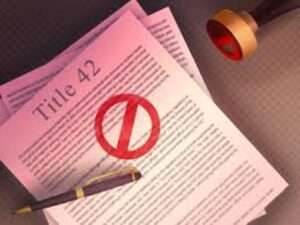
On Tuesday, the Supreme Court issued a 5-4 ruling that is likely to have the effect of perpetuating Title 42 "public health" expulsions of migrants at the US southern border. The decision stays a November DC district court ruling holding that the policy was illegal because it violates the Administrative Procedure Act, until the Supreme Court has a chance to consider the case more fully. Since March 2020, over 2 million migrants have been expelled under the Title 42 policy, including many who would otherwise have had the right to stay in the US long enough to apply for asylum. That has resulted in great suffering among migrants expelled to areas where they are threatened with violence, persecution, and other dangers.
The Supreme Court is not going to consider the case on the merits. Rather, it will only review the December 16 decision of the US Court of Appeals for the DC Circuit that prevented a group of GOP-controlled states from intervening in the case after the Biden Administration appeared ready to end the Title 42 policy rather than continue to defend it.
Title 42 expulsions were begun in March 2020 by the Trump Administration, and perpetuated in modified form by the Biden Administration until it tried to end them in May of this year, only to be stopped by a federal district court ruling in Texas, holding that the administration ended the policy without going through proper procedures under the APA. Had the Supreme Court allowed the District of DC ruling to stand, it would have taken precedence over the Texas decision, because the former holds that the Title 42 expulsions were illegal to begin with. If so, it doesn't matter if the policy were ended in a way that violates the APA, because it was never valid in the first place, and thus was not protected by the APA's rules.
Tuesday's ruling doesn't actually require the continuation of the Title 42 expulsions. Indeed, it specifically states that it "does not prevent the federal government from taking any action with respect to that policy," and that "[t]he Court's review on certiorari is limited to the question of intervention" by the state governments.
But because the Court has stayed the District of DC ruling in the meantime, it has the effect of maintaining the Texas district court injunction, which in turn bars the Biden Administration from ending the policy - at least until such time as the latter ruling is reversed by the Fifth Circuit appellate court or by the Supreme Court.
Justice Neil Gorsuch joined the three liberal justices in dissenting from the stay ruling. Gorsuch authored a dissent joined by Justice Ketanji Brown Jackson that compellingly explains why the majority was wrong:
Reasonable minds can disagree about the merits of the D.C. Circuit's intervention ruling.But that case-specific decision is not of special importance in its own right and would not normally warrant expedited review.The D. C. Circuit's intervention ruling takes on whatever salience it has only because of its presence in a larger underlying dispute about the Title 42 orders.And on that score, it is unclear what we might accomplish. Even if at the end of it all we find that the States are permitted to intervene, and even if the States manage on remand to demonstrate that the Title 42 orders were lawfully adopted, the emergency on which those orders were premised has long since lapsed. In April 2022, the federal government terminated the Title 42 orders after determining that emergency immigration restrictions were no longer necessary or appropriate to address COVID–19…. The States may question whether the government followed the right administrative steps before issuing this decision….. But they do not seriously dispute that the public-health justification undergirding the Title 42 orders has lapsed….
The only plausible reason for stepping in at this stage that I can discern has to do with the States' second request. The States contend that they face an immigration crisis at the border and policymakers have failed to agree on adequate measures to address it.The only means left to mitigate the crisis, the States suggest, is an order from this Court directing the federal government to continue its COVID-era Title 42 policies as long as possible… Today, the Court supplies just such an order. For my part, I do not discount the States' concerns…. But the current border crisis is not a COVID crisis. And courts should not be in the business of perpetuating administrative edicts designed for one emergency only because elected officials have failed to address a different emergency. We are a court of law, not policymakers of last resort.
Gorsuch is exactly right on this. The effort to perpetuate Title 42 expulsions is an attempt to use Covid emergency powers in order to pursue an unrelated policy agenda: in this case imposing severe immigration restrictions. It's exactly the sort of abuse of emergency authority that conservatives rightly condemned in the case of the CDC eviction moratorium (which used a similar provision of the same 1944 law as that which the Title 42 expulsions are based on), and Biden's attempt to use the Covid emergency to justify massive loan forgiveness.
Indeed, the situation here is even worse than Gorsuch suggests. As I describe in detail in an article about the Title 42 litigation, public health experts recognized early on that the expulsions were doing little or nothing to prevent Covid from entering the US. The Trump and Biden administrations began and perpetuated the policy for political reasons, using public health largely as a pretext. For Trump, it was part of a more general effort to curb immigration as much as possible; for Biden, it was a way to reduce perceptions of disorder at the border.
In reality, the main cause of danger and disorder at the border is the extreme difficulty of entering the country legally, which forces many desperate migrants to try illegal means. Perpetuating Title 42 expulsions won't fix that problem, and may make it even more severe, by making legal entry even harder than it would be otherwise.
But even if indefinite summary expulsions are the appropriate border policy, Gorsuch is right to emphasize that the Court cannot order their perpetuation under Title 42. At the very least, any such permanent policy must be authorized by Congress, not shoe-horned into a public health statute by courts.
I don't have a strong opinion on the issue of whether the states should be allowed to intervene in the case. But even if they should be, the Court could consider that issue without staying the district court ruling.
"Timeliness is an important consideration" to be determined from all thecircumstances, Cameron, 142 S. Ct. at 1012, "especially weighing the factor[] of time elapsed since the inception of the suit," Smoke v. Norton, 252 F.3d 468, 471 (D.C. Cir. 2001)….
In this case, the inordinate and unexplained untimeliness of the States' motion to intervene on appeal weighs decisively against intervention. First, although this litigation has been pending for almost two years, the States never sought to intervene in the district court until almost a weekafterthe district court granted plaintiffs' partial summary judgment motion and vacated the federal government's Title 42 policy…
Second, long before now, the States have known that their interests in the defense and perpetuation of the Title 42 policy had already diverged or likely would diverge from those of the federal government's should the policy be struck down…..
Despite that "palpable" divergence in interests that already existed in October 2021, neither Texas nor any of the States here moved to intervene in district court on remand from this court or during the summary judgment proceedings.
For those keeping track, one of the three judges on the DC Circuit panel denying intervention was conservative Trump appointee Justin Walker. So it isn't a case of liberal judges blocking intervention by conservative states for ideological reasons. However, I am no expert on the legal rules of intervention, so I admit I could be missing something when it comes that issue.
I am much more confident in concluding that there was no good reason for the Supreme Court to stay the trial court decision in this case merely to consider the issue of intervention.
I reviewed the earlier history of the Title 42 expulsions and litigation in detail in my recent symposium article on the subject. As I explain there, the policy never had proper congressional authorization once the Covid-19 virus became established in the US, and the Trump and Biden administrations' justifications for it raise serious nondelegation problems, and go against the Supreme Court's "major questions" precedents. In that respect, they are similar to the arguments the Court rejected in the eviction moratorium ruling, and the OSHA vaccination mandate case.
Today the Supreme Court issued an order in the Title 42 case. Title 42 refers to a series of orders that allow the federal government to deny entry to certain aliens to prevent the spread of a contagion (COVID-19). The scope of the order is very specific.
First, the Court stayed Judge Sullivan's nationwide vacatur of the Title 42 order. (For those curious, Judge Sullivan recently stepped down from the D.C. Judicial Nominations Committee--more on that later.) But the Biden Administration can still do stuff. What exactly? The Court explains:
This stay precludes giving effect to the District Court order setting aside and vacating the Title 42 policy; the stay itself does not prevent the federal government from taking any action with respect to that policy.
Your guess is as good as mine as to what the emphasized portion means.
Second, the Court treated Arizona's application for a stay as a petition for a writ of certiorari. The case will be scheduled for oral argument in February 2023. To the Rocket Docket we go! I view all of these recent grants of cert before judgment as a response to the never-ending criticism of shadow docket emergency stays. And now, those same critics are criticizing the Court for granting cert before judgment. CBJ just doesn't have the same nefarious ring as shadow docket. Whatever. The Court can't win. I think the rocket docket is a far superior method of deciding emergency appeals. As a general matter, the Court should get back in the habit of deciding cases much quicker. Arguing a case in October and deciding it in June wastes everyone's time.
Third, the Court will only take briefing on the question of intervention. But the order basically calls out for briefing on the merits question:
The Court's review on certiorari is limited to the question of intervention. While the underlying merits of the District Court's summary judgment order are pertinent to that analysis, the Court does not grant review of those merits, which have not yet been addressed by the Court of Appeals.
The vote was 5-4. Justices Sotomayor and Kagan would have denied the stay. They didn't explain their reasoning. Justice Gorsuch wrote a two-page dissent, joined by Justice Jackson.
To understand Justice Gorsuch's dissent here, we need to flash back to the COVID-19 free exercise cases. During that period, Justice Gorsuch was the most aggressive Justice who opposed the lockdown orders. Indeed, Justice Gorsuch made headlines by not wearing a mask on the bench. Remember this gem from Gorsuch's concurrence in Roman Catholic Diocese from November 2020:
Now, as we round out 2020 and face the prospect of entering a second calendar year living in the pandemic's shadow, that rationale has expired according to its own terms. Even if the Constitution has taken a holiday during this pandemic, it cannot become a sabbatical.
Here, let me rewrite this for Justice Gorsuch, circa December 2022:
Now, as we round out 2022, and face the prospect of entering a fourth calendar year living in the pandemic's shadow, the rationale in favor of Title 42 has expired to its own terms. Even if the Administrative Procedure Act has taken a holiday during this pandemic, it cannot become a sabbatical.
Justice Gorsuch's dissent today effuses this same antagonism of pandemic-related order.
The States may question whether the government followed the right administrative steps before issuing this decision (an issue on which I express no view). But they do not seriously dispute that the public-health justification undergirding the Title 42 orders has lapsed. And it is hardly obvious why we should rush in to review a ruling on a motion to intervene in a case concerning emergency decrees that have outlived their shelf life. . . .
For my part, I do not discount the States' concerns. Even the federal government acknowledges "that the end of the Title 42 orders will likely have disruptive consequences." Brief in Opposition for Federal Respondents 6. But the current border crisis is not a COVID crisis.And courts should not be in the business of perpetuating administrative edicts designed for one emergency only because elected officials have failed to address a different emergency. We are a court of law, not policymakers of last resort.
Justice Jackson joined this dissent. And I'm sure critics of Title 42 will celebrate Gorsuch's vote. But Gorsuch's analysis here led him to oppose virtually every lockdown measure. Generally, those same critics were very much opposed to Gorsuch's rulings circa 2020. I think, with good reason, Justices Sotomayor and Kagan did not join this opinion. There is history there on the free exercise cases that Justice Jackson simply was not part of.
“[G]overnment officials ... should not be unduly constrained in their attempts to regulate hate speech for the purpose of protecting the intended targets of said speech. This may require some refining of the Supreme Court’s prior guidance in its precedents.... For example, the Court could consider modifying the Brandenburg test to require only a probable and emerging threat of violence rather than imminent lawless action as a result of speech in order to regulate it.”
In Chen v. Albany Unified School Dist., Judge Ronald Gould joined the panel opinion, but added the following; the opinion dealt with K-12 public schools' restrictions on student speech, where the government already has substantial latitude (which is what the panel focused on), but its logic expressly extends to the government as sovereign criminally punishing speech and not just to the government as educator:
I write separately to express my views on the topic of hate speech, disturbingly present in both the facts of the case before the panel and regrettably, a reemerging threat to society throughout the nation today. I reaffirm the viewpoint I stated when another case involving hate speech in schools came before this court: "Hate speech, whether in the form of a burning cross, or in the form of a call for genocide, or in the form of a tee shirt misusing biblical text to hold gay students to scorn, need not under Supreme Court decisions be given the full protection of the First Amendment in the context of the school environment, where administrators have a duty to protect students from physical or psychological harms." Harper v. Poway Unified Sch. Dist. (9th Cir. 2006) (Gould, J., concurring in the denial of rehearing en banc), vacated on other grounds, 549 U.S. 1262 (2007). The continued prevalence of hate speech and crimes against American citizens and residents on the basis of race, ethnicity, religion, sexual orientation, gender identity, and disability is evidence of the enduring threat of hate crimes to the fabric of American democratic society and to the safety and security of individuals.
In light of this threat, I write to underscore that the First Amendment and Supreme Court precedent do not require courts always to strike down a government entity's attempts to prevent harm to their citizens—especially in the context of hateful speech at schools harming children.
The Supreme Court in Beauharnais v. Illinois (1952), upheld a criminal libel statute that sought to prevent the publications of items that subjected "citizens of any race, color, creed or religion to contempt, derision, or obloquy or which is productive of breach of the peace or riots." Though the viability of the Beauharnais decision has been called into question by our sister circuits, the case has not been overturned and the Supreme Court's rationale focused on protecting the dignity of the enumerated class of citizens remains persuasive. {We have also previously expressed skepticism of Beauharnais. SeeDworkin v. Hustler Mag. Inc. (9th Cir. 1989) ("We agree with the Seventh Circuit that the permissibility of group libel claims [discussed in Beauharnais] is highly questionable at best."). However, those decisions centered on the libel theory rationale within Beauharnais likely undermined by New York Times v. Sullivan (1964), while the majority opinion in Beauharnais also embraced a broad conception of the legislature's ability to regulate hate speech due to its pernicious effects on citizens' ability to participate fully in the democratic process as another basis for its ruling. This rationale has reemerged throughout the years since the Beauharnais opinion, seeR.A.V. v. City of St. Paul (1992) (Stevens, J., concurring in the judgment).}
Courts should hesitate to question attempts by the government, through its elected bodies, to protect their constituents, and this deference is applicable both when the actions in question are undertaken at the federal level by the Congress of the United States and when actions to protect students are undertaken at the local level by an elected school board, such as in Albany, California.
“Students ... remain free to express offensive and other unpopular viewpoints [at least outside school], but that does not include a license to disseminate severely harassing invective targeted at particular classmates in a manner that is readily and foreseeably transmissible to those students.”
From Chen v Albany Unified School Dist., decided today by the Ninth Circuit, in an opinion by Judge Daniel Collins, joined by Judge Ronald Gould and District Judge Roslyn Silver; the opinion is long, so I'll try to excerpt it briefly here, but you can read the whole thing for yourselves (I'll also put up a separate post shortly about Judge Gould's concurring opinion):
This case concerns a public high school's ability under the First Amendment to discipline students for assertedly "private" off-campus social media posts that, once they predictably made their way on to campus, amounted to "severe bullying or harassment targeting particular" classmates. Mahanoy Area Sch. Dist. v. B.L. ex rel. Levy (2021). We hold that, under the circumstances of this case, the school properly disciplined two of the involved students for bullying….
In November 2016, at the suggestion of a friend, [plaintiff] Epple created a private Instagram account to share comments "privately with my small group of friends." Unlike Epple's "'main' Instagram account," which he used to "share images that are appropriate for a wide audience," he intended this new account, which operated under the username "yungcavage," to be "a private forum where [he] could share funny memes, images, and comments with [his] close friends that [they] thought were funny, but which other people might not find funny or appropriate." Epple attempted to keep the account "very private," rejecting several requests to follow the account and only approving requests to "follow" the account from "close friends" that he thought he "could trust to keep the material private." Over the ensuing months, Epple only allowed about "13 people to follow the account," including [plaintiff] Chen. He "never intended any person outside [his] close group of friends to see the images [he] posted to the account." Chen "followed" the account using the Instagram username "kkkevinkkkkk." Chen likewise understood that Epple's second Instagram account was to "be a private forum (by invite only), exclusive to [their] friends, and a place where [they] could share sarcasm, jokes, funny images, and other banter privately." Not all of the persons who eventually followed the account knew who the owner of the account was.
"My sins here are embellishing my resume. I'm sorry," Santos said Monday.
Santos confessed he had "never worked directly" for Goldman Sachs and Citigroup, chalking that fib up to a "poor choice of words."
The 34-year-old now claims instead that a company called Link Bridge, where he worked as a vice president, did business with both of the financial giants.
"I will be clearer about that. It was stated poorly," Santos said of the lie….
He also admitted that he never graduated from any college, despite previously claiming to have received a degree from Baruch in 2010….
Trial court: "I understand that you have a first amendment privilege, but sometimes the first amendment privilege contravenes certain statutes that are enacted by the State ...." Appellate court: That's "a misunderstanding of the relationship between statutes and constitutions."
From Thursday's Appellate Court of Illinois decision in Pokorny v. DeBolt, written by Justice Joseph Birkett and joined by Justices Susan Hutchinson and Donald Hudson:
A plenary order of protection barring respondent from disseminating on social media any information identifying petitioner in any way, was improper. The petitioner failed to meet her burden to show that the first amendment did not protect respondent's communications that were the basis for the order.
Respondent, Lori W. DeBolt, appeals a judgment issuing a plenary order of protection under the Stalking No Contact Order Act … and an injunction in favor of petitioner, Amber Pokorny, and her daughters, A. Z. and A.V….
[P]etitioner listed the following seven writings as justifying the requested order. On June 28, 2020, respondent "post[ed]" that she was praying for "Billy," who had not seen his daughter for a year. On July 4, 2020, respondent posted on Facebook that petitioner had alienated the father of A.Z. and had abducted A.V. and taken her out of state. She also went into detail about a "claimed Rape." On July 7, 2020, respondent posted on Facebook that petitioner repeatedly lied to alienate her daughters from their fathers.
One of the twists in the Hamline blasphemy firing story is that the Hamline Oracle—the student newspaper—published and then removed a defense of a lecturer who showed the painting of Muhammad. The essay defending the lecturer was written by Prof. Mark Berkson, who is the chair of the Hamline Department of Religion, so one would think that it would be worthwhile for students to read, especially as a counterpoint to the Oracle's story that seemed to endorse the criticisms of the lecturer. But Prof. Berkson's essay (reproduced below) was taken down two days after it was published.
On Saturday, I e-mailed the Editor-in-Chief of the newspaper to ask why this happened, and on Sunday got a response pointing me to this item (which was published Sunday):
The Oracle is Hamline's independent, student-run newspaper. One of our core tenets, to minimize harm, exists for us to hold ourselves accountable for the way our news affects the lives of individual students, and the Hamline community and student body as a whole. Those in our community have expressed that a letter we published has caused them harm. We have decided, as an editorial board, to take it down.
In no way are any of us on this staff or on the Editorial Board experts about journalism or trauma. We are, however, dedicated to actively supporting, platforming and listening to the experiences and voices of members of our community.
We are a student publication that is here to provide a space to elevate the voices of students. Our work is of no value if at any time our publication is participating in furthering harm to members of our community.
Our website acts as a space to widely share information and as a digital archive. We believe that what we publish is a matter of public record that reflects and includes the viewpoints of our community that creates space for having conversations in the open that would otherwise be left in private. We hope these conversations can lead to transparency and accountability. However, our publication will not participate in conversations where a person must defend their lived experience and trauma as topics of discussion or debate.
Pulitzer Center describes minimizing harm as having "compassion and sensitivity for those who may be adversely affected by news coverage." We will continue to consider and scrutinize our coverage and angles to elevate the stories of members of our community. It is not a publication's job to challenge or define sensitive experiences or trauma. If and when situations arise where these stories are shared, it is our responsibility to listen to and carry them in the most supportive, respectful, safe and beneficial way for the story's stakeholders and our readers.
We have learned and experienced from our first day at Hamline, a liberal arts institution, the importance of seeing things from a nuanced perspective. However, trauma and lived experiences are not open for debate.
We also want to take this opportunity to thank the members of our community who continue to read, respond and discuss with us about how our publication affects them. We recognize it is never these members' job to educate us or anyone else at this institution and we hope to be an area of support, allies and, as Alicia Garza said, co-conspirators in the journey to a more just and equitable institution and society.
There's a lot going on here, but I wanted to highlight a few items:
[1.] The newspaper's position goes beyond the view that displaying a painting of Muhammad in art history class "harm[s]" students. Rather, it's that even publishing Prof. Berkson's detailed, thoughtful, and expert defense of the display itself "caused … harm" to students. In this debate over academic freedom, Islamic history, and the firing of a teacher, one side, in the newspaper's view, just ought not be expressed, because its very expression is "harm[ful]."
The painting that appears to be at the center of the controversy (from Rashid al-Din Ṭabib, Jami' al-Tawarikh, in the University of Edinburgh Library)
Michigan art history Prof. Christiane Gruber reported on this four days ago in New Lines Magazine; as readers of the blog might gather, I think that Hamline's behavior, as she describes it (and as is described in Prof. Berkson's essay, see below) is improper; see here for my thoughts on a related controversy at the University of Minnesota in 2015. But in this post I'd just like to lay out the facts as I understand them.
[1.] First, from Prof. Gruber's article:
On Nov. 18, Hamline University's student newspaper, The Oracle, published an article [link -EV] notifying its community members of two recent incidents on its campus in Saint Paul, Minnesota, one indubitably homophobic and the other supposedly Islamophobic. Both occurrences were placed under the same rubric as "incidents of hate and discrimination." …
The "Islamophobic incident" catalyzed plenty of administrative commentary and media coverage at the university. Among others, it formed the subject of a second Oracle article [link -EV], which noted that a faculty member had included in their global survey of art history a session on Islamic art, which offered an optional visual analysis and discussion of a famous medieval Islamic painting of the Prophet Muhammad. A student complained about the image's inclusion in the course and led efforts to press administrators for a response. After that, the university's associate vice president of inclusive excellence (AVPIE) declared the classroom exercise "undeniably inconsiderate, disrespectful and Islamophobic."
Neither before nor after these declarations was the faculty member given a public platform or forum to explain the classroom lecture and activity. To fill in the gap, on Dec. 6, an essay written by a Hamline professor of religion who teaches Islam explaining the incident along with the historical context and aesthetic value of Islamic images of Muhammad was published on The Oracle's website. The essay was taken down two days later. One day after that, Hamline's president and AVPIE sent a message to all employees stating that "respect for the observant Muslim students in that classroom should have superseded academic freedom." The essay's censorship and the subsequent email by two top university administrators raise serious concerns about freedom of speech and academic freedom at the university.
The instructor was released from their spring term teaching at Hamline, and its AVPIE went on the record as stating: "It was decided it was best that this faculty member was no longer part of the Hamline community." In other words, an instructor who showed an Islamic painting during a visual analysis — a basic exercise for art history training — was publicly impugned for hate speech and dismissed thereafter, without access to due process.
These incidents, statements and actions at Hamline will be for others to investigate further. As a scholar specializing in Islamic representations of Muhammad, however, it is my duty to share accurate information about the painting at the heart of the controversy. I will provide a visual analysis and historical explanation of the image in question, in essence reconstituting the Hamline instructor's classroom activity. I will then explore these types of depictions over the course of six centuries, with the aim to answer one basic question: Is the Islamic painting at the heart of the Hamline controversy truly Islamophobic? …
[2.] I have gotten a copy of the essay that The Oracle posted and then removed (I will give some more information about the removal in another post); the author is Prof. Mark Berkson, Chair of Hamline's Religion department:
Is Die Hard a Christmas movie? The answer is obviously yes, and not just because it takes place on Christmas eve. The movie's underlying themes -- overcoming adversity in pursuit of family reunification and reconciliation -- are quite common for holiday fare.
For those who remain doubters, CNN's Jake Tapper makes the case on Twitter--and in rhyme no less. The thread begins here:
'Twas the night before Christmas At Nakatomi Tower When our story of homecoming Begins with brute power pic.twitter.com/WPxtQY6rmE
The original thread is from a few years ago, but Tapper has added an update:
Five years later this poem I wish to amend To further the argument it's my joy to defend, About cinema's most perfect Christmas action potboiler — But please be forewarned THE BELOW IS A SPOILER ???? https://t.co/4mA7X5V38p
This was supposedly written for and sung at a US Department of Justice, Office of Legal Counsel Christmas party during the Carter administration—please let me know if you have more precise attribution:
You'd better watch out,
You'd better not cry,
You'd better not pout;
I'm telling you why.
Santa Claus is tapping
Your phone.
He's bugging your room,
He's reading your mail,
He's keeping a file
And running a tail.
Santa Claus is tapping
Your phone.
He hears you in the bedroom,
Surveills you out of doors,
And if that doesn't get the goods,
Then he'll use provocateurs.
So—you mustn't assume
That you are secure.
On Christmas Eve
He'll kick in your door.
Santa Claus is tapping
Your phone.
From Singh v. Berger, decided today by the D.C. Circuit, in an opinion by Judge Patricia Millett, joined by Judges Neomi Rao and Michelle Childs:
Jaskirat Singh, Milaap Singh Chahal, and Aekash Singh wish to serve their Nation by enlisting in the United States Marine Corps. They are each fully qualified to enlist, having satisfied the Corps' pre-enlistment criteria. There is just one barrier to their entry. Jaskirat, Milaap, and Aekash are members of the Sikh faith, which requires them, as relevant here, to maintain unshorn hair and beards and to wear certain articles of faith. Those religious practices conflict with the Marine Corps' standard grooming policy for the initial training of newly enlisted recruits, commonly known as boot camp. The Corps has agreed to accommodate Plaintiffs' religious commitments (with some limitations not relevant here) after each of them finishes basic training. But it will brook no exception for the Sikh faith during those initial thirteen weeks of boot camp….
[I]n exercising their "plenary constitutional authority over the military," the Political Branches have repeatedly required the military to carefully balance its need for disciplined uniformity with the religious needs of service members.