The Volokh Conspiracy

Mostly law professors | Sometimes contrarian | Often libertarian | Always independent | Est. 2002

The Volokh Conspiracy

Academia

Where Did All the English Majors Go?

A NewYorker essay on why no one studies English anymore.

|

One of the latest articles about higher education in The New Yorker is "The End of the English Major," by Nathan Heller. It analyzes the precipitous decline in college students who choose to major in English, as well as the broader decline in enrollment in the humanities.

The crisis, when it came, arrived so quickly that its scale was hard to recognize at first. From 2012 to the start of the pandemic, the number of English majors on campus at Arizona State University fell from nine hundred and fifty-three to five hundred and seventy-eight. Records indicate that the number of graduated language and literature majors decreased by roughly half, as did the number of history majors. Women's studies lost eighty per cent. . . .

. . . the decline at A.S.U. is not anomalous. According to Robert Townsend, the co-director of the American Academy of Arts and Sciences' Humanities Indicators project, which collects data uniformly but not always identically to internal enrollment figures, from 2012 to 2020 the number of graduated humanities majors at Ohio State's main campus fell by forty-six per cent. Tufts lost nearly fifty per cent of its humanities majors, and Boston University lost forty-two. Notre Dame ended up with half as many as it started with, while SUNY Albany lost almost three-quarters. Vassar and Bates—standard-bearing liberal-arts colleges—saw their numbers of humanities majors fall by nearly half. In 2018, the University of Wisconsin at Stevens Point briefly considered eliminating thirteen majors, including English, history, and philosophy, for want of pupils.

During the past decade, the study of English and history at the collegiate level has fallen by a full third. Humanities enrollment in the United States has declined over all by seventeen per cent, Townsend found. What's going on?

No doubt there are a range of variables that have influenced these trends, including incrasing demand for majors that lead directly to careers. But it is also possible that trends within the humanities themselves, and English in particular, bear some of the blame.

[Some] suggest that the humanities' loss of cultural capital has been hastened by the path of humanities scholarship itself. One theory is that the critical practices have become too specialized. Once, in college, you might have studied "Mansfield Park" by looking closely at its form, references, style, and special marks of authorial genius—the way Vladimir Nabokov famously taught the novel, and an intensification of the way a reader on the subway experiences the book. Now you might write a paper about how the text enacts a tension by both constructing and subtly undermining the imperial patriarchy through its descriptions of landscape. What does this have to do with how most humans read? Rita Felski, whose book "Uses of Literature" is studied in Adams's A.S.U. class, has argued that the professional practice of scholarship has become self-defeatingly disdainful of moving literary encounters. "In retrospect, much of the grand theory of the last three decades now looks like the last gasp of an Enlightenment tradition of rois philosophes persuaded that the realm of speculative thought would absolve them of the shameful ordinariness of a messy, mundane, error-prone existence," she wrote. "Contemporary critics pride themselves on their power to disenchant." The disenchantment, at least, has reached students.

Intrestingly enough, the decline in enrollments has not been uniform. There are some redoubts where students still flock to such courses.

Bring back the awe, some say, and students will follow. "In my department, the author is very much alive!" Robert Faggen, a Robert Frost scholar and a longtime literature professor at Claremont McKenna, told me, to account for the still healthy enrollment he sees there. (There are institutional outliers to the recent trend of enrollment decline; the most prominent is U.C. Berkeley.) "We are very concerned with the beauty of things, with aesthetics, and ultimately with judgment about the value of works of art. I think there is a hunger among students for the thrill that comes from truth and beauty."

Perhaps therein lies a lesson.

English is not the only humanities subject for which there appears to be flagging interest -- and it is not the only humanities subject that has discarded the subjects and inquiries that once fueled great interest in favor of modish theoretical inquiries or endless forms of oppression studies. Perhaps there is a connection. Perhaps declining enrollments are a market response to the gradual abandonment of the core of a great liberal education. Whether they articulate it or not, perhaps students have concluded that if they are not going to get a real education, at least they should be able to get a job.


Free Speech

$160K Libel Verdict for Accusing Stepmother of Poisoning Father Upheld

|

From Osowski v. Harer, decided today by the Minnesota Court of Appeals, in an opinion by Judge Randall Slieter, joined by Presiding Judge Jennifer Frish and Judge John Smith:

This defamation case, commenced by respondent Karen K. Osowski, arises from statements appellant Edie Harer made to law enforcement several months after the death of Harer's father (decedent). Harer made statements which suggested that Osowski—Harer's stepmother and decedent's second wife—had killed decedent.

Osowski married decedent in July 2006. Harer did not attend the wedding. In 2013, decedent discovered a cloud on the title to his property and sought signatures on a corrective deed to remedy the problem. Harer and her siblings refused to execute the corrective deed and, as a result, decedent cleared title to his home through a quiet-title action. This led decedent to "cut off all communications with his children" and sign a will that disinherited his children.

Despite their disinheritance, Osowski maintained contact with decedent's children. This included an email in early September 2018 informing Harer that decedent's health was "getting worse by the day" and she was scheduling him for cancer testing. In mid-October, Osowski informed Harer that decedent "had been tested head to toe and all is good."

On January 18, 2019, Osowski called 911 to report finding decedent dead in their home. A Cook County Sheriff's deputy responded to the call and investigated the death. Based on the deputy's description, the medical examiner declined to complete an autopsy because the death appeared to be from natural causes, and the deputy agreed that nothing "looked suspicious." Six days after her father's death, Harer called the medical examiner, asked why an autopsy had not been performed, and asked for one to be completed. It was explained to her that an autopsy would be difficult and likely uninformative at that point because the body had been embalmed.

Read More

A Different View of the "Public Intellectual Arc"

It's a choice, not a pattern.

|

I have a different take, after reading the recent post of my friend and colleague Josh Blackman, about the Arc of the Public Intellectual. It seems to me that the real dynamic is about tradeoffs. Upon getting tenure, professors who write in law and related subjects are fortunate to encounter a "choose your own adventure novel" situation. You can continue to focus on scholarship above all else. Or you can focus on any number of other things, ranging from gaining experience in academic administration (for those who want to be Deans someday) to building a social media brand. It all depends on the goals you set for your career.

Tradeoffs are inevitable, however, as all of these options tend to be time-consuming. The more you focus on one thing, the less you focus on another. So I don't see the public intellectual role as an "arc," or some kind of inherent pattern, as much as a continuing choice for how professors want their career to run. In my own case, for what it's worth, I have tended to do less media over time. I concluded that, unless a news story happened to be directly about my area or academic expertise, media appearances weren't likely to make a difference and were largely a waste of my time. But different people will answer that differently, and the answers can vary over time.

Free Speech

Police Officer's Defamation Suit Over Claims That Circled-Finger Sign Was "White Supremacist" Dismissed

|

There's finally a substantive decision in Olthaus v. Niesen, the case in which I argued before the Ohio Supreme Court challenging a pretrial prior restraint on defendant's publishing plaintiff's name, and in which my invaluable pro bono counsel Jeffrey M. Nye (Stagnaro, Saba & Patterson) argued on my behalf challenging plaintiff's pseudonymity and the sealing of his affidavit. Here's the heart of last week's opinion by Judge Megan Shanahan in Olthaus v. Niesen:

Following the death of George Floyd, racial tensions were high throughout our country. Responding to public protests on policing in Cincinnati, Cincinnati City Council scheduled a series of public meetings in the summer of 2020 to hear from constituents. On June 24, 2020, during one such meeting, Plaintiff, a uniformed police officer, was assigned to City Hall to provide police services including crowd control and security for City Council's chambers.

During that meeting, Plaintiff gave a hand signal that was interpreted by some as a "white supremacist" hand signal. According to Plaintiff, the hand signal was intended as an "okay" signal in response to an inquiry after a fellow officer that had just left the scene. The next day, through social media and filing a complaint with the Citizen's Complaint Authority, Defendants commented upon the hand signal and upon Plaintiff.

Plaintiff filed a lawsuit [for, among other things, defamation -EV] to restrain Defendants from publishing derogatory comments about him and to prevent them from publishing information about his family. Plaintiff maintains that he gave the universal hand signal for "okay" and that Defendants misinterpreted the signal as a "white power" sign. He argues that being called a white supremacist cop casts him as the worst kind of villain in today's society, damaging his professional and personal reputations and career, and threatening his safety and the safety of his family, colleagues, and friends….

Plaintiff states that in the current political atmosphere, Defendants' statements rise above mere opinion and operate as statement of fact. An opinion does not become a statement of fact because of political atmosphere.

Read More

Ending the Epicycles of the Establishment Clause

Like abortion, separationism has distorted standing doctrine.

|

In the run-up to Dobbs, I identified many areas of the law that abortion had distorted. Among these epicycles were stare decisis, freedom of speech, facial challenges, the tiers of scrutiny, third-party standing, and so on. Dobbs, thankfully, ended these epicycles. (Alas, some litigants are trying to drag religious liberty into the fray.)

Like abortion, the Supreme Court's doctrine concerning the Establishment Clause has distorted other areas of the law. As a threshold matter, I'm not even certain the Establishment Clause can be incorporated. I think the better answer, as Akhil Amar has written, is that this federalism provision prevents the federal government from interfering with state established churches. But that ship has probably sailed. Perhaps the most obvious category of distortion is standing. Flast v. Cohen allowed a taxpayer to contest government spending that may run afoul of the Establishment Clause. Flast is an anomalous outlier to Article III that permits taxpayer standing.

A related distortion of standing doctrine concerns the "offended observer" standard. In short, if a person sees or hears some government-related religious content that offends him, he has Article III standing. For example, Thomas Van Orden was an atheist who walked past the Ten Commandment monuments by the Texas Capitol. Boom, standing! I have long questioned standing in cases like Van Orden v. Perry. And more recently, Justice Gorsuch cast doubt on this doctrine in American Legion and Kennedy v. Bremerton.

Today Justice Gorsuch continued that theme on the *gasp* shadow docket. The Supreme Court denied cert in City of Ocala, Florida v. Rojas. In this case, a police chief organized a prayer vigil after a shooting spree. A resident of the City went to the vigil, knowing that she would be offended by the prayer. And that offense triggered standing. A cynic could argue the plaintiff attended the vigil for the sole purpose of generating standing. If the vigil truly bothered her, she could have stayed home.

Justice Gorsuch concurred in the denial of certiorari. He explained that the Court has never actually endorsed the "offender observer" standard. True enough, the Lemon test considered how a "reasonable observer" would view an endorsement of religion. But it is tough to square this doctrine with Valley Forge. And going forward, Kennedy has interred Lemon.

But if that logic ever made sense, it no longer does. In Kennedy, this Court put to rest any question about Lemon's vitality. We held that claims alleging an establishment of religion must be measured against the Constitution's original and historical meaning, not the sensitivities of a hypothetical reasonable observer. 597 U. S., at ___ (slip op., at 22). And with the demise of Lemon's reasonable observer test, "little excuse" now remains "for the anomaly of offended observer standing." American Legion, 588 U. S., at ___ (opinion of GORSUCH, J.) (slip op., at 9). "[T]he gaping hole it tore in standing doctrine in [the lower courts] should now begin to close." Ibid. 

Still, Gorsuch did not think cert was warranted now. The case was on an interlocutory appeal, and the lower courts can consider Kennedy in the first instance.

Justice Thomas dissented from the denial of cert. He thought the issue was jurisdictional, so a remand was not warranted.

Because standing based on mere offense is in significant tension with Article III and our precedents, I would have granted certiorari to determine whether the courts below lacked jurisdiction.

Thomas agreed with Gorsuch's opinion in American Legion, and identified the tension between Lemon and Valley Forge.

For decades, members of the Judiciary have noted that offended observer standing appears to be flatly inconsistent with our opinion in Valley Forge Christian College v. Americans United for Separation of Church and State, Inc., 454 U. S. 464 (1982). . . .

Offended observer standing appears to warp the very essence of the judicial power vested by the Constitution. Under Article III, federal courts are authorized "to adjudge the legal rights of litigants in actual controversies," not hurtfeelings 

Thomas also explains how the Establishment Clause's epicycles have distorted other areas of the law:

And, anomalous exceptions that expand an institution's power have a tendency to swallow rules that limit it. The same is true here: Far from naturally receding, offended observer standing threatens to dilute Article III requirements in other areas. See, e.g., Gerber v. Herskovitz, 14 F. 4th 500, 506 (CA6 2021) (employinga direct analogy to offended observer cases to hold that individuals had standing to bring various federal statutory,due process, and free exercise claims solely because they suffered psychological harm from alleged legal violations).We should reconsider this seeming aberration before it further erodes bedrock Article III restrictions on the judicial power.

Thomas includes a lengthy string cite of several circuit court judges who have identified this anomalous exception to the usual standing doctrine:

In that case, we held "that 'the psychological consequence presumably produced by observation of religious conduct with which one disagrees' is 'not an injury sufficient to confer standing under Article III, even though the disagreement is phrased in constitutional terms.'" Kondrat'yev v. Pensacola, 949 F. 3d 1319, 1335 (CA11 2020) (Newsom, J., concurring) (quoting 454 U. S., at 485–486; alterations omitted); Freedom From Religion Foundation, Inc. v. Mack, 49 F. 4th 941, 949 (CA5 2022) (Smith, J.) ("[T]he law of Establishment Clause standing is hard to reconcile with the general principle that standing is absent where a plaintiff has only a generalized grievance shared in substantially equal measure by all or most citizens" (internal quotation marks omitted)); Freedom From Religion Foundation, Inc.v. Obama, 641 F. 3d 803, 807 (CA7 2011) (Easterbrook, C. J.) ("[H]urt feelings differ from legal injury"); Barnes-Wallace v. San Diego, 530 F. 3d 776, 795 (CA9 2008) (Kleinfeld, J., dissenting) ("[B]eing there and seeing the offending conduct does not confer standing"); Doe v. Tangipahoa Parish School Bd., 494 F. 3d 494, 500 (CA5 2007) (DeMoss, J., specially concurring) (explaining that offended observer standing "opens the courts' doors to a group of plaintiffswho have no complaint other than they dislike any government reference to God"); American Civil Liberties Union of Ohio Foundation, Inc. v. Ashbrook, 375 F. 3d 484, 497 (CA62004) (Batchelder, J., dissenting) (explaining that standing based on "unwelcome contact" with governmental religiousdisplays is "inconsistent with . . . Valley Forge"); Washegesic v. Bloomingdale Public Schools, 33 F. 3d 679, 684–685 (CA6 1994) (Guy, J., concurring) (explaining that offended observer standing "establishe[s] . . . a class of 'eggshell' plaintiffs of a delicacy never before known to the law"); Penkoski v. Bowser, 486 F. Supp. 3d 219, 231 (DC 2020)(McFadden, J.) (explaining that offended observer standing "cannot be squared with" Valley Forge).

Thomas explains that Establishment Clause cases that did not squarely address standing lack precedential effect:

Fortunately, "'drive-by jurisdictional rulings of this sort' carry 'no precedential effect.'" Ibid. (quoting Steel Co., 523 U. S., at 91; alteration omitted). But we should not "continue to hold expressly that the injury in fact requirement is no different for Establishment Clause cases, while . . . implicitly assum[ing]standing in" those cases based on an injury that, "in a non-Establishment Clause case, would not get the plaintiff intothe courthouse." Doe, 494 F. 3d, at 500 (DeMoss, J., specially concurring). Nor should we continue to countenance the undermining of our well-reasoned Valley Forge precedent by the Courts of Appeals.

The Court should jettison the "offended observer" standard. And eventually, the Court should get rid of Flast v. Cohen. Simply seeing a religious display, or being aware of government spending, should not give rise to a valid claim. To quote Justice Gorsuch, offended observes can simply avert their eyes. Consistent with Kennedy v. Bremerton, an Establishment Clause claim could only arise when there is some evidence of actual coercion. Separationism should no longer justify a distortion of Article III. The easiest way to prevent lower court judges from resisting Kennedy, and continue to quietly follow Lemon, is to divest "offended observers" of Article III standing.

Update: My colleague Howard Wasserman reaches a similar conclusion about the import of the Gorsuch/Thomas position:

I therefore re-up my 2019 post on why the Gorsuch/Thomas position eliminates pure Establishment Clause challenges to government religious expression and activities by eliminating any plaintiff with standing. Absent some compelled participation or exclusion (which would violate other constitutional provisions), no one suffers an injury from the display or program.


Politics

Harlan Institute-Ashbrook Virtual Supreme Court - Round of 12

12 Teams of HS Students presented oral argument in Students for Fair Admission v. UNC

|

The topic for the 11th Annual Harlan Institute-Ashbrook Virtual Supreme Court competition is Students for Fair Admission v. UNC. In February, twenty-six teams of high school students presented oral arguments in the semifinal round. Last week, we hosted arguments from the top-twelve advancing teams. The teams were superb. Truly, these high school students could compete in any law school moot court competition. The Round of 4 will be held later this month.

Match #1

Team #11965 v. Team #12048

Read More

Politics

The Arc Of The "Public Intellectual"

|

I've long been fascinated by the concept of the "public intellectual." I view this person as embodying two characteristics: first, an intellectual, as measured by scholarship; second, a public-facing scholar, as measured by media exposure. Generally, the press will not give an opportunity to a scholar unless she has already achieved a threshold level of scholarship. However, a person who achieves "public intellectual" status will invariably see a dip in scholarship, even if the media machine continues to churn.

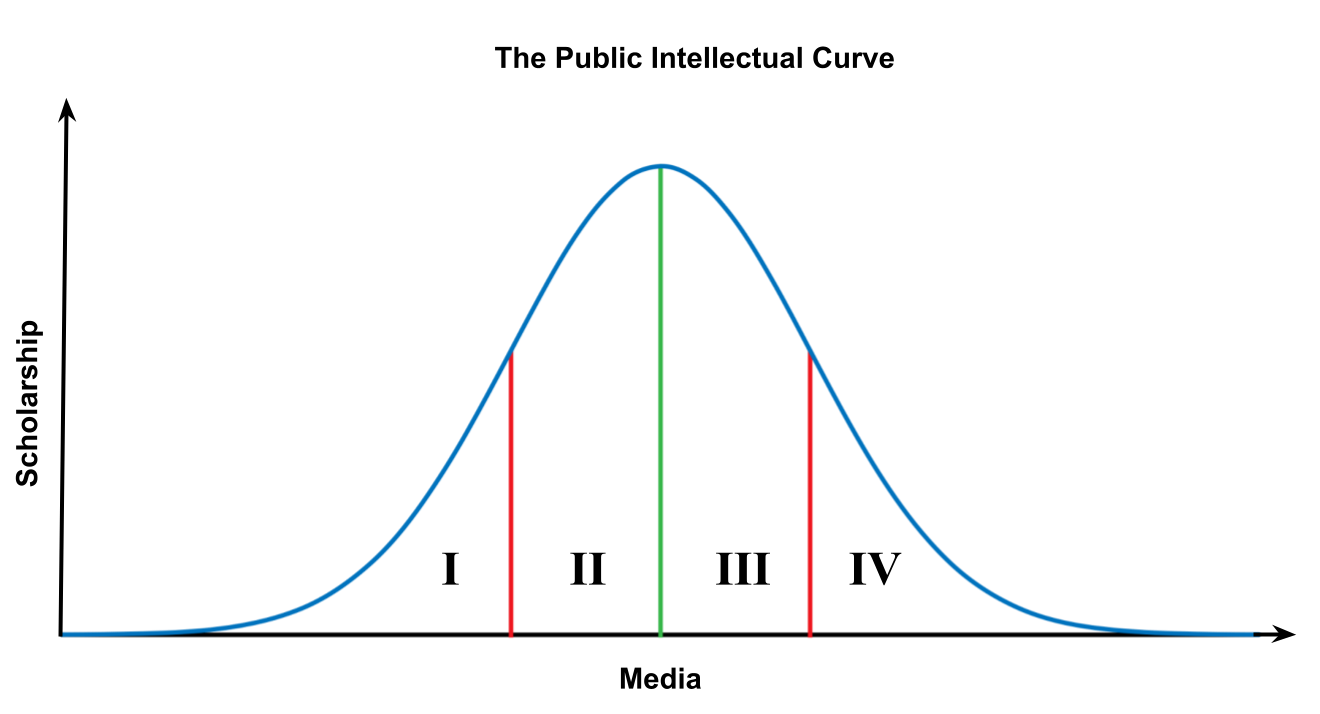
The arc of a public intellectual's career can be represented on a graph. On the y-axis is scholarship. On the x-axis is media exposure.

The overwhelming majority of scholars never even make it onto the curve. Their work, while important for the literature, may not have resonance in public discourse. And for good reason. The best scholarship focuses on ideas for the sake of ideas, not based on what gets the most clicks. Moreover, most professors choose not to do media. It is time-consuming, and seldom contributes to a scholarly agenda. Professors can choose many other forms of service.

Some professors will gravitate--by chance or by choice--towards scholarship that touches on the zeitgeist. And if their publications meet some threshold of quality, the media calls will begin. I refer to this area as Zone I. Here, a professor's greatest contribution is still to the literature, but she is increasingly called upon to speak to the press. Scholars may spend their entire careers in Zone I: publishing quality scholarship, and talking to the media on occasion. This is a career well-spent. But other scholars may ride up the curve.

In Zone II, professors continue to publish important scholarship, as they become fixtures in the press. At some threshold, they become the coveted public intellectual. The academic community reads and respects their scholarship, while elite institutions of media routinely call on them. The professors may choose to publish books with a popular press, rather than an academic press. And invariably, popular presses will push authors to be more edgy, and less scholarly. Footnotes do not sell books. On a book tour, they'll give lectures to academic and non-academic audiences. Perhaps they will receive a regular column in a magazine or newspaper, that blends their academic curiosities with the news of the day. Or they'll become a paid contributor on TV or radio. Media producers, like editors, also demand edginess. But at least for a time, as their media profile grows, they can maintain their scholarly output, as well as teaching and other service obligations. Perhaps some public intellectuals can spend their entire careers in Zone II. Alas, for everyone else, all good things come to an end.

Zone III represents the decline. Public intellectuals will spend more and more time on the "public" part of their job, and less time on the "intellectual" work. Dedicating hours to writing op-eds, popular books, recording podcasts, and (gasp) tweeting will necessarily take away time from academic scholarship. Often this decline can be masked. Public intellectuals can hire an army of super-smart research assistants who can prop up their scholarship. Or they will co-author with junior scholars who do the bulk of the work, but list their name second on the author block. But these scholars will seldom have the devoted time and space that allowed them to develop their intellectual bona fides in the first place. Alas, the press doesn't actually care if a person's scholarship slips. Public intellectuals can tread on their work from decades earlier, as the media continues to call. Thus, in Zone III, even as a professor's scholarship drops, the media exposure increases. There is a vicious cycle: the more a public intellectual seeks the public spotlight, the scholarly community regards her work less. And eventually, even Zone III comes to an end.

Zone IV represents the final chapter of a public intellectual's career. After many years of declining scholarship, the professor is almost exclusively a media figure. Sure, she may publish things from time-to-time. Professors with high profiles can leverage their reputations to secure publications, such as invited pieces and symposium essays. But the professor becomes something of a has-been in scholarly debates. Yet, remarkably, the media keeps calling! Reporters are more interested in punchy lines than citable papers. Moreover, in this zone, the public intellectual may become more strident. Rather than using a scholarly tone, she will will sound not much different than a pundit on cable news who lacks an endowed chair. And often, due to aging, judgment and discretion begin to slip. These professors will cross lines they would have never crossed years earlier. At some point, the cycle concludes.

***

I have been very careful not to identify any scholars in particular, and where they fall on the curve--myself included. I'm sure readers will try to plot me and others on the graph.

An Important Wiretap Act Case Pending in the New Jersey Supreme Court

The law professor hypo come to life.

|

For decades, a major uncertainty about the scope of the Federal Wiretap Act has been how it applies to the repeated but discrete access that can often occur with electronic communications. Telephone wiretapping occurs in real time; the eavesdropper listens in.  But electronic wiretapping can be periodic but discrete. An eavesdropper can access an account discretely but repeatedly over time. The question is, does the Wiretap Act, with its strong privacy protections, still apply?

Here's how I phrased the question in the LaFave Criminal Procedure treatise, for which I have written the electronic surveillance chapter, Chapter 4:

[A]n acquisition occurs under the Wiretap Act only if the collection of the communication is 'in flight' in real-time, during prospective surveillance of an ongoing communication. Exactly what this means can be tricky in cases involving electronic communications, as electronic communications can be stored or transmitted for extremely short periods of time. The basic question is this: If a tool makes copies of a communication shortly after it arrives at its destination, is that acquisition contemporaneous with transmission or is it only after the transmission has been completed? Put another way, can surveillance circumvent the Wiretap Act by acquiring communications immediately after they have arrived at their destination? If an e-mail account is accessed once an hour, is that an intercept? What about one a minute, once a second, or once a milli-second?

2 Wayne LaFave et al, Crim. Proc. § 4.6(b).

I asked the same question in my computer crime law casebook:

[T]he Wiretap Act regulates prospective surveillance and not retrospective surveillance.

At the same time, the line between prospective surveillance and retrospective surveillance can become fuzzy. Imagine a government agent has access to a suspect's e-mail account, and he can click a button and receive an update with all new incoming or outgoing messages. Is the access prospective or retrospective if the government agent clicks the button every hour? Every minute? Every second?

Orin Kerr, Computer Crime Law 667 (5th ed. 2022).

It turns out this hypothetical has turned into a real case, currently pending in the New Jersey Supreme Court, with oral argument scheduled for March 13.  The question: Can the government avoid the Wiretap Act by getting access to an account every 15 minutes?  New Jersey state prosecutors obtained Communications Data Warrants (CDWs) that required Facebook to hand over the contents of the suspects' accounts every 15 minutes for 30 days.  Facebook objected, saying that the orders violate the Wiretap Act.

The lower court opinion held that Facebook was required to comply with the CDWs because compliance was not an "intercept" under the Wiretap Act:

[T]he CDWs did not grant access to the contents of prospective communications on Anthony's and Maurice's Facebook accounts while they were either "en route," or "within the same second," that they were placed on Facebook's servers. Rather, police would not have access until, at earliest, fifteen minutes after any electronic communication's  transmission. Though the CDWs compelled Facebook to disclose the entire stored contents of each target's Facebook account for thirty prospective days, that did not make the disclosures contemporaneous with transmission. Luis, 833 F.3d at 627. Rather, once the communications would come to "rest" on Facebook's servers, they would be in "electronic storage," and thereby subject not to the wiretap acts, but to the SCA and the provisions of the NJWESCA that mirror that statute. Ibid.

The court then ruled that Fourth Amendment concerns limited this procedure to 10 days:

In formulating an acceptable constitutional solution to the disclosure of that information, we choose to apply a practical approach to the release of prospective electronically stored communications under a CDW. To remain within the parameters of state warrant procedure, the CDWs can be issued, assuming probable cause is once again established, and served on Facebook requiring that any information identified in the warrant and stored by Facebook during the period up to the day it is served with the warrant must be turned over. In addition, incorporating our state warrant procedures under Rule 3:5-5, going forward, if the State serves a CDW on Facebook for the disclosure of prospective electronic communications, no disclosures may be compelled beyond ten days from the issuance of the warrant. And, Facebook can comply with that requirement by producing the stored information on the day of or after the electronic communications have been stored.

Any further attempt to secure information from prospective time periods must be based upon new CDWs issued on new showings of probable cause. We believe that this practical approach, which modifies the trial courts' dispositions, is consistent with the federal and state constitutions and our warrant procedures, comports with the applicable statutes, and fairly balances the interests of the parties before us.

The New Jersey Supreme Court then accepted review.

I think the lower court Wiretap Act's analysis is wrong, and that the Wiretap Act applies to repeated access every 15 minutes.  This is one issue I felt strongly enough about that I included it in the LaFave treatise when I joined it, around 2008 or so.  Here's how I recommend answering this issue in the LaFave treatise, with emphasis added: Read More

Law & Government

Models of Forum Shopping

Thoughts relevant to the Texas district courts.

|

There are a few different ways to think about the differences between judges, and about the related problem of forum shopping:

On one model, all judges are exactly the same. They all apply the law, which has uniquely right answers. It never matters who your judge is, because they will all apply the law, and all reach the right answer.

On a second model, there are two kinds of judges: fair, and unfair. Fair judges are basically the same. They all apply the law, which has uniquely right answers. But there are also unfair judges, who don't apply the law. So it matters whether you get a fair judge or an unfair judge.

On a third model, all judges are political. Judges are different to the extent that their politics are different. It matters who your judge is, because judges have different politics, and judges will apply their politics. Some people think this model is fair, and some think it is unfair.

On a fourth model, all judges are fair, and non-political, and apply the law, but they are also not exactly the same. The law is complicated enough that even two fair judges, both applying the law, might not always reach the same answer in every case. Neither judge is unfair, but the judges are different.

These models affect how we think about things like forum shopping and judge shopping. On the first model, of course, forum shopping is pointless, and people who complaint about it are delusional. On the second model, forum shopping is presumably bad to the extent that people with bad cases are picking unfair judges, and we should take the cases away from the unfair judges, or get rid of them entirely if we can. Etc.

But suppose we believe in something like the fourth model. Excessive forum shopping will systematically bias adjudication in favor of the plaintiffs, even though the judges are not biased. So it would be a mistake, a category error, to ask those opposed to forum shopping whether they think the judge is biased. Instead we should ask whether judges are different, and if so, whether we care if the plaintiff gets to pick the same one of the different judges over and over again. Maybe we do, maybe we don't, but that's the question. This is why I don't share Josh's reaction to the litigation over the federal district judges in Texas.

Department of Justice v. Texas Judges

Does DOJ actually agree with "a couple of law professors beating a drum on Twitter"?

|

Forum shopping is not new. Judge shopping is not new. Litigants have strategically filed cases in single-judge divisions for as long as single judge divisions have existed. Yet, in recent years, this practice has become intolerable. Writers at Slate and Vox push out a never-ending series of attacks on a handful of district court judges in Texas. Law professors on Twitter amplify those claims. And now, the Department of Justice has embraced this argument. Sort of.

It's important to stress what DOJ has not done. DOJ has not filed any motions for recusal on account that these judges are biased. DOJ has not asked the Fifth Circuit to remove any of these judges. DOJ has not filed a mandamus motion.DOJ has not lobbied Congress to modify the judicial divisions in Texas, or any other state. DOJ has not asked Congress to eliminate all single-judge divisions. DOJ also has not filed a motion for sanctions against the Texas Attorney General for abuse of process. Nor has DOJ filed any misconduct complaint against Texas AG lawyers. All of these actions would be the appropriate vehicles if in fact there was some sort of malfeasance. DOJ hasn't even argued that venue is improper. DOJ has taken none of these actions. Instead, DOJ has filed a series of motions that would not actually determine whether there is any actual malfeasance on the part of the judges or the Texas Attorney General.

What did DOJ do? The government has asked federal judges in Victoria, Amarillo, and Lubbock to transfer certain cases brought by the Texas Attorney General. Why did DOJ file these motions? The precise reasoning is not entirely clear.

Last week, Judge Tipton in Victoria held a hearing on DOJ's motion. DOJ dispatched Erez Reuveni, a career attorney in federal programs, to represent the government. Three themes repeated throughout the hearing.

First, did DOJ think Tipton was biased? The answer was consistently, no.

THE COURT: No. What I'm -- what I want is for you to be candid. I've got thick skin. Lord knows I better. And so my question is -- I just want to find out: Does the United States think that I can be fair and impartial?

MR. REUVENI: The United States thinks Your Honor can be fair and impartial. That is why we are not filing a motion to recuse.

DOJ did not file a motion to recuse, and made no allegations of bias.

THE COURT: And that's what -- I mean, that's what you've said. So do you believe that I would preside over this case fairly and impartially if it stayed in Victoria or went to Corpus Christi?

MR. REUVENI: Yes, Your Honor.

Judge Tipton pointed out that he consistently stayed his rulings, so the Fifth Circuit or the Supreme Court could weigh in.

THE COURT: Right. And so then -- so my -- my opinions don't even go into effect until at least three judges of the Fifth Circuit have a chance to review my work and grade my papers. I mean, my decision doesn't -- and after that, with the cases before the Supreme Court, it was immediately appealed to the United States Supreme Court. So then we had nine very smart people who had the opportunity to review my decision, and it did not go into effect until the Court of Appeals and the Supreme Court had a chance to take a look at it. Don't you think that that also could go a long way toward addressing public perception issues if they hear that my decision doesn't go into effect until a court of appeals allows it to? . …

THE COURT: No, no. No, I'm telling you that in every case the United States has moved for a stay, and I have granted it, and then it goes up to the Supreme Court -- then it goes to the Court of Appeals, and it's up to them how long that stay, stays in place.

Judge Tipton's rulings are not the actions of someone who is intent on ramrodding nationwide policy by himself, contrary to the incessant postings on social media.

I spoke to the Washington Post for their profile of Judge Kacsmaryk. It is true enough that Judge K is batting 1.000 in the Fifth Circuit. He hasn't been reversed by his superiors yet. Of course, critics would argue that the Fifth Circuit is packed with rabid right-wing reactionaries. Yet, our humble circuit has a fair share of moderates and progressives. None of them have ever argued that Kacsmaryk, Tipton, or Hendricks is incapable of being fair. None of these judges have had cases taken away from them. (The Fifth Circuit does reassign cases, for example, against Judge Hughes.) Plus, on appeal to the Supreme Court, none of the Justices have argued that these judges are rogue juristocrats. The bias allegation is a nonstarter.

Second, DOJ argued that Texas's decision to keep filing in single-judge divisions "raises questions" and "creates a perception." What those questions and perceptions are, DOJ could not really say. Consider this colloquy:

THE COURT: Right. And so you said after -- after that, it starts to raise questions. What questions does it raise?

MR. REUVENI: It's a perception problem.

THE COURT: What --

MR. REUVENI: It's a perception problem.

THE COURT: What is that perception?

The exchange goes on, and the lawyer said that Texas's filings "casts this cloud over the whole proceeding." He added, "And so now we have justices of the Supreme Court questioning the hard work of the lower courts, and then we have the public asking: Why is Texas filing in these -- in these -- only these specific divisions?"

Later Tipton asked if DOJ shared that perception. The answer was no.

THE COURT: Do you share that perception?

MR. REUVENI: Do I share the perception that Texas -- that I just described? Yes. I wouldn't have signed this brief --

THE COURT: No, no, no, no. I'm saying: Do you share the perception that Texas has gotten -- Texas is picking me because they think that I'm going to rule in their favor? Do you share that perception? Do you think that -- do you think, starting off right now, that -- that I'm already going to rule against the United States?

MR. REUVENI: No. I don't -- I do not -- I cannot say -- I cannot say whether we believe that you will rule against us.

To summarize, some unknown members of the public (who may be on the faculty of the UT Law School) have this perception. DOJ does not share this perception. But DOJ filed the motion on the basis of this perception.

THE COURT: I'm asking it a different way. Mostly, what you're saying is you're not worried about whether or not you're going to get a fair trial. You're worried that the Court is damaged by the fact that there is a public perception that I'm not going to be fair. Is that…

MR. REUVENI: That's part of it.

Are federal judges (not named John Roberts) supposed to base their decisions on the basis of public perception? DOJ says, "sort of."

Third, assuming that such a "perception" exists, does DOJ's motion help, or exacerbate that perception?

THE COURT: It's not that you're -- it's not that you're not publicizing it. It's that you're kind of furthering the public perception concern by filing a motion that says that single-judge divisions are sketchy. I mean, that's what -- it's hard for someone to look at it and say, Well, what's the problem? Well, Tipton must be in the tank, you know. And like I said, if you said, No, Tipton is not automatically biased against us; he can provide fair and impartial -- I think the public perception, which is 100 percent of what your single-judge division motion is about, public perception, that, and the fact that my opinion is stayed until a court of appeals gets to look at it seems, to me -- I don't know how a public that doesn't want a particular result, regardless of what the law says, would -- could look at that and go, Oh, okay, well, that makes sense. . . .  Like I said, whether or not you issue a press release -- I'm not saying that -- but the fact that you filed a motion which kind of reinforces what I think everybody agrees is a false premise, which is, is that -- that Judge Tipton is going to be biased or prejudiced in favor or against the parties in this case.

Reuveni, speaking for himself, did not disagree!

MR. REUVENI: Again, I can't find really anything to disagree with there, Your Honor, speaking for myself. I just -- to me, that seems incomplete.

It seemed very obvious Reuveni personally agreed with Tipton. Reuveni was fighting with one arm tied behind his back. I think DOJ would have been better served by letting a political appointee argue the case, who actually believed the nonsense on Twitter. A lawyer who has been in the trenches at federal programs understands how problematic this motion was.

Couldn't DOJ help to push back against this "perception" by publicly stating that Judge Tipton will resolve the matter fairly?

THE COURT: On this issue about the public concern about fairness, don't you think you could go a long way toward addressing any concern the public might have by just saying, in public, what you said here on the record as an officer of the Court? "We don't have any concern about Judge Tipton. He will give us a fair trial. We don't have any concern about the way he's presided over previous cases." Wouldn't that go a long way to addressing any public perception issues? . . . Don't you think if the public heard the Department of Justice say that, that it would go a long way towards addressing your public perception concern?

Reuveni could only reply with "I know you are but what am I?"

MR. REUVENI: I mean, I think that's a fair point, Your Honor, and I think, if you're raising the question as to why doesn't the Department of Justice say something to that effect, I would also wonder why doesn't Texas tell the public why it files only in front of six or seven judges.

Texas was represented by Lief Olson, who is a friend and colleague. He addressed the public perception argument directly:

MR. OLSON: Inasmuch as that actually is a public perception, Your Honor, yes, that could -- that could happen. I doubt that that actually is the public perception so much as it is a couple of law professors beating a drum on Twitter. I have never heard anybody with any actual knowledge of the federal court system think that a judge was in the tank for one party or another.

Lief would know. He has experience facing down progressive Twitter mobs.

I fear DOJ has been captured by the solipsistic Twitter #LawProf echo chamber.

Politics

Short Circuit: A Roundup of Recent Federal Court Decisions

Flouncing, flaunting, flirting, flouting, foundering, and flounting.

|

Please enjoy the latest edition of Short Circuit, a weekly feature written by a bunch of people at the Institute for Justice.

Friends, come join us at Georgetown Law this Tuesday, March 7, for a symposium on Shielded: How the Police Became Untouchable, a timely new book by Joanna Schwartz. Click here for the details and to RSVP.

Read More

Free Speech

Tennessee Bans Pornographic Performances by "Male or Female Impersonators" Where Minors Can See Them

|

The newly enacted statute provides:

… "Adult cabaret entertainment" … [m]eans adult-oriented performances that are harmful to minors, as that term is defined in § 39-17-901, and that feature topless dancers, go-go dancers, exotic dancers, strippers, male or female impersonators, or similar entertainers; …

"Entertainer" means a person who provides: (A) Entertainment within an adult-oriented establishment, … or (B) A performance of actual or simulated specified sexual activities, including removal of articles of clothing or appearing unclothed, [both] regardless of whether a fee is charged or accepted for the performance …;

It is an offense for a person to perform adult cabaret entertainment:
(A) On public property; or
(B) In a location where the adult cabaret entertainment could be viewed by a person who is not an adult ….

To understand this, one has to read § 39-17-901, which provides:

Read More

Guns

Should People Who Attempt Suicide Lose Second Amendment Rights, and, If So, for How Long?

|

An interesting decision Wednesday by N.Y. trial court judge Thomas Marcelle (Albany County), Hines v. Doe:

Doe lives in terrible discomfort caused by a host of ailments. In the last three years matters have gotten worse. As a result, Doe drinks every Sunday (but only on Sunday) to cope with his present dysphoria. One Sunday, Doe turned on a football game and consumed 60 proof blackberry brandy to deaden the pain. During the game, Doe's wife began screaming at the TV. The alcohol, the screaming and his afflictions overcame Doe, and he told his wife to shut up. Mrs. Doe stormed upstairs. Doe decided to leave the house, call an Uber and go visit a friend in northern New York. In short order Doe changed his mind. Tormented by his pain, Doe decided that death was better than life. To end his life, Doe walked into a cemetery, opened his jacket, laid down on the snowy ground waiting for hypothermia to take him.

After a few hours Mrs. Doe became gravely concerned about her husband, so she called the police. New York State Trooper Matthew Yankowski responded and conducted a search. Trooper Yankowski located Doe in the cemetery. There and then, under the auspices of MHL 9.41, the Trooper took Doe into custody and transported him to Albany Medical Center to be treated. At the hospital, Doe was visited and examined by a battery of psychiatrists. The next day Doe was released neither with a diagnosis of mental illness nor a prescription for medication.

Petitioner, under CPLR 6341, sought a temporary extreme risk protection order to retain possession of three shotguns and a long rifle that Doe had already surrendered to the State Police. The court granted the temporary order (CPLR 6342) and now must determine if petitioner has "prov[en], by clear and convincing evidence, that the respondent is likely to engage in conduct that would result in serious harm to himself." A likelihood of serious harm means "a substantial risk of physical harm to himself as manifested by threats of or attempts at suicide."

The case is complicated by the Second Amendment…. [Under Bruen], courts must search the historical record to determine if a categorical exception to the Second Amendment exists—without an exception, Doe's right to keep weapons may not be infringed.

Read More

Guns

Judge James Ho's Revised Concurrence in the Second Amendment / Restraining Order Case

|

Yesterday, the Fifth Circuit released an updated version of its opinion in U.S. v. Rahimi, which held that people can't be disarmed just based on a civil restraining order. The changes to the majority are comparatively minor, but Judge Ho used the release of the new opinion as an occasion to put out a substantially enlarged version of his concurrence, which I thought was worth passing along:

The right to keep and bear arms has long been recognized as a fundamental civil right. Blackstone saw it as an essential component of "'the natural right'" to "'self-preservation and defence.'"And the Supreme Court has repeatedly analogized the Second Amendment to other constitutional rights guaranteed to every American. See, e.g., Johnson v. Eisentrager (1950) (describing the First, Second, Fourth, Fifth, and Sixth Amendments as the "civil-rights Amendments"); Konigsberg v. State Bar of Cal. (1961) (comparing "the commands of the First Amendment" to "the equally unqualified command of the Second Amendment"); N.Y. State Rifle & Pistol Ass'n v. Bruen (2022) (quoting Konigsberg).

But lower courts have routinely ignored these principles, treating the Second Amendment as "a second-class right." So the Supreme Court has now commanded lower courts to be more forceful guardians of the right to keep and bear arms, by establishing a new framework for lower courts to apply under the Second Amendment.

"When the Second Amendment's plain text covers an individual's conduct, the Constitution presumptively protects that conduct." "The government must then justify its regulation by demonstrating that it is consistent with the Nation's historical tradition of firearm regulation." "[T]his historical inquiry that courts must conduct will often involve reasoning by analogy—a commonplace task for any lawyer or judge. Like all analogical reasoning, determining whether a historical regulation is a proper analogue for a distinctly modern firearm regulation requires a determination of whether the two regulations are 'relevantly similar.'"This framework "is neither a regulatory straightjacket nor a regulatory blank check." It requires the government to "identify a well-established and representative historical analogue, not a historical twin."

Our court's decision today dutifully applies Bruen, and I join it in full. I write separately to explain how respect for the Second Amendment is entirely compatible with respect for our profound societal interest in protecting citizens from violent criminals. Our Founders firmly believed in both the fundamental right to keep and bear arms and the fundamental role of government in combating violent crime.

[I.] "[T]he right to keep and bear arms … has controversial public safety implications." But it's hardly "the only constitutional right" that does. To the contrary, "[a]ll of the constitutional provisions that impose restrictions on law enforcement and on the prosecution of crimes fall into the same category."

Read More

Free Speech

Libel Lawsuit Over Daily Dot's Allegations That Someone Was "Jan. 6 Capitol Riot Organizer" Can Go Forward

|

From Bostic v. Daily Dot, LLC, decided Wednesday by Judge Robert Pitman (W.D. Tex.):

This case revolves around an article … published on February 23, 2021, by the Daily Dot—a wholly owned subsidiary of Clarion Media—which stated that Plaintiff Daniel Bostic … was a "Jan. 6 Capitol riot organizer." Bostic claims that he "was not connected in any way with the January 6 riots, much less that he was an organizer or coordinator of riots and insurrection." According to his complaint, Defendants knew or disregarded that Bostic was not connected with the January 6 riot and falsely attempted to portray him as an organizer by using a photo of him at an event from a different rally in November 2020.

Bostic has a background in politics but maintains that he has never been substantially involved in any attempts to overturn the 2020 election. He first interned for and later worked as a staff assistant for Congressman Tim Scott, and in 2018, volunteered with the organization "Stop the Steal," which protested ongoing recounts in Broward County, Florida. After 2018, he maintained contact with the organizers of Stop the Steal but began to focus on promoting his filmmaking. He attended political rallies in 2020, including some following the November election results, but alleges that he did not play any part in organizing the Stop the Steal rallies planned for January 5 or 6, 2021. While Bostic does not firmly deny that Stop the Steal helped to organize parts of the January 6 protest, he says that the organization did not plan the march on the Capitol or rally at then-President Trump's speech.

While Bostic acknowledges that he was at a protest in Washington D.C. on January 6, he maintains that he only attended a peaceful portion of the protest. Bostic walked from the White House Ellipse to the media area of the Capitol Lawn and live-streamed a portion of the walk on Twitter via Periscope with "Stop the Steal" chants in the background. He captioned one of the videos "Storming the Capitol#StopTheSteal" but argues that he was so far away from the Capitol building that it should have been obvious that he was not actually storming anything. When he reached the Capitol, Bostic saw the violent scene unfolding, deleted his Periscope stream, and left the protest. According to Bostic, that was the extent of his participation in the events of January 6.

On January 19, 2021, Salon published an article stating that Bostic could be seen on video climbing the steps of the Capitol building. On February 23, 2021, the Daily Dot—an online news organization based out of Austin, Texas—published a short article stating that Bostic would be attending an upcoming Conservative Political Action Conference ("CPAC"). The Article was written by [Zachary] Petrizzo, who Bostic describes as an investigative reporter who has published for the Daily Dot[], Mediaite, Salon, and the Daily Beast….

Read More

More