The Volokh Conspiracy

Mostly law professors | Sometimes contrarian | Often libertarian | Always independent | Est. 2002

The Volokh Conspiracy

"The World's First Robot Lawyer Has Been Practicing Law Without a License —"

"doing a pretty poor job of it to boot, according to a putative class action filed Tuesday," reports Courthouse News Service.

|

From its story:

Defendant DoNotPay Inc. began as an app to fight parking tickets and in the eight years since it began has morphed into an online legal service which claims to be able to handle a slew of legal services for its clients ranging from finding hidden money and filing lawsuits to annulling marriages and beating bureaucracy, all without having to hire a lawyer.

The app now offers divorce settlement agreements, defamation demand letters, restraining orders, and U.S. Securities and Exchange complaints in addition to dozens of other legal services. "The DoNotPay app is the home of the world's first robot lawyer," the company claims on its website. "Fight corporations, beat bureaucracy and sue anyone at the press of a button."

But the plaintiffs in Tuesday's lawsuit have their doubts….

You can read the Complaint; here's DoNotPay's initial response (though of course it will respond in more detail in the litigation):

Read More

Religion and the Law

Zooming Zion: Israeli S. Ct. Holds That Remote Utah Marriages Are Valid in Israel

|

From Times of Israel (Jeremy Sharon):

The Supreme Court has ruled that the Interior Ministry is obligated to register as married couples who wed in online civil ceremonies through the American state of Utah ….

The decision means that couples who cannot marry in Israel through the Chief Rabbinate, or do not wish to do so, are now legally able to get married without physically leaving the country. Israel has no civil marriage mechanism due to the objection of religious political parties, but recognizes civil unions formed abroad….

In its decision issued on Tuesday, the High Court ruled that the clerks of the Population and Immigration Authority were not legally authorized to challenge the validity of the Utah marriages and refuse to register them….

And from Jerusalem Post (Zvika Klein), more on the motivation for foreign marriages (which Israeli law has long recognized):

Read More

"Antisemitic Invective" at the University of Michigan Law School

The only announcements on the law student listserv that attract hateful commentary are from the Jewish Law Students Association

|

[Author's note: I published a significantly longer version of this post at the Times of Israel.]

I recently posted an article about the increasingly hostile environment Jewish students face at elite law schools. Within hours, I heard from Michigan Law students upset and concerned about what one called "antisemitic invective" on a student email listserv called LawOpen, a listserv used almost entirely for student-group events and to resell tickets.

Students representing the Jewish Law Students Association sent out two separate emails, each advertising an event. The first announced an anti-bias event sponsored by the Anti-Defamation League (ADL), the prominent (and very liberal) Jewish civil rights organization. The second announced that students could apply for a trip to Israel.

The ADL email was met with unhinged invective. One student wrote, among other things, that ADL is a "hateful group" that, among other things, supports "racist, militarized policing." Moreover, the student claimed that ADL's anti-bias work "centers the experience of white Jewish people" and therefore "is not true anti-bias work."

A second student accused ADL of being a "pro-racism organization" and supporting this accusation with a laundry list of charges ranging from the grossly exaggerated to the inventively imaginative. As a rather clear example of the latter, the student claimed that ADL tried to squash medical and social recognition of AIDS. Right-wing hate groups and the Nation of Islam have made wild charges against the ADL in the past, but even after consulting Dr. Google and inquiring with antisemitism experts, I couldn't find a source for that one.

More disheartening to me than the nutty conspiratorial emails about the ADL is the reaction of the rest of the students, which was that no one objected to this absurd calumny. One student raised the question of why this particular event attracted so much vitriol: "We don't have a whole public discourse on every event that FedSoc [the conservative Federalist Society] puts on, in fact any discourse at all, and they're FedSoc."

The second mail, about the trip to Israel, was met with the response, "Enjoy the apartheid with your falafel!" Things deteriorated from there into a very long thread full of fact-challenged denunciations of Israel. Early in the thread, one student interjected that it "makes me really uncomfortable when the only events or announcements that are quickly and harshly disparaged on lawopen happen to be those that deal with Israel or Jewish organizations that hold certain viewpoints on Israel." This had no effect.

Consciously antisemitic or not, the threads at the very minimum reflect a complete lack of concern for the sensibilities of Jewish students at Michigan Law School. Every other group on campus (even the conservative FedSoc!) advertises whatever events they want, no matter how controversial, without provoking enmity. It's only the Jewish law student group that attracts such a reaction, and that reaction continued even after a student pointed out that his colleagues were singling out the Jewish student association's posts.

If this were an isolated incident, I wouldn't have bothered writing about it. But there have been a series of recent related incidents at other elite law schools. The Yale Law Journal brought in an antisemitic "diversity trainer," without any significant soul-searching thereafter. NYU students boldly proclaimed that "Zionists" control the media, and continued to do so even after the fact that this is an antisemitic trope was made clear to them. Georgetown Law Center's Students for Justice in Palestine hosted a speaker with a long history of antisemitic statements, and declined to cancel his invitation when this history was publicized. The law school administration said nothing, even while it was busy denouncing and investigating Ilya Shapiro for an ill-phrased tweet about President Biden's promise to appoint a black woman to the Supreme Court. And some of the most prominent law student groups at Berkeley have vowed not to invite any "Zionist speakers" to speak on any issue, in theory precluding the vast majority of Jews from speaking at their events.

Coincidentally, Tablet recently published a piece by Jacob Savage about how Jews are gradually disappearing from visible places in American life where they were once prominent. He blames this on woke and DEI considerations, though in my view broader factors are also at work. But Jews are clearly being pushed out of progressive political spaces. Jews are deemed to be, at best, generically white, more often "privileged whites," and, increasingly, "privileged whites who use their privilege to support Israel's oppression of people of color in Palestine." Under any of those perspectives, Jewish sensibilities don't count on the woke left, at best amounting to "white tears."

We are less than eight decades from the Holocaust (dismissed by the woke as relatively unimportant "white on white violence"), Jews are the only group in the United States that needs armed guards at all of their institutions to protect their constituents from violence. Just last month, an antisemite targeted and shot two Orthodox Jews in Los Angeles.

But at elite American law schools, where many future leaders will come from, students believe that combating anti-Jewish bias isn't "real" anti-bias work, the very liberal ADL is a right-wing hate group, and that not only should Jewish sensibilities be ignored, Jews should be affirmatively provoked until they all fully buy into the woke agenda, including on "Palestine."


Politics

I'd Like a Real Translation, Please

|

From ABC Corp. v. Partnerships & Unincorporated Ass'ns Identified on Schedule A (one of the many recently filed cases involving alleged mass copyright infringement by apparently off-shore businesses), decided Dec. 19 by Judge Joan Gottschall (N.D. Ill.) but just posted to Westlaw:

Before the court is plaintiff's motion for leave to proceed temporarily under a pseudonym and for leave to file under seal the complaint, the accompanying exhibits, plaintiff's Local Rule 3.2 notice of affiliates, and its anticipated motion for a temporary restraining order. Plaintiff relies heavily on translations of a Chinese-language website to support its motion. One of plaintiff's attorneys created these translations using the Microsoft Edge web browser's automatic translation service. There is no indication that anyone with knowledge of the Chinese language reviewed the computer-generated translations created by plaintiff's lawyer. The Chinese-to-English translations plaintiff has filed are therefore inadmissible under the "well-established rule that a document in a foreign language is generally inadmissible unless accompanied by a certified English translation."

Additionally, questions of a translation's reliability and accuracy go to its weight and credibility rather than its admissibility. The court does not know what the emphasized portion of the following passage means: "TWO NEW BRANDS FILED! A POPULAR ANIMATION AND AN ILLUSTRATION WORK, TAKE ADVANTAGE OF THE FACT THAT IT IS NOT FROZEN AND QUICKLY REMOVE THE SHELF TO WITHDRAW CASH." Two additional examples are: (1) "GBC AGENT GENERAL MOTORS A NEW WAVE OF CASES TO ATTACK, GMC TRADEMARK RIGHTS PROTECTION, JUST OCCURRED, SELLERS PAY ATTENTION TO VIEW!" and (2) "HSP AGENT CASIO, HAS NOT YET BEGUN TO FREEZE, THE SELLER QUICKLY CHECKED AND REMOVED!" What these statements mean is not apparent and has not been explained. These statements could indicate either that the translation is unreliable or that the translation is reliable, but the website is ambiguous in context.

Read More

Did You Lie About COVID During The Pandemic?

Parents were often not truthful about whether their children were vaccinated or needed to quarantine.

|

The pandemic ushered in a wave of difficult ethical choices. In the early days, there were shortages of N-95 masks, ventilators, and certain forms of treatment. How would those scarce resources be rationed? What about "essential" workers who were immunocompromised? Could they be forced to work? And later, there were different ways in which the vaccines were distributed. The elderly and the immunocompromised generally went first. But people with certain comorbidities could jump the line. And in some places, governments administered vaccines based on racial preferences (or some proxy like zip code).

Throughout this process, people had perverse incentives to lie. For example, a person could lie or exaggerate about the extent to which she was immunocompromised. That term was broadly understood. And there was no real way of linking a particular health condition to COVID. A person who did not want to work in a crowded workplace had an incentive to embellish a health condition. There were similar perverse incentives for declaring "comorbidities." Take "obesity" for example. Many people who would not generally call themselves "obese" would promptly check that box if it helped them get a vaccine quicker. There is also the issue of bribery. I know that people paid money under the table to get the vaccines quicker. Finally, there is the issue of testing and quarantining. We were all on the honor system. A person could conceal her symptoms, or chalk a cough up to allergies. There was no way to track these sorts of things.

A recent paper published by Journal of American Medical Association considers how often parents lied about COVID during the pandemic. The Hill summarizes the results:

In a survey of 580 parents with children under the age of 18, about 26 percent reported that they misrepresented or lied about their children's COVID-19 status, according to a study published Monday in the journal JAMA Network Open.

Out of seven behaviors related to adherence to public health guidelines, the most common behaviors were not informing someone who spent time with their child that they suspected or knew that their child had COVID-19, at 24 percent of respondents, and allowing their child to break quarantine, at about 21 percent of respondents.

About 19 percent of respondents did not get their child tested for the coronavirus when they thought their child might have COVID-19.

Other behaviors included:

  • Stating that their child was older than they were so that they could get vaccinated (9.7 percent of respondents)
  • Saying that their child was vaccinated when they were not (10.1 percent)
  • Saying their child was not vaccinated when they were (12.2 percent)
  • And saying that their child did not need to quarantine when they actually did need to (16.4 percent)

These numbers cut in both directions. Roughly the same percentage of parents lied to get their children vaccinated, as parents who lied so their children would not have to get vaccinated.

Perhaps these parents justified the lie, in the interest of protecting the health of their children--either because they believed the vaccine would help or hurt their child. Or they lied about quarantining to avoid having to keep their children out of social circles. At least in this limited regard, truth was sacrificed during the pandemic. I suspect these sorts of lies can be extrapolated to wide ranges of behavior during these unsettled times.

Judge in L.A. City Councilman Mark Ridley-Thomas's Corruption Trial: No Lawyer Internet Research on Prospective Jurors

|

From U.S. v. Ridley-Thomas, decided yesterday by Judge Dale Fischer (C.D. Cal.):

Defendant Mark Ridley-Thomas seeks the Court's permission to engage in {internet-based} background research to seek out public information related to the prospective jurors in the venire. The government opposes this request.

The Court recognizes that it has wide discretion over jury selection and almost certainly has the discretion to approve Defendant's request. Unfortunately, despite years of widely available social media profiles, there is no authoritative federal guidance on the proper use—or denial of use—of these tools in jury selection. Defendant cites opinions from various state professional organizations approving of—or at least allowing—the practice, but these are primarily focused on the ethical implications of juror research and not whether it is a good idea from the perspective of the administration of justice.

The Court recognizes that a number of courts have allowed the kind of juror research Defendant seeks, particularly in state courts. Defendant even cites two federal cases where the district court found, after trial, that defense counsel should have conducted internet searches during voir dire to find objectionable material on jurors that was uncovered later. Obviously, if the Court forbids such research, Defendant will not later be penalized for not engaging in the searches.

The Court's objections to the kind of juror research that Defendant seeks were well-summarized by Judge Alsup when he considered a request to allow juror research in Oracle America, Inc. v. Google, Inc. (N.D. Cal. 2016). This Court, like Judge Alsup, is very concerned that if and when jurors discover that the lawyers have conducted research into their personal lives, the jurors will believe that they are justified in ignoring the Court's admonition not to conduct their own independent research. See id. ("The one-sidedness of Oracle's approach will be hard to accept and therein lies the danger.").

Read More

Free Speech

"Montana State University Student Settles Free Speech Lawsuit" Related to "Sorority's 'Insistence' on Preferred Pronouns"

|

From Keila Szpaller (Daily Montanan):

In January, Daria Danley sued MSU, its president and director of the Office of Institutional Equity, along with the commissioner of higher education. Danley argued a no-contact order MSU had imposed on her without an end date or due process infringed on her rights.

In the settlement agreement filed last week in U.S. District Court of Montana in Helena, the Bozeman campus agreed to end its no-contact order, and Danley agreed to dismiss the case….

Danley filed the lawsuit after she questioned her sorority leader about using preferred pronouns, and about an alleged stalking by another sorority student who is LGBTQ,Free the complaint said.

As a result, MSU punished Danley for "hate speech" and imposed the no-contact order, which prohibited her from attending sorority events or entering a building where her alleged harasser was present, the lawsuit said.

For more on plaintiff's allegations, see her brief in support of her motion for a preliminary injunction; for MSU's response, see its brief.

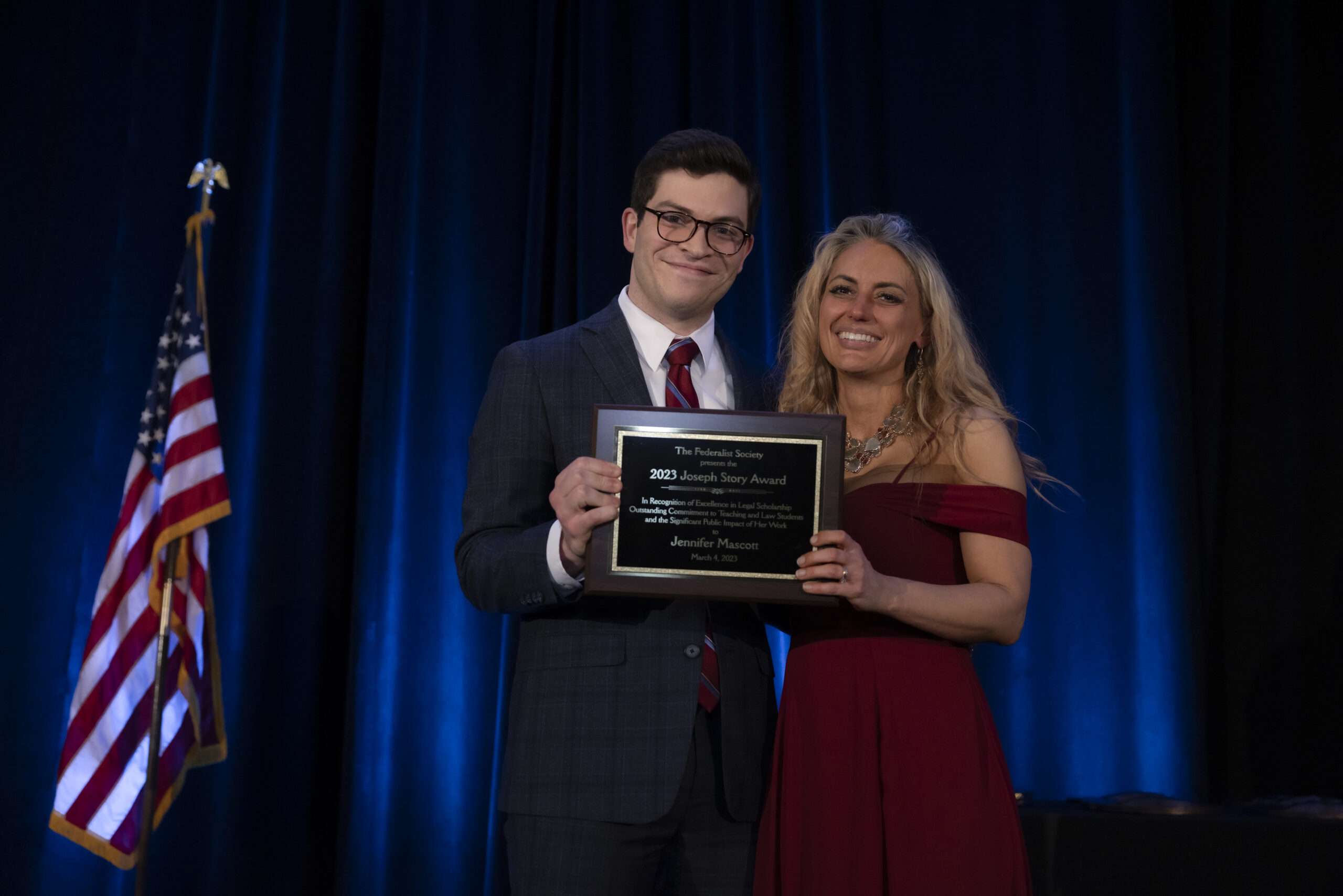
Professor Jennifer Mascott, Winner of 2023 Joseph Story Award

|

Congratulations are in order for Professor Jennifer Mascott of George Mason, winner of the 2023 Joseph Story Award. This award recognizes a junior academic who has demonstrated excellence in legal scholarship, a commitment to teaching, a concern for students, and who has made a significant public impact in a manner that advances the rule of law in a free society. This award is richly deserved.

Matt Phillips, who chairs the Story Committee at the University of Chicago, provides some of the highlights of Jenn's career:

Mr. Phillips began by detailing Professor Mascott's scholarly contributions.  Referencing her article "Who Are Officers of the United States?," which he called "an originalist tour de force," Mr. Philips noted that Professor Mascott's "seminal work"situated her at the "forefront of the national debate" on the separation of powers. He said Prof. Mascott is an "intellectual trailblazer" and "stalwart defender of the rule of law." He also pointed out her extensive involvement in the legal profession, including her "incredible thought leadership" as the Co-Executive Director of the Gray Center, Public Member of the Administrative Conference of the United States, and Vice Chair of the Constitutional Law and Separation of Powers Committee within the ABA's Section of Administrative Law and Regulatory Practice, as well as her "tireless public service" at the Office of Legal Counsel in the Department of Justice.

Finally, Phillips described Professor Mascott's strength as a "dedicated teacher and mentor" to her students at Scalia Law. He identified her various roles on campus, including that of faculty director of the law school's Supreme Court and Administrative Law clinics, founder of the Separation of Powers Clinic, and co-professor with two Supreme Court Justices. In the words of her students, she is a "fantastic instructor" and "wonderful person" who "models a commitment to family and takes genuine joy in her profession."

This award came at a very difficult time for Jenn and her family.

Mr. Phillips closed with a moment of silence to honor the memory of Professor Mascott's late husband, Jeff Mascott, who passed away only a few days earlier, on February 28, after battling advanced pancreatic cancer.

In accepting the award, Prof. Mascott remarked that the award came at a tragic and difficult time for her and her family.  But she noted that the award also provided the opportunity to "reflect on deep-seated values of family, sacrifice, and faith that are important to this community and to the development and flourishing of personal excellence and character in the practice of law."

Prof. Mascott began by thanking and remembering her late husband Jeff, who through his dedication to family enabled her to "enjoy government service at the Department of Justice, to join many law school symposia, conferences, and Federalist Society chapter events around the country, and to take a lengthy period of time in our basement as a Georgetown Olin/Searle Fellow when I researched the original meaning of officers of the United States."  She also thanked her inlaws and her many mentors in the legal community who throughout the years "provided encouragement and a model of excellence for scholarship, service, and family oriented values along the way."

Jenn accepted the award with grace and strength that few of us could muster.

Read the rest of the release here, and the video of the ceremony begins at 1:15:00.

I was honored to sit at Jenn's table as she received this distinguished recognition. Welcome to the club!

Town Public Comment Policy Requiring Remarks to Be "Respectful and Courteous" Violates Massachusetts Constitution

|

From today's Massachusetts high court opinion in Barron v. Kolenda, written by Justice Scott Kafker (and dealing with a claim brought under the state constitution's free expression provisions, rather than under the First Amendment):

[W]e conclude that the public comment policy of the town of Southborough (town) violates rights protected by art. 19 [freedom of assembly] and, to the extent it is argued, art. 16 [freedom of speech]. Under both arts. 19 and 16, such civility restraints on the content of speech at a public comment session in a public meeting are forbidden. Although civility, of course, is to be encouraged, it cannot be required regarding the content of what may be said in a public comment session of a governmental meeting without violating both provisions of the Massachusetts Declaration of Rights, which provide for a robust protection of public criticism of governmental action and officials.

What can be required is that the public comment session be conducted in an "orderly and peaceable" manner, including designating when public comment shall be allowed in the governmental meeting, the time limits for each person speaking, and rules preventing speakers from disrupting others, and removing those speakers if they do. We have concluded that such time, place, and manner restrictions do not violate either the right to assembly under art. 19 or the right to free speech under art. 16….

The policy provided, among other things, "All remarks and dialogue in public meetings must be respectful and courteous, free of rude, personal or slanderous remarks"; the event that triggered the lawsuit was this:

Read More

Software Liability

Episode 447 of the Cyberlaw Podcast.

|

Our last episode of the Cyberlaw Podcast (No. 446) was a long interview on the U.S. national cybersecurity strategy with Chris Inglis, until recently the national cybersecurity director.  So this episode 447 focuses only on the most controversial recommendation in the strategy – liability for certain security flaws.  Nick Weaver, Maury Shenk and I explore the pros and cons of what's become known as cybersecurity's third rail.

Turning to the U.K., Maury brings us up to date on the pending Online Safety Bill. Signal has threatened to "walk" out of the U.K. if the bill's protections for children threaten its end-to-end encryption ideology. Far from being deterred, members of Parliament are pushing for a tougher bill, and the government is being forced to accommodate them with tough criminal penalties for Big Tech execs who do not take their obligations sufficiently seriously.

Is the Biden administration getting ready to impose restrictions on outbound U.S. investment in critical Chinese industries?  The Wall Street Journal says it is, but Justin Sherman thinks that the administration may just be meeting Congress's requirements for a briefing on the topic. Meanwhile, I wonder whether we've got this tech control thing backwards. If ASPI , the Australian think tank, is right, the U.S. has already lost the lead to China in 37 of 44 critical new technologies, so what we really need to worry about is Chinese restrictions on U.S. access to its technology.

Maury and I explore "woke AI," the notion that the "ethical guardrails" built into ChatGPT and other engines are simply disguised forms of political bias. Maury notes that Justice Gorsuch has questioned whether AI engines might have the protection of section 230. That seems like a legally dubious proposition to us, but don't underestimate the willingness of Big Tech's lawyers to argue the point.

TikTok suffered a setback on the Hill last week, as Republicans passed out of committee a bill effectively banning the app. It was a party line vote, showing how what had been a bipartisan issue is now fraying into partisanship, at least in the House. In the Senate, though, Senate Intelligence Committee Chair Mark Warner is working toward a similar outcome on a bipartisan basis, creating real jeopardy for the company over the next two years. If anyone should be hoping China does not sell arms to Russia, I suggest, it is TikTok.

Speaking of China, the most eye-opening story of the week comes from the Globe and Mail. It breaks a story about how aggressively China tried (and with real success) to tilt the 2021 Canadian national election toward the Liberals, using tactics we are bound to see in other countries.  My favorite? Persuading China-friendly companies to hire students from China in Canada and then release them to "volunteer" for the CCP's favored candidate.

In other China news, Maury and Nick note that Elon Musk's remarks lending credibility to the Wuhan lab leak theory drew a brushback pitch from official Chinese sources, and Nick and I puzzle over stories that China plans to launch 13,000 satellites to keep up with Starlink. Meanwhile, Twitter's revenue continues to sink. I think we can see bottom for the company, but Nick thinks not.

Nick overcomes my skepticism about Meta's deployment of a tool for taking down nude photos and worse. It is a variant of existing methods, but it has the advantage of not requiring victims to send their nude photos to Meta.

Justin responds to my criticism a few episodes back of Duke's study claiming that Americans' mental health data is being sold by data brokers.

In quick hits,

Download 447th Episode (mp3)

You can subscribe to The Cyberlaw Podcast using iTunes, Google Play, Spotify, Pocket Casts, or our RSS feed. As always, The Cyberlaw Podcast is open to feedback. Be sure to engage with @stewartbaker on Twitter. Send your questions, comments, and suggestions for topics or interviewees to CyberlawPodcast@steptoe.com. Remember: If your suggested guest appears on the show, we will send you a highly coveted Cyberlaw Podcast mug! The views expressed in this podcast are those of the speakers and do not reflect the opinions of their institutions, clients, friends, families, or pets.

Guns

Federal Court Strikes Down Missouri's Second Amendment Protection Act on Supremacy Clause Grounds

|

From today's U.S. v. Missouri, decided by Judge Brian Wimes (W.D. Mo.):

The Supremacy Clause provides that the "Constitution, and the Laws of the United States which shall be made in Pursuance thereof … shall be the supreme Law of the Land; and the Judges in every State shall be bound thereby, any Thing in the Constitution or Laws of any State to the Contrary notwithstanding." "By this declaration, the states are prohibited from passing any acts which shall be repugnant to a law of the United States." "The states have no power, by taxation or otherwise, to retard, impede, burden, or in any manner control the operations of the constitutional laws enacted by congress to carry into effect the powers vested in the national government." Further, "[t]he law of congress is paramount; it cannot be nullified by direct act of any state, nor the scope and effect of its provisions set at naught indirectly." As such, a state legislature's attempt to "interpos[e]" itself against federal law "is illegal defiance of constitutional authority." …

Section 1.420 [which is part of the Missouri Second Amendment Preservation Act] provides that certain federal firearms regulations are "infringements on the people's right to keep and bear arms, as guaranteed by Amendment II of the Constitution of the United States and Article I, Section 23 of the Constitution of Missouri, within the borders of this state, including, but not limited to," in summary, (1) taxes or fees on firearms, accessories, or ammunition; (2) registration of firearms, accessories, or ammunition; (3) registration or tracking of ownership of firearms, accessories, or ammunition; (4) bans on possession/ownership/transfer of firearms, accessories, or ammunition by law-abiding citizens; and (5) confiscation of firearms, accessories, or ammunition from law-abiding citizens.

A federal law preempts a state law if the two are in direct conflict. A "direct conflict" occurs "[w]hen compliance with both federal and state regulations is a physical impossibility or when a state law stands as an obstacle to the accomplishment and execution of the full purposes and objectives of Congress …." If "Congress enacts a law that imposes restrictions or confers rights on private actors," and "a state law confers rights or imposes restrictions that conflict with federal law," then "the federal law takes precedence and the state law is preempted."

Read More

An Interview with Chris Inglis on the National Cybersecurity Strategy

Episode 446 of the Cyberlaw Podcast.

|

Chris Inglis was the first National Cyber Director at the White House, after a long and highly successful career at the National Security Agency (ending with seven years as Deputy Director). In his role as Cyber Director, he brought the office from one employee up close to its planned strength of nearly 100 staffers. He also oversaw the drafting of the first National Cybersecurity Strategy, leaving office just a couple of weeks before the strategy was publicly released

So what does he think now about the strategy, its reception, and its future?  I sat down with him to review the strategy's recommendations – especially the hardest ones. Chris speaks candidly about the need for (and the limitations on) cybersecurity regulation, the wide cybersecurity gaps between different sectors of our economy, the reasons for rethinking liability for cybersecurity failures, and how the Office of the National Cyber Director can work with the Deputy National Security Adviser for Cyber and Emerging Technology.

Download 446th Episode (mp3)

You can subscribe to The Cyberlaw Podcast using iTunes, Google Play, Spotify, Pocket Casts, or our RSS feed. As always, The Cyberlaw Podcast is open to feedback. Be sure to engage with @stewartbaker on Twitter. Send your questions, comments, and suggestions for topics or interviewees to CyberlawPodcast@steptoe.com. Remember: If your suggested guest appears on the show, we will send you a highly coveted Cyberlaw Podcast mug! The views expressed in this podcast are those of the speakers and do not reflect the opinions of their institutions, clients, friends, families, or pets.

Free Speech

Appellate Court Vacates Order Aimed at Stopping Child from Calling Stepfather "Dad"

|

From Rogowski v. Kirven, decided last week by the Pennsylvania Superior Court, in an opinion by Judge Judith Ference Olson, joined by Judges Mary Jane Bowes and Mary P. Murray:

[T]he trial court … placed the following restriction on the Child's speech:

The parties shall not encourage the Child to refer to anyone other than the parties as Mother, Mom, Father, Dad, [et cetera.] In the event the Child refers to a party's spouse or significant other in such a way, that party shall correct the Child.

… [W]e find this restriction to be a content-based restriction because the purpose of the restriction was to limit the message that the Child conveyed through use of the terms "Mom" or "Dad" to denote a biological, familial relationship with the person rather than a non-biological, familial relationship as exists in the case of a step-parent. Therefore, this restriction is subject to the strict scrutiny standard.

Read More

Religion and the Law

Court Reverses Denial of Unemployment Compensation to Employee Fired for Religious Objection to Vaccination

|

From Washa v. Actalent Scientific, LLC, decided two weeks ago by Minnesota Court of Appeals Chief Judge Susan Segal and Judges Peter Reyes and Randall Slieter, but just posted on Westlaw:

Actalent Scientific employed Washa and placed him as a medical lab technician with North Memorial Clinics. On January 3, 2022, North Memorial terminated Washa's assignment because he refused to obtain a COVID-19 vaccination as required by North Memorial's policies. Washa had requested an exemption from the vaccine requirement, but it was denied….

Washa was denied unemployment benefits, administratively appealed, and participated in a hearing before the ULJ [unemployment law judge]. When the ULJ asked Washa about his reasons for refusing the COVID-19 vaccine, Washa testified:

[I]t's a matter of not wanting to be defiled. It's like the God that actually comes, like, has a spot in me, and I need to keep the spot good, otherwise he's not as able to enter as well, where ultimately I could go to hell over it. But it's a matter of purity of a person's body. Body is a temple type belief.

Washa testified that he had not received any vaccines for the past 15 years. Washa testified that his beliefs derive from the Bible and that he attends a Bible study with a group of friends about once every two weeks to "go over the Bible in different ways." …

Read More

Politics

Mallory v. Norfolk Southern Just Got A Lot More Real

If the Supreme Court upholds Pennsylvania's personal jurisdiction statute, residents of East Palestine, Ohio can sue the railroad in Philadelphia.

|

As a practical matter, what is the most consequential Supreme Court case this term? No, it is not Students for Fair Admission or Moore v. Harper. These constitutional law decisions will affect things that law professors care about, but most people will barely even notice. I've long thought the most consequential decision is also a sleeper case: Mallory v. Norfolk Southern. This case concerns personal jurisdiction. To grossly summarize, the question presented is whether Pennsylvania can require businesses to consent to personal jurisdiction in order to do business in the Commonwealth. In this case, a Virginia resident sued a Virginia corporation for injuries that arose in Virginia and Ohio. And the plaintiff filed suit in Philadelphia. The tort had no "minimum contacts" with Pennsylvania. Personal jurisdiction could only be premised on the registration statute.

I covered this case in my Supreme Court seminar, and we were fortunate to have counsel for petitioner (Ashley Keller) and respondent (Carter Phillips), as well as amicus (Steve Sachs) speak to our students over Zoom. Based on my gross read of the transcript, I think there are four votes for the plaintiff here, but I'm not sure there are five. And the votes here will not line up along ideological lines.

In light of recent events, this case has became even more important. In early February, Norfolk Southern Railway had a horrific derailment in East Palestine, Ohio. The incident leaked millions of pounds of toxic chemicals into the environment. Thousands of people have had to evacuate. The impact of this derailment is difficult to quantify.

As could be expected, trial lawyers are lining up across the region to represent affected people. Of course, the issue will arise about the ideal forum. And trial lawyers, like state attorneys general, will forum shop. If the Supreme Court blesses Pennsylvania's registration regime, perhaps some of the plaintiffs will choose to file suit against Norfolk Southern in a Philadelphia trial court. Or Illinois may choose to enact a similar regime, Welcome to Cook County, Norfolk Southern! It does not seem the company has any tracks in California, but I'm sure they can find a hook.

Mallory just got a lot more real.

Free Speech

Libel Statute of Limitations for Blog Posts Starts When They're Published, Not When Plaintiff Discovers Them

All the more reason to frequently Google your own name!

|

From the North Dakota Supreme Court's decision Friday in Arthaud v. Fuglie (opinion by Chief Justice Jon Jensen):

Jim Arthaud appeals a district court judgment granting Jim Fuglie's motion to dismiss. Arthaud argued this Court should adopt the "discovery rule" when determining whether a litigant has timely brought a defamation claim. We hold it is unnecessary to decide whether to adopt the discovery rule for defamation claims because the Uniform Single Publication Act precludes the discovery rule from applying to statements made to the public. We affirm….

Arthaud sued Fuglie, alleging Fuglie published a defamatory statement in his internet blog titled "A Bridge to Nowhere." The blog was published in August 2018 on Fuglie's website, "The Prairie Blog." In the post Fuglie wrote:

Arthaud knows something about dealing with politicians. Here's a story from a friend of a friend of a friend. Someone was in Arthaud's office and needed something from Sen. John Hoeven. Arthaud picked up the phone, dialed up Hoeven's office in Washington, DC, got Hoeven on the phone, got what his friend needed, hung up, and said "That's what $20,000 will get you."

Arthaud brought suit on October 5, 2021, asserting he did not learn about the post until September 2021. Fuglie responded and filed a motion to dismiss, arguing Arthaud's claim was time barred under the applicable statute of limitations….

Read More

More