

4/25/1938: United States v. Carolene Products decided.
The Volokh Conspiracy
Mostly law professors | Sometimes contrarian | Often libertarian | Always independent | Est. 2002
A New Amicus Brief Arguing Against a Local D.A. Circumventing California's Three Strikes Law
Meg Garvin, John Yoo, and I argue to the California Supreme Court that L.A. District Attorney George Gascon is not free to ignore the commands of California's Three Strikes Law.
Today law professors Meg Garvin, John Yoo, and I filed an application to file an amicus brief in the California Supreme Court. We seek to argue that L.A. District Attorney George Gascón cannot ignore the requirements of California's three strikes law. The California Court of Appeals previously granted a preliminary injunction in favor of this position.
The case arises from the following facts: In December 2020, new district attorney Gascón adopted several "Special Directives" concerning sentencing, sentence enhancements, and resentencing that made significant changes to the policies of his predecessor. In essence, the Special Directives prohibited deputy district attorneys in most cases from alleging prior serious or violent felony convictions (commonly referred to as "strikes") under the three strikes law and required deputy district attorneys in pending cases to move to dismiss or seek leave to remove from the charging document allegations of strikes and sentence enhancements.
The Association of Deputy District Attorneys for Los Angeles County (ADDA) is the certified exclusive bargaining representative for approximately 800 deputy district attorneys in Los Angeles County. ADDA sought a writ of mandate and a preliminary injunction to prevent the district attorney from enforcing the Special Directives, arguing they violated a prosecutor's duties to "plead and prove" prior strikes under the three strikes law (Pen. Code, §§ 667, subds. (b)-(i), 1170.12, subds. (a)-(d)); to exercise prosecutorial discretion in alleging and moving to dismiss under section 1385 prior strikes and sentence enhancements on a case-by-case basis; to continue to prosecute alleged strikes and sentence enhancements after a court denies a motion to dismiss under section 1385; and to prosecute certain special circumstances allegations. The trial court largely agreed with ADDA and issued a preliminary injunction enjoining the district attorney from enforcing certain aspects of the Special Directives.
On appeal, on the issue of standing, the California Court of Appeals concluded that ADDA had associational standing to seek relief on behalf of its members. On the merits, the Court of Appeals concluded the voters and the Legislature created a duty, enforceable in mandamus, that required prosecutors to plead prior serious or violent felony convictions to ensure the alternative sentencing scheme created by the three strikes law applies to repeat offenders. This duty did not violate the separation of powers doctrine by materially infringing on a prosecutor's charging discretion; to the contrary, the California Court of Appeals concluded, the duty affirmed the voters' and the Legislature's authority to prescribe more severe punishment for certain recidivists. But the Court of Appeals also concluded that neither the voters nor the Legislature could create a duty enforceable in mandamus to require a prosecutor to prove allegations of prior serious or violent felony convictions, an inherently and immanently discretionary act. Nor, the Court of Appeals concluded, was mandamus available to compel a prosecutor to exercise his or her discretion in a particular way when moving to dismiss allegations of prior strikes or sentence enhancements under section 1385 or when seeking leave to amend a charging document.
The case has moved to the California Supreme Court. Here's the introduction to our proposed amicus brief supporting the deputy district attorneys:
The California Constitution grants the state Legislature plenary legislative power, including the sole power to codify crimes and their punishments. The executive is bound to follow and carry out those commands. Petitioner Los Angeles District Attorney George Gascón concedes as much, yet he refuses to comply with the Three Strikes Law. He claims that the separation of powers grants him the license to defy admittedly valid legislation and substitute his own policy preferences. That proposal inverts separation of powers principles. It would allow a local elected official to seize the Legislature's policy-making power. In this case, would defeat the Legislature's authority to enact criminal law and transfer to prosecutors the power to rewrite criminal law.
District Attorney Gascón believes that the Three Strikes Law (Pen. Code, § 667, subd. (b)-(i)) mandates unfair sentences. That is his right. But his disagreement with the policy of a statute does not allow him, as an executive officer, to refuse to execute its terms. Gascón may choose not to bring the charges that trigger the Three Strikes Law, or he may choose to bring misdemeanors rather than felonies. But if he pleads and proves felony charges against defendants who fall under the Three Strikes Law, he must also seek the punishments required by statute. The process set out by the California Constitution for Gascón to pursue his policy disagreement with the Legislature is by persuading its members to amend the law, not to refuse to execute the law unilaterally.
The issue in this case is not only the limits on the policy positions of a single district attorney. The principle at stake is the separation of power, one of the most important frameworks in the California Constitution and the American Constitution. The separation of powers was Montesquieu's ingenious solution to a problem that plagued civilizations for millennia before him: create a government that is effective enough to protect individual rights, but not so effective that the same government can violate individual rights without consequence. A government vested with no power can do no good. But a government vested with broad powers can affect great damage if those powers go unchecked.
Thus, the Founders of our Nation provided for a "necessary partition of power among the several departments." (James Madison, Federalist No. 51 in The Federalist (Carey and McClellan, ed., 1990) p. 267). By dividing government functions, the Framers correctly believed, power would check power and thus reduce unconstitutional violations of Document received by the CA Supreme Court the people's rights and liberties. Fundamental to the separation of powers was the division of the executive and legislative powers. As Montesquieu declared: "When the legislative and executive powers are united in the same person, or in the same body of magistrates, there can be no liberty." (1 Montesquieu, Complete Works: Spirit of the Laws (1777) p. 199). The California Constitution explicitly adopts this vision of the separation of powers. Article III, Section 3 declares: "The powers of state government are legislative, executive, and judicial. Persons charged with the exercise of one power may not exercise either of the others except as permitted by this Constitution." (Cal. Const. art. III, § 3.)
To vindicate this core principle of the California Constitution, this Court must uphold the decision of the Court of Appeal below and restrain District Attorney Gascón within the proper limits of his constitutionally mandated role: to enforce, not make, the laws.
Our proposed brief also focuses on the implications of California's Marsy's Law, which limits prosecutorial discretion by by guaranteeing that crime victims are "[t]o be treated with fairness and respect for his or her privacy and dignity." (Cal. Const. art. I, § 28(a)(3).) It specifically requires that victims' safety be "considered in fixing the amount of bail and release conditions." (Id. at subd. (b)(3).) It also requires the government to give reasonable notice and "to reasonably confer" with victims regarding arrests, charges, and pretrial dispositions. (Id. at subd. (b)(6).) These rights are not empty promises. Instead, victims' interests must be considered, even when prosecutors exercise their discretion. (See Paul G. Cassell & Margaret Garvin, Protecting Crime Victims in State Constitutions: The Example of the New Marsy's Law for Florida, (2020) 110 J. Crim. L. & Criminology 99 (2020).
Special thanks to David DeGroot for preparing the application for us.
Justice Kavanaugh Wants to Hear More Cases
Justice Kavanaugh was alone in noting his desire to accept certiorari in two cases the justices rejected.
There were no opinions released by the Supreme Court today, but there was an Order List. The Court granted petitions for certiorari in two related cases concerning the use of social media by government officials (discussed by Eugene below). It denied certiorari in several dozen more.
Although there were no opinions dissenting from the denials of certiorari, the Court's order list noted two cases in which Justice Kavanaugh noted that he voted to grant: Steward v. Gable and Suncor Energy (U.S.A.) Inc., v. Board of County Commissioners of Boulder County. The first was a petition filed by Oregon challenging a lower court's grant of a habeas petition. The second was one of several petitions filed by oil companies seeking to have state common law climate change suits removed to federal court. (I blogged on these later cases here, here, and here.)
The Supreme Court's docket has shrunk dramatically since the 1980s. Oral arguments may be longer, but the number of opinions is declining. Indeed, in the past few years the Court has issued fewer decisions in argued cases than at any time in the past 150 years. Perhaps Justice Kavanaugh's votes for certiorari indicate that at least one justice believes the justices could stand to hear and decide a few more cases.
Is the Jones Act Unconstitutional?
An argument that the wasteful law violates the Constitution's Port Preference Clause.
The Jones Act requires that cargo shipped between U.S. ports must be carried on vessels that are built, owned, crewed, and flagged in the U.S. These requirements are inefficient and lead to higher costs for domestic industry and consumers and contribute to supply-chain disruptions.
The Jones Act is not only terrible policy. It may also be unconstitutional, or so Sam Heavenrich argues in the Wall Street Journal. He writes:
The Merchant Marine Act of 1920 is special-interest politics at its worst—a destructive law that Congress can't seem to repeal. The protectionist statute, commonly known as the Jones Act, prohibits foreign vessels from transporting goods between U.S. ports. As a consequence, domestic waterborne transportation is restricted to U.S. vessels, which are more expensive to operate and tend to be considerably older and less safe than their foreign counterparts. Studies estimate that the Jones Act costs the U.S. economy more than a billion dollars annually, with noncontiguous areas such as Alaska, Hawaii and Puerto Rico bearing the brunt of its effects. Despite the cost of the law, powerful shipping and shipbuilding interests have successfully lobbied to keep it afloat.
But there may be a solution in one of the most neglected provisions of the Constitution: the Port Preference Clause.
That clause, in Article I, Section 9, prohibits Congress from giving preference "by any regulation of commerce or revenue to the ports of one state over those of another." And that's exactly what the Jones Act does. Contiguous states with major ports thrive, while states with ports more remote from the mainland suffer.
This clause is not invoked all that often, and there are not too many precedents construing its scope. Nonetheless, Heavenrich argues, an originalist interpretation of the clause would cut against the Jones Act's constitutionality, as the law has the purpose and effect of advantaging some ports over others.
He concludes:
In purpose and effect, the Jones Act has carved out a market for the domestic shipping industry at the expense of citizens living in the noncontiguous U.S. But the Jones Act is more vulnerable than it appears. A constitutional challenge to the Jones Act could bring relief to those on America's geographic peripheries who, like the Port Preference Clause, have been ignored for too long.
Some Levity On A Technical Oral Argument Day
Today, the Harlan Institute and Ashbrook hosted the championship round for our virtual Supreme Court competition. Every year, we fly the top two teams and their coaches, to Washington, D.C. These high schoolers had a jam packed day. In the morning, we attended oral argument at the Supreme Court. For lunch, we chatted with a Supreme Court advocate about his just-argued case. And in the afternoon, the students presented arguments mooted before a panel of three federal judges at the Georgetown Supreme Court Institute. It was a memorable day for everyone. I'll write much more about the competition later. Here, I'd like to focus on the two argued cases. Preview: they are, at least on paper, extremely technical and, dare I say, boring. But the arguments were quite entertaining, and had their moments of levity.
The first argued case was Dupree v. Younger. At a high level, the case concerned whether an issue raised in a summary judgment motion was preserved for appeal. I won't even bother getting into the nuances of Rule 50 here. If you'd like a readable take on the case, go to Adam Unikowsky's post. (Yes, he writes on things other than mifepristone--you should follow his helpful Substack!)
For reasons that would become clear at the end, Justice Gorsuch was very engaged. He asked questions for most of the Petitioner's argument. At several junctures, Gorsuch seemed to fault the trial counsel for not clearly preserving an exhaustion issue. But Gorsuch immediately stressed that he was not directing fault at Andrew Tutt, who argued the case before the Court. Also, Gorsuch suggested at several points that the Court may have taken the wrong case, and there should be a DIG. (He likes to DIG). In the process, Gorsuch does this strange performance. He sort of leans forward, and drops his voice several registers, and speaks really slowly with a deadpan, as if he is a detached narrator. The transcript does not do justice to this dynamic:
JUSTICE GORSUCH: And I just struggle to see whether maybe we picked the right case for deciding this question given that I would have thought that an affirmative defense, you would have had to raise something at trial. You didn't even make a proffer of evidence. You didn't do anything at trial on your own affirmative defense.
MR. TUTT: Well --well, Your Honor, I promise you -
JUSTICE GORSUCH: I know it's not you, counsel. (Laughter.)
MR. TUTT: I promise you picked the right case. The --the --the relevant fact that meant that we were not going to win at trial was undisputed at summary judgment.
The emphasized line got a (laughter), but it was a bit awkward. And then he did it again:
JUSTICE GORSUCH: And I am not arguing with your --your basic premise that --that there are some legal issues that you don't need to raise.
MR. TUTT: Your Honor, the --if we had tried to put exhaustion on at trial, I think that the other side would have said: What are you doing? You're distracting the jury. You are -
JUSTICE GORSUCH: We'll never know what they would have done.
(Laughter.)
MR. TUTT: Well, Your --Your Honor, I just don't know of a --of a situation where this would actually happen, where you would try to press a foreclosed or a doomed claim.
Gorsuch was gentle not to fault Tutt, who didn't litigate the case in the trial court, but still wanted to make the point in his sotto voce.
Speaking of sotto, the Court's two members who actually served on a trial court seemed to agree with Tutt. Justices Sotomayor and Jackson both said the procedure respondent was recommending would never actually happen in the real world. This comment from Justice Sotomayor sums it up:
JUSTICE SOTOMAYOR: I --I'm sorry. Let's go back to when a district court will change its mind. In my experience, it's when something new is brought to its attention, whether it's a decision by another court or it's a new factual situation or answer. Here, as Justice Jackson keeps pointing to the district court's decision, it wasn't relying on facts. It was saying, as a matter of Maryland law, given the Maryland regulations, when an IAU is started, the grievance procedure must end. A warden's directed to end it.
Why was Justice Gorsuch so worked up over this case? It seems that during his practice experience, he made such a proffer under Rule 50. So of course, all lawyers should be expected to the same. Or something like that.
Tutt did get in one laughter line. Barrett offered him a helpful comment of how the Court could rule for him, and leave the difficult questions for remand:
JUSTICE BARRETT: And we don't even have to decide what the standard is. You're saying that the standard should be, you know, without reference to any undisputed facts. But we don't necessarily even have to articulate a standard here, right, because there's some disagreement among the circuits on the majority side of the split about how to isolate that question of what is a purely legal issue. I mean, maybe we should let that percolate.
MR. TUTT: Yeah --Your Honor, yes. You can rule for us as long as it says reversed at the bottom -( Laughter.)
JUSTICE BARRETT: You'll take anything?
MR. TUTT: --we will take it.
Tutt also--in what I think is a first--asked for more time during his opening statement (maybe 15 seconds or so). It worked!
He claims this is --that this approach would avoid retrials in the event of successful appeals. But it would never happen. No one thinks it is right, and I doubt Mr. Younger will defend it here today. And if you'll permit me to go slightly over time, I'll just close by saying that the Court should reject a rule that would prevent appellate courts from collect --correcting clear legal errors, even when those errors can be intelligently reviewed on an undisputed record and when no party is prejudiced by that review. I welcome the Court's questions.
Amy Saharia, who represented the respondent also had a funny colloquy with Justices Gorsuch and Sotomayor. The upshot: trial courts are more fun than appellate courts.
JUSTICE GORSUCH: Counsel -
MS. SAHARIA: --on appeal.
JUSTICE GORSUCH: --counsel, we used to live in a world of trials. Now nobody wants to try --everybody wants to do everything on the papers.
MS. SAHARIA: I go to trial, Your Honor.
JUSTICE GORSUCH: I miss it too. It's a lot of fun, isn't it?
MS. SAHARIA: It sure is.
JUSTICE GORSUCH: Yeah.
JUSTICE SOTOMAYOR: More fun than here.
(Laughter.)
JUSTICE GORSUCH: I --I --I expect you're having fun here today too, though.
MS. SAHARIA: There's only one judge at trial.
JUSTICE GORSUCH: Yeah.
(Laughter.)
Don't forget: Williams & Connolly lawyers go to trial!
The facts of the second case were perhaps even more eye-glazing. Lac du Flambeau Band v. Coughlin involved whether federal bankruptcy law abrogated tribal immunity. No, this was not a fun Section 5 or Indian Commerce Clause case. Rather, the case turned on interpreting the words of a statute. Still, the arguments were quite entertaining.
Throughout the argument, Pratik Shah, counsel for the tribe, referred to the "big four." That is, the four entities that are usually referenced in abrogation statutes: the United States, states, foreign governments, and Indian tribes. Shah probably spent a lot of time working on that phrase, which I found very effective. And the Chief Justice riffed on the sportsy-term:
MR. SHAH: But even there, Congress felt the need to then define that term and lay out the big four -
CHIEF JUSTICE ROBERTS: Well, I don't mean -
MR. SHAH: --in its definition.
CHIEF JUSTICE ROBERTS: It sounds a little bit like, you know, a college football poll, but there are --there are others here that I can imagine in other contexts would think --you'd think of them before you'd think of Indian tribes. I mean, it's United States, state, municipality, foreign state, agency of the United States.
Alas, Justice Sotomayor thought that term was not inclusive enough:
MR. SHAH: Sure, Your Honor. When I mean big four, I mean really when we're talking about abrogation because there really only are four entity --entities that this Court has recognized as having sovereign immunity in which to abrogate: the United States, states, foreign governments, Indian tribes. That's it.
CHIEF JUSTICE ROBERTS: Justice Thomas?
Justice Alito?
Justice Sotomayor?
JUSTICE SOTOMAYOR: I would call it the big five. Territories.
MR. SHAH: Territories. Fair --fair enough. Thank you.
And --and, Justice Sotomayor, what I would add is the statute does include territories by name, Section 101(27). So, when there's doubt, it includes it by name. So now they've included four of the big five, even more in my favor.
You get it? The big four ignores the territories. And the Court has some experience with bankruptcy cases from Puerto Rico.
For more levity,Justice Gorsuch offered an admittedly "silly" hypo:
JUSTICE GORSUCH: --before we leave that, though, let's say --I'll give you a silly hypothetical. Let's say I invite you to go to my refrigerator and take out either vanilla or chocolate ice cream and help yourself. Does that license you to take the last scoop of the chocolate-vanilla swirl ice cream in a separate container, maybe one with a note on it that says "reserved for a later birthday"?
I'm still not sure I fully understand the hypothetical, but I worry that Justice Gorsuch keeps ice cream in the refrigerator, rather than the freezer.
And since it was an Indian law case, you knew Justice Gorsuch would come ready to play. One colloquy focused on how to characterize an Indian tribe. In the process, Gorsuch called the Insular Cases "crazy." He said it quickly, so I thought I misheard him. But it's right there in the transcript:
JUSTICE GORSUCH: In many respects, a foreign and independent nation. You said similar things about the territories too. I mean, we actually, in the --in the crazy Insular Cases, said they are foreign to the United States in a domestic sense.
MR. RAPAWY: Well, if you were to conclude -
JUSTICE GORSUCH: Whatever that means.
MR. RAPAWY: Understood, Your Honor.
There it is. A Supreme Court precedent that the Court declined to overrule was crazy.
Finally, in other news today, the Court denied certiorari in several cases brought by oil companies. These defendants were sued by local governments in state court, and tried to remove the cases to federal court. I blogged about the issue here. Justice Kavanaugh noted that he would have granted granted certiorari in Suncor Energy v. Boulder (21-1550).
One last note. My recollection is that the Court used to provide courtesy paper copies of the order list. Is my memory fault? In any event, I learned today that only slip copies of opinions are handed out.
Monday Morning Media Recommendations
Have a book you want to recommend? A TV show? A movie? A podcast? A website? Post your suggestions here.
Restraining Order May Ban False Accusations, But Can't Ban "Speaking About [Someone] to Others"
From Thompson v. Britton, decided today by the Minnesota Court of Appeals, in an opinion by Judge Michelle Larkin, joined by Judges Randall Slieter and Francis Connolly:
Tyler Grant Thompson petitioned for an HRO [Harassment Restraining Order] against appellant Arlen Britton…. Thompson alleged that Britton regularly made phone calls to the police, Thompson's treatment center, and Thompson's social worker, accusing Thompson of "assault, sexual assault, theft and drug use." … The district court issued an HRO against Britton for a period of two years, finding that he "harassed [Thompson] by contacting various people and places associated with [Thompson] and making allegations of criminal behavior against [Thompson]." The district court ordered Britton to have no direct or indirect contact with Thompson, prohibited Britton from being within 100 feet of Thompson's residence, and prohibited Britton "from speaking about [Thompson] to others." …
The district court may grant an HRO if "the court finds … that there are reasonable grounds to believe that the respondent has engaged in harassment." Harassment includes "repeated incidents of intrusive or unwanted acts, words, or gestures that have a substantial adverse effect or are intended to have a substantial adverse effect on the safety, security, or privacy of another." …
A fact-finder "may infer that a person intends the natural and probable consequences of his actions." Britton testified that he called a social worker "to report some concerning conduct" regarding Thompson. Thompson's social worker testified that Britton called him "to complain" about Thompson and to warn that Thompson "was doing illegal things, felonious things" while in treatment. This record supports the district court's implicit inference that Britton acted with intent to have a substantial adverse effect on Thompson's safety, security, or privacy….
"Egregious Violations of Academic Freedom at Collin College"
A report from the American Association of University Professors, apropos the incidents that I've blogged about before (generally relying on the Foundation for Individual Rights and Expression's coverage):
Today, the AAUP published an investigative report concerning the Collin College administration's summary termination of the services of professors Lora Burnett, Suzanne Jones, and Michael Phillips.
Professor Burnett became the subject of national controversy in October 2020 for her tweets about the US vice-presidential debate, including one that urged Vice President Mike Pence to "shut his little demon mouth." A state representative texted Collin's president to point out that Burnett was "paid with taxpayer dollars"; the president replied that he was "aware of the situation" and "would deal with it." In denying her reappointment for the following year, the administration cited her "insubordinate" challenging of the administration and governing board on social media and institutional email lists during that controversy.
In acting against Professors Jones and Phillips, the administration charged them with using social media to exert "external pressure" on the administration regarding what many faculty members considered to be inadequate COVID-19 policies instead of using "internal communications processes." The administration's action against Jones also invoked "misuse of the college's name" because she had failed to prevent the Texas Faculty Association, of which she was a statewide and chapter officer, from listing her as a Collin College faculty member on its website and Facebook page.
Tucker Carlson is More a Symptom of Our Problems than a Cause
I have more reason than most to cheer his departure from Fox News. But it's unlikely to significantly diminish the problem of political misinformation, which is driven by demand more than supply.
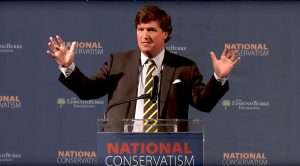
Tucker Carlson's abrupt departure from Fox News today is being hailed by many as a positive development that will improve our political discourse. But I fear it won't make nearly as much difference as some hope.
I certainly will not miss Carlson. I was on his show in 2017 (video linked here) to talk about immigration and public ignorance. He was a jerk to me on the air; in fairness, I knew he was likely going to be that way, so can't say I was tricked into appearing.
Afterwards some of his more rabid fans sent me death threats. One of them was Cesar Sayoc, who later became famous as the "pipe bomber." I don't blame Carlson for the death threats. I do blame him for his constant promotion of lies, malice, and xenophobia.
At the same time, I think it's at best premature to conclude that Carlson's departure will significantly improve the right-wing media scene. Tucker Carlson didn't become popular by persuading his audience to change their minds. He did it by telling them what they wanted to hear. Whoever replaces him is likely to do the same.
Admittedly, in the wake of the Dominion case in which Fox was forced to pay $787.5 million to settle a lawsuit arising from its mendacious coverage of the 2020 election, the network may be more cautious about airing material that verges on defamation. But most political lies and misinformation aren't clear and egregious enough to meet the appropriately high legal standard for a successful defamation lawsuit targeting political speech about a public figures (ironically, Donald Trump and some other right-wingers have been trying to get that standard lowered).
The Dominion lawsuit revealed that audience preferences drives Fox's decisions much more than the reverse. Ultimately, the supply of political misinformation is far less of a problem than the demand for it. Regardless of what happens to Carlson, that problem is likely to persist - and not just on the political right.
S. Ct. Calls for Response in NRA v. Vullo
This is the case I wrote about in March, and again last week, when I noted the amicus briefs from state attorneys general, from the Foundation for Individual Rights and Expression, and from two financial and business law scholars. I also noted last week that the New York state government defendants didn't file a response to the petition.
Today, the Supreme Court called for a response; this doesn't guarantee that the Court will agree to hear the case, but it does suggest some interest on the part of at least one Justice. It also gives an extra 30 days for any other people or groups to file amicus briefs in support of the petition: "An amicus curiae brief submitted in support of a petitioner … before the Court's consideration of a petition for a writ of certiorari" may be "filed within 30 days after … a response is called for by the Court." It will be interesting to see whether any other amicus briefs come in. And it will of course also be interesting to see what the state argues in opposing the petition, and whether there will be amicus briefs filed in support of the state.
Here again is the Introduction from the cert. petition:
The Second Circuit's opinion below gives state officials free rein to financially blacklist their political opponents—from gun-rights groups, to abortion-rights groups, to environmentalist groups, and beyond. It lets state officials "threaten[ ] regulated institutions with costly investigations, increased regulatory scrutiny and penalties should they fail to discontinue their arrangements with" a controversial speaker, on the ground that disfavored political speech poses a regulable "reputational risk."
Blasphemy Conviction for Displaying Rainbow Virgin Mary at "Equality March" in Poland

Notes from Poland (Daniel Tilles) reports:
A court has found two women guilty of offending religious feelings – a crime in Poland that carries a prison sentence of up to two years – for displaying an image of the Virgin Mary and Jesus with rainbow haloes during an LGBT march.
One was handed five months of community service while the other was fined 2,000 zloty. The pair's lawyer has, however, announced their intention to contest the judgement, as they are entitled to do, meaning the case would proceed to a full trial….
Last year, the same court in Częstochowa acquitted a man who had also been indicted for offending religious feelings by displaying an image of the Black Madonna with rainbow colours added.
The judge found that the symbol contained a positive – not an offensive – message supporting equality and opposing discrimination. In another case, three LGBT activists were acquitted of the same offence in 2021 for producing and distributing images of the "Rainbow Virgin Mary"….
"Polish TV Station Investigated Over Holocaust Scholar's Claim Poles Did Little to Help Jews in WW2"
Daniel Tilles at Notes from Poland ("founded in Kraków in 2014 by Stanley Bill, Director of the Polish Studies Programme at the University of Cambridge") reports:
Poland's broadcasting regulator has launched proceedings against the country's largest private TV network, American-owned TVN, following remarks on air by a leading Holocaust scholar, Barbara Engelking, in which she suggested that Poles did little to help Jews during the war….
In an interview on Wednesday evening with TVN presenter Monika Olejnik, Engelking said that "Jews were unbelievably disappointed with Poles during the war. They knew what to expect from the Germans, [who were] the enemy…but the relationship with Poles was much more complex".
"Poles had the potential to become allies of the Jews and one would hope that they would behave differently, that they would be neutral, kind, that they would not take advantage of the situation to such an extent and that there would not be widespread blackmailing [szmalcownictwa]," she continued.
"It seems to me that this disappointment plays a role, that Poles simply failed," continued Engelking, who is director of the Polish Center for Holocaust Research, which is part of the Polish Academy of Sciences (PAN)….
Following Engelking's interview, government figures including the education minister, Przemysław Czarnek, and the prime minister, Morawiecki, condemned her remarks and TVN for airing them. The station, which is often critical of the government, has regularly clashed with the authorities.
S. Ct. Will Decide: When May Politicians Selectively Block Public Comments on Their Social Media Pages?
The question turns on whether the politician's web page is seen as the politician's own speech as a citizen, or as a government page.
When a government body (e.g., a school board or a city council) sets up a social media account, the public comments on that account are viewed as a "limited public forum," in which the government may not discriminate based on viewpoint. (See, e.g., Davison v. Randall (4th Cir. 2019).) The government therefore can't selectively remove comments on that page, or block commenters from posting to it, based on the comments' or commenters' views.
Individual social media users, on the other hand, are free to delete comments or block commenters (to the extent the social media software allows it). That includes government officials in their private capacities, whether they're acting as ordinary citizens or as candidates.
But how can courts tell politicians' official pages from their private ones? This question first hit the national news as to President Trump's blocking of commenters on the @RealDonaldTrump page, but that matter became moot when Trump left office. This morning, the Supreme Court agreed to hear two cases that deal with this issue, Garnier v. O'Connor-Ratcliff (coming from the Ninth Circuit) and Lindke v. Freed (coming from the Sixth). Here's part of the analysis from the Ninth Circuit decision:
Today in Supreme Court History: April 24, 1963
4/24/1963: Sherbert v. Verner argued.
What Joan Biskupic "Learned" in Nine Black Robes?
The inside-information largely trickled to a halt after 2020.
There are two primary approaches to Supreme Court books. The first category is told from an outsider's perspective: how do scholars and other observers view the Court, the Justices, and their decisions. (I've written two such books.) The second category purports to bring an insider's perspective: the author cites unnamed sources who provide behind-the-scenes details about why the Court did what it did. The virtue of the former approach is that sources can be verified. The risk of the latter approach is that many of the sources cannot be verified. Still, an entire genre of behind-the-scenes stories have become quite popular: The Brethren, The Nine, Supreme Conflict, among others. We can now add to that list Joan Biskupic's latest book, Nine Black Robes.
I've read Biskupic's columns very closely over the years. There was some new content in Nine Black Robes, but not much. Indeed, much of the book is based on her reporting for CNN. And as I've noted on this blog many times, her ability to find leaks largely trickled to a halt after Justice Ginsburg's death in September 2020. Indeed, Biskupic cites interviews with "multiple Justices" after the 2019-2020 term. But she does not cite interviews with "multiple justices" in subsequent terms. That's not to say that RBG was Biskupic's source. But a potential fountain of leaks was sealed. It may be that one Justice provided some information, and then other Justices responded to provide their perspective. It is a common journalistic tactic: here's what I heard, what is your response? But in the absence of that first mover, there were no follow-ups. Or, maybe my blog posts worked, and the Chief Justice was able to get everyone to stop talking to her! I'm glad he didn't resign. In any event, Biskupic's ability to break news has weakened. Let's not forget that Politico scooped her, and everyone else, on the Dobbs leak.
My biggest frustration of the book was the attempt to force a narrative. Even the subtitle reveals the aim: "Inside the Supreme Court's Drive to the Right and Its Historic Consequence." At every juncture, Biskupic described the Court's "right wing" and "far-right bloc" in very negative terms. At the same time, the Court's liberal justices were described as principled defenders of the rule of law. And Biskupic's reporting on the abortion cases was in no sense neutral. She obviously favored the Court keeping Roe and Casey, and conveyed disappointment with Dobbs. Her choice of adjectives gives the game away. I had similar reactions when I've watched her CNN appearances over the years--especially during the S.B. 8 litigation.
Of course, there is nothing wrong with a writer having an opinion. I surely do. But expressing such strong opinions throughout the book undermines one's claim to be an objective journalist. At this point, I would place Biskupic in the same category as Linda Greenhouse: a former distinguished journalist who now writes informative opinion pieces. There is a big difference between reading Linda Greenhouse and Adam Liptak. I learn a lot from both writers, but read everything Greenhouse writes through a political prism. And now the same for Biskupic.
I doubt my criticism will matter much to Biskupic. She has reached the pinnacle of the profession with her perch at CNN. But there is an undeniable cost to her approach. To the extent conservative "sources" were willing to talk to Biskupic before, they did so on the belief that she could be a quasi-neutral player. But Biskupic has blown up any pretense of neutrality. She is, in my view, no different than Linda Greenhouse or Jeffrey Toobin. If you read her book with that perspective, things will be much simpler.
Rather than writing a full review of the book, I thought it would be useful to highlight many of the inside bits of information Biskupic reports on. She has a tell. Whenever she uses the phrase "I learned," there is a signal that she got the information from an unnamed source. I'll relay them in somewhat chronological order.
Texas Will Test Whether Kennedy v. Bremerton Abrogated Engel v. Vitale, Stone v. Graham, and Wallace v. Jaffree
And good luck challenging the law. The Texas Senate passed an S.B. 8-like bulletproof bill for prayer in school.
Kennedy v. Bremerton overruled the Lemon test. Sort of. Justice Gorsuch's majority opinion did not come out to formally overrule that case. Indeed, the question presented did not even concern the Establishment Clause. That issue only rose indirectly. Rather, the Court deemed Lemon as "abandoned." That much is clear. But the Court did more than inter that Burger-era precedent. The Court also seemed to undermine the coercion test. This plank of Establishment Clause jurisprudence stretches back to Engel v. Vitale (1962). That Warren-era precedent held that the government cannot subject students to indirect coercion with regard to religion. Even exposing students to prayer in the classroom, without requiring them to participate, could be sufficiently coercive to violate the Establishment Clause.
This line of precedent carried for the course of six decades. Lee v. Weisman (1992) held that clergy could not offer prayers at a high school graduation ceremony. In Lee, the Court recognized that "there are heightened concerns with protecting freedom of conscience from subtle coercive pressure in the elementary and secondary public schools." And "prayer exercises in public schools carry a particular risk of indirect coercion." The Court observed that "adolescents are often susceptible to peer pressure, especially in matters of social convention." Therefore, "the State may no more use social pressure to enforce orthodoxy than it may use direct means." Attendance at the graduation ceremony was optional, but "to say a teenage student has a real choice not to attend her high school graduation is formalistic in the extreme." Due to that risk of "indirect coercion," the prayer at graduation violated the Establishment Clause. Eight years later, Santa Fe Independent School District v. Doe (2000) reached a similar result. The Court held that schools could not permit students to select and lead prayers before football games. The "delivery of a pregame prayer ha[d] the improper effect of coercing those present to participate in an act of religious worship."
Kennedy, however took a decidedly different approach to identifying "coercion" in Establishment Clause cases. In Kennedy, a high school football coach would quietly pray after games at the fifty-yard line. Some players from both teams would pray with him. The coach was disciplined, in part, because the school worried that the prayers violated the Establishment Clause. The Court disagreed. It held that the coach's prayers were within the bounds of the Establishment Clause. Here, there was "no evidence that students ha[d] been directly coerced to pray with Kennedy." And students who voluntarily choose to participate in the prayers were not necessarily coerced. It did not matter that some students were bothered or felt excluded by the prayers. The Court stated that "[o]ffense . . . does not equate to coercion." Justice Sotomayor dissented in Kennedy. She wrote that the majority "applie[d] a nearly toothless version of the coercion analysis" from Lee and Santa Fe. Sotomayor added that the Court "fail[ed] to acknowledge the unique pressures faced by students when participating in school-sponsored activities."
After Kennedy was decided, I wrote that Lee and Santa Fe were abrogated. But what about earlier cases, stretching back to Engel? Abington School District v. Schempp (1963) held that teachers cannot recite passages of the Bible or the Lord's Prayer, without comment, at the start of each school day. Stone v. Graham (1980) held that classrooms cannot post the Ten Commandments, which are "plainly religious in nature." Wallace v. Jaffree (1985) held that public schools cannot hold a moment of silence "for meditation or voluntary prayer." Are Engel, Schempp, Stone, and Jaffree abrogated? Or should those cases be overruled because they are "egregiously" wrong? (Thomas Bickel makes the latter case in the Harvard JLPP).
The Texas Senate recently passed two bills that could require the courts to answer those questions. SB 1515 is a frontal challenge to Stone, as well as McCreary County:
A public elementary or secondary school shall display in a conspicuous place in each classroom of the school a durable poster or framed copy of the Ten Commandments that meets the requirements of Subsection.
Indeed, the bill requires a specific version of the Decalogue to be used:
"The Ten Commandments I AM the LORD thy God. Thou shalt have no other gods before me. Thou shalt not make to thyself any graven images. Thou shalt not take the Name of the Lord thy God in vain. Remember the Sabbath day, to keep it holy. Honor thy father and thy mother, that thy days may be long upon the land which the Lord thy God giveth thee. Thou shalt not kill. Thou shalt not commit adultery. Thou shalt not steal. Thou shalt not bear false witness against thy neighbor. Thou shalt not covet thy neighbor's house. Thou shalt not covet thy neighbor's wife, nor his manservant, nor his maidservant, nor his cattle, nor anything that is thy neighbor's."
And schools can accept privately-donated framed copies of the Tenth Amendment. This bill would have been dead on arrival during the Warren Court. But that was a different era. Someone should go check Arlington Cemetery. There is probably some stirring in the grave of Hugo Black.
The second bill, SB 1396, is a frontal challenge to Engel, Schempp, and Jaffree. The bill allows school districts to adopt a policy that would "provide students and employees with an opportunity to participate in a period of prayer and reading of the Bible or other religious text on each school day." I am doubtful that large school districts in Austin or Dallas would adopt such a policy. But smaller districts will likely consider such a policy. Indeed, there are guardrails in the bill that make it very difficult to challenge.
The only students who will even exposed to the bill are students whose parents want them to be exposed to the prayer. Parents or guardians would be required to sign a consent form for their child to be exposed to the prayer. And that consent form is an express waiver of the right to bring a lawsuit!
A policy adopted under Subsection (a) must prohibit . . . a student or employee of the school district or open-enrollment charter school from being permitted to participate in the period of prayer and reading of the Bible or other religious text unless the employee or parent or guardian of the student submits to the district a signed consent form that includes . . . signed consent form that includes…. an express waiver of the person's right to bring a claim under state or federal law arising out of the adoption of a policy under this section, including a claim under the Establishment Clause of the First Amendment to the United States Constitution or a related state or federal law, releasing the district or school and district or school employees from liability for those claims brought in state or federal court;
What about students whose parents do not sign the form? The bill ensures these students will not be able to even hear the prayer. The policy must ensure the prayer is not read "in the physical presence of, within the hearing of, or in another manner which would constitute an injury in fact within the meaning of the United States or Texas Constitution on a person for whom a signed consent form has not been submitted." Indeed, the prayer cannot be read "over a public address system." To put it bluntly, this bill makes it impossible for children of objecting parents to even hear the prayer!
But wait a minute? Didn't Lee and other cases hold that it is unfair to exclude students from activities like graduation? How can it be constitutional that objecting-students can simply be excluded from classroom activities? The bill provides a few responses. The prayer "may not be a substitute for instructional time." Moreover, the prayer may be read "before normal school hours." And the prayer may be read "only in classrooms or other areas in which a consent form under Subsection (b)(1) has been submitted for every
employee and student." In other words, objecting students can still complete 100% of their usual classroom activities. Plus, the Attorney General will defend any school district sued under this bill, and the state will cover any expenses. Thus school boards can adopt a policy without fear of liability.
This bulletproof bill is like S.B. 8 for prayer in school. Good luck finding any plaintiffs who actually suffers an Article III injury. The bill makes it virtually impossible for objecting students to challenge the policy in court. And even if someone suffers an injury, under Kennedy, indirect coercion, such as the risk of exclusion, is not sufficient to state an Establishment Clause claim.
If these bills are enacted, federal judges in Texas will have a choice. They cannot overrule Engel and its progeny. But could federal judges deem Engel and its progeny abrogated by Kennedy? Recall that the Fifth Circuit Dobbs panel declared unconstitutional the Mississippi abortion ban, as it was bound to do so under Roe and Casey. But Kennedy alters the constitutional calculus. Texas, once again, will push the vanguard of constitutional law and standing law.
Today in Supreme Court History: April 23, 1985
4/23/1985: Cleburne v. Cleburne Living Center, Inc. argued.
"Plaintiff's Answer to the Complaint or the Appropriate Motion [Must] Be Written in English"
From Judge Paul Maloney's opinion Friday in Al Qassimi Academy v. Abuhaltam (W.D. Mich.) [UPDATE: note that some of the references to "Plaintiff" presumably mean "Defendant"]:
Plaintiff is an educational institution serving the Muslim Arabic community in Israel. Defendant resides in Okemos, Michigan. In the complaint, Plaintiff alleges Defendant has defamed and slandered Plaintiff in various social media outlets….
Plaintiff is currently not represented by an attorney, he is "pro se." This Court must liberally construe the pleadings and other filings of pro se parties. The United States Supreme Court has cautioned that this rule does not relieve a pro se litigant of the obligation to follow a court's procedural rules ….
Plaintiff asks the Court "for extina of time AT least I need Tow moth to Print All Decoumnt releted to this case witch in the sosha sotial media it is over than 175 thousend pages…" Plaintiff's "motion" exceeds 380 pages. Most of the pages are printouts from various websites. And, most of the pages are in Arabic. Approximately 30 pages are handwritten in English. The Court infers that English is not Defendant's first language….




