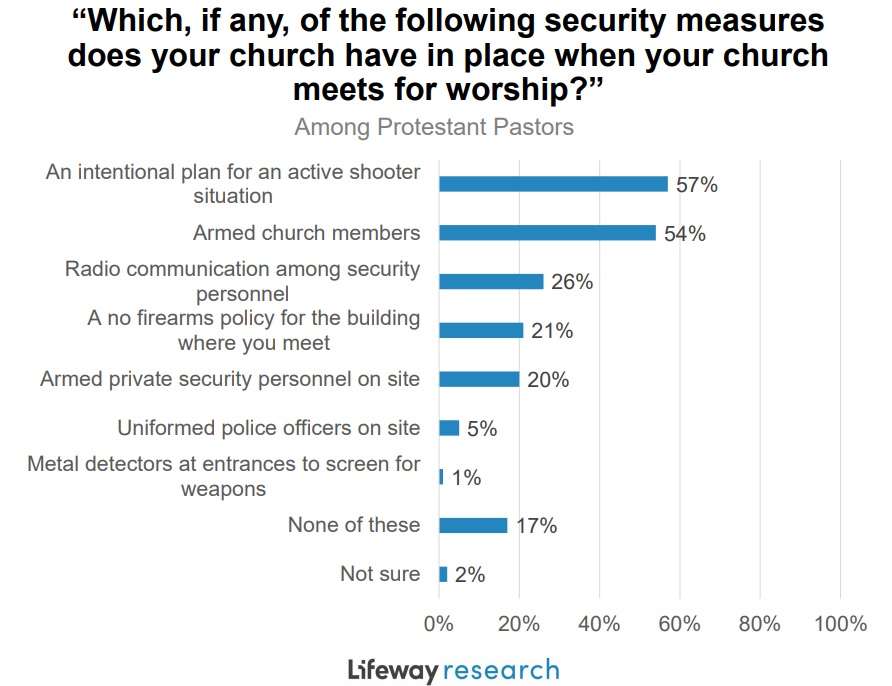
So reports a 2022 survey by Lifeway research (and see this summary, released June 6). This was apparently a "stratified random sample, drawn from a list of all Protestant churches," and the results were:
The percentage (54%) is up from 2019 (45%), which appears statistically significant. The breakdowns among subcategories, as to likelihood of selecting armed church members as security, are:
Plaintiff … is unable to counter Defendants' showing that enforcement of the Dress Code was undertaken to protect the invasion of the rights of other students to a safe and secure educational environment. School administrators were well within their discretion to conclude that the statement "THERE ARE ONLY TWO GENDERS" may communicate that only two gender identities—male and female—are valid, and any others are invalid or nonexistent, and to conclude that students who identify differently, whether they do so openly or not, have a right to attend school without being confronted by messages attacking their identities. As Tinker explained, schools can prohibit speech that is in "collision with the rights of others to be secure and be let alone."
Plaintiff contends that … Defendants could not restrict the Shirt as an "invasion of the rights of others" unless it determined that the speech "targeted a specific student" (quoting Norris on behalf of A.M. v. Cape Elizabeth Sch. Dist. (1st Cir. 2020)). Norris, however, did not attempt to set a rule for all speech that is an "invasion[] of the rights of others" or even "the precise boundaries of what speech constitutes 'bullying' such that it falls within the 'invasion of the rights of others' framework of Tinker." Instead, Norris concluded that where the school had justified the limitation on the student's statement that "THERE IS A RAPIST IN OUR SCHOOL AND YOU KNOW WHO IT IS" on the ground that the student had engaged in "bullying" under the school's policy, the school was required to demonstrate that it had a reasonable basis to determine that the speech targeted a specific student and invaded that student's rights.
The search warrant that authorized the search of Mar-A-Lago in August 2022 cited three statutes: 18 U.S.C. §§ 793(e), 1519, and 2071. Section 793(e) prohibits "unauthorized possession" of "information relating to national defense." Section 1519 prohibits destruction or falsifications of records in a federal investigation. And Section 2071 likewise prohibits concealment or removal of certain records. Critically, a person convicted of violating Section 2071 "shall forfeit his office and be disqualified from holding any office under the United States." (There's that language again--Groundhog Day!)
If Trump were convicted of violating this statute, would he be disqualified from holding the office of the presidency? Put aside for a moment whether the presidency is an "office under the United States" for purposes of Section 2071. Under U.S. Term Limits v. Thornton, Congress cannot add additional qualifications for an elected federal position. My colleague Seth Barrett Tillman addressed this argument in September. But even if Trump were convicted of this statute, the trial court would have no occasion to decide whether Trump was in fact disqualified from the presidency. That decision could only come in follow-up litigation, should Trump seek to hold some other office. Still, hovering over a Section 2071 prosecution would be the specter that a conviction could lead to Trump's disqualification. And I think that political storm could create a distraction from the underlying merits of the case.
Fast-forward to the present. Special Counsel Smith indicted Trump for violating Section 793(e). This statute does not impose any sort of disqualification. The indictment also references Section 1519, though not under a specific count. However, Smith did not bring a charge under 18 U.S.C. § 2071. Why?
The New York Times published an article titled, In Trump Prosecution, Special Counsel Seeks to Avoid Distracting Fights. The article explains that, at least so far, Smith has taken actions to minimize ancillary disputes, and instead focus on the underlying merits. For example, Smith did not seek any bond conditions on Trump, such as limiting Trump's ability to have contact with co-defendants, victims, and witnesses. The Times offers this commentary:
It also provided telling insights into the fist-inside-a-kid-glove approach that Mr. Smith and his team employed: an aggressive fast-track approach to prosecution coupled with a conspicuously respectful posture toward the defendant. Mr. Smith's decision not to demand any conditions at the arraignment, people familiar with the situation said, reflected a belief that prosecutors should avoid impairing Mr. Trump's ability to campaign. He is also seeking to dodge potentially distracting elements to a case focused on concrete evidence about the former president's handling of classified documents and efforts to obstruct government efforts to reclaim them.
Jack Goldsmith explains that Smith's strategy is designed to lower the "temperature" on this red-hot matter:
"The prosecution of a former president and the current political rival of President Biden is obviously hugely politically fraught and comes against the background of prior Justice Department actions against Trump marked by error and excess," said Jack Goldsmith, a Harvard Law professor and former assistant attorney general. "Trump and his allies will do everything they can to demonize the prosecution as unfair," he added. "It makes perfect sense that Smith, who has the law clearly on his side, would do everything he can to avoid raising the temperature on the matter further."
This background may explain why Smith did not bring an indictment under Section 2071. Such a charge would have ushered in a political storm that distracts from the underlying goal: a fast-track prosecution for failing to turn over the documents.
Conspicuously absent from the indictment was a potential charge that had been listed in the affidavit the Justice Department filed to obtain a search warrant for Mar-a-Lago last summer: Section 2071 of the federal criminal code, which prohibits the concealment and mishandling of sensitive government documents.
It was the only crime on the sheet that might have directly affected Mr. Trump's 2024 presidential bid, requiring that anyone convicted of it "shall forfeit his office and be disqualified from holding any office under the United States."
Many legal scholars believe that the provision is unconstitutional and would have ultimately been struck down if it were imposed on Mr. Trump. But Mr. Smith's team sidestepped the issue altogether, leaving it out of their 37-count indictment on a section of the Espionage Act that imposes a prison term but no restrictions on holding office.
"I think it's a very savvy move not bringing that charge," said John P. Fishwick Jr., who was the U.S. attorney for the Western District of Virginia from 2015 to 2017. "It makes this much less about politics — this is about the evidence, not about blocking him from office."
This strategy seems prudent, and minimizes any charges of politicization. Smith's decision to avoid a Section 2071 charge in Florida may provide some tea leaves about his plans for the District of Columbia with regard to January 6. Many scholars and advocates have urged the special counsel to indict Trump for violating 18 U.S.C. § 2383, the federal insurrection statute. It provides:
Whoever incites, sets on foot, assists, or engages in any rebellion or insurrection against the authority of the United States or the laws thereof, or gives aid or comfort thereto, shall be fined under this title or imprisoned not more than ten years, or both; and shall be incapable of holding any office under the United States.
There's that language again--Groundhog Day! I think it is widely agreed that Section 2071 cannot be used to disqualify a defendant from the presidency. But there is some debate about whether Section 2383 could disqualify Trump from the White House, to the extent that it invokes Section 3 of the Fourteenth Amendment. Seth and I wrote an article in early-2017 contending that this statute could not disqualify Trump from the presidency. (Ned Foley recently flagged our views on the Election Law Blog). But, to quote a recent brief, our view is probably idiosyncratic. Ultimately, Trump's lawyers may find our views with regard to Section 2383 more persuasive than our views on the federal removal statute.
If the Times is correct about Smith's strategy, then a Section 2383 prosecution would go beyond distracting--it would consume the nation. A single jury in the District of Columbia could make a finding of guilt that could place Trump's ability to run for re-election in doubt. Smith has very good reasons to avoid these problems. If he pursues an indictment based on Trump's January 6 conduct, there are many other charges he could bring that would avoid distracting fights.
To date, DOJ has not indicted anyone on Section 2383. Rather, the government has prosecuted Stuart Rhodes and the Oath Keepers under charges of seditious conspiracy. This statute does not impose any sort of disqualification. Would Special Counsel Smith seek to make Trump the test case for Section 2383? I am doubtful.
In any event, even if Trump were convicted of violating Section 2383, the district court would have no occasion to decide the scope of disqualification. This litigation would almost certainly arise on ballot litigation, with a resolution by the Supreme Court, if not in Congress on January 6, 2025.
Please enjoy the latest edition of Short Circuit, a weekly feature written by a bunch of people at the Institute for Justice.
Hey, look at that! SCOTUSblog's "Petition of the Week" is none other than IJ's cert petition in Gonzalez v. Trevino, a retaliatory arrest case that—so far—illustrates just how easy it is for officials to escape liability for throwing someone in jail for criticizing them. Many thanks to our amici who filed seven briefs in support of truth and justice.
On May 18, Seth Barrett Tillman and I published a post on Lawfare, titled Why the Manhattan DA's Trump Case Cannot Be Removed to Federal Court. We wrote that "there are good reasons to conclude that the elected president was not an 'officer of the United States,' so the case should stay in Manhattan criminal court." Two weeks later, Alvin Bragg, the District Attorney of New York (DANY) argued that Trump was not an "Officer of the United States," so the case should stay in Manhattan criminal court. We wrote about the filing here.
Yesterday, Trump's attorneys filed the opposition to DANY's motion to remand. Part I of the brief cites several Blackman/Tillman publications:
The President of the United States is an "officer . . . of the United States" under 28 U.S.C. § 1442(a)(1). DANY's argument to the contrary is unconvincing and the Court should reject it. Although DANY disappointingly never gives them any credit, DANY's argument is cribbed, at times nearly word-for-word, from a recent Lawfare blog post by Professors Blackman and Tillman. See Josh Blackman and Seth Barrett Tillman, Why the Manhattan DA's Trump Case Cannot Be Removed to Federal Court, Lawfare, May 18, 2023, available at https://www.lawfareblog.com/why-manhattan-das-trump-case-cannot-be-removed-federal-court. But while this argument—that elected officials, including the President, are not "officers of the United States"—has been advocated by these professors for some time,[FN1] to our knowledge it has never been accepted by any court.
[FN1]: See, e.g., Seth Barrett Tillman, Why Our Next President May Keep His or Her Senate Seat: A Conjecture on the Constitution's Incompatibility Clause ("Our Next President"), 4 Duke Journal of Constitutional Law & Public Policy 107 (2009); Seth Barrett Tillman & Josh Blackman, Offices and Officers of the Constitution, Part I: An Introduction, 61(3) S. TEX. L. REV. 309 (2021); Seth Barrett Tillman and Josh Blackman, Offices and Officers of the Constitution, Part III: The Appointments, Impeachment, Commissions, and Oath or Affirmation Clauses, 62(4) S. TEX. L. REV. 349 (May 2023). To be clear, we mean no disrespect to either of these fine academics but their views on this matter are idiosyncratic, see, e.g., Our Next President, at 5-6 (collecting the contrary views of numerous scholars), and of limited use to this Court.
I am grateful for the citation. Moreover, I think this brief models how attorney can cite those they disagree with.
Going forward, the issue of whether the President is an "Officer of the United States" is squarely teed up. And the parties are squarely at odds on an important issue of federal law that affects the Executive Branch. The Department of Justice should weigh in.
Before ruling, the court should consider calling for the views of the Department of Justice. The executive branch has an institutional interest to represent the president's unique station in our constitutional framework.
Thanks to the invaluable UCLA Law Library, I got a copy of the affidavit in which the lawyer apologizes and explains why he used ChatGPT to draft a motion:
I have been practicing Civil Litigation for less than three (3) months and the MSA was the first motion I have ever researched, drafted, and filed myself….
As of today, May 5, 2023, I have spent 6.5 hours researching this case, conferring with paralegals and senior attorneys about our client's options, and drafting the MSA. With respect to drafting the MSA specifically, I have spent approximately 4 hours researching, drafting, and revising that motion. I detail this in hopes to demonstrate to the Court my dutiful time spent drafting a motion that I hoped would relieve my client from an exceptional judgment against him.
Now I will explain the fictitious case cite issue to assuage the Court's concern of willful misconduct. The issue surrounds the emerging technological advancement and use of Artificial Intelligence, commonly referred to as "AI". AI for the legal industry is emerging, and coincidentally on 5/5 I received an email from Lexis Nexis introducing an AI search engine for their platform – Meet Lexis+ AI, the most powerful generative AI solution for legal professionals - YouTube (see Exhibit 1 – Email from Lexis+ AI). In this instance, a search engine/software from OpenAI, commonly known as "ChatGPT" was used. This software was brought to my attention as a potentially useful research tool for our firm on April 26, 2023, just three (3) days before the MSA was finalized and filed. Overwhelmingly impressed by the technology, I excitedly used it to find case law that supports my client's position, or so I thought.
An entity—a landlord, a manufacturer, a phone company, a credit card company, an Internet platform, a self-driving-car manufacturer—is making money off its customers' activities. Some of those customers are using the entity's services in ways that are criminal, tortious, or otherwise reprehensible. Should the entity be held responsible, legally or morally, for its role (however unintentional) in facilitating its customers' activities? This question has famously been at the center of the debates about platform content moderation, but it can come up in other contexts as well.
It is a broad question, and there might be no general answer. (Perhaps it is two broad questions—one about legal responsibility and one about moral responsibility—but I think the two are connected enough to be worth discussing together.) In this essay, though, I'd like to focus on one downside of answering it "yes": what I call the Reverse Spider-Man Principle—with great responsibility comes great power. Whenever we are contemplating holding entities responsible for their customers' behavior, we should think about whether we want to empower such entities to surveil, investigate, and police their customers, both as to that particular behavior and as to other behavior. And that is especially so when the behavior consists of speech, and the exercise of power can thus affect public debate.
Of course, some of the entities with whom we have relationships do have power over us. Employers are a classic example: In part precisely because they are responsible for our actions (through principles such as respondeat superior or negligent hiring/supervision liability), they have great power to control what we do, both on the job and in some measure off the job. Doctors have the power to decide what prescription drugs we can buy, and psychiatrists have the responsibility (and the power) to report when their patients make credible threats against third parties. And of course we are all subject to the power of police officers, who have the professional though not the legal responsibility to prevent and investigate crime.
On the other hand, we generally don't expect to be in such subordinate relationships to phone companies, or to manufacturers selling us products. We generally don't expect them to monitor how we use their products or services (except in rare situations where our use of a service interferes with the operation of the service itself), or to monitor our politics to see if we are the sorts of people who might use the products or services badly. At most, we expect some establishments to perform some narrow checks at the time of a sale, often defined specifically and clearly by statute, for instance by laws that require bars not to serve people who are drunk or that require gun dealers to perform background checks on buyers.
On Thursday, the Supreme Court decided Lac Du Flambeau Band of Lake Superior Chippewa Indians v. Coughlin. The majority held that the phrase "other foreign or domestic government" in the bankruptcy code includes Indian tribes. Justice Gorsuch in dissent, however, found that under the clear statement rule, Indian tribes were not covered by this language. Thus, for the ninth consecutive time, Gorsuch wrote an opinion ruling for the Indian tribes.
I had attended oral argument in this case back in April. Justice Gorsuch offered an admittedly "silly" hypo.
JUSTICE GORSUCH: --before we leave that, though, let's say --I'll give you a silly hypothetical. Let's say I invite you to go to my refrigerator and take out either vanilla or chocolate ice cream and help yourself. Does that license you to take the last scoop of the chocolate-vanilla swirl ice cream in a separate container, maybe one with a note on it that says "reserved for a later birthday"?
And wouldn't you know it, that exact hypo made it into Justice Gorsuch's dissent--albeit he swapped "chocolate-vanilla swirl" for Neapolitan.
With this point in mind, respondent's reading collapses.To see why, consider another example. Suppose you are a houseguest, and your host invites you to "help yourself to the chocolate or vanilla ice cream in the freezer." Upon opening the freezer, you find three tubs—vanilla, chocolate, and Neapolitan. For argument's sake, too, let's say the last tub also has a sticky note: "Do not eat without clear permission." Which ice cream can you take? If the host meant "or" exclusively, you may take either chocolate or vanilla, not both. If the host meant it inclusively, you may scoop some of each. In neither event, however, would you have permission to take the Neapolitan ice cream—especially given the cautionary note.
Another turn of phrase stuck out at oral argument. Justice Barrett observed that the phrase "other foreign or domestic governments" was "an attempt to cover the waterfront." This phrase refers to an effort to be thorough or comprehensive. There is also a famous song, titled "I Cover the Waterfront," which was performed by Billy Holiday, Frank Sinatra, and others. This idiom is especially fitting since Lac du Flambeau translates to Lake of Torches, and the Chippewa Indians are of Lake Superior.
And wouldn't you know it? This phrase made it into Footnote 7 of Justice Jackson's majority opinion, responding to Gorsuch's ice cream hypothetical:
For another, whereas the pairing of "foreign" and "domestic" often covers the waterfront, see supra, at 6, the dissent's hypothetical pairings do not have that same effect. And unlike animals (which need not be small or doglike) or ice creams (which need not be chocolate or vanilla), every government must be foreign or domestic to some degree; the question is just where on the spectrum it falls.
It has become fashionable to claim that Justice Jackson is influencing the other Justices. I've yet to see any actual evidence of this assertion. But at least here, Justice Barrett's phrasing during oral argument was transplanted directly into a pivotal footnote in the majority.
Speaking of nautical themes, a related phrase is "On the Waterfront," the title of the famous Eliza Kazan movie. I think Marlon Brando's famous advice should be heeded by the Justices who could have been contenders, but instead consistently underperform.
Norm McDonald, Carly Simon, Billy Holiday, and Eliza Kazan. Not a bad week for pop culture references. Now, onto Brackeen.
By my count, Justice Gorsuch has written nine opinions in cases in which an Indian tribe or member was a party. My methodology is imperfect--I searched the Supreme Court Database for "+Gorsuch & Indian". But I think I captured all of the relevant opinions. (Please email me if I am missing any.) This total includes majority opinions, concurrences, as well as dissents.
In each of these nine cases, Justice Gorsuch ruled in favor of the Indian tribe or member.
Here is my list:
Upper Skagit Indian Tribe v. Lundgren (2018) - Justice Gorsuch wrote majority opinion finding in favor of tribal sovereign immunity. (Justices Thomas and Alito dissented).
Washington State Department of Licensing v. Cougar Den (2019) - Justice Gorsuch wrote a concurrence, joined by Justice Ginsburg, supporting enforcement of Indian treaty. (Chief Justice Roberts and Justices Thomas, Alito, and Kavanuagh were in dissent).
McGirt v. Oklahoma (2020) - Justice Gorsuch wrote majority opinion finding that Congress did not disestablish Creek Reservation in Oklahoma. (Chief Justice Roberts and Justices Thomas, Alito, and Kavanaugh were in dissent).
Yellen v. Confederated Tribes of Chehalis Reservation (2021) - Justice Gorsuch wrote a dissent, joined by Justices Thomas and Kagan, finding that for-profit Alaska Native Corporations do not qualify as "Tribal Governments" for purposes of CARES Act funding. Here, Gorsuch did not rule against a Tribe, because, in his view, ANCs are not actually tribes. Indeed, the Secretary of the Interior does not list the ANCs as federally recognized tribes.
Denezpi v. United States (2022) - Justice Gorsuch wrote a dissent, joined by Justices Sotomayor and Kagan, finding that the Double Jeopardy Clause prohibits second prosecution for violating Code of Indian tribe.
Ysleta Del Sur Pueblo v. Texas (2022) - Justice Gorsuch wrote majority opinion finding that federal law only bans on tribal lands those gaming activities also banned in Texas. This was a victory for Tribal gaming. (Chief Justice Roberts, and Justices Thomas, Alito, and Kavanaugh were in dissent).
Oklahoma v. Castro-Huerta (2022) - Justice Gorsuch wrote a dissent, joined by Justices Breyer, Sotomayor, and Kagan, finding that the states do not have concurrent jurisdiction to prosecute crimes committed by non-Indians against Indians in Indian country.
Lac du Flambeau Band of Lake Superior Chippewa Indians v. Coughlin (2023) - Justice Gorsuch wrote a solo dissent, finding that the Bankruptcy Code did not abrogate tribal sovereign immunity.
Haaland v. Brackeen (2023) - Justice Gorsuch wrote a concurrence, joined by Justices Sotomayor and Jackson, to provide "an understanding of the long line of policies that drove Congress to adopt ICWA."
How do we explain this 9-0 record? The usual line is that Gorsuch is a westerner. Adam Liptak explores this point in the Times:
In a pair of opinions on Thursday, Justice Neil M. Gorsuch again demonstrated that he is the fiercest proponent of Native American rights on the Supreme Court. That does not surprise people who knew him when he served on the federal appeals court in Denver. "He's from Colorado," said John E. Echohawk, executive director of the Native American Rights Fund. "He's the only Westerner on the court. He knows these issues. He knows these tribes."
I agree with Mike Dorf that this explanation is not entirely persuasive:
At this point, Justice Gorsuch's sympathy for American Indians and Indian tribes cannot be doubted. Its exact source is a bit of a mystery. I have seen it said that, as with Douglas, it comes from the fact that Gorsuch is a westerner. But that's hardly a satisfactory explanation. So were Bryon White, William Rehnquist, and Sandra Day O'Connor, none of whom was a special champion of Indian rights.
Perhaps it's pointless to speculate. People attribute Justice Kennedy's sympathy for gay rights to his personal friendships, but that only raises the question of why he was open to such friendships. Why any of us develops the particular views we have is a complex and perhaps unanswerable question.
Justice Gorsuch exclusively writes opinions favoring Indian tribes and members. And he is consistently on the other side of Justices Thomas and Alito. Moreover, Gorsuch writes with such a passion for the plights of native people. For whatever reason, Justice Gorsuch is committed to the cause. To paraphrase his dissent in Lac du Flambeau, in a case concerning Indian rights, when Gorsuch takes the pen, it is as "good as a possession arrow favoring" the Indian tribe or member.
In a recent post, I wrote about the bipartisan Venezuelan Adjustment Act currently before Congress, which would grant permanent residency rights to some 400,000 Venezuelans who came to the US fleeing their home country's brutal socialist dictatorship. As mentioned in that post, a Ukrainian Adjustment Act was also recently introduced by a different bipartisan group of members of the House of Representatives, Reps. Mike Quigley (D-IL), Bill Keating (D-MA), Brian Fitzpatrick (R-PA), and Marcy Kaptur (D-OH).
Unfortunately, unlike in the case of the Venezuelan Adjustment Act, the Ukrainian Act's official website doesn't include the text of the bill. So I don't know its exact scope, or whether it has any problematic limitations, such as the Venezuelan Act's restriction of permanent residency rights to those Venezuelans who entered the US on or before Dec. 31, 2021. Still, the summary put out in this press release by Rep. Quigley's office seems promising:
Following Russia's illegal, full-scale invasion of Ukraine, the Biden Administration established the Uniting for Ukraine program which has provided a vital pathway for Ukrainian citizens and their immediate family members to temporarily reside and seek safety in the United States. Since February 2022, 271,000 Ukrainians have entered the U.S. - with over 117,000 having been admitted specifically under the Uniting for Ukraine program.
Given the prolonged nature of the conflict, those Ukrainians who have entered the U.S. remain under threat and are unable to return to their homes. The Ukrainian Adjustment Act would provide those Ukrainians who have been paroled into the U.S. since 2014 with permanent residency status, allowing them to work, contribute to society, and maintain a stable life in the U.S. until they are able to return home.
"The Ukrainian Adjustment Act builds on our work to aid Ukrainian refugees. These individuals have fled their homes and their families in the hopes of maintaining their freedom. They need our support and the chance to begin building a new life here in America," said Congressman Quigley. "Let this serve as a reminder that Ukrainian refugees are not the only group in need of permanent status. Those who aided our efforts in Afghanistan and have since fled are still waiting nearly two years after the withdrawal. Ukrainian and Afghan refugees have overcome immeasurable odds and devastation—they both deserve our help."
If the proposed Act indeed covers all Ukrainians admitted through parole since 2014, it will likely include the vast majority of Ukrainians currently in the US. But it might exclude some who entered prior to February of last year, and were admitted by other means, and later were allowed to stay after the Biden Administration, in March of last year, granted Temporary Protection Status (TPS) to Ukrainians in the United States at that time.
In the post about the Venezuelan Act, I included links to earlier writings summarizing the reasons reasons why granting permanent residency to Ukrainians, Venezuelans, and others fleeing horrific war and oppression is both morally right and serves US economic and foreign policy interests (see, e.g., here and here). In the same post, I also addressed the concern that it is unfair to grant permanent residency to Venezuelans or Ukrainians if we cannot simultaneously do the same for similarly situated migrants from elsewhere.
I will try to use my contacts learn more about the proposed Ukrainian Adjustment Act, and will post on it further when and if I do.
If any attorney for a party, or a pro se party, has used Artificial Intelligence ("AI") in the preparation of any complaint, answer, motion, brief, or other paper, filed with the Court, and assigned to Judge Michael M. Baylson, MUST, in a clear and plain factual statement, disclose that AI has been used in any way in the preparation of the filing, and CERTIFY, that each and every citation to the law or the record in the paper, has been verified as accurate.
Thanks to Jake Karr for the pointer. For more such orders, see here and here.
UPDATE: I had originally titled described the order as being "regarding AI-generated documents," but as some commenters have pointed out, it actually covers all use of AI; I've revised the title accordingly.
"I felt ... my efficiency ... could be exponentially augmented to the benefit of my clients by expediting the time-intensive research portion of drafting."
KRDO (Quinn Ritzdorf) reports the lawyer "thought he was filing a motion with cited cases that would favor his client's argument, only to find out many of the cases were made up by Artificial Intelligence software ChatGPT." The lawyer said that "it was the first motion to set aside a summary judgment he had ever researched, drafted, and filed by himself:
"I felt my lack of experience in legal research and writing, and consequently, my efficiency in this regard could be exponentially augmented to the benefit of my clients by expediting the time-intensive research portion of drafting," Crabill said in a court document….
At first, he asked ChatGPT about existing Colorado laws. He said the responses were accurate and he trusted the technology….
"Based on the accuracy of prior validated responses, and the apparent accuracy of the case law citations, it never even dawned on me that this technology could be deceptive," Crabill [the lawyer] said in court documents.
New research by legal scholar Kyle Roxzema finds that bar exam requirements reduce the number of lawyers by 16%, and even variations in the difficulty of exam requirements have big effects.
An important new study by Washington University (St. Louis) legal scholar Kyle Rozema finds that bar exam requirements massively reduce the number of lawyers. While some might cheer that result, the main effect is to increase the cost and reduce the availability of legal services. Lack of access to affordable legal representation is a serious problem in our legal system, particularly for the poor and lower middle class.
The ABA Journal has a helpful summary of several of Rozema's key findings:
If jurisdictions eliminate the bar exam as an entry to attorney licensure, the labor supply of lawyers would increase by 16%, according to new research by Kyle Rozema, an associate professor at the Washington University School of Law in St. Louis…..
Additionally, Rozema found that the labor supply of lawyers would increase by 8% if states adopt the most lenient bar exam policies and would decrease by 14% if the strictest policies are adopted….
Rozema also examined the time period between taking a bar exam, getting the results and being admitted to practice law. The average lawyer can get a law license five months after graduation, according to the working paper, which is posted on SSRN.
"Although this lag may seem like a temporary delay to recent law school graduates, the fact that it happens each year to subsequent cohorts means that changes to policies that eliminate the lag can increase labor supply by as much as 3%," Rozema wrote.
The 16% figure is an imperfect estimate, and Rozema notes a number of factors it doesn't consider. But even if the true reduction in the number of lawyers caused by bar exam requirements is "only," say, 10%, it's still a big effect.
Many people dislike lawyers and believe there are too many of them. If you hold that view, you might conclude that Rozema's findings are cause for celebration! Things could be even better if state governments made bar exams more onerous, thereby reducing the number of lawyers even more.
But restricting the number of lawyers makes their services more expensive, reducing competition in the legal profession. This makes it difficult or impossible for many lower-income people get access to legal services - a problem that has been long been highlighted by economists, legal scholars, and activists. It's a rare point of agreement between conservative Supreme Court Justice Neil Gorsuch and liberal Sonia Sotomayor. (though I am not a fan of her proposed solution to the problem).
The reduction in competition might be worth it if bar exams tested skills that practitioners must have in order to be effective lawyers. In reality, however, bar exams are largely a test of your ability to memorize thousands of arcane rules, the vast majority of which most practitioners don't actually use. As co-blogger Orin Kerr puts it, "when [the bar exam] is over you can forget everything you just learned." The reason you can do that is you are unlikely to ever use that knowledge again!
Essentially, bar exams screen out large numbers of people whose memorization skills aren't good enough to remember a vast number of rules. Yet many people with relatively weak memorization skills can still be competent lawyers - especially in an age where it is relatively easy to look up details in electronic databases.
The main beneficiaries of bar exams are not consumers of legal services, but already licensed lawyers. The exams reduce the amount of competition we face!
For this reason, I have long been an advocate of abolishing bar exams, even though it may not be in my self-interest to hold that view. More recently, such luminaries as Yale Law School Prof. Stephen Carter have joined the "ban the bar exam" bandwagon (I commented on his critique here). As I have pointed out in previous writings on this topic, abolishing the bar exam wouldn't deprive consumers of all indicators of a lawyer's competence (or lack thereof). The public could still rely on voluntary certification mechanisms, the lawyer's track record, referrals from previous clients, and other factors.
And state bar associations could still offer bar exams if they wanted to. If passage really is an indicator of quality useful to consumers, lawyers would have an incentive to take the exams and advertise the fact they passed them. Making the exam optional would incentivize bar associations to revamp them in ways that make them better measures of competence.
For the record, I also advocate abolishing the requirement (in force in most states) that lawyers must graduate from an ABA-accredited law school; though Rozema finds that that requirement actually has much less impact in reducing the number of lawyers than the bar exam does (I am not sure his conclusion there is correct). Let law schools compete in the voluntary certification market!
But if abolition is too radical an approach for you to swallow, I take this opportunity to once again tee up my "modest proposal" for bar exam reform:
Members of bar exam boards… and presidents and other high officials of state bar associations should be required to take and pass the bar exam every year by getting the same passing score that they require of ordinary test takers. Any who fail to pass should be immediately dismissed from their positions…. And they should be barred from ever holding those positions again until… they take and pass the exam.
After all, if the bar exam covers material that any practicing lawyer should know, then surely the lawyers who lead the state bar and administer the bar exam system itself should be required to know it. If they don't, how can they possibly be qualified for the offices they hold? Surely it's no excuse to say that they knew it back when they themselves took the test, but have since forgotten….
Of course, few if any bar exam officials or state bar leaders could pass the bar exam without extensive additional study…. That's because, as anyone who has taken a bar exam knows, they test knowledge of thousands of arcane legal rules that only a tiny minority of practicing lawyers ever use. This material isn't on the exam because you can't be a competent lawyer if you don't know it. It's there so as to make it more difficult to pass, thereby diminishing competition for current bar association members….
If bar exam board members and bar association leaders were required to take and pass the exam every year, they would have strong incentives to reduce the amount of petty trivia that is tested. After all, anything they include on the exam is something they themselves will have to memorize! As prominent practicing lawyers, however, they presumably are already familiar with those laws that are so basic that any attorney has to know them; by limiting the exam to those rules, they can minimize their own preparation time. In this way, the material tested on bar exams might be limited to the relatively narrow range of legal rules that the average practicing lawyer really does need to know.
Rozema's study strengthens the case for the "modest proposal" and for other, more conventional, approaches to reducing the amount of material tested on bar exams.
Almost all platforms for user-generated content have written policies around what content they are and are not willing to host, even if these policies are not always public. Even platforms explicitly designed to host adult content, such as OnlyFans, have community guidelines. Of course, different platforms' content policies can differ widely in multiple regards. Platforms differ on everything from what content they do and do not allow, to how vigorously they enforce their rules, to the mechanisms for enforcement itself. Nevertheless, nearly all platforms have two sets of content criteria: one set of rules setting a minimum floor for what content the platform is willing to host at all, and a more rigorous set of rules defining standards for advertising content. Many social-media platforms also have additional criteria for what content they will actively recommend to users that differ from their more general standards of what content they are willing to host at all.
These differences, which exist in both policy and enforcement, create vastly different user experiences of content moderation in practice. This chapter will review the content-moderation policies and enforcement practices of Meta's Facebook platform, YouTube (owned by Google), TikTok, Reddit, and Zoom, focusing on four key areas of platforms' content-moderation policies and practices: the content policies as they are written, the context in which platforms say those rules will be enforced, the mechanisms they use for enforcement, and how platforms communicate enforcement decisions to users in different scenarios.
Platforms usually outline their content-moderation policies in their community guidelines or standards. These guideline documents are broad and usually have rules about what kinds of actions users can take on their platform and what content can be posted. These guideline documents often also describe the context in which rules will be enforced. Many platforms also provide information about the enforcement actions they may take against content that violates the rules. However, details about the consequences for users who post such content are typically sparse.
On January 1, 2021, Plaintiffs wrote political messages, some of which were critical of the Seattle Police Department (SPD), in sidewalk chalk and charcoal on "eco-block" walls that were temporarily erected by the City outside of the SPD's East Precinct. Tucson wrote the words "peaceful protest" in charcoal, while the precise messages the other Plaintiffs wrote are not clearly identified.
Plaintiffs were arrested for violating a Seattle ordinance that at the time said,
[A.] A person is guilty of property destruction if he or she:
[1.] Intentionally damages the property of another; or
[2.] Writes, paints, or draws any inscription, figure, or mark of any type on any public or private building or other structure or any real or personal property owned by any other person.
[B.] [1.] It is an affirmative defense to property destruction under subsection [A.1] that the actor reasonably believed that he had a lawful right to damage such property.
[2.] It is an affirmative defense to property destruction under subsection [A.2] that the actor had obtained express permission of the owner or operator of the building, structure, or property.
[C.] Property destruction is a gross misdemeanor. "Property destruction" … is punishable by imprisonment of up to 364 days and a fine of up to five thousand dollars.