10/21/1919: Abrams v. United States argued.

Mostly law professors | Sometimes contrarian | Often libertarian | Always independent | Est. 2002
10/21/1919: Abrams v. United States argued.
What Swift v. Tyson has to say to The Slaughter-House Cases
I have posted a new article, with co-conspirator Steve Sachs, and professor Jud Campbell at Stanford, on the original meaning of the Privileges or Immunities Clause of Section One of the Fourteenth Amendment: General Law and the Fourteenth Amendment, forthcoming in the Stanford Law Review.
Our core claim is that the privileges or immunities of citizens were defined by the unwritten general law recognized by Swift v. Tyson and later deprecated by Erie Railroad v. Tompkins.
Here is the abstract:
The Fourteenth Amendment's Section One is central to our constitutional law. Yet its underlying principles remain surprisingly obscure. Its drafting history seems filled with contradictions, and there is no scholarly consensus on what rights it protects, or even on what kind of law defines those rights.
This Article presents a new lens through which to read the Fourteenth Amendment—new to modern lawyers, but not to the Amendment's drafters. That lens is general law, the unwritten law that was taken to be common throughout the nation rather than produced by any particular state. Though later disparaged in the era of Erie Railroad Co. v. Tompkins, general law was legal orthodoxy when the Amendment was written.
To those who created the Fourteenth Amendment, general law supplied the fundamental rights that Section One secured. On this view, while Section One identified the citizens of the United States, it did not confer new rights of citizenship. Instead, it secured preexisting rights—rights already thought to circumscribe state power—by partially shifting their enforcement and protection from state courts and legislatures to federal courts and Congress. This general-law understanding makes more sense of the historical record than existing theories, which consider the Fourteenth Amendment solely in terms of federal or state law. And it has significant implications for modern Fourteenth Amendment doctrine, from state action to civic equality to "incorporation" to "substantive due process."
From today's order and accompanying opinion in Murthy v. Missouri:
The application for stay … is granted. The preliminary injunction issued on July 4, 2023, by the United States District Court for the Western District of Louisiana … as modified by the United States Court of Appeals for the Fifth Circuit on October 3, 2023 … is stayed. The application for stay is also treated as a petition for a writ of certiorari, and the petition is granted on the questions presented in the application….
Justice Alito, with whom Justice Thomas and Justice Gorsuch join, dissenting from grant of application for stay.
This case concerns what two lower courts found to be a "coordinated campaign" by high-level federal officials to suppress the expression of disfavored views on important public issues. To prevent the continuation of this campaign, these officials were enjoined from either "coerc[ing]" social media companies to engage in such censorship or "active[ly] control[ling]" those companies' decisions about the content posted on their platforms. Today, however, a majority of the Court, without undertaking a full review of the record and without any explanation, suspends the effect of that injunction until the Court completes its review of this case, an event that may not occur until late in the spring of next year. Government censorship of private speech is antithetical to our democratic form of government, and therefore today's decision is highly disturbing.
This case began when two States, Missouri and Louisiana, and various private parties filed suit alleging that popular social media companies had either blocked their use of the companies' platforms or had downgraded their posts on a host of controversial subjects, including "the COVID–19 lab leak theory, pandemic lockdowns, vaccine side effects, election fraud, and the Hunter Biden laptop story." According to the plaintiffs, Federal Government officials "were the ones pulling the strings," that is, these officials "'coerced, threatened, and pressured [the] social-media platforms to censor [them].'" Based on extensive findings of fact that spanned 82 pages, the District Court held that the plaintiffs were likely to be able to prove their claims and were threatened with irreparable harm, and it therefore issued a preliminary injunction against a number of Executive Branch agencies and officials.
On appeal, the Court of Appeals agreed with the District Court's assessment of the evidence, which, in its words, showed the existence of "a coordinated campaign" of unprecedented "magnitude orchestrated by federal officials that jeopardized a fundamental aspect of American life." The Court of Appeals found that "the district court was correct in its assessment—'unrelenting pressure' from certain government officials likely 'had the intended result of suppressing millions of protected free speech postings by American citizens.'"
To stop this "campaign," the injunction, as it now stands, prohibits the covered officials from doing two things. First, they may not "coerce" social media platforms to make "content-moderation decisions." Second, they may not "meaningfully contro[l]" social media platforms' "content-moderation" efforts. Displeased with these restrictions, the Government filed an emergency application asking us to stay the effect of this injunction pending certiorari.
Harvesting Facebook data, directorial diversity, and corrupt intent.
Please enjoy the latest edition of Short Circuit, a weekly feature written by a bunch of people at the Institute for Justice.
New on the Short Circuit podcast: Special guest Joe Diedrich joins the panel to talk at various levels of generality about public school principals' occupational liberty and the effects of campaign finance disclosure laws on mom and pop.
A conversation with a colleague leads me to repost this item from 2016; I also made similar points in this 2017 post about a different controversy. It's of course far removed in some ways on the facts from the controversies we've been seeing recently. Some might argue, for instance, that outright support of murder (or what seems like outright threats of violence) should be treated differently from wearing blackface, condemning Catholicism, condemning Islam, and the like. But the underlying principle, both as a matter of First Amendment law for public institutions and as a matter of academic freedom for all institutions, may be relevant to at least some degree in all these cases. All these other examples are helpful, because of course decisions made as to one category of speech will often end up being used as precedents and analogies as to other categories as well (especially in light of censorship envy).
[* * *]
People often support disciplining and even firing professors who say things that are perceived as racist on the grounds that
I've seen these arguments made often, most recently as to the University of Oregon controversy [involving a professor's coming to a Halloween party in blackface, to represent the title character in a black doctor's memoir, "Black Man in a White Coat"]. One response to my Oregon post, for instance—a tweet by @TimothyWright3, "What does the institution say to students of color by allowing [Prof. Nancy] Shurtz back into a classroom?"—seems to be implicitly making these arguments (though it seems to focus most clearly on No. 3). But, again, this is just one example among many.
I appreciate the force of these arguments, and indeed, if all you care about is maximum teaching effectiveness and reliability, you might take such a view. But, if accepted, these arguments really will be the end of freedom of expression—both casual and more formally academic—on university professors' part, because they reach far beyond black makeup in Halloween costumes.
Imagine, for instance, a professor who says—at a party, in an op-ed, at a debate, in a scholarly article, or wherever—that she thinks that Catholicism is a foolish and evil religion, because it oppresses women and gays.
The Supreme Court in N.Y. State Rifle & Pistol Ass'n v. Bruen (2022) held that the Second Amendment secures a right to carry guns in public places for self-defense, but added:
To be clear, nothing in our analysis should be interpreted to suggest the unconstitutionality of the 43 States' "shall-issue" licensing regimes, under which "a general desire for self-defense is sufficient to obtain a [permit]." Because these licensing regimes do not require applicants to show an atypical need for armed self-defense, they do not necessarily prevent "law-abiding, responsible citizens" from exercising their Second Amendment right to public carry. Rather, it appears that these shall-issue regimes, which often require applicants to undergo a background check or pass a firearms safety course, are designed to ensure only that those bearing arms in the jurisdiction are, in fact, "law-abiding, responsible citizens." And they likewise appear to contain only "narrow, objective, and definite standards" guiding licensing officials, rather than requiring the "appraisal of facts, the exercise of judgment, and the formation of an opinion"—features that typify proper-cause standards like New York's.
That said, because any permitting scheme can be put toward abusive ends, we do not rule out constitutional challenges to shall-issue regimes where, for example, lengthy wait times in processing license applications or exorbitant fees deny ordinary citizens their right to public carry.
Of course, that leaves the question about when wait times become unconstitutionally "lengthy" and fees become "exorbitant." This question arises also with regard to other rights. The Supreme Court has upheld—over heated dissent—a 24-hour waiting period for abortions, justified by a cooling-off rationale. A short-lived Ninth Circuit decision that recognized a right to assisted suicide said that "reasonable, though short, waiting periods to prevent rash decisions" would be constitutional, and the later-enacted Oregon assisted suicide statute indeed provides a 15-day waiting period.
More on an important free-speech case from the recent Supreme Court Term
Maybe I'm a bit late with this post, because it's been about four months, and there's been a wealth of other posts on the subject on this blog (see, e.g., these posts from Dale Carpenter, David Post, and Richard Re). But I did write an op-ed about 303 Creative LLC v. Elenis in July on the Emory Law News Center website, and since this is, after all, an important civil-rights precedent, I thought I would finally get around to sharing it here too.
303 Creative: Free speech reigns, even in the marketplace
The Supreme Court has taken an enthusiastic role in enforcing free speech guarantees. In 303 Creative LLC v. Elenis, the Court made clear that customized website design is "pure speech," and that free speech protections trump antidiscrimination law, even when the speaker is acting in the marketplace.
Lorie Smith owns 303 Creative LLC, a website and graphic design business in Colorado. She decided to expand into the wedding website design business, where she would offer "original, customized, and tailored websites" that "celebrate and convey the details of [the] unique love story" of the couples she would serve. She refuses to create websites that contradict her own views, for instance—as relevant here—by celebrating gay marriages. But this would violate the Colorado Anti-Discrimination Act, which prohibits public accommodations from denying "the full and equal enjoyment" of their goods and services to anyone based on, among other grounds, sexual orientation. (This is the same statute that appeared recently in Masterpiece Cakeshop v. Colorado Civil Rights Commission (2018).)
The Supreme Court ruled that the First Amendment prohibits Colorado from forcing Smith to design websites with messages she disagrees with. This conclusion is located at the intersection of several important aspects of doctrine.
First, and most fundamentally, the First Amendment protects one's availability to oppose gay marriage—and to say that one opposes gay marriage because of one's religion. But the principle is of course broader: there's nothing in this opinion that's specific to gay marriage, or to religion at all. One might as well assume the case involved an atheist who opposed interracial marriage for purely secular racist reasons. This is a pure free-speech case, so it doesn't matter what the website designer believed. It's First Amendment canon that viewpoint discrimination is heavily disfavored, and indeed, the Court just reaffirmed recently, in Matal v. Tam(2017), that so-called "hate speech" is just as protected as any other kind of speech.
Second, free speech protections aren't only about "speech." They're about any form of expressive activity, from words to photography, from Facebook "likes" to nude dancing, from flag-burning to flag-saluting. But this case involved a very traditional form of expression, which the Court characterized as "pure speech": literally putting words and pictures together in a document.
Third, the First Amendment also protects against compelled speech. This is a principle that goes back to West Virginia Board of Education v. Barnette (1943), the Pledge of Allegiance case. But it has also shown up in freedom of association cases like Hurley v. Irish-American Gay, Lesbian and Bisexual Group of Boston (1995) and Boy Scouts of America v. Dale (2000): parade organizers can design their own message, and expressive organizations can choose their leadership, even when state public accommodation laws mandate otherwise.
Fourth, whether the First Amendment doesn't depend on whether one is speaking for money. Admittedly, commercial speech has long been treated as second-class speech, though in recent decades the Court has recognized that it, too, deserves substantial protection. But "commercial speech" doesn't mean any speech that's part of commerce—if that were the case, The New York Times and Harry Potter, which are sold in the marketplace, would have reduced protection. Also, organizational form doesn't matter: speakers don't "shed their First Amendment protections by employing the corporate form to disseminate their speech."
But what of the anti-discrimination context? Justice Sotomayor's dissent argued that public accommodation laws embody a deeply rooted "social contract": "A business that chooses to sell to the public assumes a duty to serve the public without unjust discrimination. . . . The First Amendment does not entitle petitioners to a special exemption from a state law that simply requires them to serve all members of the public on equal terms. . . . Even if Smith believes God is calling her to do so through her for-profit company, the company need not hold out its goods or services to the public at large." In Justice Sotomayor's view, this was a case about regulating conduct, not speech; the commercial context reduced Smith's protections, and so did the requirement to merely serve everyone equally.
This may be the most enduring legacy of 303 Creative: it clearly rejects the idea that the commercial context matters or that antidiscrimination values supersede free-speech values. After 303 Creative, public-accommodation antidiscrimination law is still constitutional—but it's clear that whatever leeway the government may have to force people to serve others in a business context, it can't force them to speak.
Prof. JoAnn Koob at George Mason University [Antonin Scalia] School of Law told me about this project, which sounds very interesting, so I thought I'd pass it along. Here's the blurb from her:
Bringing Civil Discourse to Law Schools
As the country becomes increasingly divided, civil and thoughtful discussion about important issues is often shut down before it can get off the ground. The Public Discourse Project, which is run by the Liberty & Law Center at George Mason University, is rectifying this by bringing civil discourse to law schools across the nation. Specifically, it hosts events where students with different viewpoints and backgrounds come together and learn how to engage in civil discourse and then practice doing so through conversations about today's most pressing policy and legal issues.
In post-program surveys nearly 100% of participants want to participate again. It is common to get feedback such as:
"This was such a great experience! … I really appreciated how reasonably we were able to talk about issues that really mattered to all of us."
"We have more in common with each other than we think."
Hosting an event is easy! The Liberty & Law Center will provide a speaker/facilitator as well as event materials. Events can be done virtually or in-person and can be as short as one hour. While the program's primary focus is law students, it works with a wide variety of others. To learn more about hosting an event or about the program generally reach out to Professor JoAnn Koob at jkoob@gmu.edu. Please share this information with others you think may be interested in it!
What's on your mind?
Police at my university decline to enforce the law.
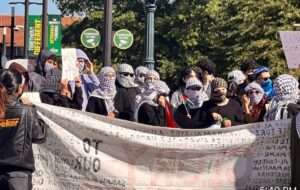
Below is a picture that a friend forwarded to me from a Students for Justice in Palestine rally at my university's Fairfax campus. The organizers advised students to wear face coverings to hide their identities (one post specifically about this rally advised the students to wear face coverings, another post on general protest advice told students to hide their identities, including their faces).
Like many states, Virginia has a law, aimed at hate groups like the KKK (and, for that matter, SJP), prohibiting the wearing of face coverings in public, except for theatrical or medical reasons or during a state of health emergency (which does not currently exist in Virginia): "It shall be unlawful for any person over 16 years of age to, with the intent to conceal his identity, wear any mask, hood or other device whereby a substantial portion of the face is hidden or covered so as to conceal the identity of the wearer, to be or appear in any public place, or upon any private property in this Commonwealth without first having obtained from the owner or tenant thereof consent to do so in writing." Virginia statutes § 18.2-422.
Are such laws a good idea? Are they constitutional? I am ambivalent on both counts. There is significant value in allowing for anonymous protest, and also significant value in not allowing masked hate groups to intimidate others--I've been told by a reliable source that Jewish students at Mason were terrified to be out and about during this rally--and potentially cover up criminal behavior by masking their identities in public. Some courts have upheld these laws in modern cases, others have found that they violate the First Amendment. It's a genuinely difficult issue, I think.
But regardless of my views, the law is on the books, creates a felony, and has been upheld in a decision of the Virginia Court of Appeals. The police should not get to pick and choose which laws they enforce and against whom.
I know from my friend that several people called the George Mason University police in advance to inform them that a masked rally was scheduled to occur, that wearing a mask at such a rally is a felony, and that they want the police not to arrest the students or quash the rally, but only to require them comply with the law and not wear masks. Obviously, the police did nothing, apparently telling people that since the rally was peaceful, they weren't going to interfere. Surely, however, if a KKK or neo-Nazi rally was taking place on campus, no matter how "peaceful," the police would have enforced the law. That's what's known as selective enforcement, and it's a real problem.
[Cross-posted in slightly different form at instapundit.com.]
It's hosted by the UCLA "campus community" of Heterodox Academy; here's the blurb:
Monday, October 30th, 5:00 – 6:30 pm
School of Law, Room 1357
The use of puberty blockers, gender-affirming sex hormones, and (more rarely) surgery to address gender dysphoria in minors has become the focus of intense controversy in recent years. Citing inadequate knowledge about the efficacy and long-term health effects of such medical interventions, several European countries have adopted a more cautious stance towards such treatments, without banning them. Meanwhile, several US states have enacted draconian restrictions on gender-affirming care, which, alongside the sometimes dehumanizing language deployed against trans and gender nonconforming people, has only further polarized the public discussion of youth gender medicine.
In this highly charged context, where space for civil discussion of a complex and fraught issue may seem to be shrinking, the UCLA chapter of Heterodox Academy has invited Jesse Singal to campus to speak on the subject. Singal's extensive reporting on youth gender medicine, while not shying away from controversy, has shown that it is possible to address a heatedly contested public issue in a nuanced manner that recognizes the complexities of the issue and respects the diversity of perspectives affected by it. His talk will cover the basics of the research into youth gender medicine, the heated debate going on among gender clinicians themselves, and prior examples of the politicization of scientific debates that have had dire consequences for vulnerable people.
It was such a pleasure to be on this panel (part of the Safeguarding Democracy Project's webinar series) on Tuesday here at UCLA. Genevieve is always excellent, and Rick—one of the top election law scholars in the country—did a great job moderating. Hope some of you folks will enjoy watching this as much as I enjoyed participating.
From last week's posting by the Florida Bar:
The Board Review Committee on Professional Ethics will consider adopting a proposed advisory opinion at the direction of The Florida Bar Board of Governors based on an inquiry by the Special Committee on Artificial Intelligence (AI) Tools and Resources, at a meeting to be held on Thursday, November 30, 2023, from 1-3 p.m. at the Henderson Beach Resort in Destin, Florida.
There are no drafts for the committee's consideration at this time. The proposed advisory opinion will address:
1) Whether a lawyer is required to obtain a client's informed consent to use generative AI in the client's representation;
2) Whether a lawyer is required to supervise generative AI and other similar large language model-based technology pursuant to the standard applicable to non-lawyer assistants;
3) The ethical limitations and conditions that apply to a lawyer's fees and costs when a lawyer uses generative AI or other similar large language model-based technology in providing legal services, including whether a lawyer must revise their fees to reflect an increase in efficiency due to the use of AI technology and whether a lawyer may charge clients for the time spent learning to use AI technology more effectively;
4) May a law firm advertise that its private and/or inhouse generative AI technology is objectively superior or unique when compared to those used by other lawyers or providers; and
5) May a lawyer instruct or encourage clients to create and rely upon due diligence reports generated solely by AI technology?
How could something so adorable cause this much interpersonal trouble?
The 45th episode (Apple Podcasts link here and Spotify link here) of Strangers on the Internet with co-host and psychologist Michelle Lange revolves around the role of pets when humans date.
While a cute pet picture can attract someone to your dating profile, pets can also be a major hindrance in romance. What happens when a significant other's pet prevents spontaneous travel or acts up jealously when someone comes over? What are reasonable expectations for how pet owners and non-owners should adapt to each other in relationships? Michelle and I--both long-time pet owners--break down the possible challenges that even a well-behaved Fido or Garfield might bring to the dating game!

The Foundation for Individual Rights and Expression responds.
[UPDATE 10/19/2023, 7:57 pm EST: The AG's office has withdrawn its request as to Rumble, writing: "While we wholeheartedly disagree with your analysis and the contentions in your letter, in view of your statement that Rumble has 'already provided its content-moderation policies' to the Attorney General's Office, and in the interest of avoiding any unnecessary dispute, this Office hereby withdraws the voluntary requests
set forth in its October 12, 2023 letter to Rumble."]
From a letter sent by the New York Attorney General to "Google, Meta, X (formerly Twitter), TikTok, Reddit, and Rumble" on Oct. 12:
Re: Removing Calls for Violence on the [name of platform] Platform …
In the wake of the horrific terrorist attacks in Israel, there have been reports of growing antisemitism and Islamophobia, including threats of violence against Jewish and Muslim people and institutions. We have also become aware of press reports that terrorist groups and individuals that sympathize with them are disseminating calls for violence and other materials that may incite violence against Jewish and Muslim people and institutions on social media platforms. We are deeply concerned about this activity in light of the tragic history of such calls for violence. We would like to better understand how [your platform is] ensuring that its platform (the "Platform") is not being used to incite violence and further terrorist activities, including by describing how the company is identifying, removing, and blocking the re-uploading of such content.
We request that you promptly respond to the following questions by October 20, 2023.
- What actions, if any, has the company taken to address the recent calls for violence against Jewish and Muslim people and institutions and the possibility that the Platform may be used to plan, encourage, or disseminate those acts?
- Describe in detail the public-facing terms of service, community rules, or other policies that prohibit users from using your Platform to disseminate calls for violence, including copies of any documentation or policies.
- Describe in detail the company-facing policies that govern the determination of whether content is a call for violence that should be removed, including copies of any documentation and policies.
- Describe in detail the company's process for reviewing and removing calls for violence in response to reports from Platform users, including copies of any internal documentation.
- Describe in detail the company's process for identifying and removing calls for violence other than in response to reports from Platform users, including copies of any internal documentation.
[Originally posted on October 13. In light of the updates, I am reposting this and moving it to the to the top of the Conspiracy.]
This was circulated to the law school community on Monday [Oct. 10], so no excuses about it being an initial visceral reaction to be re-thought as a scope of the massacre became clear. I have the entire statement, which I am happy to share, but for now I just want to present the first paragraph. I don't really have words to describe how disgusting this is. It's both morally appalling and wildly dishonest at the same time:
Palestinians in Gaza are fighting against the Israeli colonial entity on an unprecedented scale. So far, they have bulldozed barbed wire and walls that have kept them trapped as hostages in Gaza, the largest open-air prison in the world. They have captured Israeli occupying soldiers and retaken some of their land from Israel. This guerilla warfare, although not without a steep cost to Israelis and Palestinians, is the first instance of Palestinians fighting occupying Israel in recent years. Despite Palestinians understanding the brutal reaction of the Israeli regime, they remain persistent in fighting for their life because in all actuality, the war has been ongoing for the past seven decades. As one Gazan poignantly said, "Today, we will either be free or be killed, and either is better than being caged."
Here are the student organizations that sent it.
Law Students for Justice in Palestine (LSJP)
Black Law Student Association (BLSA)
Muslim Law Student Association (MLSA)
Middle Eastern and North African Law Student Association (MENALSA)
National Lawyers Guild (NLG)
Res Sista Loquitur: Women of Color Coalition
Students Taking Action for Racial Solidarity (STARS) Executive Board
[UPDATE: Following immediate pushback from the Jewish Law Students Association and I'm sure others, BLSA retracted its endorsement of the statement within a few hours of it being circulated. STARS retracted its endorsement the next morning.
RSL provided a clarification: "We appreciate and recognize the nuance of the Israel-Palestine conflict, its impact on both communities, the significance of the atrocities impacting civilians, and the unprecedented grief amongst the Jewish community. As such, we cannot emphasize enough that as an organization, students, and humans, we are vehemently opposed to - and do not condone -violence. As a signatory, we sought to acknowledge and support Palestinian liberation. In no way did we aim to hurt our peers."
SJP, which drafted the letter, essentially reaffirmed its statement. I'm going to reprint its entire reaffirmation after the fold.
After SJP's reaffirmation, MLSA spent most of its follow-up decrying Islamaphobia and racism. It did not retract its signature, and instead condemned all recent violence against civilians, equating Hamas's barbaric massacre with Israel's military response: "Consistent with our historical stance across the years -we, as Muslim members of this community, unequivocally condemn all acts of violence targeting innocent civilians with the hope that this condemnation serves as a lasting commitment. This includes the recent violence against civilians at the hands of Hamas and the IDF. To assume otherwise is unsound in its reasoning and rooted in disturbing racist ideologies. It is self-evident, yet the presumptions made against our humanity speak to the extent of Islamophobia on this campus."
Thereafter, MENALSA weighed in: "The MENALSA board would like to clarify our position on the recent discourse. It's very easy for us to condemn the violence perpetrated by Hamas against Israeli citizens. We apologize for staying silent on this issue, we certainly did not mean to imply approval for, or celebration of, acts of terror."
After the fold is SJP's followup statement. If you read it carefully, while the email stats that SJP's words were "distorted to imply that we condone violence against innocent civilians," you will not find any specific criticism of Hamas's Oct. 7 orgy of violence against innocent civilians, nor, for that matter, any clarification that SJP considers Israelis civilians to be "innocent civilians," an important omission given the trope in Palestine Solidarity circles that no settler is a civilian, and all Israeli Jews are settlers.
And as one student responded:
Your words were not distorted they were simply read. You said "captured occupying Israeli Soldiers" "guerrilla warfare" and "only now that they feel the consequences of their own racist colonial actions that the one-sided war has become two sided" then finally "The unprecedented resistance by Palestinians from Gaza did not happen in a vacuum. Rather this is the response of people pushed beyond endurance for years."
All those statements you made directly after a terrorist attack by Hamas that targeted, killed, and captured hundreds of civilians. The logical conclusion anyone who reads your words reaches is that you consider the attacks this weekend to be guerrilla warfare, consequences, and resistance. I want to add special emphasis on the captured occupying Israeli soldiers comment as those captured were not soldiers, but civilian's including children, and foreign nationals.
Here is SJP's followup statement:
Caitlin Doolittle <caitdo@umich.edu> [Bonus irony: while an undergrad student at U. Penn., Ms. Doolittle was an "Anti-Violence Educator."]
To: lawopen <LawOpen@listserver.law.umich.edu>
Voting for "audience favorite" in the Esperanto film festival closes at the end of Thursday, October 19.
Today is the last chance to "like" my video that I've submitted to the Esperanto film festival. It's under 3 minutes long, and it's a comedy classic. (Your mileage may vary, but… while this might not be the funniest film ever made, I believe it's the funniest film in this particular film festival.) It's about Diogenes (the Greek philosopher who went around with a lantern searching for an honest man), and it's called "Honesta homo" ("An honest person").
"Audience favorite" gets a special prize in this film festival, and I'm within striking distance of first place right now, so hopefully the readers of this blog can help me get over the top.
So… while I'm embedding the video below, please click through to YouTube and "like" ("thumbs-up") the video there: (I don't think you can "like" a YouTube video when you watch it on this blog: click on the title at the top of the video to open it in YouTube.)
You can also click here to see the full set of 50 films submitted to the festival, which is called the "Fifth American Good Film Festival", or, in Esperanto, "La 5a [pronounced 'kvina'] Usona Bona Film-Festivalo").
Once again… please click through to YouTube and "like" my video!
Celebrate your independence with a subscription to Reason magazine, your most trusted source of honest, insightful news and analysis.