Wednesday's Pennsylvania Superior Court decision in Commonwealth v. Krankowski (opinion by Judge Alice Beck Dubow, joined by Justices Maria McLaughlin & Daniel McCaffery) upheld a conviction for falsely reporting child abuse. Defendant had sent the principal and vice-principal at her son's high school an email linking to one of her Facebook posts, which alleged that a caseworker at the Snyder County Children and Youth Services Agency "subjected my son to physical and sexual abuse of his person and giggled/laughed about it. Later, Shambaugh was elevated to supervisor at Children and Youth." The recipients were "both mandated reporters, who proceeded to make a report of suspected child abuse to the Agency." Defendant had also made the same accusation in a call to the Agency. Defendant was found guilty, and sentenced "to two years' probation and, as a condition of probation, ordered … to submit to a mental health evaluation and follow all recommendations."
This, the court held, was a criminal false report even though it wasn't made directly to the police. The statute makes it a crime to "intentionally or knowingly make a false report of child abuse under 23 Pa.C.S. Ch. 63 (relating to child protective services)," and the court reasoned:
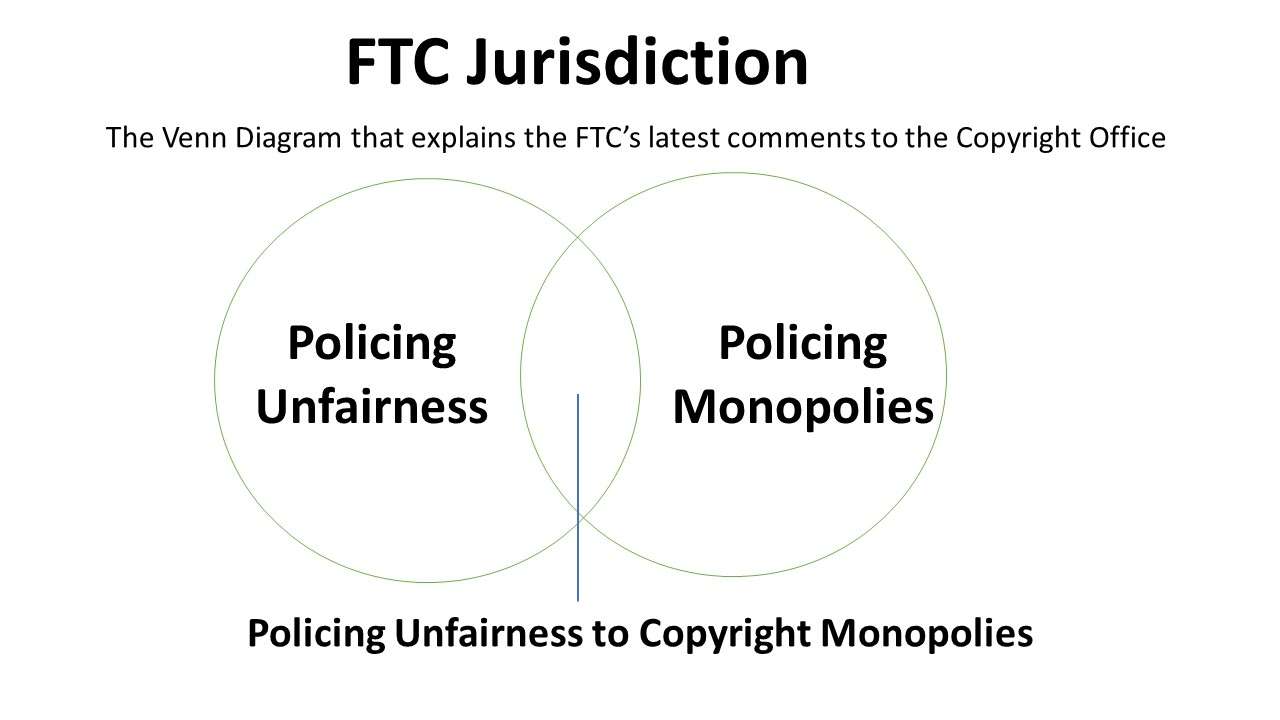
"Conduct that may violate the copyright laws––such as training an AI tool on protected expression without the creator's consent or selling output generated from such an AI tool, including by mimicking the creator's writing style, vocal or instrumental performance, or likeness—may also constitute an unfair method of competition."*
What the FTC meant, as explained by Cybertoonz:
*Artificial Intelligence and Copyright, Comment of the United States Federal Trade Commission, before the United States Copyright Office, Docket No. 2023-6 at 5 (October 30, 2023).
In Connecticut Superior Court Judge Eddie Rodriguez's opinion in Breiner v. Breiner (handed down Sept. 15 but just posted on Westlaw), the dispute was about whether plaintiff mother had breached an agreed-to provision in a 2017 parenting plan, "The parties agree the children shall be raised in the Orthodox Jewish tradition, and shall support those values with the children." Defendant father argued,
Mother has put the children in an untenable position where the development of their Jewish identity has been seriously compromised, undermining father's efforts to maintain an Orthodox Jewish home that is observant of the Orthodox Jewish tradition, and mother's conduct has resulted in a substantial change in circumstances that supports reconsideration of the amount of time mother enjoys with parental access to the children.
For example, mother has invited a non-Jewish male companion to live with her in the family home since March, 2020. Upon information and belief, the couple are in a dating relationship and he shares the parties' former marital bedroom with the plaintiff. Under any Orthodox tenet, this choice is the antithesis of supporting traditional Orthodox [Jewish] values. Further, mother is not observant of the Jewish holidays in Orthodox tradition and does not follow or support the traditions (and Jewish law) associated with the values in which the children were raised during the marriage."
Mother argued that "she has continued to raise the minor children in the Orthodox Jewish tradition, but that the defendant's attitude has been rigid and fails to recognize that the children [age 15 and 13] have established their own religious identities. Furthermore, the defendant is imposing his level of religious observance upon the plaintiff and the children, causing great anxiety and strain for the children. Lastly, the plaintiff argues that the defendant seeks to control both the plaintiff and the minor children, alleging that the defendant has undermined their religious observance to their great distress."
The court concluded that the Establishment Clause and the Free Exercise Clause precluded the enforcement of such a provision:
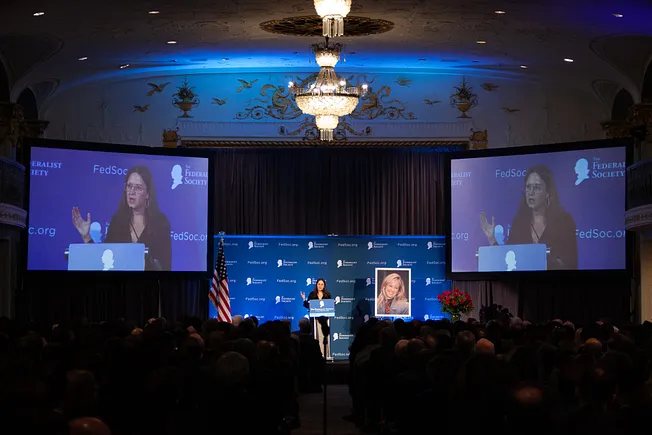
One of the capstones of the Federalist Society National Lawyer's Convention is the Barbara K. Olson Memorial Lecture. The namesake of the lecture was a conservative lawyer and political commentator, and the wife of former Solicitor General Ted Olson. Barbara Olson was tragically murdered on 9/11 onboard American Airlines Flight 77, which was flown into the Pentagon. The first Olson lecture was delivered by Ted Olson in November 2001, barely two months after the horrific terrorist attacks. Later addresses were given by Judge Robert Bork, Justice Scalia, Chief Justice Roberts, Attorney General Mukasey, and many other leading jurists. I have attended every Olson lecture since 2008, and have witnessed many moving tributes to Barbara, and the important causes she believed in.
The Olson lecture at the 2023 Convention will always stand out in my memory. The speech was delivered by Bari Weiss of The Free Press. I'll admit, when I first saw her name on the schedule, I was a bit confused. Bari is not a lawyer, not a member of the Federalist Society, and not a conservative. Yet, my confusion quickly dissipated. Bari delivered a rousing, timely, and penetrating speech. Bari spoke to our current moment, including the conflict in Israel and attempts to destroy our own civilization. She formed a common kinship with those she disagrees with--especially a FedSoc crowd. And she connected with everyone in that room. At the end, the room was silent. You could hear a Madison lapel pin drop. When Bari concluded, the standing ovation lasted for nearly ninety seconds. (It was the longest one I could remember following an Olson lecture.)
Bari has posted the text of her remarks, titled "You Are the Last Line of Defense" on TheFree Press. If you haven't already subscribed you should--I did.
Here is an excerpt, but I encourage you to read--or better yer, listen to--the entire speech:
Over the past two decades, I saw this inverted worldview swallow all of the crucial sense-making institutions of American life. It started with the universities. Then it moved beyond the quad to cultural institutions—including some I knew well, like The New York Times—as well as every major museum, philanthropy, and media company. It's taken root at nearly every major corporation. It's inside our high schools and our elementary schools.
And it's come for the law itself. This is something that will not come as a surprise to the Federalist Society. When you see federal judges shouted down at Stanford, you are seeing this ideology. When you see people screaming outside of the homes of certain Supreme Court justices—causing them to need round-the-clock security—you are seeing its logic.
The takeover of American institutions by this ideology is so comprehensive that it's now almost hard for many people to notice it—because it is everywhere.
For Jews, there are obvious and glaring dangers in a worldview that measures fairness by equality of outcome rather than opportunity. If underrepresentation is the inevitable outcome of systemic bias, then overrepresentation—and Jews are 2 percent of the American population—suggests not talent or hard work, but unearned privilege. This conspiratorial conclusion is not that far removed from the hateful portrait of a small group of Jews divvying up the ill-gotten spoils of an exploited world.
But it is not only Jews who suffer from the suggestion that merit and excellence are dirty words. It is every single one of us. It is strivers of every race, ethnicity, and class. That is why Asian American success, for example, is suspicious. The percentages are off. The scores are too high. The starting point, as poor immigrants, is too low. From whom did you steal all that success?
The weeks since October 7 have been a mark to market moment. In other words, we can see how deeply these ideas run. We see that they are not just metaphors.
Decolonization isn't just a turn of phrase or a new way to read novels. It is a sincerely held political view that serves as a predicate to violence.
If you want to understand how it could be that the editor of the Harvard Law Review could physically intimidate a Jewish student or how a public defender in Manhattan recently spent her evening tearing down posters of kidnapped children, it is because they believe it is just.
Their moral calculus is as crude as you can imagine: they see Israelis and Jews as powerful and successful and "colonizers," so they are bad; Hamas is weak and coded as people of color, so they are good. No, it doesn't matter that most Israelis are "people of color."
That baby? He is a colonizer first and a baby second. That woman raped to death? Shame it had to come to that, but she is a white oppressor.
…
Ted once said of Barbara that "Barbara was Barbara because America, unlike any place in the world, gave her the space, freedom, oxygen, encouragement, and inspiration to be whatever she wanted to be."
There is no place like this country. And there is no second America to run to if this one fails.
So let's get up. Get up and fight for our future. This is the fight of—and for—our lives.
On Monday, the Supreme Court for the first time adopted an ethics code for its justices. The relatively short (14 pages) "Code of Conduct" was likely enacted in response to various controversies over the last year. I think the rules outlined in the Code seem reasonable, though there is some legitimate concern about the lack of enforcement provisions.
In an introductory statement, the justices write that "[f]or the most part these rules and principles are not new." Even so, there is value to having these rules clearly stated, so that observers can know what rules the justices consider themselves bound by.
Most of the rules strike me as intuitive and eminently defensible. Among the highlights are guidelines for recusal - the first in the Court's over two hundred year history. While justices have at times recused themselves for various reasons, until now the Court had not systematically outlined the rules that apply in such cases.
And the rules announced Monday make good sense. For example, they require recusal when there is a significant financial conflict of interest, and when a close relative of the justice is lead counsel in the case or an equity partner in the firm litigating it (and thus stands to profit financially).
It is also notable that the Code requires justices to "comply with the restrictions on acceptance of gifts and the prohibition on solicitation of gifts set forth in the Judicial Conference Regulations on Gifts now in effect." Those regulations generally forbid receipt of large-scale gifts like the expensive free vacations Justice Clarence Thomas apparently got from conservative billionaire Harlan Crow. There are a few (to my mind sensible) exceptions, such as "travel expenses, including the cost of transportation, lodging, and meals… to attend a bar-related function, an educational activity, or an activity devoted to the improvement of the law, the legal system, or the administration of justice."
Critics of the new code have focused on the lack of enforcement mechanisms. If a justice violates the rules, there is no provision for any kind of penalty.
This is a reasonable concern. It is, however, partly mitigated by the fact that the justices care about their reputations, and a justice who violates these rules is likely to take reputational damage. He or she can no longer claim that the relevant standards are unclear. It is also the case that it's hard to create a binding enforcement mechanism for the Court without intruding on judicial independence. These considerations may block enforcement mechanisms as rigorous as critics might want.
Even so, it should be possible to have at least some enforcement mechanisms. For example, the justices might be able to agree on a system of fines for violations, adjudicated by judicial branch officials they themselves could designate. I think Congress could also mandate at least some types of fines or other similar sanctions, as it has already done with the federal bribery statute (which applies to Supreme Court justices).
In my view, Justice Alito was wrong to claim that "No provision in the Constitution gives [Congress] the authority to regulate the Supreme Court." Congress does have considerable, though far from unlimited, authority to set ethical rules for Supreme Court justices.
As I have previously noted, many of the ethics accusations against the justices are overblown, and many of the critics are at least in part motivated by their dislike of the conservative justices' rulings. It is also important to emphasize there is no evidence that any justice decided any case differently because of any gifts or other largesse they received. If Justice Thomas were really doing the bidding of Harlan Crow, he probably would not have voted to overrule Roe v. Wade, as Crow is pro-choice.
But that doesn't prove ethics concerns are completely without merit. It is reasonable to impose constraints on justices taking large gifts from private individuals and organizations, other than close relatives. Few oppose having such restrictions for lower court judges and for other influential government officials.
And some of the largesse Justice Thomas got from Harlan Crow, strikes me as going beyond what can reasonably be justified. The same goes for some of the free travel and other perks received by other justices, including some of the liberals. An occasional free dinner is no big deal. Free vacations worth tens of thousands of dollars are a different matter.
For those keeping track, I am not one of those people who raise ethics issues because they hate the Court's recent major rulings, and want to curb its power. Much the contrary. I believe most (though not all) the prominent Supreme Court decisions of the last two years are largely right, and am strongly opposed to court-packing and other similar schemes to weaken the Court's authority.
It's hard to say exactly where the line on gifts and other such matters should be drawn. Ditto for recusal standards. But the Code announced Monday at least seems like a reasonable approach. It's definitely a step in the right direction.
From General Order 23-11, effective Dec. 1, 2023, the new Local Rule CV-11(g):
Litigants remain responsible for the accuracy and quality of legal documents produced with the assistance of technology (e.g., ChatGPT, Google Bard, Bing AI Chat, or generative artificial intelligence services). Litigants are cautioned that certain technologies may produce factually or legally inaccurate content. If a litigant chooses to employ technology, the litigant continues to be bound by the requirements of Fed. R. Civ. P. 11 and must review and verify any computer-generated content to ensure that it complies with all such standards. See also Local Rule AT-3(m).
COMMENT: Recent advancements in technology have provided pro se litigants access to tools that may be employed in preparing legal documents or pleadings. However, often the product of those tools may be factually or legally inaccurate. Local Rule CV-11 is amended to add new subsection (g) to alert pro se litigants to this risk. The rule also alerts litigants that they remain bound by the certification requirements of Fed. R. Civ. P. 11 when employing such tools to verify all content meets those standards. A similar rule, Local Rule AT-3(m), is added to the standards of practice to be observed by attorneys….
Foreign Minister Joseph Wu (吳釗燮) on Sunday (Nov. 12) mocked China's government for lecturing Thailand over freedom of the press following his interview on a Thai television station.
Wu was interviewed by Thai Public Broadcasting Service (PBS) anchor Phongsathat Sukhaphong on Nov. 1 in Taipei, according to the Ministry of Foreign Affairs (MOFA). An interview segment was broadcast on Thai evening news under the headline "Taiwan's foreign minister assesses the development trends with China's military unification with Taiwan," on Nov. 3, and the complete interview was uploaded to the station's YouTube channel, as can be seen on this archived page.
During the interview, Wu said China is using various means such as military pressure, economic coercion, and international isolation in an attempt to force Taiwan to surrender utilizing the Sun Tzu lesson of "subduing the enemy without fighting." In the face of China's provocations, Wu said Taiwan has always played a responsible role, avoided becoming a party that provokes conflicts, and is willing to engage in cross-strait dialogue on the premise of equality….
A Springfield Township (Pennsylvania) resolution provides:
[T]he Board of Commissioners of Springfield Township does, as a matter of respect and sensitivity to all the citizens of the Township, hereby prohibit the publicly visible display or use of any image which depicts the Thin Blue Line American Flag symbol by any Township employee, agent, or consultant and in an effort to be clear and as reasonably limited as possible, specifically prohibits the following:
The publicly visible depiction of the symbol on the clothing or skin of any Township employee, agent or consultant while on duty, during the workday of the individual or while representing the Township in any way (specifically including the off duty time of any such individual if still wearing the Township uniform).
The publicly visible depiction of the Thin Blue Line American [F]lag symbol on any personal property of a [T]ownship employee, agent, or consultant, which is brought into the [T]ownship building (except prior to or subsequent to reporting for duty or any official assignment for the Township), and which, in the reasonable opinion of the Township Manager, is placed in a location likely to be seen by a member of the public while visiting the [T]ownship building.
The display, by installation or affixation of a publicly visible depiction of the symbol, on [T]ownship owned property (including [T]ownship vehicles), by any person.
[T]he Resolution is a viewpoint regulation—it prohibits employees, agents, and consultants from displaying only the Thin Blue Line American Flag, not from displaying flags or political speech generally. Instead, the Township argues that the Resolution is a permissible restriction on employee speech even though it targets a specific viewpoint. Given the Supreme Court's consistent assertion that viewpoint discrimination is inherently suspect, the Court questions whether the government can ever permissibly regulate employee speech based on viewpoint. {One exception to this rule is when the government is speaking on its own behalf. But the Township has not argued that [the Resolution] regulates government speech.} …
Texas Attorney General Ken Paxton today announced his appointment of Aaron Nielson as Solicitor General.
"I am delighted to welcome Aaron as Solicitor General. In this position, he will lead the critical appellate work for some of our most significant, far-reaching cases," said Attorney General Paxton. "His talent and expertise are virtually unmatched, earning him national renown in the legal community. He will be a tremendous asset to our agency and to our state's appellate leadership on the major legal questions of our era."
"It is my great honor to serve the state of Texas as Solicitor General. I look forward to working alongside the team Attorney General Paxton has assembled and to leading and learning from the world-class lawyers in the Solicitor General Division that represent Texas so well in our nation's appellate courts," said Mr. Nielson.
Mr. Nielson is a Professor of Law at Brigham Young University's J. Reuben Clark Law School, specializing in administrative law, civil procedure, antitrust, and the federal courts. One of the nation's foremost experts on the Administrative Procedure Act, he recently served as Chair of the Administration and Management Committee of the Administrative Conference of the United States. He also recently served on the Council of the American Bar Association's Section of Administrative Law and Regulatory Practice and currently co-chairs its antitrust committee. Professor Nielson is a visiting fellow at the Antonin Scalia Law School's C. Boyden Gray Center for the Study of the Administrative State. He is taking a one-year leave of absence from Brigham Young University to serve as Solicitor General.
In 2020, Mr. Nielson was appointed by the U.S. Supreme Court to brief and argue Collins v. Yellen, a separation-of-powers case about the Federal Housing Finance Agency. He also regularly represents clients in the U.S. Court of Appeals for the Fifth Circuit. His publications have appeared in many of the nation's top journals, including the University of Pennsylvania Law Review, Duke Law Journal, and University of Chicago Law Review.
Before joining the BYU faculty, Mr. Nielson was a partner at Kirkland & Ellis LLP, where for many years he has been of counsel in the appellate and antitrust groups. He also has served as a law clerk to Justice Samuel A. Alito, Jr. of the U.S. Supreme Court, Judge Janice Rogers Brown of the U.S. Court of Appeals for the D.C. Circuit, and Judge Jerry E. Smith of the U.S. Court of Appeals for the Fifth Circuit in Houston, Texas.
Mr. Nielson received his J.D., magna cum laude, from Harvard Law School. He also received an LL.M from the University of Cambridge. He received his undergraduate degree, summa cum laude, from the University of Pennsylvania, majoring in economics and political science.
Aaron will have several prominent arguments before the Court this term. I, and everyone else in the Texas conservative legal movement, welcome Aaron!
Unsurprisingly, lawyers aren't the only ones to use AI programs (such as ChatGPT) to write portions of briefs, and thus end up filing briefs that contain AI-generated fake cases or fake quotations (cf. this federal case, and the state cases discussed here, here, and here). From an Oct. 23 opinion by Chief Judge William P. Johnson (D.N.M.) in Morgan v. Community Against Violence:
Rule 11(b) of the Federal Rules of Civil Procedure states that, for every pleading, filing, or motion submitted to the Court, an attorney or unrepresented party certifies that it is not being presented for any improper purpose, such as to harass, cause unnecessary delay, or needlessly increase the cost of litigation," that all claims or "legal contentions are warranted by existing law or by a nonfrivolous argument for extending, modifying, or reversing existing law or for establishing new law," and that factual contentions have evidentiary support….
Plaintiff cited to several fake or nonexistent opinions. This appears to be only the second time a federal court has dealt with a pleading involving "non-existent judicial opinions with fake quotes and citations." Quite obviously, many harms flow from such deception—including wasting the opposing party's time and money, the Court's time and resources, and reputational harms to the legal system (to name a few).
The foregoing should provide Plaintiff with enough constructive and cautionary guidance to allow her to proceed pro se in this case. But, her pro se status will not be tolerated by the Court as an excuse for failing to adhere to this Court's rules; nor will the Court look kindly upon any filings that unnecessarily and mischievously clutter the docket.
Why is being single so frustrating sometimes? Michelle and I explore both the emotional and practical side of single life. In addition to dealing with feelings of loneliness, single people--and frequently especially single women--face tasks that are difficult or even impossible to accomplish on one's own.
Michelle talks about the lawn mower she physically couldn't start while single without her (male) neighbor's help, while I discuss the challenges of building furniture that requires two people. We analyze how to overcome some of these obstacles and how community members can best support each other with life's small and large complexities regardless of relationship status.
Today the Harvard Law Review has published its issue on the Supreme Court's October 2022 Term, and Will Baude and I have a case comment on Biden v. Nebraska and more generally on standing doctrine in the term. The piece is called Proper Parties, Proper Relief.
So in thinking about what the piece covers, consider three concentric circles. The narrowest is Biden v. Nebraska: was there standing for the states to sue to stop the Biden Administration's (first) student-loan relief plan? A second circle is broader: what are the circumstances in which a state is able, or should be able, to sue the national government? A third circle is broader still, and it's the first principles of standing doctrine: What is the core of standing? What is it good for? What exactly is the point?
Proper Parties, Proper Relief tackles all these questions, and along the way it also discusses other major cases from the October 2022 Term, including United States v. Texas and Haaland v. Brackeen. Together these cases suggest important shifts in standing doctrine, especially state standing.
Part I, called "Basic Principles," offers an account of standing doctrine that emphasizes two main ideas--proper parties and proper relief—and it connects both of these to the judicial role.
Part II, called "The Massachusetts v. EPA Era and the Shifting Judicial Role," analyzes briefly and critically the meteoric rise of state standing (which is due to multiple factors, not just Massachusetts v. EPA).
Part III, called "End of an Era? Two Cheers for the Supreme Court's Course Correction," works through in detail the Supreme Court's standing cases from the October 2022 Term, especially showing how they have narrowed—perhaps even gutted—the expansive readings of Massachusetts v. EPA that have become commonplace in the lower federal courts.
Finally, Part IV, called "The Enduring Choice Between Two Approaches to Standing," distinguishes between an external concept of standing, in which it is simply a hurdle for a judge to get over before getting on with the real work; and internal concept of standing, in which it is part of the role morality of being a judge.
The piece concludes with this paragraph:
Yet as courts have come to govern so much of our political life, and as so many of us have come to expect them to do so, standing doctrine and its corresponding view of judicial power will always be under pressure. Unconstrained by such niceties, there is so much more a judge could do! This Term suggests that the Court is trying to nudge the judiciary toward the classical view of the judicial role, or at least toward the circa 2005 view of the judicial role, and if so that is a good development. But it will not be the end of the temptation. Constant pressure requires constant vigilance.
One reason I broadly oppose governmental restrictions on the expression of ideas—even obviously bad, dangerous, and offensive ideas—is the phenomenon I call "censorship envy": The common reaction that, "If my neighbor gets to ban speech he reviles, why shouldn't I get to do the same?"
[1.] To offer one example, say a public university bans speech that expresses support for Hamas attack on civilians, and a court upholds that (perhaps on the theory that this supposedly creates a "hostile educational environment" for Jewish or Israeli students).
It seems to me quite likely, and psychologically understandable, that this will create an impetus for greater moves to ban other speech, such as support for Israeli retaliatory strikes against Hamas or other future attackers. Such a misplaced desire for equality of repression is a powerful mental force, and it's one way in which narrow speech restrictions can end up leading to broader ones.
Indeed, I already often hear it as a defense for restrictions on pro-Hamas speech: In practice, some universities already do various things to try to punish speech that's supposedly racist or sexist or anti-gay or anti-trans or what have you. Isn't it only fair that they likewise punish speech that defends the killing of Jews? Yet if that argument for comparable speech suppression is accepted, why would we think it will stop there?
But beyond this, even if the envy doesn't lead to broader speech restrictions, that itself is dangerous to society. Say that, even if the ban on pro-Hamas speech is allowed, a move to similarly ban pro-Israeli-retaliation speech fails. The pro-Israeli-retaliation speech will then likely rankle many Americans even more, creating more offense and more division.
Right now, when people are deeply offended by various kinds of speech, the legal system can powerfully tell them: "Yes, you must endure this speech that you find so offensive, but others must endure offensive speech, too. Many people hate speech you like as much as you hate the speech they like, but the Constitution says we all have to live with being offended: We must fight the speech we hate through argument, not through suppression."
Yet what would we say when some offensive viewpoints are banned but other offensive viewpoints are allowed? "We who have the support of the majority get to suppress symbols we hate, but you in the minority don't"? "Our hatred of certain speech is reasonable but your hatred of other speech is unreasonable"?
Yes, it's true, you can argue for various distinctions, such as between speech defending the purposeful killing of civilians and speech defending the merely knowing killing of civilians incidental to attack military targets. (I actually agree with such a distinction on the merits, though not as a basis for banning some speech.) But are Americans on the other side of these debates from you likely to be persuaded by these arguments? Are those arguments likely to lead to more domestic peace and stability, or less?
[2.] This is also one of the reasons (though not the only one) why I oppose European-style "hate speech" laws. One recurring argument from Muslims who want Mohammed cartoons legally suppressed is that European laws prohibit other kinds of speech offensive to other groups—for instance, Holocaust denial, which is often restricted chiefly because it's seen as implicitly or explicitly anti-Semitic—and that Muslims should get the same treatment.
The Hoover Institution at Stanford University is seeking an outstanding early-career legal scholar who is interested in doing research on free speech law, in preparation for seeking an academic position at a law school or elsewhere.
If you are selected, you would work on your own research with the guidance and supervision of Senior Fellow Eugene Volokh, who is coming to Hoover after 30 years as a Professor of Law at UCLA School of Law. You would be appointed a Research Fellow with the Center for Revitalizing American Institutions (RAI), for one year from July 2024 through June 2025; the term may be renewed, if both you and Hoover agree, for one extra year. You would be expected to be physically present at the Institution, and working at it full-time, with no competing major professional commitments.
There is no teaching obligation, so you would have maximum time to research and write. You would, however, be expected to help organize and participate in occasional conferences, workshops, and lectures, and to work on occasional projects with Volokh or other Senior Fellows. These tasks would all be related to free speech law, and are expected to help promote your own research and future career.