The Volokh Conspiracy

Mostly law professors | Sometimes contrarian | Often libertarian | Always independent | Est. 2002

The Volokh Conspiracy

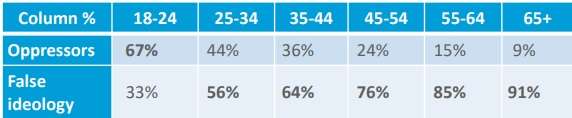
Harvard/Harris Poll: Huge Majorities of 18-to-24-Year-Olds Believe Jews, Whites "Are Oppressors"

The survey was of 2,034 registered voters

|

From the poll, conducted Wednesday and Thursday of last week:

There is an ideology that white people are oppressors and nonwhite people and people of certain groups have been oppressed and as a result should be favored today at universities and for employment. Do you support or oppose this ideology?

A question asked two questions after that (the intervening question being, "Do you think this ideology is helpful or hurtful to our society?"):

Do you think that Jews as a class are oppressors and should be treated as oppressors or is that a false ideology?

Lots more in the survey, available here. From the description:

Read More

Court Allows Sealing of Video of Police Shooting of 11-Year-Old Aderrien Murry

The boy's name has been publicly reported (apparently with his parents' permission), but the court nonetheless concludes that releasing the video would violate his privacy. (The grand jury has just declined to indict the police officer.)

|

From Murry v. City of Indianola, decided Thursday by Judge Debra Marie Brown (for stories on the incident, which confirm that the boy's name has been broadly reported, see here):

The plaintiff, A.M., an eleven-year-old boy, was shot in the chest by an Indianola Police Department officer responding to a domestic violence call at the home of his mother, Nakala Murry. The father of one of Murry's children, John Nolden, came to her home in the very early hours of May 20, 2023. His conduct and a history of domestic abuse caused Murry to fear for her safety and that of her two children and two nephews who were in the home. According to the police officers, they were unaware of the presence of children at the home, but were aware of the history of violence by Nolden.

One of the officers, the defendant, Greg Capers, shot A.M., though the parties give slightly varying descriptions of how the shooting happened. Caper's body camera captured the events giving rise to this case, including the events leading to the shooting of A.M. and the immediate aftermath of the shooting. Since the filing of this action, the plaintiff, Nakala Murry, plaintiff's counsel, and A.M. have all appeared in numerous articles, including nationwide print, and in broadcast media.

The defendants filed a motion for judgment on the pleadings and have proffered this body camera footage as an exhibit to the motion, but have moved for leave to file it under seal, at least for the duration of the litigation … .

The plaintiff—A.M.'s mother, suing on A.M.'s behalf—opposed the sealing, but the court disagreed:

Read More

Sports

Virginia Should Refuse to Subsidize the Construction of a New Stadium for the Capitals and Wizards

The proposed deal could be the largest-ever government subsidy for a sports stadium. Studies consistently show such handouts don't benefit communities.

|

Washington Wizards.

The Washington Post reports that Virginia state and local governments may be about to give Washington Capitals (NHL) and Washington Wizards (NBA) owner Ted Leonsis a giant $1.35 billion subsidy to build a new stadium complex in Alexandria - the largest-ever government stadium subsidy:

A Northern Virginia sports arena that would move the Washington Capitals and Wizards out of downtown D.C. would receive the largest-ever public subsidy for a project of its kind, an estimated $1.35 billion in state and local funds, if it goes forward….

The net cost to taxpayers would ultimately reach an estimated $1.35 billion, according to the study. That includes $1.15 billion directly for the project — more than any comparable facility on record, according to J.C. Bradbury, a Kennesaw State economics professor who studies sports facilities and reviewed the study for The Post.

Virginia Gov. Glenn Youngkin claims the money will mostly come from revenue that wouldn't be available in the absence of the project. I'll believe that when I see it! Among other things, that claim doesn't take account of the loss of revenue from alternative uses of the same land. The Post reports that experts who have examined the plan are skeptical of that claim as well.

There is broad cross-ideological consensus among economists and other experts that sports stadium subsidies create net losses for communities, not gains. The billionaire owners and millionaire players make out like bandits. The general public, not so much. A recent survey of 130 studies on the impact of sports stadiums, written by economists J.C. Bradbury, Dennis Coates, and Brad Humphrey, concludes that "[e]ven with added nonpecuniary social benefits from quality-of-life externalities and civic pride, welfare improvements from hosting teams tend to fall well short of covering public outlays." Bradbury is one of America's leading sports economists.

Sports stadium subsidies may be an even worse deal in northern Virginia than in most other areas. The region suffers from a serious housing shortage, and needs to build more. Arlington County (where I live), and Alexandria, where the new stadium complex would be built, recently liberalized zoning restrictions that previously severely restricted construction. But more needs to be done along these lines. If state and local authorities want to repurpose a large chunk of real estate, they should let developers build new housing there. That would simultaneously bolster our economy and enable more people - especially the lower middle class and working class - to "move to opportunity."

As a libertarian, I am skeptical of the case for providing welfare for the poor. But I can at least understand and respect the logic behind them. By contrast, there is no plausible justification for giving corporate welfare to billionaire sports team owners. If Mr. Leonsis wants to move his teams to Virginia, he should be welcome to do so. But he should pay for the stadium himself, not ask the state for a handout.

I have nothing against NBA and NHL teams. Indeed, I am a big fan of both leagues. But the state shouldn't subsidize my entertainment. Team owners are more than capable of building stadiums themselves, paying for them from their profits. That is in fact how stadiums were built during the early to mid-twentieth century, until public subsidies became common, starting in the 1950s. If unsubsidized private enterprise could build Fenway Park and the original Yankee Stadium a century ago, it can surely accomplish similar feats in today's much wealthier and more technologically advanced society.

Longtime readers may recall that, though I live in Virginia, I grew up in the Boston area and am a Celtics and Bruins fan. Cynics may suspect I would be more supportive of subsidizing the Caps and Wizards if I were a fan of those franchises.

But my opposition to stadium subsidies is not dependent on any such considerations. For example, I also think the city of Worcester, Massachusetts was wrong to subsidize the construction of a Red Sox minor league stadium, even though I am a big Red Sox fan. But this Massachusetts boondoggle (which cost Worcester some $160 million) is no justification for Virginia doing a much larger one. Our region should learn from the mistakes of others, not imitate them.

Fortunately, the stadium subsidy isn't yet a done deal. Among other things, it will have to be approved by the Virginia state legislature and the Alexandria City Council. They should just say no.

Free Speech

Failed Candidate's Lawsuit Against Anti-Defamation League Thrown Out

|

Today's decision by Magistrate Judge Jill Morris in McClanahan v. Anti-Defamation League (W.D. Mo.), rejects plaintiff's libel claim; here's an excerpt:

Plaintiff, a recent political candidate in Missouri, initiated this lawsuit contesting an article entitled "ADL Researchers Identify Failed Extremist Candidates in Missouri and North Carolina," that was published on ADL's website on August 16, 2022…. Plaintiff alleges that the article falsely identified him as a "member of the Knight's party, Ku Klux Klan," falsely labeled him as a "White Supremacist, Sore Loser, Angry American", and falsely stated that his social media posts contain "anti-Semitic, anti-government, white supremacist, and bigoted content"). The Complaint further asserts other statements in the article are false and defamatory, including:

  • The assertion that Plaintiff "did not openly express or share [his] extreme views during the primaries or in candidate forums."
  • The statement that Plaintiff's candidacy serves as a "stark reminder that extremists, some of whom may purposefully hide their extremist beliefs, continue to seek public office with the hope of influencing mainstream society."
  • That the article "attacks McClanahan's Honorary membership to the League of the South without investigating if McClanahan believed in Southern secession or a White dominated South." …

Each of the statements alleged to be defamatory by Plaintiff are nonactionable for various reasons. These reasons include being expressions of opinion, being substantially true according to Plaintiff's own assertions in the Complaint, failing to correspond accurately with the content of the article, and reflecting Plaintiff's own words….

Read More

Standing

D.C. Circuit Rejects First Amendment Lawsuit over AG's Memorandum About Threats to Schools

|

From Saline Parents v. Garland, decided today by the D.C. Circuit, in an opinion by Judge Harry Edwards, joined by Judges Neomi Rao and Florence Pan:

On October 4, 2021, the Attorney General … issued a one-page memorandum … to various units in the Department of Justice …, expressing concern over a spike in reported incidents involving harassment, intimidation, and threats of violence against school administrators, board members, teachers, and staff. The Memorandum indicated that "[w]hile spirited debate about policy matters is protected under our Constitution, that protection does not extend to threats of violence or efforts to intimidate individuals based on their views." The Memorandum instructed DOJ staff to investigate the problem and discuss strategies for addressing the issue. The Federal Bureau of Investigation … subsequently sent an email … advising its agents that it had created an internal mechanism to track investigations and threat assessments relating to the issues raised in the Memorandum.

Appellants … filed suit in the District Court against the Attorney General, claiming that the foregoing actions by the Government are unlawful because they are intended to silence Appellants and others who oppose "progressive" curricula and policies in public schools. Appellants say that they strongly and publicly voice opposition to "the divisive, harmful, immoral, destructive, and racist agenda of the 'progressive' Left." And they contend that, because their protest activities include only constitutionally protected conduct and never threats of criminal violence, they have been impermissibly targeted by what they term the "AG Policy." Appellants allege the AG Policy directs the Government "to use federal law enforcement resources to silence parents and other private citizens" who object to the "progressive" agenda. Appellants seek a declaration that the purported AG Policy is unlawful, along with an injunction barring both the alleged policy and any actions taken to enforce it.

The Government has acknowledged, both before the District Court and this court, that the professed activities cited by Appellants in their Complaint fall outside the scope of the Memorandum and are fully protected by the Constitution. The Government has also consistently maintained that Appellants are not targets of any purported AG Policy….

The court held that Appellants lacked standing to sue, because they couldn't show an "injury-in-fact" that would give them a "personal stake in the outcome of the controversy":

Read More

Dobbs Was Never In Doubt

And the leak likely did not "lock in" anything.

|

If I read the New York Times scoop about Dobbs correctly, there was never any internal uncertainty about what the Justices would do in the case. There were always enough votes to hear the case, and Alito's draft majority opinion picked up five votes at a record pace. A majority had signed on to Alito's draft several months before the leak.

Of course, readers will disagree on whether this is a good thing or a bad thing.  To some, it will show how unwavering the majority was in their commitment to the right path.  To others, it will show how zealous they were in their blind commitment to such a mistaken ruling. But however you come out on that, I think the timing should probably alter some of the assumptions sometimes made in discussions about Dobbs and the Dobbs leak.

Here's my thinking.  The article presents the story from the perspective of those who tried to prevent the Dobbs majority. Since-retired Justice Breyer seems like a likely source, given the discussion of what was in his head at various times. And that creates a dramatic narrative of (Breyer's) uncertainty that matches what I think most people had expected was happening internally.  On that expected narrative, the leak happened while the Justices were negotiating over the opinion, before five had signed on.

But apparently that wasn't the case. There was a majority around mid-February, without anyone requesting a single word of changes. The leak happened months later, on May 8.

Here's the most remarkable passage:

On Feb. 10 last year, Justice Samuel A. Alito Jr.['s] . . .  clerk circulated a 98-page draft opinion in Dobbs v. Jackson Women's Health Organization. After a justice shares an opinion inside the court, other members scrutinize it. Those in the majority can request revisions, sometimes as the price of their votes, sweating sentences or even words.

But this time, despite the document's length, Justice Neil M. Gorsuch wrote back just 10 minutes later to say that he would sign on to the opinion and had no changes, according to two people who reviewed the messages. The next morning, Justice Clarence Thomas added his name, then Justice Amy Coney Barrett, and days later, Justice Brett M. Kavanaugh. None requested a single alteration.

Given that timing, the theory that the leak was designed to "lock in" the majority, or that it had that effect, seems implausible to me.  The five in the majority had all joined almost immediately, months earlier, with not a single suggestion of changing a single word in the 98-page draft.

True, it's possible that a Justice might join an opinion one day and then "unjoin" it later before it is published. But that's rare. And this was understood as likely the most important case of the Justices' careers, with an opinion they had rushed to sign on to. And months had already passed.  By the time of the leak, Alito's opinion would have been seen as basically done.

My experience as a clerk is from 20 years ago, with mostly different Justices.  But in that bygone era, at least, a Justice hoping to prevent a five-vote majority would go to the likely 5th vote Justice and ask them to hold off until concurrences and dissents are circulated. The idea was that, as long as the circulating draft didn't have a majority yet, there was a chance that it wouldn't get one. A different opinion, circulated later, might persuade them.  That potential 5th vote would signal openness to coming out differently by waiting for other opinions first.

What's striking about the inside story here, it seems to me, is that this didn't happen. No one waited.  The Alito draft got to five at a pace faster than a 9-0 ERISA opinion.

I assume this partially explains why, after the leak, the majority did not change the draft very much. I've seen a lot of speculation that they did that because of public pressure. They couldn't change it because they would look bad, the argument runs. They would be seen as weak, so they had to join even thought they probably didn't want to.  But in light of what we know now, the more likely explanation is that the leaked Dobbs draft already had five votes "as is," and it had those votes for months.

As I said up top, different people will see this as good or bad.  But it seems like the most important lesson from the Times story.

Hallucinating Josh Blackman

Did I write "The Most Dangerous Man On the Supreme Court"?

|

I realize that I live rent-free in the heads of many law professors. Apparently, I also reside in the dreams of generative AI.

A professor emailed me to ask if I ever wrote this article:

Blackman, Josh. "The Most Dangerous Man On the Supreme Court." Charleston Law Review, vol. 11, no. 17, 2017, pp. 321-365.

No, I've never written this article. In fact, I'm not sure who would have been the most dangerous person on the Supreme Court in 2017. And I've never published in the Charleston Law Review.

Yet, a student in this professor's class submitted a paper that cited this article! And apparently the student used Chat GPT or some other generative AI. The professor wanted to verify I didn't write the article, to support an academic misconduct complaint against the student. I verified the claim, though in candor, I double checked to make sure I didn't write something with that title in some other journal. (I didn't.).

The professor also told me the student cited a book published by Justice Barrett about the Supreme Court and cinema in the Southern Illinois University Press. I think it is safe to say she did not publish that book--or any other book for that matter. (Sorry, I couldn't resist.)

I was tempted to title this post, I Dream of Joshie, but I doubt enough readers would have gotten the reference.

Climate Change

The Next Kids Climate Case: Genesis B. v. EPA

Another climate change lawsuit filed on behalf of children, this time against the Environmental Protection Agency.

|

This week, Our Children's Trust, filed another in its series of "kids climate cases"--cases raising climate change claims brought on behalf of children. OCT is the group behind the Juliana litigation, in addition to several cases brought against states in state courts.

The new case, Genesis B. v. Environmental Protection Agency, argues that the EPA has violated the constitutional rights of the plaintiffs by failing to act more aggressively to reduce greenhouse gas emissions. Specifically, the Genesis plaintiffs argue that the EPA, and the federal government more broadly, have violated the plaintiffs' rights to Equal Protection and Due Process under the Fifth Amendment. Both sets of claims ask the courts to go well beyond existing law. For the former, the plaintiffs ask the courts recognize children as a protected class for the purposes of Equal Protection. For the latter, they claim that the EPA's failure to regulate more aggressively violates the plaintiffs right to life and their "fundamental right to a life sustaining climate system." To say these are audacious claims is an understatement.

The federal government's motion to dismiss should write itself. For starters, the plaintiffs face serious standing hurdles, particularly with regard to redressability. Standing is what ultimately grounded the Juliana litigation (though the judge has sought to revive it), and as this case was also filed within the U.S. Court of Appeals for the Ninth Circuit (specifically, the Central District of California), standing concerns will cast a long shadow over this case too.

But even should the plaintiffs get past standing, substantial hurdles will remain, not the least of which is that it is based upon highly contestable constitutional premises that would remake substantial parts of existing law, such as the claim that children should be treated as a suspect class or that the federal government has a constitutional obligation to take regulatory action to protect the lives or well-being of citizens against privately caused harms.  The latter claim, in particular, calls for the de facto overruling of DeShaney v. Winnebago County in the environmental context and the recognition of a new fundamental right for which there is little basis in current law (let alone the sort of history and longstanding tradition called for under Glucksberg).

Barring some dramatic change in the federal courts, I would not expect this case to go very far. As with Juliana, the question is not whether the plaintiffs will lose, but when and on what basis. There is also a question as to whether filing of this case, at this time, affects the Supreme Court's appetite to revisit climate litigation.

As I noted earlier this week, the justices appear to be giving serious consideration to granting certiorari in American Petroleum Institute v. Minnesota. On the merits, I do not believe that case is cert worthy, as I believe the arguments made by the energy companies clearly fail under current law (as court after court has concluded).  The strongest argument for granting certiorari in that case is not that it si legally warranted, but that the accretion of climate change litigation should command the High Court's attention before it gets out of control. For that reason, this was quite the week to file an ambitious new climate claim in federal court. (Apparently the plaintiffs wanted to file "on the 75th anniversary of the Universal Declaration of Human Rights.")

The plaintiffs in Genesis B. v. EPA are asking for federal courts to pay more attention to climate claims. I would suggest they should be careful what they wish for.

Campus Free Speech

Harvard Panel on Campus Free Speech

Now available for viewing on C-Span

|

On December 12, I participated in a timely panel discussion at the Radcliffe Institute for Advanced Study on "Free Speech, Political Speech, and Hate Speech on Campus." The panel included Jeannie Suk Gersen, Nadine Strossen, and Erica Chenoweth, and was moderated by Tomiko Brown-Nagin.

A recording of that event is now available for viewing on C-Span here.

From the C-Span description.

Scholars from Harvard, Princeton, and New York Law School discussed campus speech amid the Israel-Hamas war at an event hosted by Harvard University. Topics included fostering a culture of mutual respect for disagreeing viewpoints, distinguishing between protected hate speech and harassment and bullying, protests on college campuses, and whether universities should take a stance on controversial issues. Prior to this event, Harvard University President Claudine Gay and other university presidents received backlash and calls for resignation due to their congressional testimony on antisemitism on college campuses.

Is Compelled Decryption Heading to the Supreme Court?

Unlocking phones may reach SCOTUS, but there's a potential catch.

|

One of the major issues in the law of digital evidence investigations is how the Fifth Amendment privilege against self-incrimination applies to unlocking phones.  As I wrote here at the Volokh Conspiracy back in 2020, the lower court caselaw is a total mess. No one can say what the law is.  And I've been waiting for a case to come down that might be a good candidate for U.S. Supreme Court review to clear up the mess.

Here's a possibility: The Utah Supreme Court's ruling today in State v. Valdez. In this post, I want to talk about Valdez and consider if it would be a good prospect for Supreme Court review.

The Facts

Valdez was charged with kidnapping and assault of his ex-girlfriend.  The government had a warrant to search his phone, as a lot of the evidence was thought to be of their communications. And his ex-girlfriend's phone, which would also have the communications, had gone missing. But Valdez's phone was locked, with a nine-dot pattern passcode needed to access it, and the police could not break in.  The government asked Valdez for his password, telling him that if he declined they might damage the phone to try another way to bypass the encryption. But he refused to provide the passcode, and he told them to just destroy the phone.  The government was never able to get into the phone.

At trial, the government wanted to put on testimony that Valdez refused to unlock the phone as evidence of his guilt. The defense objected, arguing that Valdez had asserted his Fifth Amendment privilege.  The trial court overruled the objection, allowing the testimony.  During the closing argument, the prosecution emphasized that the text messages between the defendant and his ex-girlfriend stored on his phone would answer whether this was a real kidnapping (as the prosecution claimed) or consensual (as the defense asserted).  And in that context, the prosecution argued, the refusal to unlock the phone was incriminating.  The jury convicted the defendant.

The Valdez Ruling

The parties in the case both assume, as the court of appeals ruled below, that the government cannot comment on a defendant's assertion of his Fifth Amendment privilege under Griffin v. California, 380 U.S. 609 (1965).  Griffin ruled that the government can't comment on the defendant's refusal to testify at trial, and it's not obvious it extends to a pre-trial assertion. But the Utah Supreme Court accepts that framing, assuming for the purposes of argument that the key question is whether Valdez had a Fifth Amendment privilege not to provide his passcode.  And the court concludes that the answer is yes.  As it summarizes:

We first address the State's argument that providing a passcode is not a testimonial communication. We disagree. Providing a passcode is testimonial because it is a communication that discloses information from the person's mind. We then move to the State's other arguments. We conclude that the foregone conclusion exception does not apply here. That exception arises in cases involving compelled acts of producing evidence to determine whether the act has any testimonial value because the act implicitly conveys information. Such an analysis is not necessary in a case involving a verbal statement that explicitly provides information.

The Utah Supreme Court thus agrees with the court of appeals that the conviction cannot stand, as it was based on a Fifth Amendment violation and it was not harmless error.

Why This Might Be Cert-Worthy

Will the U.S. Supreme Court review Valdez, assuming the state seeks review?   Maybe.

Here's the case in favor.

First, there's a state Supreme Court split on how the Fifth Amendment privilege applies to orders to compel a password in order to execute a warrant for a phone.   Unless I'm missing something, Valdez joins the Pennsylvania Supreme Court's ruling in Commonwealth v. Davis in upholding the privilege in that setting. On the other hand, the New Jersey Supreme Court disagreed with that view in State v. Andrews, ruling that the foregone conclusion doctrine applies and the defendant can be forced to disclose the password if the government can show he knows it.  So at the very least, there is a 2-1 split on compelled disclosure of passwords.

Second, Valdez would come to the Supreme Court in a better procedural posture than other cases.   Most compelled unlocking cases involve interlocutory appeals.  The government gets an order requiring the defendant  to say the password or unlock the phone, and the government seeks enforcement of the order.  Whether the order can be enforced then goes up on appeal while the rest of the case is still pending.  That can create procedural barriers, most significantly if the state wins in the state supreme court; the U.S. Supreme Court probably lacks jurisdiction to review the ruling under the final judgement rule.  Here, by contrast, there's a final judgment.

Some Potential Complications

But there are some complications.

First, Valdez is a compelled disclosure case, not a compelled unlocking case.  There are state supreme court splits on both compelled disclosure and compelled unlocking. But the issues are potentially very different, as the Valdez court explored in depth.  In a case that involves an interlocutory appeal, the two issues are often either presented together or at least are easy to address together. The government has an order, and it just wants "in" to the phone so it can execute the warrant. Typically, prosecutors are happy if the defendant either unlocks the phone or gives the government the password to unlock it.  Either is fine.

It's different with Valdez.  The record in Valdez is that he was asked to provide the passcode, not to enter it.  And the issue is whether the government could have testimony on that.  If the Supreme Court were to take Valdez, it might have to only answer the compelled disclosure issue, and then save the compelled unlocking issue for another day.

That's certainly possible. But it might be odd to only address half of the puzzle. Compelled unlocking and compelled disclosure raise different legal issues, but they go together in practice. Would the Supreme Court want to take on one half of the puzzle without being able to take on the other half?  I don't know.

A second question is whether the somewhat uncertain assumptions framing Valdez might deter the Justices.  As Footnote 6 of Valdez points out, the parties are assuming that Griffin applies to commenting on pre-trial evidence.  And there are also interesting Salinas v. Texas issues lurking: Assuming that the refusal to unlock the phone counts as an assertion of the privilege, what follows from that is an issue not explored by Salinas.  But maybe the U.S. Supreme Court would just put that set of issues aside, taking Valdez for the specific issue on which the parties have agreed the case rests.

As always, stay tuned.

Free Speech

Attempt to Vanish My Article About Attempt to Vanish My Article About Attempt to Vanish Other Articles

|

I wrote about Hyman v. Daoud, a case that sought the takedown of various online items—including mainstream media articles—in November 2020. I then wrote in 2021 about an attempt to get Google to deindex my article (among others), aimed at causing it to disappear from search results. And four days ago Google got the following takedown request from someone, seeking to deindex my 2020 and 2021 articles, plus various other media articles:

Re: Unknown

NOTICE TYPE: Court Order

Explanation of Court Order

Pursuant to the confidential , court order, which states the following:

FURTHER ORDERED AND ADJUDGED that within ten (10) of being furnished a copy of this Order any internet-related services, internet service provider, host provider and/or search engine shall remove and cause to be removed from any Site (including the web sites themselves and all URLS and links, even if they change) all statements, posts, social media, or videos or documents related to directly or indirectly to this lawsuit, and/or Kelly Hyman, Paul G. Hyman, Jr., Kaylee Hyman and Zachary Hyman and/or any website or posting defamatory, slander, or any statements against Kelly Hyman, Paul G. Hyman, Jr., Kaylee Hyman and Zachary Hyman on the internet, television, radio, print or any other forms of media including, but not limited to the Sites …

TARGETED URLS:

  1. http://conlinpa.com/2016/04/03/hyman-v-daoud/
  2. https://beforeitsnews.com/libertarian/2020/11/an-odd-response-from-one-of-the-lawyers-in-the-kelly-hyman-v-alex-daoud-case-2763652.html
  3. https://reason.com/volokh/2020/11/24/overbroad-injunction-used-to-try-to-vanish-articles-about-daughters-property-lawsuit-against-father/
  4. https://reason.com/volokh/2021/02/19/attempt-to-vanish-my-article-about-attempt-to-vanish-other-articles/
  5. https://therealdeal.com/miami/2014/11/18/judge-former-miami-beach-mayor-can-stay-in-his-home/
  6. https://www.cbsnews.com/miami/news/notorious-father-faces-eviction-by-daughter/
  7. https://www.dailymail.co.uk/news/article-2672285/Disgraced-former-Miami-Beach-mayor-court-battle-daughter-million-dollar-home.html
  8. https://www.miamiherald.com/news/local/community/miami-dade/miami-beach/article3985285.html

Read More

More