The Volokh Conspiracy

Mostly law professors | Sometimes contrarian | Often libertarian | Always independent | Est. 2002

The Volokh Conspiracy

Free Speech

Pro Se Plaintiff Wins $80K in Libel Lawsuit Against Neighbors

|

From Poimboeuf v. Merritt, decided today by the N.C. Court of Appeals (No. 23-229), in an opinion by Judge John Tyson, joined by Judges Zachary and Flood; some quick and likely not fully reliable Googling suggests that Poimboeuf wasn't trained as a lawyer, though Riselvato had been a paralegal:

Kevin Poimboeuf's … long-term girlfriend, Shelley Welch Riselvato …, owns Wildflower Preschool, a farm and nature preschool …. Wildflower Preschool bordered and shared an access easement with the adjacent Merritt's Gravel Pit, Inc. …. Merritt's Gravel Pit is owned and operated by Defendant Tony [Merritt]. Defendant Ilene [Merritt] is not an employee on the payroll of Merritt's Gravel Pit, but she often helps with the business ….

Katelyn Merritt …, Tony's and Ilene's daughter, is the Vice President of Merritt's Gravel Pit. TIK, LLC … owns the land from where Merritt's Gravel Pit operates. Tony, Ilene, and Katelyn Merritt are each one-third member-owners of TIK.

Riselvato and the Merritts have endured a contentious relationship since Riselvato first visited the property adjacent to Merritt's Gravel Pitt. Shortly after the property was listed for sale, Riselvato's realtor instructed her to review the property. While there, Tony and Katelyn confronted Riselvato, accused her of trespassing, told her the property was not for sale, and reported her to the Orange County Sheriff's Office. Tony's mother owned the property Riselvato eventually purchased, and selling the property was a source of contention amongst members of the Merritt family.

Once Riselvato and Poimboeuf began constructing Wildflower Preschool, Riselvato's and Poimboeuf's relationship with the Merritt family quickly deteriorated. Tony accused Poimboeuf of exposing his penis in the presence of children and reported Poimboeuf to law enforcement officers. Although the Merritts filed a complaint at the magistrate's office to bring criminal charges against Poimboeuf, those charges were later dismissed.

Read More

Economic Nationalism

My New National Affairs Article on "The Case Against Nationalism"

Coauthored with Cato Institute scholar Alex Nowrasteh.

|

NA

National Affairs has published my article "The Case Against Nationalism," co-authored with Cato Institute scholar Alex Nowrasteh. Alex is also the coauthor (with economist Benjamin Powell), of the excellent book Wretched Refuse? The Political Economy of Immigration and Institutions (Cambridge Univ. Press).

Here is an excerpt from the Introduction:

Nationalism has become a dominant ideology on the American political right and has gained ground in many European countries over the last decade. This has happened without sufficient attention to the dangers inherent in nationalism — dangers evident in theory and in practice in this latest iteration of nationalism as well as prior ones.

Nationalism is particularly dangerous in a diverse nation like the United States, where it is likely to exacerbate conflict. The ideology is virtually impossible to separate from harmful ethnic and racial discrimination of a kind conservatives would readily condemn in other contexts. Like socialism, with which it has important similarities, nationalism encourages harmful government control over the economy. Nationalism also poses a threat to democratic institutions. Finally, nationalist ideology is at odds with America's foundational principles, which are based on universal natural rights, not ethnic particularism.

In crucial ways, nationalism is just socialism with different flags and more ethnic chauvinism. All Americans, but especially traditional conservatives, classical liberals, and libertarians, should recognize nationalism's dangers and recommit instead to the core principles of our founding.

We go over each of these points in greater detail in the body of the article.

From the Conclusion:

Nationalism's failures in the 20th century, from starting two world wars to genocide to jingoistic economic policies that have immiserated millions, rank it as a horrific failed ideology, second only to communism. Conservatives, classical liberals, and libertarians rightly mock leftists who claim that "real communism hasn't been tried" or that "the Soviet Union wasn't really communist" when confronted with the disastrous effects of their policies. Those who make similar excuses for nationalism are on no firmer ground.

Second Amendment

Firearms Law Works-in-Progress Conference 2024

|

DATE:  May 23-24, 2024

LOCATION:  Durham, NC

ABSTRACTS DUE:  February 9, 2024

The Duke Center for Firearms Law and the University of Wyoming College of Law Firearms Research Center invite applications to participate in the sixth annual Firearms Law Works-in-Progress Conference. The conference will be held at Duke University School of Law in Durham, North Carolina on May 23 & 24, 2024. We ask all those interested in presenting a paper at the conference to submit an abstract by February 9, 2024.

At the Firearms WIP Conference, scholars and practitioners present and discuss works-in-progress related to firearms law broadly defined, including Second Amendment history and doctrine, federal and state gun regulation, and the intersection between firearms law and other areas of law.  The Firearms WIP Conference is the only legal works-in-progress event specifically focused on firearms law. Summaries of past conferences, including paper titles and attendees, are available here: 2019, 2020, 2021, 2022, and 2023.

Conference sessions are lively discussions among authors, discussants, and participants. Each accepted paper is assigned to a panel of three to four scholars with a moderator who will summarize the papers and then lead a discussion. Sessions run from Thursday afternoon through Friday afternoon. There will be a casual dinner and social event Thursday evening following the afternoon session. All conference participants are expected to read the papers in advance and to attend the entire conference.

We accept papers on a wide array of topics related to gun regulation, including from scholars who are new to the field and interested in exploring the interaction between firearms law and other disciplines. Although participation at the conference is by invitation only, we welcome paper proposals from scholars and practitioners all over the world. Please feel free to share this call for submissions widely.

Submission Details

  • Titles and abstracts of papers should be submitted electronically to andrew.willinger@duke.edu no later than February 9, 2024. Abstracts should be no longer than one page, and should be submitted as a PDF file saved under the file name "[last name, first name] – [paper title]." Please use the subject line "WIP Paper Submission" in your email.
  • Authors will be informed whether their paper has been accepted no later than March 8, 2024.
  • Workshop versions of accepted papers will be due in early May, so that they can be circulated to moderators and other conference participants in advance of the conference.

We expect that participants' home institutions will cover travel expenses to the extent possible.  However, the Duke CFL and Wyoming FRC are able to cover some costs of lodging and travel expenses for authors who would not otherwise be able to attend.  This support is intended to encourage submissions from junior faculty, especially those who are new to the field.

Some background: The Firearms WIP Conference is modeled in part after Yale Law School's Freedom of Expression Scholars Conference (FESC). The Duke and Wyoming Centers are both committed to developing to developing the Second Amendment (and arms law in general) as a field of scholarly study. Although the scholars affiliated with Duke and Wyoming have their own viewpoints -- as expressed in their articles, amicus briefs, and other works -- both centers publish diverse viewpoints. To the best of my knowledge, they are the only university centers on arms law or policy that do so.

If your paper is accepted for the conference, potential commenters include Duke's Professors Joseph Blocher and Darrell A.H. Miller, Duke's Executive Director Andrew Willinger, Wyoming's Prof. George Mocsary, and Wyoming's Senior Fellows Ashley Hlebinsky and me. Whether the commenters agree or disagree with your perspectives, they will provide constructive suggestions to improve your paper.

Climate Change

Federal Court Again Refuses to Dismiss Juliana Climate Case

Judge Aiken's reckless defiance of legal rules is turning the "Kids Climate Case" into a zombie climate case.

|

On December 29, Judge Ann Aiken of the U.S. District Court for the District of Oregon took senior status, but she did not retire from the bench. On the very same day, Judge Aiken denied the federal government's motion to dismiss Juliana v. United States, the so-called "Kids Climate Case," and directed the parties to begin preparing for a trial. It is an astounding order that threatens to bring climate litigation back to the Supreme Court, and outcome few climate activists should want.

A bit of background. The Juliana litigation began in 2015, when a group of youth plaintiffs filed suit alleging, among other things, that the federal government's failure to control greenhouse gases violates their substantive due process rights to life, liberty, and property, including a right to a "stable climate system," violates their right to equal protection, and failed to uphold its "public trust" obligation to hold certain natural resources in trust for the people and for future generations.

As one would expect, the federal government sought to dismiss the case. Not only did the district court deny the motion to dismiss, it also denied the federal government's request to certify the decision for interlocutory review. Faced with the prospect of extensive discovery requests and a looking trial, the federal government sought a writ of mandamus and stay of the proceedings, first with the U.S. Court of Appeals for the Ninth Circuit, and eventually at One First Street.

While the Supreme Court did not grant the federal government's motions, it issued two orders -- one in July and one in November 2018 -- that made clear the justices believed Judge Aiken had misapplied the relevant rules (including that governing interlocutory review) and not-so-subtly directing the Ninth Circuit to get the district court in line. The Ninth Circuit issued a stay and Judge Aiken reconsidered her prior decision to deny interlocutory review, leading to the Ninth Circuit's decision in January 2020 to dismiss the case on standing grounds.

One might have thought the Ninth Circuit's decision would have put an end to the Juliana litigation. After all, the Ninth Circuit's mandate instructed the district court to dismiss the case, so that is all there was left to do after the plaintiffs had exhausted their opportunities for en banc review and certiorari. But Judge Aiken had other ideas, and instead ordered the parties to have a settlement conference and granted the plaintiffs an opportunity to amend their pleadings so as to keep the case alive.

As one would have predicted, the federal government again sought to have the case dismissed, arguing that the district court was required to do so given the Ninth Circuit's  mandate, and that even were that mandate not binding the plaintiffs continue to lack standing and failed to state viable constitutional or other claims upon which relief could be granted. Once again, Judge Aiken refused to let the case die, denying the federal government's motion, save for dismissing the plaintiffs' equal protection and Ninth Amendment claims.

From Judge Aiken's opinion:

The parties do not disagree that the climate crisis threatens our ability to survive on planet Earth. This catastrophe is the great emergency of our time and compels urgent action. As this lawsuit demonstrates, young people—too young to vote and effect change through the political process—are exercising the institutional procedure available to plead with their government to change course. While facts remain to be proved, lawsuits like this highlight young people's despair with the drawn-out pace of the unhurried, inchmeal, bureaucratic response to our most dire emergency. Top elected officials have declared that the climate emergency spells out "code red for humanity." Burning fossil fuels changes the climate more than any other human activity. The government does not deny that it has promoted fossil fuel combustion through subsidies; tax exemptions; permits for fossil fuel development projects; leases on federal lands and offshore areas; permits for imports and exports; and permits for energy facilities. Despite many climate change suits around the country, in 2023, the United States witnessed record-breaking levels of oil and gas production. And recent calculations conservatively estimate that the United States provides the oil and gas industry $20,000,000,000.00 annually in an array of subsidies.

Defendants maintain that, because tackling the climate crisis is complex, and no single remedy may entirely redress plaintiffs' harms caused by climate change, the judiciary is constrained by the Constitution from offering any redress at all. . . . Defendants  contend that the issue of climate change is political in its nature, and that redress of plaintiffs' alleged injuries must be sought from Congress. … That unnecessarily narrow view overlooks one clear and constitutional path to shielding future generations from impacts of the onslaught of environmental disaster: that it is the responsibility of the judiciary to declare the law that the government may not deprive the People of their Constitutional guarantee of the God-given right to life. U.S. CONST. art III; U.S. CONST. amend. V; Marbury v. Madison, 5 U.S. (1 Cranch) 137, 170 (1803).

Plaintiffs' allegations are that collective resolve at every level and in every branch of government is critical to reducing fossil fuel emissions and vital to combating climate change. That curbing climate change requires an all-hands-on-deck approach does not oust the Court from its province or discharge it of its duty under the Constitution to say what the law is. Marbury 5 U.S. at 170. Combatting climate change may require all to act in accord, but that does not mean that the courts must "throw up [our] hands" in defeat. . . .

The legislative and executive branches of government wield constitutional powers entrusted to those branches by the People through the democratic process. … So too, as part of a coequal branch of government, the Court cannot shrink from its role to decide on the rights of the individuals duly presenting their case and controversy. Marbury, 5 U.S. at 170. . . .

Some may balk at the Court's approach as errant or unmeasured, but more likely than not, future generations may look back to this hour and say that the judiciary failed to measure up at all. In any case over which trial courts have jurisdiction, where the plaintiffs have stated a legal claim, it is the proper and peculiar province of the courts to impartially find facts, faithfully interpret and apply the law, and render reasoned judgment.  Such is the case here.

Among other things, Judge Aiken declares the existence of a substantive due process right to a "climate system that can sustain human life."

Exercising "reasoned judgment," the Court finds that the right to a climate system that can sustain human life is fundamental to a free and ordered society.

Defendants contend plaintiffs are asserting a right to be free from pollution or climate change, and that courts have consistently rejected attempts to define such rights as fundamental. Defendants mischaracterize the right plaintiffs assert. Plaintiffs do not object to the government's role in producing any pollution or in causing any climate change; they assert the government has caused pollution and climate change on a catastrophic level, and that if the government's actions continue unchecked, they will permanently and irreversibly damage plaintiffs' property, their economic livelihood, their recreational opportunities, their health, and ultimately their (and their children's) ability to live.

In this opinion, this Court simply holds that where a complaint alleges governmental action is affirmatively and substantially damaging the climate system in a way that will cause human deaths, shorten human lifespans, damage property, threaten human food sources, and dramatically alter the planets ecosystem, it states a claim for a due process violation. To hold otherwise would be to say that the Constitution affords no protection against a government's knowing decision to poison the air its citizens breathe or the water its citizens drink. . . .

We cannot vow to uphold the Constitution's protection of a God-given right to life, and at the same time, exercise "judicial restraint" by telling plaintiffs that "life" cannot possibly include the right to be free from knowing government destruction of their ability to breathe, to drink, or to live. "It cannot be presumed that any clause in the [C]onstitution is intended to be without effect." Marbury, 5 U.S. at 174. Plaintiffs have adequately alleged infringement of a fundamental right and defendants' motion to dismiss is denied on this issue.

The most startling part of Judge Aiken's decision is not the sweeping assertions of constitutional rights, but her refusal to certify the opinion for interlocutory review, without comment. This is striking because it was Judge Aiken's prior refusal to permit interlocutory review which ultimately prompted two separate Supreme Court orders indicating that she had misapplied the standard in 28 U.S.C. §1292 and the Ninth Circuit's ultimate stay.

The last time around, Judge Aiken deigned to explain her actions, offering both an explanation for her initial denial of interlocutory review and her subsequent reversal. This time, however, her opinion offers not a word in defense of her decision to deny the federal government's request, even though nothing has changed that would alter the application of §1292's standards to this case, and the Supreme Court's admonitions remain on point. There is simply no other way to describe this aspect of her opinion other than as outright judicial defiance (and illustrates how some "shadow docket" orders are more a measured response to misbehavior by lower court judges than a sign of High Court activism).

Judge Aiken's decision is not merely defiant, but reckless as well. The Department of Justice has little choice but to seek review of this decision, even if through a writ of mandamus, and if the U.S. Court of Appeals for the Ninth Circuit does not intervene, the question could reach the Supreme Court, where the justices are already considering whether to grant review of other climate litigation.

Those filing various nuisance and tort suits against energy companies have been working hard to keep their cases out of federal court (and with much success). Whereas the energy companies characterize the suits as unbounded efforts to dictate energy policy in state courts, the plaintiffs in those cases stress that they are simply pursuing state law claims in state courts, and that such questions are not worth the Supreme Court's review. Suits like Juliana (and the recently filed Genesis B case),  threaten to disrupt the plaintiffs "business as usual" narrative and offer the justices good cause to step in to make sure climate litigation does not get out of hand.

Many climate activists are cheering Judge Aiken's latest ruling. But should her shenanigans lead to premature High Court review of pending climate claims, they may come to rue the day Judge Aiken refused to let the Juliana litigation stay dead and buried.

*  *  *

For those interested, here are my prior posts on the Juliana litigation:

Free Speech

News Website Publisher Gets Harassment Restraining Order Against Insistent Seeker of Coverage

The trial court found that "Decker continued contacting Siewert after she had asked him to stop five times" and "Decker's intent was to impose his will on Siewert to make her write about certain issues and to cover those issues in the way that he wanted them covered."

|

From Siewert v. Decker, decided Thursday by the Wisconsin Court of Appeals (Judges Lisa Stark, Thomas Hruz, and Gregory Gill):

Siewert testified that she is the editor and publisher of Wausau Pilot and Review, a local news website, and she is also a broadcast specialist for Wisconsin Public Radio. Siewert explained that she had known Decker for five or six years, and during that time she had published some of his work on her website. She testified that "[t]hings started to get a little strange" with Decker in late October 2021, and in December he "started initiating some text messages with [her], wanting to get together." Despite Siewert telling Decker that she was busy, he continued to contact her repeatedly via text message.

In one instance, Decker texted Siewert when she was in the hospital following emergency surgery, and when she apprised him of her location, "he responded by asking if he could visit, kept on texting, asking me if I would take a bi-weekly column from him that he wanted to call 'Question Authority.' I responded by saying that I'm literally an hour out of surgery. He kept calling."

Decker continued calling and texting Siewert, and on December 27, 2021, she asked him to stop contacting her. Decker texted Siewert again on January 7, 2022, regarding an article that he wanted to write. Once again, Siewert asked Decker to stop contacting her, and she blocked his phone number. Decker then began emailing Siewert, sending her twenty-two emails after she asked him to stop contacting her. Siewert testified that she also asked Decker to stop contacting her multiple times via email.

Read More

Politics

"[Mother] Shall Not Post on Social Media About [Her Parental Rights Termination] Case"

A Florida appellate court just overturned the injunction on First Amendment grounds.

|

From Budlove v. Johnson, decided Friday by the Florida Court of Appeal (Judge J. Andrew Atkinson, joined by Judge Craig C. Villanti):

On January 15, 2021, the trial court issued a final judgment terminating Budlove's parental rights with regard to T.B., Budlove's biological child. Each of the appellees was involved in the dependency case that led to the termination….

[O]n August 17, 2021, the trial court found that Budlove had been posting

multiple videos and information on social media, including, but not limited to the following: unredacted police reports from the investigation; confidential information about the child [T.B.] and the child, M.B.; photos of the child, T.B.; details from mediation; and names of all parties, including judges, attorneys, CPIs, detectives, and the caregiver.

{M.B. is Budlove's ex-husband's niece and was previously in the care of Budlove and her ex-husband.} The trial court ordered Budlove to "remove all confidential information relating to [T.B.'s dependency case] from online or from any posting sites within twenty-four (24) hours of service of [the] order."

After learning that Budlove continued to post some things online related to the dependency case even after the August 17 order—although Budlove maintains that none of those posts violated the orders—the five appellees all filed petitions for injunctions against Budlove for stalking. At hearings on the petitions, the appellees claimed that Budlove was harassing and cyberstalking them and causing Budlove's followers on social media platforms to do the same. On April 8, 2022, the trial court announced that it was granting all five petitions for injunctions against Budlove for stalking.

The written order broadly prohibits Budlove from having any contact with the appellees. And "adding to the traditional language in the injunctions," the trial court ordered Budlove in open court to "not post online anything relating to [T.B.'s] dependency case." The trial court explained that "[t]his includes, but is not limited to, the names of parties related to the case, such as case managers, Assistant State Attorneys, caregivers, or other children in this case." The written order then stated the following: "[Budlove] shall not post on social media about case [redacted], includ[ing] but not limited to case managers, parties, and other minor children to [the] case. Anything already posted on social media about case #[redacted] shall be removed." …

Read More

Hispanic

Are Hispanics Following the Path of the Irish?

Economic policy commentator Noah Smith compiles evidence that the today's Hispanics are following a similar path to that of Irish-Americans in earlier eras of American history.

|

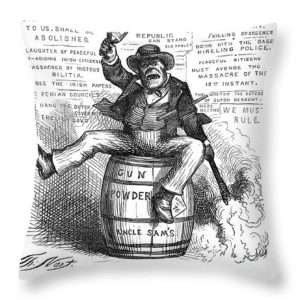
Anti-Irish Political Cartoon (1871). By Thomas Nast. (NA)


Hispanics are by far the largest American immigrant group of the last several decades, and also the focus of the most extensive nativist concerns. Immigration restrictionists contend that Hispanic immigrants increase crime, undermine American political institutions, and cannot or will not assimilate. In a recent post, prominent economic policy commentator Noah Smith compiles evidence that these complaints are largely misplaced, and that Hispanics are in fact following a trajectory similar to that of Irish-Americans in the late-nineteenth and early-twentieth centuries:

[T]he best historical analogy for Hispanic immigration to the U.S. is the great Irish immigration of the 1800s. The usual analogy we draw is to the Italians, but I think the Irish make a better model. First of all, Irish immigration, like immigration from Mexico and Central America — but unlike immigration from Italy — was very drawn-out over a long period of time….

Like Hispanics, Irish migrants were mostly working-class folks who came for mainly economic reasons — pressures from poverty back in Ireland, plus the great dream of making it in America. And like Hispanics, they provoked a sustained and ferocious pushback from nativists….

The cartoon at the top of this post is from 1871 [note: I have reproduced the same cartoon at the start of this post], and features a huge number of negative stereotypes — the Irish as terrorists, as drunkards, as criminals, as seeking to dominate American culture….

You can see these anxieties paralleled in modern conservative worries about Hispanic immigration. Conservatives worry that terrorists are coming up through the southern border, that traditional American culture will be destroyed by immigrant culture, or even that the U.S. will have a civil war along racial lines.

Economic concerns are also very similar…. Worries that poor Irish immigrants would swamp local welfare systems — similar to worries about Hispanics overloading the welfare state in the 1990s and beyond — resulted in a large number of restrictive anti-immigration measures at the state level…..

Today's fears of supposedly violent and unassimilable Hispanics are remarkably similar to the nineteenth century stereotype of brutish, un-American Irishmen.

In the rest of the article, Smith compiles evidence that the concerns about Hispanics are largely false: they are in fact rapidly assimilating, quickly increasing their wealth and income, and have significantly lower crime rates than native-born Americans (a point that applies even to undocumented immigrants). Most of this evidence is well-known to students of immigration policy. But Smith does a valuable service in compiling it in one relatively short and easily accessible piece.

I have previously written about how once-widespread hostility towards Irish-Americans gradually faded away to the point where the difference between the Irish and other white Americans no longer has much political or social significance. For example, most Americans barely even notice that Joe Biden is only the second Irish Catholic president, and hardly anyone worries that he's trying to advance Irish interests at the expense of WASPs, or that he's following the dictates of the Vatican. As Smith explains, the distinction between whites and Hispanics may well be gradually moving in the same direction.

I would, however, note a few relevant caveats to Smith's thesis. First, it is not entirely true that Irish and Hispanic immigrants "were mostly working-class folks who came for mainly economic reasons." In reality, many Hispanic immigrants were and are refugees from oppressive socialist regimes in Cuba, Nicaragua, and (most recently) Venezuela. Some others have fled repression at the hands of right-wing dictatorships. For their part, the many Irish migrants were fleeing not just poverty, but also repression at the hands of the British. This experience with repression in their countries of origin likely strengthens the migrants' attachment to American institutions, which, despite various flaws, offer them greater freedom and tolerance than those they fled.

A second caveat is that Hispanic migrants are a much more diverse lot than the Irish were. They come from a variety of different nations and ethnic groups. This makes generalizations about them more difficult. Cubans, Mexicans, Salvadorans, Brazilians, and others all have somewhat different backgrounds and experiences, though there are some commonalities, as well. Indeed, as my George Mason University colleague David Bernstein shows in a recent book, "Hispanic" is actually a largely artificial category created not by the migrants themselves, but by US government bureaucrats.

Finally, while Irish immigrants arrived in an era when there were few restrictions on European immigration, many Hispanic migrants are undocumented. Today, there are an estimated 7 million or more undocumented Hispanic immigrants in the US, which accounts for some one-third of all foreign-born Hispanics, and over 70% of the total undocumented immigrant population.

For obvious reasons, lack of legal status reduces migrants' incomes and educational opportunities, and impedes assimilation. The existence of this anchor makes Hispanics' progress look even more impressive than it would be otherwise. But, unless immigration policy changes, it is likely to continue to slow down the assimilation process highlighted by Smith.

The obvious solution to this problem is simply to grant legal status to the undocumented, or at least the vast majority of them. Previous amnesties have increased income and assimilation, and a new one would likely have similar effects (thereby also boosting the US economy in the process). But that may not be politically feasible for some time to come.

UPDATE: In my post, I list Brazilians as one of the "Hispanic" groups. But the federal government does not classify them as such, because the official definition of Hispanic is limited to people of "Spanish culture or origin." However, many Brazilians do describe themselves as "Hispanic" or "Latino" in surveys, and they are often colloquially described as "Hispanic" by others. Ultimately, little in my analysis turns on whether Brazilians are properly considered "Hispanic" or not. Even if we exclude them, the Hispanic category is still remarkably diverse, including people with origins in a variety of different countries.

Donald Trump and Section 3 of the 14th Amendment

Donald Trump is obviously not disqualified from seeking re-election under Section 3 of the 14th Amendment.

|

The Colorado Supreme Court and Maine's Secretary of State have both declared that former President Donald Trump is disqualified from being on Republican primary ballots in 2024 because of his role in the events that led to the January 6, 2021 riot at the Capitol Building when the electoral votes from the 2020 presidential election were being counted. This is a hard question, which I have thought carefully about for months now and here is my final conclusion.

An early draft of Section 3 of the Fourteenth Amendment provided in effect that: "No person shall be President or Vice President, Senator or Representative, or elector of President of President and Vice President or hold any office, civil or military, under the United States, or under any State, or as a Member of any State Legislature, or as any executive or judicial officer who, having previously taken an oath to support the Constitution of the United States shall have engaged in insurrection or rebellion against the same, or given aid or comfort to the enemies thereof.

The words "President or Vice President" were deliberately edited out of the final version of Section 3 of the Fourteenth Amendment. This, together with the disqualification of presidential electors and vice-presidential elector who have engaged in "insurrection or rebellion" makes it clear that the Framers' of Section 3 did not intend for it to apply to presidents or vice presidents who engaged in insurrection.

This impression is augmented by the fact that Section 3 methodically applies in order from the highest office to the lowest office. Section 3 first disqualifies insurrectionist Senators and then Representatives. It then disqualifies all appointed civil or military officers; it then disqualifies insurrectionists from serving as a member of any State legislature, and it finally disqualifies insurrectionists from serving as State executive or judicial officers. This careful hierarchy suggests that the phrase "or hold any office, civil or military, under the United States" does not apply to the President or Vice President, but applies only to appointed federal officers.

This fact is further confirmed by the Appointments Clause of Article II, Section 2, which says [The President shall nominate, and by and with the advice and consent of the Senate shall appoint Ambassadors, other public Ministers and Consuls, Judges of the Supreme Court, and all other Officers of the United States." The President does not appoint himself so obviously he is not an Officer of the United States under the Appointments Clause.

Moreover, the Commission clause of Article II, Section 3 says that "[T he President] shall" i.e. must, "Commission all the Officers of the United States." No President has EVER commissioned himself or his Vice President either before or after the adoption of the Fourteenth Amendment. The President is obviously not an Officer of the United States for the purposes of the Commission clause.

Finally, Article II, Section 4 provides that: "The President, Vice President and all civil Officers of the United States" shall be liable for impeachment. Note here that the text does NOT say: "The President, Vice President, and all other civil Officers of the United States. Once again, Article II does not treat the President and Vice President as being merely civil officers. It instead treats them as stand-alone officers like the King of England or the Prince of Wales.

Just as Section 3 of the Fourteenth Amendment contains a hierarchy of officers, so too does Article II in the Appointments Clause, the Commission Clause, and the Impeachment Clause making it crystal clear that the President and Vice President are not civil officers of the United States.

They are sui generis like the King of England and the Prince of Wales.

Finally, consider that the oath taken, which must be broken to engage the Disqualifications Clause is an oath "to support the Constitution." This oath appears in Article VI, Section 3 of the Constitution and applies to Senators, Representatives, and all executive and judicial officers both of the United States and of the several States. The President, in contrast, takes a special oath "to the best of my ability," to "preserve, protect and defend the Constitution of the United States." The difference in the words of the presidential oath of office from the other specified in Article VI, Section 3 is additional powerful evidence that the President and Vice President are not covered by Section 3 of the Fourteenth Amendment.

The only evidence that the President is a civil officer of the United States is two-fold and is in both cases underwhelming to say the least. During the Senate floor debate on Section 3 a Senator objected that insurrectionist Presidents are not covered by the Disqualification Clause. Another Senator then said the President was covered because he was a civil officer of the United States. This is an embarrassingly thin reed for the proponents of presidential disqualification to grasp onto, since the Congress itself voted to strike the words president and vice president from Section 3 of the Fourteenth Amendment. It has been decades since the Supreme Court, under the leadership of Justice Scalia and Chief Justice Roberts started ignoring such floor colloquies, which are often staged for the benefit of the courts, in favor of the plain meaning of the legislative text.

The second and even weaker argument is that the presidency is described in Article II as being "an office" and therefore the President must be an officer. Many people hold offices under the Constitution and statutes of the United States. FBI agents for example hold an office and are officials, but they are not officers of the United States. If they were, Congress could put them in the line of succession to the presidency. It could also impeach them and the Senate could by a two-thirds vote remove them. By now we are getting to the land of the absurd! Officers of the United States and individuals who happen to hold an office are two very different kettle of fish.

I believe that I have conclusively proved that the President and Vice President are not covered by the Disqualification Clause. I turn next to whether the events of January 6, 2021 were an insurrection. No-one would contend they were a rebellion, which requires the use of armed paramilitary force to overturn the election.

Noah Webster's First Edition 1828 Dictionary of American English defines "insurrection" as follows:

INSURREC'TION, noun [Latin insurgo; in and surgo, to rise.]

  1. A rising against civil or political authority; the open and active opposition of a number of persons to the execution of a law in a city or state. It is equivalent to sedition, except that sedition expresses a less extensive rising of citizens. It differs from rebellion, for the latter expresses a revolt, or an attempt to overthrow the government, to establish a different one or to place the country under another jurisdiction. It differs from mutiny, as it respects the civil or political government; whereas a mutiny is an open opposition to law in the army or navy. insurrection is however used with such latitude as to comprehend either sedition or rebellion.

It is found that this city of old time hath made insurrection against kings, and that rebellion and sedition have been made therein. Ezra 4:19.

Webster's defines a riot as follows:

RI'OT, noun

  1. In a general sense, tumult; uproar; hence technically, in law, a riotous assembling of twelve persons or more, and not dispersing upon proclamation.

The definition of riot must depend on the laws. In Connecticut, the assembling of three persons or more, to do an unlawful act by violence against the person or property of another, and not dispersing upon proclamation, is declared to be a riot. In Massachusetts and New Hampshire, the number necessary to constitute a riot is twelve.

The events of January 6, 2021 occurred for three-and-one-half hours in one city only in the United States, Washington D.C., and not as an overall insurgency in multiple cities across the United States. The crowd was not carrying firearms and it dispersed when then President Trump asked for it to disperse. While the interruption of the counting of electoral votes is inexcusable as is the death that day of five persons and the injury of dozens of others, the fact of the matter is that the events of January 6, 2021 were more akin to a riot than they were to a systematic planned-out "insurrection or rebellion." Section 3 of the Fourteenth Amendment use the words "insurrection" or "rebellion as synonyms. The canon of construction of noscitur a sociis, a word derives its meaning from the company it keeps applies here. The kinds of "insurrections" described in Section 3 are akin to "rebellions" as the paradigm case of the onset of the Civil War makes clear. The events that occurred on or about January 6, 2021 were very, very bad, but they were not an insurrection or rebellion.

Moreover, President Trump understandingly himself believed that mail-in voting had led to widespread fraud and abuse, which had caused him to lose the 2020 presidential election notwithstanding the fact that he received more votes than Barack Obama had received in 2008. While this does not excuse what happened on or about January 6, 2021, it does mean that President Biden or his successor should pardon Trump for any crimes he may have committed during his tenure in office as was done with President Richard M. Nixon. President Trump has a committed base of followers, which amounts to 40% of the U.S. population. He is beating President Biden with 51% of the vote in some opinion polls. One cannot and should not jail a 77-year old former President of the United States under these circumstance. Accordingly, President Trump should be pardoned in the same broad way as was President Richard M. Nixon. I say this as a Nikki Haley supporter and not as a follower of former President Trump.


Disunion, Slavery, and the Causes of the Civil War

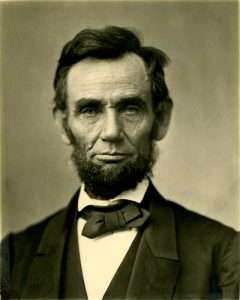
Abraham Lincoln pledged in his First Inaugural Address to keep the union together but to allow slavery in the States that had it already

|

Nikki Haley recently downplayed the role of slavery in the actual starting of the Civil War.  Technically, she is absolutely right.  President Abraham Lincoln in his First Inaugural Address said that he would fight to keep the Union together, and that he would ban slavery in the western territories, but he pledged to forever protect slavery in the southern States that had it, and Lincoln even endorsed the infamous Corwin Amendment that would have forbade by constitutional amendment federal actions that would outlaw slavery altogether.  It is Chris Christie and Ron DeSantis who have gotten the history wrong in this particular campaign food fight.

Consider what Lincoln said when he took the oath of office on March 4, 1861:

"Apprehension seems to exist among the people of the Southern States that by the accession of a Republican Administration their property and their peace and personal security are to be endangered. There has never been any reasonable cause for such apprehension. Indeed, the most ample evidence to the contrary has all the while existed and been open to their inspection. It is found in nearly all the published speeches of him who now addresses you. I do but quote from one of those speeches when I declare that--

I have no purpose, directly or indirectly, to interfere with the institution of slavery in the States where it exists. I believe I have no lawful right to do so, and I have no inclination to do so.

Those who nominated and elected me did so with full knowledge that I had made this and many similar declarations and had never recanted them; and more than this, they placed in the platform for my acceptance, and as a law to themselves and to me, the clear and emphatic resolution which I now read:

Resolved, That the maintenance inviolate of the rights of the States, and especially the right of each State to order and control its own domestic institutions according to its own judgment exclusively, is essential to that balance of power on which the perfection and endurance of our political fabric depend; and we denounce the lawless invasion by armed force of the soil of any State or Territory, no matter what pretext, as among the gravest of crimes.

I now reiterate these sentiments, and in doing so I only press upon the public attention the most conclusive evidence of which the case is susceptible that the property, peace, and security of no section are to be in any wise endangered by the now incoming Administration. I add, too, that all the protection which, consistently with the Constitution and the laws, can be given will be cheerfully given to all the States when lawfully demanded, for whatever cause--as cheerfully to one section as to another."

For Lincoln, his first priority even ahead of abolishing slavery was avoiding disunion.  As a man from Illinois, he was acutely aware of the fact that all the Midwest's farm produce floated by barge down the Ohio, Missouri, and Mississippi River to New Orleans. If Louisiana seceded, the economy of the Union would be at her disposal. It was essential to prevent this result.

In pledging to outlaw slavery in the Western territories, Lincoln was girdling the tree of slavery in the southern states where it existed in 1861.  Such a strategy would end slavery in 100 years but not sooner.

In September 1862, the United Kingdom considered recognizing the independence of the Confederacy, exchanging ambassadors, and resuming trade and commerce with the South.  But, Lincoln knew that anti-slavery opinion was very strong in the U.K., so he announced in September 1862 that all three million slaves in areas still in rebellion against the Union as of January 1, 1863 would be emancipated by presidential executive order thus turning the Civil War from being a war about keeping the Union together into a war to free the enslaved people.  And, all four million enslaved people were freed when Lincoln helped steer the Thirteenth Amendment abolishing slavery to passage in Congress and after Lincoln's assassination in April 1865.  The U.K. DID, as Lincoln predicted it would, stay out of the Civil War once it became a war to free the slaves, which is undoubtedly what Lincoln hoped would happen.

Slavery was the root cause of the Civil War, but Nikki Haley is right that from March 4, 1861 to January 1, 1863, the Civil War was about keeping the Union together. Only after Emancipation did the Civil War became a fight to end enslavement in the United States.  And, at that point the U.S. was on the North's side of the fight.

Free Speech

"Fake Sherlock," or Fake Allegations by New York Magazine?

|

An interesting false light lawsuit filed today, Walter v. Herbert (M.D. Pa.), over New York magazine's "The Case of the Fake Sherlock" article (see pp. 11-19 of this PDF for a paywall-free version). The article had been introduced by the magazine with,

Richard Walter was hailed as a genius criminal profiler at murder trials, at forensic conferences, and on true-crime TV. In reality, he was a fraud. How did he get away with it for so long?

Walter attaches to his Complaint an American Association for Forensic Science Ethics Committee report that is introduced with this cover letter (of course, the "complaint" in that letter refers to the complaint against Walter submitted to the AAFS, not the Complaint in Walter's newly filed case):

This will be an unusual report because, in the case of dismissals, we usually offer only a brief description. The very public nature of this complaint, based on publication in a nationwide magazine, requires a detailed explanation.

When this complaint was first received, it was accompanied only by an article from New York magazine, written by David Herbert. (Attachment 1) When the Ethics Committee (hereafter "the Committee") members read the article, we all thought that we would be recommending some sort of sanction. By the time we finished our investigation, we all thought that the complaint should be dismissed. The article accuses the Respondent of fraud and also makes the Academy appear ineffective for not sanctioning him as a result of two previous complaints.

Because of the very public nature of the complaint, the Respondent, Mr. Richard D. Walter, Retired Fellow, General Section, has agreed that the Ethics Committee can waive the usual requirement of confidentiality when reporting this dismissal.

Much of the misconduct alleged in the New York article occurred many years ago and was therefore outside of the Committee's jurisdiction. Mr. Walter, however, gave a deposition in 2022, wherein several of the old allegations were discussed in detail. We concluded that any material misstatements in that deposition could be considered as within our jurisdiction. After reviewing the transcript, the Committee sent the respondent a pointed letter (Attachment 2) inviting him to respond to several apparent discrepancies. It was Mr. Walter's answer, accompanied by documentation that he provided (Attachment 3), and additional information the Committee obtained independently which ultimately persuaded the Committee that this complaint should be dismissed.

The following are issues that demonstrate that the New York article is highly biased and contains factual errors….

Read More

Institute for Justice: Totally Worth Your Donations

As I've mentioned before, it's one of the public interest law firms that I admire most.

|

I just gave some money to the Institute for Justice, a first-rate libertarian public interest law firm (and also the provider of the weekly Short Circuit posts on this blog, which are written by IJ's John Ross). I've long much admired IJ: I've litigated some First Amendment cases, but it's not that hard to win them, given how strong First Amendment protections generally are—IJ, on the other hand, has figured out ways of winning even economic liberties cases, where the degree of difficulty is much higher.

Here's IJ's little pitch, which I'm delighted to pass along, with my full endorsement:

Friends, please give us money. We will use it to sue the government, whether it is arresting a grandmother for criticizing the government; flooding a fourth-generation family farm without paying; secretly declaring that a perfectly pleasant neighborhood is a slum (so it can be seized via eminent domain); robbing innocent people's safe-deposit boxes (and then losing what they took); trespassing on rural property without a warrant, stealing a trail camera, and using it to spy on the owner's family; barring a nonprofit from providing free legal advice; and many, many other things. Help IJ protect the constitutional rights of all Americans with a secure online donation today at ij.org/donate.

By the way, if you do donate (or have donated in the past), please leave a comment below saying you did, so your fellow readers can see. (No obligation, of course, but I think it might be nice.)

Podcasts

History Podcasts for the New Year

|

Want to start the new year by listening to a history podcast? Here are some suggestions.

Rather than providing links to Spotify or Apple, I'll just supply the information so that you can find the podcast anywhere you choose; not all of these podcasts are available on every player. My player of choice is Podcast Republic, which I found for free in the Google Play store.

Just as the Beatles weren't the first rock and roll band, but they did inspire the formation of many other bands, the modern founding father of history podcasts is Mike Duncan, with The History of Rome. The more than 180 episodes start with the founding of Rome and conclude with the fall of the Western Roman Empire.

Duncan then followed up Revolutions, examining in depth ten influential revolutions: the British Civil Wars of the mid-17th century in 16 episodes, the American Revolution in 15, the French Revolution in 54, the Haitian Revolution in 19, the Bolivarian revolutions of northern South America in 27, the mid-19th century European revolutions in 49 (divided into three separate units), Mexico in the late 19th and early 20th centuries in 27, and Russia's Bolshevik Revolution in 103. (Numbers are based on numbered episodes. Each of these podcasts has several supplemental episodes.)

While keeping up a prodigious output of weekly episodes, Duncan wrote two books. The first is The Storm Before the Storm: The Beginning of the End of the Roman Republic, covering 146-78 BC. As Duncan explains, the Roman Republic self-destructed because politicians and their supporters, of diverse ideological views, all started tearing down the unwritten traditions that had made republican self-government possible and had kept political battles within reasonable bounds. While Duncan doesn't make the point explicitly, the parallels to modern American politics are ominous. Duncan's other book is Hero of Two Worlds, a biography of the audacious Marquis de Lafayette.

David Crowther's The History of England is delightfully wry. Beginning with the primordial history after the collapse of Roman rule, the podcast is presently in the middle of the British Civil Wars in 1642. For any history podcast, I recommend starting at the beginning and working your way forward, just like when you discovered the existence of The Gilmore Girls in 2021.

History of the Germans, by Dirk Hoffmann-Becking, is well-named since "Germany" as a political unit long postdates the German people. Beginning in the late Dark Ages, the series has covered the rise of the Holy Roman Empire, the numerous Italian intrigues of HRE emperors trying to maintain their power there, and the rise and fall (ca. 1500) of the merchants' Hanseatic League, based in Germany's northern ports. Then, the podcast took a step back in time, to tell the story of Germany's eastern front—including the wars with the Slavs and the rise of Prussia. At the moment, in episode 131, we are in the mid-13th century.

The Russian Rulers History Podcast, by Mark Schauss, began with Rurik and continued all the way to Putin. That chronology being completed, Schauss now podcasts on special topics from all over Russian history and culture.

Eric Halsey's The Bulgarian History Podcast may seem obscure to American listeners. The podcast is an excellent starting point for learning Balkan history. Having begun with the long-age invasion of the Bulgar tribe from Central Asia, the series is now up to the Second Balkan War on the eve of World War I, in episode 198. Most listeners will be surprised to learn that there were two Bulgarian Empires, which controlled much of the Balkans, long before the emergence of the modern Bulgarian nation in the late 19th century.

Along the way, Bulgarian History necessarily looks in depth at the Byzantine and Ottoman Empires, particularly their policies and wars in the Balkans. You'll learn about Albania's greatest national hero, Skanderbeg (1405-68) who successfully led Albanian resistance to the Ottomans for 22 years, until he succumbed to malaria.

A podcast preceding the Mike Duncan era is 12 Byzantine Rulers, by Lars Brownsworth. The 17 episodes are a fine starting point for the basics of Byzantine history.

Brownsworth followed up with Norman Centuries. Educated American listeners will have at least a little familiarity with the Anglo-French Normans who conquered England in 1066. But as Brownsworth describes in 20 episodes, the Normans ranged far and wide, conquering Sicily and Southern Italy, and becoming a major power in the Mediterranean,

The History of Egypt, by Dominic Perry, begins in prehistory and takes the listener through the litany of pharaohs. With over 200 episodes, we're still not up to 1,000 BC. Perry also provides information about the lives of ordinary Egyptians, to the extent information is available. The podcast is steeped in archeology, and Perry provides many side episodes on interesting archeological sites, the history of Egyptian archeology, and interviews with modern scholars.

The Ancient World, by Scott C., aims to cover a vast array of material. The initial episodes were chronological, and bounced from one location to another. Since then, the podcast has focused on one particular topic, and followed it from start to finish. Currently, the podcast is nearing the end of Carchemish (C Episodes), about the Neo-Hittite kingdoms of Assyria (today, eastern Syria and western Iraq). Other series are Rediscovery (R Episodes), about archeologists and explorers who led the rediscovery of the ancient world; Bloodline (B Episodes), a ten-generation history of the  descendants of Mark Antony and Cleopatra; and Thea (T Episodes), about the Seleucid Empire, a successor state that ruled some of the territory conquered by Alexander the Great.

As the series titles indicate, the main focus of The Ancient World is the Near East, an area about which we have far more surviving written information from ancient times than we do about most other parts of the world.

A common feature of all the above excellent podcasts is that they are mainly apolitical and nondidactic. The podcasters let the events and individuals speak for themselves. This sets them apart from some other history podcasts whose underlying theme is convincing listeners to become leftists.

While the above podcasters sometimes express their own views, the expression is rarely intrusive or designed to make some point about modern politics.

More