The Volokh Conspiracy

Mostly law professors | Sometimes contrarian | Often libertarian | Always independent | Est. 2002

The Volokh Conspiracy

AI in Court

Will AI Make Law Productive?

|

This is my third and final installment summarizing the arguments in my draft article The Cost of Justice at the Dawn of AI. In the first, I reviewed Baumol's cost disease's implications for the legal sector. Baumol recognized that if the productivity of any sector improved less than the productivity of the economy as a whole, the goods or services from that sector would become more expensive. In the second, I assessed whether the legal sector has stagnated in this way. This turns out to be difficult or impossible to measure conclusively, because it's hard to assess whether legal work is improving in quality. But crude measures like consumer price indices suggest stagnation. Rapidly decreasing trial rates provide further evidence. It should not be surprising that fewer cases, civil and criminal, make it to trial if legal process is getting more expensive.

Will the trial continue vanishing? Or might we witness an increase in trial rates? The answers to these and other important questions depend on the future path of legal productivity. If legal productivity stagnates, then legal services will become more expensive. Fewer litigants will be willing to bear the cost of trial, and ever fewer cases will be tried. This matters not only because the trial may be seen as the canonical exhibition of our system of justice. It matters also because settlement in the shadow of trial may be only a crude approximation of the results of a hypothetical ideal legal system. Settlements have some advantages over trial, reducing randomness in selection of judges and juries and in their decisions. But the more expensive trial is, and the more asymmetric variables such as trial costs and risk aversion, the less effective the settlement market will be as a tool of justice. The legal system may react, for example by allowing more class actions. But the reluctance of courts to allow heterogeneous classes reflects that class actions too are a crude device.

If, however, AI improves legal productivity relative to the productivity of the overall economy, the legal system may better be able to achieve its aims. It will be better able to make distinctions, both at trial and in the shorter shadows of the law in which settlements would be negotiated. This is intuitively obvious in the most optimistic scenarios, in which robojudges effectively sift through evidence and reach judgments that are close to what groups of carefully deliberating, representative human actors would decide. But it's also true in less world-changing scenarios, in which large language models ease the work of lawyers, but humans are still essential to legal decision-making. As long as the productivity increases of the legal sector exceed those in other sectors—some of which may also benefit from such models, as well as from other technologies, such as robotics—then legal services will become cheaper, and access to justice, greater.

Can large language models and other AI tools materially increase legal productivity within the next decade or two? The article details both the negative and affirmative cases. The negative case highlights that basic problems, such as the tendency of large language models to hallucinate, remain outstanding research questions. Even if that can be overcome, ChatGPT's legal writing is cliché and dull, and its accuracy on complex legal questions is limited. The affirmative case suggests that these problems may be overcome by a combination of hardware and software improvements.

Perhaps the greatest uncertainty lies in the potential for synthetic data to supplement human-produced writing and improve model training. Otherwise, within a few years, we will run out of data on which the models may be trained. Eventually, investments in hardware and the continuation of Huang's Law will make it possible to generate a multiple of human-written texts. The question then becomes whether this material will be sufficiently high in quality to allow for improvements from one training generation to the next. I suspect that it will, at least if techniques like chain-of-thought prompting are used to improve on raw unimproved model output. As long as large language models can identify when writing is better than what it is able to produce, they should be able to improve. But it may be a long time before such gradual improvements enable production of legal writing at the highest level or perhaps even at the level of an average lawyer. The degree of progress in the near future thus remains uncertain, even if one accepts as inevitable that some form of artificial intelligence will eventually at least equal the most skilled humans in every intellectual domain.

If law has stagnated but might become productive, that leaves a range of possible scenarios for the short-term future. The last part of my article explores how the law might adapt. Continued stagnation suggests such remedies as lowering the requirements for class actions, encouraging greater use of arbitration, and embracing access-to-justice measures such as facilitated self-representation. A productive turn, on the other hand, might suggest moving in the opposite direction, leaning on legal procedures that ensure individualized justice. One way that the law might adjust to both possible futures is to rely on and develop provisions that explicitly or implicitly take the level of legal costs into account in determining how much legal procedure should be granted.


If Trump Prevails, How Will Section 3 Be Litigated On Or After January 20, 2025?

Even under the Trump v. Anderson per curiam opinion, Section 3 can be raised as a defense without the need for federal implementing legislation. But the Supreme Court may still avoid ruling on the merits.

|

[This post is co-authored with Professor Seth Barrett Tillman.]

In the past, Blackman has compared Chief Justice Roberts's opinions to "blue plate specials." These compromise decisions are cobbled together with a mix of precedent, pragmatism, and prescience. A classic Roberts opinion will sound in the Court's doctrine, appear eminently reasonable, but anticipate—and sometimes address—future controversies. Roberts has truly made this mode of opinion-writing an art form.

It appears to us that Roberts assigned himself the Court's per curiam opinion in Trump v. Anderson—albeit, no one can be sure until the archives are opened. The Court did not merely decide the narrow case before it: whether Colorado law could be used to remove Trump from the presidential ballot, absent federal enforcement legislation. As the two concurrences pointed out, the Court could have simply stopped there. Instead, the Roberts Court plowed forward. The per curiam relied on, and indeed expanded the scope of Chief Justice Chase's holding in Griffin's Case. Trump v. Anderson held that Section 3 could only be enforced against a candidate for federal office through "congruent and proportional" legislation under Section 5. To be sure, there is language to support that holding in U.S. Term Limits v. Thornton, but there was an extension of doctrine here that was barely acknowledged.

Why did the Court break apart what could have been a solid 9-0 decision? After all, Chief Justice Warren achieved unanimity in Brown v. Board of Education by cobbling together nine members on a fairly narrow, but momentous decision. Perhaps the majority thought it essential to explain how Congress can exercise its power in order to demonstrate why Colorado could not do the same. After all, in NFIB v. Sebelius, Chief Justice Roberts explained why the Commerce Clause power did not support the individual mandate as a predicate to explain why the law could be saved under the taxing power. There is some precedent here. But there is another, more pragmatic explanation for Part II-B of the Trump v. Anderson per curiam decision. The Court was attempting to avert the potential chaos that may arise between now and inauguration day.

We realize law professors are arguing now about whether Congress, on January 6, can disqualify Trump pursuant to the Electoral Count Act. Five justices seem to have rejected that option. The per curiam opinion states:

Any congressional legislation enforcing Section 3 must, like the Enforcement Act of 1870 and §2383, reflect "congruence and proportionality" between preventing or remedying that conduct "and the means adopted to that end." City of Boerne, 521 U. S., at 520. Neither we nor the respondents are aware of any other legislation by Congress to enforce Section 3. See Tr. of Oral Arg. 123. [emphasis added]

Certainly the Court is "aware" of the Electoral Count Reform Act (ECRA). Still, the Court suggests that no such implementing legislation exists. The ECRA does not even mention insurrection or Section 3. The Boerne test states that "There must be a congruence and proportionality between the injury to be prevented or remedied and the means adopted to that end." At a minimum, a law that does not even acknowledge the injury to be remedied cannot purport to provide a "congruent and proportional" response to that problem. The Section 5 test has never been clearly explained, but in our view, Boerne requires more than an implied recognition that Congress is providing a remedy to some problem. Another bill, sponsored by Rep. Zoe Lofgren (D-Calif.), expressly permitted objections based on section 3 of the Fourteenth Amendment. Perhaps that sort of clear statement could at least make a case under the Boerne test. But that House bill did not pass the Senate.

After Trump v. Anderson was decided, Rep. Loefgren stated that "it does not at first read appear that the Court indicated a viable path to implement Section 3 of the 14th Amendment absent enactment of a law outlining procedures to do so." Likewise, Rep. Jamie Raskin (D-Md.) observed that "my initial reading of it suggests that they are saying that Congress must act … to pass a statute." 

Of course it is possible that Congress can choose to openly disagree with Trump v. Anderson. Or Congress could assert some other basis by which to block the certification of Trump's electors, such as the Twelfth Amendment. But we think it exceedingly unlikely that Democratic congressional majorities will disqualify Trump on January 6, when the electoral votes are tabulated by Congress. If Trump is certified the winner on January 6, even over some objections from members of Congress, Chief Justice Roberts will issue the oath on January 20, 2025 at noon.

Once Trump holds the position of President, litigation will begin almost immediately. For example, Trump may begin his term by removing individuals holding federal positions. At least one of those individuals may assert that Trump is not lawfully the President because he was and remains ineligible under Section 3, so any removal of subordinate Executive Branch officers by Trump is invalid. This case would arise in a similar posture as Humphrey's Executor—with the plaintiff either seeking backpay, or perhaps reinstatement. Or, the official could claim to actually still be in office, repeating a Trump-era controversy over who was the real director of the CFPB. 

Similarly, Trump will sign various executive orders that may regulate private property interests. Those adversely affected will claim that Trump has no lawful authority to issue any such order. This posture would resemble Dames & Moore v. Regan. Perhaps Trump might issue a blanket pardon of everyone involved with the events of January 6, 2021. (Such a blanket pardon could include Trump himself by implication, if not expressly.) There will be litigation about whether such pardons (or more limited amnesties) are valid or whether various forms of supervised release remain in effect. Perhaps a federal district court judge somewhere may refuse to acknowledge the validity of the pardons. Criminal defendants will argue that Trump-appointed prosecutors are not validly appointed. New Trump-appointed judges will be characterized as "so-called" judges. And so on. In short order, the federal courts will have to decide the very questions that Trump v. Anderson avoided.

Were Trump re-elected, and contrary to Professor Lederman's hopes and aspirations, the question of whether the President is an "Officer of the United States" will not be "re-consigned to the obscure corners of implausible scholarship." It is even possible that the Trump Justice Department will vigorously argue that the President is not covered by Section 3. The future Solicitor General and Office of Legal Counsel should take note of the questioning from Justice Gorsuch and Justice Jackson during the Trump v. Anderson oral argument. These two jurists seemed quite comfortable with the position that the President is not an officer of or under the United States. 

It is also possible, perhaps likely, that a similar position will be adopted by the DOJ in future Foreign Emoluments Clauses litigation. And, yes, we expect Trump will promptly be sued in the Southern District of New York due to his continuing (indirect) ownership interest in Trump Tower. (The Trump organization has sold the Trump hotel in Washington, D.C., so the case in the District of Maryland will not be resuscitated.) Sorry—we are not done with what Justice Kagan called "Officer stuff." And for those keeping score at home, the result of the Supreme Court's reversing the Colorado Supreme Court's decision was that the Colorado state trial court's decision was left in place. The Colorado state trial court held that the President is not an "Officer of the United States."

Second, and here we agree with Lederman, the Trump v. Anderson per curiam opinion does not foreclose Trump's eligibility from being raised in a defensive posture. But this point is less-than-clear.

The Sotomayor-Kagan-Jackson concurrence stated that "All the Reconstruction Amendments (including the due process and equal protection guarantees and prohibition of slavery) 'are self-executing,' meaning that they do not depend on legislation." Here, the concurrence cited Boerne (1997) and the Civil Rights Cases (1883). The concurrence also warned that the per curiam opinion "forecloses judicial enforcement of that provision, such as might occur when a party is prosecuted by an insurrectionist and raises a defense on that score."

We will reconcile these two threads: that is, the scope of self-execution when affirmative relief is sought and when negative relief is sought. The Fourteenth Amendment is "self-executing" when raised in a defensive posture. No enforcement legislation is needed to argue that a federal constitutional provision precludes a criminal prosecution or lawsuit brought by the government against an individual defendant. Section 5 applies equally to Sections 1 and 3. Sections 1 and 3 can be raised as a defense without implementing legislation, but neither section can be used to seek affirmative relief without implementing legislation. There is no tension between Section 3 and Section 5. Indeed, Jefferson Davis raised the Fourteenth Amendment in just such a defensive context. Davis argued that a Section 3-based disqualification was the sole remedy the government can seek against an alleged insurrectionist, and that Section 3 displaced any criminal prosecution. This issue was never adjudicated.

Likewise, we think Caesar Griffin could have raised a Section 3-based defense at his trial, as opposed to making Section 3 the basis for a collateral attack where he sought affirmative relief. Justice Barrett raised this precise issue during oral argument. She pointed out that Griffin's Case was a "collateral proceeding." Griffin sought relief in federal court to challenge a state court conviction. Barrett asked, "even if Section 3 is not a basis for collateral relief in [federal] habeas, which was new at the time, could Griffin have raised [Section 3 as a defense] at his [state court] trial [or] in direct appeal"?  (Jonathan Mitchell answered, incorrectly, "No.")

In contrast to the three-justice concurrence, we do not read the majority opinion to prohibit a defendant from raising Section 3 as part of his defense. We agree with Lederman that "the majority opinion doesn't expressly reference such hypothetical 'defense to enforcement' cases." To the contrary, we read the majority opinion as consistent with the view advanced in our amicus brief: "Section 3 could only be put into effect on behalf of a private party seeking affirmative relief against the government, e.g., a party seeking habeas relief, if that relief was authorized by a federal statute." In Trump v. Anderson, the Court said such affirmative relief must come from Congress: "The Constitution empowers Congress to prescribe how those determinations should be made." (Such a "determination" would order a government official to remove a candidate from the ballot for a federal position.) This holding, we think, is consistent with the sword-shield dichotomy in federal courts jurisprudence. In any event, on its facts, Trump v. Anderson only controls cases where the plaintiff has sought affirmative relief, as opposed to the sort of negative relief customarily sought by a defendant prosecuted or sued by the government. Instead, where Section 3 is raised as a defense, a court would have to confront the primary merits questions: Is the President an "Officer of the United States" and/or Did Trump "engage" in insurrection? But perhaps not? Perhaps, the merits questions could, again, be avoided?

Third, we offer a prediction on what a future ruling may look like that, once again, avoids the merits questions. Several courts dismissed challenges to Trump's eligibility on political question grounds. That line of reasoning may have been helpful to Trump in the short term, but it would pose a risk to Trump on January 6, 2025. Why? If the joint session of Congress disqualifies Trump on January 6, 2025, he would almost certainly seek to file some sort of action in the United States District Court for the District of Columbia, with eventual appeal to the United States Supreme Court. But if the issue was in fact a political question, then the Court would likely defer to whatever it is that Congress did. 

Now, assuming that the Supreme Court precluded any possible congressional objections against Trump's holding the presidency under the ECRA, then Section 3 litigation would only resume after Trump's election is certified and after Trump is inaugurated. At that point, the political question doctrine would insulate Trump's election and his holding the presidency from judicial review. The Supreme Court could simply say "We defer to Congress's certification of Trump's election." The Court could bolster that ruling by pointing to the fact that objections were raised based on Section 3, but those objections did not prevail.

Alternatively, or, perhaps, in addition, Chief Justice Roberts could reach deep into the cookbook and pull out another recipe from Griffin's Case: the de facto officer doctrine. Under this doctrine, the Court could retroactively and prospectively insulate Trump's actions while holding the presidency from legal challenges, without actually opining on whether Trump is the lawful president. Even if it is not clear whether Trump is lawfully President, the courts will, as a practical matter, presume he is the president in all regards unless he is removed by impeachment or by the Twenty-Fifth Amendment. Through either the political question doctrine, or the de facto officer doctrine, the courts would not block Trump's actions based on Section 3, unless he is removed by the political process. Or the Court could simply hold, consistent with mounds of authority, that the President is not an "Officer of the United States," and move on. Should the Supreme Court choose any of these paths, it should do so as quickly and decisively after the inauguration as possible.

The only way to keep Trump out of the White House is for Trump to lose the general election. Lawfare, which was highly successful at hobbling Trump during his first term, will not prevent him from serving a second term.


Free Speech

ACLU on NRA v. Vullo

|

An interesting summary of the historical background to this pending Supreme Court case (in which I'm Counsel of Record, and which the ACLU's Legal Director, David Cole, will be arguing on March 18), by the ACLU's Jennesa Calvo-Friedman:

More than 60 years ago the Supreme Court ruled that the First Amendment bars the government from coercing private entities to punish speech that the government disfavors. Just as the government can't directly punish or censor speech it disagrees with, it cannot do so indirectly by coercing private parties to do the same.

History underscores the importance of this free speech protection. Government officials have all too often enlisted private parties—from the White Citizens' Councils of the Jim Crow South to the blacklists of Communists in the McCarthy era—to punish those with whom they disagree. New York's efforts to punish the National Rifle Association, at issue before the Supreme Court in National Rifle Association v. Vullo, follow in the footsteps of those earlier censorship efforts.

The ACLU disagrees sharply with the NRA on many issues, yet we are representing the group in this case because of the First Amendment principles at stake. We argue that Maria Vullo, a New York state regulator, threatened to use her regulatory power over banks and insurance companies to coerce them into denying basic financial services to the NRA and, in Vullo's own words, "other gun promotion" groups. Vullo's threats were expressly based on her disagreement with the NRA's advocacy. And they worked. Several insurance companies and banks refused to work with the NRA out of fear of reprisals from New York regulators. The ACLU urges the Supreme Court to hold that coercing third parties to break ties with the NRA because of its advocacy violates the First Amendment….

Read More

Supreme Court

Were There Last Minute Changes to Trump v. Anderson?

There are reasons to suspect the justices were wrangling over language up until the last minute.

|

All nine justices were able to agree on a bottom-line result in Trump v. Anderson: States cannot disqualify candidates for federal offices from the ballot under Section 3. But they were not in agreement on what the decision should say. I suspect that they were wrangling over the language of the per curiam and other opinions until the last minute as they rushed to issue an opinion in advance of Super Tuesday primary voting (or the Monday release the Court had already announced).

As Mark Joseph Stern noted yesterday on Xitter, the three-justice opinion concurring in the judgment appears to have been originally drafted as an opinion by Justice Sotomayor "concurring in part and dissenting in part." So either Justice Sotomayor was confused about how to style an opinion that reaches the same bottom line judgment of the majority (unlikely), or something changed in one or both opinions. [Sidenote: Who thinks to check metadata by double-clicking random parts of an opinion or searching for ghost text?]

There are other indications things may have been revised quite late. For instance, the three-justice opinion accuses the majority of holding that "a disqualification for insurrection can occur only when Congress enacts a particular kind of legislation pursuant to Section 5 of the Fourteenth Amendment." The majority certainly holds that Section 5 of the Fourteenth Amendment vests in Congress the power to enforce Section 3, but nowhere does it require a "particular kind of legislation." Might this be responding to language in a per curiam draft that was later watered down? It's quite possible the per curiam was changed leaving no time for additional revisions to other opinions.

There's also a line in Justice Barrett's separate opinion that seems to be jousting with something that is not there. After explaining why she did not join parts of the per curiam, Barrett writes:

The majority's choice of a different path leaves the remaining Justices with a choice of how to respond. In my judgment, this is not the time to amplify disagreement with stridency. The Court has settled a politically charged issue in the volatile season of a Presidential election. Particularly in this circumstance, writings on the Court should turn the national temperature down, not up.

"Stridency"? Really? Justice Barrett does not strike me as that sensitive. Perhaps the thre-justice opinion's citations to the Chief's separate Dobbs opinion and Breyer's Bush v. Gore dissent were a tad salty, but "strident"? This makes me wonder further whether there was language in the three-justice opinion that was watered down or removed, and the rush to issue the opinion prevented further revisions in response. (Or perhaps Justice Barrett initially drafted this language in response to a Justice Sotomayor partial dissent.

There are other places where the opinions do not quite mesh the way one would expect were there time for lots of back-and-forth, but these are a two I thought worth highlighting.

I had also initially wondered about the lack of a syllabus, but it turns out this is standard for per curiam slip opinions. They are initially issued without syllabi, which are later added for publication in the U.S. Reports.

Well, that's enough procrastination-through-speculation for one day.

Free Speech

Principal's Libel Lawsuit Over Claims He Was Fired for Sexual Harassment Can Go Forward

|

From last week's California Court of Appeal decision in Cusi v. Gibson, written by Alameda Superior Court Judge Michael Markman, joined by Justices Therese Stewart and Marla Miller:

Alison Gibson's appeal from the denial of her anti-SLAPP motion concerns the consequences of her demonstrably false online speech. Ramon Cusi sued Gibson after she had posted in a large Facebook community group that Cusi had been "fired for sexual harassment" from his position as principal of her daughter's middle school, as well as from a prior position at another school. Neither school, however, had terminated Cusi "due to allegations or a legal finding of sexual harassment." Cusi's attorney tried to get Gibson to take the post down, but Gibson instead posted an edited version of her comments and Gibson's husband left the attorney a voicemail refusing to take further action…..

The court concluded that Cusi introduced enough evidence of knowing or reckless falsity for the case to go forward, though the "demonstrably false online speech" reference in the first sentence above suggests that the court thought the case on falsity was open and shut. Here's the discussion of knowledge or recklessness:

Before Gibson made her second post, the PIO [Public Information Officer] for the VUSD [Vacaville Unified School District] had already posted a comment on Gibson's original post that Cusi had resigned, and unequivocally explaining that "Absolutely no report or claim about harassment or misconduct involving Dr. Cusi and any VUSD employee or students has ever been made." Gibson not only saw the explanation, but commented on it. Cusi's attorney had also messaged Gibson, notifying her that her statements were not true or accurate. Gibson's husband called Cusi's attorney in response, profanely rejecting counsel's request to stop saying that Cusi had been terminated by VUSD. This is ample evidence to show minimal merit on the element of actual malice in Gibson's second post. Given the information provided by Cusi's attorney and the PIO, it is probable Cusi can provide evidence that Gibson should objectively have had "serious doubts" regarding the truth of her statements.

Read More

Free Speech

Eleventh Circuit Strikes Down Stop W.O.K.E. Act's Restrictions on Private Employers

|

From Honeyfund.com inc v. Governor, decided today by the Eleventh Circuit, in an opinion by Judge Britt Grant, joined by Judges Charles Wilson and Andrew Brasher:

The State of Florida seeks to bar employers from holding mandatory meetings for their employees if those meetings endorse viewpoints the state finds offensive. But meetings on those same topics are allowed if speakers endorse viewpoints the state agrees with, or at least does not object to. This law, as Florida concedes, draws its distinctions based on viewpoint—the most pernicious of dividing lines under the First Amendment. But the state insists that ordinary First Amendment review does not apply because the law restricts conduct, not speech.

We cannot agree, and we reject this latest attempt to control speech by recharacterizing it as conduct….

Florida's law, the Individual Freedom Act [part of the Stop W.O.K.E Act], bans certain mandatory workplace trainings. The Act says employers cannot subject "any individual, as a condition of employment," to "training, instruction, or any other required activity that espouses, promotes, advances, inculcates, or compels" a certain set of beliefs. It goes on to list the rejected ideas, all of which relate to race, color, sex, or national origin:

Read More

Donald Trump

Supreme Court Rules for Trump in Section 3 Disqualification Case

|

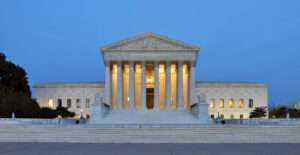
The Supreme Court. (Joe Ravi/Wikimedia/CC-BY-SA 3.0)

Today's unanimous per curiam Supreme Court decision in Trump v. Anderson overturns the Colorado Supreme Court ruling disqualifying Donald Trump from the presidency under Section 3 of the Fourteenth Amendment. It does so on the ground that Section 3 is not "self-executing." Thus, only Congress, through special legislation, has the power to enact legislation specifying which people are to be disqualified and under what procedures. This outcome was predictable based on the oral argument. But it is nonetheless badly wrong.

Section 3 states that "No person" can hold any state or federal office if they had previously been "a member of Congress, or… an officer of the United States" or a state official, and then "engaged in insurrection or rebellion against the same, or given aid or comfort to the enemies thereof."

Under the Court's reasoning only Congress, through special legislation, has the power to enact legislation specifying which people are to be disqualified and under what procedures - at least when it comes to candidates for federal office, and officials holding those offices. The majority claims that Congress' Section 5 power to enact "appropriate" legislation enforcing the Fourteenth Amendment is the exclusive mode of enforcing Section 3.

There are multiple flaws in the Court's reasoning. Start with the fact that there is no good reason to believe that Section 5 is the exclusive mode of enforcing Section 3. As the Colorado Supreme Court pointed out in its ruling, Section 5 allows Congress to enforce not just Section 3, but every other part of the Fourteenth Amendment, including its protections against racial and ethnic discrimination, the Due Process Clause, and more. All these other provisions are considered to be self-executing, under longstanding Supreme Court precedent. Thus, state governments and federal courts can enforce these provisions even in the absence of federal Section 5 enforcement legislation. Otherwise, as the Colorado Supreme Court notes,  "Congress could nullify them by simply not passing enacting legislation." Why should Section 3 be any different? Today's Supreme Court decision doesn't give us any good answer to that question.

The Supreme Court ruling also notes, following longstanding precedent, that Congress' Section 5 power is "remedial" in nature: it must be "congruent and proportional" to violations of the Amendment it is intended to remedy. If Section 5 legislation is supposed to be remedial - including when it comes to enforcing Section 3 - that implies someone else - state governments and federal courts - has the initial responsibility for ensuring compliance with Section 3. The role of Section 5 is to remedy violations of that duty.

The per curiam opinion emphasizes the need for uniformity in determining eligibility for federal office, and argues that states lack the power to make such determinations:

Because federal officers "'owe their existence and functions to the united voice of the whole, not of a portion, of the people,' " powers over their election and qualifications must be specifically "delegated to, rather than reserved by, the States." U. S. Term Limits, Inc. v. Thornton, 514 U. S. 779, 803–804 (1995)…. But nothing in the Constitution delegates to the States any power to enforce Section 3 against federal officeholders and candidates.

This argument ignores the longstanding role of states in enforcing and adjudicating other constitutional qualifications for candidates for federal office, such as the requirements that the president must be 35 years old, and a "natural born" citizen of the United States. In 2016, there was litigation in multiple states over claims brought by Trump supporters to the effect that Texas Sen. Ted Cruz, his chief rival for the GOP presidential nomination, was not a "natural born" citizen. State courts in Pennsylvania and New Jersey ruled that Cruz was eligible. But no one doubted that they had the authority to adjudicate the issue.

In a 2012 decision written when he was a lower court judge on the US Court of Appeals for the Tenth Circuit, Supreme Court Justice Neil Gorsuch upheld Colorado state officials' decision to bar from the ballot a would-be presidential candidate who was clearly not a natural born citizen. Then-Judge Gorsuch wrote that "a state's legitimate interest in protecting the integrity and practical functioning of the political process permits it to exclude from the ballot candidates who are constitutionally prohibited from assuming office." This reasoning applies to Section 3 just as readily as to the Natural Born Citizen Clause.

The main motive for the Court's decision may be the fear that letting states adjudicate Section 3 disqualifications will,  lead to a "patchwork" of conflicting procedures and determinations. On top of that, there is fear that partisan state officials will seek to disqualify opposing-party candidates for specious reasons.

These are legitimate concerns. But, for reasons outlined in my commentary on the oral argument, they are overblown:

If state officials or state courts reach unsound or contradictory legal conclusions about the meaning of Section 3 (e.g.—by adopting overbroad definitions of what qualifies as an "insurrection"), their determinations could be reviewed in federal court, and the Supreme Court could impose a uniform definition of the terms in question. Indeed, it could do so in this very case! Non-uniform interpretations of provisions of the federal Constitution by state and lower federal courts can occur in many contexts. Settling such issues is one of the reasons why we have a Supreme Court that can be the final arbiter of federal constitutional questions.

Conflicting legal and factual determinations about candidate eligibility for office can also arise with respect to other constitutional qualifications for the presidency. For example, there might be disputes over the accuracy or validity of a candidate's birth certificate (recall "birtherist" claims that Barack Obama wasn't really bon in the United States, and that his birth certificate was fake).

The possibility of divergent conclusions on such issues is an unavoidable aspect of a system in which control over elections for federal offices is largely left to individual states, rather than reserved to a federal government agency. Perhaps the Framers of the Constitution made a mistake in setting up that system. Maybe it would be better if we had a national agency administering all elections for federal office, like Elections Canada, which fulfills that function in our neighbor to the north.

But the framers chose otherwise. As the per curiam opinion recognizes,"the Elections and Electors Clauses… authorize States to conduct and regulate congressional and Presidential elections, respectively. See Art. I, §4, cl. 1; Art. II, §1, cl. 2." That gives state governments initial authority (subject to federal judicial review) to enforce other constitutionally required qualifications for federal office. Section 3 is no different.

Concerns about a potential "patchwork" of conflicting state rulings are ultimately policy objections to the Constitution's decentralized state-by-state scheme of election administration. As the conservative justices (rightly) love to remind us in other contexts, courts are not permitted to second-guess policy determinations that are under the authority of other branches of government or - as in this case - the framers and ratifiers of the Constitution.

While today's Supreme Court opinion is unanimous, it's notable that both Justice Amy Coney Barrett (writing for herself alone) and the three liberal justices (in a joint opinion) wrote concurrences that seem to reject or at least call into question much of the majority's reasoning. I will likely have more to say about these opinions later.

By focusing exclusively on the self-execution issue, the Court left for another day all the other arguments at stake in the Trump case, such as whether the January 6, 2021 attack on the Capitol qualifies as an "insurrection," whether Trump "engaged" in it (the claim that he didn't strikes me as the best argument for his side of the case), whether Trump received adequate due process, and whether the president is an "officer of the United States" covered by Section 3. The justices likely hope they can avoid ever having to decide these questions!

The one good aspect of today's ruling is that it eliminates nearly all remaining uncertainty about whether Trump can assume the presidency if he wins the 2024 election. By holding that Section 5 enforcement legislation is the sole mechanism by which federal office-holders can be disqualified, the decision forestalls such potential scenarios as a Democratic Congress refusing to certify Trump's election. In theory, Congress could enact new enforcement legislation between now and January 20, 2025 (when Trump would take office, should he win). But that is incredibly unlikely.

The price of certainty is that Section 3 is largely neutered with respect to federal office-holders. Unless and until Congress enacts new Section 5  enforcement legislation, former officeholders who engaged in insurrection will be mostly free to return to power, and try their hand at subverting democracy again.

Perhaps political norms will keep that from happening. But if norms were that effective, Trump probably would never have been elected to office in the first place, and he certainly would not once more be a leading candidate for the presidency today.

Finally, I should acknowledge an error I made in gauging what the Supreme Court was likely to do in this case. At an academic conference on Section 3 held at the University of Minnesota in October 2023, I said that if this issue came to the Supreme Court, there would be a 50-50 chance of a ruling against Trump. It's now obvious I seriously overestimated the likelihood of such a result, an error likely caused by underestimation the justices' concerns about the potential dangers of a "patchwork" of divergent state rulings on disqualification. When commentators err, they should acknowledge their mistakes, not try to bury them and hope everyone forgets. This is my acknowledgement.

NOTE: I will have more to say about the ruling in an article likely to be published within the next few days.

UPDATE: I should perhaps note I filed an amicus brief in the case, which addressed an issue largely left unaddressed by today's decision: whether a criminal conviction for insurrection is a required prerequisite for Section 3 disqualification.

The Modern Supreme Court Agrees With Chief Justice Chase: Trump Cannot Be Removed From The Presidential Ballot

From the outset of the litigation, Blackman & Tillman's argument was that Griffin's Case bars the relief sought by the Colorado voters.

|

Today the Supreme Court decided Trump v. Anderson. The majority, in a per curiam opinion, makes four primary moves.

First, the Court agrees with Chief Justice Chase's opinion in Griffin's Case (1869) that Congress must establish the procedures to enforce Section 3:

It is therefore necessary, as Chief Justice Chase concluded and the Colorado Supreme Court itself recognized, to "'ascertain[] what particular individuals are embraced'" by the provision. App. to Pet. for Cert. 53a (quoting Griffin's Case, 11 F. Cas. 7, 26 (No. 5,815) (CC Va. 1869) (Chase, Circuit Justice)). Chase went on to explain that "[t]o accomplish this ascertainment and ensure effective results, proceedings, evidence, decisions, and enforcements of decisions, more or less formal, are indispensable." Id., at 26.

Second, the States have the reserved power to disqualify state officials, but States have no power to disqualify federal positions:

We conclude that States may disqualify persons holding or attempting to hold state office. But States have no power under the Constitution to enforce Section 3 with respect to federal offices, especially the Presidency. . . .  Although the Fourteenth Amendment restricts state power, nothing in it plainly withdraws from the States this traditional authority. And after ratification of the Fourteenth Amendment, States used this authority to disqualify state officers in accordance with state statutes. See, e.g., Worthy v. Barrett, 63 N. C. 199, 200, 204 (1869) (elected county sheriff); State ex rel. Sandlin v. Watkins, 21 La. Ann. 631, 631–633 (1869 )(state judge). Such power over governance, however, does not extend to federal officeholders and candidates.

Third, legislation to enforce Section 3 must satisfy the "congruence and proportionality" test from City of Boerne v. Flores. We think the Court is suggesting that the Electoral Count Reform Act does not meet this test. And the Court suggested that Section 2383 would be valid enforcement legislation.

Any congressional legislation enforcing Section 3 must, like the Enforcement Act of 1870 and §2383, reflect "congruence and proportionality" between preventing or remedying that conduct "and the means adopted to that end." City of Boerne, 521 U. S., at 520. Neither we nor the respondents are aware of any other legislation by Congress to enforce Section 3. See Tr. of Oral Arg. 123.

Fourth, under Anderson v. Celebrezze, there are distinct interests in having a uniform system for electing the President. 

Finally, state enforcement of Section 3 with respect to the Presidency would raise heightened concerns. "[I]n the context of a Presidential election, state-imposed restrictions implicate a uniquely important national interest." Anderson v. Celebrezze, 460 U. S. 780, 794–795 (1983) (footnote omitted). But state-by-state resolution of the question whether Section 3 bars a particular candidate for President from serving would be quite unlikely to yield a uniform answer consistent with the basic principle that "the President . . . represent[s] all the voters in the Nation." Id., at 795 (emphasis added). Conflicting state outcomes concerning the same candidate could result not just from differing views of the merits, but from variations in state law governing the proceedings that are necessary to make Section 3 disqualification determinations.

There is much more to say about this case. Here we offer several preliminary observations.

First, the Court agrees with Chief Justice Chase's decision in Griffin's Case. Indeed, the Court arguably amplifies Chase's reasoning. From the very beginning, we have led off with Chase's opinion. We wrote about it in the New York Times regarding Madison Cawthorn. It was the lead argument in our article, Sweeping and Forcing. And it was Roman Numeral I in every amicus brief we filed. All the efforts by legal professors, academics in other fields, and others to attack Chase and his credibility have failed. The most that the Sotomayor-Kagan-Jackson opinion can summon to criticize Chase was to point out that Trump's counsel, Jonathan Mitchell, "distanced himself from fully embracing" Griffin's Case. (Blackman addressed Mitchell's discussion of Chase and Griffin's Case here.) Chase and his legal craftsmanship has been again vindicated, as it has been on many occasions in the past. 

Second, the Court agreed with our position that state positions stand in a different position than federal positions. In Sweeping and Forcing, we argued that Worthy v. Barrett and Sandlin v. Watkins can be explained as enforcing Section 3 against state officials. Law professors roundly rejected this distinction. Indeed, Trump's own counsel resisted this argument. Justice Barrett asked Mitchell, "Why don't you have an argument that the Constitution of its own force, that Section 3 of its own force, preempts the state's ability not necessarily, I think, not, to enforce Section 3 against its own officers but against federal officers, like in a Tarble's Case kind of way." Mitchell responded, "there could also be an argument that's more limited. You're suggesting there may be a barrier under the Constitution to a state legislating an enforcement mechanism for Section 3 specific to federal officers." Justice Barrett responded incredulously: "Well, why aren't you making those arguments?" (Blackman discussed that colloquy here.) In fact, it was this argument carried the day. 

Third, none of the Justices addressed the "office" and "officer"-related arguments. Perhaps in several decades, when the papers are released, we will gain some insights into how this opinion came together in its final form. Discussions of the Constitution's and Section 3's "office"- and "officer"-language led to probing questioning by Justices Jackson and Gorsuch during oral argument. 

Fourth, the various opinions did not cite any law review articles, amicus briefs, blog posts, or social media. But it was decided, after briefing and after oral argument. In due time, we can explore how so many, perhaps a majority of legal academics, got this case so very wrong.

Free Speech

Justices Thomas and Alito on Bias Response Teams

|

In Speech First, Inc. v. Sands, the Court vacated the Fourth Circuit's decision upholding Virginia Tech's Bias Intervention and Response Team Policy, on the grounds that the case had become moot. Justice Jackson would have denied the petition because of her views about when lower court decisions should be vacated based on mootness. But Justice Thomas, joined by Justice Alito, would have agreed to hear the case on the merits; here is his reasoning:

Speech First, a national membership organization seeking to protect free speech on college campuses, brought suit against Virginia Tech to enjoin the university's "bias intervention and response team policy." Under that policy, Virginia Tech encourages students to report one another for expressions of "bias"—defined as any "expressio[n] against a person or group because of " an enumerated list of characteristics. Students are instructed to "[r]eview" their "language, images, and other forms of communication to make sure all groups are fairly represented." A "bias intervention and response team" made up of university officials then investigates reports, with the option to refer students for discipline or to the police.

Speech First argues that this policy amounts to "a literal speech police." It contends that the policy violates the First Amendment by chilling its student-members' speech, causing students to stay silent on controversial or unpopular issues for fear of being reported to the university. The Court of Appeals for the Fourth Circuit held that Speech First lacked standing to bring this claim because the university's policy does not objectively chill students' speech. It acknowledged that this conclusion diverged from that of three other Courts of Appeals.

Speech First asks us to review whether Virginia Tech's bias response policy objectively chills students' speech. I would grant the petition. It raises an important question affecting universities nationwide; Speech First estimates that over 450 universities have similar bias-reporting schemes. Yet, because of the split among the Courts of Appeals, many of these universities face no constitutional scrutiny, simply based on geography. I have serious concerns that bias response policies, such as Virginia Tech's, objectively chill students' speech.

Read More

Free Speech

#TheyLied Libel Case, Stemming from Allegations of "Mental and Physical Abuse[]" by Fellow High School Student, Can Go Forward

The culture of public accusation and shaming, in high school (and stemming from a relationship that apparently happened when the accuser and accused were sophomores).

|

From Friday's California Court of Appeal decision in Norway v. Lee (written by Justices Kathleen Banke, joined by Justice Monique Langhorne Wilson and Alameda Superior Court Judge Arturo Castro):

This case arises from a wave of cyber bullying that occurred at Lowell High School when plaintiff and respondent Kimi Norway, and defendant and appellant Jonathan Lee, were students there…. In the fall of 2021, Norway was a senior …, involved in numerous school activities, and a student officer. As a student officer she was required to take a leadership class.

In October of that year, she attended a school dance and took photographs. She uploaded a number of the photos to a school Instagram account as part of her leadership class requirements. Unbeknownst to her (she had not been living in the area the prior year during the Covid-19 closure), one of the photos contained the image of a student accused of sexual assault.

Within hours, students posted disparaging comments about the accused student on the photo in which he was shown. One student sent a message to Norway stating the photo should be removed. Norway immediately did so, but also questioned whether the negative comments about the accused student were an example of bullying.

A week later, during a discussion in the leadership class about "recent allegations of sexual harassment and sexual assault at the school," several of the students, including [another student, referred to as] C.K., "publicly and vocally accused [Norway] of enabling sexual abuse and minimizing the plight of sexual abuse victims." The teacher allowed the discussion to continue unchecked, resulting in more "defamatory" and "vitriolic" verbal attacks on Norway.

The following day, Norway was the subject of "myriad Instagram posts" accusing her of "'victim blaming,'" "'invalidating survivor's experiences,'" "'defend[ing] sexual assaulters,'" engaging in "'performance ass activism,'" and using "'her power as [a Lowell Student Association] Officer to defend abusers.'" {Students in the leadership class had "unfettered access to post on official school Instagram accounts" and continually updated the accounts, including updates about Norway's supposed support of sexual assaulters and harassers.} Students branded her an "'abuser,'" "'sexual assaulter,'" "'serial manipulator,'" and "'literal abuser.'" Some called for her to be removed from her student office.

Among the Instagram posts that day was one by Lee, stating as follows:

"I'm going to start this off by thanking those who have been brave enough to share their experiences through their statements. They have all inspired me to come out and speak upon [sic] my own experiences. Similar to [another student's post], I'm not sure what 'category' my experience falls under. I've also been reluctant about sharing my experience as the wider majority of abusers have appeared to be male. Nonetheless, I have come to reason that there is no reason for male experiences with sexual assault, sexual harassment, abuse, manipulation, etc. not to be heard. To echo a message that others have spread through their statements, I know that there are many survivors out there and I hope that my speaking out against a manipulator/harasser/abuser inspires others to do the same. Unfortunately, our school systems are not equipped with administrators who make survivors feel comfortable enough to share our stories, leaving us with no choice but to speak out on social media.

"With that being said, here are some of the major incidents that occurred between myself and my mental and physical abuser, Kimi Norway:

Read More

Part II - A Response to Professor Jed Shugerman on Slate in 2017, and his most recent 2024 Tweet Thread(s), About The 1793 Hamilton Document!

Professor Shugerman's argument that the 1793 Hamilton Document, that is, a list of "every person holding any civil office or employment under the United States, (except the judges)," was intended to ensure compliance with the Constitution's Sinecure Clause lacks support.

|

[This post, which is co-authored with Professor Seth Barrett Tillman, continues from the first installment.]

Response #2: The 1793 Hamilton list was not limited to Senate-confirmed positions

Professor Shugerman speculates that the President and Vice President were not included on the list because the "Senate didn't confirm those [two] offices." The Sinecure Clause does not merely apply to those principal officers confirmed by the Senate. The text applies to those who hold "civil office under the Authority of the United States." This category would also include inferior officers, who are not Senate confirmed, as well as appointed positions in Congress, such as the Clerk of the House and the Secretary of the Senate. Indeed, the House and Senate would have better records than Hamilton about House and Senate officers who drew compensation from the legislature. Moreover, the 1793 Hamilton document includes many more than a few appointees who were not confirmed by the Senate. Such appointees included positions entirely outside the Executive Branch, e.g., appointees in the legislature, such as the Clerk of the House and Secretary of the Senate, and clerks of the federal courts. Shugerman's speculation is entirely disconnected from the text of the document he seeks to understand. 

Response #3: Shugerman admits he has no "explicit confirmation" for his position

Shugerman (and Rao in 2017) fault us for failing to provide any documentary evidence that Hamilton excluded the President because he did not view the President as holding an "Office under the United States." To the contrary, there is documentary evidence for that precise point. The Senate issued an order directed to Hamilton to produce a list of "every" and "any" civil office or employment under the United States. The Senate's order was specific and used language found in the Constitution. We have every reason to believe that Hamilton complied with the Senate's instructions, and we have no reason to think he ignored those instructions.

Still, we can turn the same criticism around: Shugerman (and Rao in 2017) provide no documentary evidence that Hamilton excluded the President to ensure that Senators (and Representatives) were not appointed to positions for which they were ineligible under the Sinecure Clause. The most Shugerman (and Rao in 2017) can put forward is their explanation "seems likely." Why it seems likely, they do not say. In a February 2024 tweet, Shugerman admits that his position was made "w/o explicit confirmation." That's correct: Shugerman and Rao had no documentary evidence in 2017, and Shugerman has no documentary evidence now.

Response #4: If the Senate was worried about the Sinecure Clause, why didn't it ask about the Sinecure Clause? 

Read More

Nationalism

New Podcasts on Nationalism and Immigration/Border Issues

One is an interview for the new Argue with Me podcast series, and the other is part of Michael Liebowitz's Rational Egoist series.

|

NA

Two podcast interviews I recently did are now available on Youtube. The first is an interview about nationalism which is part of Gerry Bourdeau's new Argue with Me podcast series. It is about the critique of nationalism outlined in my recent National Affairs article, "The Case Against Nationalism" (coauthored with Cato Institute scholar Alex Nowrasteh):

We discuss what nationalism is, why it's awful (including some ways in which it is similar to socialism), and potential alternatives to it.

The Argue With Me series is relatively new. But Bourdeau has already posted interviews with several prominent (mostly libertarian or libertarian-leaning) economists and political theorists, including David Friedman and Chris Freiman. Check it out.

The second podcast is about the legal and moral dimensions of the current situation at the US southern border. It is part of Michael Liebowitz's Rational Egoist podcast series.

We cover a number of issues, including whether illegal migration qualifies as "invasion" (subject of a notable recent court decision that came down only after we filmed this), the conflict between Texas and the federal government, and how to address the border situation in accordance with libertarian principles (and liberal ones, more generally).

Along the way, we also discuss a couple of really awful legal arguments that have gotten a considerable attention on Twitter/X (e.g. - claims that private citizens who house migrants are somehow violating the Third Amendment). The useful lesson here is that the fact that someone is a Twitter "influencer" with a large following, doesn't mean they know what they are talking about. This is true of the right-wing "influencers" we discuss in the podcast, but it's also true of many left-wing ones, as well.

I outlined my take on what to do with the border situation in greater detail in this USA Today article (coauthored with David Bier). See also this post on why the supposed "migrant crisis" is in in fact primarily caused by migration restrictions and regulations banning most asylum seekers from working legally (exclusionary zoning is also a significant contributing factor in some cities).


SCOTUS will announce opinions on Monday "on the homepage."

But the "Court will not take the Bench."

|

At some point this morning, the Supreme Court updated the announcements for tomorrow, Monday, March 4:

The Court may announce opinions on the homepage beginning at 10 a.m. The Court will not take the Bench.

I don't recall seeing such a notation before. Other than during the COVID-period, merits opinions are announced from the bench. And emergency docket opinions are posted on the web site without any advance warning to the public. (The press may get a heads-up.) But here, we have advanced notice of a decision without a bench handdown.

Could this be the Section 3 case? Colorado will hold its primary on Tuesday, so a ruling on the insurrection matter on Monday would be just in time.

More