The Volokh Conspiracy

Mostly law professors | Sometimes contrarian | Often libertarian | Always independent | Est. 2002

The Volokh Conspiracy

Justice Barrett's Concurrence in Vidal v. Elster Is a Repudiation of Bruen's "Tradition" Test

I expect Justice Barrett will exhibit her buyer’s remorse of Bruen in Rahimi.

|

Of the three Trump appointees, Justice Barrett was the biggest wildcard. With Justices Gorsuch and Kavanaugh, what you saw is what we got. Very little that they've done so far has surprised me. Justice Gorsuch's approaches to LGBT rights and Indian law were evident in his lower-court record. And Justice Kavanaugh's restraint and compassionate conservatism—truly the hallmarks of the George W. Bush presidency—were on display in the Obamacare litigation and other cases. Again no surprises. But Justice Barrett had limited experience on the bench, wrote little as an academic, and never took any position on controversial matters of concern. She wasn't quite a blank slate, but she was as close to it as fathomable for a Republican Supreme Court appointment.

I get the genuine sense that Justice Barrett is figuring things out as she goes along. Each of her opinions seems like a new day. Brilliant as Barrett is—and I think she is extremely intelligent—she is learning on the job. With that development, I think she has come to regret some of her decisions in short order. For example, I think she backed off her vote in Roman Catholic Diocese after incessant "shadow docket" criticism, as evident in Does v. Mills. I also think she felt compelled to reimagine the major questions doctrine as some sort of semantic/textualist cannon following criticism of the Gorsuchian substantive cannon. I wouldn't be surprised if she develops doubts about the presidential removal power, though parting company with Justice Scalia's Morrison dissent may be too much to bear.

More pressingly, I think Justice Barrett is already having second thoughts about the text, history, and tradition framework in Bruen. She couldn't even join Justice Thomas's landmark opinion without reservations. We know she wrote a concurrence in Bruen that questioned whether the relevant timeframe was 1791 or 1868. Fair enough. But I thought her concurrence went further. She seemed to be casting some doubt on Justice Thomas's majority opinion, and the entire enterprise of looking at historical analogues. It is no surprise that Justice Breyer's Bruen dissent favorably cited Barrett's concurrence. More recently, in the CFPB case, Justice Barrett put more distance between herself and Justice Thomas by joining Justice Kagan's concurrence, which fixated on liquidation and post-enactment practice.

Justice Barrett doubled-down on her disagreement with Justice Thomas in Vidal v. Elster. This case tells us far more about the Court's originalist jurisprudence than it does about trademark law. I can't remember ever seeing a unanimous decision with such a fractured lineup. To paraphrase the T-Shirt, Thomas's majority was too small.

Read More

Voting

More Evidence that Republicans are Now the Party that Benefits From High Voter Turnout

If the trend persists, it may lead to reconsideration of traditional partisan attitudes towards mandatory voting and other policies intended to increase turnout.

|

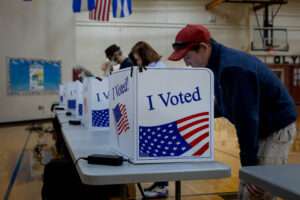
Voters cast ballots in South Carolina's 2024 presidential primary race
Voters cast ballots in South Carolina's 2024 presidential primary race. (Michael Nigro/Sipa USA/Newscom)


I have previously written about evidence indicating that, in the Trump era, Republicans are now the party that stands to benefit from relatively high voter turnout. A new New York Times/Siena study provides further confirmation:

In a reversal of one of the most familiar patterns in American politics, it appears that Donald J. Trump, not President Biden, would stand to gain if everyone in the country turned out and voted.

In New York Times/Siena College polls over the last year, Mr. Biden holds a wide lead over Mr. Trump among regular primary and midterm voters, yet he trails among the rest of the electorate, giving Mr. Trump a lead among registered voters overall….

The NYT/Siena study finds that people who voted in 2022 midterm primary elections favored Biden over Trump by a 49% to 44% margin, those who voted in 2022 general elections, but not primaries favored Biden by a slight 46-45 margin, those who voted in the 2020 election, but not midterms favored Trump 44-42; finally those who never voted before supported Trump by a large 49-35 margin.

As noted in my earlier post, the standard explanation for this shift is that the Trump-era GOP is strongest among lesser-educated voters, and they - in turn - are less likely to turn out. There is now a large "diploma gap" between Democratic and Republican voters.

The NYT analysis adds the point that high-turnout voters tend to be more supportive of abortion rights and more concerned about democracy-preservation. These are relatively strong issues for Biden. By contrast, low-frequency voters are more focused on short-term economic trends. This year, short-term economic issues are helping Trump, in part because of widespread voter ignorance about the true state of the economy and the causes of inflation (such ignorance tends to be more common among less-educated and less-engaged voters).

If the trend towards Republicans doing better among low-propensity voters continues, perhaps this will lead partisans to reconsider their traditional attitudes towards various policies intended to increase turnout, including mandatory voting. I discussed this possibility in my earlier post:

Traditionally, Democrats and progressives have been sympathetic to policies intended to increase voter turnout, while conservative Republicans have been highly skeptical. Advocates of the most extreme such policy—mandatory voting—have also mostly been on the left…..

Both sides in this debate cite high-minded, nonpartisan rationales for their positions…. But cynics have long wondered whether the real motive was partisan gain: perhaps liberal Democrats supported efforts to increase turnout because it would help them win, while conservative Republicans opposed them for the very same reason….

Recent polling trends may put both cynical and idealistic explanations for these views to the test. In the Trump era, it is increasingly Republican candidates—especially Trump himself—who stand to benefit from higher turnout.

For those interested, I have long been an opponent of mandatory voting, and a skeptic the supposed virtues of higher turnout. I held that view back when increasing turnout was expected to benefit Democrats, and still hold it today, when high turnout seems to advantage the GOP. I summarized the reasons why in my previous post:

I think most people do not have a duty to vote, even in high-stakes elections. And I have argued that relatively ignorant citizens can often do more good by abstaining from voting than by casting poorly informed votes (though I am also skeptical of arguments that government should try to weed out ignorant voters, primarily because I doubt that it can be trusted to do so in an unbiased way)…..

It isn't just that a more ignorant electorate is likely to make worse choices among the options before them. It is that those options are likely to be worse to begin with. Parties facing a relatively ignorant election are likely to select lower-quality candidates and policies than those facing a more knowledgeable one. I describe the logic behind this more fully in my book Democracy and Political Ignorance.

This connection between voter knowledge and relatively good policy outcomes is not an iron law. In Chapter 2 of my book, I go over some scenarios where voter ignorance can actually be beneficial. But I also explain why such situations are likely to be unusual.

It's possible that the Trump-era trend towards Republicans benefiting from higher turnout will prove to be an aberration. But if it continues and solidifies, I wonder if the partisans will gradually reverse positions on turnout issues. If it happens, it wouldn't be the first time that partisan advantage prevailed over consistent adherence to principle.

Free Speech

Federal Guilty Plea as to "Jane's Revenge" Threats and Vandalism Toward "Pro-Life Pregnancy Help Centers"

|

[UPDATE 9/17/2024: Caleb Freestone has been sentenced to a year and a day in prison.]

From yesterday's Justice Department press release:

Three Florida residents pleaded guilty today to conspiring to injure, oppress, threaten or intimidate employees of pregnancy resource centers in the free exercise of the right to provide and seek to provide reproductive health services. The defendants selected reproductive health facilities that provided and counseled abortion alternatives and vandalized those facilities with threatening messages.

According to court documents, between May and July 2022, Caleb Freestone, Amber Smith-Stewart and Annarella Rivera engaged in a series of targeted attacks on pro-life pregnancy help centers in Florida. The defendants admitted they participated in the attack in the dark of night and, while wearing masks and dark clothing to obscure their identities, spray painted the facilities with threatening messages, including "If abortions aren't safe than niether [sic] are you," "YOUR TIME IS UP!!," "WE'RE COMING for U" and "We are everywhere."

Read More

AI in Court

Kenya Survey: "AI Clerk's Influence on Legal Outcomes Is Seen as No Less Legitimate" Than Human Clerk's

|

From Brian Flanagan, Guilherme Almeida, Daniel Chen & Angela Gitahi, The Rule of Law or the Rule of Robots? Nationally Representative Survey Evidence from Kenya:

We explore the legitimacy of chatbot law clerks by conducting a nationally representative survey experiment of Kenya, a society whose views on such matters have particular salience in light of the Kenyan judiciary's willingness to test the effects of e-justice measures. Our choice of population also responds to criticism that experimental jurisprudence has so far been focused on W.E.I.R.D. (White Educated Industrialized Rich and Democratic) populations (Tobia 2024), which have been found to deviate systematically from global trends along several metrics (Henrich et al 2010; Barrett 2020)….

The study compared the responses of four nationally representative cohorts (totalling 2,246) to a suite of four test cases, each of which featured the same fact situation but which varied according to a) whether the verdict aligned with either the law's text or its purpose, and b) whether the verdict relied on the legal analysis of either a human or an artificial law clerk….

For instance, the "No Bodabodas in the mall" vignette was presented as follows:

The government has issued a rule: "It shall be an offence to ride a bodaboda in a shopping mall". This rule is intended to prevent injuries to shoppers. {Bodabodas are bicycle or motorcycle taxis that are common in Kenya.}

Then, we described a situation in which an agent had acted contrary to the law's text but consistently with its purpose:

Witnessing a violent attack inside a mall, Martin rides his bodaboda into the mall to stop it. Martin is later charged with the offence of riding a bodaboda in a shopping mall.

Finally, we described a legal proceeding that varied both according to its outcome and according to the source of the legal research on which the court relied:

The court, guided by legal research performed by a legal researcher/special computer program, decides that Martin violated/did not violate the rule.

Participants were asked to indicate their agreement with the sentence, "The court's decision is legitimate", on a 5-point Likert scale….

Read More

Former President Trump's NY Cases Ought to Be Removable to Federal Court

The House of Representatives should pass a bill allowing former President Trump to remove both his New York criminal and civil cases to federal court.

|

I taught Federal Jurisdiction for at least fifteen years at Northwestern Law School, from 1990 to 2005, and I have written several law review articles on this subject. I have long admired the federal removal statutes, which allow allow federal officers and persons acting under a law of the United States to remove their cases from state to federal court. See generally In re Neagle, 135 U.S. 1 (1890). One such law was passed during Reconstruction, in 1875, in the wake of the Civil War, to prevent the eleven former Confederate states from harassing or oppressing federal officers or those with a duty to act under federal law.

State judges are often elected, and they can sometimes be biased for reasons of race, sex, politics, or religion. That bias is evident in both the New York State criminal and civil lawsuits brought against former President Donald Trump this year. Those cases were tried in the most liberal borough, of one of the most liberal cities, of one of the most liberal states in the nation.

Regional biases against former Presidents are sometimes quite pronounced. The NY civil and criminal cases brought against former President Donald Trump are evidence of this fact. This makes broader removal statutes necessary and proper so that talented people will not be dissuaded from running for the office of President of the United States.

The House of Representatives should pass a bill, which is now before the House rendering such cases removable to federal court. Former President Trump's conviction in a Manhattan trial court is unconstitutional under the First Amendment, as I have previously explained on this blog. Trump's conviction thus presents a major federal question, which ought to be decided before voters cast their ballots this November by the U.S. Supreme Court. The House of Representatives can expedite that process by passing the removal bill, which is now before the House.

Any final legislation passed should allow the removal of civil as well as of criminal cases. Former President Trump's loss of a civil suit with damages assessed at around $450 million also presents major federal questions under the Due Process Clause of the Fourteenth Amendment, as well as presenting an Eighth Amendment excessive fines claim. Congress should pass a broad removal statute that covers at least state criminal and civil claims brought against former Presidents of the United States. This is necessary and proper so that talented people will not be dissuaded from running for President in the future.

In my opinion, such a statute should apply not only to former Presidents of the United States. It should also apply to former Vice Presidents and to all former officers of the United States. One can easily imagine former Vice Presidents or officers of the United States being harassed by elected state prosecutors and judges. Even former members of Congress should probably be allowed to remove civil and criminal cases from state to federal court.

The sad truth is that state prosecutorial and judicial officials are, overall, somewhat more partisan and more lacking in legal wisdom than are life tenured federal judges. This is due to the fact that state judges and district attorneys are elected at the state level. There are many superb state Supreme Court and inferior court judges and district attorneys. But, at a minimum former Presidents of the United States ought to be guaranteed that they will have access to the federal life tenured judiciary if they are sued or prosecuted. This is not only just. It is also necessary to ensure that talented people will not be dissuaded from running for or holding federal offices in the future.

Sixth Circuit

Divided Sixth Circuit Panel Affirms Preliminary Injunction Against Department of Education Title IX Guidance

The court concludes states are likely to succeed in their procedural challenges to the Education Department's decision to extend Bostock to Title IX.

|

Today a divided panel of the U.S. Court of Appeals for the Sixth Circuit affirmed a preliminary injunction against multiple Department of Education guidance documents that would apply the Supreme Court's Bostock holding -- that discrimination on the basis of sexual orientation or gender identity constitutes discrimination on the basis of sex -- to Title IX. Of note, the decision did not address the substance of the Education Department's position, but rather focused on whether this action is the sort that needs to go through a notice-and-comment rulemaking. In other words, this was more of an administrative law decision than one about statutory interpretation or gender equality.

Judge Nalbandian wrote the opinion for the court in Tennessee v. Department of Education. He was joined by Judge Larsen. Senior Judge Boggs dissented.

The suit against the Department of Education was filed by 20 state attorneys general. While there is little question the plaintiff states object to the substance of the Education Department's position, the primary legal claim concerns whether the Department violated the Administrative Procedure Act in issuing the guidance documents without going through notice-and-comment. On this question, the court concluded that the plaintiff states were likely to succeed on the merits and that the district court did not abuse its discretion in issuing a preliminary injunction. In particular, the court concluded that the documents, while styled as guidances, were actually the sort of legislative rule subject to the APA's procedural requirements. Specifically, the court credited the states' arguments that the guidance documents effectively imposed new legal obligations upon them, and did not merely set forth how the Department interpreted and expected to apply pre-existing legal obligations.

Before reaching the merits, however, the panel had to address the government's arguments that the plaintiff states lacked standing, that the guidance documents were not final agency actions subject to judicial review, and that judicial review of these actions was precluded. These are both questions that commonly arise in suits challenging agency actions that may have the effect of legislative rules without being styled as such. It was these preliminary questions -- and standing in particular -- that divided the judges. In Judge Boggs' view, the documents at issue were more properly characterized as interpretive rules or policy statements, and thus not the sort of final agency action that is subject to judicial review or that can impose the sort of injury necessary for jurisdiction.

Given that the decision focuses on administrative law questions, there's is very little in either opinion that addresses the underlying question of whether Bostock's interpretation of Title VII applies equally to Title IX. If the states are ultimately successful with this procedural challenge to the Department of Education's position, it could be some time before federal appellate courts reach the merits of that question.

Supreme Court

Supreme Court OT2023 at the Middle of June

The justices still have over one-third of the term's cases remaining.

|

The Supreme Court issued six more opinions this week, bringing the total of decided cases to thirty eight. Twenty-three cases remain, which is a substantial number if the Court is going to complete its work before the end of June.

As was true two weeks ago, the rate at which cases have been decided matches that of last term, but is well behind the rate of decision-making we observed in prior years. In theory, there are nine remaining potential opinion days in June (setting aside the Juneteenth holiday), but as of this writing the Court does not plan to issue any more opinions until June 20. If that holds, we will likely see some opinions the first week of July. (It would be quite unusual for the Court to issue opinions after July 4, though that happened in OT 2019 due to Covid-19.)

The Court's opinions still show a surprising degree of unanimity, though (as expected) we are starting to see more divisions as the justices release opinions in the more difficult cases. The justices have been unanimous in the judgement in 25 of 38 cases decided so far -- approximately two-thirds of argued cases -- but some of those cases have seen sharp splits over rationale, and the proportion of unanimous cases is almost certain to drop between now and the end of the term.

While we have seen lots of unanimous cases, we still have not seen too many 6-3 cases decided along ideological lines. There have been a total of nine 6-3 decisions thus far, but only four have been along traditional right-left lines. Only two cases this term have been decided 5-4.

In terms of individual opinion authorship, here is where we stand.

  • Sotomayor: 7
  • Thomas: 6
  • Alito: 4
  • Kagan: 4
  • Kavanaugh: 4
  • Jackson: 4
  • Barrett: 3
  • Gorsuch: 2
  • CJ Roberts: 2

There have also been two per curiam opinions, and some cases are likely to be merged into a single opinion (e.g. the two Chevron cases, Relentless and Loper-Bright will almost certainly be decided in a single opinion).

Of the remaining cases, the lion's share will be written by conservative justices. The liberal justices represent one-third of the Court, but have been responsible for 40 percent of the Court's majority opinions thus far. I would not be surprised if liberal justices write no more than four or five of the remaining majorities.

For those who have read this far, here are some purely speculative predictions about what we may see. I suspect the Chief to have quite a few major decisions, in no small part because he has only authored two opinions for the Court thus far. I could see him having Rahimi, Relentless (the Chevron case), Moore, and the Trump immunity decision. I suspect Justice Gorsuch as SEC v. Jarkesy, Murthy, and Fischer, and I would be surprised if Kavanaugh does not take Ohio v. EPA. I have no prediction with regard to NetChoice, other than I think the two cases will produce a splintered mess.

Of course, these predictions are worth no more than you paid for them, and we should know whether I am right soon enough.

Politics

Short Circuit: A Roundup of Recent Federal Court Decisions

Surprise inspections, dangerous fake weapons, and classroom interference.

|

Please enjoy the latest edition of Short Circuit, a weekly feature written by a bunch of people at the Institute for Justice.

New cert petition! Friends, the gov't has broad latitude to use eminent domain to seize private land for public uses, like parks. But what if the park is a mere pretext and what officials are actually doing is harassing someone they don't like or forcing them out of town? What then? Well, most courts say that's unconstitutional, but earlier this year the Second Circuit disagreed, holding that as long as officials are willing to lie about why they are seizing someone's property all is well. We're asking the Supreme Court to resolve the split. Click here to learn more.

Read More

The Ignored Aesthetic Standing Argument In FDA v. Alliance for Hippocratic Medicine

The fauna that did not bark, the flora that did not bloom.

|

In FDA v. Alliance for Hippocratic Medicine, the Court rejected three theories of standing: (1) expected conscience objections, (2) expected monetary harms, and (3) diversion of resources. However, there was another theory of standing adsressed in the Fifth Circuit that the Court did not resolve.

Judge Ho's concurrence found standing based on an aesthetic injuries.

In addition to the injuries analyzed by the majority, Plaintiffs have demonstrated another basis for Article III standing: the aesthetic injury they experience in the course of their work. See, e.g., Sierra Club v. Morton, 405 U.S. 727, 734-35, 92 S.Ct. 1361, 31 L.Ed.2d 636 (1972) (recognizing aesthetic harm as "injury to a cognizable interest"); Lujan v. Defs. of Wildlife, 504 U.S. 555, 562-63, 112 S.Ct. 2130, 119 L.Ed.2d 351 (1992) ("[T]he desire to use or observe an animal species, even for purely esthetic purposes, is undeniably a cognizable interest for purpose of standing."); id. at 566, 112 S.Ct. 2130 ("[T]he person who observes or works with a particular animal threatened by a federal decision is facing perceptible harm."). It's well established that, if a plaintiff has "concrete plans" to visit an animal's habitat and view that animal, that plaintiff suffers aesthetic injury when an agency has approved a project that threatens the animal. See Lujan, 504 U.S. at 564, 112 S.Ct. 2130. . . .

Unborn babies are a source of profound joy for those who view them. Expectant parents eagerly share ultrasound photos with loved ones. Friends and family cheer at the sight of an unborn child. Doctors delight in working with their unborn patients—and experience an aesthetic injury when they are aborted.

Plaintiffs' declarations illustrate that they experience aesthetic injury from the destruction of unborn life.

In short, if naturalists can claim an aesthetic injury to see plants and animals, then pro-life doctors could claim a similar injury with regard to newborn babies.

The Supreme Court has recognized that "the person who observes or works with a particular animal threatened by a federal decision is facing perceptible harm, since the very subject of his interest will no longer exist." Lujan, 504 U.S. at 566, 112 S.Ct. 2130. Every circuit, including our own, has concluded that, when a federal agency authorizes third parties to harm flora or fauna that a plaintiff intends to view or study, that satisfies all of the requirements for Article III standing. . . .

I see no basis for allowing Article III standing based on aesthetic injury when it comes to animals and plants—but not unborn human life.

The aesthetics argument was actually advanced in Havens Realty, a precedent that received its last rites today.

The three individual plaintiffs, who, at the time the complaint was filed, were all residents of the city of Richmond or the adjacent Henrico County averred that they had been injured by the discriminatory acts of petitioners. Coles, the black renter, claimed that he had been "denied the right to rent real property in Henrico County." Further, he and the two tester plaintiffs alleged that Havens' practices deprived them of the "important social, professional, business and economic, political and aesthetic benefits of interracial associations that arise from living in integrated communities free from discriminatory housing practices."

In other words, the plaintiffs asserted an aesthetic injury in having a racially diverse neighborhood. The Havens Court did not pass on this issue, but it also was not rejected.

On appeal, the Supreme Court could have considered the "aesthetic" standing argument raised in Judge Ho's concurrence. But Justice Kavanaugh did not. Indeed, he favorably cited some form of naturalist standing:

Consistent with that understanding of how standing principles can develop and solidify, the Court has identified a variety of familiar circumstances where government regulation of a third-party individual or business may be likely to cause injury in fact to an unregulated plaintiff. For example, when the government regulates (or under-regulates) a business, the regulation (or lack thereof ) may cause downstream or upstream economic injuries to others in the chain, such as certain manufacturers, retailers, suppliers, competitors, or customers. . . . When the government regulates parks, national forests, or bodies of water, for example, the regulation may cause harm to individual users. E.g., Summers, 555 U. S., at 494.

Why did the Court not address the aesthetic standing argument? The fauna did not bark, and the flora did not bloom.

Perhaps the Court said nothing because addressing aesthetic injury would have broken up a unanimous decision. Or the Court could not meaningfully distinguish the arguments raised in Judge Ho's concurrence from the various environmental cases.

It is also possible that the Court thought the issue was forfeited or waived. As best as I can tell, ADF did not advance the "aesthetic" injury argument in its briefing before the District Court or the Fifth Circuit. But ADF did advance the argument before the Supreme Court:

If plaintiffs have an "undeniably … cognizable interest" in avoiding the distress of losing "an animal species," Lujan v. Defs. of Wildlife, 504 U.S. 555, 562– 63 (1992), or even the chance to "view[ ] the flora and fauna," Summers v. Earth Island Inst., 555 U.S. 488, 494 (2009), then Respondent doctors have a concrete interest in avoiding heartbreaking emergency situations that require them to be complicit in a process that ends an unborn life. Pet. App. 80a–83a (Ho, J., concurring and dissenting in part) (Respondents' "aesthetic injury from the destruction of unborn life" is "cognizable"). The emotional harm Respondents suffer "suffice[s] for Article III standing." TransUnion, 594 U.S. at 440.

It is not clear to me that this issue was preserved below, so perhaps it was forfeited. California v. Texas held that even if a jurisdictional argument is not raised below, it is still forfeited. (I am still steamed about that holding years later--the issue was preserved.)

If the issue was waived, then the Court's failure to pass on it is of no moment. I do not think you can read this opinion to say anything at all about aesthetic standing.

This argument seems available for some future case.

Alabama Law Review: A Tribute to Twenty Years on the Bench - Chief Judge William H. Pryor Jr.

With contributions by Justice Thomas, Attorney General Sessions, and many Pryor clerks/mentees who became judges.

|

I was pleased to see that the Alabama Law Review published a symposium issue to celebrate Chief Judge Pryor's twenty years on the bench. There are essays from Justice Thomas, Attorney General Sessions, and several Pryor clerks and mentees who became judges. His accomplishments are remarkable. And Pryor, who graduated from Tulane Law School, proves how overrated Ivy League diplomas are. Pryor is one of the most influential of President Bush's circuit nominees--at least among those who were not elevated to the Supreme Court. (Another member of that list attended THE Ohio State University.)

I encourage you to read through the essays. They are short, humorous, and smart--exactly what we would expect from friends of Pryor.

Chief Judge William H. Pryor Jr.: A Tribute to Twenty Years on the Bench

Kenneth M. Rosen, A Scholarly Judge: The Honorable William Holcombe Pryor Jr.

Hon. Clarence Thomas, My Friend, Bill

Hon. Ed Carnes, Chief Judge William H. Pryor Jr. as Chief Judge

Hon. Jeff Sessions, A Man of Law, Principle, and Courage

Hon. Steven T. Marshall and Edmund G. LaCour Jr., Attorney General William H. Pryor Jr.

Hon. Andrew L. Brasher, From Clerk to Colleague

Hon. Kevin C. Newsom and Hon. Corey L. Maze, Chief Judge William H. Pryor Jr.: The Man, the Mentor, the Mensch

Hon. Anna M. Manasco, "You Can Do Better"

Hon. Sarah K. Campbell, William H. Pryor Jr.: Model of Judicial Virtue

Molly Glazner, Taylor Meehan, Kasdin Mitchell, and Hon. Kathryn Mizelle, Barbecue Mondays

Caroline Stephens Milner, From a Clerk's Perspective

Justice Kavanaugh Denies Standing For Docs Against Glocks

Doctors cannot claim an injury to challenge gun control laws because their patients may be affected by gun violence.

|

In 2011, Florida enacted a law that restricted when doctors could ask their patients if they owned a gun. The sentiment behind the law was that doctors, as a whole, were hostile to gun rights, and could not be trusted with this power. The so-called Docs v. Glocks law, however, did not survive. In 2017, the en banc Eleventh Circuit ruled that the law violated the First Amendment and violated Due Process (there were two majority opinions).

I thought of that case today while re-reading Justice Kavanaugh's standing analysis in FDA v. Alliance for Hippocratic Medicine. The doctors in that case clearly had standing because the law regulated their speech. But these same anti-gun doctors could assert standing in other cases. Imagine that some doctors who are hostile to gun rights sought standing to challenge some sort of gun control policy. The basis of their injury would be that with fewer restrictions on firearms, their patients are more likely to show up in the emergency room. I'm sure elite medical journals could pump out studies showing how that is a predictable, non-attenuated chain of consequences. That argument might have worked yesterday. But not today. AHM slammed that door shut:

In any event, and perhaps more to the point, the law has never permitted doctors to challenge the government's loosening of general public safety requirements simply because more individuals might then show up at emergency rooms or in doctors' offices with follow-on injuries. Stated otherwise, there is no Article III doctrine of "doctor standing" that allows doctors to challenge general government safety regulations. Nor will this Court now create such a novel standing doctrine out of whole cloth.

Consider some examples. . . . The government repeals certain restrictions on guns—does a surgeon have standing to sue because he might have to operate on more gunshot victims? The answer is no: The chain of causation is simply too attenuated. Allowing doctors or other healthcare providers to challenge general safety regulations as unlawfully lax would be an unprecedented and limitless approach and would allow doctors to sue in federal court to challenge almost any policy affecting public health.

I don't know if Justice Kavanaugh was thinking about Docs v. Glocks. But he is wont to reach out to decide issues that are not present. And I think this path for standing is foreclosed.

Update: On 6/14, I added these sentences: "The doctors in that case clearly had standing because the law regulated their speech. But these same anti-gun doctors could assert standing in other cases." I was making clear that in the Florida case, the doctors clearly hand standing. In this post, I was talking about a hypothetical case.

Free Speech

Prosecution for Alleged Stalking/Harassment of Israeli Tourists in N.Y. on Oct. 18, 2023 Can Go Forward

|

From New York trial judge Althea Drysdale's opinion Tuesday in People v. Amin:

This case stems from an incident where the Defendant is alleged to have stalked, taunted, and harassed a group of Israeli citizens for over ten minutes while they were sightseeing in Times Square, culminating in the assault of one of the tourists. As part of his omnibus motions, the Defendant moves to dismiss the charges of Stalking in the First Degree …, Stalking in the Third Degree …, and Aggravated Harassment …, arguing that the prosecution elicited insufficient evidence to constitute the necessary element of a "course of conduct" for those crimes. [The decision appeared not to deal with the assault charge. -EV] …

Statement of Allegations

On Wednesday, October 18, 2023 at approximately 9:30pm, the Complainant, an Israeli citizen, was visiting New York City with a group of six friends when they decided to stop by Times Square to sightsee. Several members of the group were wearing items that disclosed their religious affiliation: specifically, all five male members of the group were wearing "kippahs," traditional Jewish head-coverings also known as a "yarmulkes" as well as visible "tzitzits," which are strings that adorn the corners of a "tallit," a Jewish prayer shawl that is worn under clothing throughout the day.

After exiting the subway station located at 42nd Street and Times Square, the group was approached by a man, later identified as the Defendant, who appeared to be of Middle Eastern descent. The Complainant noticed that the Defendant was wearing what the Complainant described as a red and white "keffiyeh," a traditional headdress worn by men in the Middle East, around his head and face.

While the Defendant was initially playing what the Complainant described as "loud English music" on a speaker that he was carrying in his hand, the Complainant observed that, upon seeing the Complainant and his group of friends, the Defendant changed the music to a song in Arabic. Almost immediately after doing so, the Defendant said "Free Palestine" and stated that "the Jews have to die." The Complainant also recalled that the Defendant stated, in sum and substance, that he was "happy with what Hamas did to the Jews," and repeatedly yelled "Allah Kashi," which the Complainant understood to mean in Arabic "God is Great." The Complainant further heard the Defendant state that he was "willing to die for the sake of Gaza."

Read More

Standing

Justice Thomas Takes Aim at Associational Standing

In his AHM v. FDA concurrence, Justice Thomas suggests the Court needs to rethink associational standing and questions whether it comports with Article III.

|

Today the Supreme Court held unanimously that anti-abortion doctors lack standing to challenge the Food and Drug Administration's decisions to loosen the regulation of mifepristone. Justice Thomas wrote separately to reiterate his opposition to third-party standing and raise questions about the Court's long-standing acceptance of associational standing (and universal injunctions too). Given current pressure to rethink aspects of standing doctrine, his opinion is worth some attention.

Justice Thomas begins his opinion restating his objections to third-party standing.

Our third-party standing precedents allow a plaintiff to assert the rights of another person when the plaintiff has a "close relationship with the person who possesses the right" and "there is a hindrance to the possessor's ability to protect his own interests." . . . . Applying these precedents, the Court explains that the doctors cannot establish third-party standing to sue for violations of their patients' rights without showing an injury of their own. . .  But, there is a far simpler reason to reject this theory: Our third-party standing doctrine is mistaken. As I have previously explained, a plaintiff cannot establish an Article III case or controversy by asserting another person's rights. . . .. So, just as abortionists lack standing to assert the rights of their clients, doctors who oppose abortion cannot vicariously assert the rights of their patients.

He then goes on to note that associational standing (as opposed to organizational standing - in which an organization asserts standing to defend its own interests as an organization) can be seen as a species of third-party standing, and has some of the same problems.

Associational standing raises constitutional concerns by relaxing both the injury and redressability requirements for Article III standing. It also upsets other legal doctrines.

First, associational standing conflicts with Article III by permitting an association to assert its members' injuries instead of its own. . . . Article III does not allow a plaintiff to seek to vindicate someone else's injuries. . . . It is difficult to see why that logic should not apply with equal force to an association as to any other plaintiff. I thus have serious doubts that an association can have standing to vicariously assert a member's injury. . . .

Second, our associational-standing doctrine does not appear to comport with the requirement that the plaintiff present an injury that the court can redress. . . . The party who needs the remedy—the injured member—is not before the court. Without such members as parties to the suit, it is questionable whether "relief to these nonparties . . . exceed[s] constitutional bounds." . . . Because no party should be permitted to obtain an injunction in favor of nonparties, I have difficulty seeing why an association should be permitted to do so for its members. Associational standing thus seems to distort our traditional understanding of the judicial power.

As Justice Thomas notes, one way courts have addressed the concern about providing relief beyond the remedy to which an individual plaintiff would be entitled is through universal injunctions, but that does not really solve the underlying Article III concern.

Our precedents have provided a workaround for this obvious remedial problem through the invention of the so called "universal injunction." Universal injunctions typically "prohibit the Government from enforcing a policy with respect to anyone." . . . By providing relief beyond the parties to the case, this remedy is "legally and historically dubious." . . .  It seems no coincidence that associational standing's "emergence in the 1960s overlaps with the emergence of [this] remedial phenomenon" of a similarly questionable nature. . . . Because no party should be permitted to obtain an injunction in favor of nonparties, I have difficulty seeing why an association should be permitted to do so for its members. Associational standing thus seems to distort our traditional understanding of the judicial power.

Reliance on associational standing and universal relief, Thomas notes, "subverts the class-action mechanism" by providing a work-around to class-action rules and requirements and "creates the possibility of asymmetrical preclusion."

Associational standing may be justified and reconcilable with Article III constraints but, as Justice Thomas notes, such justification and reconciliation is not to be found in the Court's jurisprudence: "Despite its continued reliance on associational standing, the Court has yet to explain how the doctrine comports with Article III."

Justice Thomas is not the only one raising questions about associational standing. Andrew Hessick and Michael Morley make the case in opposition in a forthcoming University of Chicago Law Review article titled, appropriately enough "Against Associational Standing."

Justice Thomas concludes:

No party challenges our associational-standing doctrine today. That is understandable; the Court consistently applies the doctrine, discussing only the finer points of its operation. See, e.g., Students for Fair Admissions, Inc. v. President and Fellows of Harvard College, 600 U. S. 181, 199–201 (2023). In this suit, rejecting our associational standing doctrine is not necessary to conclude that the plaintiffs lack standing. In an appropriate case, however, the Court should address whether associational standing can be squared with Article III's requirement that courts respect the bounds of their judicial power.

The Standing Analysis in FDA v. Alliance for Hippocratic Medicine

The Court ducks the conscience theory of standing based on the government's new position, "abandons" Haven's Realty, and starts the deadpool for associational standing

|

Today the Supreme Court unanimously reversed the Fifth Circuit in FDA v. Alliance for Hippocratic Medicine. This outcome was not a surprise, since the Court granted a complete stay of the District Court's ruling in April 2023, allowing mifeprisotne to remain on the market.

After AHM was argued, I wrote that the Court should use this case as an opportunity to scale back two primary standing doctrines: Havens Realty "diversion of resources" standing and "Offended Observer" standing. The Court did just that.

Justice Kavanaugh wrote a very tight majority opinion. Part II is a very useful summary of standing doctrine. All Federal Courts students should read it for a quick review. He managed to keep all nine Justices on board, even where there were opportunities for them to jump ship. (By contrast, see Justice Thomas's fractured unanimous reversal in Vidal v. Elster.) And, as I'll explain below, there is some language here that may come back to bite progressives.

Read More

Free Speech

Justices Agree on Constitutionality of Trademark Restriction, Disagree on How to Approach Such Questions

The underlying methodological debate might also bear on free speech disputes more broadly.

|

Today's decision in Vidal v. Elster unanimously upheld a federal trademark law provision that bars federal registration of any trademark that "[c]onsists of or comprises a name … identifying a particular living individual except by his written consent." The law doesn't bar people from using others' names as part of a trademark, but bars federal registration of such marks, which would provide trademark owners special protect against infringement. (The case involved plaintiff's attempt to register the mark "Trump Too Small," but the legal issue went far beyond this mark.)

The Court unanimously agreed that this was a content-based, though viewpoint-neutral, classification. But while content-based speech restrictions are presumptively unconstitutional, the Justices agreed that this law is fine.

But the Justices sharply disagreed on the rationale for this conclusion.

  1. Justice Thomas, joined by Justices Alito and Gorsuch, concluded that the law is constitutional chiefly because of what they saw as a longstanding historical tradition of allowing such exclusions from trademark registration.
  2. Justice Barrett, joined by Justice Kagan and in considerable part by Justices Sotomayor and Jackson, concluded that the law is constitutional chiefly by analogy to the First Amendment doctrine having to do with government-provided benefits for private speakers, under which reasonable, viewpoint-neutral restrictions on the benefits are constitutional; they were quite skeptical of Justice Thomas's historical focus. (Justice Sotomayor also wrote a similar opinion, joined by Justices Kagan and Jackson.)
  3. And Justice Kavanaugh, joined by Chief Justice Roberts, tried as much as possible to abstain from this debate.

First, a bit of history that drew a majority, and that was joined by all the conservative Justices (including Justice Barrett):

Read More

More