Part I discusses First Amendment protection of physicians' professional speech, while also noting the strong framework of non-constitutional speech protections physicians long enjoyed under general health laws predating the emergence of modern First Amendment doctrine. These strong statutory protections may help explain the sparsity of First Amendment cases squarely addressing physicians' rights of access to the informational inputs of professional speech and their rights, as a profession, to exercise epistemic control of the medical evidence base in the sense of determining which sources of evidence are appropriate for a doctor to consider when advising a patient. Strongly protected by general health laws, these rights rarely are transgressed in ways that spark constitutional disputes. However, new medical technologies (and the government's attempts to regulate them) can exert new pressures that earlier health laws did not contemplate, leaving the First Amendment as physicians' only line of defense. CDS tools, I argue, have brought such a moment.
Part II describes the statutory basis for FDA's regulation of CDS [Clinical Decision Support] tools and explains how the Cures Act limits FDA's jurisdiction and requires procedural protections to avoid unjustified intrusions on physicians' free speech rights. Part III explains that the CDS Guidance deviates from the statute it purports to interpret in ways that impose a scheme of content-based regulation of physicians' professional speech. Part IV explains why ostensibly non-binding guidance documents, such as FDA's CDS Guidance, can nevertheless threaten immediate injuries to the rights of physicians and patients in their care. CDS tools offer great promise to improve health care, but they pose risks that call for careful oversight. The medical profession has a crucial role to play in that oversight, and the First Amendment keeps us safer by ensuring governmental agencies cannot oust them from that role.
The order: Sarrita Adams runs Science On Trial, Inc., which "provides forensic consultation services across the United States and the United Kingdom." Adams, who is a "University of Cambridge educated translational scientist," drew public attention by publicly criticizing the evidence in the 2023 English trial of nurse Lucy Letby, who was convicted of murdering seven infants. Her claims were mentioned in, among other publications, The Times (London), the New York Post, and most recently The New Yorker.
Her criticism, however, itself drew criticism, including on Reddit's r/scienceontrial ("This community exists to fact check claims about Science on Trial, its creator Sarrita Adams, and various statements that can be credited to her."). The main poster there is the pseudonymous Reddit user MrJusticeGossipGirl, apparently a reference to Mr. Justice Goss, the judge in the Letby trial. The posts generally criticize Adams' credentials, views on the Letby trial, responses to critics, and more. (There's also a reddit r/sarritaadams, which points the reader to r/scienceontrial.)
But on June 7, San Francisco County Superior Court Maria Evangelista issued a temporary harassment restraining order (Adams v. Gulley, PDF pp. 42-47) ordering defendant Gulley—who appears to be MrJusticeGossipGirl—
Do not make any social media posts about or impersonating plaintiff and her company Science on Trial on any public or social media platform. All harassing posts shall be removed.
This was done based on a restraining order request filed June 6; it appears that Gulley wasn't given an opportunity to appear in court to oppose the order (this is known in this context as an "ex parte" proceeding). The order is effective immediately, and until July 2, when the permanent restraining order hearing will take place.
The Office of the Solicitor General (OSG) presents oral arguments on behalf of the federal government in almost all cases before the Supreme Court. There are a few outliers. The Attorney General on occasion has argued one case during his or her tenure. And in rare cases, an attorney from an agency like the Federal Trade Commission will argue before the Court.
The Solicitor General (SG), who is Senate-confirmed, leads the Office. When the SG position is vacant, there will be an Acting SG. Below the SG is the Principal Deputy SG (PDSG), also known as the "political" deputy. Traditionally, OSG has traditionally had four Deputy Solicitor Generals (DSGs), including the PDSG. Currently there are five total deputies. The rest of the office includes Assistants to the Solicitor General (ASGs).
During the October Term 2023 (OT 2023), OSG argued a total of 53 cases. SG Elizabeth Prelogar argued ten cases and PDSG Brian Fletcher argued three cases. Four DSGs argued cases: Malcolm Stewart (3), Edwin Kneedler (2), Eric Feigin (2), and Curtis Gannon (2). The remaining 31 OSG cases were argued by the 15 ASGs.
How does this division of oral arguments compare to past terms? Since OT 2001, OSG has argued nearly 1,300 cases. I compiled this total by cross-referencing arguments in Oyez and in the WestLaw Supreme Court Oral Argument database. Even as the size of the Court's merits docket has shrunk, OSG continues to argue roughly the same number of cases. The high was 63 cases in OT 2001 and the low was 47 cases in OT 2017, averaging to about 55 per term. Still, because this number fluctuates year-by-year, it is more useful to measure percentages: what percentages of the OSG cases are argued by the SG, the PDSG, DSGs, and ASGs.
This table breaks down the percentages:
Term
SG
SG
PDSG
DSGs
ASGs
OT 01
Olson
12.70%
7.94%
15.87%
63.49%
OT 02
Olson
15.25%
8.47%
15.25%
61.02%
OT 03
Olson
15.00%
11.67%
18.33%
55.00%
OT 04
Clement (Acting)
16.00%
5.08%
20.00%
64.00%
OT 05
Clement
13.56%
0
20.34%
61.02%
OT 06
Clement
15.38%
5.77%
21.15%
57.69%
OT 07
Clement
12.73%
9.09%
20.00%
58.18%
OT 08
Garre
8.77%
3.51%
22.81%
63.16%
OT 09
Kagan
9.26%
9.26%
22.22%
59.26%
OT 10
Katyal (Acting)
10.53%
7.02%
21.05%
61.40%
OT 11
Verrilli
14.04%
5.26%
19.30%
61.40%
OT 12
Verrilli
10.94%
7.81%
18.75%
62.50%
OT 13
Verrilli
12.50%
7.14%
19.64%
60.71%
OT 14
Verrilli
12.28%
5.26%
17.54%
64.91%
OT 15
Verrilli
10.34%
5.17%
17.24%
67.24%
OT 16
Gershengorn (Acting)
6.00%
4.00%
18.00%
72.00%
OT 17
Francisco
8.51%
10.64%
19.15%
61.70%
OT 18
Francisco
9.62%
9.62%
15.38%
65.38%
OT 19
Francisco
14.00%
12.00%
20.00%
54.00%
OT 20
Wall (Acting)
10.00%
6.00%
22.00%
62.00%
OT 21
Prelogar (Acting)
9.62%
5.77%
23.08%
59.62%
OT 22
Prelogar
15.38%
5.77%
25.00%
53.85%
OT 23
Prelogar
18.87%
5.66%
16.98%
58.49%
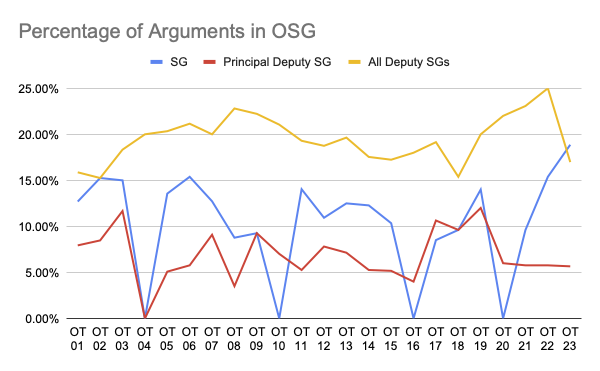
In OT 2023, SG Prelogar argued 18.87% of OSG cases, the highest percentage in at least a quarter century. Indeed, Prelogar's 10 arguments in OT 2023 was the highest raw total since SG Olson argued 9 cases in OT 2002 and OT 2003. But in those two terms, OSG had 59 and 60 total arguments, respectively. Olson's totals were 15.25% and 15%, respectively. By contrast, in OT 2023, OSG had only 53 arguments.
If Prelogar had so many arguments, who was left out? PDSG Brian Fletcher argued three cases, only 5.6% of the OSG cases. If we exclude terms in which there was no confirmed SG, and the Principal Deputy SG served as Acting SG, Fletcher's total is among the lowest in a quarter century. Moreover, the other four Deputy SGs argued 16.98% of the cases.
Again, historically there were three deputies other than the principal, but during the Trump administration, that number was increased to four. In a quarter century, this was the first term in which the SG argued a higher percentage of cases than all of the Deputy SGs combined. To state the point plainly, SG Prelogar single-handedly argued more cases than DSGs Stewart, Kneedler, Feigin, and Gannon, combined. If we exclude Prelogar's tenure, DSGs argued about 7% more cases than the SG. But during OT 2023, the SG out-argued the DSGs.
This graph distills how SG Prelogar argued more cases than her predecessors, how the Deputy SGs under SG Prelogar argued fewer cases than their predecessors, and how the Principal Deputy SG is near the bottom of utilization rates when there is a confirmed SG.
There's more. During OT 2023, Assistant SGs argued 58.49% of the OSG cases: fourteen ASGs each argued two cases, and ASG Charles Luke McCloud argued only one case. That is one of the lowest totals in a quarter century. The lowest total for ASG arguments came in OT 2022, where ASGs argued 53.85% of the cases. Even as SG Prelogar argues more cases, the Assistant SGs are arguing fewer cases. During SG Francisco's term, many ASG's had 3 arguments in a term. During OT 2022, only one ASG had 3 arguments. During OT 2023, zero ASGs had 3 arguments.
It could be argued that pairs of cases should only be counted as one. And you could pair Relentless and Loper Bright, and the two NetChoice cases. But all of my counts are premised on the actual number of arguments. I did not consider whether two cases were related. Olson, Clement, and the rest all had the opportunities to argue paired cases. In private practice, a lawyer who argues companion cases still gets two arguments to her credit. Presumably the SG will not count two cases that she argued just as just one in the future. If SG Prelogar decided to argue both Chevron cases and both NetChoice cases, to preserve parity, she could have dropped one or two of the cases from the March and April sittings. Any of her deputies could have argued AFHM, Moyle, or Fischer.
Lawyers in OSG are routinely headhunted to join private practice. One of the key incentives to work for a government salary is presenting arguments before the Supreme Court. If those arguments are not evenly doled out, it stands to reason that recruiting, morale, and retention will suffer.
Update (6/18/24 at 1:51 PM): I've found one error in my numbers. During OT 2011, Solicitor General Verrilli argued nine cases, rather than eight. Verrilli did not argue any cases during the February sittting. In the March sitting, for the Affordable Care Act litigation, Verrilli argued three cases in the span of three days. (Deputy Ed Kneedler had the fourth argument on severability.) Two of Verrilli's argued cases were titled HHS v. Florida, and I inadvertently counted them as a single case. They should have been counted separately. Mea culpa. With nine arguments, Verrilli had about 16% of the argued cases that term. That number is still less than SG Prelogar's ten cases, which were nearly 19% of the cases argued during OT 2023. I fully expect to spot other errors in the numbers, and welcome any corrections.
DACA was announced in June 2012. At the time, there were no meaningful legal challenges to the policy. Indeed, as hundreds of thousands of people received benefits under the policy, it became clear that the courts would not let it be halted.
DAPA was very different. By late 2014, the Republican Attorney General Machine was operating at full steam. Attorney General Abbott challenged the policy in the U.S. District Court for the Southern District of Texas, Brownsville Division. The brainpower on that case was staggering. Among others involved were Andy Oldham (5th Circuit), Jimmy Blacklock (Supreme Court of Texas), Brantley Starr (NDTX), Cam Barker (EDTX), Scott Keller, and more that I'm forgetting. This case innovated the "Driver's License" theory of standing, which has formed the basis of countless challenges to immigration non-enforcement. I filed an amicus brief back on behalf of the Cato Institute. (No, Cato would not file such a brief today.)
The DAPA challenge was successful, in large part, because a preliminary injunction was obtained before anyone was able to sign up for it. DACA, by contrast is still on the books. Even after President Trump tried to rescind DACA, Chief Justice Roberts made up some convoluted test about reliance interests to ensure people could keep their deferred action and work authorization.
That brief history brings us to the present. Last week, there was a report in the New York Times that President Biden was thinking about some new executive action to provide a pathway for citizenship for certain alien spouses of U.S. citizens. When the press reports that some policy is under consideration, that almost certainly means the policy will be issued. Indeed, I thought this pro-immigration policy would be used to offset the President's unpopular-on-the-left asylum policy.
The Times offered this description:
The president would exercise his authority to grant the undocumented spouses "parole in place," a designation that would permit them to remain in the country, work legally and gain access to a pathway to permanent residency.
I've been poking around to find some detailed analysis of the policy, but I was unsuccessful. What will this policy be called? Parole in Place for Spouses--PIPS?
Today, the Wall Street Journal reported that President Biden will announce the spouse policy, tomorrow, Tuesday.
President Biden is expected to announce a new immigration program Tuesday that would provide a path to citizenship for hundreds of thousands of immigrants in the country illegally who are married to U.S. citizens, according to lawmakers and others familiar with the matter.
Biden plans to make the announcement at the White House alongside members of Congress, immigration advocates and U.S. citizens who, because of arcane immigration rules, haven't been able to sponsor their spouses for green cards.
The program has the potential to benefit immigrants who have been living in the country at least a decade, offering them work permits, deportation protections—and a route for them to apply for green cards, which is the pathway to citizenship. The application process is expected to open by the end of the summer, an administration official said.
Much like with DAPA, this policy will not go into effect right away. There will at least be some application process.
I would expect legal challenges from Texas and all the usual suspects. The theory of standing will be the same as the theory of standing with DACA. If and when we get an OLC opinion, I will write about it. I made the same request on PBS a decade ago with regard to DAPA. I'm having serious deja vu to 2014. My hair was much shorter and I talked much faster.
It will be published in the Florida Law Review (2025).
We argue that the Direct Taxes Clause applies to taxes that fall straight upon a person, while imposts, duties and excises all fall only upon such transactions as: importing goods, buying or selling goods, inheriting an estate or giving a gift, renting someone's property, or selling one's labor to someone else in exchange for money. We think that a wealth tax falls directly on persons, and not on transactions, as we explain in the above cited draft law review article.
We discuss the original meaning of the Taxation Clauses, court opinions from the Founding to the present day, and arguments in law review articles and amicus briefs made by major scholars. Far from being a glitch in the Constitution, the requirement that direct taxes be apportioned prevents a majority of the states in Congress from imposing a tax that will fall heavily on certain states and regions. The Clause thus not only limits taxes on enslaved persons and undeveloped land of which the South had a lot in 1787; the Direct Tax Clause also bans Congress from taxing ships, manufacturing, or small farms, which were prevalent in the North but scarce in the South. Both types of fiscal raids are made politically impracticable by the Direct Tax Clause.
The Framers meant for the federal government to rely only on indirect taxes in peacetime, but they made available direct taxes that are not geographically biased in wartime. There is an appealing element of voluntariness in indirect taxes, which is that one can always avoid the tax by not engaging in the taxed transaction. Such voluntariness is absent when direct taxes are imposed.
From today's decision in Luo v. County of L.A.(note that this is the same Luo from Luo v. Volokh), written by Justice John Segal and joined by Justices Gonzalo Martinez and Gail Ruderman Feuer:
Xingfei Luo brought this action against the County of Los Angeles under the California Public Records Act (CPRA). In an opposition to a motion by Luo for sanctions, the County listed other lawsuits Luo had filed using a pseudonym. Seven months later, Luo filed an ex parte application for an order redacting the list of lawsuits from the County's opposition and the trial court's order denying the motion for sanctions. Luo appeals from the trial court's order denying her ex parte application. We affirm….
Luo had actually largely prevailed on her underlying demand for various records on crime statistics, but lost as to the redaction, and the appellate court concluded that the trial court didn't abuse its discretion on that score:
From Thursday's decision by Judge David Larimer in Carey v. Salvadore(W.D.N.Y.):
Plaintiffs William H. Carey and Barbara B. Carey, as administrators of the estate of their son Michael …, … allege that at the time of Michael's death from pulmonary congestion, [defendant Lisa] Salvador [{the correct spelling [of defendant's name]}] was working as a nurse at the medical unit where Michael was housed, and that she did nothing to help him and was unaware of his condition because she was asleep on duty….
The court ultimately concluded,
That some of the matter contained in these documents might cause some embarrassment or discomfiture to defendant is unremarkable; if that were all it took to justify keeping documents inaccessible to the public, sealing would be the norm, not the exception…. "[M]ost if not all litigation can be harassing and embarrassing to some extent" …. But that is not the law, as the Second Circuit has repeatedly emphasized. Sealing is the exception and defendant has the burden to justify that exception.
And it analyzed the matter thus:
"The common law right of public access to judicial documents…is based on the need for federal courts…to have a measure of accountability and for the public to have confidence in the administration of justice." "That right includes 'a general right to inspect and copy' …judicial documents." If the court determines that the documents at issue are judicial documents to which a presumption of access attaches, the court must determine the weight of the presumption of access, and then balance competing considerations against the weight of the presumption of access…. The First Amendment also provides the news media and public a qualified right to access certain judicial documents….
"of prescription medication, search her bag without permission, and find a firearm inside? And what happens when school board officials find out and want to question the perpetrator? Has the Fourth Amendment been transgressed?"
See Thursday's opinion by Judge Gregory Van Tatenhove (E.D. Ky.) in Lawson v. Creelyfor his answers to these questions. The bottom line:
School employees and officials are bestowed with a societal responsibility to keep their pupils safe from harm. As this case demonstrates, that high degree of responsibility can sometimes conflict with the individual rights of others. Here, Holly Lawson's individual [Fourth Amendment] rights were infringed by her colleagues. For the reasons explained above, however, her civil action cannot succeed.
The sanctions were imposed against Mark Finchem, "the Republican Party nominee for Arizona Secretary of State, [who] lost the November 8, 2022, election by more than 120,000 votes," and his lawyer.
From Thursday's Finchem v. Fontes, decided by the Arizona Court of Appeals (Judge Samuel A. Thumma, joined by Judges Michael J. Brown and Andrew M. Jacobs):
Mark Finchem appeals from two awards of attorneys' fees as sanctions totaling $47,706.50 based on his filing of this election challenge without substantial justification…. Finchem, the Republican Party nominee for Arizona Secretary of State, lost the November 8, 2022, election by more than 120,000 votes. On December 9, 2022, … Finchem filed a Verified Statement of Election Contest (VSEC), challenging that result and requesting a special election. Finchem's amended VSEC asserted (1) misconduct and (2) illegal votes…. After oral argument, in a thirteen-page Rule 54(b) final judgment entered in late December 2022, the court granted the motions to dismiss. The judgment concluded that the amended VSEC "fail[ed] to state a meritorious challenge," "cannot sustain an election contest," and that the allegations are "not well-pled facts; they are legal conclusions masquerading as alleged facts." …
[B.] The Superior Court Did Not Err in Finding Finchem's Claims Were Groundless.
… In finding Finchem's claims were groundless, the superior court properly noted sanctions in election cases are, and should be, rare, given "the potential chilling effect a sanctions award may have on legitimate challenges in the future." With that starting point, however, the court then looked at the record and concluded Finchem's claims were groundless.
After summarizing the allegations in the amended VSEC, the superior court concluded that none of the alleged "misconduct presented a 'fairly debatable' election challenge as Finchem did not and could not allege that any of these acts rendered uncertain the outcome of an election he lost by over 120,000 votes." Finchem has not shown that was wrong. Instead, … Finchem argues that the amended VSEC "specifically called into question more than 261,000 votes." … [T]he argument is not supported. Nowhere does the amended VSEC assert that 261,000 votes were missing or cast illegally, instead addressing 60,000 votes in Maricopa County and 20,000 votes in Pima County—a total of 80,000. That number is still 40,000 votes less than what Finchem would have needed to challenge the results of an election he lost by more than 120,000 votes.
One of several interesting questions that arises in a case involving regulations of pregnancy centers that seek to help pregnant women without offering abortions or abortion counseling.
From today's decision by Judge William K. Session III (D. Vt.) in Nat'l Inst. of Family & Life Advocates v. Clark, which allows plaintiffs' challenge to a Vermont regulation to go forward (denying defendants' motion to dismiss):
Plaintiffs challenge [a] provision[] in Vermont Senate Bill No. 37 …. [that] prohibits "unfair and deceptive" acts in commerce by LSPCs [limited services pregnancy centers], including dissemination of information to the public any "advertising about the services or proposed services performed at that center that is untrue or clearly designed to mislead the public." The subsection on legislative intent explains that "accurate information about the services that a limited-services pregnancy center performs … is essential to enable individuals in this State to make informed decisions about their care."
The Advertising Provision does not explicitly define what it means for an advertisement to be misleading. However, the statement of findings and legislative intent states that some LSPCs "provide confusing and misleading information to pregnant individuals contemplating abortion by leading those individuals to believe that [the LSPCs] offer abortion services and unbiased counseling," and that some LSPCs have promoted "patently false or biased medical claims about abortion." Such misleading advertising is "of special concern to the State because of the time-sensitive and constitutionally protected nature of the decision to continue or terminate a pregnancy." …
Defendants argue that the advertising provision only prohibits false and misleading commercial speech, which is not protected by the First Amendment, and accordingly ask the Court to dismiss Plaintiffs' Complaint. For the following reasons, that request is denied.
The threshold issue is whether the restricted speech is commercial in the first place. "The propriety of distinguishing commercial from noncommercial speech in evaluating a First Amendment claim derives from Supreme Court precedents affording the former only 'a limited measure of protection, commensurate with its subordinate position in the scale of First Amendment values.'" Commercial speech is generally defined as "speech that does no more than propose a commercial transaction." Courts have explained that this definition is a "starting point," and try to give effect to "a 'common-sense distinction between commercial speech and other varieties of speech."
A.M. Juster, whose work I've noted here before (and who in prosaic life is the former head of the Social Security Administration) wrote this poem, apparently in April of this year. It's called "Epistle to a Friend Confused about the Ivy League"; as Joseph Bottum (Poems Ancient and Modern) notes, it is in the form of "the elegiac couplet, … a hexameter line followed by a pentameter line." You can read the entire thing here.
I should note that my experience of law school deans at UCLA has not been the same as that which Juster describes, even when I have had substantial differences with them. But I've certainly heard such things before, especially accounting for the poetic license to engage in a certain degree of hyperbole; see, e.g., Jonathan Adler's "A Frightening View of Free Speech and Academic Freedom at Harvard."
The Supreme Court's 6-3 ruling in Garland v. Cargill was based purely on the statutory text. The National Firearms Act defines "machinegun" as "any weapon which shoots … automatically more than one shot, without manual reloading, by a single function of the trigger…." A bump stock is a device that allows a semiautomatic rifle to fire more rapidly by pulling the trigger and maintaining forward pressure on the handguard, which harnesses recoil to continue firing.
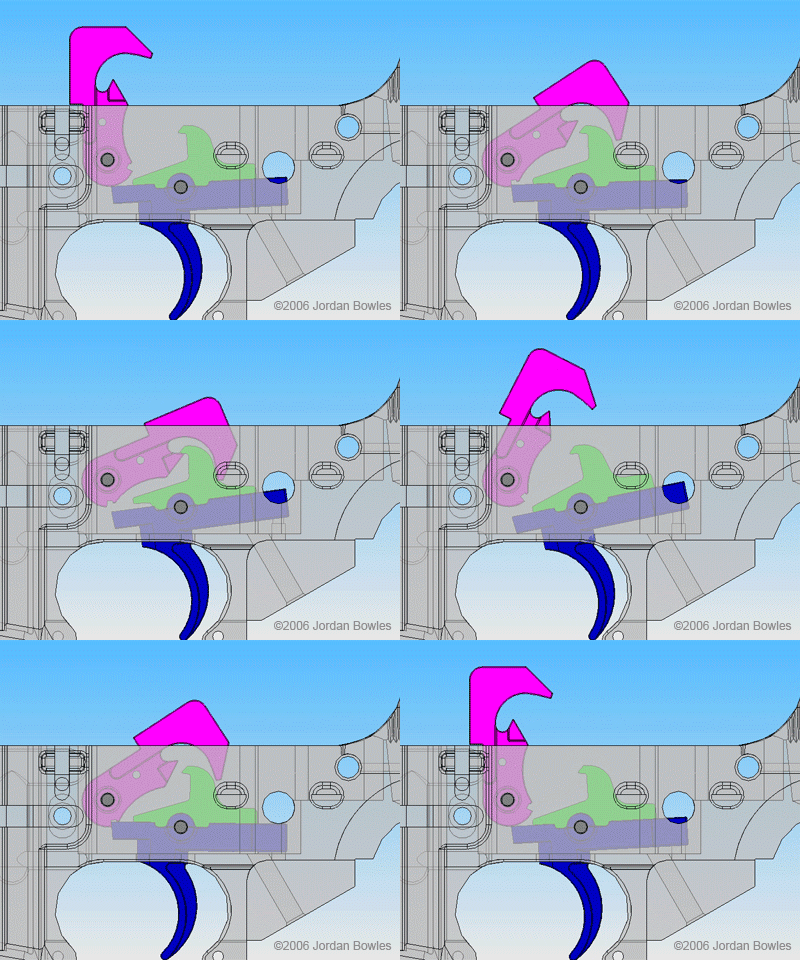
The opinion by Justice Clarence Thomas includes extensive technical information on how the internal parts of AR-15 rifles function, including diagrams and an animated graphic showing the movement of the parts. Firing a rifle with a bump stock still requires a separate function of the trigger for each shot, and it is not "automatic" because it will not fire without constant manual pressure on the handguard. The Court has never before ventured into such a detailed explanation about how a firearm works.
While the Court's discussion of how the trigger, sear, disconnector, and bolt interact in the firing sequence is quite technical, the decision embodies broader implications that are significant in other contexts.
First, it is settled once and for all that a semiautomatic is not a machinegun. That should be a no-brainer, but plaintiffs alleged that AR-15s are machineguns in the Las Vegas, Highland Park, and Mexico civil lawsuits. Here's what the Court said: "No one disputes that a semiautomatic rifle without a bump stock is not a machinegun because it fires only one shot per 'function of the trigger.'"
Is it outside the bounds of acceptable professional conduct for a faculty member to excoriate University leadership, faculty, staff, or students with the intent to arouse external intervention into University business? And does the broad publication of such views cross a line into sanctionable violations of professional conduct?
Yes it is and yes it does.
Vigorous debate is to be expected and encouraged at any University interested in promoting freedom of expression. But here is the rub: As the events of the past year evidence, sharply critical speech from faculty, prominent ones especially, can attract outside attention that directly impedes the University's function.
A faculty member's right to free speech does not amount to a blank check to engage in behaviors that plainly incite external actors — be it the media, alumni, donors, federal agencies, or the government — to intervene in Harvard's affairs. Along with freedom of expression and the protection of tenure comes a responsibility to exercise good professional judgment and to refrain from conscious action that would seriously harm the University and its independence.
In support of this position, he even notes "you can't escape sanction for shouting 'fire' in a crowded theater."
Conor Friedersdorf has an appropriate response to Dean Bobo's argument, tweeting: "Harvard Dean Lawrence D. Bobo's op-ed has incited me, an external actor, to publicly lament the subset of Harvard leaders who neither understand nor support free speech. By his logic, I guess he needs to be sanctioned."
One suggestion the article makes which is worth some consideration is that faculty should be sanctioned for encouraging students to engage in civil disobedience that violates university policies and puts the students at risk of sanction. I would agree that faculty who encourage that students put themselves at risk of punishment while they sit on the sidelines themselves are cowardly, but I disagree that encouraging others to engage in civil disobedience is itself civil disobedience that can or should be sanctioned.
Regrettably, this is not the first time I have heard university administrators suggest that speech by faculty or other members of the university community should be curtailed if it might generate controversy, provoke a response, or otherwise reflect poorly on the university. (I can also say, from personal experience, that if my university had ever adopted such a position, I would have been among those in the crosshairs.) That there are university administrators -- let alone prominent professors such as Dean Bobo -- who do not recognize the profound threat such a position poses to academic freedom and the truth-seeking function of a university is both sobering and depressing.
I was in the Court when Trump v. Hawaii was handed down. I remember the scorn with which Justice Sotomayor referred to "President Donald Trump" by name. It was visceral. However, in Cargill v. Garland, Justice Sotomayor name-dropped President Trump in a good way. She wrote:
Shortly after the Las Vegas massacre, the Trump administration, with widespread bipartisan support, banned bump stocks as machineguns under the statute.
Now, there is no reason to mention the President's name when referring to a rulemaking. It was a regulation promulgated by ATF, not signed by the President. But the import here is that even a right-wing fascist like Trump thinks this rule is sensible. Moreover, it is strange to think of a regulation having "bipartisan support." Usually, when people on both sides of the aisle agree on a policy, legislators pass a statute, which the President can sign. But there was no statutory amendment here. Indeed, President Trump was quite clear that he didn't want Congress to pass a statute, and directed ATF to change the rule. Presidential administration in action! (Justice Kagan probably was proud.)
However, I saw the dynamics as presidential maladministration. ATF had a long-standing interpretation in which bump stocks were not machine guns. After the Las Vegas mass killing, there were calls to abandon that long-standing interpretation. The President directed his agencies to abandon that long-standing interpretation. And wouldn't you know it, ATF reaches the exact result the President wanted. I called it a presidential reversal. In 2019, I advanced this position in amicus briefs filed on behalf of the Cato Institute back before the Tenth Circuit and the D.C. Circuit.
Justice Thomas gestured towards this maladministration:
"ATF abruptly reversed course in response to a mass shooting in Las Vegas, Nevada. In October 2017, a gunman fired on a crowd attending an outdoor music festival in Las Vegas, killing 58 people and wounding over 500 more."
"This tragedy created tremendous political pressure to outlaw bump stocks nationwide."
"While the first wave of bills was pending, ATF began considering whether to reinterpret §5845(b)'s definition of 'machinegun' to include bump stocks."
"ATF's about-face drew criticism from some observers, including those who agreed that bump stocks should be banned."
"The final Rule also repudiated ATF's previous guidance that bump stocks did not qualify as 'machineguns' under §5845(b)."
"Moreover, it is difficult to understand how ATF can plausibly argue otherwise, given that its consistent position for almost a decade in numerous separate decisions was that §5845(b) does not capture semiautomatic rifles equipped with bump stocks."
"Curiously, the dissent relegates ATF's about-face to a footnote, instead pointing to its classification of other devices."
And here is Justice Sotomayor's footnote, in part:
The majority emphasizes that ATF previously took the position that certain bump-stock devices were not "machinegun[s]" under the statute. See ante, at 3, 19. ATF, however, has repeatedly classified other devices that modify semiautomatic rifles by allowing a single activation of the shooter to automate repeat fire as machineguns.
All of the Court's six conservatives found this statute unambiguously does not support the bump stock ban. However, the en banc Fifth Circuit could only muster eight votes for that position—one short of a majority. Please recognize that the en banc Fifth Circuit is not as conservative as critics would tell you. The other Fifth Circuit appeals that the Supreme Court heard this year did not go through the en banc court: FDA v. AHM, Rahimi, NetChoice, and CFPB. In any high-profile en banc case, there are three of four moderate Republican appointees who can vote with the Court's Democratic appointees. If those Republican appointees judges end up taking senior status during a second Trump administration, I think the en banc court would look very different.
Sign up here to receive all of the new Volokh Conspiracy posts in a daily e-mail.
The All-Argentina Issue is Here
New from Reason: a look into what Javier Milei
has accomplished and what it will take to make the most of Argentina’s window for real change. Out now
for subscribers.