The Volokh Conspiracy

Mostly law professors | Sometimes contrarian | Often libertarian | Always independent | Est. 2002

The Volokh Conspiracy

Free Speech

Massachusetts High Court Upholds Ban on Picketing Within 200 Feet of Courthouse in Karen Read Murder Trial

|

From Spicuzza v. Commonwealth, decided yesterday by the Massachusetts High court:

The petitions stemmed from the ongoing trial, in the Superior Court in Norfolk County, in Commonwealth vs. Karen Read. Read has been indicted for murder, among other crimes, and the case has garnered significant public interest, including protests and demonstrations in the vicinity of the court house complex….

The trial court issued an order stating,

no individual may demonstrate in any manner, including carrying signs or placards, within 200 feet of the courthouse complex during trial of this case, unless otherwise ordered by this Court. This complex includes the Norfolk Superior courthouse building and the parking area behind the Norfolk County Registry of Deeds building. Individuals are also prohibited from using audio enhancing devices while protesting….

The Massachusetts high court upheld the order:

Read More

Climate Change

Are State Law Climate Change Tort Suits Preempted by Federal Law?

A recent panel discussion on whether state and local suits against fossil fuel producers are preempted by federal law (and my arguments for why the answer is "no, they are not").

|

Honolulu, like many state and local governments around the country, is suing fossil fuel companies alleging a range of state-law torts related to climate change. The defendants in such cases have been trying to get the suits dismissed, or transferred to more favorable forums.

Initially the defendants sought to have the cases removed to federal court, but those efforts universally failed. Now they are trying to claim that the various state-law claims are preempted by federal law.

The Hawaii Supreme Court rejected the preemption claims in Honolulu v. Sunoco. Now Sunoco and the other defendants are seeking certiorari on the preemption claims.

As long time readers know, I believe the argument that these tort claims are preempted (or displaced) by federal law are baseless. (My longer article on the subject is here.) The federal common law of interstate nuisance may have been displaced by federal environmental regulation, but the Supreme Court has explicitly held that federal environmental statutes do not preempt state law claims (though they do prevent plaintiffs in one state from extra-territorializing the substantive standards of their state's laws). Indeed, other than with regard to product standards, federal environmental law rarely preempts state law. Congress could preempt much state regulation and litigation concerning climate change, it just has not done so.

Earlier this week, I participated in a webinar on this issue with AEI's Adam White, NYU law's Richard Epstein, and Alabama Solicitor General Edmund LaCour. The webinar was sponsored by the C. Boyden Gray Center for the Study of the Administrative State at the Antonin Scalia Law School of George Mason University. We had a few technical hiccups, but I think it was a substantive and worthwhile discussion (even if it was three against one).


Here are my prior posts on climate-related tort litigation (as distinct from the Juliana climate litigation):

Free Speech

Message from Johns Hopkins University President

"I am writing today to reiterate the reasons why the encampment is so problematic and why I am calling on you to end it."

|

Circulated yesterday "regarding a pro-Palestinian protest initiated at the Homewood campus April 29":

Dear Johns Hopkins Community,

I am sharing with you the message I sent earlier today to the members of the Hopkins Justice Collective and student protesters who are encamped on our Homewood campus.

As I did earlier this week, I chose to speak directly to the protesters, who include members of our community and those unaffiliated with Hopkins, to share the reasons why we are calling for an immediate end to the encampment, which contravenes multiple university policies and codes.

As we head into the final weeks of the academic year and look forward to celebrating our newest graduates at Commencement later this month, we are committed to maintaining a campus environment that values free speech, but also where everyone feels safe and welcome….

[* * *]

Dear Hopkins Justice Collective members and student protesters,

I am writing at a critical juncture in the protest. I appreciated the opportunity to meet with several of you on Monday evening at the start of the encampment you initiated on the Beach and to speak together in an open and constructive way about the purposes of your protest, including your desire to conduct the protest and any programming in a way that would ensure no violence, injury, or anti-Semitic expression.

I am writing today to reiterate the reasons why the encampment is so problematic and why I am calling on you to end it.

Read More

Free Speech

"Antisemitism Awareness Act of 2023" (Which Just Passed the House) Could Suppress First-Amendment-Protected Criticism of Israel

|

HR6090, which passed the House of Representatives Wednesday by a 320-91 vote, would provide, in relevant part,

For purposes of this Act, the term "definition of antisemitism"—

Read More

Supreme Court

Adler v. Chemerinsky on the U.S. Supreme Court

A civil discussion on the U.S. Supreme Court and its role in American life, past and present.

|

Last week, I had the honor and pleasure of participating in a forum at the University of California at Berkeley law school on the U.S. Supreme Court with Dean Erwin Chemerinsky. As one might expect, we disagreed on quite a bit.

The program, "Reshaping American Life: Today's Supreme Court in Historical Context, and its Potential Impact on our Future," was expertly moderated by Justice Carol Corrigan of the California Supreme Court and was the first in a series of programs co-sponsored by the Berkeley Judicial Institute, Bolch Judicial Institute of Duke Law, and the of the American Bar Association Litigation Section.

For those interested, here's a video of the event.

An Embarrassing Letter on Current Events from Academic Social and Personality Psychologists

|

The letter, which as of this writing has over 200 hundred signatories, starts off like this:

Social and Personality Psychologists on Student Protests for Justice in Palestine
We are a group of faculty from various demographic, religious, and ethnic backgrounds who are trained in the methods and practice of social and personality psychology. Although there are no doubt many topics on which we disagree, we are united in this call to listen to, engage with, and protect our students as they protest the mass killings of Palestinian civilians—which the International Court of Justice of the United Nations determined "could amount to genocide."

The words in quotations do not appear in the ICJ's opinion. The closest the Court comes to saying anything like that is to say that "at least some of the acts and omissions alleged by South Africa to have been committed by Israel in Gaza appear to be capable of falling within the provisions of the (Genocide) Convention." The Court, however, made no finding as to whether South Africa's allegations were true, and the Genocide Convention bars actions that are not "genocide," such as incitement to genocide. The only time the words "amount to genocide" without the "could" appear in the opinion is in the court's summary of South Africa's allegations.

It says a lot about the decline of intellectual integrity in academia that so many are willing to sign a statement without due diligence to ensure that what they are signing is accurate, and that whomever drafted the letter either did not bother to check that the letter was accurate, or knew it was inaccurate but did not care.

Free Speech

Again, Someone Trying to Vanish My Post About a Case on One-Sided Pseudonymity

|

In February, I wrote about a Fourth Circuit decision in Doe v. Sidar, which discusses one-sided pseudonymity. On Wednesday, Google received a request that it remove that post from its indexes—and thus vanish it from search results—on the theory that the post violated the copyright in a blog post, https://europeannewschannels.blogspot.com/2024/01/fourth-circuit-on-one-sided.html:

Re: Unknown
NOTICE TYPE: DMCA

Copyright claim 1
KIND OF WORK: Unspecified
DESCRIPTION[:] The decision allows such pseudonymity when the defendant has already been found (by default judgment) to have committed the assault, but Judge Wilkinson's concurrence argues that, absent this unusual factor, one-sided pseudonymity should be frowned on.

ORIGINAL URLS: 01. https://europeannewschannels.blogspot.com/2024/01/fourth-circuit-on-one-sided.html

ALLEGEDLY INFRINGING URLS: 01. https://reason.com/volokh/2024/02/21/fourth-circuit-on-one-sided-pseudonymity-in-sexual-assault-cases/

JURISDICTIONS[:] CA

The blogspot.com post has apparently been removed, but there appears to be an archived version here. According to that archive, the supposedly "original" blogspot post purports to have been published Jan. 30, 2024, more than three weeks before the Fourth Circuit opinion (which the post quotes) was released. And the blogspot post talks about and quotes what it refers to as "my amicus brief" in the case; that's actually my brief, which court records show was written by me, and not a brief written by the blogspot post's author. (See also this post from March describing two similar requests that had a similar structure.) [UPDATE 5/3/24, 11:55 am: This paragraph has been revised in light of the archived version (which I hadn't been able to find when I first put up the post); thanks to commenter ReadMyLips88, who pointed me to the archived version.]

This appears to be a known sort of deindexing trick, which I discussed at pp. 300-01 of my Shenanigans (Internet Takedown Edition) piece, and which has been known as far back as 2016, see this Tim Cushing (TechDirt) piece, and likely even earlier. (Again, I say "appears to be" just because the blogspot.com post has been deleted, so I can't verify this, but this seems very likely to be so based on the similarities to what I described here.) Fortunately, it appears that Google has not acted on this request, and I expect that it will not.

I unfortunately can't tell who is behind this; the deindexing requests have submitters' names attached, but those could be just as fake as the rest of the request. But in any event, I thought I'd mention what's going on here. For those curious to see what someone wants to hide, I copy my original post below.

Read More

The Senate's "Longer Lines, Less Security" Caucus

The Merkley-Kennedy Amendment Would Prevent Travelers From Choosing TSA Lanes with Face Recognition

|

There's a new proposal on Capitol Hill to improve air travel. On the one hand, it will slow down passenger screening and lengthen checkpoint lines.  On the other hand, it will make you a little less safe.

Remarkably, the idea of combining slower TSA wait times with weaker security has bipartisan support from fourteen Senators, led by Sen. Merkley (D-OR) and Sen. Kennedy (R-LA). Naturally, they're not selling their proposal that way. Instead, they claim to be saving air travelers from themselves -- and from Big Brother.

They're wrong on all counts.

The Merkley-Kennedy amendment to FAA reauthorization will be offered in the next few days. If passed, it would prevent TSA from expanding its use of face recognition technology in place of ID checks.

This is remarkable. We've all gone through TSA checkpoints juggling a carry-on in one hand and a briefcase or purse in the other while using any leftover hands to hold wallets and present IDs to the TSA officer. Lacking four hands, each passenger spends time fumbling with these items at the checkpoint, guaranteeing an extra couple of minutes' delay; at a busy airport, that all adds up to much longer wait times for everyone

TSA's pilot project, Touchless ID, is far more efficient.  I saw it in action at Atlanta's airport as a member of the Commission on Seamless and Secure Travel. Passengers walk up, stand on a circle, look at the camera, and are cleared in seconds. Even when the neighboring PreCheck line was backed up, the lane for Touchless ID never had more than one or two people in it. I've never seen happier people at a TSA checkpoint.

Maybe that's what worries politicians and groups like the ACLU, who have campaigned relentlessly against facial recognition. They're afraid they'll lose if they let ordinary travelers make up their own minds about TSA and facial recognition.

It sure looks like that's what Senators Merkley and Kennedy have in mind. Their amendment would flat-out prohibit TSA from expanding face recognition at its checkpoints -- in Atlanta or at an airport near you.

What justifies this ban? Well, advocacy groups claim that face recognition invades privacy and discriminates based on travelers' race. But neither charge is true.

Privacy fears are particularly overdone; the system I saw compared a picture the government already had (a passport photo) to a picture taken at the checkpoint and then discarded. And everyone who got in that lane knew what they were doing; the whole process is built on consent

Claims of bias based on skin tone or race, meanwhile, are years out of date. According to recent studies by TSA and CBP and by NIST, facial recognition systems demonstrate a negligible difference in accuracy when identifying members of different groups, as long as the systems use good algorithms, good lighting, and good cameras. TSA's sister agency, Customs and Border Protection (CBP), uses such a system already, and in daily use, it shows no significant demographic disparities, operating at an accuracy rate that consistently exceeds 98 percent.

What about security? It turns out that human beings are nowhere near 98 percent accuracy when they check ID. The technology is far better at matching faces than even experienced passport examiners. As for bias, it's worth remembering that handing decisions to human being doesn't eliminate that risk. If you want to be safer, and run less risk of bias, algorithmic face recognition is the better choice.

That leaves just one question for supporters of the Kennedy-Merkley amendment.

Why are you afraid to let travelers make their own decisions about face recognition?

Politics

Today in Supreme Court History: May 3, 1802

|

5/3/1802: Washington D.C. incorporated as the capital of the United States. Article I, Section 8 empowers Congress to "To exercise exclusive Legislation in all Cases whatsoever, over such District (not exceeding ten Miles square) as may, by Cession of particular States, and the Acceptance of Congress, become the Seat of the Government of the United States."

Housing Policy

How Immigration Restrictions Reduce Housing Construction and Exacerbate Shortages

A new study shows deportation of undocumented migrants reduces housing construction by diminishing the supply of workers needed to do it.

|

Wooden block homes with a ban sign
Andrii Yalanskyi/Dreamstime.com

The most significant factor inhibiting the construction of new housing in the United States - resulting in severe housing shortages in many areas - is exclusionary zoning. But a new study suggests immigration restrictions contribute to the problem, by reducing the supply of workers. Here's the abstract to the paper by economists Troup Howard, Mengqi Wang, and Dayin Zhang:

US housing markets have faced a secular shortage of housing supply in the past decade, contributing to a steady decline in housing affordability. Most supply-side explanations in the literature have tended to focus on the distortionary effect of local housing regulations. This paper provides novel evidence on a less explored channel affecting housing supply: shortages of construction labor. We exploit the staggered rollout of a national increase in immigration enforcement to identify negative shocks to construction sector employment that are likely unrelated to local housing market conditions. Treated counties experience large and persistent reductions in construction workforce, residential homebuilding, and increases in home prices. Further, evidence suggests that undocumented labor is a complement to domestic labor: deporting undocumented construction workers reduces labor supplied by domestic construction workers on both extensive and intensive margins.

The basic idea here is fairly intuitive Economics 101: immigrants - including undocumented immigrants - are an important part of the construction work force. Reducing the number of available workers increases the price of construction, and thereby reduces output.

More counterintuitive is the finding that reducing the number of undocumented construction workers also reduces employment for native workers. But, as the authors point out, this can occur when native-born and immigrant workers in the industry are complements, rather than substitutes. Previous studies document such effects in other industries, and it can occur in this one, too. The authors' findings are consistent with recent work by noted immigration economist Michael Clemens showing that mass deportation - on net - reduces job opportunities for native workers more than it expands them.

Obviously, as the authors recognize, immigration can also increase demand for housing, thereby increasing prices. Similarly, deporting immigrants (or any other group) can reduce demand, thereby lowering prices. But the authors show this effect is outweighed by the ways in which deportation reduces supply, thereby leading to a net increase in housing prices when more immigrants get deported. This makes intuitive sense: allowing in a group that is disproportionately represented in the housing construction industry can result in sufficient new construction to both meet the extra demand created by that group, and also build additional new housing for others.

None of this proves that immigrant workers never displace native-born ones (or vice versa). Similarly, immigrants can sometimes outbid natives for housing (and, again, vice versa). But, on net, the two groups benefit each other economically far more than the reverse. That appears to be true in the housing sector, as in the economy more generally.

If this seems implausible, consider the impact on white males of allowing more women and minorities to compete on a more equal basis in the labor force in the twentieth century.  I summarize this comparison in my last post on the impact of deportation:

One helpful way to think about the issue is to ask whether the twentieth-century expansion of job market opportunities for women and blacks helped white male workers, on net, or harmed them. Some white men likely were net losers. If you were a marginal white Major League Baseball player displaced by Jackie Robinson or other black baseball stars after MLB was integrated, it's possible that you would never find another job you liked as much as that one. But the vast majority of white men were almost certainly net beneficiaries by virtue of the fact that opening up opportunities for women and blacks greatly increased the overall wealth and productivity of society.

If, today, we barred women from the labor force, or restricted them to the kinds of jobs open to them a century ago, some male workers would benefit….

But, overall, men would be much poorer, by virtue of living in a far less productive and innovative society. And many men would lose jobs or suffer decreases in wages because their own productivity depends in part on goods and services produced by women….

Similar consequences would occur if we were to reinstitute racial segregation, thereby severely restricting the job opportunities of black workers. While some whites would come out ahead, most would be net losers, as our economy becomes much less productive.

The key point to remember is that the economy—including the labor market—is not a zero-sum game. Men and women, blacks and whites—and immigrants and natives—can all prosper together, if only the government would let them.


Free Speech

UCLA Chancellor's Statement

|

Just circulated:

Our community is in deep pain. We are reeling from days of violence and division. And we hope with all our hearts that we can return to a place where our students, faculty and staff feel safe and, one day, connected again.

Our approach to the encampment that was established on Royce Quad last week has been guided by several equally important principles: the need to support the safety and wellbeing of Bruins, the need to support the free expression rights of our community, and the need to minimize disruption to our teaching and learning mission.

The events of the past several days, and especially the terrifying attack on our students, faculty and staff on Tuesday night, have challenged our efforts to live up to these principles and taken an immense toll on our community.

We approached the encampment with the goal of maximizing our community members' ability to make their voices heard on an urgent global issue. We had allowed it to remain in place so long as it did not jeopardize Bruins' safety or harm our ability to carry out our mission.

But while many of the protesters at the encampment remained peaceful, ultimately, the site became a focal point for serious violence as well as a huge disruption to our campus.

Read More

Democracy

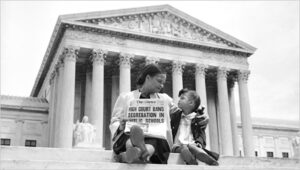
New Article on "Brown, Democracy, and Foot Voting"

My contribution to the American Journal of Law and Equality symposium on the 70th anniversary of Brown v. Board of Education.

|

Brown v. Board of Education. (NA)


This year is the 70th anniversary of Brown v. Board of Education, arguably the Supreme Court's most iconic decision. The American Journal of Law and Equality is publishing a symposium on the topic, and I am one of the participants. A draft of my contribution, entitled "Brown, Democracy, and Foot Voting," is now available on SSRN. Here is the abstract:

Traditional assessments of Brown's relationship to democracy and popular control of government should be augmented by considering the ways it enhanced citizens' ability to "vote with their feet" as well as at the ballot box. Brown played a valuable role in reinforcing foot voting, and this has important implications for our understanding of the decision and its legacy.

Part I of the article summarizes the relationship between foot voting and ballot box voting, and how the former has important advantages over the latter as a mechanism of political choice. Relative to ballot box voting, foot voting offers individuals and families greater opportunities to make decisive, well-informed choices. It also has special advantages for minority groups, including Blacks.

Part II considers traditional attempts to reconcile Brown and democracy, through arguments that the decision was actually "representation-reinforcing." While each has its merits, they also have significant limitations. Among other flaws, they often do not apply well to the Brown case itself, which famously originated in a challenge to segregation in Topeka, Kansas, a state in which – unlike most of the South – Blacks had long had the right to vote.

Part III explains how expanding our understanding of Brown to include foot voting opportunities plugs the major holes in traditional efforts to reconcile the decision and democratic choice. Among other advantages, the foot-voting rationale for Brown applies regardless of whether racial minorities have voting rights, regardless of whether segregation laws are motivated by benign or malevolent motives, and regardless of whether the targeted ethnic or racial groups can form political coalitions with others, or not.

In Part IV, I discuss the implications of the foot-voting justification of Brown for judicial review of other policies that inhibit foot voting, particularly in cases where those policies have a history of illicit racial motivations. The most significant of these is exclusionary zoning.

As noted in the article, producing a thesis on Brown that is both new and useful is a tall order. Few if any other judicial decisions have been analyzed so much. But, as the saying goes, "fools rush in where the wise fear to tread." And so I accepted the journal's invitation.

I welcome comments, suggestions, and criticisms.


Judges Encouraging Oral Argument Opportunities for Junior Lawyers

|

Various district courts have put out such orders; here's the most recent I've seen, a Standing Order on Requests for Hearings and Oral Arguments from Magistrate Judge David Horan (N.D. Tex.):

With regard to possible oral argument or an evidentiary hearing, the Court notes a trend today in which fewer cases go to trial and in which there are fewer speaking or "stand-up" opportunities in court, particularly for junior lawyers (that is, lawyers practicing for less than seven years). The Court encourages litigants to be mindful of opportunities for junior lawyers to conduct hearings or oral argument before the Court, particularly hearings or oral arguments as to which the junior lawyer drafted or contributed to the underlying motion or response.

In those instances in which the Court is inclined to rule on the papers, a representation that the oral argument would be handled by a junior lawyer – or by a lawyer who has more than seven years in practice but who has had less than five speaking appearances in any federal court – will weigh in favor of holding oral argument. The Court understands that there may be circumstances in which having a junior lawyer handle a hearing or oral argument might not be appropriate – such as where no junior lawyers were involved in drafting the motion or response or where the motion might be dispositive in a "bet-the-company" type case.

Even so, the Court believes it is crucial to provide substantive speaking opportunities to junior or other less experienced lawyers and that the benefits of doing so will accrue to junior lawyers, to clients, and to the profession generally. The Court encourages all lawyers practicing before the Court to keep this goal in mind.

This relates to a potentially complicated matter in many professions, I think.

Read More

Do Fourth Amendment Protections Change When Property Is Moved?

A new lecture on a recurring topic.

|

This past fall, I had the pleasure of being the Michael A. Doyle '62 and Bunny Winter Distinguished Visiting Professor at Yale Law School.  As part of that appointment, I recently delivered a lecture on a topic that is the subject of my most recent (as-yet-unavailable) draft article: What happens to Fourth Amendment protection when property is moved?  Three quick examples from recent cases give you a flavor of the problem:

  • Officers arrest a man who is carrying a backpack. For their own safety, officers initially remove the backpack, place it twenty feet away.  They return to the backpark and search it later. The Fourth Amendment permits a warrantless search of property on the person incident to his arrest, but it does not allow a search outside the person's area of immediate control.  Did the officers' placing the backpack outside the area of immediate control mean the government could no longer search it?
  • Officers want to arrest a suspect at home, but they lack the arrest warrant needed to enter the home to make the arrest. From their position outside, officers point their guns at the suspect inside and order him to exit the house. The man complies with the order, leaves his house, and he is arrested outside. Was a warrant needed?
  • Fourth Amendment protections are weak at the international border. Officials seize a suspect's computer at the border, but they lack the expertise to search it there. Officials bring the computer a few hundred miles inland to a computer forensics expert who searches the computer there. Is the search governed by the weak rules of searches at the border or the strong rules of searches inland?

The lecture, "Searching, Seizing, and Moving," is available below, preceded by an overly kind introduction by Dean Heather Gerken:

I plan to finish the draft of this article over the summer, and I'll post it when it's  available. In the meantime, comments on the lecture version are very welcome.

Climate Change

Ninth Circuit Puts An End to the Kids Climate Case

A unanimous panel orders dismissal of Juliana v. United States, bringing this zombie litigation to a close.

|

Today a unanimous panel of the U.S. Court of Appeals for the Ninth Circuit granted the U.S. Department of Justice's petition for a writ of mandamus seeking dismissal of Juliana v. United States, the so-called "Kids Climate Case."

The brief order was short and direct. It noted that the Ninth Circuit had previously concluded that the plaintiffs lacked standing and ordered the case dismissed. Contrary to the plaintiffs' claims, no intervening decisions changed that fact, and that there was no basis for the district court to allow the plaintiffs to amend the complaint.

This decision should not have been a surprise. It should also be a relief to those who hope to see further climate litigation, as the Ninth Circuit panel saw no need to consider issues beyond the plaintiffs' Article III standing, and dismissal of the case obviates any need for the DOJ to seek Supreme Court review. Judge Aiken was wrong to revive this case, and now the Ninth Circuit has killed it for good.

Meanwhile, there are other (more well-grounded) climate cases proceeding in state courts under state law. More on those cases in future posts.

I've reproduced the Ninth Circuit's order after the jump.

Read More

Free Speech

Ohio State University President's Statement on Clearing of Protest Encampments

|

Released Monday by OSU President Ted Carter; I'm not up on the factual details, but I agree that such encampments can and should be forbidden under content-neutral time, place, and manner rules, and those rules should be enforced:

Listening to the feedback from our community over the last several days, I want to set the record straight regarding the events that took place on the South Oval on April 25.

I value and welcome free speech. I have spoken to this since the day I arrived here at Ohio State. As many of you know, I wore the cloth of our nation for 38 years to support and defend these rights. What occurred on our campus on April 25 was not about limiting free speech. It was an intentional violation of university space rules that exist so that teaching, learning, research, service and patient care can occur on our campuses without interruption.

As a public university, demonstrations, protests and disagreement regularly occur on our campus — so much so that we have trained staff and public safety professionals on-site for student demonstrations for safety and to support everyone's right to engage in these activities. Sadly, in recent days, I have watched significant safety issues be created by encampments on other campuses across our nation. These situations have caused in-person learning and commencement ceremonies to be canceled. Ohio State's campus will not be overtaken in this manner.

We have been abundantly clear in a multitude of communications that Ohio State has and will enforce the law and university policy, which is what we did on April 25. I most recently stated this in a campus message on April 22. Dr. Shivers again reinforced this and the rules that apply to Finals Week in a message to all students on April 23.

The university's long-standing space rules are content neutral and are enforced uniformly. Thursday's actions were taken because those involved in creating the encampment on the South Oval were in violation of these rules and had been notified of this beginning at 4:30 a.m. when the first encampment was attempted, and continuing repeatedly throughout the day. During and after the attempted encampment on Thursday morning, students asked our demonstration staff pointed questions about the space rules and received answers, confirming they were aware of the rules.

Read More

More