The Volokh Conspiracy

Mostly law professors | Sometimes contrarian | Often libertarian | Always independent | Est. 2002

The Volokh Conspiracy

Free Speech

No Pseudonymity in Race Discrimination Lawsuit over Academic Dishonesty Finding

|

From Doe v. Univ. of Pennsylvania, decided Friday by the Third Circuit, in an opinion by Judge Tamika Montgomery-Reeves, joined by Judges David Porter and Jane Roth:

In 2020, Doe enrolled as a student in UPenn's Pre-Med Post-Baccalaureate Program …. She planned to complete the Program in Spring 2021 and apply to medical school. Doe alleges that a chemistry professor in the Program discriminated against her based on her race by denying her extensions, grading her unfairly, and reporting her for academic dishonesty. She reported this discrimination to UPenn. According to Doe, UPenn retaliated by launching a deficient academic integrity investigation, finding she committed academic dishonesty, and suspending her for one and a half years. Doe further contends that

[b]y improperly suspending Plaintiff and placing a notation on her transcript and disciplinary record, UPenn has damaged Plaintiff's future educational and career prospects. Specifically, as a result of UPenn's actions, Plaintiff will be forced to disclose and explain to medical schools and potential employers to which she may opt to apply that she was disciplined at UPenn for academic dishonesty….

As a result, Plaintiff has suffered and will continue to suffer reputational damage, economic losses, and damages to her future educational and career prospects.

The District Court refused to let Doe sue pseudonymously (under Title VI and state contract law), and the Third Circuit held that this was not an abuse of discretion:

Read More

Free Speech

Stanford President's Message About Student Misconduct "as Part of a Protest March"

|

From a message posted Thursday:

Stanford President Richard Saller today made the following remarks to the Faculty Senate:

On Monday evening, as part of a protest march on campus, a group of individuals entered an engineering building where students were present and working in labs. The marchers who entered the building blocked entryways with constructed barricades they had brought with them and furniture from the building, and vandalized an interior wall and door with spray paint.

Read More

Supreme Court

Justice Sotomayor Speaks on Her "Desperation" on the Court

Recent remarks at Harvard may be a preview of what is to come.

|

The New York Times reports on recent remarks by Justice Sonia Sotomayor at Harvard University's Radcliffe Institute.

Some days, after Justice Sonia Sotomayor listens to the Supreme Court announce its decisions, she goes into her chambers, shuts the door and weeps.

"There are days that I've come to my office after an announcement of a case and closed my door and cried," Justice Sotomayor told a crowd on Friday at the Radcliffe Institute at Harvard University, where she was being honored. "There have been those days. And there are likely to be more." . . .

"There are moments when I'm deeply, deeply sad," she said, without citing any specific cases. "There are moments when, yes, even I feel desperation. We all do. But you have to own it, you have to accept it, you have to shed the tears and then you have to wipe them and get up."

In saying there "are likely to be more" trying days on the Court was Justice Sotomayor providing a hint of what the Court will do this term? Or is it merely an indication of what she expects in coming years given the current makeup of the Court?

Earlier this term, Justice Jackson may have dropped a hint on the outcome of Loper Bright and Relentless.

Short Circuit: A Roundup of Recent Federal Court Decisions

Private prisons, Pyrrhic victories, and a single-family hotel.

|

When Texas journalist Justin Pulliam started recording the response of the Fort Bend County Sheriff's Office to a mental health call in December 2021, he didn't know that he would end up arrested and charged with interfering with a police officer. And when his criminal trial ended in a hung jury in April 2023, he hoped that would be the end of it. This week, after making Justin wait more than a year, the county formally dismissed the charges against him. But Justin's federal lawsuit against the county for violating his First Amendment rights continues. Learn more here.

Read More

Trans

Life in the Academy

|

It's an understatement to say that it's been difficult to be in the academy in this period. Teaching and learning through Covid, the push from some quarters to redefine the academic mission away from open inquiry pursued through the tools of one's discipline and toward a particular set of social justice goals, and then the creeping incivility about it all, introduced new forms of stress into our lives. For those of us whose work puts us squarely in the heart of the culture wars, as mine does, the situation has been especially difficult as we've been subject to—you know the drill—censorship and de-platforming, cancelation and, in some famous cases—see, e.g., Kathleen Stock and Carole Hooven—even separation.

I'm relatively privileged because even as I have and continue to be subject to these strategies, my institutions—Duke University and the divisions of which I'm a part, including Duke Law School—have consistently stood by my right to do my work. Even still, things were bad enough at certain points that I was checking my pension balance to see if there was a realistic possibility of stepping out. There wasn't, but regardless, it shouldn't be this way.

No one person or political faction—regardless of whether they're on the left or the right—should have the power to turn a university, a department, or a classroom into a place where the important questions of the day can't be discussed in an honest way. Moreover, academic freedom, intellectual engagement, and civil discourse aren't values owned by conservatives or liberals; they're among the defining features of a modern university without which its societal importance is difficult to justify.

I'll leave you with these two related excerpts from a section of Chapter Eight of On Sex and Gender called The Left's Assault on Free Expression. The first is about my personal experiences with censorship, de-platforming, and cancelation in the academy, including as they played out during that visit to UCLA law that I mentioned in my first post. The second elaborates on the relationship between these strategies to the broader questions with which we're currently engaged about the mission of the university and its role in society.

(Other parts of the chapter contain a lengthier discussion of censorship, cancelation, and de-platforming as strategies outside of academia, including additional examples from my own experience.)

For a time, the censorship of my name, my work, and the facts and science on which I rely was only an issue outside of the academy. Mainly it was a press issue. That all changed in 2020.

At the invitation of First Amendment scholar Eugene Volokh and the Federalist Society, right before the country shut down for Covid, I gave a talk at UCLA on Title IX and ways to accommodate transgender girls in girls' and women's sports.

Leftist student organizations sent protestors with posters calling me a 'TERF" and a "transphobe" and my work "transphobic"—along with "Fuck TERF" and "Transphobia is not welcome here"—to disrupt the event. They lined the hallway to the lecture room and then interrupted the beginning of my remarks to read their manifesto—the protest appears to have been led by a Marxist student organization—before clearing the lecture hall by threatening to report any students who stayed to listen to any prospective employers: Anyone who listens to a transphobe is a transphobe. They then photographed the mostly empty room and posted the image on Twitter with a comment to the effect that no one wants to hear what I have to say.

Read More

Justice Thomas's Concurrence in Alexander v. SC NAACP

I think Justice Thomas is setting up to find that the Voting Rights Act is unconstitutional, at least with regard to redistricting.

|

On Thursday, the Court decided Alexander v. South Carolina Conference of the NAACP. This redistricting case was unique in that it was brought directly under the Constitution, rather than under the Voting Rights Act. The Court split 6-3 along the right-left divide. The majority held that race did not predominate in drawing the congressional district. Justice Alito's majority opinion afforded a presumption of good faith to the legislature. At most, the Court found, the legislature sought to decrease the political power of Democrats. I don't have much to say about these doctrinal points in the majority, or Justice Kagan's dissent.

Instead, I train my focus where it usually goes: Justice Thomas's concurrence. He wrote "separately to address whether our voting-rights precedents are faithful to the Constitution." Thomas explains that the Court "has no power" to decide these redistricting claims under the Constitution. Thomas's opinion received the usual blowback in the press, but as usual, he shifts the Overton window, and now we are talking about whether the VRA may be unconstitutional.

First, Justice Thomas explains that there are no judicially manageable standards to resolve such racial gerrymandering claims. Here, Thomas echoes Rucho: "Determining the proper shape of a district is a political question not suited to resolution by federal courts." In this regard, Justice Thomas sees no difference between political and racial gerrymanders.

Second, Justice Thomas wrote that "The Constitution contemplates no role for the federal courts in the districting process." He wrote that the Elections "Clause makes Congress the exclusive federal authority over States' efforts to draw congressional districts, to the exclusion of courts." And the Reconstruction Amendments did not change that analysis.

Third, Justice Thomas observes that the Fourteenth and Fifteenth Amendments do not provide a "textual basis for judicial resolution of districting claims." Instead, Thomas explains, "Reconstruction Amendments are perfectly consistent with Congress's exclusive authority to oversee congressional districting." Thomas, citing Chris Green, contends that the Equal Protection Clause only focuses on protecting people and property from violence, not discrimination. Likewise, the Privileges or Immunities Clause, the Citizenship Clause, and the Due Process Clause have no bearing on the issue. By contrast, "The express provision of a nonjudicial remedy for voting-rights violations in [Section 2 of the Fourteenth Amendment] counsels against reading §1 to allow judicial remedies implicitly in those same voting-rights disputes." Yes, everyone is fixated on Section 3, but don't forget about Section 2. (Gerard Magliocca may be the only legal scholar on planet earth with actual expertise on both Section 2 and Section 3.) Moreover, Justice Thomas writes that the Fifteenth Amendment only concerns "access to the ballot," and "not a claim about the way minority voters [are] distributed."

Thomas concludes:

At this juncture, I see no directive in the Reconstruction Amendments for courts to police the lines between political districts. Instead, the Elections Clause assigns the responsibility for supervising the States' drawing of congressional districts solely to Congress.

Thomas makes these points in the context of justiciability, but I think they sweep far more broadly. If the text of the Fourteenth and Fifteenth Amendments do not provide any sort of textual authority over redistricting, then those provisions cannot be the jurisdictional hook for the Voting Rights Act. Stated plainly, if Thomas is right about the Fourteenth and Fifteenth Amendments, then the Voting Rights Act could not be constitutionally applied to redistricting. The federal courts absolutely could not redraw maps. This would be a gargantuan shift in the law. To be sure, only Justice Thomas reached this conclusion. But his solo opinions have a way to plating seeds and growing roots.

Fourth, Justice Thomas raises the issue of whether the federal courts even have the equitable power to draw remedial maps.

The Court's insistence on adjudicating racial gerryman-dering and vote dilution claims has also tempted it to ignore constitutional limits on its remedial powers. Ultimately, the only remedy for the constitutional injuries caused by an illegally drawn map is a new map. But, federal courts lack "the power to create remedies previously unknown to equity jurisprudence." Grupo Mexicano de Desarrollo, S. A. v. Al-liance Bond Fund, Inc., 527 U. S. 308, 332 (1999). And, there is no "indication that the Framers had ever heard of courts" playing any role in resolving electoral districting problems. Rucho, 588 U. S., at 699. The power to redraw a States' electoral districts therefore exceeds "the jurisdiction in equity exercised by the High Court of Chancery in England at the time of the adoption of the Constitution and the enactment of the original Judiciary Act."

Thomas concludes:

No court has explained where the power to draw a replacement map comes from, but all now assume it may be exercised as a matter of course.

Again, Alexander was brought under the Constitution, and not under the Voting Rights Act. Seth Barrett Tillman and I have written quite a bit about whether parties can seek affirmative relief under the Constitution in the absence of a federal cause of action. Barely a month ago, Justice Thomas wrote for the unanimous Court in DeVillier v. Texas, "constitutional rights are generally invoked defensively in cases arising under other sources of law, or asserted offensively pursuant to an independent cause of action designed for that purpose." Tillman and I thought this passage was significant. It may have been on Thomas's mind in Alexander.

I will likely have much more to say about the equitable issue in due course. Relatedly, the Eighth Circuit held that the Voting Rights Act does not create an implied cause of action. This issue has now been circulated to the en banc Fifth Circuit.

Finally, Justice Thomas opined on what must be a issue that is quite personal to him: the majority of black voters are Democrats, so any effort to dilute the political power of Democrats will invariably dilute the political power of black voters.

As the Court observes, roughly 90% of black voters in South Carolina supported the Democratic candidate in the last Presidential election. Ante, at 4, and n. 2. When nearly all black voters support Democrats, an effort to strategically sort Democratic voters can be indistinguishable from an effort to strategically sort black voters. In this case, all Democratic-leaning maps presented during the districting process featured a black share of the voting-age population of 21% or higher, and all Republican-leaning maps featured a black voter share of 17% or lower. Ante, at 15. The dispute in this case therefore focuses on whether that correlation reflected a racial purpose, or merely reflected the result of a political purpose.

Justice Thomas also flips the argument around, as the Plaintiffs assert that blacks who are not democrats cannot represent black voters:

The plaintiffs' argument therefore assumes that the "candidate of choice" for black voters is simply a black candidate. But, the stereotyping is worse than that. In 2016, South Carolina reelected Republican Tim Scott to the United States Senate; Scott is the first black senator from the South since Reconstruction. The plaintiffs and their expert nonetheless decided that this race was not "considered probative for Black electoral opportunity." Supp. App. to Juris. Statement 174a. Plaintiffs' argument therefore combines two stereotypes by assuming that black South Carolinians can be properly represented only by a black Democrat.

Preach CT.

The Value of Legislative Drafting Guides

In Brown v. United States, Justice Alito relied on them, but Justice Jackson did not.

|

Today the Court decided Brown v. United States. The case turned on how to interpret the Armed Career Criminal Act (ACCA). The Court split 6-3, with Justice Alito writing the majority opinion. Justice Jackson dissented, and was joined by Justices Sotamayor and, in part, Justice Gorsuch. I don't have much to say about the substance of the opinion. One point of disagreement, however, stuck out.

Justice Alito's majority opinion relied on a legislative drafting guide:

Use of the present tense, as opposed to the past, was likely a stylistic rather than a substantive choice. Around the time of ACCA's enactment, legislative drafters were instructed, "[w]henever possible," to "use the present tense (rather than the past or future)." House Office of the Legislative Counsel, Style Manual; Drafting Suggestions for the Trained Drafter §102(c), p. 2 (1989); see also D. Hirsch, Drafting FederalLaw §5.6, p. 45 (2d ed. 1989) ("Various commentators on drafting have tried, over the years, to persuade drafters touse the present tense . . . "). So, at least in the instant context, we cannot place too much weight on the use of the present tense as opposed to the past.

Justice Jackson's dissent challenges this citation:

The majority attributes ACCA's use of the present tense to a mere"stylistic" choice by Congress, relying primarily on a contemporaneous legislative drafting manual as support for that conclusion. Ante, at 16. But the wholly speculative suggestion that ACCA's drafters actually relied on the cited manual's tense-related directives conveniently comes out of nowhere. Moreover, to the extent the majority now believes that verb tense is irrelevant when a court undertakes to interpret the text of a statute, it has taken a strange and unwarranted departure from this Court's ordinary interpretive practices. Before today, we have consistently used all aspects of a statute's text to ascertain its meaning, including the verbs that Congress chooses. See, e.g., Barton v. Barr, 590 U. S. 222, 236 (2020); Carr v. United States, 560 U. S. 438, 448 (2010); United States v. Wilson, 503 U. S. 329, 333 (1992); Gwaltney of Smithfield, Ltd. v. Chesapeake Bay Foundation, Inc., 484 U. S. 49, 57 (1987). An objection to this approach has surfaced only once before, in dissent. See Carr, 560 U. S., at 462–464 (opinion of ALITO, J.) (relying on legislative drafting manuals to suggest that the tense of the verbs in a statute was not relevant to the provision's interpretation).

I question Justice Alito's citation at this moment. One of the primary justifications to keep Chevron is that Congress has relied on this background principle when drafting legislation. Lisa Schultz Bressman and Abbe Gluck have demonstrated that drafters overwhelmingly rely on Chevron. I can see this citation being turned around against the Relentless majority. (You're welcome Justice Kagan.) Seems like an unforced error by Justice Alito. Or may be it is just another false flag.

On Flags and Collars

RBG wore her dissent jabot the day after the 2016 election.

|

In 2016, election day was on Tuesday, November 8. Against all odds, Donald Trump prevailed. The next day, the Supreme Court held a session. There were no opinions to hand down. But Justice Ginsburg still wore her "dissent" jabot. Here is Art Lien's sketch:


The symbolism of Ginsburg's jabot was unmistakable. The Associated Press reported:

The day after Donald Trump beat Hillary Clinton to win the 2016 presidential election, Supreme Court Justice Ruth Bader Ginsburg took the bench wearing a black necklace with crystals. It was a piece she typically wore to express her displeasure while reading a dissent from the bench. But Ginsburg, who had called Trump a faker ahead of the election and then apologized, had no dissents to read.

Ginsburg's collars were more than a subtle statement every time she entered the courtroom.

The Court did not return a request for comment. If you'll notice, Justice Alito is not wearing a MAGA hat.

In 2020, after RBG's death, The New York Times praised her sense of style:

Her dissent collar, a spiky bejeweled necklace on a black band from Banana Republic that had been gifted to her when she was named a Glamour Woman of the Year in 2012, she wore when she read her equally spiky dissents from the bench. (She also wore it the day after the 2016 election, which no one thought was a coincidence; the dissent collar became so famous on its own that it was memorialized in jewelry, magnets and temporary tattoos.)

I have a very, very difficult time taking the outrage over the Alitos' flags seriously. The Justices routinely convey messages through their words and deeds. Who gets to decide what is an appearance of impropriety? People who are inclined to despise the conservative Justices will draw the worst possible inferences from all of their acts. Indeed, the Alitos' neighbors remind me of the "objective observers" under the defunct Establishment Clause jurisprudence. These people are loathe to co-exist with anything they disagree with, so will take umbrage at the slightest sleights.

This story will keep going, nowhere.

Donald Trump

Cato Institute President Peter Goettler on Why Trump is no Libertarian

He also explains how the same is true of the current leadership of the Libertarian Party.

|

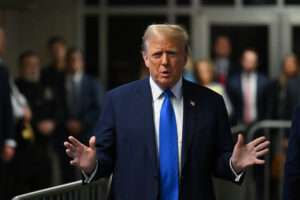
Donald Trump outside Manhattan Criminal Court
Donald Trump. (Angela Weiss/UPI/Newscom)


In a recent Washington Post op ed, Cato Institute President Peter Goettler (the head of the nation's leading libertarian think tank) explains why Donald Trump is no libertarian. Much of this should be obvious, but many people (including some libertarians) tend to ignore it:

We know by now that Donald Trump likes nothing better than stepping onto a stage, hearing his name chanted by an adoring crowd, and flashing his familiar thumbs-up sign. This week, the former president will do just that under the bright lights at the Libertarian National Convention in D.C.

It will be the first time in U.S. history that a presidential candidate of a rival party will address the convention of a party that is presumably gathering to nominate its own candidate. And this strange turn of events has many libertarians scratching their heads…

[T]he list of Trump policies and postures that libertarians oppose is long and dangerous. He allowed government spending and debt to continue to spiral upward, increasing the national debt by $8.4 trillion. Federal outlays soared from $4 trillion his first year (2017) to $6.8 trillion in his last year. He persists in railing against immigration and free trade, supports further expansion of presidential power and seeks to crack down on political enemies….

Of course, both the Republican and Democratic parties share an addiction to executive power. And neither is above using extralegal means to accomplish policy objectives, as demonstrated by President Biden's brazen efforts to cancel student loan debt. And, of course, the supreme example is the Capitol riot of Jan. 6, 2021, a tragic event that celebrated a total disregard for the peaceful transfer of power and constitutional order. Libertarians know that the Constitution and the rule of law are essential elements in keeping government power constrained.

This list of Trump's anti-libertarian policies could easily be extended. For example, he advocates imposing the death penalty on drug dealers, and wants to transform the War on Drugs into a real war by attacking Mexico. Few issues define libertarianism so clearly as opposition to the War on Drugs.

As Goettler also points out, the current leadership of the Libertarian Party (which invited Trump to address their convention) isn't libertarian, either:

[T]oday's party leadership has been taken over by a faction that places it well outside the bounds of libertarianism altogether and appears comfortable with right-wing authoritarianism. Some tweets issued from state libertarian parties and other libertarian operators can only be described as shockingly racist or antisemitic — the Libertarian Party of Michigan, for instance, posted a cartoon portraying Jews as puppet masters of the Democratic and Republican parties — and would be more welcome on the alt-right than among true libertarians.

This situation arose because in 2022, the Party was taken over by the right-wing populist "Mises Caucus," which effectively exploited flaws in party rules. Many members and donors have fled the party since then, bringing it to its weakest state in decades.

The Libertarian Party has never represented more than a minority of American libertarians. Many stayed away because of factional ideological disputes or because they believed third party politics is likely to be ineffective in an electoral system heavily tilted towards the two major parties. I myself was skeptical of the LP for a combination of both those reasons. But the right-wing populist takeover has alienated the Party from most of the broader libertarian community far more than was ever the case previously.

I don't agree with every point in Goettler's article. For example, I think he is probably overoptimistic about trends in public opinion. While it is moving in a more libertarian direction on some issues, the opposite is true on many others. I also do not believe libertarians should support a broad reduction in the nation's involvement in "foreign affairs."  Doing so would, I think, increase the influence of authoritarian states like China and Russia, thereby actually weakening prospects for liberty in much of the world. This is a longstanding divergence between my views and that of many other libertarians.

Be that as it may, Goettler does an excellent job of outlining Trump's flaws and those of the current Libertarian Party leadership. Neither deserves the support of people with any genuine commitment to liberty.

NOTE: As my bio at this site states, I am the Simon Chair in Constitutional Studies at the Cato Institute, as well as a professor at George Mason University. If readers believe I am biased in favor of Peter Goettler's views because of this connection, they are welcome to do so. But everything said above is consistent with views I have expressed for many years, including long before I became the Simon Chair at Cato in late 2022.

Inflation

Inflation, the Economy, and Political Ignorance

Public ignorance has a big impact on voter atttudes on a major issue in the 2024 election.

|

NA

Inflation and high prices have emerged as major issues in the 2024 presidential election. Public anger over these issues - and the general state of the economy - may be the single biggest obstacle to President Biden's reelection chances. A recent Harris poll commissioned by the Guardian finds that public attitudes on inflation and the state of the economy are heavily influenced by ignorance. While there really was a big increase in inflation in 2021-22, the current state of the economy is much better than most voters believe:

The poll highlighted many misconceptions people have about the economy, including:

  • 55% believe the economy is shrinking, and 56% think the US is experiencing a recession, though the broadest measure of the economy, gross domestic product (GDP), has been growing.

  • 49% believe the S&P 500 stock market index is down for the year, though the index went up about 24% in 2023 and is up more than 12% this year.

  • 49% believe that unemployment is at a 50-year high, though the unemployment rate has been under 4%, a near 50-year low….

The poll underscored people's complicated emotions around inflation. The vast majority of respondents, 72%, indicated they think inflation is increasing. In reality, the rate of inflation has fallen sharply from its post-Covid peak of 9.1% and has been fluctuating between 3% and 4% a year.

In April, the inflation rate went down from 3.5% to 3.4% – far from inflation's 40-year peak of 9.1% in June 2022 – triggering a stock market rally that pushed the Dow Jones index to a record high.

The poll also finds that 58% of respondents blame Biden for the state of the economy. This is part of a broader pattern where people credit and blame incumbent presidents for short-term economic trends, even though the latter generally have only modest influence over them.

The Guardian, of course, is a left-wing media outlet, and that viewpoint may well have influenced them to commission this survey. But Harris is a generally respected polling firm, and I don't see major flaws in the wording of the relevant questions in this survey.

Biden probably does deserve some blame for the massive outbreak of inflation in the immediate post-pandemic period. He supported massive spending increases that helped create a situation where there was a vast increase in the amount of money in the economy that was not matched by a comparable increase in production. But most of that spending was also supported by the Republicans, including President Donald Trump, when he was still in office in 2020-21. Biden also deserves blame for continuing many of Trump's tariffs (which caused significant price increases and reductions in consumer welfare) and adding some of his own.  Nonetheless, few of the policies that helped cause inflation are ones that Biden supports, but Trump would have acted differently on. There was also bipartisan support for the Federal Reserve's massive infusion of money into the economy during Covid.

The evidence in this poll is just the tip of a larger iceberg of public ignorance about inflation, prices, and related issues. For example, a February poll found that 59% of Americans believe corporate greed is a "major cause" of inflation.  Economists overwhelmingly reject that view - not because corporations aren't greedy for profits but because there is no good reason to believe corporations are more greedy during periods of high inflation or that their greed somehow has a bigger impact during such times. Corporate greed is a constant, and therefore cannot explain a variable like inflation or price changes. In this case, public ignorance may be helping Democrats at the margin, as they emphasize curbing corporate greed much more than the GOP does.

Ignorance may also explain why voters angry about inflation and high prices tend to back Trump as a result. In so doing, they ignore the fact that many of his policies would make price increases much worse. For example, Trump's plan to impose a 10% tariff on all imported goods would massively increase prices on many goods, costing the average American household about $1700 per year. This goes far beyond anything Biden proposes, though his trade record is far from wonderful.

Trump's plan for massive deportation of undocumented immigrants would also predictably lower production and increase prices in much of the economy, thereby likely stimulating inflation more generally. Contrary to popular perceptions, such deportations also destroy more jobs for native-born workers than they create, thereby making it even harder for many families to make ends meet.

Trump also plans to undermine the independence of the Federal Reserve. If he succeeds, that is likely to worsen inflation, as well. Historically, more independent central banks do a better job of constraining inflation than those more subject to political pressure.

Biden's record on inflation and prices is far from ideal. But Trump's policies are likely to be much worse. If voters focused on these issues understood that, they would be trending in a different direction.

Public ignorance about inflation and the economy is part of a broader problem of widespread political ignorance that degrades the quality of public policy. While in this instance, the ignorance is benefiting Trump and the GOP, the problem is not limited to any one side of the political spectrum and doesn't always benefit the political right rather than the left. There are many examples of ignorance and misconceptions that are disproportionately common among Democrats and left-wingers.

The fundamental problem is not that voters are stupid, but that the low chance that any one vote will decisively effect electoral outcomes gives most voters strong incentives to be "rationally ignorant" about political issues and to do a poor job of evaluating the information they do learn. That problem affects voters on all parts of the political spectrum.

It's also worth noting that public ignorance  doesn't just influence voter decisions between the available options, as with the choice between Biden and Trump this year. It also affect the quality of those options themselves. If parties faced a more knowledgeable and discerning electorate, they would have incentives to nominate better candidates, choose better policies, or some combination of both.

Instead, parties and candidates are incentivized to exploit public ignorance for electoral advantage. Trump does this on a truly massive scale, and it played a key role in his rise to power in 2016. But more conventional politicians, including left-wing ones like Barack Obama, engage in such chicanery, as well.

There is no quick and simple solution to the problem of ignorance. In my view, the best approach to addressing widespread voter ignorance and bias is to empower people to make more decisions by "voting with their feet" and fewer at the ballot box. Foot voters have better incentives to seek out information and evaluate it objectively than ballot box voters do. I go over the strengths and weaknesses other possible solutions in my book Democracy and Political Ignorance and in this more recent article.

Sadly, we are unlikely to make significant progress in curbing political ignorance in time for the 2024 election. But perhaps we can at least increase awareness of the problem, which might make it easier to address in the future.

A Family Affair for President Biden's Nominees To First and Sixth Circuits

CA6 nominee Karla M. Campbell was Judge Stranch's first law clerk, and CA1 nominee Justice Julia M. Lipez is filling the seat her father formerly held.

|

President Biden has now made his fiftieth round of judicial nominees. The two circuit nominees stand out.

First, in January 2024, Judge Jane Branstetter Stranch of the Sixth Circuit announced that she would take senior status on the confirmation of her successor. Now, Biden has nominated Karla M. Campbell to fill Stranch's seat. Campbell  spent her entire career at the Nashville firm formerly known as Branstetter, Stranch & Jennings, PLLC. If those names look familiar, it should. Jane Branstetter also started her career at that firm, where her father, Cecil D. Branstetter, was a founding partner. And Jane's husband, James Stranch, also worked at that firm. And wouldn't you know it, Campbell was Judge Stranch's first law clerk on the Court of Appeals. It is very much a family affair! Did Judge Stranch have any say in picking her replacement? We know that the President nominated Judge Gibbons's former law clerk to replace her. As a general rule, I would offer a rebuttable presumption: whenever a Judge is replaced by a former law clerk, there were some backroom dealings.

Second, in November 2023, Judge William Kayatta of the First Circuit announced his intention to take senior status on October 31, 2024 (just before the election!), or upon the confirmation of his successor, whichever happens sooner. Kayatta, who was confirmed in 2012, has only been in the seat for about twelve years--a fairly short tenure on the court of appeals. He was nominated at the not-so-young age of 58, so quickly hit the Rule of 80. Twelve years ago, Kayatta filled the Maine seat of Judge Kermit Lipez. Who did President Biden nominate to fill Kayatta's seat? Julia M. Lipez on the Maine Superior Court. And if that name sounds familiar, it should. Julia Lipez is the daughter of Kermit Lipez.

I imagine that any father would be very proud that his daughter was nominated as a federal judge. But did the father have any role to play in the selection of his child for the court? I've seen what parents do to get their kids into elite kindergardens. I imagine a similar treatment would apply to the federal judiciary. Obviously, it was Judge Kayatta's decision to take senior status. But I the longtime judge in the circuit probably had some sway, and could have suggested to Kayatta, and the powers that be in Maine, that his daughter would be a good fit. I would offer another similar rebuttable presumption: when a federal judge is appointed to a court on which a close relative sits, there were some backroom dealings. Another family affair.

It should be easy enough for the First Circuit to avoid putting the Lipezs on the same panel. And the senior-status Kermit would generally not sit on the en banc court, but if Kermit is on a panel for a case that goes en banc, he would be entitled to sit on the same court as his daughter. Then again, the First Circuit, which has zero active status Republican appointees, will probably never go en banc because it is about ideologically diverse as Senator Whitehouse's private beach club in Newport.

What about the federal nepotism statute, you might ask? Doesn't federal law prohibit appointing a father-and-daughter to the same federal court? The Office of Legal Counsel construed the statute to not apply to judicial nominations, to avoid any constitutional doubts of whether the statute was unconstitutional. Thus William A. Fletcher could serve on the Ninth Circuit along with his mother, Betty Fletcher. There have been other relatives on the same federal court. Learned Hand and his cousin Augustus Hand both served on the Second Circuit. Morris Arnold and Richard Arnold both served on the Eighth Circuit. Diana Motz serves on the Fourth Circuit, while her husband serves on the District of Maryland.

I am working on an article now to deal with judges who time their senior status to hand-pick their successors. It is unseemly, and I think it happens more often than we know.

Update: Judge Kermit Lipez will fully retire if his daughter is confirmed. He cited the statute, a concern that did not bother Judge Betty Fletcher:

Free Speech

Libel Case Against Internet Sleuth / "True Crime" Podcaster, Related to Kiely Rodni Case, Can Go Forward

|

From Tuesday's decision in Robertson v. Upchurch by Judge William Campbell (M.D. Tenn.):

Plaintiffs allege that [Defendant Ryan] Upchurch is a media personality who has approximately 3,140,000 subscribers on YouTube. Plaintiffs also allege that Kiely Rodni, the granddaughter of Plaintiff David Robertson and daughter of Plaintiff Daniel Rodni, disappeared after a party near Tahoe National Forest on August 6, 2022.

Plaintiffs state that on August 13, 2022, after Kiely Rodni's disappearance, Upchurch began making social media post about her disappearance and offered "theories" of what happened to Kiely Rodni, including that other YouTube personalities were involved in or responsible for Kiely Rodni's disappearance. Kiely Rodni's body was discovered on August 21, 2022. That same day, authorities confirmed that the body was "more than likely" Kiely Rodni and that an autopsy had been ordered to confirm the identity. On that same date, Upchurch learned that Kiely Rodni's body had been discovered and purported to offer a "prayer" for Kiely Rodni and her family.

On that date, Upchurch posted that "nobody should really be doing anything about this now. There really shouldn't be anything put anywhere that's gonna make her mom even more devastated than she's already gonna be." Plaintiffs allege that Upchurch accepted on August 21, 2022, that Kiely Rodni was real, that she had died, and that further online posting relating to her could traumatize her family.

On August 22, 2022, Upchurch posted a video in which he appeared to express his condolences to Kiley Rodni's family. On August 23, 2022, authorities confirmed the identity of Kiely Rodni's body. On August 28, 2022, Upchurch posted a video in which he accused the sheriff's office that identified Kiely Rodni of being a "fake police department" and stated that Kiely Rodni's disappearance was fake and that the police were involved in faking her existence and death. On August 29, 2022, Upchurch posted a video that Kiely Rodni and her family were "not real" and that her death was a "scam" to raise money on GoFundMe.

On September 1, 2022, Upchurch posted a phone number and address for Daniel Rodni. Plaintiffs allege that a result of this video and the ensuing negative attention he received, Daniel Rodni went into hiding and made substantial investments in home security, surveillance, and cameras. On September 3, 2022, Upchurch posted a video stating that "Kiely Rodni is not Kiely Rodni. Kiely Rodni is Callie Ross. Callie's Ross's dad is fake Kiely Rodni's grandpa…". On that same date, Upchurch posted a video stating "I would not say this unless I was 100% confident. Kiely Rodni is not real. Her grandfather is not real. Her dad is not real. Her mom is not real…All the pictures and videos you're seeing of this Kiely Rodni person are actual pictures and videos from someone else named Callie, that are five to seven years old."

Read More

Trans

The Language Wars

|

One of the most provocative manifestations of the culture wars around sex and gender is the battle over the operative words—what they are, what they mean, how they can and can't be used, and whether they can be said at all. I introduce this topic in the beginning of On Sex and Gender:

[i]f you're reading this book, you already know that the words we use to talk about sex and gender are contested, starting with sex and gender themselves—but also woman and female, man and male, transgender, and so on. Because language—the words we have and how we define them—affects what we can communicate and ultimately what we understand, the people who run movements understandably want to control it. The left is much more aggressive and organized about this, but the effort is made on both sides.

In this book, I try to define the words as I go and explain how I'm using them, but in general, my goal is neither to be disrespectful of nor to pander to one side or the other. Rather, it's to speak freely and honestly; to communicate not to obfuscate; and to reach people who want to learn and to engage.

The battle over the words runs throughout the book but the focused discussion is in Chapters Three and Eight.

Chapter Three is on the answer to the question "What is sex?" from progressive advocacy. It features the story around Senator Marsha Blackburn's now infamous question to then Judge Ketani Brown Jackson, "Can you please provide a definition for the word 'woman'?" In that context, I summarize the trans movement's goals and discuss its strategies, which include changing the definition of sex. I explain that,

[h]owever they're ultimately motivated, to take down the traditional biological definition of the word sex, progressive advocates working in this space have focused on two related efforts. The first is exporting the idea from academia that sex as we know it—as a complete body designed toward reproductive ends—isn't real but rather socially constructed in service of the patriarchy. The second is changing the common usage and legal definitions of the words male (and man and boy) and female (and woman and girl) so that they're consistent with this deconstruction.

Read More

Flagpole to Heaven

|

I've learned a few things this past week about the Alitos. It seems that they have flag poles at their homes, and use flags to convey messages. I'm not sure if the Alitos have taken classes on flag semaphore. What those messages are, exactly, I do not know.

At the Alito home in Virginia, Mrs. Alito flew the flag upside down as part of some neighborly spat. Was this some sort of secret symbol that Martha-Ann was trying to stop the steal? There is no actual evidence of this, but countless news stories, and politicians, accepted this insinuation as obvious. I think it far more likely that she was trying to signal distress with her neighbors.

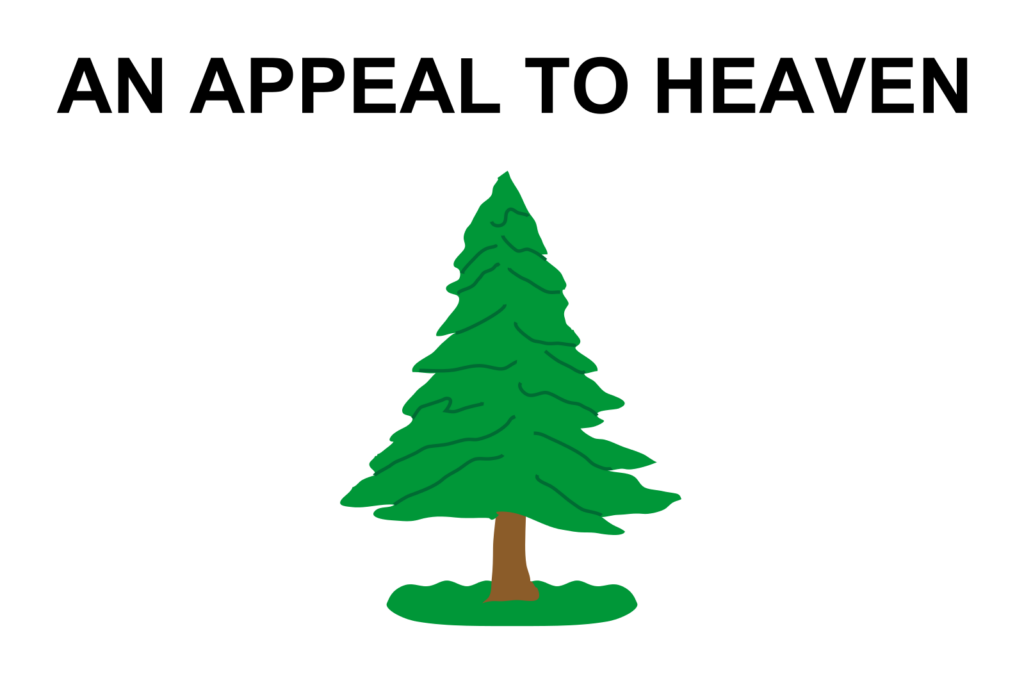
Last summer, at the Alito home in New Jersey, an "Appeal to Heaven" flag was flown. I had never heard of this Pine Tree Flag before. The flag traces its roots to George Washington's Continental Army in 1775. (Before you read Wikipedia, review the changes made in the past 24 hours.)

According to the New York Times, the flag can now be seen as "a symbol of support [1] for former President Donald J. Trump, [2] for a religious strand of the 'Stop the Steal' campaign and [3] for a push to remake American government in Christian terms." A bit of a hodgepodge to be sure. Did Mr. or Mrs. Alito choose to fly this flag to "stop the steal" nearly three years after the election? That seems a stretch. Again, there is no actual evidence of this, but countless news stories, and politicians, will accept this insinuation as obvious.

I think it is far more likely that the Alitos used the flag to convey some sort of message about religion. Exactly what, I'm not sure. But let's assume that Justice Alito personally chose to fly this flag. Here, at least, he did not blame his wife, so we might infer that he was aware of the flag. Much of the New York Times articles focuses on whether Alito should recuse from any Trump-related case. But I'm surprised they missed a more obvious angle: if Alito is trying to endorse some kind of Christian nationalism, shouldn't he recuse in all Free Exercise and Establishment Clause cases? Why limit the recusal attacks to the election cases?

If you'd like to go down that road, there is plenty of other evidence you can use. Justice Alito has publicly attended mass at various churches throughout the country and given speeches that lamented how religious liberty has come under siege. Forget cryptic symbols about an arboreal flag. Alito has been quite overt with his views on the topic.

I know it is gauche to talk about Justice Ginsburg, but I will. In August 2013, she made headlines by being the first Supreme Court Justice to preside at a same-sex wedding. In January 2015, the Supreme Court granted cert in Obergefell v. Hodges, and in June 2014 Justice Ginsburg joined a majority opinion that found a right to same-sex marriage somewhere in the penumbras of the Fourteenth Amendment. The act of marrying a same-sex couple, far more than a cryptic flag, signaled Justice Ginsburg's views on the topic. She did not recuse. It is true enough that Ginsburg apologized for her comments about President Trump, but she did not recuse in Trump-related cases that turned on his conduct during the election. (Mark Paoletta makes these points in WSJ.)

The Times article observed that today, the Alitos' flagpole to heaven was "bare." Maybe they can still whisper their thoughts in the recesses of their homes.

More