…I see a duck-billed platypus. Cf. Garland v. Cargill (Sotomayor, J., dissenting) ("When I see a bird that walks like a duck, swims like a duck, and quacks like a duck, I call that bird a duck."). Alas, a platypus does not quack.
But it is not pleasant when a duck meets the single function of a trigger.
Eugene has raised a fascinating subject with respect to unpublished memorandum opinions that cannot be cited. It is not clear to me that the Article III federal courts have the power, as an original matter, to issue opinions that cannot be cited, are not binding precedent, and that are therefore somewhat unconstrained by the rule of law.
When I clerked on the Second Circuit and the D.C. Circuit from 1983 to 1985, memorandum opinions accounted for only 20% of the docket. Today, in 2024, memorandum opinions account for a stunning 90% of almost all 12 of the Federal Circuit Courts of Appeal. When I was a law clerk, memorandum opinions were drafted by law clerks, received cursory review form an Article III judge, and were an exception to the norm. The fact that 90% of the Federal Circuit Courts of Appeals are now memorandum opinions means that those courts have only a discretionary docket, like the U.S. Supreme Court, and can pick and choose which cases they want to make law with.
All of this reflects the fact that there has not been an increase in the number of lower court judges since 1993, and, since then, the docket of the lower federal courts has tripled. Partisan fights over the appointment of new judges explain the failure to get a new judgeship bill passed by a 60 vote margin by obtaining cloture in the Senate. Moreover, the current sitting 179 Circuit Court of Appeals judges on active duty do not want new federal judgeships created because it would diminish their status to triple the size of the lower federal court judges to match the tripling in caseload of the lower federal courts.
I fear that we are stuck with this phenomenon, but the evils it produces ought not go unnoticed. A judge who can issue an opinion in a case that is not citable is not bound by precedent or the expectations of the parties in deciding each case on its own facts, unbound by the rule of law, and probably unlikely to be reversed by a Supreme Court that only heard 60 cases this year out of the 40,061 cases in 2023.
This issue arose in the Adams v. Gulleythread ("California Judge Orders Removal of Reddit Criticism of Scientist/Consultant Who Publicly Criticized English Lucy Letby Murder Trial"), but I've also seen confusion about it in other places as well, so I thought I'd write briefly about it.
In federal appellate courts and many state appellate courts, many court opinions are labeled "unpublished" or "not for publication." This essentially means that they are not binding precedent, and are not to be published in the official reporters where binding precedent is published. The opinions are often "published" in the lay sense of the term: They are made public on pay services like Westlaw and Lexis, and on many free sites, generally including the sites of the very courts that label them "unpublished." Indeed, some are published in print volumes (such as the Federal Appendix, where federal appellate unpublished decisions are printed).
There is no legal prohibition on writing about them, quoting them, or reproducing them online or elsewhere. They are just not binding precedent.
Now some courts, such as the California Court of Appeal, go further and make the opinions noncitable even as persuasive precedent. California Rule of Court 8.1115(a), for instance, provides that
There is a growing movement to let churches and other religious organizations build housing on their property that would otherwise be banned by zoning regulations.
America has a serious shortage of housing in many parts of the country, and the main cause of the probem is exclusionary zoning: regulations that severely restrict the amount and types of housing that can be built in many areas. One increasingly popular proposal for addressing the housing crisis is "Yes in God's Backyard": giving religious organizations like churches, synagogues, and mosques exemptions from zoning rules and other restrictions that would otherwise prevent them from building housing on their land. Rachel Cohen of Vox has a helpful summary of this idea and the growing support for it:
About five years ago, Harvey Vaughn, the senior pastor at Bethel AME, the oldest Black church in San Diego, heard a radio report about rising homelessness in his city. He wondered if his congregation, which owned a roughly 7,000-square-foot lot around the corner, could help.
Today, the lot is a construction site for a new housing complex that will offer 25 one-bedroom apartments for low-income seniors and veterans. It's the first of what advocates hope will be many such projects in San Diego, led by a group called YIGBY, which stands for Yes in God's Backyard, a spin on the pro-housing Yes in My Backyard movement.
In a country with a shortage of affordable homes and a surplus of religious institutions grappling with rising costs and declining memberships, developers are looking to partner with churches, temples, and synagogues to build new housing. And amid a thicket of local land-use regulations that complicate the construction, some elected officials are looking for ways to nudge these efforts along.
The YIGBY idea — working with faith-based groups to help address the housing crisis — originated from local advocates who knew homeless people eager to move from the streets into housing but unable to find any. The San Diego Association of Governments estimates San Diego County has a shortage of roughly 100,000 homes.
Local funders dedicated to solving homelessness helped bring the YIGBY concept to life, and new zoning laws approved in 2019 helped streamline the process further, removing requirements that developers first seek approval from local planning agencies or elected boards to build….
Now this model is poised to spread across California, helping to address the state's severe housing shortage.
Last year California's legislature passed the Affordable Housing on Faith Lands Act that, like in San Diego, streamlines approval for new projects on land owned by churches, so housing can no longer be blocked by zoning or environmental objections. This first-of-its-kind YIGBY law took effect in January.
The Terner Center for Housing Innovation at UC Berkeley estimates that, across California, there are more than 47,00 acres of land owned by faith-based organizations that could potentially be developed into affordable housing.
State Sen. Scott Wiener, a Democrat from San Francisco who spearheaded the statewide YIGBY law, said California doesn't yet have data on how the new law is being utilized, but he often hears from interested people who say their congregation is preparing to do it.
"Even if just 10 percent of the plots of land identified by Terner did it, that could lead to a massive increase in housing," Wiener told Vox. "Overall it's very, very popular and you can really build a huge diverse political coalition around it."
This policy could potentially spread to other states. Letting religious organizations build housing on their property is likely to prove popular. Surveys suggest that much opposition to "YIMBY" housing policies may be driven by a combination of economic ignorance and fear and suspicion of for-profit developers. By contrast, most people have more positive attitudes towards religious organizations.
But, as Cohen also notes, even relatively ambitious YIGBY policies are unlikely to make more than a modest dent in housing shortages, especially in areas where there are severe zoning restrictions and high demand. Religious institutions own only a small proportion of land in areas with serious housing shortages.
Ultimately, the most compelling arguments for letting religious organizations build new housing on their property also apply to conventional secular property owners. And, despite suspicion of the profit motive, there is little reason to think religious entities will necessary build better or more affordable housing than commercial developers would.
Indeed, where allowed to do so, the latter have strong incentives to build affordable housing precisely because they are motivated by profit. To paraphrase Adam Smith's famous statement about butchers, brewers and bakers: "It is not from the benevolence of the builder and the developer, that we expect our housing, but from their regard to their own interest."
Other things equal, if I were a tenant (as I was in my younger days), I would probably rather rent from a randomly selected for-profit landlord than from a randomly selected religious institution. As a general rule, a commercial landlord is likely to be better at managing and maintaining the property, in part because of superior expertise - and because the landlord knows that a reputation for poor management is likely to result in lower profit.
Obviously, religious institutions could potentially hire professional developers and management firms to build and operate their new housing complexes. But that means bringing in the profit motive, at least to some extent. The developers and managers probably won't do the work just to earn the church's or synagogue's good will, or even that of the Almighty.
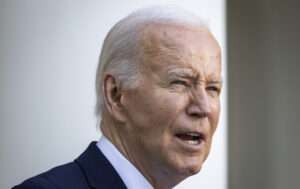
President Joe Biden. (Samuel Corum/Pool via CNP/Polaris/Newscom)
Today, President Biden announced a policy granting "parole in place" to undocumented immigrant spouses of US citizens who have been in the US for at least 10 years, and meet some other criteria. Those eligible can apply for parole status. If they get it, they will then have a three-year period during which they will have work permits and can apply for "green card" permanent residency (that status will eventually also enable them to apply for citizenship). Currently spouses of US citizens are already eligible to apply for green cards. But if they entered the US illegally, they are required to meet onerous conditions, such as first leaving the United States, and staying away for up to ten years. About 500,000 people could potentially benefit from the program.
The grant of parole will enable them to dispense with these requirements. Under Section 245 of the Immigration and Nationality Act, undocumented immigrants who have been granted parole may have their status adjusted to that of temporary legal residents. That adjustment would dispense with various penalties for unlawful entry, including the requirement to leave the US for a long period of time before applying for a green card.
The moral and policy case for this step is obvious. Granting legal residency to spouses of US citizens keeps families intact, and enables these people to work legally. The latter will benefit both their families and the broader US economy. And letting them get green cards without having to leave the country for many years also helps prevent cruel family separations. That has obvious benefits for the immigrants, themselves, their US-citizen spouses, and their children (who are also US citizens). Don't take my word for it! Take that of the social conservatives who have (rightly) insisted for decades that intact families are good for children, and for the broader community. If you believe in "family values," you have every reason to support the administration's new policy here.
Some will argue we must always enforce every law to the hilt, and thus that it is wrong to give illegal migrants any reprieve. But if you really believe all law-breakers should be punished, then you must also insist it's wrong to let off the hook the millions of Americans who routinely engage in minor traffic law violations or transgress a variety of other laws that are rarely enforced against most violators, such as the federal ban on marijuana possession. A "just enforce the law" approach would require authorities to punish a majority of adult Americans, as most of us have violated federal criminal law at one point or another (to say nothing of state and local laws and regulations).
If, on other hand, you think it's justifiable to forego punishment in cases where inflicting it would cause great harm or injustice, or where doing so diverts law enforcement resources from more important priorities, then there is a strong case for granting reprieves to undocumented migrants who fled horrible poverty and oppression. Their case for forbearance is actually stronger than that of those who engaged in minor speeding, marijuana possession, or other crimes that most Americans are happy to see go unpunished, in most situations. That reasoning applies with even greater force in a situation where a reprieve for the migrants would greatly benefit their US-citizen spouses and children.
The legal issues raised by Biden's new policy are more complicated than the moral ones. The relevant statute gives the president the power to grant parole entitling non-citizens to temporary legal residence, "on a case-by-case basis for urgent humanitarian reasons or significant public benefit."
As in the CNVH case, there is a strong argument that parole for spouses of US citizens is backed by "urgent humanitarian reasons." Deporting such people (or requiring them to leave the country for many years to become eligible for legal residency) inflicts serious harm on their families, including many children. There is also a strong case that this grant of parole creates "significant public benefit." As already noted, keeping families intact benefits the larger community, as well as the families themselves. Again, don't take my word for it! Take that of pro-family social conservatives (as well as many social scientists across the political spectrum).
If, as is likely, conservative red states challenge the new policy in court, they will probably focus on the requirement that parole only be granted on a "case-by-case basis," and claim that the administration's rules are too categorical. This issue has come up in the CNVH case, and I addressed it in some detail in my amicus brief in that case (filed on behalf of the Cato Institute and MedGlobal, as well as myself) (pp. 11-20). I think most of the points made there apply to parole for spouses of citizens, as well. I summarize the most important points in a September 2023 article in the Hill:
[A]ny case-by-case decision-making must be guided by rules and presumptions, if it is not to be completely random and arbitrary. And it is entirely reasonable to presume that migrants from nations with horrifically oppressive governments, widespread violence and economic crisis, have urgent humanitarian needs.
The same goes for the presumption that paroling people from these countries will reduce pressure on the southern border, as it actually has [thereby creating a significant public benefit]….
Similarly, it is reasonable to presume that families have an "urgent humanitarian need" to stay together, and that keeping them together is a significant public benefit.
It is worth noting that parole in place has been used since 2007 to protect spouses of US military servicemembers from deportation (a policy begun by administration of Republican President George W. Bush). That policy, too, relies on general rules and presumptions: that keeping servicemembers' families intact is a humanitarian imperative, and that it creates significant public benefits.
As in the CNVH case, a legal challenge to Biden's new parole-in-place policy will raise standing issues. State standing issues in the two cases have some obvious similarities, but there may also be some differences. My own view is that states should have broad standing rights to challenge a variety of federal policies, including those that - like this one - I think should be upheld on the merits. But, in recent years, the Supreme Court and some lower federal courts have taken a harder line on state standing, including in some challenges to immigration policies. I may have more to say about standing questions later, once cases challenging the policy have actually been filed.
In sum, this is a good policy, and it is authorized by the parole power granted to the executive by Congress. But it will almost certainly be challenged in court, in what may turn out to be a prolonged legal battle.
The New York Times has a lengthy article about Professor William English, who has written articles and briefs about gun ownership. Buried towards the bottom of the article is some new reporting on the deliberations in Bruen:
The draft opinion that Justice Clarence Thomas circulated to his colleagues in February 2022 was sweeping, with the potential to outlaw many common gun-control measures. The majority was slow to sign on. Chief Justice John Roberts and Justice Kavanaugh requested modifications, according to people familiar with the deliberations, who requested anonymity because that process is intended to be secret.
By May, Justice Thomas still had not mustered the five votes needed. Mass shootings that month in Buffalo and Uvalde galvanized public attention anew on gun violence. It was not until June that his opinion prevailed, when Justice Kavanaugh signed on but wrote his own more moderate concurrence, joined by the chief.
The authors, Mike McIntire and Jodi Kantor, do not provide any more details on their sourcing. I've heard that Kantor, whom I blogged about recently, spent some time researching the OT 2021 Term, and the Dobbs leak in particular, so I wouldn't be surprised if she gained some information about Bruen. Like with Joan Biskupic's reporting, I will remain skeptical, though presume it is true for purposes of the analysis.
Bruen was argued in November. If Kantor is right, then as late as May, there was still not a majority opinion. It is completely plausible that Justice Thomas wrote a sweeping opinion. It seems, at least that Justice Barrett signed on in full--perhaps ironic since she is the one who most likely has misgivings about Thomas's jurisprudential approach. But Chief Justice Roberts and Justice Kavanaugh were unwilling to join. For Heller, it was long assumed that Justice Kennedy requested modifications to water down the opinion--you know the lines about "sensitive places" and "dangerous" people. Here, it seems that Roberts and Kavanaugh both made the requests. And, apparently, Justice Thomas was willing to water things down to assuage Roberts and Kavanaugh.
Kantor also hints that the mass killings in Uvalde and Buffalo may have impacted the deliberations. I'll add one more data point. The attempted assassination of Justice Kavanaugh occurred on June 8. It is not clear if the majority coalesced before or after that crime. At the time, I wrote that Kavanaugh's concurrence that referenced "mental health reference checks" was likely influenced by his experience. That post was not well received, but I firmly suspect these sorts of external events have to affect the Justices.
May and June of 2022 were such chaotic times, especially with the leak and the assassination attempt. It is still nothing short of a miracle that in the span of a few days, the Court released Dobbs, Bruen, and Kennedy.
Part I discusses First Amendment protection of physicians' professional speech, while also noting the strong framework of non-constitutional speech protections physicians long enjoyed under general health laws predating the emergence of modern First Amendment doctrine. These strong statutory protections may help explain the sparsity of First Amendment cases squarely addressing physicians' rights of access to the informational inputs of professional speech and their rights, as a profession, to exercise epistemic control of the medical evidence base in the sense of determining which sources of evidence are appropriate for a doctor to consider when advising a patient. Strongly protected by general health laws, these rights rarely are transgressed in ways that spark constitutional disputes. However, new medical technologies (and the government's attempts to regulate them) can exert new pressures that earlier health laws did not contemplate, leaving the First Amendment as physicians' only line of defense. CDS tools, I argue, have brought such a moment.
Part II describes the statutory basis for FDA's regulation of CDS [Clinical Decision Support] tools and explains how the Cures Act limits FDA's jurisdiction and requires procedural protections to avoid unjustified intrusions on physicians' free speech rights. Part III explains that the CDS Guidance deviates from the statute it purports to interpret in ways that impose a scheme of content-based regulation of physicians' professional speech. Part IV explains why ostensibly non-binding guidance documents, such as FDA's CDS Guidance, can nevertheless threaten immediate injuries to the rights of physicians and patients in their care. CDS tools offer great promise to improve health care, but they pose risks that call for careful oversight. The medical profession has a crucial role to play in that oversight, and the First Amendment keeps us safer by ensuring governmental agencies cannot oust them from that role.
The order: Sarrita Adams runs Science On Trial, Inc., which "provides forensic consultation services across the United States and the United Kingdom." Adams, who is a "University of Cambridge educated translational scientist," drew public attention by publicly criticizing the evidence in the 2023 English trial of nurse Lucy Letby, who was convicted of murdering seven infants. Her claims were mentioned in, among other publications, The Times (London), the New York Post, and most recently The New Yorker.
Her criticism, however, itself drew criticism, including on Reddit's r/scienceontrial ("This community exists to fact check claims about Science on Trial, its creator Sarrita Adams, and various statements that can be credited to her."). The main poster there is the pseudonymous Reddit user MrJusticeGossipGirl, apparently a reference to Mr. Justice Goss, the judge in the Letby trial. The posts generally criticize Adams' credentials, views on the Letby trial, responses to critics, and more. (There's also a reddit r/sarritaadams, which points the reader to r/scienceontrial.)
But on June 7, San Francisco County Superior Court Maria Evangelista issued a temporary harassment restraining order (Adams v. Gulley, PDF pp. 42-47) ordering defendant Gulley—who appears to be MrJusticeGossipGirl—
Do not make any social media posts about or impersonating plaintiff and her company Science on Trial on any public or social media platform. All harassing posts shall be removed.
This was done based on a restraining order request filed June 6; it appears that Gulley wasn't given an opportunity to appear in court to oppose the order (this is known in this context as an "ex parte" proceeding). The order is effective immediately, and until July 2, when the permanent restraining order hearing will take place.
The Office of the Solicitor General (OSG) presents oral arguments on behalf of the federal government in almost all cases before the Supreme Court. There are a few outliers. The Attorney General on occasion has argued one case during his or her tenure. And in rare cases, an attorney from an agency like the Federal Trade Commission will argue before the Court.
The Solicitor General (SG), who is Senate-confirmed, leads the Office. When the SG position is vacant, there will be an Acting SG. Below the SG is the Principal Deputy SG (PDSG), also known as the "political" deputy. Traditionally, OSG has traditionally had four Deputy Solicitor Generals (DSGs), including the PDSG. Currently there are five total deputies. The rest of the office includes Assistants to the Solicitor General (ASGs).
During the October Term 2023 (OT 2023), OSG argued a total of 53 cases. SG Elizabeth Prelogar argued ten cases and PDSG Brian Fletcher argued three cases. Four DSGs argued cases: Malcolm Stewart (3), Edwin Kneedler (2), Eric Feigin (2), and Curtis Gannon (2). The remaining 31 OSG cases were argued by the 15 ASGs.
How does this division of oral arguments compare to past terms? Since OT 2001, OSG has argued nearly 1,300 cases. I compiled this total by cross-referencing arguments in Oyez and in the WestLaw Supreme Court Oral Argument database. Even as the size of the Court's merits docket has shrunk, OSG continues to argue roughly the same number of cases. The high was 63 cases in OT 2001 and the low was 47 cases in OT 2017, averaging to about 55 per term. Still, because this number fluctuates year-by-year, it is more useful to measure percentages: what percentages of the OSG cases are argued by the SG, the PDSG, DSGs, and ASGs.
This table breaks down the percentages:
Term
SG
SG
PDSG
DSGs
ASGs
OT 01
Olson
12.70%
7.94%
15.87%
63.49%
OT 02
Olson
15.25%
8.47%
15.25%
61.02%
OT 03
Olson
15.00%
11.67%
18.33%
55.00%
OT 04
Clement (Acting)
16.00%
5.08%
20.00%
64.00%
OT 05
Clement
13.56%
0
20.34%
61.02%
OT 06
Clement
15.38%
5.77%
21.15%
57.69%
OT 07
Clement
12.73%
9.09%
20.00%
58.18%
OT 08
Garre
8.77%
3.51%
22.81%
63.16%
OT 09
Kagan
9.26%
9.26%
22.22%
59.26%
OT 10
Katyal (Acting)
10.53%
7.02%
21.05%
61.40%
OT 11
Verrilli
14.04%
5.26%
19.30%
61.40%
OT 12
Verrilli
10.94%
7.81%
18.75%
62.50%
OT 13
Verrilli
12.50%
7.14%
19.64%
60.71%
OT 14
Verrilli
12.28%
5.26%
17.54%
64.91%
OT 15
Verrilli
10.34%
5.17%
17.24%
67.24%
OT 16
Gershengorn (Acting)
6.00%
4.00%
18.00%
72.00%
OT 17
Francisco
8.51%
10.64%
19.15%
61.70%
OT 18
Francisco
9.62%
9.62%
15.38%
65.38%
OT 19
Francisco
14.00%
12.00%
20.00%
54.00%
OT 20
Wall (Acting)
10.00%
6.00%
22.00%
62.00%
OT 21
Prelogar (Acting)
9.62%
5.77%
23.08%
59.62%
OT 22
Prelogar
15.38%
5.77%
25.00%
53.85%
OT 23
Prelogar
18.87%
5.66%
16.98%
58.49%
In OT 2023, SG Prelogar argued 18.87% of OSG cases, the highest percentage in at least a quarter century. Indeed, Prelogar's 10 arguments in OT 2023 was the highest raw total since SG Olson argued 9 cases in OT 2002 and OT 2003. But in those two terms, OSG had 59 and 60 total arguments, respectively. Olson's totals were 15.25% and 15%, respectively. By contrast, in OT 2023, OSG had only 53 arguments.
If Prelogar had so many arguments, who was left out? PDSG Brian Fletcher argued three cases, only 5.6% of the OSG cases. If we exclude terms in which there was no confirmed SG, and the Principal Deputy SG served as Acting SG, Fletcher's total is among the lowest in a quarter century. Moreover, the other four Deputy SGs argued 16.98% of the cases.
Again, historically there were three deputies other than the principal, but during the Trump administration, that number was increased to four. In a quarter century, this was the first term in which the SG argued a higher percentage of cases than all of the Deputy SGs combined. To state the point plainly, SG Prelogar single-handedly argued more cases than DSGs Stewart, Kneedler, Feigin, and Gannon, combined. If we exclude Prelogar's tenure, DSGs argued about 7% more cases than the SG. But during OT 2023, the SG out-argued the DSGs.
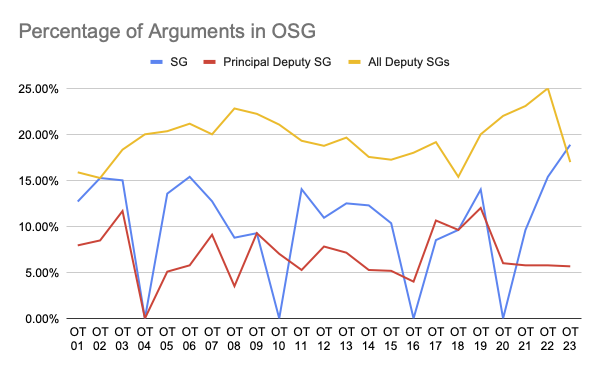
This graph distills how SG Prelogar argued more cases than her predecessors, how the Deputy SGs under SG Prelogar argued fewer cases than their predecessors, and how the Principal Deputy SG is near the bottom of utilization rates when there is a confirmed SG.
There's more. During OT 2023, Assistant SGs argued 58.49% of the OSG cases: fourteen ASGs each argued two cases, and ASG Charles Luke McCloud argued only one case. That is one of the lowest totals in a quarter century. The lowest total for ASG arguments came in OT 2022, where ASGs argued 53.85% of the cases. Even as SG Prelogar argues more cases, the Assistant SGs are arguing fewer cases. During SG Francisco's term, many ASG's had 3 arguments in a term. During OT 2022, only one ASG had 3 arguments. During OT 2023, zero ASGs had 3 arguments.
It could be argued that pairs of cases should only be counted as one. And you could pair Relentless and Loper Bright, and the two NetChoice cases. But all of my counts are premised on the actual number of arguments. I did not consider whether two cases were related. Olson, Clement, and the rest all had the opportunities to argue paired cases. In private practice, a lawyer who argues companion cases still gets two arguments to her credit. Presumably the SG will not count two cases that she argued just as just one in the future. If SG Prelogar decided to argue both Chevron cases and both NetChoice cases, to preserve parity, she could have dropped one or two of the cases from the March and April sittings. Any of her deputies could have argued AFHM, Moyle, or Fischer.
Lawyers in OSG are routinely headhunted to join private practice. One of the key incentives to work for a government salary is presenting arguments before the Supreme Court. If those arguments are not evenly doled out, it stands to reason that recruiting, morale, and retention will suffer.
Update (6/18/24 at 1:51 PM): I've found one error in my numbers. During OT 2011, Solicitor General Verrilli argued nine cases, rather than eight. Verrilli did not argue any cases during the February sittting. In the March sitting, for the Affordable Care Act litigation, Verrilli argued three cases in the span of three days. (Deputy Ed Kneedler had the fourth argument on severability.) Two of Verrilli's argued cases were titled HHS v. Florida, and I inadvertently counted them as a single case. They should have been counted separately. Mea culpa. With nine arguments, Verrilli had about 16% of the argued cases that term. That number is still less than SG Prelogar's ten cases, which were nearly 19% of the cases argued during OT 2023. I fully expect to spot other errors in the numbers, and welcome any corrections.
DACA was announced in June 2012. At the time, there were no meaningful legal challenges to the policy. Indeed, as hundreds of thousands of people received benefits under the policy, it became clear that the courts would not let it be halted.
DAPA was very different. By late 2014, the Republican Attorney General Machine was operating at full steam. Attorney General Abbott challenged the policy in the U.S. District Court for the Southern District of Texas, Brownsville Division. The brainpower on that case was staggering. Among others involved were Andy Oldham (5th Circuit), Jimmy Blacklock (Supreme Court of Texas), Brantley Starr (NDTX), Cam Barker (EDTX), Scott Keller, and more that I'm forgetting. This case innovated the "Driver's License" theory of standing, which has formed the basis of countless challenges to immigration non-enforcement. I filed an amicus brief back on behalf of the Cato Institute. (No, Cato would not file such a brief today.)
The DAPA challenge was successful, in large part, because a preliminary injunction was obtained before anyone was able to sign up for it. DACA, by contrast is still on the books. Even after President Trump tried to rescind DACA, Chief Justice Roberts made up some convoluted test about reliance interests to ensure people could keep their deferred action and work authorization.
That brief history brings us to the present. Last week, there was a report in the New York Times that President Biden was thinking about some new executive action to provide a pathway for citizenship for certain alien spouses of U.S. citizens. When the press reports that some policy is under consideration, that almost certainly means the policy will be issued. Indeed, I thought this pro-immigration policy would be used to offset the President's unpopular-on-the-left asylum policy.
The Times offered this description:
The president would exercise his authority to grant the undocumented spouses "parole in place," a designation that would permit them to remain in the country, work legally and gain access to a pathway to permanent residency.
I've been poking around to find some detailed analysis of the policy, but I was unsuccessful. What will this policy be called? Parole in Place for Spouses--PIPS?
Today, the Wall Street Journal reported that President Biden will announce the spouse policy, tomorrow, Tuesday.
President Biden is expected to announce a new immigration program Tuesday that would provide a path to citizenship for hundreds of thousands of immigrants in the country illegally who are married to U.S. citizens, according to lawmakers and others familiar with the matter.
Biden plans to make the announcement at the White House alongside members of Congress, immigration advocates and U.S. citizens who, because of arcane immigration rules, haven't been able to sponsor their spouses for green cards.
The program has the potential to benefit immigrants who have been living in the country at least a decade, offering them work permits, deportation protections—and a route for them to apply for green cards, which is the pathway to citizenship. The application process is expected to open by the end of the summer, an administration official said.
Much like with DAPA, this policy will not go into effect right away. There will at least be some application process.
I would expect legal challenges from Texas and all the usual suspects. The theory of standing will be the same as the theory of standing with DACA. If and when we get an OLC opinion, I will write about it. I made the same request on PBS a decade ago with regard to DAPA. I'm having serious deja vu to 2014. My hair was much shorter and I talked much faster.
It will be published in the Florida Law Review (2025).
We argue that the Direct Taxes Clause applies to taxes that fall straight upon a person, while imposts, duties and excises all fall only upon such transactions as: importing goods, buying or selling goods, inheriting an estate or giving a gift, renting someone's property, or selling one's labor to someone else in exchange for money. We think that a wealth tax falls directly on persons, and not on transactions, as we explain in the above cited draft law review article.
We discuss the original meaning of the Taxation Clauses, court opinions from the Founding to the present day, and arguments in law review articles and amicus briefs made by major scholars. Far from being a glitch in the Constitution, the requirement that direct taxes be apportioned prevents a majority of the states in Congress from imposing a tax that will fall heavily on certain states and regions. The Clause thus not only limits taxes on enslaved persons and undeveloped land of which the South had a lot in 1787; the Direct Tax Clause also bans Congress from taxing ships, manufacturing, or small farms, which were prevalent in the North but scarce in the South. Both types of fiscal raids are made politically impracticable by the Direct Tax Clause.
The Framers meant for the federal government to rely only on indirect taxes in peacetime, but they made available direct taxes that are not geographically biased in wartime. There is an appealing element of voluntariness in indirect taxes, which is that one can always avoid the tax by not engaging in the taxed transaction. Such voluntariness is absent when direct taxes are imposed.
From today's decision in Luo v. County of L.A.(note that this is the same Luo from Luo v. Volokh), written by Justice John Segal and joined by Justices Gonzalo Martinez and Gail Ruderman Feuer:
Xingfei Luo brought this action against the County of Los Angeles under the California Public Records Act (CPRA). In an opposition to a motion by Luo for sanctions, the County listed other lawsuits Luo had filed using a pseudonym. Seven months later, Luo filed an ex parte application for an order redacting the list of lawsuits from the County's opposition and the trial court's order denying the motion for sanctions. Luo appeals from the trial court's order denying her ex parte application. We affirm….
Luo had actually largely prevailed on her underlying demand for various records on crime statistics, but lost as to the redaction, and the appellate court concluded that the trial court didn't abuse its discretion on that score:
From Thursday's decision by Judge David Larimer in Carey v. Salvadore(W.D.N.Y.):
Plaintiffs William H. Carey and Barbara B. Carey, as administrators of the estate of their son Michael …, … allege that at the time of Michael's death from pulmonary congestion, [defendant Lisa] Salvador [{the correct spelling [of defendant's name]}] was working as a nurse at the medical unit where Michael was housed, and that she did nothing to help him and was unaware of his condition because she was asleep on duty….
The court ultimately concluded,
That some of the matter contained in these documents might cause some embarrassment or discomfiture to defendant is unremarkable; if that were all it took to justify keeping documents inaccessible to the public, sealing would be the norm, not the exception…. "[M]ost if not all litigation can be harassing and embarrassing to some extent" …. But that is not the law, as the Second Circuit has repeatedly emphasized. Sealing is the exception and defendant has the burden to justify that exception.
And it analyzed the matter thus:
"The common law right of public access to judicial documents…is based on the need for federal courts…to have a measure of accountability and for the public to have confidence in the administration of justice." "That right includes 'a general right to inspect and copy' …judicial documents." If the court determines that the documents at issue are judicial documents to which a presumption of access attaches, the court must determine the weight of the presumption of access, and then balance competing considerations against the weight of the presumption of access…. The First Amendment also provides the news media and public a qualified right to access certain judicial documents….
"of prescription medication, search her bag without permission, and find a firearm inside? And what happens when school board officials find out and want to question the perpetrator? Has the Fourth Amendment been transgressed?"
See Thursday's opinion by Judge Gregory Van Tatenhove (E.D. Ky.) in Lawson v. Creelyfor his answers to these questions. The bottom line:
School employees and officials are bestowed with a societal responsibility to keep their pupils safe from harm. As this case demonstrates, that high degree of responsibility can sometimes conflict with the individual rights of others. Here, Holly Lawson's individual [Fourth Amendment] rights were infringed by her colleagues. For the reasons explained above, however, her civil action cannot succeed.