The Volokh Conspiracy

Mostly law professors | Sometimes contrarian | Often libertarian | Always independent | Est. 2002

The Volokh Conspiracy

Free Speech

Hawaii Law Mandating Sealing of All "Medical and Health Records" Unconstitutional

|

From last week's decision in Civil Beat Law Center for the Public Interest, Inc. v. Maile, decided by Judge Richard Paez, joined by Judges Milan Smith and Lucy Koh:

Under the First Amendment, "the press and the public have a presumed right of access to court proceedings and documents." "By offering such protection, the First Amendment serves to ensure that the individual citizen can effectively participate in and contribute to our republican system of self-government." This right of access does not attach to every judicial proceeding or court record. But where the First Amendment right of access attaches, and "the State attempts to deny [that] right of access," "it must be shown that the denial is necessitated by a compelling governmental interest, and is narrowly tailored to serve that interest."

The Hawai'i Court Records Rules, which apply to all criminal and civil proceedings in Hawai'i state courts, require that all "medical and health records" be filed under seal without further order of a judge. We are asked to determine whether a state may mandate the categorical sealing of all "medical and health records" filed in any state court proceeding in order to protect the individual privacy rights of the subjects of those records, without any case-by-case consideration of the privacy interest implicated by the records or whether less restrictive alternatives exist to sufficiently protect that interest. We conclude that it may not….

Defendants argue that, even if the First Amendment grants a presumptive right of access to any "medical and health records," requiring that all such records be filed under seal is necessary to protect the individual right to privacy guaranteed by Hawaii's constitution and laws, such that the challenged provision does not run afoul of the First Amendment.

We agree that protecting an individual's constitutional and statutory right to privacy is a compelling interest that may justify sealing a particular medical or health record. As we have recognized, "[t]he need to protect individual privacy rights may, in some circumstances, rise to the level of a substantial governmental interest and defeat First Amendment right of access claims." But where, as here, the individual privacy interest implicated by a particular record may vary, the State of Hawai's general interest in protecting the privacy of its citizens cannot justify the categorical, mandatory sealing of every such record.

Read More

Politics

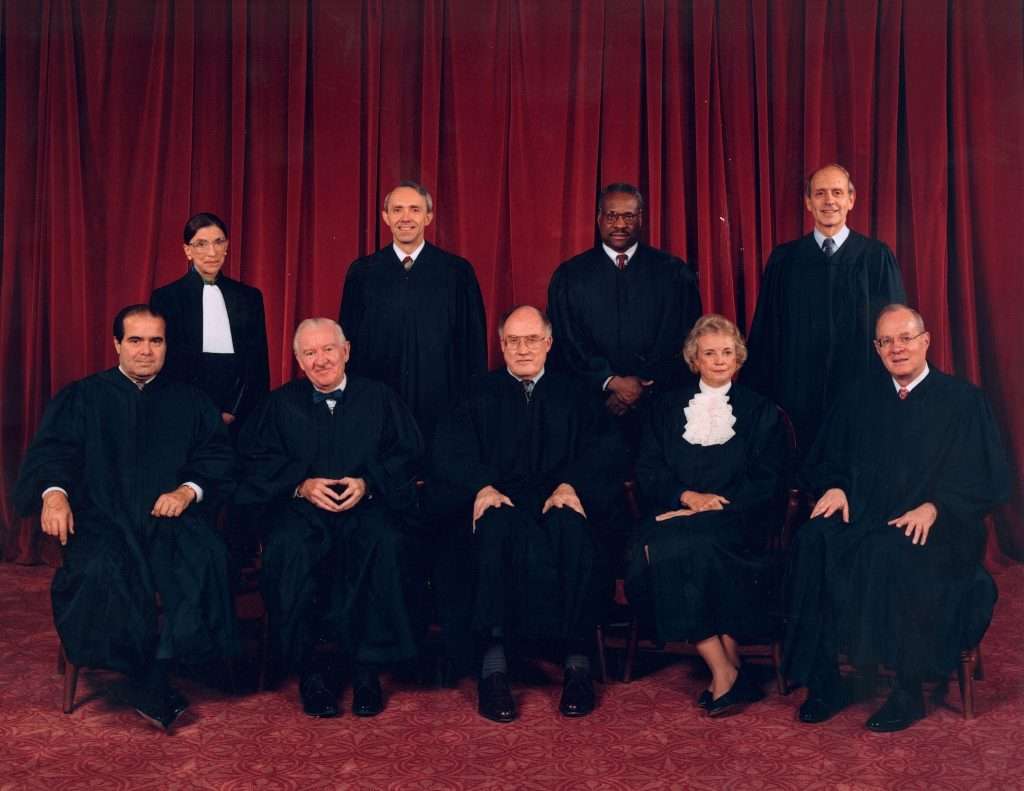
Today in Supreme Court History: August 31, 1995

|

8/31/1995: Students at Santa Fe Independent School District voted to allow a student to say a prayer at football games. In Santa Fe Independent School Dist. v. Doe (2000), the Supreme Court declared this prayer unconstitutional.

The Rehnquist Court

Free Speech

X's Lawsuit Against Media Matters Can Go Forward

|

From yesterday's opinion by Judge Reed O'Connor (N.D. Tex.) in X Corp. v. Media Matters for America:

Plaintiff alleges that Defendants knowingly and maliciously fabricated side-by-side images of various advertisers' posts on Plaintiff's social media platform X depicted next to neo-Nazi or other extremist content, and portrayed these designed images as if they were what the average user experiences on the X platform. Plaintiff asserts that Defendants proceeded with this course of action in an effort to publicly portray X as a social media platform dominated by neo-Nazism and anti-Semitism, and thereby alienate major advertisers, publishers, and users away from the X platform, intending to harm it….

As the Court must accept all well-pleaded facts in the complaint as true and view them in the light most favorable to the plaintiff, for the reasons that follow, Defendants' Motion [to Dismiss] is DENIED….

[1.] Tortious Interference with Contract

To allege a prima facie case of tortious interference with existing contractual relations, a plaintiff must plead "(1) an existing contract subject to interference, (2) a willful and intentional act of interference with the contract, (3) that proximately caused the plaintiff's injury, and (4) caused actual damages or loss."

Plaintiff has provided sufficient allegations to survive dismissal. Plaintiff has factually alleged: the existence of contracts subject to interference; intentional acts of interference; and proximate causation. It cannot reasonably be disputed that Plaintiff has named parties who contracted for paid ads on X. Media Matters' reporting has acknowledged as much….

Read More

AI in Court

Fugees Rapper Pras Michel Not Entitled to New Trial Based on Lawyer's Use of AI to Help Craft Closing Argument

Among other things, "Michel does not explain how ... the [AI-generated] mistaken attribution of a Puff Daddy song in the closing argument" sufficiently undermined his case.

|

From today's opinion by Judge Colleen Kollar-Kotelly (D.D.C.) in U.S. v. Michel; Michel was convicted of crimes related to "conduit contributions, witness tampering, and foreign lobbying," and sought a new trial on many grounds, including this one:

Michel's first [ineffective assistance of counsel] claim involves [his trial lawyer David] Kenner's purported use of a "proprietary prototype AI program" to draft his closing argument. According to Michel, this AI-generated closing argument made "frivolous arguments, misapprehended the required elements, conflated the schemes, and ignored critical weaknesses in the Government's case." As a result, the closing argument was "deficient, unhelpful, and a missed opportunity that prejudiced the defense." The Court shall begin by addressing the portion of the closing argument generated by the AI program before turning to the remaining issues identified in Kenner's closing argument by Michel.

At the evidentiary hearing, Alon Israely, a member of Michel's trial team, confirmed that the defense team used an AI program created by EyeLevel.AI ("EyeLevel") "as a preparation" tool during trial. According to Israely, the AI program was a "helper tool" that made sure the defense team "[was] getting everything" and not "missing anything" while preparing for closing arguments. Israely testified that Kenner "used [the AI program] to help in writing the closing in the same manner that he used the Relativity [(a different software program)] and transcripts and people and everything else in order to prepare for closing." Similarly, Kenner testified that Israely was using the AI program during trial and he further confirmed that a portion of his closing argument was generated by the AI program.

Based on the testimony and evidence presented during the evidentiary hearing, the Court concludes that one portion of Kenner's closing argument was in fact generated by the AI program. Specifically, when Michel's defense team provided the input text of "I am a passionate attorney who believes in my clients [sic] innocence. Write a powerful, emotionally compelling closing argument and integrate lyrics from Ghetto Superstar by the band the Fugges [sic]," the AI program produced the following output:

Read More

Free Speech

Ohio Criminal Harassment Statute Unconstitutional as to Certain Emails Sent to Government Official

|

So Magistrate Judge Stephanie Bowman concludes (correctly, I think) in her Report and Recommendation in today's Hicks v. Faris (S.D. Ohio) [UPDATE 9/27/24: the District Court adopted the Magistrate Judge's Report and Recommendation]:

Plaintiff Christopher R. Hicks is a self-described political watchdog and member of the Central and Executive Committee of the Clermont County Republican Party. This case concerns email communications sent to non-party Jeannie Zurmehly, who holds public office as the Clermont County Treasurer. Hicks sent emails to Zurmehly's Government email address raising concerns about Zurmehly's role as treasurer of the Clermont County Republican Party. Zurmehly objected to the use of her Government email for matters that she deemed unrelated to her public office and asked him to stop. Hicks persisted.

In April 2020, Zurmehly filed an offense report with the Clermont County Sheriff's Office, seeking to press criminal charges for Telecommunications Harassment under Ohio law. Based on a clear conflict of interest, the Clermont County Prosecutor's Office referred the matter to a special prosecutor with the Ohio Attorney General's Office. After the special prosecutor interviewed him at length, Hicks filed suit against both the Clermont County Prosecutor and the Ohio Attorney General ("OAG") in their official capacities, seeking declaratory and injunctive relief to prevent enforcement of Ohio Rev. Code. §2917.21(A)(5)…. The undersigned finds that § 2917.21(A)(5) is unconstitutional as applied to Hicks….

Hicks has demonstrated that § 2917.21(A)(5) is unconstitutional as applied. Specifically, the Defendant OAG may not criminalize—based on the recipient's objection to the content—Hicks' sending of a small number of emails {just four emails} to a public official's Government email. Two factors are key to this conclusion: (1) the OAG seeks to apply § 2917.21(A)(5) against Hicks based solely on the content of his emails; and (2) the OAG seeks to expand the use of a "harassment" law to shut down email communication from a constituent to his elected official at her government email address that is not threatening, abusive, intimidating or otherwise "harassing" in any traditional sense of the word.

Read More

Religion and the Law

Title IX's Exemption for Religious Institutions as to Sex, Sexual Orientation, and Gender Identity Is Constitutionally Permissible

The court concludes that the government may institute such an exemption, though doesn't decide whether it must do so.

|

So holds today's Ninth Circuit opinion in Hunter v. U.S. Dep't of Ed., decided by Judge Milan Smith, joined by Judges Mark Bennett and Anthony Johnstone:

Title IX, a landmark law prohibiting gender discrimination at federally funded educational institutions, carves out an exception for religious institutions whose tenets mandate gender-based discrimination. Plaintiffs are lesbian, gay, bisexual, transgender, and/or nonbinary (LGBTQ+) students who applied to or attended religious institutions and alleged that they experienced discrimination on the basis of their sexuality or gender identity.

They brought suit against the Department of Education (Department), claiming that Title IX's religious exemption violates the equal protection guarantee of the Fifth Amendment and establishes a religion in violation of the First Amendment. They also challenge the Department's implementing regulations of Title IX as arbitrary and capricious under the Administrative Procedure Act (APA)….

This case addresses, among other issues, the question of whether Congress's attempt to balance the important interests of religious freedom and gender-based equality violated the Constitution. Because we hold that Congress did not exceed its constitutional boundaries, we affirm….

Title IX prohibits certain educational institutions from receiving federal funding if they exclude, deny benefits to, or subject to discrimination any person "on the basis of sex." We have recently interpreted this provision to prevent federally funded educational institutions from discriminating against gay or transgender students. See also Bostock v. Clayton County (2020) ("[I]t is impossible to discriminate against a person for being homosexual or transgender without discriminating against that individual based on sex" in the context of Title VII.). Title IX does not prohibit discrimination, however, when an educational institution "is controlled by a religious organization if the application of [Title IX] would not be consistent with the religious tenets of such organization." …

The court held that the exemption doesn't violate the Establishment Clause:

Read More

Short Circuit: A Roundup of Recent Federal Court Decisions

A tardy oath, old-timey drunkards, and telling it man to [redacted] man.

|

New on the Bound By Oath podcast: Civil forfeiture is a civil rights nightmare. On this episode, we dig into the birth of the modern forfeiture regime (which we put at 1984, give or take), and we dig into forfeiture's historic roots (1789). And we ask what forfeiture's historic pedigree means for its constitutionality today. (It's still unconstitutional.)

And check out recent episodes of the Short Circuit podcast, some of which are now on YouTube. Proving that our host and guests are (or at least resemble) real people. Read More

Religion and the Law

Can a Public School Ask Students to State their Religion?

Overzealous school administrators should think about students' privacy rights.

|

Last month, at the end of a three-year saga, the U.S. Department of Education ruled on a complaint that New Jersey parents had filed against the Cedar Grove School District. The conflict is interesting for what it suggests about overreaching school administrators and about the capacity of persistent parents who believe their kids' rights have been violated to get things done.

Back in 2021, without giving parents prior notice, the district surveyed elementary, middle and high school students about a variety of sensitive topics, including the students' gender identity, race, ethnicity and, in the case of high school students, religious affiliation. The district argued that it was collecting the students' information confidentially in the interests of promoting diversity, equity, and inclusion.

When they learned about the surveys, many parents objected. One of those parents was my colleague at St. John's Law, Patricia Montana. As she recounts in a recent Legal Spirits podcast, with a little research, she discovered that the surveys violated several state and federal privacy laws, including, with respect to the question about religious affiliation, the federal Protection of Pupil Rights Amendment, or PPRA. The PPRA requires a school district that wishes to survey students on certain subjects, including religious affiliation, to notify parents in advance and allow parents an opportunity to opt their children out of participation.

The district didn't act on the parents' complaints, so the parents contacted the NJ and US Departments of Education for help. The NJ authorities quickly sided with the parents and ordered the district to destroy the results of the surveys. The US DOE delayed giving an answer, for reasons that are unclear, so Montana and the parents sued. Last month, US DOE finally ruled—again, in favor of the parents. The US DOE ordered the district to train its employees so that violations of the PPRA's parental notification and opt-out provision do not occur again (and to provide documentation of such training) and, in future, to notify parents of their rights under the PPRA.

This is a fascinating story for a couple of reasons. First, it shows how overzealous school administrators can be so sure of their own good faith that they ignore basic privacy concerns. How could the administrators have thought it was wise to ask students about their religious affiliations? Just as the state has no business forbidding students from holding and expressing religious beliefs, it has no business asking students to reveal their beliefs. Even if surveys are anonymous—and Montana and the other parents were skeptical about how anonymous they were—students could legitimately feel uncomfortable revealing such sensitive information to school authorities. Plus, asking about religious affiliation, at least without advance notice to parents, is illegal—which the school administrators should have known.

Second, the story shows that parents can prevail against school bureaucracies. True, some of the parents' success here resulted from the serendipitous fact that one of them just happened to be a lawyer, who saw that what the district had done was illegal. That won't always be the case, of course. But with luck and persistence, it is possible to win an important battle every now and then. That's worth remembering as another school year begins.

You can listen to my podcast with Professor Montana here.

Campus Free Speech

Private Universities That Reject First Amendment Principles Put Themselves At Legal Risk (Updated)

Conforming speech policies to the First Amendment would serve private universities well, legally and otherwise.

|

As private institutions, private universities are not legally obligated to comply with the First Amendment. Some university administrators relish this fact, and think this is a reason to adopt and enforce policies related to speech and expression that would not pass First Amendment muster. Some may even think this approach makes sense as a matter of reducing legal risk, given the existence of federal civil rights laws and the like. This is a mistake.

Failing to adopt and enforce speech policies that follow the First Amendment is actually a source of legal risk and potential liability, as Northwestern law professors Max Schanzenbach and Kimberly Yuracko explain in the Chronicle of Higher Education. 

Universities are facing a tsunami of federal enforcement actions and private litigation stemming from their responses — or their lack of one — to campus protests. Some universities still do not realize how legally exposed they are. Their own speech policies are a big part of the problem.

Private universities are not bound by the First Amendment, but they are bound by Title VI of the Civil Rights Act to enforce their policies in a way that does not discriminate on the basis of race, color, or national origin. But many universities have student-speech policies that are inconsistent, vague, and in some cases seemingly illegal on their face. . . .

the problem is not simply that universities have poorly written policies. It is that such policies are likely to lead to discriminatory enforcement. Universities are too one-sided and too politically homogeneous to be able to enforce ambiguous and vague policies in a neutral way.

As we have seen from recent campus controversies, universities get themselves in particular trouble when they do not enforce speech, expression, and protest policies in a neutral and consistent fashion. Thus, private universities that seek greater discretion in what sorts of speech and expression to allow actually put themselves at greater legal risk under federal law.

As Schanzenbach and Yuracko explain, conforming speech policies to the First Amendment solves these problems.

private universities should voluntarily commit to following the First Amendment with regard to student speech. Doing so will not shield universities from their Title VI obligations, but it will make compliance easier for several reasons. Committing to the First Amendment makes consistency across cases more likely. From a legal perspective, the main risk to universities from existing speech policies flows from their inconsistent and ideologically driven application. The First Amendment mitigates this risk in the first instance by simply shrinking the class of cases plausibly subject to university sanction. With less speech subject to punishment, there are fewer opportunities for administrative bias, inconsistency, and error.

Committing to the First Amendment also provides greater clarity regarding the scope of protected speech. While university speech codes are often vague and the outcomes of disciplinary proceedings secret, making it difficult for students and adjudicative bodies to understand the boundaries and parameters of university codes, there is a robust body of First Amendment case law to guide university decisions.

One thing that many university administrators seem to forget is that statutes like Title VI cannot require universities to suppress First Amendment-protected speech. For starters, the federal government cannot adopt and enforce a statute that violates the Constitution. Moreover, state universities--which are clearly bound by the First Amendment--are also fully capable of complying with statutes like Title VI.

One thing I have always found curious about university administrators who seek to avoid conforming their policies with the First Amendment is that they are implicitly adopting at least one of two arguments.  Either they believe that their students, staff, and faculty are not deserving of the same speech and expression rights as their state university counterparts, or they believe that (as administrators) they are less capable of fulfilling the university's educational and truth-seeking missions than their state university counterparts. Were I an administrator at a private university, I would be embarrassed to embrace either premise, yet here we are.

[Note: I recognize that some universities have religious or other missions that may justify a different approach, but that is not the case at most private universities.]

Of course there are other reasons why private universities should embrace First Amendment values. Among other things, this can help ensure that universities protect divergent viewpoints, foster an environment of open inquiry, and support academic freedom. Indeed, there are few things a university can do that are more integral to its educational and truth-seeking mission than to safeguard the fullest possible right to hold and express opinions, to speak and write, to listen, challenge, inquire and learn. But if that were not reason enough, adopting this sort of standard can reduce a university's legal risk too.

UPDATE: Perhaps due to lack of clarity on my part, some readers seem to misunderstand the claim about why neutrality and consistency reduces legal risk for universities. To clarify, my claim (and the claim I understand Schanzenbach and Yuracko to be making) is not that Title VI requires private universities to be ideologically neutral or consistent. As private institutions, they have no legal obligation to be neutral about ideological or other matters, and no obligation to be consistent beyond that which is entailed in their own voluntarily assumed legal commitments (such as commitments to respect academic freedom and the like).

The claim here is that a lack of neutrality and consistency in certain instances that implicate matters covered by Title VI (such as, say, the handling of protest activity that may implicate protected classes) can be a source of legal risk, and that such neutrality and consistency can protect against Title VI liability. Further, a commitment to adhere to First Amendment standards can help ensure that a university maintains a sufficiently neutral and consistent posture that will reduce its legal vulnerability. Obviously, a university that neutrally and consistently allows for overt racial harassment or other conduct that is not plausibly protected by the First Amendment could not use its consistency or neutrality as a defense, but that is not a position I understand any university administrator to be advocating.

Free Speech

Confusing Use of Another Political Group's Name as "Source Identifier" May Lead to Trademark Injunction

A dissenting subgroup of the Libertarian Party of Michigan was barred from "from identifying as the Libertarian Party of Michigan in the provision of services."

|

From Wednesday's decision in Libertarian National Committee, Inc. v. Saliba, by Sixth Circuit Judge Julia Smith Gibbons, joined by Judges Guy Cole and Chad Readler:

This trademark action arises out of a dispute within the Libertarian Party of Michigan (referred to by name or as the "Michigan affiliate"). The Libertarian National Committee, Inc. ("LNC") sued dissenting members of the Michigan affiliate—mainly former officers of the affiliate or board members of local parties—for using the LNC's trademark to hold themselves out as the official Michigan affiliate after a turnover of power resulted in two factions claiming to hold power.

The district court granted the LNC's request to preliminarily enjoin the dissenting members' use of the mark, and the dissenting members appealed. They argue that the district court's application of the Lanham Act to the context of noncommercial speech both unduly expands the Act and violates the First Amendment. Even if the Lanham Act covers the dissenting members' use of the trademark, they argue that their use was authorized and not likely to cause confusion [details on this omitted -EV].

The circuit court largely agreed with the district court, concluding that trademark law may permissibly restrict confusing uses of another entity's name as "designat[ing the] source" of speech, goods, and services, even in political speech rather than commercial advertising:

In Taubman Co. v. Webfeats (6th Cir. 2003), this Circuit addressed the use of a shopping mall's trademark in domain names by the creator of a "fan site" and, after the relationship between the parties soured, a gripe site for that mall. The website creator contended that his purpose for using the mall's trademark in his websites was expressive rather than commercial, and thus outside of the realm of the Lanham Act and protected by the First Amendment. In combatting the defendant's allegation that the Lanham Act conflicted with the First Amendment, the Taubman Court reasoned that the Lanham Act is constitutionally sound "because it only regulates commercial speech, which is entitled to reduced protections under the First Amendment." …

In explaining why the defendant's use of the mall's mark was protected expression, the Taubman Court expounded that the defendant used the mark to comment on the trademark holder—not "to designate source." Jack Daniel's Properties, Inc. v. VIP Prods. LLC (2023). In other words, the defendant did not use the mark to pass off the goods or services advertised on his website as those of the shopping mall.

Since Taubman, the Supreme Court has explained how the Lanham Act and the First Amendment interact when a defendant uses a trademark to misrepresent his or her goods or services as those of or associated with the trademark owner. Just last year, the Court noted that where a defendant uses a trademark as a source identifier, "[t]he trademark law generally prevails over the First Amendment." Jack Daniel's Properties. This is because use of a trademark as a source identifier undermines the primary function of trademark law, which is to prevent "misinformation[ ] about who is responsible for a product" or service. Such is true even where the defendant's use of the mark also conveys an expressive message. Cf. San Francisco Arts & Athletics, Inc. v. U.S. Olympic Comm. (1987) ("The mere fact that the [nonprofit defendant] claims an expressive, as opposed to a purely commercial purpose does not give it a First Amendment right to appropriate to itself the harvest of those who have sown."). In that circumstance, "the likelihood-of-confusion inquiry does enough work to account for the interest in free expression."

Read More

National Constitution Center Podcast on United States v. Trump (Florida Edition)

Can the Attorney General Appoint a Special Counsel?

|

Today I recorded the We the People Podcast with Jeff Rosen and Matt Seligman. We discussed one of several cases called United States v. Trump. No, not the immunity case. Instead, we talked about the appointment of Jack Smith as special counsel. I though this was a wide-ranging and informative conversation. Also, Seligman and I both presented arguments before Judge Cannon in March.

You can listen here.

Some Thoughts on Raising the Sanity Waterline

|

[I am happy to share this guest post from Professor Seth Barrett Tillman, which addresses some discourse on legal academia, including a recent post by Will Baude.]

There has been much back-and-forth on social media and blogs lately about what constitutes good behaviour for academics. Having been in academic affrays from time to time—mostly unsought by me—I thought I would add my thoughts on that and some closely related issues.

1. E-mail.

For academia to work, we have to be free to talk to one another. And that means contacting one another, without fear of sanctions. From time to time, I have sent or offered to send other academics, in law and other fields, courtesy copies of my drafts and published articles. I often make such offers to people whom I have cited or people who have written about one of the topics discussed in my paper. Usually, I will receive one of two pro forma responses. Many will write back: "Thank you very much, I am sure I will benefit from reading your contribution to the literature, as time allows." Alternatively, I will sometimes receive: "Really—no need for e-mail contact in the future—I stay abreast of developments in the literature." The virtue of these two responses is their directness, clarity, and guidance: they leave you no doubt about whether future contacts are desired. Yes to the former; no to the latter.

Still, on other occasions, I have not received any response at all. And that produces a quandary: Do you contact that person again? So, a year or two or three later, I might have another paper, and I might e-mail a non-responding recipient a second time or third time or fourth time. At that juncture, I might receive a pro forma response. But I might not. At that juncture, I might get a (pleasant) response along these lines:

Professor A: Dear Professor Tillman—thank you so much for writing me. Your article comes timely as I am writing/teaching on this topic currently, and I will be sure to cite/discuss your new perspective. (Albeit, I am not saying, I agree with it!) I now see also that you wrote me on several prior occasions. My mistake—your e-mails went to my spam folder, or perhaps, I just did not recognize your name and mistakenly ignored your e-mail. I won't do so again.

This has happened to me more than once, and it has led to fruitful contacts, intellectual exchanges, and occasionally, friendships.

On other occasions, you get another sort of response.

Professor B: Mr Tillman, I have received your recent e-mail, as well as several prior e-mails. I chose not to respond to your prior e-mails. But you still persist in contacting me. You should have taken the hint. But seeing that you have not: stop now.

In situations involving a non-responding e-mail recipient, we can let Professor-A or Professor-B set the norm for good (academic) behaviour. We can value autonomy, privacy, and peace of mind. If so, a first-non-response becomes a basis for a sender's refraining from future contacts. Or, we could let Professor-A set the norm. In that situation, a non-response counts for nothing because it lacks clarity and directness. This leaves the possibility open that future contacts will be welcomed. As they sometimes are.

So what to do?

Given that our business—academia—exists to develop ideas, my view is that one ought to risk upsetting many Professor-B-type-individuals to discover any one Professor-A. It is this latter strategy that permits the exchange of ideas, even if it risks some unwelcome and some unpleasant contacts. I might add: unpleasant for both the recipient and the sender. To put it another way, I do not think we should let the most fragile personalities amongst us set the ground rules for intellectual contact.

2. Responses As Counter-Authority.

I have had the good fortune of putting forward novel ideas from time to time. Putting forward a new idea poses challenges. One such challenge is: What to do with counter-authority? Any development of counter-authority runs the risk that one will present such evidence in a biased manner in order to insulate one's idea from criticism. And even if one does not do that, more than a few readers might very well suspect that you have done so. That's why in the past, I have actively solicited responses to my articles to be published along with my own. I either reached out to the respondent myself (usually to several potential respondents) or had the journal, where my publication was placed, do so. See, e.g., Lawson (2005); Levinson (2006); Bruhl (2007); Kalt (2007); Calabresi (2008); Blomquist (2009); Prakash (2009); Sheppard (2009); Bailey (2010); Peabody (2010); Teachout (2012, 2014, 2016); cf., e.g., Hoffer (2014); Kalt (2014); Melton (2014); Stern (2014); Baude (2016). In one of these exchanges, I had good reason to believe that I had information unknown to the respondent—so, I sent that information to the respondent, leaving it to that individual how (if at all) to make use of the information and how to present it.

There are many benefits to this approach, albeit, there are some downsides too. On the upside: First, it frees up your allotted journal space to present your idea as a standalone idea. Second, it leaves it to others how best to knock your idea down—and such points, as necessary, can be addressed in replies. Third, the exchange itself makes both publications attractive to readers—as the exchange itself is some indicia that a serious idea is at stake, and that the idea and counterpoints are well presented. Fourth, by inviting a third party to respond, you often make a friend, particularly if that person is a junior academic who is happy to have an extra publication. The downside is that there will be a few less-than-well-informed readers who are not bemused by your new idea, who believe that they have a monopoly of expertise, and who are entirely unaware of the existence of the response, and so, they are led to think that obvious counter-authority has been ignored—if not wilfully hidden from the readers. (Of course, they know all about what was purportedly hidden.) Here too, I do not think we academics should live in fear of the most mistaken and most suspicious amongst us—otherwise, we lose the advantages I outlined above. See, above, First through Fourth.

3. Changing One's Mind.

It is a good thing that what are considered settled issues are re-opened from time to time. Moreover, people should get to change their minds. Indeed, if a person has never changed his mind or has never expressed doubt about ideas he has held, then it is fair to ask what sort of mind that person has. When a person changes his mind—particularly in public—they court opprobrium for doing so. Rather than punishing people for risking their reputation, we should praise their courage.

Recently, Professor Calabresi has changed his mind. In 2008, he thought I was wrong about one of my novel ideas about the Constitution's "office"- and "officer"-language. More recently, he has taken the opposite view. Professor Baude has moved in the opposite direction in regard to my novel idea about the Constitution's "office"- and "officer"-language. In 2016, he put forward praise. More recently, he has taken a different position. Although I understood their 2008 and 2016 views, I really do not understand why they have changed from their prior positions. But that's my problem, not theirs. They have started a new conversation. They work on their schedules; they don't owe me a further detailed explanation about why they changed their views. Perhaps, they are each satisfied that they have put forward grounded, fully fleshed-out explanations for their change of position. Perhaps, they think that I just do not understand their new reasons for having changed their minds. And if so, they have no reason to return to these issues.

In any event, both Calabresi, in 2008, and Baude, in 2016, and both Calabresi and Baude during the recent Trump-related ballot-access litigation (2023 and 2024) spelled my name correctly and cited my material correctly. So, I have nothing about which to complain. I hope that one day they both return to these issues, but that's just a hope. And if they do not do so, they and I have plenty of other things to do with our time.

4. What Academics Should Not Do On Social Media.

There are more than a few legal academics whose behaviour on social media fails to meet the standard for good behaviour. They publicly deprecate ideas, causes, individuals, and organizations in hyperbolic terms. The problem here is not the lack of public reason. (That's a problem, but it is not the problem.) The problem here is not the injury, deserved or not, incurred by the targets of their tweets, and the concomitant social media mob. (These are problems too, at least, where the injury is not entirely deserved.) Rather, the problem is the model these academics are setting for students—including their own students.

The legal academics who engage in this sort of behaviour have tenure. They are part of a protected class enjoying institutional goodwill and privilege arising in connection with special protections which accrued to universities during feudalism. Our students do not enjoy such benefits. And employers, public and private, now monitor the social media footprints of both those who apply for work and extant employees. When students copy the less than wholesome behaviour of these academics, they may find themselves unemployed and unemployable. These academics are trading their students' futures for the rush of an exhilarating barb.

Anyway, that is social media. Academic articles are, arguably, another thing. Perhaps the standards are different. Still, if your articles systematically describe others' work-product as "appalling" or "wacky" or "bonkers" or in other similar language … you might not be Raising the Sanity Waterline. William Baude & Michael Stokes Paulsen, The Sweep and Force of Section Three, 172 U. Pa. L. Rev. 605 (2024).


Immigration

Biden Administration Restarts CHNV Immigration Parole Program for Migrants From Four Latin American Nations

The program should not have been suspended to begin with. The restart, unfortunately, includes some dubious security measures that will make applications more difficult and time-consuming.

|

Venezuelans fleeing the socialist regime of Nicolas Maduro. (NA)


Today, the Biden Administration Department of Homeland Security restarted the CHNV (AKA "CNVH") migrant sponsorship program for migrants from Cuba, Haiti, Nicaragua, and Venezuela:

The Biden administration is reopening an updated version of a migrant sponsorship program it paused abruptly earlier this summer due to concerns about fraud, Department of Homeland Security officials said Thursday.

First set up in late 2022 and expanded in early 2023 as a way to divert migrants away from the U.S.-Mexico border, the initiative allows up to 30,000 people from Cuba, Haiti, Nicaragua and Venezuela to fly to the U.S. each month if U.S.-based sponsors successfully apply to support them….

After a weeks-long pause, the Department of Homeland Security is restarting the program with an enhanced screening process for those applying to sponsor migrants under the policy. The government will now require those who wish to sponsor migrants to submit fingerprints for the vetting process. Officials also plan to more closely review the financial and criminal records of would-be sponsors, and increase scrutiny of repeat sponsors….

Sponsors need to be U.S. citizens or permanent residents, or hold another legal immigration status. The fraud concerns about the program centered around would-be sponsors, not the migrants, who also undergo security vetting before being allowed to book travel to the U.S.

DHS officials said an initial probe into potential fraud within the program found that a majority of cases of concern had a "reasonable explanation," including filing errors. But officials said the review did find some cases involving fraud, including prospective sponsors using fraudulent Social Security numbers. A small number of applicants have been referred to law enforcement for further investigation and potential prosecution, officials said.

It's good that the administration has restarted the program. In a previous post, I explained why it should never have been suspended in the first place; see also this Reason article by Cato Institute immigration policy specialists David Bier and Alex Nowrasteh. The fact that DHS appears to have found only a few cases of fraud by sponsors and none at all by actual migrants, is further evidence that the pause was a mistake.

I  worry that the new fingerprinting requirement and other additional vetting will make an already excessively bureaucratic application process more complicated and time-consuming, without much affecting the already-low rate of fraud. DHS should be simplifying the process, not making it more difficult. The administration would also do well to drop the arbitrary 30,000 per month cap for migrants from all four nations combined.

The CHNV program is vital as both a way to help migrants escape horrific oppression and violence (including at the hands of Cuba, Nicaragua, and Venezuela's brutal socialist governments), and for reducing disorder at the border. CHNV migrants, like previous migrants from Latin America, also make valuable contributions to our economy.

As noted in my previous post about the pause, I am a sponsor in the Uniting for Ukraine program, which is very similar to CHNV and uses the same forms and procedures (at least up until now); indeed, CHNV is largely based on U4U. I have also advised CHNV sponsors and applicants (on an unpaid basis).  I am, therefore, familiar with how the program works, and with the application process.

Donald Trump

My Forthcoming Article "A Lost Opportunity to Protect Democracy Against Itself: What the Supreme Court Got Wrong in Trump v. Anderson"

The forthcoming Cato Supreme Court Review article is now available on SSRN. It critiques the Supreme Court's decision in the Trump Section 3 disqualification case.

|

My forthcoming Cato Supreme Court Review article, "A Lost Opportunity to Protect Democracy Against Itself: What the Supreme Court Got Wrong in Trump v. Anderson," is now available on SSRN. Here is the abstract:

In Trump v. Anderson, a divided Supreme Court achieved unusual unanimity in an important case. All nine Justices agreed that state governments could not use Section 3 of the Fourteenth Amendment to disqualify former President Donald Trump from running for the presidency in the 2024 election. Section 3, the Court ruled, is not self-enforcing. Unfortunately, the Court achieved unanimity by making a grave error. In so doing, they went against the text and original meaning of the Fourteenth Amendment and undermined a potentially vital constitutional safeguard of liberal democracy.

Section 3 states that "No person shall be a Senator or Representative in Congress, or elector of President and Vice-President, or hold any office, civil or military, under the United States, or under any State, who, having previously taken an oath, as a member of Congress, or as an officer of the United States, or as a member of any State legislature, or as an executive or judicial officer of any State, to support the Constitution of the United States, shall have engaged in insurrection or rebellion against the same, or given aid or comfort to the enemies thereof." Plaintiffs argued Trump had engaged in insurrection by instigating the January 6, 2021 attack on the Capitol in order to stay in power after losing the 2020 presidential election.

In this article, I explain what the Court got wrong. I also consider some of the broader issues raised by the case that the Justices did not address because they disposed of the litigation against Trump on the self-enforcement issue. Part I provides a brief overview of the history of the Section 3 litigation against Trump. Part II explains why the Court got the issue of self-enforcement badly wrong. In the process, I also address the argument that disqualification required a prior criminal conviction for "insurrection." Part III considers the question of whether the January 6 attack qualifies as an "insurrection," and—more briefly—whether Trump "engaged" in it. The answers to both questions are "yes," though the second is a closer call than the first. Part IV addresses broader implications of Section 3 for constitutional democracy. There is an obvious tension between respect for democracy and provisions that limit voter choice, as Section 3 necessarily does. Nonetheless, there is good reason for this and some other constitutional constraints that protect the democratic process against itself. The Supreme Court's effective gutting of Section 3 gravely weakens one of those constraints. Finally, Part V summarizes the implications of the Trump v. Anderson decision for the future.

Free Speech

Court Dismisses Lawsuit Over Non-Renewal of Stanford Lecturer Who Conducted "Exercise" on Oct. 10 Allegedly Targeting Jewish Student

|

Here are plaintiff's factual allegations, as reported in Monday's decision by Judge Jacquelyn Scott Corley (N.D. Cal.). in Loggins v. Leland Stanford Jr. Univ.:

Dr. [Ameer Hasan] Loggins is a "black, African American, Muslim male[.]" He earned his doctorate degree from the University of California at Berkeley in 2019. Stanford hired him as a lecturer in August 2023.

On October 10, 2023, Dr. Loggins led two Stanford class discussions on settler colonialism and sought "to have a difficult dialogue" about "dehumanization, Israel, and Palestine." He "wanted the focus to be on the Palestinian civilians. [Dr. Loggins] also wanted to complicate the ways in which many frame the Israel and Palestine 'conflict,' which is through the frame of Jewish people vs. Muslim people." So, Dr. Loggins "asked whether any Jewish students were present in the classroom, in an effort to speak to the diversity within the Jewish diaspora and to demonstrate to the students that the Jewish diaspora is not one with a monolithic politic."

Dr. Loggins then led an "exercise to create a scene within a scripted space" wherein he selected two students "(one white/Jewish male and one woman of Asian descent)" in each class section based on their seat and "physical size to illustrate a power differential between the large and the small, the oppressed and the oppressor." After the selected students agreed to participate in the exercise, Dr. Loggins took their backpacks and computers and directed them to stand facing the classroom window. Dr. Loggins told the participating students they could come from facing the window if they could produce identification. The purpose of the exercise was to illustrate "profiling and policing within a scripted space." Dr. Loggins asserts Gaza "is an extreme version of a scripted space."

Read More

More