The U.S. Supreme Court in New York State Rifle & Pistol Asssoc. v. Bruen instructed lower courts how to decide right to arms issues: "In keeping with Heller, we hold that when the Second Amendment's plain text covers an individual's conduct, the Constitution presumptively protects that conduct." If so, "the government must demonstrate that the regulation is consistent with this Nation's historical tradition of firearm regulation." This Post describes how some lower courts are evading Bruen by contrivances that claim particular regulations do not involve "the Second Amendment's plain text."
This Post proceeds as follows:
1. A short overview of how a preliminary step in most constitutional adjudication necessarily involves a look at the plain text of the clause in question.
2. Discussion of the plain text of the Freedom of the Press Clause, which is the Bill of Rights provision most similar to the Second Amendment, in that both involve rights regarding particular man-made tools.
3. Summary of Supreme Court glosses on the meaning of the Second Amendment, which may, at least arguably, save some arms restrictions that could not be justified under Bruen's "historical tradition" test.
4. Summary of some easy cases that held an individual's conduct was not protected by the Second Amendment's plain text.
5. Discussion of cases involving firearms businesses, some of which wrongly claimed that the plain text does not apply to firearms commerce.
6. Discussion of waiting periods, shooting range zoning, rifle bans, and serial number cases that incorrectly claimed that the activity at issue was not covered by the Second Amendment's plain text. In most of these cases, the courts conducted an alternative analysis that upheld the challenged law under the historical tradition test, so the erroneous rulings about plain text might be considered harmless error. This Post does not examine the quality of reasoning of any court's application of the historical tradition test.
7. Finally, the Post discusses a pair of cases where judicial error about plain text clearly changed the result. When deciding challenges to prohibitory laws about switchblade knives, the Massachusetts Supreme Judicial Court and the U.S. District Court for the Southern District of California both agreed that the government failed to meet its burden to justify the statutes based on historical tradition. The Massachusetts court therefore held the law unconstitutional, because carrying a switchblade knife is conduct protected by the plain text of the Second Amendment. The California court, however, claimed that even the mere keeping of a switchblade knife in one's home does not involve the plain text of the Second Amendment.
"The Community Guidelines' prohibitions of, inter alia, 'homophobia, transphobia, misogyny, ableism, racism, or any other forms of oppressive beliefs or behaviors,' 'name-calling,' and 'disrespect' are prohibitions against ideas that offend, and therefore discriminate on the basis of viewpoint in violation of the First Amendment."
An excerpt from yesterday's long opinion by Judge Diane Gujarati in Alexander v. Sutton(E.D.N.Y.); read the whole thing for more:
New York Education Law Section 2590-c sets forth that each community district shall be governed by a community district education council ("CEC")…. Plaintiffs declare that they understand that for CEC 14's December 18, 2023 public meeting, CEC 14 adopted "Community Guidelines." … [Among other things, the Guidelines] provide a list of "Absolute no's," as follows:
This is not a space where we will tolerate antagonistic behavior or any of the following: homophobia, transphobia, misogyny, ableism, racism, or any other forms of oppressive beliefs or behaviors. Anyone who violates this guideline will be removed.
There will be no name-calling of any community members in this space. If you violate this, you will be removed.
If you continually disrespect the community, you will be given 2 warnings before being removed.
Plaintiffs further declare that they understand that CEC 14 rewrote its rules as "Community Commitments" in connection with the January 2024 public meeting. The Community Commitments, also referred to as the "Community Agreements," provide [in part]:
… We reserve the right to remove participants causing discord, spreading misinformation and/or affiliated with hate groups. The DOE may not utilize this practice or standard, but we do.
The court held that many of these restrictions are unconstitutionally overbroad, vague, or viewpoint-based, and held (among other things) that the removal of one plaintiff from CEC likewise violated the First Amendment:
Although the Second Circuit does not appear to have addressed the constitutionality of Regulation D-210, courts outside of the Second Circuit—referencing Tam and/or Iancu—have held speech restrictions similar to those set forth in Regulation D-210 to violate the First Amendment. See, e.g., Ison v. Madison Loc. Sch. Dist. Bd. of Educ. (6th Cir. 2021) (concluding that school board's restrictions on "abusive," "personally directed," and "antagonistic" speech, facially and as applied, constituted impermissible viewpoint discrimination because "they prohibit speech purely because it disparages or offends"); Mama Bears of Forsyth Cnty. v. McCall (N.D. Ga. 2022) (concluding that school board's "respectfulness" requirement, which court interpreted to be prohibition against "offensive, rude, insulting, or abusive" speech, was viewpoint-based and thus facially unconstitutional and that "because the Plaintiffs' facial challenge is successful, the Court need not address their as-applied challenge"); see also, e.g., Marshall v. Amuso (E.D. Pa. 2021) (concluding that defendant had not met burden to show that school district's prohibitions against speech deemed, inter alia, "personally-directed" and "abusive" did not constitute viewpoint discrimination as applied to plaintiffs, and concluding that defendant had not met burden to show that prohibitions against speech deemed, inter alia, "personally directed," "abusive," "offensive," "otherwise inappropriate," "personal attack," "inappropriate," and "intolerant" were not facially vague or overbroad); but see Moms for Liberty - Brevard Cnty. v. Brevard Pub. Schs. (M.D. Fla.), aff'd (11th Cir. Nov. 21, 2022)….
Plaintiffs have shown a clear and substantial likelihood of establishing that the challenged portions of Regulation D-210—namely, the prohibitions against "frequent verbal abuse and unnecessary aggressive speech that serves to intimidate and causes others to have concern for their personal safety"; "derogatory or offensive comments about any DOE student"; and "conduct that would publicly reveal, share or expose private or personally identifiable information about a DOE student or a member of such student's family without their consent"—are unconstitutional, facially and/or as applied.
Today, The Hill published my article entitled "Both Donald Trump and Kamala Harris are Preying on Political Ignorance." Here's an excerpt:
There are many differences between Donald Trump and Kamala Harris. But one crucial similarity is that both have proposed terrible economic policies that have political appeal because of widespread voter ignorance.
The harmful effects of tariffs are the subject of a broad cross-ideological consensus among economists. Yet tariffs often get support from voters if presented as a way to save American jobs….
Economists across the political spectrum agree here, too. Jason Furman, chair of Barack Obama's Council of Economic Advisers, notes that "[r]ent control has been about as disgraced as any economic policy." Nonetheless, polls indicate that both rent control and price controls more generally are often popular with voters. That is partly because a majority of the public wrongly believes that high prices are caused by "corporate greed…."
Extensive support for these terrible policies is part of a broader pattern of widespread political ignorance. Decades' worth of data show that most voters know very little about government and public policy. For example, surveys show only about one-third to a half of Americans can even name the three branches of government.
Political ignorance is perfectly rational for most voters. If your only reason for following politics is to be a better voter, that turns out to not be much of an incentive at all, because there is so little chance that your vote will actually make a difference to the outcome of an election (about 1 in 60 million in a presidential race)….
The danger of ignorance isn't just that it leads voters to choose the "wrong" candidate. It's that it incentivizes both parties to promote harmful policies that cater to ignorance. Not all bad policies are caused by ignorance, but voter ignorance does facilitate some terrible policies that a better-informed electorate would reject.
From Doe v. Bd. of Ed. of City of Chicago, decided today by Judge Matthew Kennelly (N.D. Ill.), plaintiff's allegations (as usual, they are just allegations):
Doe was a student at Lincoln Park High School (LPHS), where he played on the boys' basketball team. During the 2019–2020 school year, Doe was a starter on the varsity team. In December 2019, the varsity basketball team participated in a basketball tournament in Detroit called the Motor City Roundball Classic. At the time, defendant Pat Gordon was the team's head coach. Though Gordon submitted paperwork to Chicago Public Schools (CPS) requesting permission for the Detroit trip, the trip was not approved because the paperwork was submitted late. Regardless, LPHS officials, including then-interim principal John Thuet, authorized the trip. The varsity basketball team played in the tournament, which was held on December 27 and 28.
On the evening of December 28, 2019, three members of the basketball team had sexual contact with the team's female manager, referred to in the complaint as Jane Doe. All these individuals were minors at the time.
Though Jane Doe had consented to have sex with one of the boys (hereinafter John Doe II), she was unaware that two other boys (hereinafter John Doe III and John Doe IV) had switched places with Doe II. Jane Doe was also unaware that a video recording had been made of the sexual encounter, which was subsequently shared with other LPHS students.
The following morning, December 29, two of the boys involved told other members of the basketball team about the sexual misconduct, including that Jane Doe did not know Doe III and Doe IV had engaged in sexual contact with her. Later that day, plaintiff Doe and another member of the team, John Doe V, separately informed their fathers of the sexual misconduct.
One of the functions of the First Amendment is to create a kind of arms control agreement: With respect to censorship, all sides agree to lay down their arms.
A personal confession: While I much enjoy writing, it was not a lot of fun to write parts of my new book on free speech on campus. Writing about the vicissitudes of fame or about habituation, is fun as well as intriguing; there's a lot there that's funny.
But writing about racist, sexist, and antisemitic speech doesn't exactly produce a bright smile.
Here's something that might produce, if not a smile, at least a nod: Seeing the First Amendment, in its current form, as an arms control agreement. Some people would much like to ban critical race theory on campus. Other people would like to ban teaching, or perhaps speech, that puts the United States and U.S. history in the most unfavorable light—emphasizing, for example, what might be seen as the centrality of slavery and racism.
Some people would like to ban antisemitic speech on campus. Other people would like to ban racist and sexist speech, regarding it as incompatible with the educational mission. How, it might be asked, can students learn, if they are demeaned by virtue of their skin color or their gender?
If we understand the First Amendment as an arms control agreement, we can give essentially the same answer to all these people. Properly understood, the Constitution requires all censors to lay down their arms.
Harvard economist Edward Glaeser, a leading expert on housing policy, offers some ideas on how Congress can use conditional spending to break down barriers to housing construction.
Many parts of the United States are suffering from severe housing shortages. The main culprits are exclusionary zoning restrictions and other regulations imposed by state and local government. But the federal government could potentially help break down these barriers. So far, unfortunately, Donald Trump and Kamala Harris have mostly offered terrible policies that are more likely to make things worse than better. In a recent New York Times article (non-paywalled version here), Harvard economist Edward Glaeser - one the world's leading expert on the economics of housing and urban development - offers a proposal for how the feds can do better:
Our next president could do much to unwind America's housing shortage, which has its roots in regulations enacted by innumerable municipalities. But "not in my backyard" towns won't start building out of the goodness of their hearts. To unleash enough new building to bring affordability, we need to dust off our history books and remember how this country raised the legal alcohol drinking age. The National Minimum Drinking Age Act of 1984 demanded states raise the minimum age to buy or publicly possess alcohol to 21 — or face a reduction in federal highway funds. The threat of losing such funds is a big stick….
As many observers have already realized, residents have made it particularly difficult to build in the most productive parts of America, such as Silicon Valley, which means that America's G.D.P. is much lower than it would be if people could move to where the jobs pay the most. Areas with the most upward mobility limit building the most, which makes America more permanently unequal….
The rules that limit building are hyperlocal, and the limits on local government are set by state governments. States have been taking small steps forward in recent years. For example, in 2022 the California State Legislature eliminated the ability of most local governments to require that new building projects build extra parking spaces if they are close to public transportation. The goal should be to nudge state legislatures to reduce the ability of communities to zone out change.
For example, the legislation could establish minimum construction levels over three years for all counties with median housing values above $500,000. States with high-price, low-construction counties would have to figure out how to overrule local zoning codes themselves or lose federal transportation funding.
Glaeser also explains how such a funding condition could meet constitutional requirements:
What about the constitutional challenges facing such a federal law? In South Dakota v. Dole, the Supreme Court ruled 7 to 2 that "indirect encouragement of state action to obtain uniformity in the states' drinking ages is a valid use of the spending power," although the court also placed limits on such "indirect encouragement of state action."
The most important requirement is that the spending requirement must relate "to the federal interest in particular national projects or programs." To make the case that building new housing is closely related to transportation spending, any federal legislation would need to emphasize that the benefits of transportation are closely linked to the ability to build near that transportation. If you built a train system to an exurb but didn't allow any building near the new stations, then the value of that system is far lower than if housing surrounded the stop.
I largely agree with Glaeser's proposal. Indeed, Congress should go further. In addition to tying transportation grants to zoning reform, it should also tie other economic development grants. After all, development is much more effective if more people can "move to opportunity," thereby becoming more productive. Reducing housing costs would enable millions of people to do just that. This should satisfy the South Dakota v. Dole requirement that the condition must be related to the purpose of the grant.
The same logic applies to education grants. Education spending is more effective if more families with children can move to areas where there are better educational opportunities.
Relatedness is not the only requirement that conditional spending grants must satisfy under Dole and other Supreme Court precedents. Conditions must also be "unambiguously" stated in the text of the law "so that the States can knowingly decide whether or not to accept those funds." Thus, Glaeser's proposed law would need to make clear what types of zoning are forbidden. I would urge drafters to presumptively forbid most restrictions on the amount and types of housing that property owners are allowed to build. Narrowly drawn restrictions are vulnerable to circumvention. To the objection that such preemption overrides "local control," I would respond that YIMBYism is the ultimate localism. Letting property owners decide for themselves what can be built on their land is the most local form of control possible!
The Supreme Court also holds that grant conditions must not be so onerous as to become "coercive." The Court has never precisely defined what counts as coercion in this context. But, in the famous case of NFIB v. Sebelius (2012), Chief Justice John Roberts did indicate there is unconstitutional coercion if the condition is like a "gun to the head." Glaeser's ideas and mine fall well short of that. Even in combination, federal transportation, economic development, and education grants don't impact state budgets nearly as much as the Medicaid funds the federal government threatened to withhold from states that refused conditions imposed by the Affordable Care Act, which amounted to 10% or more of states' total revenue. Still, Congress would need to be careful to stay on the right side of this admittedly nebulous line. If necessary, it could condition only some education, economic development, and education grants on rolling back zoning restrictions, rather than all of them.
I admit to having some reservations about relying on conditional spending here. In one of my earliest articles, I argued that most conditional spending requirements are unconstitutional under the text and original meaning of the Constitution. But the Supreme Court has decided otherwise, and is highly unlikely to reverse the relevant precedents anytime soon.
Moreover, I do think conditional spending restrictions are a permissible tool when Congress is enforcing the requirements of the Fourteenth Amendment and the Bill of Rights, which the Fourteenth "incorporated" against state governments. And, as I have argued in a more recent article (coauthored with Josh Braver), most exclusionary zoning violates the Takings Clause of the Fifth Amendment. For that reason, the use of spending conditions here is far more defensible than it might be in other contexts.
Conditional spending isn't the only tool the federal government could use to curb exclusionary zoning. They would also do well to support constitutional litigation against such zoning rules. Federal Justice Department support for such lawsuits would not guarantee success. But it would improve the odds by, among other things, giving the plaintiffs' arguments some instant additional credibility with courts.
Unless you've been living under a rock, you will have seen wall-to-wall press coverage about Justice Jackson's new book. She has already made headlines by saying something about an enforceable ethics code and something about the immunity case and something about the election. But if you read the transcript, she really didn't say anything at all about the Court. And you'll find much the same in the actual book.
Abbe Van Sickle of the New York Times sounds almost frustrated with how little Jackson reveals:
Justice Jackson was far less forthcoming about the current court, where she and the justices have come under historic scrutiny after the leaked draft of its decision to overturn the constitutional right to abortion. Revelations about the failure of some of the justices — most notably Justice Clarence Thomas — to disclose luxury gifts and travel from wealthy benefactors only intensified the attention.
For a justice who seemed to find her footing on the bench immediately, peppering lawyers with questions and writing sharp dissents, she was circumspect in addressing the existing pressures facing the court.
After the revelations about Justice Thomas and others, the court announced an ethics code last fall, the first in its history. But Justice Jackson would say only that it was a "very interesting moment to be on the court," acknowledging that discussions about whether to strengthen the ethics code were "ongoing."
Indeed, the press was put under strict instruction to not ask about anything of interest:
Shortly before the interview, her publicist outlined the parameters of the interview, noting that Justice Jackson "will not be able to discuss past or present Supreme Court cases, the upcoming presidential election or any other political or electoral matters."
I bought a Kindle copy of the book so you don't have to. The Kindle version of the book has no actual index, which makes scanning through the contents tough. (Jackson obviously did not follow the wisdom of the Volokh crowds on this one.) If you search, there are exactly zero entries about Clarence Thomas and Samuel Alito. There is a brief mention of the Trump appointees:
Over the next four years, President Trump would have the opportunity to fill not one but three vacancies on the Court. First, he would select Tenth Circuit Judge Neil Gorsuch to replace Justice Scalia. Then he chose D.C. Circuit Judge Brett Kavanaugh to succeed Justice Anthony Kennedy, who retired in July 2018. And after Justice Ruth Bader Ginsburg passed away only weeks before the 2020 presidential election, he appointed Seventh Circuit Judge Amy Coney Barrett Barrett to fill her seat. The appointment of these new justices decisively shifted the ideological balance of the Court, since, as of O.T. 2021, only three of the nine justices—Sonia Sotomayor, Elena Kagan, and my old boss and mentor Stephen Breyer—regularly maintained and expressed a progressive perspective regarding the Constitution and, more broadly, the law.
She does write about some of her high-profile cases on the District Court, but I doubt that will be of much interest to SCOTUS watchers.
In the acknowledgments, she thanks Rosemarie Robotham as a "collaborator." Robotham's actual title is actually "literary collaborator."
First and foremost, I must give thanks where it is most profoundly due: to my intrepid and indefatigable collaborator, Rosemarie Robotham. If a day went by during the writing process that Rosemarie and I did not communicate in some fashion, I don't recall it. She was always there, from the start and throughout, gathering the various pieces of my life story; developing the framework that weaves them all together; assisting with my vision of a narrative that, like me, moves seamlessly between law and life; and, of course, employing her exquisite writing and storytelling capabilities. It is Rosemarie's mastery of prose that breathes life into this book's retelling of my lived experience. I did what I could. Still, it is a point of pride for me that, notwithstanding the demands of my day job, our little duo managed to do a lot. With Rosemarie serving as principal drafter, we conceptualized, wrote, edited, analyzed, reassessed, and revised the myriad strands of my personal and professional story, ultimately producing an intricate tapestry that recounts my journey while also providing information in a manner that reflects my authentic self. I cannot imagine how such a mammoth undertaking could have possibly come into being without such a brilliant, selfless, and dedicated partner. In another stroke of my great good fortune, I never had occasion to find out.
Generally, one would call the "principal drafter" the "author," or perhaps a "co-author." But in the publishing world, this sort of recognition does not appear on the cover, but on page 387. Again, I'll give kudos to Justice Gorsuch for giving Janie Nitze the full-billing of co-author.
Jackson's description of her "collaboration" is similar to the praise that Justice Sotomayor gave to her "collaborator" in My Beloved World:
Given the demands of my day job, this book would not have been possible without the collaboration of Zara Houshmand. Zara, a most talented writer herself, listened to my endless stories and those of my families and friends, and helped choose those that in retelling would paint the most authentic picture of my life experiences. Zara, you are an incredible person with a special ability to help others understand and express themselves better; I am deeply indebted to your assistance. One of the most profound treasures of this process has been the gift of your friendship, which will last a lifetime.
Jackson's book came out within two years of her confirmation. Speedy! But where is Justice Barrett's memoir? She was confirmed in November 2020, and the advance was announced in spring 2021, but her book is still in the works. Barrett tends to be one of the fastest justices to write opinions. What's the holdup? Does Barrett have a "collaborator"?
I'll close by beating my dead horse. Justices should not be able to bypass the limits on outside income by styling a $3 million payment as an "advance" of royalties. Congress should close this actual ethical loophole. At least Justice Jackson gave interviews in her publisher's office, and not at the Court. I find that practice less objectionable than using the trappings of One First Street to earn media.
On June 9, 2022, one of Samuels' students "threw a hard ball that hit Samuels in the head, causing a concussion." Upon being struck, Samuels immediately reported the incident and her injuries to Defendants. Although Noah [the school's founding principal] "instructed Samuels to not give the police any information about the student who had assaulted her," she nonetheless began reporting the incident to the police. Samuels asserts that Noah then physically confronted her, "approach[ing] her within a few inches of her face … and angrily ask[ing] if she really wanted to get a kid involved in the criminal justice system." In response to Noah's alleged "attempt[ ] to prevent her from reporting the incident," Samuels "objected" and continued to report the incident to the police officers present. Soon after, Samuels left Urban Assembly in an ambulance and the school "disabled her school email and system access."
After being transported to the emergency room, Samuels was allegedly "diagnosed with a head injury, neck pain, and concussion." Her symptoms included blurred vision, which prevented her from "read[ing] from her phone or computer screen" and restricted her ability "to operate a car or navigate public transportation." For example, Samuels was "unable to drive herself to the hospital for a PET scan the day following her injuries." She also says that she experienced "severe, persistent head and neck pain," which "impacted her ability to bend her neck and rotate her head," including "even minor head and neck movements." Her head and neck pain also "impacted her ability to sleep, … read, concentrate, and think."
A day later, on June 10, 2022, Noah messaged Samuels: "I [h]ope your head is feeling better. I assume you're not coming in so you can recuperate." Samuels responded as follows: "After being as[s]aulted on campus I sought medical care, and was discharged this evening to recuperate. Please see the attached physician letter excusing me from work for ten days. This includes not being able to participate in tomorrow's Algebra 1 Regents Prep session." The email included an attached doctor's note from Malcolm Johnson MD, stating that "Melissa Samuels was seen and treated in our emergency department on 6/10/2022. Please excuse the absence. She may return to work on 6/21/2022. If you have any questions or concerns, please don't hesitate to call."
The next morning, on June 11, 2022, Noah sent Samuels a reply email:
You were not assaulted. [A student] accidently hit you with a nerf ball while he was throwing it at [another student] in a raucous classroom…. [I]t was an accident, it was a nerf ball, and he is a child in a school. It's one thing for him to face consequences or for you to ask to be moved out of the advisory. It's entirely another to make what I believe is a bad faith assault claim…. Your account was temporarily disabled because I was sincerely afraid that you were sharing a student's personal information without parental consent or cause[.] … I'm not sure why you are doing this, but if it's just to avoid coming to work, let's please talk…. I suggest a virtual meeting to come to a shared understanding about next steps[.] … In the unlikely event you are unable to meet until the 21st, please plan on meeting in my office at 8:15.
Chinese diplomats and pro-China diaspora groups based in the United States organized demonstrations in San Francisco that harassed and silenced protesters opposed to Beijing's policies, including through violence, during Chinese leader Xi Jinping's visit to the city in November, a six-month investigation by The Washington Post shows.
The events in San Francisco illustrate how the Chinese Communist Party (CCP) is willing to extend its intolerance of any dissent into the United States and target people exercising their First Amendment rights in an American city. It is part of a broader global pattern of China attempting to reach beyond its borders and suppress parts of its diaspora advocating against the CCP and ongoing rights abuses in Tibet, Xinjiang, Hong Kong and mainland China, the U.S. government and human rights groups say.
I did not expect to write a book on free speech on campus. If you had asked me in 2020, 2021, 2022, or 2023, whether I might ever produce such a book, I would have said, "Are you kidding? Definitely not!"
But as they say, life is full of surprises. The on-campus disputes of 2024, spurred by protests connected with events in Israel and Palestine, led me to write a kind of extended "note to self," on my travel laptop—and here we are.
There's an issue that did not make it into the book, but that has haunted me for the last months. In thinking about freedom of speech on campus, we could use a lodestar. Two of the canonical First Amendment opinions—perhaps the most canonical, and perhaps the greatest—come from Justices Louis Brandeis and Oliver Wendell Holmes. Though they're grouped together, they're very different.
Brandeis' opinion is more elevated and soaring. It is almost a poem.
In Whitney v. California (1927), he wrote, "Those who won our independence believed that the final end of the State was to make men free to develop their faculties, and that, in its government, the deliberative forces should prevail over the arbitrary." He added (and this is where he soared),
Virginia Beach lawyer Roger Hinde, 64, alleged in a 2022 lawsuit against 62-year-old Ana Meyers, also spelled "Myers" in other court documents, that the two met in August 2021 via the online dating website match.com and became engaged later that year. Hinde's lawsuit accused Meyers of "malicious prosecution" and "defamation and slander" for having gone to a magistrate days after the couple split up in May 2022 and taken out four felony warrants accusing Hinde of rape and three counts of sexual battery….
A background check Hines arranged on Meyers, according to his complaint, revealed her as the alleged owner of multiple properties and assets under a number of aliases and holding companies across the nation. By May 10 of that year, according to Hinde's complaint, Meyers had denied knowledge of the property and aliases that had turned up in Hinde's background check, and "made false claims that she suddenly did not feel safe with" Hinde, prompting him to offer to move out….
[When Hinde returned to collect his belongings], according to Hinde's complaint, … Meyers [struck] him and [threw] his phone to the ground. Court records indicate an assault and battery charge against Meyers resulting from the May 21, 2022, incident ended in a deferred disposition, which allows criminal defendants to avoid a conviction if they complete probation or community service. The rape allegation came a day later.
There are more details in the article. Thanks to James Creigh for the pointer.
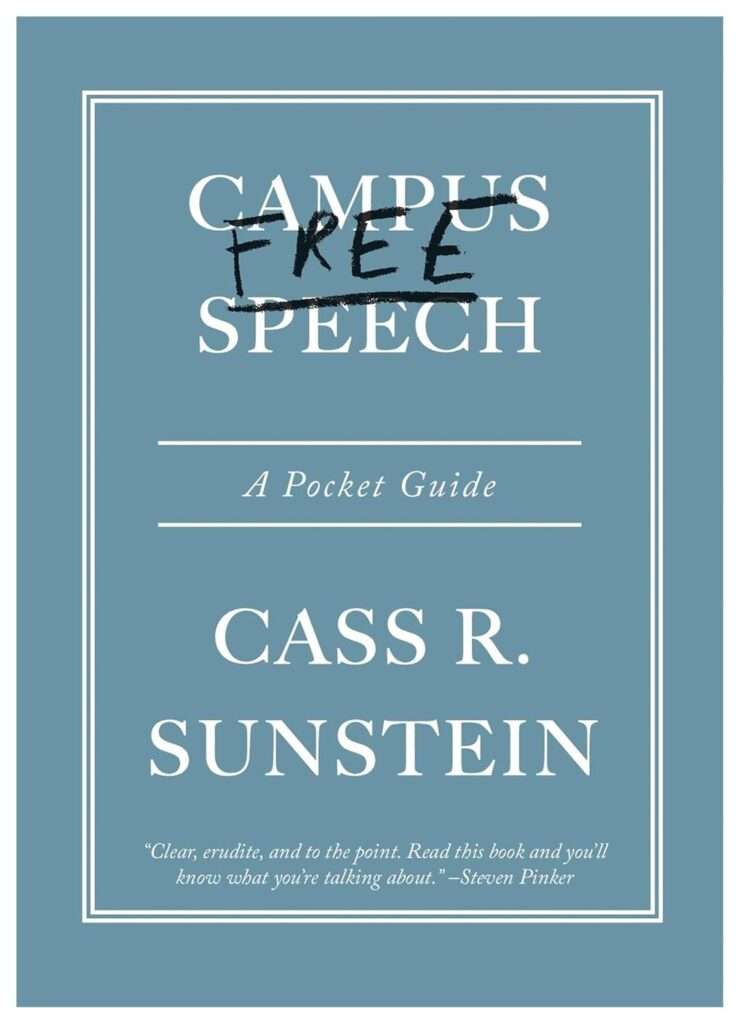
I'm delighted to report that Prof. Cass Sunstein (Harvard) will be guest-blogging this week about this new book. Here's the publisher's summary:
From renowned legal scholar Cass R. Sunstein, a concise, case-by-case guide to resolving free-speech dilemmas at colleges and universities.
Free speech is indispensable on college campuses: allowing varied views and frank exchanges of opinion is a core component of the educational enterprise and the pursuit of truth. But free speech does not mean a free-for-all. The First Amendment prohibits "abridging the freedom of speech," yet laws against perjury or bribery, for example, are still constitutional. In the same way, valuing freedom of speech does not stop a university from regulating speech when doing so is necessary for its educational mission. So where is the dividing line? How can we distinguish reasonable restrictions from impermissible infringement?
In this pragmatic, no-nonsense explainer, Cass Sunstein takes us through a wide range of scenarios involving students, professors, and administrators. He discusses why it's consistent with the First Amendment to punish students who shout down a speaker, but not those who chant offensive slogans; why a professor cannot be fired for writing a politically charged op-ed, yet a university might legitimately consider an applicant's political views when deciding whether to hire her. He explains why private universities are not legally bound by the First Amendment yet should, in most cases, look to follow it. And he addresses the thorny question of whether a university should officially take sides on public issues or deliberately keep the institution outside the fray.
At a time when universities are assailed on free-speech grounds from both left and right, Campus Free Speech: A Pocket Guide is an indispensable resource for cutting through the noise and understanding the key issues animating the debates.
Labor Day is the right time to remember that we can make workers vastly better off by empowering more of them to vote with their feet, both within countries and through international migration.
Each Labor Day since 2021, I have written posts explaining how breaking down barriers to labor mobility can help many millions of workers around the world. Virtually everything in last year's post is just as relevant today. So I am reprinting it with some updates and modifications:
Today is Labor Day. As usual, there is much discussion of what can be done to help workers. But few focus on the one type of reform that is likely to help more poor and disadvantaged workers than virtually anything else: increasing labor mobility. In the United States and around the world, far too many workers are trapped in places where it is difficult or impossible for them to ever escape poverty. They could vastly improve their lot if allowed to "vote with their feet" by moving to locations where there are better job opportunities. That would also be an enormous boon to the rest of society.
Internationally, the biggest barriers condemning millions to lives of poverty and oppression are immigration restrictions. Economists estimate that eliminating legal barriers to migration throughout the world would roughly double world GDP - in other words, making the world twice as productive as it is now. A person who has the misfortune of being born in Cuba or Venezuela, Zimbabwe or Afghanistan, is likely condemned to lifelong poverty, no matter how talented or hardworking he or she may be. If they are allowed to move to a freer society with better economic institutions, they can almost immediately double or triple their income and productivity. And that doesn't consider the possibility of improving job skills, which is also likely to be more feasible in their new home than in their country of origin.
As with lowering immigration restrictions, breaking down domestic barriers to labor mobility would create enormous benefits for society as a whole, as well as the migrants themselves. Economists estimate that cutting back on exclusionary zoning would greatly increase economic growth. Like international migrants, domestic ones can be more productive and innovative if given the opportunity to move to places where they can make better use of their talents.
Many proposals to help workers have a zero-sum quality. They involve attempts to forcibly redistribute wealth from employers, investors, consumers, or some combination of all three. Given that virtually all workers are also consumers, and many also have investments (e.g. - through their retirement accounts), zero-sum policies that help them in one capacity often harm them in another. Breaking down barriers to labor mobility, by contrast, is a positive-sum game that creates massive benefits for both workers and society as a whole; it similarly benefits both migrants and natives.
Some on the left point out that, if investors are allowed to move capital freely, workers should be equally free to move, as well. It is indeed true that, thanks to government policies restricting labor mobility, investment capital is generally more mobile than labor. It is also true that the restrictions on labor mobility are deeply unjust. In many cases, they trap people in poverty simply because of arbitrary circumstances of birth, much as racial segregation and feudalism once did. The inequality between labor and capital, and the parallels with segregation and feudalism should lead progressives to put a higher priority on increasing labor mobility.
At the same time, it is worth recognizing that investors and employers, as a class, are likely to benefit from increased labor mobility, too. Increased productivity and innovation create new investment opportunities. The biggest enemies of both workers and capitalists are not each other, but the combination of nativists and NIMBYs who erect barriers to freedom of movement, thereby needlessly impoverishing labor and capital alike. Despite conventional wisdom to the contrary, even current homeowners often have much to gain from curbing exclusionary zoning policies that block the construction of housing needed by workers seeking to move to the region.
Obviously, there are those who argue against increasing labor mobility, either on the grounds that existing communities have an inherent right to exclude newcomers, or because allowing them to come would have various negative side-effects. I address these types of arguments here, and in much greater detail in Chapters 5 and 6 of my book Free to Move: Foot Voting, Migration, and Political Freedom. As I explain in those earlier publications, nearly all such objections are wrong, overblown, or can be ameliorated by "keyhole solutions" that are less draconian than exclusion. In addition, the vast new wealth created by breaking down barriers to mobility can itself be used to help address any potential negative effects. In the book, I also push back against claims that mobility should be restricted for the benefit of those "left behind" in migrants' communities of origin.
In recent years, there has been important progress on both expanding immigration and reducing exclusionary zoning. Several states have also enacted occupational licensing reform, which facilitates freedom of movement between states. But there is much room for further improvement on all these fronts. Moreover, especially when it comes to restrictions on international migration, we could easily get regression, rather than progress over the next few years. Unfortunately, we have to protect against backsliding, as well as promote improvement.
Workers of the world, unite to demand more freedom of movement!
One of the four men charged in a conspiracy to harass and intimidate a New Hampshire journalist for negative coverage of the founder of a mental health and addiction treatment center was sentenced to more than two years in federal prison.
U.S. District Court Judge Indira Talwani sentenced Tucker Cockerline, 33, of Salem, N.H., to 27 months in prison to be followed by three years of supervised release. Cockerline pleaded guilty in federal court in Boston last December to one count of conspiracy to commit stalking through interstate travel.
Cockerline was indicted along with co-conspirators Michael Waselchuck, Keenan Saniatan and Eric Labarge. All but Saniatan have entered plea agreements and Saniatan is expected to plead guilty in a change of plea hearing scheduled for Sept. 5….
The feds say that the intimidation campaign began in retaliation for the publication of an article on Eric Spofford, founder of the Granite Recovery Centers, in March 2022….