The Volokh Conspiracy

Mostly law professors | Sometimes contrarian | Often libertarian | Always independent | Est. 2002

The Volokh Conspiracy

Judge Reed O'Connor's Remarks On Forum Selection and "Judge Shopping"

"Appearing to cave to criticism from commentators and political officials, this Judicial Conference proposal rejects the idea that there are no partisan judges—only judges doing their level best to faithfully apply the law to reach the correct decision."

|

I am pleased to pass on these remarks from Judge Reed O'Connor (NDTX). Yesterday, he opened the Federalist Society's 2024 Texas Chapters Conference in Fort Worth. Judge O'Connor addressed the topic of forum selection and "judge shopping," as well as and recent proposals from the Judicial Conference.

Welcome to the Fort Worth Division of the Northern District of Texas. Fort Worth is honored that the Federalist Society chose to hold its annual Texas Conference here.

I am confident you will find that Fort Worth is a very welcoming city. And, no, I don't mean for judge-shopping, as some like to think. I mean Fort Worth truly has a welcoming spirit.

For those who have seen the movie 12 Mighty Orphans, that orphanage was located in southeast Fort Worth. The book the movie was based on described "Fort Worth . . .  as one of the friendliest places to downtrodden children in the hardest years of the Depression." That welcoming spirit remains just as strong today.

There is a lot of resilient history in this corner of Texas. Fort Worth was established in 1849 as an army outpost on a bluff overlooking the Trinity River. It has come a long way since then as it is now the 11th largest city in the United States—having just passed Austin—and was one of the fastest growing cities in the country last year.

Despite its size, Fort Worth resiliently maintains its small-town charm and original western heritage, as you can see in its historic Stockyards entertainment district and the Sid Richardson Museum in Sundance Square.

At the same time, Fort Worth also features first class cultural experiences in its incredible museums that boast works of art from the Renaissance to the 21st Century, including Michelangelo's very first painting, which hangs in the Kimbell Art Museum. That cultural experience also includes the world class Bass Performance Hall.

Situated in the heart of Fort Worth is the federal courthouse—a beautiful Depression-era WPA construction project that has been the venue for many historic cases.

In the exact courtroom in which I preside, former Texas Governor Coke Stevenson sued then-Congressman Lyndon B. Johnson over the primary results for the 1948 Democratic Senate primary. This decision was ultimately appealed to the U.S. Supreme Court where Justice Black ruled in Johnson's favor. And the rest is history, as Senator Johnson became Majority Leader, Vice President, and then President.

In the same courtroom, Judge David Belew, a World War 2 soldier who stormed the beaches of France and was shot on D-Day, presided over the longest aviation trial in U.S. history—spanning 14 months.

And in this courtroom Judge Terry Means handed down the first federal death sentence in the nation after its reinstatement as a punishment under the 1994 Federal Death Penalty Act.

These kinds of high-profile cases continue to be filed in this Division. Some of those cases impact the topics that will be debated today. Nothing too controversial, mind you—things like the line between governmental power and parental rights, First Amendment cases, and cases highlighting the tension between federal power and the power of border states.

Of course, decisions in cases like these often result in outside efforts to undermine public support for the judiciary from a host of commentators, so-called watchdogs, and even elected officials. But by design, federal judges were given life tenure so that the passions of the public would not influence them. It doesn't mean judges are immune from criticism. In fact, don't become a judge if you are uncomfortable with criticism.

But sometimes these decisions lead to threats and intimidation tactics directed at the presiding judges, or other acts designed to undermine the legitimacy of judges. We will hear from distinguished panelists today who will discuss the difference between legitimate criticism versus efforts to undermine the judiciary, along with the duty placed on those in the legal profession to defend the judiciary, and why that is important.

This discussion is critically important when these external efforts to undermine judges spark internal pressure within the judiciary. Just this year, in response to political pressure that named specific judges, the Judicial Conference took aim at single-judge divisions, especially those in Texas. Appearing to cave to criticism from commentators and political officials, this Judicial Conference proposal rejects the idea that there are no partisan judges—only judges doing their level best to faithfully apply the law to reach the correct decision.

Notably, the proposal did not target longstanding forum-shopping—or as Judge Jim Ho put it, forum-selling—in bankruptcy courts or patent venues. Such cases impact our economy in the billions of dollars and were recently highlighted only due to an embarrassing scandal. Yet the practice in these areas remain untouched by reform efforts given the absence of comparable political pressure from commentators and political officials.

Instead, the proposal focused entirely on remedies the Department of Justice, the world's largest law firm and regular forum shopper, complained of—that is, injunctions and vacaturs. The reason for this was clear: the Judicial Conference was responding to external political criticism.

Thankfully, judges and members of our profession pushed back, ensuring that heavier access-to-justice burdens aren't imposed on citizens in our district based solely on where they live. But this pressure remains a constant and will not ease up anytime soon. Indeed, it appears that the Judicial Conference Rules Committee intends to adopt a procedure mandating the case assignment guidance.

During such times, we are especially fortunate to be part of organizations like the Federalist Society, whose main purpose is to sponsor fair, serious, and open debate about protecting constitutional freedoms and the role of the courts in saying what the law is rather than what they wish it to be. I think you will all agree that this purpose will be fulfilled by the great program today.

In our current climate of efforts to undermine the judiciary, and when law schools and law professors across the country increasingly teach students to presume malicious intention on the part of judges with whom they disagree, there is no place more resilient to host critical conversations about the judiciary than at this conference, in this circuit, and in this division.

Thank you all for being here in our great city, and for your continued commitment to the judicial system and to the people of the United States of America.

Welcome to Fort Worth!
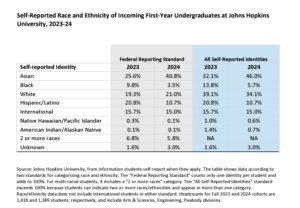
Comparing Class of 2027 to Class of 2028 Demographic Data is Tricky (UPDATED)

|

[I have updated and basically rewritten the post in light of new information that allows me to explain matters much more clearly, I think.]

This year's entering class is the first since admissions decisions were constrained by the Supreme Court's ban on racial preferences in the SFFA case, and lots of interesting data have been coming out. Some elite universities like Yale, despite swearing in an amicus brief that there was no way to retain racial diversity without using preferences, have seen their "underrepresented minority" demographics barely change. Others, like MIT and Johns Hopkins, have seen their Asian American populations increase with a concomitant decrease in Hispanic and Black matriculants and little change in the percentage of white students.

For those interested in how SFFA has changed college admissions stats, one pitfall to watch out for is that universities do not always report the data consistently. One way to report the data, preferred/required by the government, is to assign each student only one racial or ethnic (Hispanic) classification, regardless of how many boxes the student checked. My understanding is that if a student checks white and Hispanic (an ethnic classification), he is reported as Hispanic. If he checks two racial classifications, he is reported under a "multiracial" category. The total should add up to 100%, give or take a minor rounding up or down.

The other way to report the data is to count every student by every box they check. Thus, a student who checks both white and black will be reported in both the white and black percentages, instead of in the multiracial classification. In this context, someone with, say, Native American, black, Hispanic, and white ancestry would "count" for all four categories. As a result, the percentages will add up to over 100%.

Some universities that previously reported their data to the public (as in press releases and admissions material) the first way, one classification per student, are now reporting it the second way. So, for example, a school that reported 10% black students last year and reports 10% again, may in fact have, say, only 7% if they had reported the data the same way, along with 3% of students who previously would have been reported as multiracial rather than black.

Johns Hopkins seems to be one of the few institutions that have posted the demographic data in both formats for both 2023 and 2024. As you can see below, how a university reports the data can make a significant difference in the relevant percentages, but the basic story is the same either way: Hispanic and Black matriculants fell sharply, white matriculants were pretty steady, and Asian American matriculants rose sharply. And kudos to Hopkins for transparency.

Criminal Justice

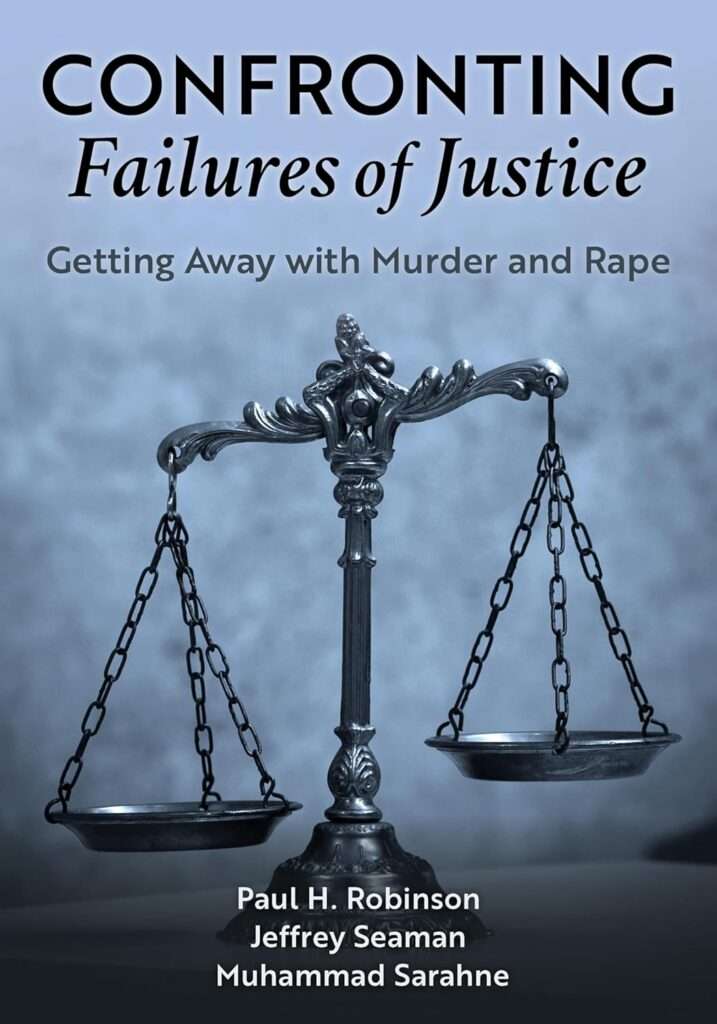
Prof. Paul Robinson & Jeffrey Seaman Guest-Blogging About "Confronting Failures of Justice: Getting Away with Murder and Rape"

|

I'm delighted to report that Prof. Paul Robinson (Penn) and Jeffrey Seaman will be guest-blogging this coming week about their new book. Here's the publisher's summary:

Most murderers and rapists escape justice, a horrifying fact that has gone largely unexamined until now. This groundbreaking book tours nearly the entire criminal justice system, examining the rules and practices that regularly produce failures of justice in serious criminal cases. Each chapter outlines the nature and extent of justice failures in present practice, describing the interests at stake, and providing real-world examples. Finally, each chapter reviews proposed and implemented reforms that could balance the competing interests in a less justice-frustrating manner and recommends one—sometimes completely original—reform to improve the system.

A systematic study of justice failures is long overdue. As this book discusses, regular failures of justice in serious criminal cases undermine deterrence and the criminal justice system's credibility with the community as a moral authority. The damage caused by unpunished crime is immense and, even worse, falls primarily on vulnerable minority communities. Now for the first time, students, researchers, policymakers, and citizens have a resource that explains why justice failures occur and what can be done about them.

And the jacket blurbs:

Read More

Organ transplants

Progress on the End Kidney Deaths Act

This legislation could save many lives by giving tax credits to kidney donors. But it would not be as good as full legalization of organ sales.

|

NA

The bipartisan End Kidney Deaths Act (EKDA) is making some progress in Congress. Dylan Matthews of Vox has a helpful summary of the legislation and its importance:

A few months ago, I wrote about a proposal called the End Kidney Deaths Act, which seeks to make sure that every one of the more than 135,000 Americans who get diagnosed with kidney failure every year has access to a kidney transplant.

Its method is simple: a federal tax credit worth $10,000 a year for five years, paid to anyone who donates a kidney to a stranger. It's the kind of thing that would've helped a lot when I donated a kidney back in 2016. Elaine Perlman, a fellow kidney donor who leads the Coalition to Modify NOTA, which is advocating for the act, estimates the measure will save 100,000 lives over the first decade it's enacted, based on conversations with transplant centers on how many surgeries they can perform with their current resources….

Since we last covered it, the Act has taken some huge strides forward. It has been introduced in the House of Representatives with two Republicans (Reps. Nicole Malliotakis of New York and Don Bacon of Nebraska) and two Democrats (Reps. Josh Harder of California and Joe Neguse of Colorado) in support of it. Dozens of supporters took to the Hill last week for a lobby day, meeting with staff for over 50 other senators and representatives.

As Matthews notes, EKDA is also generating some opposition. Still, it's good that it has gained so much support so quickly. In the rest of his article, Matthews effectively addresses a variety of criticisms of the Act, such as claims that payment for kidneys is too dangerous for donors, or that such compensation would exploit the poor. I agree with nearly all of his points.

I do have one reservation about the End Kidneys Act, which I laid out in a previous post on the subject:

The major shortcoming of the End Kidney Deaths Act is the implicit price control it creates. By setting the payment at $50,000, it prevents higher payments where that would be necessary to ensure adequate supply. While the Act would save thousands of lives, the estimates Matthews cites (some 6000 to 11,500 additional kidney donations per year) would still leave us many thousands of kidneys short, thereby still dooming many people to needless death, or at least additional years on kidney dialysis.  This problem might be especially acute for patients whose genetics make it unusually difficult to find a matching donor. Conversely, if some potential donors are willing to sell for less than $50,000, there is no good reason to ban such transactions.

Full legalization of organ sales, with no price controls, would fix these problems. It's basic economics 101 that markets function best if prices are allowed to fluctuate in response to supply and demand. In a free market, insurance companies, medical care providers, and others have every incentive to pay what it takes, as the alternative of kidney dialysis is far more expensive. If necessary, the government could subsidize consumption by the poor, as it already does for kidney dialysis and many other health care expenses.

The big problem is that the End Kidney Deaths Act would not actually end preventable kidney deaths, though it would significantly reduce them. As discussed in my forthcoming article, "The Presumptive Case for Organ Markets," full legalization could save an estimated 47,000 lives per year, several times more than EKDA. It would also save many thousands more people from years of costly and painful life on kidney dialysis. In that article, I also address various objections in detail, emphasizing that, even if they have some validity, they cannot outweigh the enormous benefits of legalization.

Despite its limitations, EKDA would still be a major improvement over the status quo. The best should not be the enemy of the good, and I would be happy to see it pass. But full organ market legalization would be much better still.


Politics

Short Circuit: A Roundup of Recent Federal Court Decisions

Equity training, intrusive questions, and a sorry mofo.

|

Please enjoy the latest edition of Short Circuit, a weekly feature written by a bunch of people at the Institute for Justice.

New case! Last year, Macon-Bibb County, Ga. officials demolished IJ client Eric Arnold's house without any notice or any kind of court proceeding—one of 800 houses to be demolished in the county over the last three years as part of a secret code enforcement program that lacks the most basic due process safeguards. Eric was renovating the house, which he planned to give to family; and while there was still work to do, the yard was neat, the exterior was clean, and it was in vastly improved shape compared to when he bought it. Click here to learn more.

New case! In 2022, a Broward County, Fla. officer arrested IJ client Jennifer Heath Box on a warrant for a woman with a somewhat similar name but completely dissimilar age, address, SSN, driver's license #, and much, much more. (It turned out officers in Texas had mistakenly put Jennifer's driver's license photo on the warrant.) She spent three days in jail in miserable conditions that included a strip search, freezing temperatures, and a male inmate who repeatedly tried to get into her cell when she was alone. "[The officer] had so much evidence that he had the wrong Jennifer, and he either ignored that evidence or deliberately misled other Broward County officials," says IJ Attorney Jared McClain. "We must be able to hold government officials accountable when they overlook glaring evidence and arrest the wrong person." Click here to learn more.

Read More

Supreme Court

A Critique of Justice Kagan's Supreme Court Ethics Reform Proposal

Could a panel of lower court judges evaluate ethics complaints against Supreme Court justices?

|

Over the summer, Justice Elena Kagan offered support for an ethics code for Supreme Court justices and suggested possible ways such a code could be enforced, such as through a panel of lower court judges. She reiterated this position earlier this month.

Would such a proposal work? James Burnham has doubts.

This proposal has several fundamental problems. For starters, it would give a future chief justice extraordinary power over his or her colleagues—power that some future, malevolent chief justice could easily abuse. By selecting the lower court judges who stand in judgment of the justices, the chief justice could put a thumb on the scale of those determinations. Gaining an upper hand on an intractable colleague would be as easy as stacking the ethics panel with that colleague's antagonists. We can certainly hope no judge would abuse such authority. But to borrow from the old adage—if judges were angels, no ethics panel would be necessary.

And consider this dynamic in the context of a problem facing the Court right now: leaks of confidential information. Last weekend, the New York Times printed an exposé on the most recent Supreme Court term, replete with details of internal memos, the justices' deliberations, and more. We have no idea who leaked this sensitive information to the Times—and particularly whether any justice was involved—but the leaks appear designed to undermine Chief Justice John Roberts and cast an unflattering light on the Court's majority in certain important decisions. The judiciary's ethical canons flatly prohibit politically motivated leaks of confidential judicial deliberations. Canon 4(D)(5) states: "A judge should not disclose or use nonpublic information acquired in a judicial capacity for any purpose unrelated to the judge's official duties." Presumably, a campaign to influence the chief justice and his colleagues by leaking "nonpublic information" to the New York Times would meet that description.

It's a fair question, then, how the proposed ethics panel would address this prima facie ethical violation at the Court. Someone at the Supreme Court provided confidential information to reporters. Would the chief justice's hand-selected panel of lower court judges conduct a leak investigation at the Court? Would the ethics panel have compulsory process over Court staff? What about the justices themselves? Could the ethics panel demand internal documents from the Court? Could the ethics panel sanction a law clerk, staff member, or justice who refuses to participate in its inquiry? These questions would arise immediately if such an institution existed.

It's also unclear how the proposed ethics panel would enforce its determinations. Allowing lower court judges to force the recusal of specific justices is a recipe for disaster: it would create the real prospect of an obscure judicial panel changing the outcome of an important Supreme Court case. Or perhaps the panel could go further and suspend offending justices? That would be even more calamitous, enabling the chief justice's lower court appointees to change the composition of the Court without regard to life tenure, presidential appointment, or Senate confirmation.

Russell Wheeler of the Brookings Institute offers a more sympathetic assessment of Kagan's proposal, but also acknowledges there are serious questions about how such a program would be implemented.

Is any such set of reforms necessary? Congress retains the authority to discipline justices that fail to engage in "good behavior" through impeachment -- and Congress could well enact or endorse a set of standards, the violation of which, would justify initiating an impeachment inquiry.  The problem, of course, is that impeachment requires a broader political consensus about alleged misconduct that currently exists.

Free Speech

Security Clearance Denied for Watching Furry Porn Depicting Animated 16-Year-Olds

|

From Bierly v. Dep't of Defense, decided Wednesday by Judge Royce Lamberth (D.D.C.):

In 2020, Bierly was offered employment with the Air Force Joint Warfare Analysis Center in Dahlgren, Virginia as a Student Trainee. As a condition of his employment, Bierly was required to maintain a Top Secret with Special Compartmented Information (TS/SCI) security clearance, for which he was polygraphed by NSA investigators in February 2020. Starting in June 2020, Bierly began working for the Air Force in a probationary capacity….

In November 2022, the DCSA notified Bierly of its intent to revoke his security clearance pursuant to Security Executive Agent Directive (SEAD) 4, Guideline D, which provides for revocation on the basis of the subject's sexual behavior. DCSA's notification included a Statement of Reasons (SOR) document, explaining the agency's rationale for its preliminary revocation determination. The SOR indicated that, during his polygraph, Bierly admitted to viewing pornographic videos featuring "furries," which may refer either to real people wearing animal costumes or to animated images of anthropomorphic animals.

Bierly confessed that some of the furries in the videos he watched were depicted as minors as young as age 16. The SOR advised that Bierly's history of "engaging in criminal sexual behavior by viewing and masturbating to pornographic images of minors" and intent to continue doing so constituted a "security concern." For his part, Bierly objects to characterizing the videos as child pornography because they featured animated characters rather than actual 16-year-old people….

Bierly's constitutional claims are as follows: Count I claims that viewing animated furry pornography is protected speech under the First Amendment, and that DCSA's suspension of his security clearance therefore infringes this right.

Read More

Politics

"Put a Walmart Bag on Her Head … to Keep the Sex Witches Away": Court Upholds Limit on Aunt's Access to Divorced Couple's Children

|

From Styles v. Styles, decided Wednesday by the Arkansas Court of Appeals, in an opinion by Judge Kenneth Hixson, joined by Judges Stephanie Potter Barrett and Wendy Scholtens Wood:

In the final order, the trial court ordered that Angela's twin sister, Andrea, not be left alone with the children or communicate with them in any way except as authorized in the order. The trial court found that Andrea "poses a clear threat to the emotional well-being of the children based on earlier findings resulting from her testimony in open court." The trial court ordered that, if Andrea wished to see the children, the visitation would be supervised by a person of Jamey's choosing….

The testimony at trial showed that Andrea had exhibited concerning behavior, including praying in the presence of the children for a spirit of confusion to come upon one of Jamey's sisters and her family. Andrea also thought Jamey's sister was a witch and controlled Andrea's mind, and Andrea shared this with the children.

There was also testimony that, while working at Angela's [dermatology] clinic, Andrea put a Walmart bag on her head and stated that she had to wear it to keep the sex witches away. As a result of Andrea's behavior at the clinic, she was banned from the clinic by the Arkansas State Medical Board. Finally, the children's attorney ad litem, who was very familiar with the case, recommended that the children have no contact with Andrea unless it was supervised by someone other than a relative.

While we agree with the principle that a parent's visitation rights cannot be denied for their religious beliefs, we observe that Andrea is not these children's parent, and we further conclude that the trial court's decision to limit the children's contact was motivated not by religious considerations but rather by the well-being of the children. We hold that, on this record, the trial court did not clearly err in finding that it was in the children's best interest to have only restricted contact with Andrea.

Bart W. Calhoun (McDaniel Wolff PLLC) represents the father.

Man Indicted For Threatening To Lynch "Corrupt" Justice Thomas And His "Insurrectionist" Wife

There are consequences to the rhetoric about the Court from high ranking officials.

|

Yesterday the Department of Justice indicted Panos Anastasiou for making threats against "Supreme Court Justices 1-6." Threats were also made against "Family Members 1 and 2" of "Supreme Court Justices 1 and 2." The indictment doesn't name who the six Justices and their family members are, but it isn't hard to figure things out. The motion to seek a detention hearing lists the specific messages that the defendant submitted through the Supreme Court's website. I will reproduce theme here, as relayed by DOJ.

January 4, 2024: "I'd like to see [Former President 1 and Supreme Court Justice 1] hanging together from an Oak tree. I'd gladly provide the rope and pull the handle."

May 10, 2024: "Subject: N***** [Supreme Court Justice 1]", "I'd like to see you have a real lynching and I'll donate the tree and pull the lever… you worthless piece of n***** shit."1

May 16, 2024: "I would have had NO reservations about walking up to [Supreme Court Justice 2] and not asking him to take it down but to put a BULLET in this mother fuckers head."

May 17, 2024: "I'm going to call and urge my fellow Vietnam veterans… to drive by the [Supreme Court Justice 2]'s house with their AR15's and when fucking [Supreme Court Justice 2] and his fucking PIECE OF SHIT CUNT WIFE are HOME spray the home of these disrespectful mother fuckers with hundreds of rounds… hopefully killing these SCUMBAG COCKSUCKERS. Hopefully N***** [Supreme Court Justice 1] and his white trailer trash n***** loving insurrectionist wife are visiting."

June 18, 2024: "I don't want to see these two corrupt mother fuckers assassinated… I'd like to see them TORTURED worse than Kim Jung Un would torture his own family. You know, like putting electrodes up their ass and on their balls, needles under their finger nails, pulling their teeth with pliers, etc etc. Make these SCUMBAGS beg for their lives."

July 1, 2024: "ASSASSINATING THESE COCKSUCKERS IS THE ONLY PANACEA… that includes the CONVICTED CRIMINAL, [Former President 1]. Again as an AMERICAN and to defend the constitution and democracy I want the assassinations by any ENTITY of the government or even a PATRIOTIC AMERICAN to commence. And PLEASE start with the assassination of the N***** and HERMAPHRODITE. As a Vietnam veteran and if I had the means and way I'd assassinate them myself. These fuckers are NOT ABOVE THE LAW."

July 3, 2024: "WE NEED MASS ASSASSINATIONS. If you're corrupt you're corrupt… don't give us this official and unofficial bullshit. You mother fuckers are UNELECTED and Americans have no trust in you. The internet is abuzz with Americans clamoring for your ASSASSINATIONS. We need to assassinate you fuckers and put your heads on a pike and use them as soccer balls. I want to be the first to kick [Supreme Court Justice 6] head down Pennsylvania Ave. You don't want to ask me what I'd like to do to the N***** and [Supreme Court Justice 2]."

July 5, 2024: "We should make [Supreme Court Justices 1-6] be AFRAID very AFRAID to leave their home and fear for their lives everyday."

Justice 1 is Justice Thomas. Family member 1 is Ginni Thomas.

Justice 2 is Justice Alito. Family member 2 is Martha Ann Alito.

And I am just going to guess that Justices 3 through 6 include Chief Justice Roberts, Justice Gorsuch, Justice Kavanaugh, and Justice Barrett. I'm not sure for certain who Justice 6 is, and why the defendant wants to kick his or her head down Pennsylvania Avenue.

I am grateful that the defendant was apprehended, but these threatening messages began nearly eight months ago. Far be it from me to question law enforcement, but it seems in recent times that the government has failed to act upon threats until guns were in the vicinity of public officials. Do would-be assassins get one free shot at a Justice's ear? Are they allowed to hide for twelve hours in a bush outside the Justice's home? We know the Kavanaugh assassin was able to take a stroll past the Justice's house. I'm glad DOJ finally got around to indicting him! In the meantime, Justice Barrett needs to explain to her children why she has a bullet-proof vest.

Let me make a broader point. There is a common theme in the defendant's rants: the Justices are corrupt, they are in cahoots with President Trump, and Ginni Thomas is an insurrectionist. Where could the defendant possibly have heard such messages? Surely, one could find these comments in the dregs of social media. But these slanders are also issued repeatedly by leading Democratic lawmakers. Indeed, the entire basis of President Biden's "Court Reform" plan is that the Justices are "corrupt" and cannot be trusted. There are consequences to the rhetoric about the Court from high ranking officials.

I wish more people in positions of power would defend the Court. I praise in the highest terms a recent speech that Kannon Shanmugam delivered at Duke, as reported by the Wall Street Journal. Kannon points out how public officials use language that is similar to Panos Anastasiou's, minus the racial slurs. Kannon offers some examples:

… the attacks have been accompanied by unusually toxic rhetoric. Consider statements like these:

• "The extreme far-right, MAGA majority on the United States Supreme Court is totally out of control."

• "This activist, extremist MAGA court faces a legitimacy crisis."

• "The problem is not that the Supreme Court is just conservative. The problem is that it is corrupt."

• "We must restore justice and balance to the rogue, radical Supreme Court."

• "The Supreme Court is a cesspool of corruption devastating our communities."

These statements do not come from random people; all of them come from members of Congress. And it does not take much imagination to realize what the rhetoric elsewhere looks like.

And Kannon expressly ties this sort of rhetoric with the assassination attempt against Justice Kavanaugh:

As observers across the political spectrum noted in the immediate aftermath of the attempted assassination of former President Trump, the rhetoric in American public life, on both sides, has more generally become overheated; indeed, we practicing lawyers (myself included) sometimes cross the line, too. But I believe that the attacks on the Court's legitimacy, and the accompanying rhetoric, are having two deeply concerning effects. First, as the two distinguished recent leaders of this school's Bolch Judicial Institute, David Levi and Paul Grimm, have recently warned, attacks on the legitimacy of the courts are contributing to the threat of violence against judges in general. And the same can be said with regard to the Supreme Court in particular. Most obviously, a man has been charged with the attempted assassination of Justice Kavanaugh after allegedly turning up at his home with a gun and other weapons. (The man has pleaded not guilty and is awaiting trial.) Others have recently been charged with or detained for making threats against the Chief Justice and Justice Barrett. It is impossible to draw a direct link between the attacks on the Court's legitimacy and any of these recent alleged crimes. But when even members of Congress are threatening that Justices will "pay the price" and "won't know what hit them" if they issue decisions reaching certain outcomes, it is not unreasonable to conclude that the rhetoric around the Court's legitimacy risks adding to the problem.

Kannon is exactly right. As we are told over and over again, words have consequences.

And I only wish more members of the Supreme Court bar would be so vocal in speaking out on this issue. They make a lot of money off of the Court. Certainly their firms, and clients, would appreciate even a modest defense of the Justices.

The same charge goes to the Department of Justice. I'm looking right at you Attorney General Garland. You are quite fond of criticizing former-President Trump, whom your special counsel is trying to convict, but criticism should also be targeted at your boss. Ditto for Solicitor General Prelogar, who should spend a little less time sitting with Vanity Fair, and spend more time explaining why her boss's proposal would be so destructive for the Court. One wonders if any other Attorney General would ever approve of such a puff piece about the Solicitor General.

Free Speech

California Litigants Must Ask for Pseudonymity, Rather Than Just Filing Under a Pseudonym

|

From L.A. Superior Court Judge Frank Tavelman's order last Friday in Roe v. Smith:

Plaintiffs have not adhered to the proper procedure for proceeding anonymously. Before a party can proceed anonymously, they must move the Court for permission to do so. This procedure is addressed in Department of Fair Employment and Housing v. Superior Court of Santa Clara County (2022) 82 Cal.App.5th 105 (hereinafter DFEH). There the Court observed the following:

Procedurally, because a hearing is required, a party who wants to proceed anonymously will file the initial complaint or petition conditionally under a pseudonym and then move for an order granting permission to proceed that way. If the request is granted, the initial pleading can remain. If pseudonym use is denied, the pleading must be amended to state the party's true name.

Here, no motion was made to proceed anonymously, and no hearing was ever conducted on Plaintiff's right to do so. This procedural posture is important because it places the burden on the party seeking to proceed anonymously to demonstrate an overriding interest. Plaintiff's failure to move for permission to proceed anonymously has essentially improperly shifted this burden to First Amendment and Defendants. Plaintiffs have never demonstrated to the Court that they can overcome the presumption of openness provided by CRC Rule 2.550(c)….

Read More

Free Speech

No Pseudonymity for Plaintiff Challenging Suspension Under Title IX

So holds the Eleventh Circuit, upholding the district court's decision—but the court's standard of review suggests that the exact oppose district court decision might have been upheld, too.

|

Yesterday's Eleventh Circuit decision in Doe v. Florida Gulf Coast Univ. Bd. of Trustees (by Eleventh Circuit Judges Robert Luck, Andrew Brasher, and Nancy Abudu) involved a plaintiff who was suing under Title IX, challenging the University's decision to suspend him for allegedly having sex with his ex-girlfriend "when she was too intoxicated to consent." Plaintiff sought to proceed under a pseudonym—quite routine in such cases. But the district court said no, and the Eleventh Circuit held that the district court's decision wasn't an abuse of discretion:

We have laid out several considerations relevant to determining whether a district court should allow a litigant to proceed anonymously[:] … "whether the party seeking anonymity (1) is challenging government activity; (2) would be compelled, absent anonymity, to disclose information of utmost intimacy; or (3) would be compelled, absent anonymity, to admit an intent to engage in illegal conduct and thus risk criminal prosecution." "The 'information of utmost intimacy' standard" generally relates to topics like "abortion" as well as "prayer and personal religious beliefs." "On the other hand, courts have often denied the protection of anonymity in cases where plaintiffs allege sexual assault, even when revealing the plaintiff's identity may cause her to 'suffer some personal embarrassment.'" … We have [also] considered, for example, [4] whether "the party seeking anonymity is a minor," [5] whether the person "faces a real threat of physical harm absent anonymity," and [6] whether the movant would face "social stigma" if forced to proceed under the movant's true name.

The appellate court held that the district court didn't abuse its discretion as to the utmost intimacy and stigma factors:

Read More

Politics

"Discard [Library] Books … That Reflect Gender, Family, Ethnic, or Racial Bias"

Professional librarian sources seem split on viewpoint-based book removals: some firmly call for viewpoint neutrality, while others say that books should be evaluated for "biased viewpoints."

|

[1.] Next week, the entire en banc Fifth Circuit will be hearing Little v. Llano County, a case involving allegations of viewpoint-based book removals in a public library. As I've noted before, the Supreme Court has never resolved whether such removals are unconstitutional. Pico v. Bd. of Ed. (1982), which considered the matter as to public school libraries, split 4-4 on the subject, with the ninth Justice, Justice White, expressly declining to resolve the substantive question. (The Pico Justices generally agreed that schools could remove some material as age-inappropriate because of its vulgar or sexual content; the debate was about viewpoint-based removals.)

U.S. v. American Library Ass'n (2003), which dealt with the related question of Internet filtering in public libraries generally, was also a splintered decision, and didn't resolve the broader question, either. A 1995 Fifth Circuit panel decision had generally precluded such viewpoint-based removals, but the Fifth Circuit en banc court will need to consider whether that decision should stand: Rehearing by the full en banc court is the normal way that federal appellate courts reconsider whether three-judge panel decisions should be overruled.

I'm not sure what the answer here should be. I tentatively think a public school is entitled to decide which viewpoints to promote through its own library: School authorities can decide that their library will be a place where they provide books they recommend as particularly interesting/useful/enlightening/etc., essentially as supplements to the school curriculum (over which the school has broad authority). The process of selecting library books is part of the government's own judgment about what views it wishes to promote. And the ability to reconsider selection decisions—including in response to pressure from the public, which is to say from the ultimate governors of the public schools—should go with the ability to make those decisions in the first place. To be sure, some such decisions may be foolish or narrow-minded, but they're not unconstitutional.

But this doesn't necessarily resolve the question of how librarians should administer non-school public libraries, which aren't the adjunct to any sort of school curriculum. Libraries are much more about giving more options to readers, rather than about teaching particular skills and attitudes to students. The case for viewpoint neutrality is therefore stronger there—though not, I think, open and shut. (Note also that even the challengers in this case leave open the possibility that courts shouldn't scrutinize book acquisition decisions to decide whether they are viewpoint-based, but only book removal decisions. See Appellees' En Banc Brief at 43-44 & n.13, 50.)

In any case, that's the big picture; here, I want to talk about a particular twist in the dispute, which can be particularly well seen in a friend-of-the-court brief filed by the Freedom to Read Foundation, the Texas Library Association, and American Library Association. The passage, and the sources it cites, refer to the necessity to remove books on some criteria—this is called "weeding," and some sources suggest that each year a public library would generally weed out 5% of its stock—and discuss which criteria are proper:

Read More

Free Speech

Blocking Dissenters from School System's "StaffPride" Twitter Account May Have Violated First Amendment

|

From yesterday's opinion by Judge Paula Xinis (D. Md.) in Foldi v. Bd. of Ed. for Montgomery County:

Foldi and Mandel live in Montgomery County, Maryland. Foldi writes for a news magazine, The Spectator, and Mandel is a columnist for several national publications and has written extensively on education and parental rights. Id. In October 2022, the School Board announced the introduction of LGBTQIA+-themed books into the MCPS [Montgomery County Public Schools] curriculum. In response, several parents sought permission from MCPS for their children to "opt out" of any classroom instruction involving these books.

At first, it appeared that MCPS would permit this opt-out alternative. On March 22, 2023, MCPS confirmed that parents could choose to have their children read other material in lieu of the LGBTQIA+ books. But the next day, the School Board reversed course and informed parents that no such opt-out alternative would be available, nor would MCPS notify parents when classroom instruction would involve LGBTQIA+-themed materials….

The question of LGBTQIA+-inclusive reading materials became a hot button issue for MCPS. At a March 2023 School Board meeting for example, one parent vocally opposed the Board's refusal to provide an opt-out alternative to parents on behalf of their children. In response, Board Member Harris challenged the protestor, publicly announcing that the parent's position "is just telling that kid, 'here's another reason to hate another person.'"

Over the next few months, the debate over the propriety of the opt-out alternative intensified, and in advance of a June 6, 2023, School Board meeting, "scores of parents and community members" gathered in peaceful protest outside of the MCPS Carver Educational Services Center ("Carver Center"), where the meeting was being held. Also at the June 6th meeting, a female Muslim student attested to her discomfort with being made to read LGBTQIA+ books that ran contrary to her religious beliefs, to which Board Member Harris said she "felt kind of sorry" for the student, and opined about whether the student was "parroting [the] dogma" of her parents.

Read More

More