
Monday Open Thread
What's on your mind?

Mostly law professors | Sometimes contrarian | Often libertarian | Always independent | Est. 2002
What's on your mind?
10/27/1787: First Federalist Paper is published.
The allegedly libelous claims about the candidate were made three months after he lost the election; a Magistrate Judge had held the candidate was no longer a public figure, but the District Court disagreed.
From Tallman v. Miller, decided yesterday by Judge Michael Simon (D. Or.):
Tallman … lives in the city of Boardman, Oregon, in Morrow County. He owns and operates a coffee shop in Boardman called, "The Farmer's Cup." In November 2020, Tallman ran for election for the office of Mayor of Boardman but did not win. In May 2021, Tallman ran for election for a seat on the Port of Morrow Board of Commissioners but did not win. In November 2022, Tallman ran for election for a seat on the Boardman City Council but did not win. In May 2023, Tallman again ran for election for a seat on the Port of Morrow Board of Commissioners but did not win.
Miller … grew up in Boardman. In approximately April 2019, she began working at The Farmer's Cup, as a server. She was 16 years old. Tallman hired Miller and was her supervisor. Shortly after she began working for Tallman, Miller "experienced what [she] now know[s] to be highly inappropriate behaviors from a 40-year-old man toward a 16-year-old girl." [Note that these are just the plaintiff's allegations at this point, which the court is taking to be true solely for dealing with defendant's motion to dismiss. -EV] She describes that behavior in detail in her declaration.
She adds that "Tallman would only engage in these behaviors when there wasn't another adult present" and that she "did not feel safe working with Tallman." She also witnessed a friend and co-worker experience similar behavior from Tallman. In August 2019, Miller and her friend were at sports practice. They discussed Tallman's behavior and were overheard by their coach, who was a mandatory reporter under Oregon law. The coach reported what he had heard to the Boardman Police Department. Shortly thereafter, Miller, accompanied by her parents, was interviewed by the Boardman Police, who prepared a report. No charges were ever brought against Tallman. In 2022, Miller left Boardman and moved to Washington.
Another local resident (Nuñez) "either posted or shared the police report on Facebook" in August 2023, and Miller in turn reposted the material. Tallman sued for libel, and the Magistrate Judge recommended that the Court deny Miller's anti-SLAPP motion (which sought to promptly dismiss the case): Tallman, the Magistrate Judge concluded, wasn't a public official or a public figure at the time Miller wrote her Facebook post, so Tallman only had to allege that Miller's speech was negligently false, which he had sufficiently done.
10/26/1774: First Continental Congress ends its first session in Philadelphia.
The Dispatch asked four immigration policy specialists (including myself) to write pieces on the pros and cons of the presidential candidates' immigration policies.
Yesterday, the Dispatch published a symposium on the pros and cons of Donald Trump and Kamala Harris's immigration policies. The participants were David Bier (Cato Institute), Mark Krikorian (Center for Immigration Studies), Alex Nowrasteh (Cato) and myself. Alex, David, and I are obviously strongly pro-immigration, whereas Krikorian is a pretty hard-core restrictionist.
This may be the first time three different Cato-affiliated analysts participated in the same immigration symposium. For what it's worth, I did not know ahead of time that Alex and David were also participating, and we did not coordinate our contributions in any way.
Here's an excerpt from my piece:
For people who value free markets and limited government, this presidential election is a choice of evils—but one of the evils is much greater than the other. Trump's terrible immigration policies are massive. And, unlike Kamala Harris' worst policies, they can largely be implemented through executive power alone….
Trump's mass deportation proposal would cause immense damage to both immigrants and U.S. citizens. It would create disruption, increase prices, and cause shortages. It also destroys more American jobs than it creates… Drastic cuts in legal immigration would exacerbate the economic damage. Cutting migration would also worsen the federal government's dire fiscal situation.
Harris does have some flawed immigration policies of her own, such as her endorsement of President Joe Biden's badly flawed Trump-lite asylum restrictions. She would do better to emphasize the expansion of options for legal migration. But Trump's immigration plans are vastly worse…..
In their contributions (which I largely agree with), David Bier and Alex Nowrasteh both emphasize the dangers of Trump's plans to greatly reduce legal migration. This aspect of his agenda hasn't gotten as much attention as it deserves, even though - as Alex and David note - the president has vast discretion in this field.
For his part, Mark Krikorian fears that Trump might actually expand legal migration. I wish he were right. But that goes against both Trump's stated plans now, and his first-term record, when he massively cut legal migration, far more than the illegal kind.
Aspiring thieves, conquesting marketers, and derivative sovereign immunity.
Please enjoy the latest edition of Short Circuit, a weekly feature written by a bunch of people at the Institute for Justice.
New cert petition: Friends, it was unreasonable and unconstitutional for a SWAT team to raid 593 Eighth Street when it had a warrant to raid 573 Eighth Street, and indeed the SWAT commander concedes as much. (What else can you do when you were meant to look for contraband in a garage, and the house you raided doesn't have a garage?) Sadly, however, the Fifth Circuit ruled that the commander's "deficient" efforts to identify the correct house were enough to get him qualified immunity. In other words, he was reasonably unreasonable. We're asking the Supreme Court to step in. Click here to learn more.
New on the Short Circuit podcast: Our biennial election law special! Foreign contributions, voter rolls, "ballot harvesting," the right to not run for office, and "learned in the law."
Judges Ho and Thapar favor different approaches.
On Wednesday, I was honored to hear Judge Amul Thapar deliver the Story Lecture at the Heritage Foundation. The theme of his lecture is that originalists courts need originalist classrooms. I couldn't agree more. At most law schools, originalism is taught, if at all, as something of a strawman. Professors will introduce it, briefly, and then spend the bulk of time explaining why the doctrine is incoherent. I can count on two hands the number of originalist constitutional law professors in the United States. Law schools are derelict in not hiring more of these scholars. Even if faculties reject originalism, they must recognize that courts are receptive of these arguments, and students need to be trained on originalism.
However, it seems that a different facet of Judge Thapar's remarks made headlines. Judge Thapar offered a proposal of how to ensure that law schools promote originalism.
"Make no mistake: money talks. Only when the taxpayers and donors alike demand it will law schools start to change," Thapar said. "When law schools do change, the hefty price paid for a law degree might actually be worth it, because lawyers will leave law school equipped to practice in today's courts."
Indeed, many legislatures in conservative states are taking a closer look at university curriculums. And several states have established classical institutes within colleges, some of which can confer degrees, to provide students with a different approach to knowledge. But these alternative institutions are unlikely to affect the actual curriculums of accredited law school. Moreover, many conservative donors have halted donations to universities--especially in the wake of October 7.
And to be fair, there are costs to these approaches. If a legislature, or donor, withholds money from a law school, that will have a negative impact on many innocent actors. Law students have little control over what is taught, yet they will likely feel the brunt of any cut in funding. Even originalist professors, a discrete and insular minority, may feel the burn of reduced funding. Still, Judge Thapar seems to support this divestment from institutions that do not teach originalism.
In addition to divestment, there is another approach to fostering change: boycotts. I speak, of course, about the boycotts promoted by Judges Ho, Branch, and others. These judges have declined to hire law clerks from certain law schools based on their policies concerning free speech and anti-semitism. These boycotts are prospective, and only apply to students who choose to go to a school after the boycott is announced. The boycotts are a far more narrowly tailored approach than divestment. Rather than cutting funding throughout a law school, these judges are only withholding a very specific prestige point: federal clerkships. To be sure, both divestment and boycotts harm innocent people. But I think boycotts are far less harmful than divestment, because of their targeted nature.
During the Q&A session, Judge Thapar was asked about the boycotts by Judges Ho and Branch. Here is his answer, roughly transcribed (42:!5):
Thapar: … I appreciate that that's the tack they've taken and that every judge should choose what tact is best for them. I think for me I think speaking out about it's important putting pressure through donors and taxpayers as I mentioned I think is critical the reason is is I don't think as much as you know we may think.
I don't think kids in the military that are going to law school right now are paying attention to what Amul Thapar is saying or any of my colleagues. I think they have much bigger things to worry about about and I don't know that those students should be excluded.
I worry that there's kids like myself that went to law school. I didn't even know what a clerkship was. I'm still the only person in my extended family that went to law school I had no guidance. And I just showed up. I wasn't even a conservative then. I was a nothing right. I was a normal college kid that enjoyed College, played Sports, had fun, probably drank a little too much, and and went to law school.
And I got there and I thought I was going to be interpreting text interpreting law that's just kind of logically, if you have no idea you think that's what you're going to do and then you get there. And it's craziness and a lot of those kids I think either quietly or vocally moved to the right during law school.
And so I struggle with excluding a whole group of essentially students that believe in originalism or want to do originalism to punish their law school now. I'm not saying it might not be effective. I'm not saying the Jim [Ho] and Lisa [Branch] haven't made great strides. I'm saying it's just not the tact I and others have taken because we want to encourage the schools to change we're very vocal about it at the same time we don't want to punish the very students that uh believe in originalism as a result.
Thankfully, as Hamilton explained, judges do not have the power of the purse, so they have no power over the budgets of the states. But judges do have authority over who they hire. Both divestment and boycott will hurt innocent bystanders. If Judge Ho refuses to hire originalist students at Yale, a small number of those elite students will lose a particular line on their sterling resumes. If the Kentucky legislature defunds the University of Kentucky Law School for not hiring originalists, all originalist students at Kentucky would suffer. At this point, then, the only question is about which means you prefer.
The court also concluded defendant had libeled plaintiff, but the court held that even the nonlibelous expressions of opinion could lead to emotional distress liability. The total verdict of $6.8M.
From Shanley v. Hutchings, decided earlier this year by Judge David Barlow (D. Utah); later in the year, a jury awarded plaintiff $1.15M in economic damages, $1.15M in noneconomic damages, and $4.5M in punitive damages:
… Plaintiffs Tera Shanley and her publishing company Wicked Willow Press, LLC ("Wicked Willow") sued Defendant Robyn A. Hutchings for defamation per se, defamation, injurious falsehood, false light, tortious interference, and intentional infliction of emotional distress. Now, Plaintiffs move for summary judgment. Ms. Hutchings did not respond to Plaintiffs' Motion….
This case arises from voluminous statements Ms. Hutchings posted on various social media platforms concerning Ms. Shanley. Both Ms. Shanley and Ms. Hutchings are writers who primarily publish paranormal romance fiction novels. Ms. Shanley writes under her given name along with a penname, T.S. Joyce. Ms. Hutchings publishes under pennames Terry Bolryder and Domino Savage.
From around early July 2022 to at least August 29, 2022, Ms. Hutchings made hundreds of social media posts on various platforms accusing Ms. Shanley of various acts, including: rape, child sexual abuse, human trafficking, adultery, sexual coercion, blackmail, white supremacy, plagiarism, and abusing fans. Specifically, Ms. Hutchings explicitly accused Ms. Shanley of rape or rape of a child at least 13 times and alluded to such acts at least another 10 times. Ms. Hutchings then accused Ms. Shanley of human trafficking at least twice; adultery, "homewrecking," or "coercion" at least six times; plagiarism at least three times; white supremacy at least once; stalking at least once; and being abusive at least twice. Ms. Hutchings claimed to have proof of her accusations on several occasions.
More generally, Ms. Hutchings simply harassed and insulted Ms. Shanley. And on several occasions, Ms. Hutchings alluded to physically harming Ms. Shanley. Indeed, Ms. Hutchings suggested that "she had been planning this for years." Notably, in her Answer, Ms. Hutchings admits to making a number of the posts at issue in Ms. Shanley's Motion. Ms. Shanley has submitted a declaration denying the acts of which Ms. Hutchings accused her.
10/25/1795: Justice John Blair resigns from the Supreme Court.
Filed this week in United States v. Smith.
Back in August, I had two very long posts about the Fifth Circuit's remarkable decision in United States v. Smith on geofence warrants, which ruled not only that geofencing requires a warrant but that geofencing warrants are categorically unconstitutional. I had this post strongly criticizing the decision on August 13, and this follow-up debate with the ACLU on August 16th.
I thought I would flag that this week the Justice Department filed its petition for rehearing. It begins:
The U.S. Attorney's Office for the Northern District of Mississippi seeks rehearing en banc because the panel's decision conflicts with the decisions of multiple other courts of appeals, misreads applicable Supreme Court precedent, and presents far-reaching implications that could prohibit the government's use of important investigative techniques. Every other U.S. Attorney's Office in the Fifth Circuit joins this petition.
As you might guess from my earlier posts, I hope rehearing en banc is granted. As always, stay tuned.
Why I'm voting for Harris in the 2024 election.

In this post I am going to explain why Kamala Harris is a far lesser evil than Donald Trump, and therefore, I plan to vote for her. Both candidates have serious flaws. But Trump's record of trying to overthrow constitutional democracy after he lost the 2020 election creates a strong presumption against him. In addition, he is worse on key policy issues, most notably, trade, immigration, federal spending, and maintaining the Western alliance in the face of threats from authoritarian powers.
This outweighs Kamala Harris's significant weaknesses on some other issues, especially because Trump is more likely to be able to implement his worst policies through unilateral executive action, while Harris's worst ideas require hard-to-secure new legislation. Arguments that Trump is superior on deregulation and issues related to the judiciary are greatly overblown, and nowhere near enough to offset his awfulness elsewhere.
It would be foolish to expect this piece to have any meaningful impact on the outcome of the election. I am no Taylor Swift, and my endorsement has little, if any, political value. But I hope readers might find it of value as an exercise in how to assess issues and weigh them against each other.
When it comes to public policy and choosing candidates, my priorities are promoting freedom and human happiness. Thus, I give greatest weight to those issues with the biggest impact on them. People with relatively similar values are likely to find my assessment of greater relevance than those with very different ones.
Elsewhere, I have defended the idea of voting for a lesser evil, which means the least-bad candidate among those with a realistic chance of winning the election. Check out my earlier writings on that subject if you want to know why I'm not going to vote for a third party candidate, even though Libertarian Party nominee Chase Oliver is far superior to both Harris and Trump on most issues (with the important exception of national security policy). The other third party candidates - RFK, Jr. (where he remains on the ballot), Jill Stein, Cornel West, etc. - all both have zero chance of winning and are absolutely terrible on policy.
The Presumption Against Trump
Before getting into policy issues, it is important to emphasize that Trump's efforts to undermine the Constitution and overturn the results of the 2020 election by force and fraud create a strong presumption against him. If such behavior is left unpunished and instead rewarded with another term in office, it creates an obvious incentive for both Trump and other politicians to engage in similar - and perhaps even worse - skullduggery in the future. If future presidents can view acceptance of election results and peaceful transition of power as optional, that poses a serious threat to the entire system of constitutional democracy.
This danger is exacerbated by Trump's repeated promises to use the power of government to persecute his political enemies. Even if he doesn't launch another insurrection or coup, Trump could severely undermine basic norms of liberal democratic government, and his past track record indicates he has every intention of trying to do so. His authoritarian tendencies are so blatant that even many of his former cabinet members and advisers - such as Gen. John Kelly (Trump's former chief of staff) warn against them, and have refused to support him for a second term.
Libertarian political philosopher Michael Huemer cogently argues this danger is so great that it renders normal policy issues irrelevant, even though he is also no fan of the political left, which he regards as the biggest long-term threat to liberty. I wouldn't go quite that far. A sufficiently great superiority on other issues might still justify backing Trump over Harris.
But Trump's track record of trying to overthrow constitutional democracy at least creates a very strong presumption against him, one that can only be overcome by truly overwhelming advantages elsewhere. As we shall see, not only is there no such overwhelming advantage, but Trump's policy agenda is actually much worse than Harris's.
Why Trump's Policy Agenda is More Dangerous than Harris's
Trump proposes truly horrible policies on trade, immigration, and national security. And he has a good chance of being able to carry out this agenda through unilateral executive action.
On trade, Trump plans to impose 10% or higher across-the-board tariffs on virtually all imports. This would inflict immense damage on the US economy (reducing GDP by 0.8% even without considering the impact of retaliation by trade partners), cost the average family $1350 to $3900 per year (again, even without accounting for retaliation), destroy more jobs than it would create, trigger a massive mutually destructive trade war, and severely damage US relations with our allies, thereby weakening our position relative to authoritarian adversaries like Russia and China. Moreover, under current judicial precedent, Trump could likely implement this policy without any new legislation, and courts would probably do little or nothing to curb it. Even if Trump implemented "only," say, half of this tariff agenda (e.g. - 5% tariffs instead of 10%), it would still be a terrible disaster.
The story on immigration is similar. Trump plans to adopt mass deportation and also massively cut legal immigration (probably even more than he did in his first term, when he slashed legal migration far more than the illegal kind). Elsewhere, I have explained why reducing immigration restrictions should be a high-priority issue for anyone who cares about freedom and human happiness. Trump's agenda would move us in the wrong direction on a truly massive scale.
Trump's policies would consign millions of would-be immigrants to lives of poverty and oppression, for no better reason than that they were born in the wrong place. Libertarians who condemn socialism should oppose barring migrants fleeing repression by socialist regimes like those of Cuba and Venezuela.
Current US citizens would also suffer great harm from Trump's mass deportations and cuts to legal migration would disruption markets, increase prices and cause shortages. Deportation destroys more American jobs than it creates. In addition, cutting migration would also exacerbate the federal government's already dire fiscal situation. The Congressional Budget Office estimates the increased immigration since 2021 will reduce deficits by almost $1 trillion over the next decade.
The impact on civil liberties would also be great. Large-scale deportation routinely results in detention and deportation of US citizens, due to poor due process protections. This problem is likely to be exacerbated by the enormous scale of Trump's plans.
Executive power over immigration is somewhat more constrained than that over trade. Some of Trump's most extreme plans might be struck down by the courts. Others may also be impeded by liberal sanctuary jurisdictions (though red states and localities might actually help Trump). But Trump could still do great harm here. Congress has delegated broad discretion to presidents on immigration policy, and courts are generally more deferential to the executive on immigration issues than elsewhere. That unjustified double standard is unlikely to change soon. As Cato Institute immigration policy expert Alex Nowrasteh emphasizes, the president has particularly sweeping discretion over legal migration, and little stands in the way of Trump's plans to radically cut it.
Harris has plenty of awful policies of her own, such as price controls and rent control - (though she has scaled back the price control plan). But virtually all the worst ones require new legislation that will be hard to get through a closely divided Congress, especially since Republicans are highly likely to regain control of the Senate.
Like Biden before her, Harris would likely try to push through some harmful regulatory and spending policies through executive action. But the courts are much tougher on executive power grabs outside the fields of trade and immigration. For example, last year, the Supreme Court struck down Biden's massive student loan forgiveness plan, and lower courts (including Democratic-appointed judges) have invalidated the administration's most recent efforts to resuscitate the idea. Recent Supreme Court decisions cutting back on judicial deference to administrative agencies are likely to make major power grabs still harder to pull off.
A Harris administration would surely still succeed in enacting some terrible regulations. But nothing with the enormous impact of Trump's tariff and immigration policies.
Government spending is another major area where Trump is likely to be worse. Harris and Trump are both awful on spending issues, with neither willing to do much to address the looming fiscal crisis facing the nation. But Trump's policy agenda would grow the deficit significantly more than Harris's. Amazingly, deficit spending increased much more during Trump's first term in office than during Biden's term, even without factoring in the Covid crisis.
Congress bears at least as much responsibility for these trends as presidents do. But here, there is a crucial dynamic that makes Harris less dangerous. Over the last several decades, congressional Republicans are happy to spend like drunken sailors when there is a Republican in the White House, but then stress fiscal restraint when there is a Democratic president. Congressional Democrats mostly support high spending regardless of who is in the Oval Office.
As fiscal policy analyst Brian Riedl, of the conservative Manhattan Institute puts it, "[f]or deficit hawks, a Democratic president and GOP Congress has been the best bet. During those later parts of the Clinton and Obama admins, the GOP Congress would become deficit hawks and box in the president. On the flip side, GOP presidents and Democratic Congresses have teamed up to expand deficits, such as under Bush and later Trump years. Full Democratic or GOP control have been the most expensive disasters." Thus, a Harris victory combined with the GOP controlling at least one house of Congress (a likely scenario given the state of the Senate), is our best bet for fiscal restraint. In addition, as already noted, Trump's immigration polices would further balloon the deficit, because immigrants contribute much more to the public fisc than they take out.
Some argue Trump will be constrained by opposition from the "deep state" federal bureaucracy, while those officials would do more to help Harris. But groups like the Heritage Foundation are working to ensure that a second Trump administration would be able to pack federal agencies with pre-screened loyalists, thereby greatly weakening this constraint. Moreover, the federal employees who staff agencies dealing with issues on which Trump's policies are likely to cause the most harm -trade and immigration - are often actually supportive of his policies. For example, the Border Patrol union has endorsed Trump.
Trump won't be able to completely bend the federal bureaucracy to his will. But a second Trump administration would feature far more MAGA loyalists and fewer "adults in the room" than the first.
Security and Defense Policy
Foreign and defense policy is an area where presidents have especially broad discretion. And here, Trump's agenda is truly awful. It would gravely weaken the Western alliance at a time of rising threats from authoritarian powers such as Russia and China. Starting a massive trade war with our allies, as Trump proposes to do, would seriously damage relations. Trump has repeatedly called into question our obligations under NATO, a crucial cornerstone of our alliance system. That, too, is likely to poison relations with key allies, and embolden our enemies.
Trump also advocates ending all or most US aid to Ukraine, and VP nominee J.D. Vance is even more unequivocal on that score. In addition to the enormous moral and humanitarian stakes (a Russian victory would result in further mass murder and oppression), the Ukraine war is the central front in the global confrontation between liberal democracy and authoritarian nationalism. Effectively letting Putin win would be a huge boost for the latter, and encourage further aggression. Conservatives who claim helping Ukraine is a diversion from countering China in the Pacific should remember that our Asian allies—including Taiwan—believe helping Ukraine is in their strategic interest. They know countering Russia also weakens China (for whom Russia is a key ally), and that showing resolve in Ukraine helps deter China, as well.
Pro-Israel conservatives could argue that Trump's weaknesses on Ukraine are paralleled by the Democrats' dubious stance on Israel. But any such comparison is off-base. Biden and Harris have sometimes urged excessive restraint on the Israelis. But they have nonetheless continued to provide extensive assistance, enough to allow Israel to not only continue to fight, but wipe out most of the leadership of Hamas and Hezbollah. Ultimately, Democratic policies impose only modest constraints on the Israelis' ability to fight. Don't take my word for it; take that of the far-leftists who bitterly denounce Biden and Harris on that score.
By contrast, Trump's approach to Ukraine would far more severely undermine its ability to resist. Moreover, if we have to choose between the two, Ukraine's fight deserves higher priority, because many more lives are at stake (due to the larger scale of the war), Russia is a more important enemy of the West than Iran and its proxies, and Ukraine needs outside assistance more, because it faces a much stronger adversary.
Deregulation and Judicial Reform
Libertarians and pro-market conservatives who support Trump often cite regulation and the Democrats' supposed threat to the judiciary as key reasons. Both arguments are largely wrong, or at least overblown.
Trump actually expanded regulation more than he contracted it during his first term (and that's without considering the impact of his trade and immigration policies). A second Trump term is likely to be worse, as more of it will be staffed by MAGA "national conservatives," who support government intervention in the economy as much or more than leftists do. VP nominee J.D. Vance is a leading figure among such anti-market conservatives, and he would likely have considerable influence over regulatory policy in a second Trump administration (as Trump himself is notoriously inattentive to policy details). Trump is still likely to be less bad than Harris on some regulatory issues; but nowhere near enough to outweigh the impact of his awful trade and immigration policies.
The supposed Democratic threat to the judiciary is similarly overblown. Elsewhere, I have analyzed the main judicial reforms proposed by Biden and endorsed by Harris: term limits for Supreme Court justices, a Supreme Court ethics code, and a constitutional amendment stripping the president of all or most immunity from criminal prosecution. The first and third pose no meaningful threat to judicial independence.
Term limits for SCOTUS justices are actually a good idea with broad cross-ideological support, but one that would be problematic (and unconstitutional) if enacted by statute rather than constitutional amendment. Still, any such statutory term limit is unlikely to be enacted in a closely divided Congress, especially if (as is highly likely) Republicans control the Senate.
Some congressional Democrats advocate court-packing, a much more dangerous idea. But Harris has not endorsed that plan, Democrats remain internally divided on it, and it is even more unlikely to get through Congress than statutory term limits.
People concerned about the future of judicial review should also recall that Trump refused to accept judicial decisions against his challenges to the 2020 election, and resorted to force and fraud to reverse them. J.D. Vance has likewise advocated defying such rulings. To put it mildly, such attitudes are at least as great a threat to the judiciary - and the rule of law, generally - as anything Harris is likely to do.
Similar points apply to the argument that Trump would appoint better judges than Harris. From a libertarian and originalist point of view, conservative judge are indeed, on average, better than liberal ones, on such issues as property rights, racial preferences, and deference to administrative agencies. But they are often weak in precisely those areas where a Trump administration is most likely to cause harm: immigration and trade. Moreover, a second Trump administration might well appoint more MAGA types to the judiciary, and fewer traditional conservative jurists. Trumpists are angry at the latter for judicial rulings limiting some of Trump's initiatives in his first term, and especially for rejecting his election challenges. Ultimately, whatever advantage Trump might have here is nowhere near great enough to outweigh his awfulness on other fronts.
In sum, we face two bad options in this election. But for people who care about freedom, liberal democratic institutions, and the strength of the Western alliance, one is clearly far worse than the other.
I wrote in September about this case, Doe v. Columbia Univ. (S.D.N.Y.); as Judge Dale Ho wrote there,
[T]hese cases concern allegations of sexual assault and that the events in question occurred from 2012 to 2014 or 2015, around the time that Plaintiff was an undergraduate student at Columbia University…. Plaintiff … filed identical letters seeking to proceed pseudonymously in each case …. In his letter motions seeking pseudonymous status, Plaintiff noted that his "Complaint includes sensitive health information regarding a sexual assault, and medical and psychiatric treatment for these assaults, which could have deleterious consequences if this information became public record." Plaintiff did not request that the Complaints be sealed altogether, but the Clerk of Court, as a precaution given Plaintiff's motions to proceed under a pseudonym, limited electronic docket access to Plaintiffs' Complaints to "court users and case participants." …
I moved to intervene and unseal the Complaint "with any necessary redactions of various people's personally identifying information" (but didn't oppose pseudonymity), and the court agreed. That unsealed redacted Complaint has now been filed, and it is here; there's a lot going on there, but plaintiff (a gay black man) is alleging both that he was wrongly disciplined for alleged sexual misconduct and that Columbia failed to take seriously his own claims against two other students. More generally, he's claiming race discrimination, sexual orientation discrimination, antigay harassment, breach of contract, and intentional infliction of emotional distress.
You could also call this "Why people who hate Trump should love reining in agencies' power to determine their own power."
I've just published a short article on Chevron and Loper Bright in CPI Antitrust Chronicle, called "Goodbye, Chevron: Rediscovering the Virtues of an Independent Judiciary". Most of it talks about the Chevron regime generally, though some of it mentions the specific consequences for antitrust policy.
The issue of CPI Antitrust Chronicle also contains a number of other Chevron-related articles:
You might encounter a paywall, so here are a few excerpts from my article:
The Chevron Court had defended the rule of deference by appealing to agencies' greater subject-matter expertise and democratic accountability (through the president). These twin policy rationales are both potentially relevant for agencies like the FTC, though neither is airtight. In the first place, the FTC has over a century of experience in defining "unfair methods of competition." (But again, recall that, when such unfair methods relate to labor, one can debate whether the FTC should have any privileged position relative to, say, the Department of Labor.) And in the second place, the FTC is subject to political control, and it surely shows some responsiveness to democracy that the FTC's views have shifted substantially with administrations of different political parties. (Though at the same time, it can be problematic to talk about democratic accountability for independent commissions that are, by design, shielded from presidential control through restrictions on removal.)
But, more broadly, these policy rationales are in substantial tension with other features of separation-of-powers law. Much of administrative law was forged in the D.C. Circuit of the 1960s and 1970s, when influential appellate judges — "liberals" and "judicial activists" like J. Skelly Wright and David Bazelon — tightened up the APA's procedural requirements and developed a "searching and careful" version of hard-look review. Their idea was that — contrary to the credulous view of apolitical bureaucratic expertise that prevailed in the 1930s — agencies will tend to pursue narrow agendas (for instance, the agenda of the regulated industry itself) rather than the public interest, and therefore need a strong and independent separate branch to check their bad impulses. These procedural and substantive features of administrative law can be thought of as anti-delegation canons, predating by decades the major questions doctrine and coming from a very different ideological perspective than, say, the anti-administrative anti-delegationism that has long been popular in Federalist Society circles and is now championed by Justices Gorsuch and Thomas.
Consider, too, one of the finest moments of separation-of-powers doctrine, which arose in a military-and-national-security-adjacent context where one would have expected strong deference. In Youngstown Sheet & Tube Co. v. Sawyer, the Supreme Court held that President Truman didn't have the power to seize steel mills, even though the president claimed military necessity.
Was there ambiguity in the statute? Yes, there was: Just as in Loper Bright, the statute provided the necessary seizure authority in a number of cases but was silent on the case at hand; this could be interpreted as mere statutory silence, but (in a sort of expressio unius move) the Court instead interpreted it as a congressional decision to deny the president the seizure power. Was there subject-matter expertise? Yes, because the president, as Commander-in-Chief, understands military necessity better than judges, and because the Supreme Court has long held that the president occupies a privileged position when foreign and military affairs are involved. Was there democratic accountability? Yes, because the president himself (not some obscure agency) was directly involved, and because the Korean War (though never declared by Congress) had a high degree of political salience.
Nonetheless, the Court exercised its independent judgment and kept the president within statutory and constitutional bounds. The Youngstown Court and the later D.C. Circuit judges would surely have agreed that to do otherwise would be to leave the fox guarding the henhouse.
And here's a bit from the end, suggesting that someone (like me) who, looking at current poll results in swing states two weeks before the election, is afraid of the possibility of a new Trump term, might welcome a move that reins in agencies' discretion to determine the bounds of their own power:
Putting the courts in the driver's seat, and preventing agencies from interpreting statutes in ways that are wrong but not crazy — these are positive moves. Consider, for some perspective, City of Arlington v. FCC, where the Supreme Court confronted whether Chevron applied to an agency's interpretation of the scope of its own jurisdiction or authority. Justice Scalia wrote that the distinction between jurisdictional and non-jurisdictional interpretations is illusory: "No matter how it is framed, the question a court faces when confronted with an agency's interpretation of a statute it administers is always, simply, whether the agency has stayed within the bounds of its statutory authority." For courts, the jurisdictional/non-jurisdictional distinction is meaningful: "Whether the court decided correctly is a question that has different consequences from the question whether it had the power to decide at all." But for agencies, that distinction makes no sense: "Both their power to act and how they are to act is authoritatively prescribed by Congress, so that when they act improperly, no less than when they act beyond their jurisdiction, what they do is ultra vires."
Justice Scalia used that reasoning as an argument in favor of Chevron deference: Because the question of whether the agency acted ultra vires is the same every time the agency adopts an interpretation of its statute, there's no reason to separate out supposedly "jurisdictional" interpretations.
Against the background of his longstanding support for Chevron, this meant Chevron all the time. But one could turn this around and make it an argument against Chevron deference.
The premise and promise of cases like Youngstown is that courts are ready to guard against executive overreach by authoritatively interpreting statutes and holding the government within its proper bounds. The "province and duty of the Judicial Department," says Marbury v. Madison, is, after all, to "say what the law is." But Justice Scalia's reasoning implies that all agency statutory interpretations are created equal; if this is so, then any deference allows the fox to guard the henhouse, and any admission that the agency is wrong-but-not-crazy amounts to acquiescence in ultra vires action.
The Marbury/Youngstown promise of checks and balances works when courts tell the executive what statutes mean — not the other way around. The idea of robust separation of powers sits uneasily with an attitude that the Executive Branch is allowed to be wrong-but-not-crazy. Of course, if there really were a delegation of congressional lawmaking power, that might be acceptable under our current loose non-delegation doctrine; but the idea of anti-delegation canons suggests that such delegations shouldn't be casually allowed as a broad background principle of administrative law.
Much of the hand-wringing over the end of the Chevron regime stems from the idea that agencies are fundamentally more trustworthy interpreters of the statutes they administer than are federal courts. How the political winds change: Back in 1984, some critics interpreted Chevron as a capitulation to the Reagan Administratio[n's] deregulatory tendencies. Indeed, everything old is new again: The modern-day criticism of federal courts, especially the current Supreme Court, looks a lot like it did in FDR's day, right down to some commentators' advocacy of court-packing; and the relative defense of agencies has the flavor of the 1930s paeans to technocratic, apolitical expertise.
But some perspective may be useful. For every utopian vision of well-meaning technocrats hobbled by lawfare and stymied by ideological judges, there is a dystopian vision of lawless bureaucrats challenged by their victims and checked by a heroic judiciary. Perhaps the truth is somewhere in between. Note, though: The federal judiciary changes gradually with every president's appointments, and we've had a pretty regular alternation of parties in the White House for decades. But in executive agencies, the high-level agency staff turns over immediately. (Even in multi-member independent commissions like the FTC, party control can change quickly when a president of an opposing party takes over — perhaps with the first presidential appointment.)
President Trump's agency appointees from 2017–21 may be running agencies again in 2025, or perhaps it'll be President Vance's or DeSantis's appointees in 2029. Anyone who broke out in a cold sweat while reading that last sentence may yet come to appreciate a regime that takes agencies out of the driver's seat of interpreting their own statutes, and may come to thank the Trump-appointed Justices who made it happen.
As they say, Read the Whole Thing.
What's on your mind?
may be constitutionally unprotected threat.
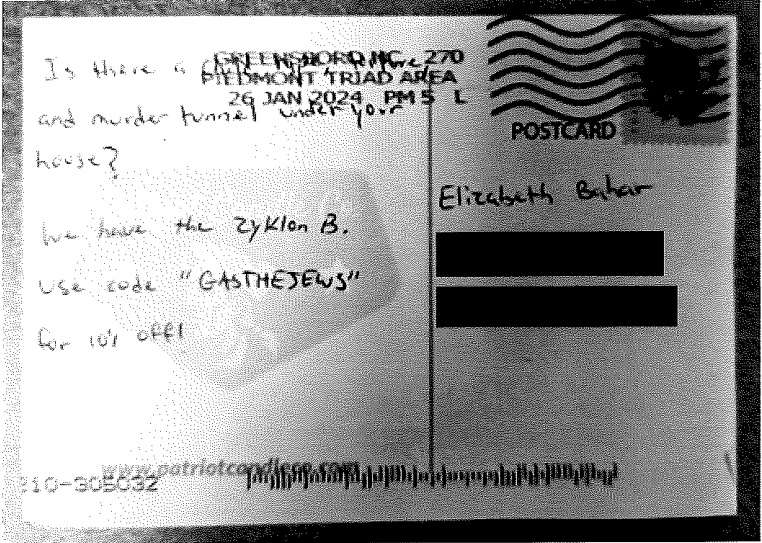
U.S. v. Ramos, decided Sept. 27, 2024 by Judge Marc Treadwell (M.D. Ga.), allowed the threats prosecution against the defendant to go forward:
"To obtain a conviction under 18 U.S.C. § 876(c), the government must prove beyond a reasonable doubt that the defendant (1) knowingly sent a message through the mail, (2) knew that the mailing contained a 'true threat,' and (3) intended (or at least knew) that the statement would be viewed as a threat."
"True threats" are not protected by the First Amendment of the United States Constitution. True threats are "statements where the speaker means to communicate a serious expression of an intent to commit an act of unlawful violence." A prohibition on true threats, such as § 876(c), "protects individuals from the fear of violence and from the disruption that fear engenders." Courts have consistently held that "whether a communication is a threat is an issue of fact to be left to the jury." However, "[i]f there is no question that a defendant's speech is protected by the First Amendment, the court may dismiss the charge as a matter of law." …
The indictment alleges that Ramos made the decision to mail a threatening, handwritten postcard to the home address of a Rabbi who had been speaking publicly against antisemitism following a neo-Nazi demonstration at her synagogue.
Chief Justice Marshall:
It is also objected that some of the Defendants in error do not show a complete legal title under Terrell and Hawkins, for which reason they have not entitled themselves to a conveyance from Charles Simms; and that one of them, John Meiggs, has obtained a decree for 140 acres of land, although in the bill he claimed only 100 acres.
Regularly the Claimants who have only an equitable title ought to make those whose title they assert, as well as the person from whom they claim a conveyance, parties to the suit. For omitting to do so an original bill might be dismissed. But this is a bill to enjoin a judgment at law rendered for the Defendant in equity against the Plaintiffs. The bill must be brought in the Court of the United States, the judgment having been rendered in that Court. Its limited jurisdiction might possibly create some doubts of the propriety of making citizens of the same state with the Plaintiff, parties Defendants. In such a case, the Court may dispense with parties who would otherwise be required, and decree as between those before the Court, since its decree cannot affect those who are not parties to the suit.
Simms v. Guthrie, 13 U.S. 19, 24–25 (1815) (emphasis added).
City officials are threatening to invoke the "Modell Law" to prevent a potential move to a new facility in Brook Park.
Cleveland Browns owners Jimmy and Dee Haslam have announced plans to relocate the team to Brook Park, a Cleveland suburb, where a new stadium can serve as the anchor of a new retail and entertainment complex. City officials, as you might expect, are not happy, and some local officials scoff at the idea.
Despite the wealth of academic evidence that local subsidies for sports team rarely (if ever) pay for themselves, city officials would prefer the Browns stay on the city's lakefront, and have proposed substantial renovations to the current stadium, or the possibility of (yet another) new stadium.
City officials are not just proposing further subsidies for the team. They are also threatening legal action. Attorneys in the city's law department are apparently preparing to invoke the "Modell Law," which was enacted to discourage local teams from leaving.
Suing to keep the Browns sounds like an aggressive strategy, but it is not clear what that would accomplish. Here is what the Modell Law says:
No owner of a professional sports team that uses a tax-supported facility for most of its home games and receives financial assistance from the state or a political subdivision thereof shall cease playing most of its home games at the facility and begin playing most of its home games elsewhere unless the owner either:
(A) Enters into an agreement with the political subdivision permitting the team to play most of its home games elsewhere;
(B) Gives the political subdivision in which the facility is located not less than six months' advance notice of the owner's intention to cease playing most of its home games at the facility and, during the six months after such notice, gives the political subdivision or any individual or group of individuals who reside in the area the opportunity to purchase the team.
So the Haslams have to give Cleveland six months notice, during which time they can field offers for the team. That's it. Given that any move is years away (both because of the existing lease and the time required to build a new stadium in Brook Park), it is not clear how the city could even allege that the law is being violated, so it's not clear what filing a lawsuit would accomplish (other than giving politicians the ability to claim they fought to keep the Browns in the city).
If city officials were really serious about preventing the Browns from moving to the suburb, they would investigate the use of eminent domain to force a sale of the team to the city. This strategy, if combined with the creation of some sort of local ownership structure like the Green Bay Packers have, would also prevent the recurring cycle of private owners demanding ever-greater stadium subsidies to remain. (Subsidies, it is worth reiterating, which do not appear to ever pay for themselves.)
This would be a financially audacious and legally risky strategy, as sports teams are not cheap and I am not sure the use of eminent domain to acquire a sports team so as to prevent it from moving to the suburbs would satisfy the Ohio Constitution, which has been interpreted to impose a more stringent public use requirement than does the Fifth Amendment. I am also not a big fan of using eminent domain to take private property, and I am not at all confident that the city would be a competent manager of the team. (OTOH: Could it be worse than the Haslams?) My only point is that if city officials were intent on playing hardball, they would be talking about something more meaningful than a suit to "enforce" the Modell Law.
10/24/1894: U.S. v. E.C. Knight argued.

Celebrate your independence with a subscription to Reason magazine, your most trusted source of honest, insightful news and analysis.




