I've blogged a lot about the recent geofence warrant cases in the Fourth Circuit and the Fifth Circuit, which reached opposite conclusions on whether access to geofence records is a search (and in the latter case, held all geofence warrants unconstitutional). Today the Fourth Circuit announced that will rehear its geofence warrant case, United States v. Chatrie, en banc. Meanwhile, the Fifth Circuit's petition for rehearing is still pending.
While we're at it, it's interesting to ponder an aspect of modern Fourth Amendment litigation in play with these cases. Although the theoretical basis of the litigation is possible suppression of evidence—the defendants have filed motions to suppress—all the uncertainty about the law doesn't mean there's real uncertainty as to who will win. The reason is the good-faith exception to the exclusionary rule, which as a practical matter reserves suppression of evidence for particular violations—typically, ones that were clear ex ante. The scope of the good-faith exception to the exclusionary rule is uncertain, but the exception is at its strongest when courts resolve novel issues of Fourth Amendment law. Even with the panel ruling in Smith, the Fifth Circuit's remarkable decision saying that all geofence warrants are unconstitutional, the government won in the end on the good-faith exception.
This echoes a common pattern these days in caselaw on the Fourth Amendment and digital evidence. As a practical matter, litigation over novel questions of Fourth Amendment law provides opportunities for courts, if they want, to issue optional advisory opinions on the law going forward. In some cases, courts they take the option and issue an opinion that has holdings to guide future courts. But quite often, courts decline to hand down rulings on the law and say, well, whatever the constitution means, there's no remedy under the good-faith exception. This is what has happened in a bunch of the major cases I have blogged about here, such as the Second Circuit's ruling in United States v. Ganias, and the Fifth Circuit's ruling in United States v. Morton. Lots of discussion of critically important questions, and then, ultimately, no answer.
I would speculate that this might be one of the reasons that the Supreme Court has largely stayed away from Fourth Amendment law in the last few years. The ever-broader good-faith exception leads to fewer merits rulings. I had a research assistant look into this, and the numbers checked out; there are fewer precedential merits rulings on Fourth Amendment law these days than in the past. And fewer merits rulings means fewer splits. So no one knows what the law is, and new litigation on the most important issues often ends without a ruling on what the law is. This is a big problem if you're interested in knowing what your rights are, but I take it to be a dynamic the Justices just haven't been all that worried about.
Anyway, fingers crossed that the Fourth Circuit and Fifth Circuit don't just resolve their cases on the good-faith exception in the end without reaching the merits. And stay tuned for the en banc argument in the Fourth Circuit, and for a decision on whether the Fifth Circuit will grant rehearing, too.
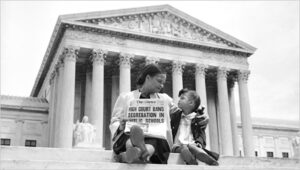
The American Journal of Law and Equality has just published a symposium on the 70th anniversary of Brown v. Board of Education, possibly the Supreme Court's most iconic decision. The symposium includes contributions by many prominent legal scholars, including Mark Tushnet, David Strauss, Geoffrey Stone, Sheryll Cashin, and my Volokh Conspiracy co-blogger David Bernstein, among others.
My own contribution, entitled "Brown, Democracy, and Foot Voting," is available on SSRN and also at the AJLE site. Here is the abstract:
Traditional assessments of Brown's relationship to democracy and popular control of government should be augmented by considering the ways it enhanced citizens' ability to "vote with their feet" as well as at the ballot box. Brown played a valuable role in reinforcing foot voting, and this has important implications for our understanding of the decision and its legacy.
Part I of the article summarizes the relationship between foot voting and ballot box voting, and how the former has important advantages over the latter as a mechanism of political choice. Relative to ballot box voting, foot voting offers individuals and families greater opportunities to make decisive, well-informed choices. It also has special advantages for minority groups, including Blacks.
Part II considers traditional attempts to reconcile Brown and democracy, through arguments that the decision was actually "representation-reinforcing." While each has its merits, they also have significant limitations. Among other flaws, they often do not apply well to the Brown case itself, which famously originated in a challenge to segregation in Topeka, Kansas, a state in which – unlike most of the South – Blacks had long had the right to vote.
Part III explains how expanding our understanding of Brown to include foot voting opportunities plugs the major holes in traditional efforts to reconcile the decision and democratic choice. Among other advantages, the foot-voting rationale for Brown applies regardless of whether racial minorities have voting rights, regardless of whether segregation laws are motivated by benign or malevolent motives, and regardless of whether the targeted ethnic or racial groups can form political coalitions with others, or not.
In Part IV, I discuss the implications of the foot-voting justification of Brown for judicial review of other policies that inhibit foot voting, particularly in cases where those policies have a history of illicit racial motivations. The most significant of these is exclusionary zoning.
As I noted in the article, it is difficult to produce a thesis on Brown that is both original and useful. More has been written about this ruling than almost any other Supreme Court case. Readers will have to judge whether I managed to succeed.
From Lee v. Garland, decided Tuesday by the D.C. Circuit (in an opinion by Judge Gregory Katsas, joined by Judges Karen LeCraft Henderson and Douglas Ginsburg)
The Federal Bureau of Investigation revoked Jason Lee's security clearance after he failed three polygraph examinations. It then fired Lee because his job required a clearance. Lee contends that the revocation was based on race, national origin, and protected speech. He brings various claims under the First Amendment, the Fifth Amendment, and Title VII. We hold that Department of Navy v. Egan (1988), bars judicial review of these statutory and constitutional claims….
In 2003, the FBI hired Jason Lee, an American citizen of Chinese ancestry, and granted him a Top Secret security clearance. To ensure that cleared individuals remain trustworthy, the FBI periodically subjects them to polygraph examinations. Lee failed his 2013 exam. The examiner noted problems with Lee's answers to questions about terrorism, unauthorized release of information, and failure to disclose security violations. Lee then failed a follow-up exam in 2014. This time, the examiner noted that Lee's breathing patterns indicated deception. The FBI revoked Lee's clearance.
Lee appealed the revocation to the Access Review Committee (ARC) of the Department of Justice, which reviews clearance revocations by DOJ component agencies. In 2018, the ARC ordered Lee to sit for a third polygraph exam, which was administered by FBI Agent Stacy Smiedala. Before that exam, Lee admitted to serving as a source for media articles exposing what he regarded as inappropriate FBI polygraph testing practices. The exam ended when Lee refused to answer further questions about what information he had divulged to the media.
I spent this week in Switzerland, where I gave two talks on immigration policy: one at Avenir Suisse, a classical liberal/libertarian-leaning think tank, and one at NZZ Real Estate Days (annual convention of the Swiss real estate industry). The experience engendered some reflections, which I cover in this post. But it's important to note some caveats right off the bat: I am not an expert on Swiss politics and society, though I do have some knowledge by virtue of being a federalism and immigration scholar (Switzerland is an important case study for both fields). I only speak one of Switzerland's two main languages (French; the other is German, and German-speaking Swiss outnumber the French-speakers). As described below, my knowledge of French was of little use on this trip. In addition, I should stress that I did not speak to a statistically representative sample of Swiss people. Among other things, because of the nature of the two events, those I met were overwhelmingly highly educated and relatively affluent.
These reflections won't resolve either Swiss or US debates about immigration. But I hope they might be of some small interest, nonetheless.
J.D. Vance recently said that if immigration was the path to prosperity, then "America would be the most prosperous country in the world." Well, we very nearly are! Depending on which data set you look at, the US ranks somewhere between 6th and 10th in per capita GDP. Ahead of us are various small oil-rich states (e.g. the UAE, Qatar, and Norway), Luxembourg (tiny city state that specializes in banking), Ireland …. and Switzerland! Thus, Vance can still argue that if immigration were economically beneficial, we would be ahead of Switzerland, not behind it. But here's the problem: Switzerland actually has way more immigration relative to population than we do. Over 30% of the Swiss population is foreign-born, compared to about 14% for the US. Ireland also has a higher per capita GDP than the US in most rankings. Their percentage of immigrants in the population is almost 20%, lower than Switzerland, but considerably higher than the US.
Correlation doesn't prove causation. Switzerland and the US could be rich despite immigration, rather than because of it. And much of what's going on is that richer nations attract more immigrants. However, extensive evidence indicates that immigration is a major driver of economic growth and innovation.
The current debate over immigration in Switzerland has many similarities to that in the US and other countries. There is a strong anti-immigrant political movement, spearheaded by the People's Party (which has done relatively well in recent Swiss elections). At both speaking events (particularly the more politically diverse NZZ event), some people were relatively sympathetic to my pro-immigration position, and others much less so. That is to be expected for such a controversial issue.
Most of the objections I heard were very similar to those I encounter in the US and elsewhere. I address these standard objections here and in greater detail in my book Free to Move: Foot Voting, Migration, and Political Freedom. But one argument was much more prevalent in Switzerland than elsewhere: concerns about what I call "swamping" - the possibility that the native population will swiftly be overwhelmed by large numbers of immigrants from widely different cultures.
This is understandable, given the small size of Switzerland. Swamping is a more plausible scenario there than for larger nations. I answered the objection with a number of points adapted from Chapter 6 of Free to Move. But there is a Swiss-specific response that didn't occur to me until afterwards: A large fraction of migrants to Switzerland are actually from countries with very similar languages and cultures. The largest immigrant groups in Switzerland are Italians (14% of the foreign-born population), Germans (13.4%), Portuguese (10.6%), and French (6.8%). Germans, French, and Italians are of course among the traditional native populations of Switzerland.
Switzerland gets a lot of immigration from other European nations because, while not a member of the European Union, it has an agreement with the EU permitting freedom of movement, under which EU citizens are allowed to live and work in Switzerland. As the richest nation in Europe (with the exception of small city-states like Luxembourg and oil-rich Norway), and one with relatively open labor markets (especially by European standards) Switzerland attracts many EU migrants. I in fact met many German immigrants to Switzerland during my stay. They come because Switzerland has better job opportunities than Germany's overregulated labor market.
Given this state of affairs, even with a complete "open borders" policy, immigration to Switzerland from geographically and culturally distant nations is always likely to be in large part balanced by migration from nearby culturally and linguistically similar ones. This in turn helps increase the incentive for more culturally distant immigrants to assimilate.
At the NZZ event, I made a point of including a section on the impact of immigration on housing, in my talk. Among other things, I noted that immigrants disproportionately work in the construction sector, thus making it easier to build new housing. This effect - along with other aspects of migration - also increases the profitability of the real estate industry (which I pointed out). I thought that might be of special interest to an audience of real estate professionals. Indeed, when I first got the NZZ invitation, I thought they would want me to do a presentation primarily focused on housing issues, a subject I also write about (the organizers made clear they wanted me to speak about immigration more generally).
Interestingly, none of the many questions I got at the NZZ conference were about housing or real estate. This is another example of how, contrary to popular belief, self-interest is not the major determinant of people's views on most political issues.
Almost everyone I met at the two events were either native-born Swiss or immigrants from Germany. But, while in Zurich, I ran into immigrants from a variety of other countries, including Turkey, Ethiopia, Tunisia, Bulgaria, and Ukrainian war refugees (whom I spoke to in Russian). Even more than in the US, most Uber drivers are recent immigrants from relatively poor nations.
These immigrants speak highly of Switzerland, and most seem to work hard to learn German (and in many cases, also English). One Turkish immigrant (an Uber driver) told me he moved to Switzerland because the pay is better, and Switzerland is a "peaceful" and orderly country. Much better - he said - than Germany, where "there is too much disorder" (I stress this is his view, not mine).
While Switzerland seems to be doing a good job of absorbing immigrants, the country's policy of promoting multilingualism seems less successful. Switzerland has four official languages (French, German, Italian, and Romansch), with German (the majority language) and French being by far the most prevalent.
Both of my talks were in German Switzerland (Zurich for the Avenir Suisse event and Davos for NZZ). But I naively thought that my knowledge of French would be useful, because German-speaking Swiss are supposed to learn that language in school, and could use it when traveling to the French-speaking part of the country.
What I actually found is that most of the German Swiss I met either don't speak much French at all (one told me he had studied French in school for six years, but forgotten nearly everything), speak it worse than I do (I am only moderately fluent), or are much more comfortable speaking English. English is, to be fair, easier for German speakers to learn than French, and there is a strong incentive to learn it because it is the language of international business.
As already noted, I did not speak to a representative sample of Swiss. Perhaps those I met were just unusually averse to French. But, as a general rule, I would expect highly educated professionals to be more likely to learn another language than working class people. A 2022 study finds that 38% of Swiss use more than one language at work, but most of that seems to be people using Standard German in addition to the Swiss dialect, or using English. Only a small fraction of German Swiss regularly use French.
While immigrants have strong incentives to learn the dominant language in their new home, learning two languages is a much tougher challenge. For most adults, learning a foreign language is hard, painful work, and they will only do it if there is a strong incentive. I expect, therefore, that high immigration levels make the multilingualism policy even harder to implement than is already the case. If even many native-born Swiss Germans don't learn much French (or don't remember what they do learn), immigrants to majority-German parts of the country probably learn even less. Given the enormous benefits of migration (including for receiving-country natives), I think this tradeoff is worth it. But it should be acknowledged.
Sidi Mohammed Abdullahi, 22, already faces 14 felony counts, including attempted first-degree murder, aggravated battery, and attempted murder of a police officer, after allegedly shooting a Jewish man walking to synagogue Saturday morning. The victim was wearing a kippah, a traditional Jewish head covering also known as a yarmulke.
Police said Abdullahi shot him without saying a word. Roughly 30 minutes later, the incident escalated when Abdullahi reportedly opened fire on five first responders. Police fired back, shooting him multiple times….
"We will never do things just based on belief. We need proof," [CPD Supt. Larry Snelling] said. "Evidence from the offender's phone indicated he planned the shooting and specifically targeted people of Jewish faith."
Four days ago, NBC Chicago and other outlets reported (though third-hand) that,
In designing and adopting any regulatory scheme, there are two separate but important decisions to make. First, of course, we must decide on the substantive rules or standards that will govern the behavior to be regulated. This is often the most visible and contentious decision to make. Setting out the rule to be enforced is generally viewed as tantamount to setting the policy itself. But there is a second decision that must also be made, perhaps even more consequential than the first. Once we know what rule will be enforced, we must decide who will be empowered to interpret and enforce that rule. After we design the regulation, we must design the regulator. Rules are not usually self-enforcing. Someone will have to determine whether the rule has been violated and what to do in the case of violations. Those two decisions are critical to the success and significance of any regulatory scheme.
In this regard, the regulation of speech is no different than any other regulatory scheme. Changing the context of speech regulation does not change the dilemma. When we lay down a rule about what kinds of speech should be forbidden, we must also decide who will interpret and enforce that rule. Who will decide whether the rule is violated by a particular utterance and therefore whether the speech in question should be suppressed, or the speaker punished?
Moreover, such issues arise whenever we seek to regulate speech. If the government wants to prohibit some speech, it will need a process of enforcing that law or administrative regulation. If the government wants to criminalize "terroristic threats," it will need both to specify the rule against such threats and to rely on a criminal justice process for investigating and prosecuting those who make such threats. If Congress wants to exclude from federal trademark protection marks that are "scandalous" or disparaging, it will need to articulate the exception to trademark law and empower a government official to review trademark proposals and reject those that violate the rule. If the comment section of an online journal excludes some kinds of posts, the publisher will need to specify a rule explaining what content is prohibited and designate a moderator to review and delete posts that potentially offend the rule.
An Introduction To Constitutional Law Video Library: Chisholm v. Georgia (1793), Marbury v. Madison (1803), McCulloch v. Maryland (1819), Gibbons v. Ogden (1824), Barron v. City of Baltimore (1833)
An Introduction to Constitutional Lawby Barnett and Blackman has sold tens of thousands of copies, and has been adopted by educators at every level--law school, undergraduate, and high school. Each copy of the book provides access to our fourteen-hour video library. These rich videos bring the cases to life with photographs, archival video, and audio from the Supreme Court.
And now, the Foundation for the Constitution has secured the rights to post all of the videos for free on YouTube. In this post, we will include the videos from Part I: Foundational Cases on Constitutional Structure. Subscribe to see the remaining seventy videos as they are posted. We hope you enjoy watching these videos as much as we enjoyed producing them.
Part I: Foundational Cases on Constitutional Structure
"Specific guarantees in the Bill of Rights have penumbras, formed by emanations from those guarantees that help give them life and substance." An ''emanation'' refers to a ray of light. During a lunar eclipse, the ''umbra'' refers to the darkest part of the shadow formed when the Earth orbits between the sun and the moon. The ''penumbra'' refers to the lighter part of the shadow, where some of the ''emanations'' from the sun are visible.
As regular readers may recall, I argued in a recent article that terms of service to an Internet account have little or no effect on Fourth Amendment rights in the account:
Almost everything you do on the Internet is governed by Terms of Service. The language in Terms of Service typically gives Internet providers broad rights to address potential account misuse. But do these Terms alter Fourth Amendment rights, either diminishing or even eliminating constitutional rights in Internet accounts? In the last five years, many courts have ruled that they do. These courts treat Terms of Service like a rights contract: by agreeing to use an Internet account subject to broad Terms of Service, you give up your Fourth Amendment rights.
This Article argues that the courts are wrong. Terms of Service have little or no effect on Fourth Amendment rights. Fourth Amendment rights are rights against the government, not private parties. Terms of Service can define relationships between private parties, but private contracts cannot define Fourth Amendment rights. This is true across the range of Fourth Amendment doctrines, including the "reasonable expectation of privacy" test, consent, abandonment, third-party consent, and the private search doctrine. Courts that have linked Terms of Service and Fourth Amendment rights are mistaken, and their reasoning should be rejected.
I'm pleased to say that the Second Circuit handed down a ruling in United States v. Maher this week rejecting the claim that terms of service waive Fourth Amendment rights, at least in the important context of a Google account. The decision is written in a somewhat narrow way, but I think it gets the basics correct. Here's the key passage from Maher:
The government argues that Maher's expectation of privacy in the Maher file that he emailed to his own Google account was extinguished by Google's Terms of Service, which advise users that Google (1) "may review content to determine whether it is illegal or violates our policies," App'x 113, (2) "may" report "illegal content" to "appropriate authorities," id. at 142, and (3) "will share" users' information with law enforcement when necessary to comply with applicable law, id. at 131.
This court has not had occasion to address what effect, if any, a private company's terms of service might have on a defendant's reasonable expectation of privacy. It may well be that such terms, as parts of "[p]rivate contracts[,] have little effect in Fourth Amendment law because the nature of those [constitutional] rights is against the government rather than private parties." Orin S. Kerr, Terms of Service and Fourth Amendment Rights, 172 U. PA. L. REV. 287, 291 (2024) (summarizing case law). We need not here draw any categorical conclusions about how terms of service affect a user's expectation of privacy as against the government. On this appeal, it suffices that we conclude that Google's particular Terms of Service—which advise that Google "may" review users' content, App'x 113—did not extinguish Maher's reasonable expectation of privacy in that content as against the government.
In reaching that conclusion, we adopt the reasoning of the Sixth Circuit in United States v. Warshak, 631 F.3d at 286–87 (holding that government violated Fourth Amendment when, without warrant, it compelled internet service provider to surrender contents of user emails). There too, the government argued that an internet service provider's contractual reservation of the right to access user emails extinguished a defendant's expectation of privacy in his emails. In rejecting the argument—at least with respect to a reservation phrased in terms of what the provider may do, see id. at 287 (quoting Acceptable Use Policy provision stating that provider "may access and use individual Subscriber information in the operation of the Service and as necessary to protect the Service" (emphasis in original))—the Sixth Circuit held that "the mere ability of a third-party intermediary to access the contents of a communication cannot be sufficient to extinguish a reasonable expectation of privacy" as against the government, id. at 286 (emphasis in original). As the court explained, that conclusion finds support in the seminal Fourth Amendment case, Katz v. United States, 389 U.S. 347 (1967), where "the Supreme Court found it reasonable to expect privacy during a telephone call despite the ability of an operator to listen in." United States v. Warshak, 631 F.3d at 287 (noting that telephone companies could then "listen in when reasonably necessary to protect . . . against the improper and illegal use of their facilities" (internal quotation marks omitted)). It also finds support in cases recognizing that hotel guests retain a reasonable expectation of privacy in their rooms, "even though maids routinely enter hotel rooms." Id.; see United States v. Stokes, 733 F.3d 438, 443 n.7 (2d Cir. 2013) ("Hotel guests retain a legitimate expectation of privacy in the hotel room and in any articles located in their hotel room for the duration of their rental period."). We too conclude from these precedents that Google's Terms of Service, advising users of what the company "may review," App'x 113, did not extinguish Maher's reasonable expectation of privacy in his emails as against the government.
A curious order yesterday, from U.S. v. Teixeira (a case involving Jack Teixeira, a national guard member "who pleaded guilty to leaking highly classified military documents about the war in Ukraine"):
147 Oct 29, 2024 Judge Indira Talwani: ELECTRONIC ORDER entered. All non-parties who accessed or obtained copies of Defendant's sentencing memorandum or attachments thereto are ORDERED to destroy all electronic and print copies of these documents. The filings are sealed documents in accordance with this court's prior order 141. (Talwani, Indira) (Entered: 10/29/2024)
That can't be right, I think. (Disclosure: After seeing this order, I tried to figure out what was going on, and in the process obtained what appears to be a copy, from the CourtListener site, so the order would have technically bound me, alongside anyone else who likewise accessed the order.) Apparently, not long before, the court granted a motion to file defendant's full sentencing memorandum under seal; that motion read,
An interesting turn of phrase from Tuesday's concurrence by Judge Michael Catlett, joined by Judge James Morse Jr., in Hintzen-Gaines v. Adelson. The specific issue the two judges (who actually formed the majority of the three-judge panel, but wrote this in a concurrence) discussed was this:
[W]hen properly raised, this court should set things right in this area of law by making clear that only common law rules apply when a private-figure plaintiff brings a defamation claim based on speech addressing only matters of private concern. Ultimately, however, we agree with the majority decision that plaintiff did enough under existing caselaw to survive a motion to dismiss, and therefore we join the majority decision in full.
As election day approaches, here are links to all my writings on the 2024 election and the issues at stake. Except where otherwise noted, these are all posts published right here at the Volokh Conspiracy blog, hosted by Reason. I list these items in reverse chronological order - most recent first:
"Political Ignorance is an Even Worse Problem than I Thought," Nov. 3, 2024. I've long warned about the dangers of political ignorance. But recent events - including the course of this election - suggest I was overly optimistic on one key aspect of the problem.
"Kamala Harris is a Far Lesser Evil than Donald Trump," Oct. 24, 2024. My case for voting for Harris on "lesser evil" grounds. Matt Zwolinski, coauthor of The Individualists:Radicals, Reactionaries, and the Struggle for the Soul of Libertarianism, writes: "[I]f you're still on the fence about Trump, and you're only going to read one piece on the subject, I implore you to read Ilya Somin's essay at Reason, which makes a careful and detailed libertarian case against Trump (and for Harris)."
"Trump's Mass Deportation Proposal Ignores a Huge Economic and Social Cost," The Dispatch, Oct. 24, 2024 (symposium on immigration and the 2024 election). This piece explains why Trump's immigration policy plans are particularly dangerous, and much worse than Harris's far from ideal immigration policies.
"Wokeness is Awful. Nationalism is Far Worse," The Dispatch, July 1, 2024. Not directly about the election. But I include it here because it addresses a major ideological tradeoff at stake. Though both are bad, the nationalism embraced by the Trump-era GOP is worse than the wokeness prevalent among many Democrats.
In a decision issued at the dawn of Prohibition, the Supreme Court quietly gutted a freedom guaranteed in the Bill of Rights: the protection against unwarranted search and seizure. The 100th anniversary of that decision is a perfect time to kill the open fields doctrine.
In 1919, revenue agents spotted Charlie Hester selling a quart of moonshine outside his South Carolina home. When confronted, Hester and the buyer each dropped their jugs, which shattered but retained a portion of their contents. That allowed the agents to determine the jugs contained illegally distilled whiskey.
Hester challenged his arrest as a violation of the Fourth Amendment: The agents had hopped a fence and traipsed across a pasture, without a warrant, to get to him. In 1924, the Supreme Court sided with the government in Hester v. United States. Justice Oliver Wendell Holmes wrote for the majority that "the special protection accorded by the Fourth Amendment to the people in their 'persons, houses, papers, and effects,' is not extended to the open fields." Ostensibly, Holmes' open fields doctrine held that a person's home and the "curtilage"—the area immediately surrounding the home—receive full Fourth Amendment protection, while the rest of one's property does not.
Holmes' decision is less than three pages long, but the damage it's caused to personal liberty and the right to be free from government intrusion has been huge.
The proposal, as I understand it, would be to extend the curtilage protection to all land. Any entry onto a person's land would require a warrant under the Fourth Amendment. The essay also argues that there should be state constitutional protections or statutory protections to have the same effect.
I want to focus on the Fourth Amendment part of the argument. There seems to me a problem with eliminating the open fields doctrine: How do you square that with the Fourth Amendment's text?
The text of the Fourth Amendment text does not impose a ban on unreasonable searches in some general or abstract sense. The language is more specific: the protection is against unreasonable searches and seizures of "their persons, houses, papers, and effects[.]" To be protected by the Fourth Amendment, the thing searched has to be a person, house, paper, or effect.
The idea of the open fields doctrine is that an open field is not a person, not a house, not a paper, and not effects (which means movable personal property). Following the text, you don't get protection on the land itself—unless you have your person, house, paper, or effects there.
What about the "curtilage"? The idea of curtilage is that there are some spaces so close to the house that they are functionally part of it, even if technically outside the house. You need to protect those spaces as a sort of penumbra around the house to fully protect the house. That prevents an officer from hanging out on your front porch all day, or walking right right up to your kitchen window and just staying there watching you inside. To protect the home, the law treats the area right around the home as the home. It gets called the "curtilage," a common law concept for the area right around the home that (in the old days) was treated as the home for some purposes. See Jacob Giles, A New Law Dictionary (1732) (defining "curtilage" as a "Court, Yard, Backside, or Piece of Ground lying near and belonging to a Dwelling-house").
Some might object, textually, that using an emanations-and-penumbras-type argument to extend the "house" to the curtilage area technically outside the house is a bit of a stretch. Others might think it's textually fair, as "searching" a "house" shouldn't require physical entry inside it if outside space is used as an extension of it. Either way, I think it's challenging, at least if you take text seriously, to argue that any land a person owns fits within the categories of "persons, houses, papers, [or] effects" even if it's just an open field not near a house.
Of course, you can endorse or oppose the open fields doctrine as a matter of policy. But at least for those focused on the text, it seems to me a pretty sound way to interpret the Fourth Amendment.
Throughout the mid-twentieth century, many commentators sharply criticized the perceived oligarchy of mass communications. "Freedom of the press," journalist A. J. Liebling famously said in 1960, "is guaranteed only to those who own one." For a while in the early 2000s, thanks to the "cheap speech" made possible by the internet, everyone seemed to own a printing press capable of producing and distributing thousands (sometimes millions) of copies of one's electronic leaflets. Many thought that the future of free speech was therefore one with broad freedom for speakers.
But now, we see it was too good to be true—for certain values of the variable "good." It turns out that, today, we're just borrowing printing presses: Facebook's, X's (formerly Twitter), YouTube's. Even those of us who have our own blogs rely on hosting services such as WordPress, GoDaddy, and the like. And while most of the time these services are happy to let us use them, some of the time they say no. This platform interest in restricting speech has surged in the last ten years, and it seems likely to grow further.
What to do about this is one of the main free speech questions likely to occupy courts and legislatures in at least the near future. It arises in various contexts. For instance, are state laws that ban viewpoint discrimination by private platforms wise and consistent with the First Amendment, Section 230 of Title 47 of the U.S. Code (which gives internet service providers and platforms certain immunities from state regulation), and the Dormant Commerce Clause (which limits state authority to regulate interstate transactions)? What should we think about calls for greater "responsibility" on the part of platforms and other intermediaries? And, especially important, when may the government encourage or pressure social media platforms and other intermediaries to restrict speech on their property?
Dr. Janet Monge, an anthropologist and former curator of Penn Museum, brings this action against several individuals and news outlets following statements they made concerning her work with human bone fragments recovered from the 1985 MOVE bombing in Philadelphia….
Hyperallergic Media ("Hyperallergic") is a New York corporation that operates an online arts and current events magazine. On October 31, 2021, Hyperallergic published an article titled "How the Possession of Human Remains Led to a Public Reckoning at the Penn Museum." …. Dr. Monge contends that the article "falsely blames [her] for a racially motivated investigation of the bone fragments" by stating that "Consuella [sic] did not consent to Monge's continued use of her daughter's remains for research. Even after those objections, Monge used Tree Africa's remains for teaching." …
"[C]ourts applying Pennsylvania law have found that even where the complained-of statements are literally true, if, when viewed in toto, the accurate statements create a false implication, the speaker may be liable for creating a defamatory implication." As such, "the literal accuracy of separate statements will not render a communication true where the implication of the communication as a whole was false." …
Dr. Monge alleges that she "sought to contact the MOVE family"—specifically, Katricia (Tree) Africa's mother, Consuewella Africa—for a DNA sample to assist in identifying the remains. "Despite multiple efforts to communicate with Consuella [sic] … Dr. Monge failed to retrieve a DNA sample from any of Katricia's relatives." Without a DNA sample, "Dr. Monge was forced to label the case 'cold' …."
Dr. Monge further alleges that, after attempting to contact the MOVE family, she used the bone fragment remains in her Coursera course to "compar[e] those fragments to other similar bone fragments and models for comparison and explain[] how forensic techniques could be used to determine the age of the remains." Thus, it is literally true that Dr. Monge did not obtain Consuewella Africa's consent to use the bone fragment remains for research, and Dr. Monge then used the bone fragment remains when teaching her Coursera course.