11/16/1939: Justice Pierce Butler dies.

Mostly law professors | Sometimes contrarian | Often libertarian | Always independent | Est. 2002
11/16/1939: Justice Pierce Butler dies.
Ivory Law, non-essential supplies, and medically induced comas.
Please enjoy the latest edition of Short Circuit, a weekly feature written by a bunch of people at the Institute for Justice.
Nearly a decade ago, New Mexico all but eliminated civil forfeiture, ending the practice of taking people's stuff without convicting them of a crime. And then what happened? Did the state descend into lawlessness? On the contrary, crime rates were not impacted. So says a peer-reviewed study newly published in the Criminal Justice Review that used nine years of monthly data and compared against control states. Henceforth, policymakers can rest easy knowing that if they do the right thing and nuke civil forfeiture into the sun, the only thing they'll be doing is protecting civil rights.
If you use Threads, please let us know whether our feed (https://www.threads.net/@volokhconspiracy) works for you.
UPDATE: We originally had this as /@volokhc, but lost access to the underlying Instagram account (and thus the Threads feed) because of some technical problem. We therefore had to reconstruct this at /@volokhconspiracy.
11/15/1882: Justice Felix Frankfurter's birthday.
Farewell to the Mayflower, hello to the Hilton.
The first day of the 2024 Federalist Society National Lawyers Convention is in the can. And unfortunately, the Fifth Circuit could not stay this change of venue. After nearly four decades at the Mayflower, FedSoc moved about a mile down Connecticut Avenue to the Washington Hilton. Yes, the hotel where President Reagan was shot. Not exactly the best vibes. But I will still try to be objective. The verdict, from my perspective, is mostly negative, but there are some upsides.
I'll start with the downsides. The Mayflower is a classic hotel. Every ballroom was finely crafted with accents on the walls, and a welcoming ambiance. So much history was made in those rooms. The Washington Hilton feels like a hospital. It is cold, sterile, and soulless. The smaller conference rooms have low ceilings and obstructive columns in the middle. The cavernous ballroom has dreadful acoustics. It is nearly impossible to hear anything close to the stage (thankfully there were closed captions). I felt like I was attending someone else's conference. Moreover, the hotel rooms are dark and drab, and desperately in need of renovation. The wireless in the room is also painfully slow--I am on my hotspot at the moment. On a personal note, I have lifetime platinum status with Marriott Bonvoy, but am a mere plebeian with Hilton Honors.
But there are some plusses. FedSoc long ago outgrew the Mayflower. The hotel room blocks quickly sold out, which forced people to stay at nearby hotels. The conference rooms were not nearly big enough. It was difficult to find a seat for most panels, and the overflow rooms were packed. It could take nearly 20 minutes just to get lunch at the buffet. The Hilton has more than enough space to fit four concurrent panels. That simply cannot be done at the Mayflower.
Another plus is the lack of schlepping: the conference is at the same hotel as the annual dinner. That hasn't happened in about two decades. In the old days, everything would be held in the Mayflower. But since the 2000s, the conference would be at the Mayflower, and the dinner would be somewhere else--the Marriott Wardman (now defunct), the Omni Shoreham, and more recently Union Station. The former two hotels were a short cab ride from the Mayflower. The latter could take nearly an hour by cab. (FedSoc members tend not to take the Metro). And do not even remind me of the dreadful time we had to schlep to the Gaylord National Harbor. That took nearly two hours on the busses! But with the Hilton, we merely have to take an escalator to the annual dinner. It was a delight. I didn't need to go outside all day. (It was raining apparently). Plus, this ballroom can fit several hundred more people than Union Station.
It is true that more people can attend, but this leads to a massive drawback. The greatest feature of the National Convention is the networking. The panels are fun, to be sure. But the magic happened outside the sessions. I wrote an entire book chapter about how the constitutional challenge to Obamacare was hatched in the grand hallway of the Mayflower--the Mayflower Compact. That space worked so well because everyone had to congregate in a centralized location to get too and from the panels. There was no way ot avoid the hallway. That was a magical time. Alas, the Hilton has no such centralized place. The 2024 convention takes place on three levels. At any point, FedSoc members are scattered throughout the hotel. And we are no longer standing shoulder-to-shoulder. There is ample space between us--dare I say, social distancing! These positions are simply not conducive to spontaneous order. I can spend an entire day schmoozing and not see certain people that I want to see.
In some regards, the bigger conference space is perhaps emblematic of the bigger tent that FedSoc has become. As the group grows and grows, it becomes harder and harder to forge the sorts of personal relationships that were developed years ago. Sure, we can now fit a few hundred more people into the conference. But that increased head count makes the networking more diffused. It was much easier for me to pinhole Randy Barnett in a single hallway. But I didn't see my colleague at any point today. (We will have a book signing on Friday at 10:45--stop by!).
I understand that we will be stuck at the Hilton for the foreseeable future. I think we'll have to get used to it.
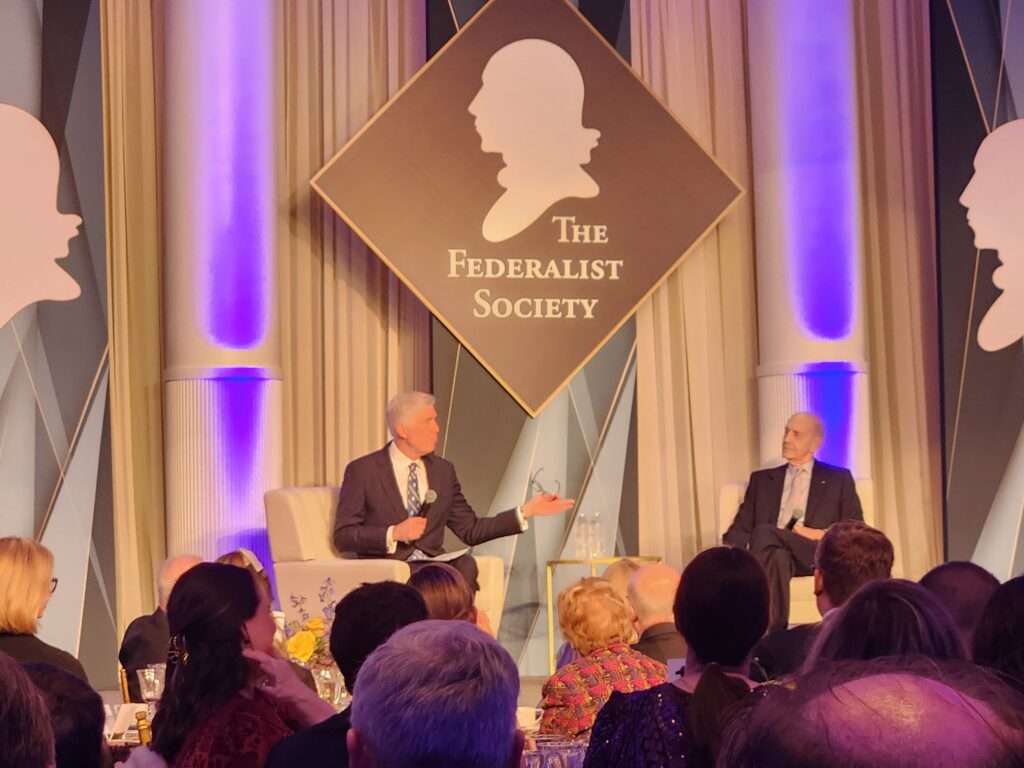
I'll close on a positive note. It was so refreshing to see Justices Breyer and Gorsuch speak at the Scalia dinner. They have such a good rapport, and they demonstrated through word and deed why protecting the Court is so important. I would hope that the American Constitution Society could host a similar gathering at their annual conference. The Court would be in a much better place than it was only a few years ago.
Berry explains why the plan is flawed on legal and other grounds.
This is a guest post is by my Cato Institute colleague Thomas Berry. What follows is written by him (Berry), not me (Ilya Somin):
President-elect Trump has demanded on X that Senate Republican leadership "must agree to Recess Appointments (in the Senate!), without which we will not be able to get people confirmed in a timely manner." In this post I'll explain the consequences of allowing recess appointments, why the Senate has not done so for over a decade, and why it would be unwise to allow recess appointments now.
First, here are the basics on congressional timelines. These days, each 2-year Congress comprises two 1-year sessions, running from January 3rd of one year to January 3rd of the next. But in the eighteenth and nineteenth centuries, sessions were much shorter than a year, and they had months-long gaps in between them when members of Congress traveled home.
The Constitution's Recess Appointments Clause was written to accommodate the delays that could occur in Senate confirmation back when travel between the Senate and the rest of the country took much longer. As Alexander Hamilton wrote in Federalist 67, the clause was adopted "as it would have been improper to oblige [the Senate] to be continually in session for the appointment of officers and as vacancies might happen IN THEIR RECESS, which it might be necessary for the public service to fill without delay."
The clause says, "The President shall have Power to fill up all Vacancies that may happen during the Recess of the Senate, by granting Commissions which shall expire at the End of their next Session." Article II, section 2, clause 3. For decades, two questions were in doubt concerning this clause. What's "the Recess," and which vacancies "happen during the Recess"? The Supreme Court finally answered both questions in the 2014 case NLRB v. Noel Canning.
In Noel Canning, the Supreme Court held that any Senate adjournment of 10 days or more is "the Recess" and that vacancies which originally opened up before such an adjournment are still considered to have "happened" during that adjournment so long as they remain vacant during the adjournment. In my view, the Supreme Court got both of these questions wrong. There's convincing scholarship by Professor Michael Rappaport that "the Recess" meant only the one gap between Senate sessions and that only vacancies that arose during that gap were eligible to be filled by recess appointment. Justice Scalia argued for this position in a concurrence in the judgment, but this view only received four votes on the Noel Canning Court.
Whether it was rightly decided or not, Noel Canning is the law of the land, and it gives the Senate a seemingly easy tool to aid a President of the same party. If the Senate simply adjourns for 10 days, a sitting President could fill every single vacancy in the executive branch and judiciary unilaterally. (From time to time, some people have questioned whether recess appointments may be used to temporarily fill judicial seats, given that there is some tension between a time-limited recess appointment and the Constitution's command that federal judges "shall hold their Offices during good Behaviour." Nonetheless, judicial recess appointments have been made throughout the country's history.)
All recess appointments take immediate effect without Senate consent, and they last until the end of the next session of the Senate. So any recess appointments made in 2025 would last until January 3rd, 2027.
The Senate has not allowed any recess appointments in the decade since Noel Canning was decided, not even at times when the Senate majority and President were of the same party. Why not? One wrinkle is that under the Constitution, neither house may "adjourn for more than three days" without the consent of the other. Article I, section 5, clause 4. So it is only possible for the Senate to adjourn long enough to enable recess appointments when it has the consent of the House. But why hasn't it even happened when the Senate, House, and presidency have all been controlled by the same party?
One answer is that triggering recess appointments is an "all-or-nothing" move. The Senate can't give the President authority to fill just some offices. Thanks to Noel Canning's holding that vacancies arising before an adjournment are eligible for recess appointments, every vacancy across the government could be filled at once, no matter how long ago the vacancy arose. So a senator who might be comfortable with, say, a recess appointment of Marco Rubio but not a recess appointment of Matt Gaetz or RFK Jr. would have no way to limit President Trump to just the former but not the latter. Even when the Senate and President are of the same party, that's a lot of leverage for the Senate to give up. Vetting and voting on nominees is one of the most important Senate prerogatives. Thus far, Senate leadership has never been willing to abdicate that role for two years.
Additionally, triggering recess appointments isn't necessary to ensure the executive branch remains fully staffed. There's a statute for exactly that purpose: The Federal Vacancies Reform Act. This law allows the President to fill all vacant offices with acting officers on day 1. I've written about abuses of the Vacancies Act, but it has an important and legitimate purpose. It allows the government to function while permanent nominees are considered by the Senate. Although acting officers at the beginning of an administration have a 300-day time limit, the law generously tolls the time limit on acting service while the Senate considers a nomination. So effectively, the President just needs to make a nomination within 300 days, and then the ball is in the Senate's court.
Senators know that the President has the Vacancies Act at his disposal. The Act allows for positions to be filled immediately (just like recess appointments), so it is simply not the case that recess appointments are necessary to keep the government running. But several limitations in the Vacancies Act incentivize the President to make permanent nominations and to get them confirmed, and these limitations are why a President would naturally prefer recess appointments.
First, the Vacancies Act places limits on who may serve as an acting officer, which the Recess Appointments Clause does not. Unless the President wants to let the deputy to a position take over as that position's acting officer, he is limited to choosing another Senate-confirmed officer or someone who has served in the highest tier of the federal civil service in that department for at least 90 days. Since nearly all Senate-confirmed officers resign when the White House changes hands, Presidents at the start of an administration are typically limited to the latter category (most of whom are career, nonpartisan civil servants). So a recess appointment would allow the President to immediately fill an office with a more ideologically aligned appointee.
Second, the Vacancies Act generally forbids serving simultaneously as the nominee for a position and as the acting officer in that same position. The Supreme Court clarified in the 2017 case NLRB v. SW General that this prohibition applies to the vast majority of acting officers. The only exception is for acting officers who also happen to be serving as the deputy to the vacant position, and who have either been confirmed by the Senate to that deputy position or who have served in that deputy position for at least 90 days. (This is why Julie Su, the Senate-confirmed Deputy Secretary of Labor, could serve as the Acting Secretary of Labor while simultaneously being the nominee for permanent Secretary of Labor). This exception is unlikely to apply to anyone Trump wants to nominate (since all current deputies were appointed by Biden), so recess appointments would be the only way to immediately install the same person that he wants to nominate for the permanent job.
Finally, as noted, the Vacancies Act requires a permanent nomination be made within a certain time limit. Recess appointments come with no such requirement, so a President could make a recess appointment and fill a slot with his preferred choice for nearly two years without even making a permanent nomination.
Ever since Noel Canning, the Senate has held a pro forma session every three days like clockwork to ensure that Presidents could not make recess appointments, no matter which party was in power. The Senate as an institution has little to gain from breaking this practice, and much to lose. That is why I hope (and believe) that the Senate will not voluntarily write the President a blank check to fill all offices across the government without any Senate scrutiny and approval.
But there is one more wrinkle. In 2020, then-President Trump threatened to employ (but ultimately did not use) an obscure constitutional clause: "in Case of Disagreement between [both houses], with Respect to the Time of Adjournment, [the President] may adjourn them to such Time as he shall think proper." Article II, section 3. As far as I am aware, this clause has never been invoked by a President, so it is highly uncertain how it would operate in practice. (Four years ago, Hans von Spakovsky and John Malcolm also wrote that they believed "this provision never has been invoked.") Both the majority and concurring opinions in Noel Canning briefly mentioned this clause as a potential tool for the President to create a recess, but neither spelled out how this would be achieved (and since this clause was not at issue in the case, these discussions should be considered dicta).
One interpretation (which may be favored by President-elect Trump) is that this clause can be invoked whenever one house adopts a joint resolution to adjourn both houses and the other house does not agree to that joint resolution. (Ed Whelan writes that this is apparently the interpretation the administration would urge if it attempted this strategy).
But there is another, much narrower, interpretation that presents itself when this clause is considered in its full context. (I am not aware of any other arguments that have been made along these lines concerning this clause, but I have not done all the research necessary to be sure that it has not already been presented elsewhere.) The full text of Article II, section 3 is as follows ("He" refers to the President throughout):
He shall from time to time give to the Congress Information of the State of the Union, and recommend to their Consideration such Measures as he shall judge necessary and expedient; he may, on extraordinary Occasions, convene both Houses, or either of them, and in Case of Disagreement between them, with Respect to the Time of Adjournment, he may adjourn them to such Time as he shall think proper; he shall receive Ambassadors and other public Ministers; he shall take Care that the Laws be faithfully executed, and shall Commission all the Officers of the United States.
This entire clause is one long sentence, but it is divided by semicolons into seemingly discrete (and connected) subclauses. If we read each subclause between semicolons as a single idea, we get this: "he may, on extraordinary Occasions, convene both Houses, or either of them, and in Case of Disagreement between them, with Respect to the Time of Adjournment, he may adjourn them to such Time as he shall think proper." Read this way, the President's power to adjourn both houses applies only when he has already used his extraordinary power to convene both houses. Under this interpretation, this power is only relevant if there is a disagreement about when to end (or when to bring back) such a special convening.
If the Senate is unwilling to adjourn for 10 days but President-elect Trump attempts to use this clause, we will be in uncharted waters. We would then almost certainly see litigation over the meaning of the "Time of Adjournment" clause for the very first time.
Thomas Berry is the director of the Cato Institute's Robert A. Levy Center for Constitutional Studies and Editor in Chief of the Cato Supreme Court Review.
Yesterday I wrote about my memorable experience at the 2008 FedSoc student leadership conference at Ted Olson's house. I regret that I did not take a photograph of Ted that day. Fortunately, my friend and contemporary Steve Klein did. This photo catches the ambiance of the day, perfectly.

And Steve managed to take a group shot of the students. I'm in there, scratching my heads for reasons I cannot recall. Remember this was 2008, between my second and third year of law school. There was no Twitter and no blog. I was just getting ready to apply for clerkships--an experience I wrote about here.
 More on the 2024 convention shortly.
What's on your mind?
From Tuesday's press release by the U.S. Attorney's office in Colorado:
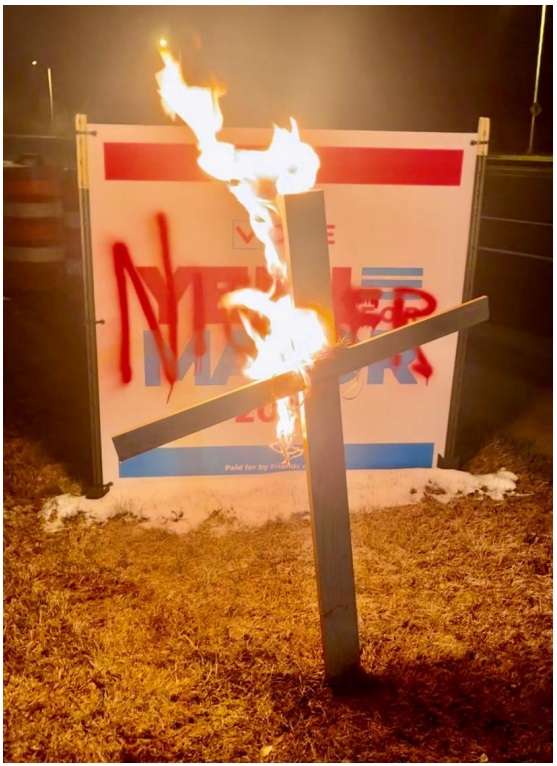
The United States Attorney's Office for the District of Colorado announces that Derrick Bernard Jr., 35, [Ashley] Blackcloud, 40, and Deanna West, 38, were indicted by a federal grand jury for maliciously conveying false information about a threat made by means of fire: a burning cross in front of a campaign sign defaced with a racial slur.
According to the indictment, the three defendants were charged for their alleged roles in a conspiracy to spread disinformation about the threat. The 2023 Colorado Springs mayoral run-off election involved Candidate 1, who was Black, and Candidate 2, who was white. After the initial election but before the run-off, Bernard sent a message to the other defendants in which he explained he was "mobilizing my squad in defense. Black ops style big brother." He also sent messages referencing a desire to prevent "the klan" from gaining political control of the city. Bernard then worked with Blackcloud and West to stage, at an intersection in the City of Colorado Springs in the early hours of April 23, 2023, a cross burning in front of a campaign sign for Candidate 1 defaced with a racial slur. The three then allegedly spread false information about the event through an email from an anonymous source to various news and civic organizations.
From the indictment:
During the election, supporters of CANDIDATE 1 placed a campaign sign encouraging others to vote for CANDIDATE 1 in a grassy area on the northwest corner of the intersection of North Union Boulevard and East Fillmore Street, two of Colorado Springs's major traffic arteries. On or about April 23, 2023, between approximately 2:30 a.m. and 3:30 a.m. BERNARD, BLACKCLOUD, and WEST worked together to place a wooden cross in front of that campaign sign. Red spray paint, similar in kind to a can later found in the passenger compartment of BLACKCLOUD's car, was used to write the word "nigger" on the sign. The wooden cross was then set on fire….
You can read the Complaint (filed yesterday) in Moody v. Criswell (S.D. Fla.); there are all sorts of interesting federal civil rights litigation and federal courts issues, such as parens patriae, the scope of § 1985(3) liability, the intracorporate conspiracy doctrine, and more. And of course the case raises the factual question of whether the discrimination was the work of a rogue employee (as FEMA seems to argue) or was endorsed by higher ups (as the employee has claimed, and as Florida is asserting). An excerpt from the Complaint:
"[A]void homes advertising Trump." This was the directive that Defendant Marn'i Washington gave to federal relief workers responding to Hurricanes Helene and Milton in Lake Placid, Florida.
While the Federal Emergency Management Agency (FEMA) has fired Defendant Washington and called her behavior "reprehensible," Defendant Washington insists that she is a "patsy" and that FEMA made her a "scapegoat." Defendant Washington says that similar conduct occurred in North Carolina and throughout areas affected by Hurricanes Helene and Milton. And she represents that senior FEMA officials claiming not to know that the agency was discriminating against Trump supporters are promoting a "lie."
While the facts will continue to come out over the weeks and months, it is already clear that Defendant Washington conspired with senior FEMA officials, as well as those carrying out her orders, to violate the civil rights of Florida citizens. This conspiracy is actionable under 42 U.S.C. § 1985, which creates a cause of action for "[c]onspiracy to interfere with civil rights." See Smith v. Meese, 821 F.2d 1484, 1492 n.5 (11th Cir. 1987) (suggesting that "selectively enforc[ing] a law" by "prosecuting only Republicans" would violate § 1985 (quotations omitted)); accord Lyes v. City of Riviera Beach, 166 F.3d 1332, 1338 (11th Cir. 1999) (en banc) (discussing legislative history suggesting that "actionable conspiracies" under § 1985 "would include those against a person because he was a Democrat" (quotations omitted)); United Bhd. of Carpenters & Joiners of Am., Loc. 610, AFL-CIO v. Scott, 463 U.S. 825, 836 (1983) (suggesting that § 1985(3) "was intended to" protect "Republicans" because Republicans "championed the[] cause" of Black Americans after the Civil War).
I've been reading and much enjoying Paul Mirengoff & Bill Otis's Ringside at the Reckoning. I don't always agree with them, and I think that politically they tend to be more conservative than I am. But I've generally found them to be blunt, level-headed, and thoughtful, and they generally strike me as astute observers of American politics. (Paul Mirengoff was a cofounder of the conservative Power Line blog, which has been following American politics for 20 years.)
I thought I'd pass along Mirengoff's most recent post, Trump's picks: The good, the questionable, and the crazy. As you can tell from the title, he praises some (Marco Rubio for Secretary of State, John Ratcliffe for CIA Director), expresses doubt about others (including criticizing Kristi Noem for Homeland Security as not being conservative enough), and sharply criticizes others, including Matt Gaetz for Attorney General. Since the AG position is of especial interest to me as a lawyer and someone who writes mostly about law, I thought I'd pass along Mirengoff's thoughts:
I agree with the Wall Street Journal's editorial board:
This is a bad choice that would undermine confidence in the law. Mr. Trump lauded Mr. Gaetz's law degree from William and Mary, but it might as well be a doctorate in outrage theater. He's a performer and provocateur, and his view is that the more explosions he can cause, the more attention he can get. "It's impossible to get canceled if you're on every channel," he once said. "If you aren't making news, you aren't governing."
Mr. Gaetz has no interest in governing. When Republicans took control of the House in 2022, it was with a small margin. Rather than work to get things done, Mr. Gaetz sabotaged Speaker Kevin McCarthy before finally leading a rebellion to oust him. Eight Republican malcontents plunged the GOP into weeks of embarrassing paralysis, since Mr. Gaetz had no alternative that could command a majority….
We're at:
Please let us know if you have any difficulties with accessing any of these. We'd also be glad to get feeds working to other social media services, but the key is to have a mechanism to automatically have posts generated from our RSS feed (as we do for Twitter and Facebook via IFTTT, and for Bluesky and Mastodon via dlvr.it).
A very good Substack post by Yascha Mounk; two short excerpts:
The aspiration of many journalists to save democracy has not just proven counterproductive because it drove a big part of their readership away from mainstream outlets. It has also deprived Democrats of key facts they would have needed to make good strategic decisions—which, ironically, has helped to strengthen the very political forces that the journalists who were self-consciously striving to preserve democracy were trying to contain.
Over the last months, I have heard from multiple European diplomats that the extent of Joe Biden's struggles has long been well-known. In meetings with a number of senior statesmen, Biden repeated the same anecdotes, or seemed unsure about his own whereabouts, as early as 2021. Is it really plausible that American journalists were unable to learn something that has been known in capitals across Europe for so long—something that, as it happens, tens of millions of American voters have long cited as a serious concern in opinion polls?
No. The obvious truth of it is that, for the most part, journalists simply did not want to go there. Part of that reluctance may have been rooted in an understandable (if misplaced) sense of propriety. But another part of it was rooted in the unspoken suspicion that open consideration of this topic would somehow wind up helping Donald Trump.
As it happens, the reluctance to level with readers ultimately accomplished the opposite of what was intended. It allowed Biden to stay in the race long enough to make the entire Democratic establishment complicit in covering up the true state of his mental health. And it made it virtually impossible to stage an open primary to choose his successor….
But the truth of it is that the American mainstream itself now suffers from a serious epistemological crisis. If you were a faithful reader of The New York Times or a frequent listener of NPR, you were less likely than the average American citizen to believe that Biden was suffering from serious mental decline or that Harris was an unpopular politician with a steeply uphill path towards winning the presidential election. You were also less likely to recognize that school closures would exact a big toll on students' educational outcomes and mental health or to realize that a lot of Latinos were embracing the Republican Party. And you would, even now, be less likely than most voters to recognize how utterly simplistic it is to believe that America can meaningfully be divided into two opposing blocks of "whites" and "people of color."
Americans have lost trust in many of their institutions in good part because, despite their assurances to be the arbiters of truth and science, legacy news outlets and establishment institutions fundamentally misconstrue and misunderstand basic aspects of American life. The reasons for this sorry state of affairs go well beyond the decision by many journalists to flatter themselves into thinking that their task was to save democracy. But the first step towards fixing the problem is for journalists to re-embrace the humdrum conception of their own work that served them comparatively well in the past: to cultivate a healthy distrust of everyone, including those you may secretly believe to be on the right side of history, and report the news without fear or favor.
The whole post is much worth reading.
An Introduction To Constitutional Law Video Library: Griswold v. Connecticut (1965), Roe v. Wade (1973), Planned Parenthood v. Casey (1992), Whole Woman's Health v. Hellerstedt (2016), Lawrence v. Texas (2003), U.S. v. Windsor (2013), Obergefell v. Hodges (2015), Dobbs v. Jackson Women’s Health Organization (2022)
11/14/1922: Pennsylvania Coal Co. v. Mahon argued.
A fond memory of the student leadership reception at Ted's palatial estate.
I am deeply saddened by the passing of Theodore Olson. Ted, as he was known, was a giant in the conservative legal movement. Generations of law students will study his defeat in Morrison v. Olson, as well as his victories in Bush v. Gore and Citizens United. But Federalist Society members, in particular, owe Ted a special debt. He was instrumental in the flourishing of our society. Here, I will relay one small anecdote, that I'm sure many will share.
For years, the Federalist Society has held the student leadership conference every July. In more recent years, the reception has been held at the United States Supreme Court. But in the 2000s, the reception was held at Ted Olson's home in Northern Virginia.
I was fortunate enough to attend the gathering in July 2008, after my second year of law school at George Mason. As I recall, we instructed to park our car at a nearby church, and ride a shuttle bus to Ted's home. (I sat next to a student from Harvard named Sarah Isgur.)
Entering the Olson estate was like walking into Disneyland. There was a huge backyard with an enormous swimming pool. There was something that looked like a robot cleaning the bottom of the pool. Such a gadget may be common nowadays, but it was beyond futuristic sixteen years ago. I remember just walking around in awe at the luminaries I saw. I walked onto the back porch and Judge Robert Bork was sitting there, drinking Iced Tea. The year before, Bork was injured in a fall at the Yale Club in New York. Bork was complaining about his leg, which was still bothering him. I was tempted to ask Bork about the Ninth Amendment and the "inkblot" comment, but I figured I would come across as a smartass, so I didn't. In hindsight, I am grateful I just sat and listened to him chat about whatever was on his mind.
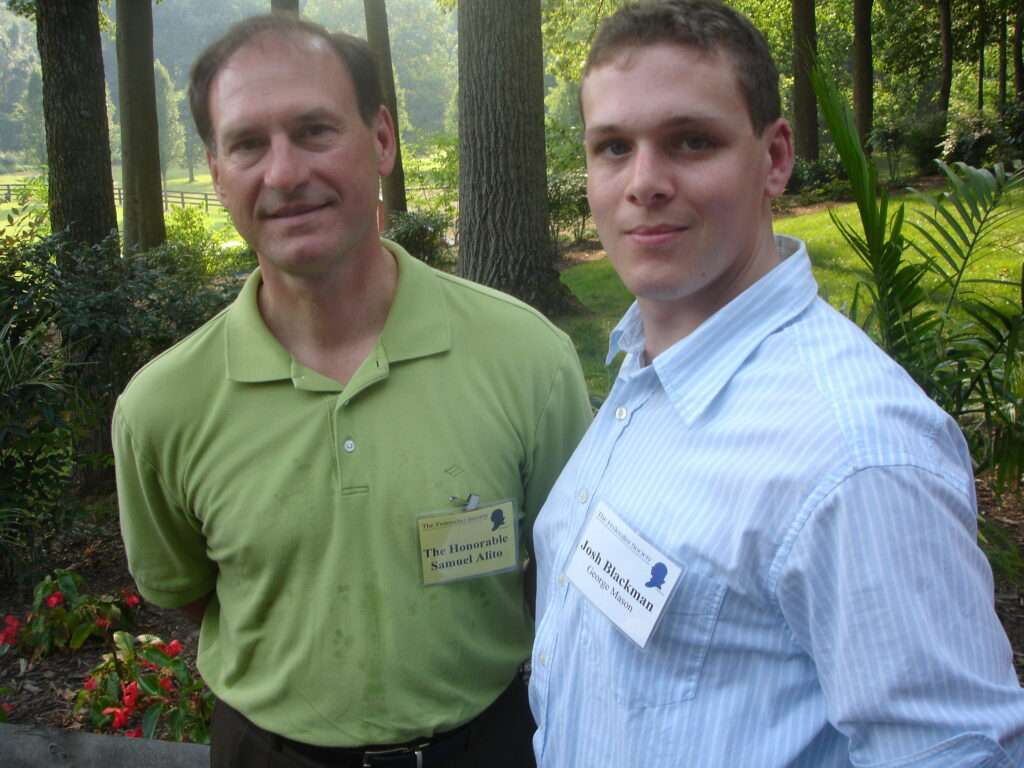
I walked around the ground and saw Justice Samuel Alito. He was wearing a polo shirt. I was star struck. We chatted for a few moments, and I sheepishly asked for a picture. I also asked the then-Junior Justice to sign my pocket Constitution, which he did. I continued to walk around and I found the host of the party Ted Olson. I don't remember exactly what I said, but I recall thanking him for hosting us at his palatial home. He was very gracious. I asked Olson if he too would sign my pocket Constitution. Olson gladly did. And, for good measure, I saw Judge Dave Sentelle. He too signed that Constitution. That Constitution now hangs on the wall in my office, alongside another Constitution that is signed by Justices Thomas and Scalia. These are among my most prized possessions.
Last year, I chatted with Ted after the 2023 Olson Lecture. I relayed to him this story about my experience at his home, and I shared how meaningful it was to me and countless other FedSoc members. He beamed with pride. It was an exchange I will not forget.
Ted will be deeply and profoundly missed. The 2024 Federalist Society Convention will not be the same without his presence.
Here is the photo of me with Justice Alito in July 2008. This is what Ted's backyard looked like!
And here is a photograph of my signed pocket Constitutions.
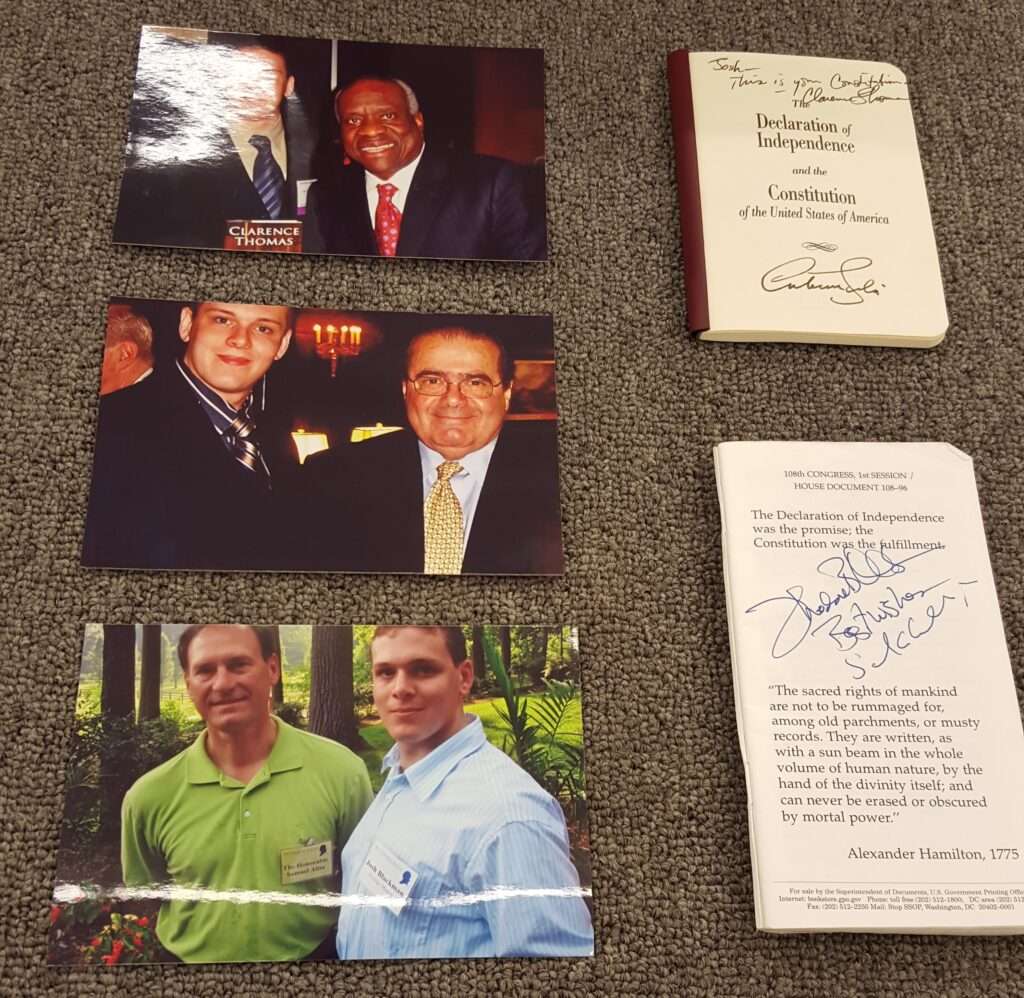

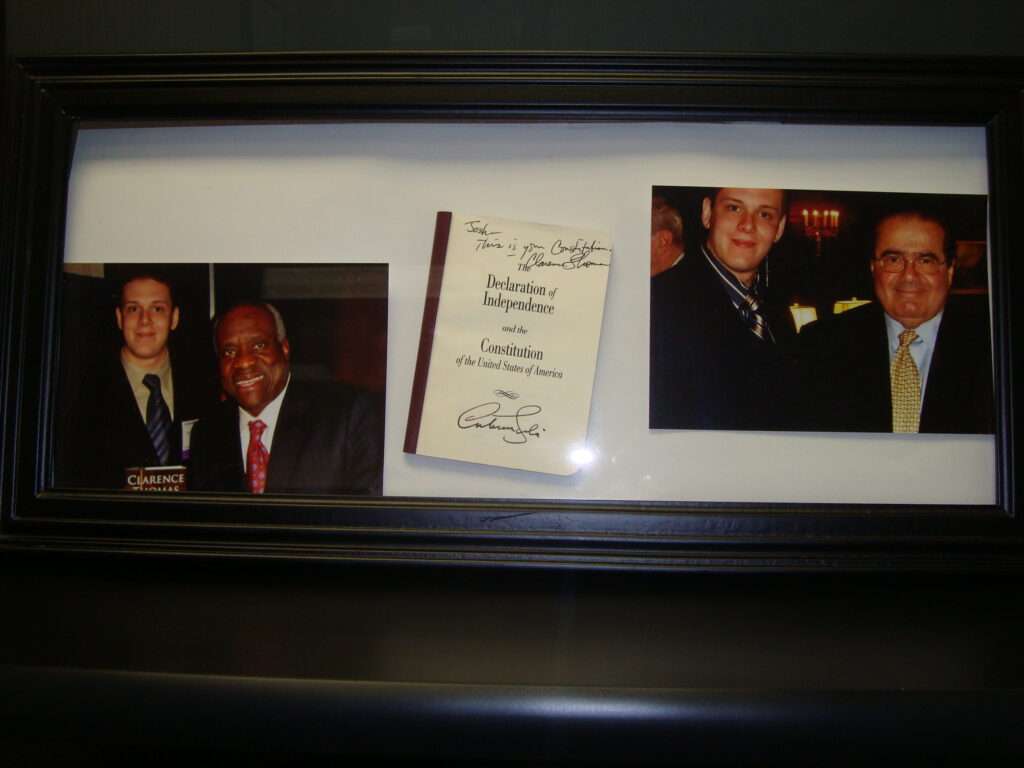
I'm sorry I don't have a better photographs to share. I am on the road, staying in the soulless Washington Hilton this evening. I'll share my longing for the Mayflower in another post.
Would a person serving under the Vacancies Reform Act, who resigns, create a vacancy for purposes of the Recess Appointments Clause? Would a presidential adjournment of Congress be an inter-session or an intra-session recess?
Ed Whelan writes that President Trump may adjourn Congress as a means to instantly confirm his entire cabinet without any confirmation hearings. In an earlier post, Ed writes that this approach may risk the Court overruling Justice Breyer's Noel Canning majority opinion, and adopting Justice Scalia's concurrence.
I maintain that Justice Scalia's opinion is correct on originalist grounds, as I noted in my earlier post. And I would be happy to see Justice Breyer's majority opinion repudiated. But even so, is this potential plan inconsistent with Justice Scalia's concurrence?
Under Scalia's opinion, the President could only fill a vacancy that arises during the recess of the Senate. Trump's plan would only be feasible if these cabinet positions become vacant during the recess of the Senate. Presumably, the holdover Biden cabinet officials will be long gone on January 20. And, on January 20, I suspect the President will use the Vacancies Reform Act to detail friendly people already in the federal government to serve as acting cabinet officials. What if one of them were to resign during the presidentially-induced recess? That is, on January 21, Trump adjourns Congress, and all acting cabinet officials resign. Would those vacancies have arisen during the recess of the Senate? Or, would the relevant starting point be when the last-confirmed official resigned? I don't know how the Recess Appointments Clause, as understood by Scalia, interacts with the Vacancies Reform Act. I doubt anyone has given this issue much thought.
There is a second issue. Under Justice Scalia's concurrence, the President can only make a recess appointment during an inter-session recess, and not during an intra-session recess. That is, the President can make a recess appointment during the recess between sessions, and not during the recess in the middle of a session. Would a presidential-induced recess be an inter-session recess or an intra-session recess? This power has never been exercised before, so there is no precedent.
I had always thought this clause would cause an inter-session recess. At the Framing, intra-session recesses were very rare. Generally, Congress would meet for continuous periods, taking only short breaks, and then take very long inter-session breaks. To the extent this power was more likely to be used, it would be used to decide when to conclude one session, and begin another. But I don't know. I do think it is the case that this clause was not designed to trigger the President's recess appointment power. But that is a separate question from what kind of recess this power would trigger.
Those who joined the Noel Canning majority may very soon regret their choice.
Justice Gorsuch shows more interest in property rights challenges than his colleagues on the Court.
Yesterday, the Supreme Court denied certiorari in two cases, G-Max Management v. New York and Building and Realty Institute of Westchester and Putnam Counties, Inc. v. New York, that sought to challenge the constitutionality of New York's rent stabilization laws, primarily on Fifth Amendment Takings Clause grounds.
The Roberts Court has been quite sympathetic to Takings Clause claims, but has also largely avoided taking case that asked the Court to make dramatic changes in existing law. In effect, the Court has given property rights activists a string of base hits, but no Grand Slams. These two cases had the potential to advance the constitutional protection of property rights quite substantially, but the Court showed little interest. On the Order List, only Justice Gorsuch is listed as supporting certiorari.
In the past, I have repeatedly noted Justice Kavanaugh's apparent interest in granting petitions of certiorari that his colleagues rejected. Interestingly enough, he did not join Justice Gorsuch in supporting certiorari here.
Celebrate your independence with a subscription to Reason magazine, your most trusted source of honest, insightful news and analysis.