The Volokh Conspiracy

Mostly law professors | Sometimes contrarian | Often libertarian | Always independent | Est. 2002

The Volokh Conspiracy

Free Speech

Odds Are Against TikTok at the Supreme Court

It seems unlikely that five Justices will buy TikTok's First Amendment arguments when neither Judge Douglas Ginsburg nor Judge Neomi Rao nor Chief Judge Sri Srinivasan did so.

|

The Supreme Court's decision to hear the TikTok divestment statute case is better for TikTok than the alternative: The D.C. Circuit had upheld the statute, and now TikTok has a chance to try to reverse that.

But it's not a high chance, I think, chiefly because the D.C. Circuit opinions on the First Amendment were detailed and careful, and were written by a highly respected and ideologically mixed group of judges: Douglas Ginsburg, a Reagan appointee; Sri Srinivasan, an Obama appointee; and Neomi Rao, a Trump appointee. Srinivasan took a different approach on the First Amendment issue than did Ginsburg and Rao, but he reached the same result: All three voted to uphold the law.

It seems to me a good bet that most of the Supreme Court Justices will take a view similar to either Ginsburg's and Rao's or Srinivasan's. It's hard to identify up front any Justices who, as a matter of their general jurisprudence or of their particular First Amendment views, are likely to be quite different than all three of the D.C. Circuit judges. There are certainly highly plausible arguments against the law, as well as in favor. It just seems unlikely to me that those arguments will persuade five Justices when they persuaded neither Ginsburg nor Srinivasan nor Rao.

Read More

Tick, Tock Goes the SCOTUS Clock

The timing of TikTok v. Garland.

|

Today, the Supreme Court acted on pending applications in the challenges to the "Protecting Americans from Foreign Adversary Controlled Applications Act." The Court did not grant an injunction pending review. Instead, the Court construed the applications as petitions for writs of certiorari, and granted them. The Court set a blazing fast briefing schedule, with opening briefs due two days after Christmas, reply briefs to be filed two days after New Years, with oral argument one week later.

The parties are directed to file electronically simultaneous opening briefs, limited to 13,000 words, and a joint appendix on or before 5 p.m. (EST), Friday, December 27, 2024. Reply briefs, limited to 6,000 words, are to be filed electronically on or before 5 p.m. (EST), Friday, January 3, 2025. Any amicus curiae briefs are to be filed electronically on or before 5 p.m. (EST), Friday, December 27, 2024. Booklet format briefs prepared in compliance with Rule 33.1 shall be submitted as soon as possible thereafter.

The case is set for oral argument on Friday, January 10, 2025.

Happy Holidays everyone!

The timing here is extremely tight, with good reason. The law goes into effect on January 19, 2025. The President can only extend this deadline once, assuming that certain conditions are satisfied.

Again, the Court did not grant some sort of temporary injunction. In the past, Justices Barrett and Kagan have been critical of granting injunctions on the shadow docket. That the Court agreed to promptly hear oral argument, and placed it on the rocket docket, seems consistent with past precedents.

What happens after oral argument? I see a few different possibilities.

First, a majority of the Court promptly affirms the D.C. Circuit. I think this can be done fairly quickly. Judge Ginsburg's decision is extremely thorough, and there is no need to reinvent the wheel. It is also possible that one or more Justices finds persuasive Judge Srinivasan's concurrence. But a simple majority affirm could be done in a summary fashion. There may be dissents filed right away, or the dissents could be issued at a later date.

Second, a majority of the Court promptly reverses the D.C. Circuit. That sort of opinion would have to be more-fully developed, and explain why Judge Ginsburg erred. I think that sort of outcome, especially on a prompt timeline, is unlikely. Then again, that opinion may already be drafted. Bush v. Gore was written on a tighter timeline. And the Justices have had months to think about the case. (Justice Barrett's NetChoice concurrence presaged some of these issues.)

Third, the Court could grant a temporary injunction immediately after oral argument, to provide enough time to develop a written opinion. This opinion could ultimately affirm, but more likely would reverse. Again, an affirmance can be done quickly without making any broad pronouncements about First Amendment law. Any injunction may have one or more dissents, which would provide a preview of the final vote count.

Fourth, on January 11, the Court denies an injunction, but does not rule on the petition for a writ of certiorari. That outcome would create an unusual game of chicken with the White House. President Biden would then have about eight days to decide whether an extension should be granted. SCOTUS could then wait until January 18 to decide whether to release its opinion. (I am not certain what time the law goes into effect on January 19.) Remember, if TikTok comes into compliance with the law, there is no need for the Court to resolve this issue. And who knows what happens when Trump comes into office. He has spoken in support of TikTok. If somehow TikTok comes into compliance with the law, then Judge Ginsburg's opinion will be vacated under Munsingwear and we can all forget this ever happened.

Fifth, if January 18 comes, and there is no extension granted, the Court will have to do something. Or it could do nothing at all. Indeed, if the President and the Court fail to act by January 19, TikTok would suffer the same fate as Heinrich Quirin. Remember, by the time the Court decided Ex parte Quirin, the Nazi Saboteurs had already been executed.

Tick Tock, goes the clock.

Free Speech

S. Ct. Will Hear First Amendment Challenge to TikTok Divestment on Jan. 10

|

The question presented is:

Whether the Protecting Americans from Foreign Adversary Controlled Applications Act, as applied to petitioners, violates the First Amendment.

The parties' briefs are due the same day, Dec. 27, as are friend-of-the-court briefs. Both parties appear to be entitled to file reply briefs by Jan. 3. Two hours are allotted for oral argument. For more on the D.C. Circuit panel majority opinion, see this post; for the concurring opinion's alternate path to reaching that result, see this post.

Free Speech

Trump v. Selzer Likely Going Nowhere

|

Monday's Complaint in this case essentially alleges that pollster Ann Selzer's Nov. 2 poll for the Des Moines Register, which showed Harris ahead in Iowa by 3 points, was deceptive to consumers and thus violated Iowa consumer fraud law:

62. President Trump, together with all Iowa and American voters, is a "consumer" within the meaning of the statute.

63. Defendants furnished "merchandise" to consumers within the broad meaning of the statute since they provided a service: physical newspapers, online newspapers, and other content that contained the Harris Poll.

64. Defendants engaged in "deception" because the Harris Poll was "likely to mislead a substantial number of consumers as to a material fact or facts," to wit: the actual position of the respective candidates in the Iowa Presidential race.

65. Defendants engaged in an "unfair act or practice" because the publication and release of the Harris Poll "cause[d] substantial, unavoidable injury to consumers that [was] not outweighed by any consumer or competitive benefits which the practice produced," to wit: consumers, including Plaintiff, were badly deceived and misled as to the actual position of the respective candidates in the Iowa Presidential race. Moreover, President Trump, the Trump 2024 Campaign, and other Republicans were forced to divert enormous campaign and financial resources to Iowa based on the deceptive Harris Poll. Consumers within Iowa who paid for subscriptions to the Des Moines Register or who otherwise purchased the publication were also badly deceived. Additionally, Iowans who contributed to the Trump 2024 Campaign were similarly deceived.

Read More

Free Speech

No Pseudonymity for Attempt to Get President-Elect Trump Disqualified and to Allow Him to Be Privately Prosecuted

|

From Doe v. Chutkan, decided today by Chief Judge James Boasberg (D.D.C.):

In this pro se lawsuit, Plaintiff John Doe seeks, first, a court declaration that President- elect Trump is constitutionally ineligible to serve as President and the Supreme Court's recent decision holding otherwise is "void"; and, second, an order requiring Defendants Judge Tanya Chutkan and Attorney General Merrick Garland to preserve and provide Plaintiff grand-jury materials and other documents so that he and other private citizens may "prosecute" President-elect Trump.

Plaintiff moves here to proceed pseudonymously on the ground that bringing this lawsuit will "expose [him] to retribution." As Plaintiff has not made the detailed showing required to overcome the presumption in favor of disclosure, the Court will deny the Motion, subject to any further consideration by the United States District Judge to whom this case is randomly assigned….

Generally, a complaint must identify the plaintiffs. That requirement reflects the "presumption in favor of disclosure [of litigants' identities], which stems from the 'general public interest in the openness of governmental processes,' and, more specifically, from the tradition of open judicial proceedings." A party moving to proceed pseudonymously thus "bears the weighty burden of both demonstrating a concrete need for such secrecy, and identifying the consequences that would likely befall it if forced to proceed in its own name." As a result, the court must "'balance the litigant's legitimate interest in anonymity against countervailing interests in full disclosure'" ….

The court concludes that the public interest in identifying the plaintiff is especially strong here:

Read More

"Out of My Peripheral I Felt as if Something Could Have Taken Place."

From State v. Barnes, a new decision from the Ohio Court of Appeals.

|

Here's some remarkable testimony from the suppression hearing in State v. Barnes, handed down yesterday by the Ohio Court of Appeals, in which an officer searched through a suspect's pockets and found drugs.  The officer had already frisked the suspect for weapons and found nothing, but then searched him again on the suggested ground that another suspect might have just handed him something:

On cross-examination, Patrolman Risner admitted that the body camera footage contained no indication that any type of exchange occurred but stated that he "felt as if something could have taken place." (Emphasis added.) (Tr. 136). The following exchange then occurred:

[Defense Counsel:] At no time do we see from the body cam any type of exchange occur, do we?

[Patrolman Risner:] We don't see the exchange, no.

[Defense Counsel:] And you didn't either, did you?

[Patrolman Risner:] Out of my peripheral I felt as if something could have taken place.

[Defense Counsel:] But you didn't see anything, did you?

[Patrolman Risner:] No, I didn't see a handoff, no.

[Defense Counsel:] Now why on the body cam, then, did you tell Mr. Barnes that you saw him put that in his pocket?

[Patrolman Risner:] Because I believed that I did.

[Defense Counsel:] Okay. But you didn't, did you?

[Patrolman Risner:] No.

* * *

[Defense Counsel:] I mean, how do you believe you see something from what we just saw [on the body camera footage]?

[Patrolman Risner:] I can't explain to you how I felt at that moment. I was busy dealing with her [Williams]. Out of my peripheral, it looked like something could have been potentially handed off so I investigated further and I was right.

The very unimpressed Court of Appeals ruled that the search violated the Fourth Amendment and that the trial court properly suppressed the evidence.

UPDATE: Reading over the case again, and thinking more about it, I think the testimony above may have come off pretty differently in the opinion than at the suppression hearing.  In the opinion, it reads as if the officer is trying to pull a fast one, like he's trying to defend the search based on his feelings.  But the opinion later points out that there was another possible Fourth Amendment basis for the search that the officer was apparently relying on:  The automobile exception, based on a positive drug detection dog alert before the search occurred.

Let me explain this a bit. If a dog alerts to drugs in a car, that entitles officers to search the car. The officer appears to have been thinking that this allowed the search through the former passenger's pockets, not that the officer safety rationale of stop-and-frisk law did so.  The court points this out in passing to explain why there was no real officer safety rationale, but it's worth pointing out that this presumably explains the officer's testimony. Presumably he wasn't trying to justify the search based on his feelings, but rather was just being truthful about his thinking:  He was seeing this as a drug case based on the dog alert, and he thought he could search a person from the car and was just explaining why he searched that person. If that view were correct, he would not need additional suspicion.

As it turns out, though, that belief about Fourth Amendment law is not correct.  The automobile exception allows a search of property that a passenger carries out of the car when ordered to exit after probable cause has been established, lower courts have held.  But the Supreme Court has held that the automobile exception does not extend to a passenger's pockets. See United States v. Di Re, 332 U.S. 581, 587 (1948).  So it's possible that what happened here is that the officer was thinking of one exception to justify the search but the prosecution ended up trying to justify the search based on a different exception.  The testimony seems odd because the government ended up arguing that the search was justified based on an exception that the officer was not trying to invoke.  Or at least that seems like a distinct possibility.

Jurisprudence on the Adjournment Power, Old and New

|

Last month, Washington was in a tizzy about whether President Trump could use the adjournment power as a means to create a recess, and then make recess appointments for his cabinet member. That frenzy seems to have died down, but scholars continue to investigate the issue.

There are two primary legal questions to consider about the adjournment clause. First, can the President invoke the clause to adjourn any session of Congress, or only those extraordinary sessions that he may convene? Second, does the adjournment power empower the President to decide when to adjourn Congress, or does it merely empower him to decide the duration of an adjournment?

I'd like to flag two recent entries in the debate. First, Alan Erbsen wrote a draft article titled "Constitutional Limits on the President's Authority to Adjourn Congress." Second, Jason Willick and Phillip Huff publishded a detailed column in the Washington Post, titled How a long-ago fight over a dormant constitutional weapon echoes today.

Erbsen contends that the adjournment power is limited to extraordinary sessions:

First, the Constitution tethers the Disagreement Clause to the Convening Clause. The President may adjourn Congress only if the President convened at least one of the houses in an extraordinary session. If both houses convened on their own in a regular session, the President lacks power to adjourn them.

To his credit, Erbsen cites Section 1557 of Justice Story's Commentaries, which suggests the power is not so limited:

§ 1557. The power to adjourn congress in cases of disagreement is equally indispensable; since it is the only peaceable way of terminating a controversy, which can lead to nothing but distraction in the public councils.

Erbsen also contends that the President can only determine the date that Congress can adjourn till, and even then, Congress can choose to reconvene on its own power:

Third, even if the President can force the Senate to adjourn, the Senate can reconvene to protect its role in the appointments process. The President can authorize the Senate to remain adjourned until a specified date, but cannot suppress the Senate's inherent authority to reconvene on an earlier date.

Mike Stern made a similar point on the Lawfare Podcast (starting at 26:21). Stern argues that this power is only triggered when the House and Senate both wish to adjourn, but they do not agree how long that adjournment should be. And, the President can mediate that disagreement to decide how long the adjournment should be. He argues the power is not triggered when the House wants to adjourn but the Senate does not want to adjourn.

Erbsen also cites a contrary source, which I am embarrassed that I had forgotten about: Justice John Marshall Harlan's lecture notes, which I transcribed with Brian Frye and Michael McCloskey. Harlan seems to be saying the President has the broader power to adjourn Congress, and not just to set the date on which the adjournment ends.

"The Senate wants to adjourn to one period. The House says, 'No, we won't agree to that. We propose to adjourn to another day.' Well, the Senate won't agree to that. And here is a hung jury, to use a popular phrase. And the time of the country, and the money of the country, is not to be wasted in fruitless endeavor of these two Houses to agree as to the time to which they shall adjourn. Now, in that state of case the President may interfere and say, 'I adjourn you both to a certain day in the future.' That is lawful."

Harlan and Story did not seem to limit the power to extraordinary sessions.

Alan has a rich and detailed history of these provisions, which I would commend to your attention.

Now, let's turn to Willick and Huff's article in the Post. They reveal that debates over these two questions are not new. Indeed, both of these issues were debated in 1834--one year after Story's Commentaries were published. At the time, President Andrew Jackson considered whether to adjourn the Senate to prevent the re-authorization of the Second Bank of the United States. Willick and Huff describe this episode as "largely forgotten." They're right. I hadn't heard about it before, and I don't recall it being mentioned in last month's recess kerfuffle. The authors cite a wealth of primary sources.

First, was the adjournment power limited to extraordinary sessions? The Globe, a pro-Jackson newspaper, argued that the adjournment power was not limited to extraordinary sessions:

Read More

Free Speech

Missouri Legislative Employee Was Unconstitutionally Fired for Pro-Mask-Policy Letter

|

From Mayfield v. Missouri House of Representatives, decided Friday by Eighth Circuit Judge Jane Kelly, joined by Judges Lavenski Smith and Jonathan Kobes:

On August 3, 2020, while employed in the assistant clerk's office of the Missouri House of Representatives …, Mayfield sent an email to Elijah Haahr, the Speaker of the House, and Dave Schatz, the President Pro Tem of the Missouri Senate, titled "Capitol Safety." It read:

I am writing to you because I feel an ethical and moral obligation to do so. We are living in unprecedented times that requires, likewise, unprecedented actions and decisions from the leadership and citizens of our state. Those actions and decisions, or lack thereof, will be recorded in history as either appropriate measures that helped save lives, or inappropriate and resulted in an increase in lives lost.

Businesses, cities, and states across this great nation have heeded the CDC's warnings and implemented a number of measures designed to slow/stop the spread of COVID-19, including mandatory face coverings, if we are to continue in our efforts to reopen the economy and get people back to work. I am grateful the Missouri House of Representatives has implemented some of the same measures in an attempt to protect Members, staff, and visitors to our Capitol. Unfortunately, as of yet, the decision to require face coverings in the chambers and public spaces in our Capitol has not been made, leaving all who enter our Capitol at greater risk of contracting COVID-19, and ultimately, negates any benefit received by the measures that have been implemented.

Read More

Free Speech

Judge Rejects Meta's Attempt to Seal Various Information About Moderating Practices

"The manner in which Meta moderates content from an adult platform competing with OnlyFans versus content that originates from OnlyFans is directly at issue. Therefore, Meta's general policies which articulate the extent to which sexual content is permitted on any of Meta's social media platforms are also relevant."

|

From Judge William Alsup's opinion Thursday in Dangaard v. Instagram, LLC (N.D. Cal. 2024):

The public enjoys the right to know to whom the public courts provide relief (or not). Filings "more than tangentially related to the merits of a case" may be sealed only for "compelling reasons." That "standard applies to most judicial records," with a "good cause" standard applying otherwise….

This order now addresses materials contained within Meta's motion for summary judgment that Meta wishes to keep sealed…. First, Meta states that citing to its internal policies of how it moderates content and statistics reflecting how Meta blocks certain content would allow "malicious actors to take advantage of this specialized internal information to circumvent or otherwise render ineffective" Meta's moderation processes…. Second, that Meta's content moderation policies could cause competitive harm if disclosed because competitors could copy Meta's techniques to better operate their online services. Third, that some of the information contains personal identifying information and other material implicating the privacy interests of third parties.

As a preliminary issue, Meta seeks to seal portions of the motion for summary judgment itself. Given that the motion is dispositive, Meta must articulate a compelling reason to justify sealing swaths of a dispositive motion. This order finds that Meta has not met its burden. Though Meta seeks to seal specific sentences and headers, all of the proposed redactions speak to the merits of the action for which the public should have access.

Read More

Free Speech

After Plaintiff "Criticized the City Manager …, the Manager Complained About Him to the Police."

"Two officers convinced a prosecutor to charge Blackwell with stalking. But a judge acquitted him. Blackwell then sued the manager and officers for violating the First Amendment by inducing this prosecution in retaliation for his political speech."

|

From yesterday's decision in Blackwell v. Nocerini, written by Sixth Circuit Judge Eric Murphy and joined by Chief Judge Jeffrey Sutton and Judge John Bush:

After Mark Blackwell criticized the city manager of a small Michigan city, the manager complained about him to the police. Two officers convinced a prosecutor to charge Blackwell with stalking. But a judge acquitted him.

Blackwell then sued the manager and officers for violating the First Amendment by inducing this prosecution in retaliation for his political speech. The district court held that his complaint alleged enough facts to rebut the city officials' qualified-immunity defense at the pleading stage. The officials now appeal. We agree that Blackwell plausibly pleaded that the officials sought to prosecute him in retaliation for his speech and without probable cause that he had committed a crime….

Because this case reaches us at the pleading stage, we must accept the allegations in Blackwell's complaint as true. We summarize the facts relying solely on those allegations, keeping in mind that the evidence developed in discovery may refute them down the road.

In 2018, many people complained about the "divisive and hostile" work environment for public employees in the City of Wayne, Michigan. Because the poor environment had led to low morale and high turnover, the City hired a human-resources expert to investigate the complaints. This expert allegedly confirmed much of the concerns. His findings pointed the fault at Wayne's City Manager: Lisa Nocerini. She allegedly showed favoritism toward some employees and a lack of respect toward others.

Blackwell, a Wayne resident, obtained the expert's report. He began to call for Nocerini's termination during the public-comment period of City Council meetings. Unhappy with this criticism, Nocerini allegedly tried to convince Wayne's then-existing police chief to charge Blackwell with a crime. This police chief refused.

Read More

What Is The Remedy For Judge Wynn's "Brazenly Partisan" Withdrawal of Senior Status?

Should he be forced to recuse from any case involving the Trump Administration?

|

The Article III project filed a judicial misconduct complaint against Judge Wynn of the Fourth Circuit. Yesterday, I wrote about Wynn's "brazenly partisan" withdrawal of his intent to take senior status because Trump prevailed. But the facts are even worse than I knew. The complaint recites:

In January 2024, Judge Wynn announced his intention to assume senior status upon the confirmation of his successor.1 In March 2024, he attended a "retirement celebration" held in his honor, where prepared remarks from President Obama, who had nominated Judge Wynn, were read to the crowd.

Is it common for the President who appointed a judge to provide remarks when the judge retires? When Judge Kim Gibson, for whom I clerked, took senior status, there was a statement read from Circuit Justice Alito (who attended the same High School as Judge Gibson). I thought that was quite appropriate. But from the former President? From nomination to retirement, Judge Wynn was an Obama judge.

As we know now, he did not retire. The complaint states the obvious:

Given the timing of his announcement, the fact that he celebrated his retirement nine months earlier, and the lack of any other provided explanation combine to make clear that Judge Wynn's decision to rescind his announcement was likely made because of the outcome of the 2024 presidential election. Indeed, the media is already reporting that Judge Wynn apparently changed his mind as a result of the election.5 Even worse, the timing of Park's needless withdrawal followed immediately by Judge Wynn's letter gives the appearance that there was coordination between Park, Judge Wynn, and the White House to give the misimpression that Park's pointless withdrawal—and not the 2024 election results—was what prompted Judge Wynn to change his mind.

Certainly the judiciary has the power to determine what communications arose between Wynn, the Senate, and the White house. If Judge Newman can be forced to sit for a medical exam, Judge Wynn can turn over his email and call logs.

Let's assume the facts are as stated. What is the remedy? I suppose Judge Wynn could be forced to actually take senior status, to avoid any appearance of impropriety. Or maybe he could be forced to recuse from any case involving the Trump-administration. After Justice Ginsburg called President Trump a "faker" and worse, she apologized, but declined to recuse. But as we are often reminded, the lower courts are subject to an enforceable ethics code.

Professor Rob Leider suggested that Trump should go ahead an nominate somone, and let the Senate confirm them:

Another colleague wrote that Congress should pass an appropriations riders saying notwithstanding any other statutory provision, no funds may be spent on staff or chambers of judges who withdraw their senior status request. Going forward, bilateral judicial reform can solve this problem.

Of course, lurking in the background is Judge Stranch of the Sixth Circuit. Were she to withdraw her request for senior status, especially after what happened with Judge Wynn, the appearance of playing politics will be just that much worse.

How To Think About Justice Jackson "& Juliet"

The role that was created for her, and for no one else, has a value that cannot be stated on a disclosure form.

|

Being a Supreme Court Justice is a cushy gig. In addition to having immense power, you gain access to opportunities that would have been unthinkable for an inferior court judge. This weekend, Justice Jackson acted out a role in the Broadway Musical & Juliet. To be precise, a speaking role was specifically written for her. Jackson had this to say:

"I think that it means that anything is possible. Five years ago, I was a district court justice; nobody knew who I was. To have both of the pieces of my fondest dreams come true in this little bit of time has been extraordinary for me."

"I'm overwhelmed with the joy of this experience. I'm so grateful to the staff and crew of '& Juliet' for helping my dream come true. It was phenomenal."

On one level, I'm happy for Justice Jackson. It is always rewarding for people to have their dreams come true. If you sense a but is coming, you're right. But I am somewhat uneasy about this unique opportunity.

To be sure, Justices have been invited for distinct honors. Several Justices have thrown out first pitches at baseball games, including Justices Stevens, Alito, and Sotomayor. Justices Scalia and Ginsburg had non-speaking roles in an opera. Justice O'Connor served as the grand marshal of the Rose Bowl parade. The Justices also routinely preside over classical moot courts, that often involve works of Shakespeare. They give commencement addresses. I'm sure there are other examples you can think of. But in each case, the Justices were offered an honorific that was available for other distinguished individuals. None of these roles were one-offs, created just for the Justice.

By contrast, in Justice Jackson's case, the show created a special role just for her, and wrote lines just for her. This was an experience that was not available to anyone else. And I've seen no suggestion that the producers of & Juliet had some sort of pre-existing friendship with Justice Jackson. It is true that Jackson was performing some work, but the show was clearly giving the Junior Justice something of value--indeed something that has no price tag. And this isn't the first time Justice Jackson has received priceless gifts. While concert tickets from Beyonce have a face value, receiving them directly from the artist, and being able to fraternize with celebrities in the Knowles suite, was priceless. And while the clothes provided from Vogue magazine have a price tag, being photographed by Annie Leibovitz is a once-in-a-lifetime experience.

Justice Jackson will surely be able to disclose these gifts, but whatever dollar amount she lists will not even come close to signifying the true value. How do you quantify a "dream come true"? And why are these strangers to Justice Jackson feting her with these gifts? Because she will rule on cases the right way. Make no mistake about that. Justice Jackson is celebrated as a cultural icon. And Justice Thomas barely gets a mention at the Smithsonian African-American Museum. If Justice Jackson pulled a reverse-Souter tomorrow, and became an arch-conservative, these opportunities would dry up quickly.

Speaking of Justice Thomas, by now, some detractors are screaming, What about Harlan Crow? Sure, let's play that game. Justice Thomas accepted certain travel from his actual friends, and did so when those trips were permitted by the rules. Those rules have since changed, and Thomas will now abide by those rules. Pro Publica and other outlets spent untold resources to track every destination Justice Thomas visited. And the Justice's good name has been dragged through the mud. What about Justice Jackson? She gets a standing ovation and yet another puff piece on CBS News. And silence from the so-called "watch dogs."

One final note. During Justice Jackson's confirmation hearing, Senator Blackburn asked her to define the word "woman." Justice Jackson feigned confusion, and said she was not a biologist. We all knew the point of the question, and Jackson had no interest in engaging in it. Two years later, Justice Jackson showed some expertise about gender identity issues during oral argument in Skrmetti. Go figure!

For those who haven't seen & Juliet, the show created a dustup. The New York Times reported in 2023:

A principal performer in the new Broadway musical "& Juliet" has withdrawn from consideration for the Tony Awards rather than compete in a gendered category, shining a renewed spotlight on the question of whether major awards should continue to have separate categories for men and women.

The performer, Justin David Sullivan, is trans nonbinary and uses the pronouns he, she and they. In the pop-song-fueled musical, which imagines an alternative to "Romeo and Juliet" in which Juliet does not die, Sullivan plays May, one of Juliet's best friends. May — an adolescent, like Juliet — is still figuring things out.

Does Justice Jackson's participation in & Juliet, of all plays, cast any doubt on her participation in Skrmetti? Readers may recall that before Obergefell was decided, Justice Ginsburg officiated over John Roberts's same-sex marriage. (Yes, that was actually one of the groom's names.) Did anyone think that Justice Ginsburg's vote in Obergefell was not pre-ordained?

Justice Jackson should be grateful the Supreme Court lacks an enforceable ethics code.

YIMBY

Is the YIMBY Movement Hopelessly Divided?

Internal tensions within the movement are real, but far from irreconcilable. Litigation and political reform are mutually reinforcing, not mutually exclusive pathways to curbing exclusionary zoning.

|

NA

In a helpful recent Vox article, Rachel Cohen suggests the "YIMBY" ("yes in my backyard") housing deregulation movement may be "divided against itself":

These days, it seems as though everyone is something of a YIMBY: a "Yes in My Backyard" activist advocating for more housing and fewer barriers to making that happen…

Yet as three recently published books reveal, this YIMBY-ish agreement across the political spectrum can mask deeper divides, including about property rights, community development, and the very meaning of democracy in housing policy. Escaping the Housing Trap by urbanists Charles Marohn and Daniel Herriges of Strong Towns advocates for a slower-paced, locally driven form of development that they believe will be more sustainable over the long term. On the Housing Crisis by journalist Jerusalem Demsas challenges this kind of incrementalism, arguing the severity of today's housing shortage demands bolder intervention. And in Nowhere to Live, James Burling, a lawyer with the libertarian Pacific Legal Foundation, frames the housing shortage as the result of diminished respect for private property, something he argues will have to be reversed for any real change.

Read together, these new books tell us that while it has become mainstream to say that America needs more homes — and even to acknowledge that zoning rules and self-interested homeowners play a role in blocking new housing — there's not a clear consensus about what kinds of homes we should build, how we should build them, and who should decide where they go. While it's tempting to think a pro-housing consensus at least forecasts positive changes, the authors say a close read of history should leave us unconvinced that policymakers will ultimately take the necessary steps for reform. There's an opportunity, but we should be clear-eyed about the obstacles.

I agree there are various tensions within the YIMBY movement. But they are not as great as Cohen suggests. Legislation and constitutional litigation are not mutually exclusive paths to curbing exclusionary zoning. To the contrary, the history of previous reform movements shows they are mutually reinforcing. Each can help advance the other. Josh Braver and I discuss this in  our recent Texas Law Review article, which  explains why exclusionary zoning violates the Takings Clause of the Fifth Amendment, and also describes synergies between litigation and political reform efforts. For a shorter version of our argument, see our June article in the Atlantic.

Some progressive YIMBYs may object to supporting judicial review of "economic" policies like zoning. But, as Braver (himself a progressive constitutional theorist), and I explain, judicial invalidation of much exclusionary zoning is well-supported by a variety of progressive "living constitution" theories, as well as by originalist ones.

Local and state-wide reform efforts also aren't mutually exclusive, though - like Cohen - I am skeptical that the former are likely to be highly effective, given the disproportionate power of "NIMBY" forces at the local level. I also agree with Demsas and Burling that we need more sweeping reforms than most localities are likely to be willing to enact on their own. That said, YIMBYism is actually the ultimate "localism," in so far as it lets each property owner decide how to use his or her own property. That's a greater degree of decentralization and local control than letting zoning boards and other munincipal government agencies decide.

There are unavoidable internal tensions in a YIMBY movement that draws on people with widely divergent interests and ideologies. But those disagreements need not be as severe as they sometimes seem. Reform should be pursued on multiple tracks, not just one.

Housing Policy

How Exclusionary Zoning Increases Homelessness

A new paper by housing expert Salim Furth shows it does so by making it harder for marginal people to find housing with relatives and friends.

|

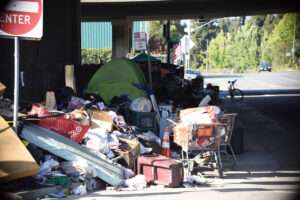
Homeless encampment under an overpass in Oakland, California.
Homeless encampment (Oakland, CA). (Blackkango | Dreamstime.com)


Homelessness has been in the news a great deal lately, and become a major focus of public debate. I've written previously about how homelessness is greatly exacerbated by exclusionary zoning rules and other restrictions that make it difficult or impossible to build new housing in response to demand. Much evidence indicates that the expansion of homelessness in recent years is primarily a problem of housing availability, rather than increasing incidence of social problems like mental illness, alcoholism, or drug abuse.

A new draft paper by Mercatus Center housing expert Salim Furth has a helpful discussion of how exclusionary zoning exacerbates homelessness. It does so by making it difficult for marginally homeless people to find housing with friends and relatives, which many could otherwise do even if they could not afford housing on their own:

In the United States, the primary definition of homelessness includes those who sleep outdoors or in a tent, car, or recreational vehicle, or who are in a homeless shelter or transitional housing provided by a homeless services agency. This often differs from the colloquial use of the phrase, which connotes a vivid human portrait: a person who has lived on the street or in shelters for a long time, who spends his days begging or loafing, who likely suffers indignities, abuses, ill health, and toilet insecurity, and likely has mental illness, a drug addiction, or both.

In truth, many of the people who a passerby might call homeless aren't homeless at all – they spend their nights in a home (perhaps an imperfect one) while spending their days in public. And many of the homeless are undetectable as such in daily life.

The American cities with the highest housing prices have the worst homelessness problems. YIMBY (Yes in My Backyard) advocates highlight this correlation to argue for policies that increase housing supply. But, when you think about it a bit, it's not clear exactly how high rent contributes to homelessness. It's not like $800 per month apartments are any more affordable to most homeless people than $1,000 per month apartments. And homelessness is frequently associated with mental health or drug abuse problems. This is why non-YIMBY progressives insist that only more generous vouchers or subsidies can help and non-YIMBY conservatives argue that only behavioral change can help by tackling alcoholism, drug abuse, and mental health problems.

The stories and data in this essay show the missing link between homelessness and housing costs: people without money who avoid becoming homeless do so mostly by staying with others, usually their own parents. This happens outside the formal housing market. But parents' and others' ability to offer space is limited by what they can afford in the market. Where housing costs are moderate, friends and family have bigger homes. When they are higher, friends and family don't have space to share, and this is often what puts a vulnerable person onto the streets.

Furth presents extensive evidence that a large proportion of the homeless are in this position. They are generally sane and able-bodied people who could find housing with friends or relatives, if housing were cheaper. Some could potentially live with roommates. "YIMBY" policies that make it easier to build new housing in response to demand could alleviate this problem.

The causal mechanism Furth highlights is highly intuitive. Unless you've been wealthy all your life, you probably have taken advantage of free housing with friends and relatives yourself, or know people who have done so. If, during that period in your life, you instead had to live in the streets, you would likely have been far worse off. Exclusionary zoning closes off this type of lifeline for a substantial population of relatively poor people, pushing them into homelessness.

Getting housing could also make it easier for these people to look for and find jobs, and - where necessary - improve job skills. Job-hunting and education are easier to do if you're not sleeping on the street! That, in turn, can make it easier for marginally homeless people to increase their incomes, thereby benefiting both themselves and the broader society.

In our recent Texas Law Review article, Josh Braver and I explain why exclusionary zoning violates the Takings Clause of the Fifth Amendment, which requires government to pay "just compensation" when it takes private property. There, and in an Atlantic article, we explain how litigation should be combined with political action to break down zoning restrictions on housing construction.

As Furth and I both recognize, increasing the availability of housing may not do much for homeless people who have severe physical or mental disabilities, or who engage in serious alcohol or drug abuse. But reducing the overall homeless problem could still help these people indirectly, by freeing up resources such as shelter space for them.  And helping the able-bodied homeless is a great good in itself, even if it doesn't fully solve all homelessness issues.

Does Your Law Review's Cite-Checking Process Include Retraction Checking for Cited Scientific Articles?

It's analogous to checking whether a case has been overruled, or whether a statute has been repealed.

|

The UCLA Law Library has a new guide by librarian Lynn McClelland with recommendations on that, Understanding Scholarly Metrics and Retractions for Law Students. Let me know, please, what law reviews that you've worked with have done along these lines.

Likewise, if your law firm often cites scientific articles (social, physical, medical, or otherwise), please let me know if you have a procedure for checking whether there the cited articles have been retracted.

More