The Volokh Conspiracy

Mostly law professors | Sometimes contrarian | Often libertarian | Always independent | Est. 2002

The Volokh Conspiracy

Free Speech

"Speaking with and in Favor of a Foreign Adversary Is One Thing. Allowing a Foreign Adversary to Spy on Americans Is Another"

|

From Justice Gorsuch's opinion concurring in the judgment (and thus agreeing with the majority's result without signing on to its reasoning) in TikTok, Inc. v. Garland:

We have had a fortnight to resolve, finally and on the merits, a major First Amendment dispute affecting more than 170 million Americans. Briefing finished on January 3, argument took place on January 10, and our opinions issue on January 17, 2025. Given those conditions, I can sketch out only a few, and admittedly tentative, observations.

[1.] [T]he Court rightly refrains from endorsing the government's asserted interest in preventing "the covert manipulation of content" as a justification for the law before us. One man's "covert content manipulation" is another's "editorial discretion." Journalists, publishers, and speakers of all kinds routinely make less-than-transparent judgments about what stories to tell and how to tell them. Without question, the First Amendment has much to say about the right to make those choices. It makes no difference that Americans (like TikTok Inc. and many of its users) may wish to make decisions about what they say in concert with a foreign adversary.

"Those who won our independence" knew the vital importance of the "freedom to think as you will and to speak as you think," as well as the dangers that come with repressing the free flow of ideas. Whitney v. California (1927) (Brandeis, J., concurring). They knew, too, that except in the most extreme situations, "the fitting remedy for evil counsels is good ones." Too often in recent years, the government has sought to censor disfavored speech online, as if the internet were somehow exempt from the full sweep of the First Amendment. See, e.g., Murthy v. Missouri (2024) (Alito, J., dissenting). But even as times and technologies change, "the principle of the right to free speech is always the same." Abrams v. United States (1919) (Holmes, J., dissenting).

[2.] I harbor serious reservations about whether the law before us is "content neutral" and thus escapes "strict scrutiny." More than that, while I do not doubt that the various "tiers of scrutiny" discussed in our case law—"rational basis, strict scrutiny, something(s) in between"—can help focus our analysis, I worry that litigation over them can sometimes take on a life of its own and do more to obscure than to clarify the ultimate constitutional questions.

Read More

Free Speech

The TikTok Majority Opinion

|

Here's a quick summary of the unsigned majority opinion (called a "per curiam"), joined by all the Justices except Justice Gorsuch (who concurred in the result, but with a different analysis) and (in part) Justice Sotomayor:

[1.] The Court expresses some doubt about whether the law triggers First Amendment scrutiny at all. The Court views the law as regulating "corporate control" over TikTok, rather than restricting speech directly, which makes it unclear (in the Court's view) whether the law should be treated as a "direct regulation" of expression.

The Court recognizes that " the Act's prohibitions, TikTok-specific designation, and divestiture requirement 'impose a disproportionate burden upon' their First Amendment activities," and acknowledges that "an effective ban on a social media platform with 170 million U. S. users certainly burdens those users' expressive activity in a non-trivial way." But while the law "will burden various First Amendment activities, including content moderation, content generation, access to a distinct medium for expression, association with another speaker or preferred editor, and receipt of information and ideas,"

[A] law targeting a foreign adversary's control over a communications platform is in many ways different in kind from the regulations of non-expressive activity that we have subjected to First Amendment scrutiny. Those differences—the Act's focus on a foreign government, the congressionally determined adversary relationship between that foreign government and the United States, and the causal steps between the regulations and the alleged burden on protected speech—may impact whether First Amendment scrutiny applies.

But after all that, the Court still "assume[s] without deciding that the challenged provisions fall within this category and are subject to First Amendment scrutiny," because it concludes that they would pass the proper scrutiny (see below).

Read More

All The Things TikTok v. Garland Did Not Decide

CTRL-F the decision for "need not" and "assume"

|

Today, the Court affirmed the D.C. Circuit in TikTok v. Garland. In a fairly short period, the Justices mustered a twenty page per curiam decision. Justice Sotomayor wrote a brief concurrence, in which she disagreed with the Court on burdened protected speech. Justice Gorsuch concurred in judgment, disagreeing with the Court on whether the law was content neutral. My prediction of the "administrative injunction" did not come to pass. The opinion is fairly tight. It reads like Roberts and/or Kagan wrote it. I suspect they started on this before briefing concluded.

What struck me about the decision was how much the Court did not decide. One trick is to search the case for hedge words like "need not" and "assume."

Here are a few highlights.

First, the Court announces a ticket good for one ride: like Bush v. Gore, this case is limited to its unique circumstances. No ruling for the ages here:

As Justice Frankfurter advised 80 years ago in considering the application of established legal rules to the "totally newproblems" raised by the airplane and radio, we should take care not to "embarrass the future." Northwest Airlines, Inc. v. Minnesota, 322 U. S. 292, 300 (1944). That caution is heightened in these cases, given the expedited time allowed for our consideration. [FN1] Our analysis must be understood to be narrowly focused in light of these circumstances.

[FN1] Applications for an injunction pending review were filed on December16, 2024; we construed the applications as petitions for a writ of certiorari and granted them on December 18, 2024; and oral argument was held on January 10, 2025.

Roberts likes citing Frankfurter, hence my suspicion above.

Second, the Court doesn't actually decide if the law triggers heightened review.

This Court has not articulated a clear framework for determining whether a regulation of non-expressive activity that disproportionately burdens those engaged in expressive activity triggers heightened review. We need not do so here. We assume without deciding that the challenged provisions fall within this category and are subject to First Amendment scrutiny.

Justice Sotomayor would have resolved the First Amendment isue:

I join all but Part II.A of the Court's per curiam opinion.I see no reason to assume without deciding that the Act implicates the First Amendment because our precedent leavesno doubt that it does.

No one else joined Sotomayor on this point. We cannot assume that everyone else joined the per curiam opinion, but that is a good assumption in this case.

Third, the Court finds that the statute, as applied to TikTok, is "facially content neutral." But the Court declines to consider an exemption in the statute that does not apply to TikTok, because this is only an as-applied challenge:

Petitioners argue that the Act is content based on its face because it excludes from the definition of "covered company" any company that operates an application "whose primary purpose is to allow users to post product reviews, business reviews, or travel information and reviews." We need not decide whether that exclusion is content based. The question before the Court is whether the Act violates the First Amendment as applied to petitioners. To answer that question, we look to the provisions of the Act that give rise to the effective TikTok ban that petitioners argue burdens their First Amendment rights. The exclusion for certain review platforms, however, applies only to the general framework for designating applications controlled by "covered compan[ies]," not to the TikTok-specific designation.§§2(g)(3)(A)–(B). As such, the exclusion is not within the scope of petitioners' as-applied challenge.

Justice Gorsuch really likes talking about Brandeis and Holmes:

But the question we face today is not the law's wisdom, only its constitutionality. Given just a handful of days afteroral argument to issue an opinion, I cannot profess the kindof certainty I would like to have about the arguments andrecord before us. All I can say is that, at this time and under these constraints, the problem appears real and the response to it not unconstitutional. As persuaded as I am ofthe wisdom of Justice Brandeis in Whitney and Justice Holmes in Abrams, their cases are not ours. Speaking with and in favor of a foreign adversary is onething. Allowing a foreign adversary to spy on Americans is another.

Justice Gorsuch is not so sure the law is content neutral, and has doubts about scrutiny altogether:

Third, I harbor serious reservations about whether the law before us is "content neutral" and thus escapes "strict scrutiny." More than that, while I do not doubt that the various "tiers of scrutiny" discussed in our case law—"rational basis, strict scrutiny, something(s) in between"—can help focus our analysis, I worry that litigation overthem can sometimes take on a life of its own and do more to obscure than to clarify the ultimate constitutional questions. Riddle v. Hickenlooper, 742 F. 3d 922, 932 (CA102014) (Gorsuch, J., concurring).

In Bruen, the Court wrote that Free Speech cases follow a "text and history" approach. That was news to me! "Text and history" is not mentioned anywhere in this decision.

Fourth, the Court limits is holding based on the vast size of TikTok's data-collection powers:

While we find that differential treatment was justified here, however, we emphasize the inherent narrowness ofour holding. Data collection and analysis is a common practice in this digital age. But TikTok's scale and susceptibility to foreign adversary control, together with the vast swaths of sensitive data the platform collects, justify differential treatment to address the Government's national security concerns. A law targeting any other speaker would by necessity entail a distinct inquiry and separate considerations. On this understanding, we cannot accept petitioners' call for strict scrutiny. No more than intermediate scrutiny is in order.

Fifth, the Court does not consider any information in the classified record:

Our holding and analysis are based on the public record, without reference to the classified evidence the Government filed below.

Justice Gorsuch's concurrence praises the Court for not going down this road:

Second, I am pleased that the Court declines to consider the classified evidence the government has submitted to us but shielded from petitioners and their counsel. Ante, at 13, n. 3. Efforts to inject secret evidence into judicial proceedings present obvious constitutional concerns. . . . dissenting). But as the Court recognizes, we have no business considering the government's secret evidence here.

Sixth, the Court declines to consider China's ability to control TikTok's algorithm, to manipulate content. Instead, the Court rules solely based on the data collection justification:

Petitioners have not pointed to any case in which thisCourt has assessed the appropriate level of First Amendment scrutiny for an Act of Congress justified on both content-neutral and content-based grounds. They assert, however, that the challenged provisions are subject to—and fail—strict scrutiny because Congress would not have passed the provisions absent the foreign adversary control rationale. We need not determine the proper standard for mixed-justification cases or decide whether the Government's foreign adversary control justification is content neutral. Even assuming that rationale turns on content, petitioners' argument fails under the counterfactual analysis they propose: The record before us adequately supports the conclusion that Congress would have passed the challenged provisions based on the data collection justification alone.

Justice Gorsuch also praises the Court for not going down this road. He fears any sort of government control over the algorithm can pave the way to censorship:

First, the Court rightly refrains from endorsing the government's asserted interest in preventing "the covert manipulation of content" as a justification for the law before us. Brief for Respondent 37. One man's "covert content manipulation" is another's "editorial discretion." . . . "Those who won our independence" knew the vital importance of the "freedom to think as you will and to speak as you think," as well as the dangers that come with repressing the free flow of ideas. Whitney v. California, 274 U. S. 357, 375 (1927) (Brandeis, J., concurring). They knew, too, that except in the most extreme situations, "the fitting remedy for evil counsels is good ones." Ibid. Too often in recent years, the government has sought to censor disfavored speech online, as if the internet were somehow exempt from the full sweep of the First Amendment. See, e.g., Murthy v. Missouri, 603 U. S. 43, 76–78 (2024) (ALITO, J., dissenting). But even as times and technologies change, "the principle of the right tofree speech is always the same." Abrams v. United States, 250 U. S. 616, 628 (1919) (Holmes, J., dissenting).

What happens next? Biden has already announced he will not enforce the law. Trump apparently will sign an executive order declining to enforce the law as well. So was there any point to this entire exercise?

Free Speech

Banning Rideshare Driver from Airport for Telling Another Driver to "Move His 'Ass'" May Violate First Amendment

|

From Tuesday's decision by Chief Judge Richard Myers in Glover v. RDU Airport Authority (E.D.N.C.):

Plaintiffs allege that Plaintiff Glover, a rideshare driver who regularly serviced the Raleigh-Durham International Airport ("Airport"), sought assistance from Defendant concerning a male rideshare driver "who had been stalking, harassing, and intimidating her." One of Defendant's officers told Plaintiff Glover that there was nothing he could do about the harassment. Plaintiff Glover attempted to fill out a statement regarding the male driver's actions but was threatened (by another of Defendant's officers) with a lifetime ban if she submitted the statement to Defendant. Instead of completing the statement, Plaintiff Glover warned the male driver that she had reported his conduct to Defendant.

At that point, the male driver complained to Defendant about a months-old incident where Plaintiff Glover had told the male driver to move his "ass" in the Airport's rideshare staging lot if he did not "like" where he was "parked." After receiving that complaint from the male driver, Defendant allegedly banned Plaintiff Glover from the Airport's property for life, and admitted that the ban was due to the male driver's report that she said "a curse word."

Read More

Free Speech

Free Speech and Private Power: No Decision About Speaker- and Content-Based Protections

|

[I am serializing my short Harvard Law Review Forum essay titled "Free Speech and Private Power", responding to the Harvard Law Review's publication of Evelyn Douek & Genevieve Lakier's excellent new article, Lochner.com? I actually agree with much of what Douek & Lakier say, but offer a somewhat different perspective on the matter, mostly asking what the Court's recent cases mean going forward, rather than trying to critique them.]

The Florida law in Moody didn't ban all removals by platforms: It banned only removal of materials posted by political candidates and journalistic organizations, as well as material about political candidates. The Texas law covered speakers and topics generally, but banned only viewpoint discrimination, and not viewpoint-neutral content discrimination, and excluded expression that "is the subject of a … request from an organization with the purpose of … protecting survivors of sexual abuse from ongoing harassment." Likewise, even bans on viewpoint discrimination in direct messaging would presumably need to have some exclusions for spam, and determining what is spam may sometimes involve content judgments.

Would such rules themselves be viewed as impermissibly content-based? The Court left this question unsettled. The Court did not, for instance, resolve whether the laws should be judged under "strict or intermediate scrutiny," because it concluded that any restrictions on the platforms' newsfeeds—their "curated compilation[s]"—would fail even intermediate scrutiny.

Nor do the Court's precedents resolve the issue. To be sure, laws that restrict speech are generally subject to strict scrutiny if they are content-based, even if they are viewpoint-neutral. But the Court has never decided how courts should review laws that selectively protect speech from private restrictions, as many laws do.

Read More

Free Speech

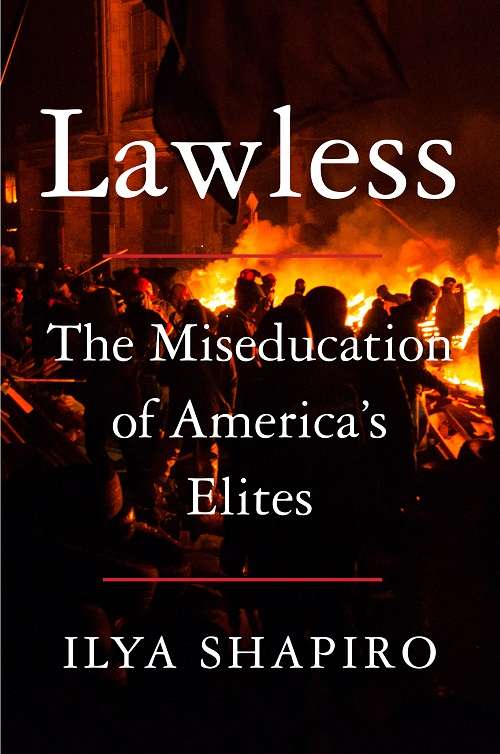
Lawless V: Where Do We Go from Here?

There are ways to reform, but it won't be easy.

|

This isn't rocket science. University officials know how to set campus culture. Whether it's entrepreneurship, public service, environmental consciousness, or anything else, they instill values in their students all the time. It wouldn't be that hard to do with commitments to academic freedom, intellectual diversity, civil discourse, and returning to the core educational mission of truth-seeking and knowledge-creation. Fixing campus cultures seems like a management issue.

Indeed, the University of Chicago has largely avoided cancel-culture issues even in the last five years of campus upheaval. Former president Robert Zimmer was a rarity among his peers in standing up to all sorts of moral panics, most notably in defending geophysics professor Dorian Abbot's right to criticize the university's affirmative action programs.

UChicago's law school, which is where I got my JD, has similarly avoided shoutdowns and the like. For example, when a student facilitated the disruptive protest of an event regarding Israel in April 2019, he was effectively expelled and there haven't been any incidents since.

Creating such an environment requires intentional effort, which is to say: leadership. Dean Thomas Miles gave a presentation to alumni in May 2023 that explained the formula. First, he set out the "community priorities," which consisted of: (1) imparting the law school's core values (academic rigor, free inquiry, intellectual curiosity, and dialogue), (2) fostering a climate in which students build community and class affinity, (3) encouraging professionalism and respectful communication, (4) fostering a sense of belonging, and (5) promoting wellness and resilience. Miles had a separate slide on the freedom of expression, in which he discussed introducing students to the Chicago Principles (on which more shortly). Miles noted that the faculty works hard to "educate our community," including with orientation exercises and the practice of model discourse, as at roundtables where professors debate controversial issues.

Read More

SCOTUS May Announce Opinions, But Will Not Take the Bench.

Will TikTok ruling come at 10 ET?

|

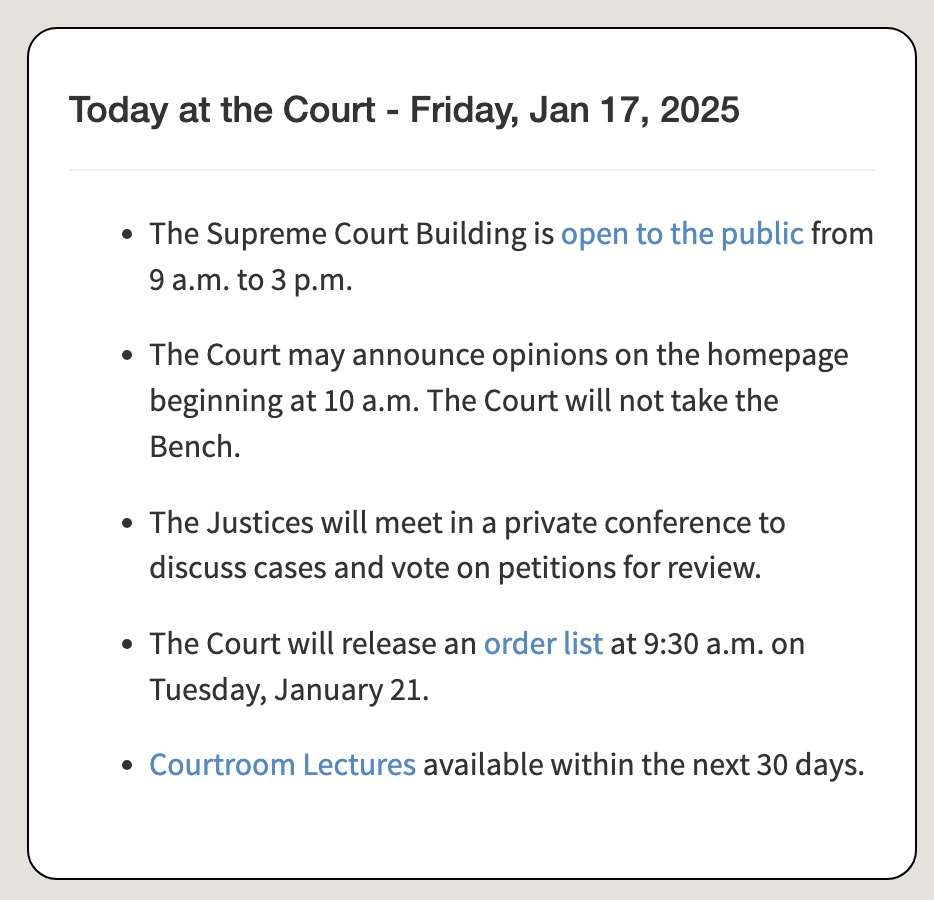
I just noticed an unusual notation the Supreme Court's website for Friday, January 17: "The Court may announce opinions on the homepage beginning at 10 a.m. The Court will not take the Bench."

The last time I saw this notation was on March 3, 2024. The following day, the Court announced Trump v. Anderson. It seems this is the notation for big cases, decided on an irregular schedule, which the Justices want not part in announcing in person.

It looks like we may get some ruling in the TikTok case. What will it be? Perhaps an administrative injunction? A summary affirmance? An actual ruling on the merits, written in a week? We will see soon enough.

Comparing The Dates of Tom Goldstein's SCOTUS Oral Arguments And The Dates In His Indictment

According to the government, Goldstein was very busy before and after his arguments at the Court.

|

Earlier today, I wrote about the allegations in the Tom Goldstein indictment. Here, I will compare some of the dates in the indictment with the dates of Tom Goldstein's oral arguments before the Supreme Court. Of course, the allegations in an indictment are just that--allegations. Throughout this post, I will assume the government's claims are correct, but all of these allegations would need to be proven in Court.

The indictment concerns Goldstein's conduct between 2016 and 2021. During that period, according to Oyez, he argued seven cases before the Supreme Court. This represents a drop-off in the number of oral arguments from earlier in his career. He had consistently argued multiple cases per term: 4 in 2003, 3 in 2004, 2 in 2005, 3 in 2008, 2 in 2011, 3 in 2012, 2 in 2013, 4 in 2014, and 3 in 2015.

In April 2017, Goldstein had two arguments in the span of eight days.

Leading up to this period, the indictment alleges:

Between late 2016 and early February 2017, GOLDSTEIN engaged in a series of heads-up poker matches in Los Angeles against a California businessman who had made millions in the real estate market ("California Businessman-3"). In those matches, GOLDSTEIN suffered net losses of over $9.5 million dollars. Because no one had staked or bought a piece of him in the matches, GOLDSTEIN was responsible for paying his entire losses to California Businessman-3 after each losing match. . . ,

In early February 2017, GOLDSTEIN engaged in a scheme to divert to his Gambling Account a $250,000 legal fee owed by Law Firm-1 to G&R in connection with G&R's Supreme Court briefing in a securities class-action case. To divert the fee, GOLDSTEIN exchanged a series of emails on or about February 1, 2017, with a named partner of Law Firm-1, culminating in an agreement that Law Firm-1 would pay $500,000 to G&R over the course of the various phases of the Supreme Court appellate process, including, at GOLDSTEIN's insistence, an initial $250,000 to be paid by Law Firm-1 "immediately." . . .

In early March 2017, GOLDSTEIN continued playing the series of heads-up poker matches with California Businessman-3. To help satisfy a $500,000 poker debt stemming from an early March 2017 match against California Businessman-3, GOLDSTEIN contacted Law Firm-2 and asked a named partner at the firm whether he was interested in "investing'' in one of GOLDSTEIN's poker matches against California Businessman-3. In connection with his request, GOLDSTEIN sent an email to the Law Firm-2 partner on or about March 6, 2017, containing a link to an online gambling-related forum, which included a discussion thread in which certain poker aficionados had commented tliat California Businessman-3 was a poor poker player. When sending the email, GOLDSTEIN did not reveal to the Law Firm-2 partner that, over the preceding months, he had already lost approximately $10 million to California Businessman-3.

Even the best Supreme Court advocates, with 100% focus, will struggle arguing against Paul Clement and Neal Katyal. I can't fathom going to the Court with this sort of stuff going on about a month before the argument.

Goldstein's next argument was in November 2017.

Read More

McGinnis and Rappaport on Gienapp: A "Frustrating Book" That "Fails to Take Seriously … The Constitution itself."

"Jonathan Gienapp seeks to use the historian’s tools to challenge originalism, but in the process he neglects the text of the Constitution itself."

|

Recently, Jonathan Gienapp published a new book that challenges originalism as inconsistent with how the Framers understood the Constitution. The title says it all: "Against Constitutional Originalism." The book has already received extremely favorable reviews. Many of those positive reviews are from people who are not themselves constitutional originalists. For a contrary opinion, I would recommend a critical commentary from John McGinnis and Mike Rappaport, who approach the book from the perspective of originalists.

Here is the introductory paragraph:

With his new book Against Constitutional Originalism, Stanford historian Jonathan Gienapp has garnered effusive praise from those eager to undermine the originalist enterprise. For those attracted to the originalist project, however, the book is unlikely to persuade. On the contrary, it highlights the persistent difficulties historians face when they venture into constitutional interpretation. Gienapp neglects the most primary of sources—the Constitution—its text, structure, and self-referential nature. He compounds this oversight by privileging mere disagreement among historical actors over rigorous evaluation of their arguments, a hallmark of legal reasoning. He also confuses objections to originalism as an interpretive method with objections to particular readings of the original meaning. Finally, Gienapp often fails to situate the Constitution in the transformative historical moment of its creation, particularly the Founders' disillusionment with the unwritten British constitution. These deficiencies weaken his case and, ironically, reinforce the intellectual strength of originalism, which at its best rigorously takes account of text and context.

One example about Hamilton stuck out:

Gienapp correctly observes that some individuals in the runup to drafting and ratification believed that a constitution extended beyond the document itself. But the Philadelphia Convention rejected that understanding. Once the Constitution was ratified, advocates and jurists argued primarily from its text. Gienapp's treatment of Alexander Hamilton is emblematic of this mistake. He cites Hamilton's famous line—"the sacred rights of mankind are not to be rummaged for among old parchments"—to suggest skepticism about written constitutions. Yet Gienapp omits critical context: Hamilton made this remark in 1775, long before the drafting of the Constitution, and as part of an argument against British parliamentary supremacy. By the time of the Founding, Hamilton's views, like those of his contemporaries, had evolved. As a Federalist author and Secretary of the Treasury, Hamilton embraced the Constitution as a written, fixed standard. Gienapp's omission here is not merely an oversight; it exemplifies his tendency to employ understandings from much earlier or later than the Constitution's enactment.

By contrast, Gienapp does not discuss things Hamilton said after our Constitution was ratified:

The weight of evidence from the Constitution's proponents also supports the inferences from the document itself that it is legal. For instance, in 1791 Alexander Hamilton wrote the Constitution should be interpreted "according to the usual [and] established rules of construction," certainly implying he regarded it as a legal document. While Gienapp does quote from Hamilton's opinion on the bank, he never discusses this observation, which seems much more relevant to the nature of constitutional interpretation than what Hamilton said in 1775.

To a legal historian, it may not matter much what Hamilton said, and when he said it. But for an originalist, these details really do matter.

Here is the conclusion:

Ultimately, Gienapp's Against Constitutional Originalism is a frustrating book. It lectures originalists on the importance of history but fails to take seriously the primary historical artifact at issue: the Constitution itself. Gienapp ignores the historians' duty to weigh conflicting evidence, often favoring provocative claims over measured judgment. Most surprisingly, he also neglects the Revolutionary experience that led the founders to create, in the words of Justice William Paterson, a fundamental written law of "exactitude and precision" on which to found a new nation.

I don't think any one book can settle the debate about originalism. But I think the sustained attacks of this doctrine is, whether critics admit it or not, a reflection of the strength of originalism.

Biden Will Not Enforce TikTok Ban For Final 36 Hours Of His Presidency

Anyone remember the Take Care Clause? And way to undermine your SG!

|

The TikTok ban goes into effect at 12:01 AM on January 19, 2025. President Biden has the power to grant an extension if certain conditions are met, though it doesn't seem like that will happen. Instead, President Biden has simply announced that he will not enforce the law for the final 36 hours of this presidency. Or more precisely, the Biden Administration will not impose any fines on companies that allow TikTok to operate. Instead, they will let Trump deal with it.

"Given the timing of when it goes into effect over a holiday weekend a day before inauguration, it will be up to the next administration to implement," a White House official said.

What a mess. For starters, what about the Take Care Clause? The President has a duty to take care that the laws are faithfully executed. The Solicitor General has vigorously argued that the law is constitutional, and essential to national security. Yet, Biden has simply told his administration to not enforce the law, full stop. What plausible justification is there for this decision? I eagerly await the return of the Take Care Blog.

Trump is not President yet. The buck stops with Biden until January 20. But President Biden's capitulation on the issue is a recognition that Trump is really in charge. Again, elites mocked the Trump amicus brief, but it accurately described the state of play.

This video is an example. A reporter asked Biden who takes credit for the ceasefire in the Gaza Strip, him or Trump. Biden could only muster, "Is that a joke?"

More pressingly, this decision undermines the Solicitor General's argument to the Supreme Court. The government defended the ban as a necessary means to protect Americans from a foreign adversary. But when push comes to shove, the President simply doesn't care. China can keep on doing whatever it is they are doing. Could it be that the government's arguments in defense of the TikTok ban are, as they often are, exaggerated?

Where does all this news leave the Court? Do the Justices really want to write a landmark First Amendment decision in a few days for a law that the President won't even enforce? I am skeptical. I think an administrative injunction is looking like a pretty good option now. I suggested this option before argument, and Justice Alito raised the possibility during argument. The Court can just put the law on hold and let Trump make a deal.

Free Speech

Bill Maher's Saying Trump "Might Be" "Fucking" Republican Activist Laura Loomer Might Be Defamation of Loomer

A judge lets Loomer's defamation claim against Maher and HBO go forward.

|

An excerpt from today's decision in Loomer v. Maher, by Judge James Moody (M.D. Fla.):

[According to] the Complaint[,] Plaintiff Laura Loomer is a "well-known conservative investigative journalist." Loomer is also a "conservative, Republican, Jewish female activist." In the past, Loomer has worked for Canadian news publisher The Rebel Media as well as Project Veritas. Loomer also has her own media company called Illoominate Media, which operates in this circuit. Loomer was a Republican candidate for Florida's 11th congressional district in 2022. Defendant Bill Maher is the host of "Real Time with Bill Maher," a weekly hour-long television program that airs on Defendant Home Box Office, Inc.'s network ("HBO")….

[T]he Complaint alleges that on a September 13, 2024, episode of Maher's show "Real Time," which HBO broadcasted nationally and internationally, Maher made and published the following false, malicious, and defamatory statement of and concerning Loomer:

I think maybe Laura Loomer's in an arranged relationship to affect the election because she's very close to Trump. She's 31, looks like his type. We did an editorial here a few years ago…it was basically, who's Trump fucking? Because I said, you know, it's not nobody. He's been a dog for too long, and it's not Melania. I think we may have our answer this week. I think it might be Laura Loomer.

According to the Complaint: "In this statement, Defendant Maher makes the false statement that Ms. Loomer is in a sexual relationship with Donald Trump, who is a married man." Thus, Defendant Maher "falsely and maliciously accused Ms. Loomer of having committed adultery with Donald Trump."

Read More

Tom Goldstein Was Indicted on Tax Evasion Charges

A Real Farewell to SCOTUSBlog?

|

Last year I wrote a post title A Requiem for SCOTUSBlog. Publisher Tom Goldstein had announced that the site would be scaling back its coverage of the Court. SCOTUSBlog remains functional, but it is nowhere near as comprehensive as it used to be.

Today's news, however, may signal a real farewell to SCOTUSBlog.

Tom Goldstein was indicted in the U.S. District Court for the District of Maryland on charges of tax evasion, willful failure to pay taxes, false statements, and other charges. The indictment contains some stunning allegations (of course Goldstein remains innocent until proven guilty):

6. In addition to the legal work he performed at G&R [Goldstein & Russell], GOLDSTEIN was also an ultrahigh-stakes poker player, frequently playing in matches or series of matches in the United States and abroad involving stakes totaling millions, and even tens of millions, of dollars. GOLDSTEIN's poker activities included both "ring games" (which typically involved five or more players) as well as "heads-up" matches (which were two-player matches). . . .

10. To make and receive payments related to his gambling and certain other private activities between 2016 and 2022, GOLDSTEIN typically used a personal bank account (''the Gambling Account") over which he exercised exclusive control and authority, including the authority to effectuate transfers. The G&R firm managers did not have access to the Gambling Account. By contrast, GOLDSTEIN permitted the G&R firm managers to share authority with respect to the G&R bank accounts, as well as a different personal bank account for GOLDS1EIN and his wife, through which the G&R firm managers, as part of their official duties, paid certain of GOLDSTEIN's personal bills. . . .

24. Between 2016 and 2022, GOLDSTEIN engaged in a scheme to evade the assessment of taxes, file false tax returns, and fail to pay his tax obligations when they were due.

The allegations go on.

I do not have much to say about these substantive offenses. But I worry that this news may spell the end of SCOTUSBlog. Indeed, the indictment will seek criminal forfeiture of "any property, real or personal, which constitutes or is derived from proceeds traceable to the offenses." Does SCOTUSBlog fall in that category? If so, I hope someone else acquires SCOTUSBlog. It would be a shame to lose this valuable resource.

Update: Shortly after my post went up, I received a statement from a rep for Goldstein:

Hello - Reaching out on behalf of Tom Goldstein, I saw your story. Here is a statement attributed to John Lauro of Lauro & Singer and Christopher Kise of Continental, trial counsel for Mr. Goldstein:

"Mr. Goldstein is a prominent attorney with an impeccable reputation. We are deeply disappointed that the government brought these charges in a rush to judgment without understanding all of the important facts. Our client intends to vigorously contest these charges and we expect he will be exonerated at trial."

USA Today: "Liberals owe Justice Barrett an apology"

What do conservatives owe Justice Barrett's supporters?

|

The USA Today published an essay titled "Liberals owe Justice Barrett an apology. She's clearly not in Trump's pocket." The subtitle is "Trump's most 'controversial' Supreme Court nominees – Barrett and Kavanaugh – are among the most independent of the conservative majority. Democrats would be better served by understanding that."

Here are some excerpts:

Barrett, who cast the surprise deciding vote against Trump, has been criticized by Democrats, yet she continues to rule independently of the conservative majority. In this case, her decision should dispel the myth that she is somehow beholden to Trump. . . .

As it turns out, she has proved to be one of the most willing of the court's conservatives to deviate from the supposed extreme MAGA court, particularly in matters related to Trump. . . .

Even beyond this, Barrett has repeatedly demonstrated she is not beholden to the man who appointed her to the court. She has frequently departed from the pack of the conservative majority to rule against Trump.

Democrats can criticize Barrett's form of jurisprudence all they want, but the attacks on her character during her nomination were way over the line.

Her decisions since then have proved a commitment to the law. . . .

Both of Trump's most "controversial" Supreme Court nominees ‒ Barrett and Kavanaugh ‒ are among the most independent of the conservative majority. Democrats would be better served by understanding that.

While Democrats are free to disagree with her jurisprudence, Justice Barrett is as favorable to the liberals on the court as Democrats could wish for. Democrats should regret how they treated her during her confirmation.

And it's not just Trump cases. Justice Barrett, and to a lesser extent Justice Kavanaugh, have ruled against Trump, and conservative positions more broadly, in contrast with Justices Thomas, Alito, and Gorsuch. I've made this point in more writings than I can recall.

In 2018, as the left was trying to destroy nominee Kavanaugh (now "Kavanaugh" is a verb akin to "Bork") I wondered if they really wanted someone else. Had Kavanaugh dropped out, Trump almost certainly would have nominated someone to Kavanaugh's right, who would have been confirmed far more easily.

With Justice Barrett's super-fast nomination, there was not nearly enough time to destroy her. Indeed, her scanty record probably made it harder to manufacture any sort of scandal. Yet the left savaged her as a Christian nationalist who would force all women to be handmaidens, or something like that. But again, I thought to myself, if it were not Barrett, it would be someone to Barrett's right. (It is true enough that a replacement could not have been confirmed before the election, but there was plenty of time between election day and January 3.)

With the benefit of hindsight, liberals absolutely owe an apology to Justice Barrett and Justice Kavanaugh. As I've said many times on the stump, liberals should be grateful Trump picked those two jurists. And if any members of Indian tribes ever spoke out against Justice Gorsuch, they too should apologize. And while we're on the topic, every Democrat who opposed John Roberts's nomination in 2005 should make a formal apology. Where's John Kerry?! George W. Bush's most enduring decision was almost an accident of history. Had Rehnquist held on a few more months, we very likely may have had a Chief Justice Alito.

Finally, if liberals owe Justice Barrett an apology, what do conservatives owe Justice Barrett's supporters? How do we respond to those boosters who assured conservatives that Justice Barrett was "solid"? Or those who told us she would become the next Justice Scalia? If President Trump was told that Justice Barrett would be a free-thinking independent who practiced restraint, would he still have picked her? Did any of Barrett's backers recognize that Ruth Marcus could call Barrett a "pleasant surprise"?

I, for one, am surprised by very little that the Trump appointees have done. And I hope those lessons are learned for all future vacancies at the Supreme Court, and on the courts of appeals.

Free Speech

Interesting Obscenity Prosecution for Sending Sexually Themed Letter to Sender's 14-Year-Old Adopted Sister

|

From Tuesday's decision in U.S. v. Miller, by Fourth Circuit Judges Steven Agee, Marvin Quattlebaum, and Allison Rushing:

The record shows that while Miller was imprisoned in a state facility, he sent a sexually explicit letter [excerpted in relevant part on p. 2 of the Trial Brief -EV] to his adopted sister in which he described, in graphic detail, sexual acts he envisioned occurring between himself and his sister. At the time, Miller was thirty-eight years old and she was fourteen years old….

Miller was indicted for violating 18 U.S.C. § 1470, which prohibits "using the mail or any facility or means of interstate or foreign commerce" to "knowingly transfer[ ] obscene matter to another individual who has not attained the age of 16 years, knowing that such other individual has not attained the age of 16 years, or attempt[ing] to do so." … The jury convicted Miller, and … [t]he court then sentenced him to thirty-seven months' imprisonment, to run concurrently with the remainder of his state sentence, and to three years' supervised release….

The Fourth Circuit affirmed:

[T]he Court has recognized that printed words alone can be "obscene" and thus fall outside the First Amendment's protection. The Supreme Court requires balancing three prongs when determining whether something is obscene: First, we consider "whether 'the average person, applying contemporary community standards' would find that the work, taken as a whole, appeals to the prurient interest in sex." Appealing to prurient interest means that the material appeals to a "shameful or morbid interest in nudity, sex or excretion" or being "substantially beyond customary limits of candor in description or representation of such matters."

Read More

Free Speech

No First Amendment Problem with Police Department Allowing Pro-LGBTQ Uniform Patches But Rejecting Alternatives Police Officer Requested

|

The factual backstory, from an earlier District Court decision:

In approximately August 2017, defendant Edgardo Garcia, then the Chief of Police, created a Lesbian, Gay, Bisexual, Transgender, and Queer ("LGBTQ") Advisory Board at the SJPD…..  Concurrent with the creation of the advisory board, Chief Garcia created a LGBTQ Liaison Officer position within the SJPD…. In August 2019, as part of the region's celebration of Silicon Valley Pride Month, Chief Garcia raised a rainbow-themed LGBTQ pride flag in place of the City of San Jose flag on the flagpole outside SJPD headquarters.

On July 28, 2020, Chief Garcia issued official SJPD Memorandum #2020-33, introducing a rainbow-themed LGBTQ pride shoulder patch for the SJPD uniform.  On the same day, Chief Garcia also issued official SJPD Memorandum #2020-36, authorizing SJPD uniformed personnel to "permanently" wear either a Breast Cancer Awareness, Pride, or Military specialty patch on their uniforms "in lieu of the traditional shoulder patch."

On November 11, 2020, Mr. Sangervasi sent a memorandum to Chief Garcia titled, "Desecration of The Uniform by Memorandum #2020-33." Mr. Sangervasi's memorandum "detailed his intent to forever protect and defend the sacrosanct neutral and impartial visual appearance of The American Uniform" by submitting various "free speech patch and flag designs" that he wanted the SJPD to adopt. Mr. Sangervasi proposed patch designs featuring phrases and images such as "natural hetero-sexual pride," what appears to be Christian rosary beads encircling the traditional SJPD crest, and an image of the Christian archangel Saint Michael. He proposed flag designs featuring phrases and images including, for example, "father + mother = girls + boys," "white lives matter," and the confederate battle flag.

And the Ninth Circuit's analysis from Sangervasi v. City of San Jose, decided Tuesday by Judges Diarmuid O'Scannlain, Andrew Kleinfeld, and Barry Silverman:

Read More

More