The Volokh Conspiracy

Mostly law professors | Sometimes contrarian | Often libertarian | Always independent | Est. 2002

The Volokh Conspiracy

No Injunction in Electronic Privacy Information Center v. U.S. Office of Personnel Management

|

Today's opinion is here. I'm on the run, and can't add more right now, but I thought I'd pass it along.

UPDATE: Just got back, and thought I'd post this excerpt:

Plaintiffs allege that, since February 20, 2025, USDS [DOGE] personnel have obtained unprecedented access to information systems across numerous federal agencies, including Treasury and OPM. In this regard, Treasury operates the Bureau of Fiscal Service ("BFS"), which manages "a federal payment system that distributes nearly 90% of all federal payments, including Social Security benefits, tax refunds, and vendor payments." The BFS payment systems contain the sensitive personal data, such as full Social Security numbers, of "tens of millions of individuals." OPM manages the Enterprise Human Resources Integration ("EHRI") system, which is "responsible for maintaining the integrity of the electronic Official Personnel Folder (eOPF), which protects information rights, benefits, and entitlements of federal employees." The EHRI contains "Social Security numbers, dates of birth, salaries, home addresses, and job descriptions of all civil government workers, along with any disciplinary actions they have faced." Plaintiffs further assert that the BFS and EHRI systems and the information contained therein are typically protected by information security protocols mandated by the Federal Information Security Act of 2014 ("FISMA"), privacy protections established by the Privacy Act of 1974 (the "Privacy Act"), and supervision by trained personnel.

Plaintiffs allege that, at the direction of the DOGE Defendants, the Government Defendants have abandoned these safeguards by providing the DOGE Defendants with unlawful access to sensitive and protected data in the BFS and EHRI systems and allowing the data to be used for prohibited purposes. On January 27, 2025, after being confirmed as Secretary of the Treasury, Defendant Scott Bessent granted USDS personnel access to the BFS payment systems, allegedly giving USDS personnel the ability to "stop payments from the federal government."

As a consequence of granting this access, Plaintiffs assert that Secretary Bessent and the Treasury Department disclosed personal information contained in those systems to individuals not authorized by law to access them. After USDS personnel received access to the BFS systems, the official USDS/DOGE account on Twitter/X tweeted that it was "stopping improper payments." Similarly, Elon Musk, "an individual who is either Acting USDS Administrator or otherwise exercising substantial authority within USDS," stated on his personal Twitter/X account that "[t]he @DOGE team is rapidly shutting down these illegal payments." Plaintiffs further allege that, upon information and belief, USDS and Treasury personnel are unlawfully exfiltrating identifying information from the BFS payment systems and redisclosing the information to individuals not employed at Treasury, and that USDS is moving to "stop approved payments to federal contractors, charities that provide social services, and other federal departments."

Read More

Free Speech

Insulting E-Mail to Ex-Lawyer Wasn't Unprotected True Threat or Fighting Words

|

From JDT v. DMT, decided Wednesday by Michigan Court of Appeal Chief Judge Michael F. Gadola and Judges Thomas C. Cameron and Matthew S. Ackerman:

Respondent was placed on probation … after pleading no contest to two violations of a personal protection order ("PPO") that prohibited him from contacting petitioner, his ex-wife. As a condition of his probation, respondent was barred from engaging in "any assaultive, abusive, threatening, or intimidating behavior."

The instant probation violation stemmed from a series of e-mails respondent sent over the course of a month to attorney Wayne Crowe, who represented respondent in his divorce proceedings and the PPO proceeding. {According to respondent, the attorney-client relationship ended after Crowe resigned from his law firm without notifying respondent or moving to withdraw as respondent's counsel.}

In the initial e-mails, which were sent only to Crowe, respondent referred to him as a "pussy" and a "negligent piece of shit," accused Crowe of "ignor[ing] child abuse" and owing respondent money, and stated, "Fuck you." In respondent's subsequent e-mails, he copied various other people, including the county prosecutor, and referred to Crowe as a "fraud" and a "twat," accused Crowe of breaking the law, and accused the presiding judge of ignoring evidence of child abuse and parental alienation.

Some of the e-mails included photos, such as a photo of the presiding judge and his family at a judicial investiture and another of respondent's children, edited to appear as though they were in a jail cell. Crowe reported the emails to respondent's probation officer, who filed a warrant request alleging a technical probation violation for respondent's "threatening/intimidating behavior" toward Crowe.

At the probation violation hearing, Crowe testified that the e-mails made him fear for his safety. He also testified about several telephone calls in which respondent allegedly threatened him, although he could not recall the substance of those threats. After the presentation of evidence, respondent argued that the e-mails were constitutionally protected speech. The trial court disagreed, finding that respondent intended to threaten and intimidate Crowe, the e-mails caused Crowe to feel threatened and intimidated, and respondent's speech was not protected under the First Amendment because the language in his e-mails constituted fighting words. The trial court found respondent guilty of the probation violation [and] {sentenc[ed] him to five days' imprisonment and extend[ed] his probation for an additional six months}.

Read More

Judge Ho's Decision To Appoint Paul Clement In United States v. Adams (Updated)

This decision may not pan out for the court.

|

Today, Judge Ho (no, not that Judge Ho) appointed Paul Clement as an amicus in United States v. Adams.

Accordingly, to assist with its decision-making via an adversarial process, the Court exercises its inherent authority to appoint Paul Clement of Clement & Murphy PLLC as amicus curiae to present arguments on the Government's Motion to Dismiss. See Seila L. LLC v. Consumer Fin. Prot. Bureau, 591 U.S. 197, 209 (2020) ("Because the Government agrees with petitioner on the merits of the constitutional question, we appointed Paul Clement to defend the judgment below as amicus curiae. He has ably discharged his responsibilities.") . The Court expresses its gratitude to Mr. Clement for his service and will provide Mr. Clement a copy of this Order and the transcript from the February 19 conference.

From time-to-time, the federal government declines to defend a judgment in a pending Supreme Court case. In such cases, the Court will appoint an amicus to defend the judgment below. In other words, the amicus is not arguing his own personal views on the law, but is instead defending what the lower court did.

This approach makes some sense when there is an actual lower-court opinion. But this approach does not make sense in a trial court. The Court appointed Paul Clement to "present arguments on the Government's Motion to Dismiss." What kind of arguments? The order does not say. Maybe Clement will agree with the government. Maybe he won't. Who knows? In effect, the Court has appointed Paul Clement to give Paul Clement's opinion on the issue. Clement is a friend of the Court, to be sure. But unlike most amicus,  he is being elevated to the status of a party. I think Article III jurisdiction demands adversity, and appointing an amicus to argue his own views does not suffice for adversity. For all we know, Clement will agree with the government, and there still will be no adversity.

In candor, I am a bit befuddled by this decision. I know Judge Sullivan appointed an amicus in the Michael Flynn case. That is certainly a precedent, but not a particularly good one.

There is another element to discuss here. It is pretty obvious the Court appointed Clement to have a well-known conservative (potentially) argue against the Trump Administration. Judge Ho took a page from the Seila Law playbook, in which Circuit Justice Kagan selected Clement. I described Kagan's choice back in 2020:

That choice fell to Justice Kagan, the Circuit Justice for the Ninth Circuit. And she made a strategic decision. Rather than selecting someone like Deepak Gupta, a steadfast defender (and former employee) of the CFPB, she looked to the right, and picked Paul Clement. Yes, she selected the former Scalia clerk who (I suspect) agrees with fellow Scalia clerks, SG Francisco and Kannon Shanmugam.

At the time, I thought it was a shrewd move. Clement would be better served to hand-craft arguments for the conservatives on the bench, particularly Chief Justice Roberts, who may otherwise be inclined to rule against the CFPB. In effect, Kagan chose Clement as the equivalent of a counter-clerk. (I am not sure if Kagan has adopted the sometimes-practice of Justice Scalia, and picked counter-clerks for her own chambers).

Did Kagan's choice pan out? I do not think it did. You can read what I wrote in 2020, which I know caused some controversy at the time. Lawyers are trained to zealously argue in favor of a client. But Clement has no client here.

Will Clement's appointment here work out for Judge Ho? Well, unlike with Seila Law, Clement is not forced to defend any particular judgment. He will give his own opinion. And I have to think that Judge Ho did not inquire about those views in advance. If he did, that would be extremely problematic.

Ultimately, I think this entire exercise is a waste of time. The Judge should dismiss the prosecution promptly. This appointment simply reaffirms the perception of how Lawfare continues to hobble the Trump Administration. Indeed, DOJ is trying to de-weaponize the law by dismissing an indictment. But it cannot do so.

Update: Maybe we can predict what Clement might say in this case. As some readers may know, Paul Clement represented Boeing before the Fifth Circuit. Boeing and the United States reached a deferred prosecution agreement, which would have effectively dismissed the prosecution. Co-blogger, Paul Cassell represented the family members of victims of Boeing crash, who objected to the deal. Clement's brief to the Fifth Circuit speaks about the importance of the Prosecutor's ability to dismiss cases:

The Constitution entrusts the Executive—and the Executive alone—with the duty to "take Care that the Laws be faithfully executed." U.S. Const. art. II, §3. Given that constitutional command, it is unsurprising that "[t]he Executive's primacy in criminal charging decisions is long settled," as "decisions to initiate charges, or to dismiss charges once brought, lie at the core of the Executive's duty to see to the faithful execution of the laws." Fokker, 818 F.3d at 741 (alterations omitted); see, e.g., United States v. Nixon, 418 U.S. 683, 693 (1974) ("[T]he Executive Branch has exclusive authority and absolute discretion to decide whether to prosecute a case[.]"). Conversely, judicial authority is "at its most limited" when reviewing a prosecutor's exercise of discretion over charging decisions, as "few subjects are less adapted to judicial review than the exercise by the Executive of his discretion in deciding when and whether to institute criminal proceedings, or what precise charge shall be made, or whether to dismiss a proceeding once brought." Fokker, 818 F.3d at 741; see Wayte v. United States, 470 U.S. 598, 607 (1985) ("[T]he decision to prosecute is particularly ill-suited to judicial review."). While several other countries have systems in which courts have a direct role in initiating or supervising criminal prosecutions, that is decidedly not the system the Framers adopted. See Blakely v. Washington, 542 U.S. 296, 313 (2004). Our Constitution leaves it to prosecutors, not courts, to decide whether and how to pursue or dismiss criminal charges. As the Second and D.C. Circuits have recognized, those principles preclude district courts from superintending the quintessentially prosecutorial decisions embodied in DPAs.

Clement also represents Attorney General Drummond in Glossip v. Oklahoma. The entire premise of that case is that the Attorney General, and not the Court, decides whether a prosecution goes forward. Those facts are not exactly analogous to the Adams context, but they are consistent with what Clement argued in the Boeing case.

Anyway, if I was looking to appoint a lawyer who has filed arguments in support of Emile Bove's position, then Paul Clement would be my pick. I do not know if Judge Ho was aware of these cases.


Free Speech

Defamation/Impersonation Campaign as RICO Violation (with $9M in RICO Trebled Damages)

|

My sense is that such claims are often made but nearly never win—yet here they did.  From Hartman v. Does 1-2, decided earlier this month, Eleventh Circuit Judges Adalberto Jordan, Robin Rosenbaum, and Barbara Lagoa upheld a $12.5M verdict (including $9M under RICO) in such a case:

In this action, Plaintiffs-Appellees real-estate professional Jason Hartman and his companies accused Defendants—a rival real estate investor and his associates—of committing a wide variety of misconduct as part of a smear campaign to harm Plaintiffs' reputation and steal their clients. The allegations asserted federal and state RICO violations, false advertising, invasion of privacy, trademark infringement, and unfair competition. The case proceeded to trial, and the jury returned a verdict for Plaintiffs and awarded substantial damages, including for counts on which the court had already determined liability at summary judgment….

Hartman is a real-estate investment professional and podcaster who formed two companies, Platinum Properties Investor Network Inc. and The Hartman Media Company LLC, to promote real estate investment through his investor network. Hartman Media owns the valid, registered service marks "Jason Hartman" and "jasonhartman.com."

Charles Sells ("Sells") owned and operated a competing real-estate investment advisory company, the PIP Group, LLC, along with his wife, Elena Sells ("Lena"), PIP's director of operations and 49% owner.

In 2018, Hartman's businesses were on a "steady upward trajectory," earning a spot on Inc. Magazine's list of the 5,000 fasting growing companies. Sells, meanwhile, was trying to combat negative online reviews of PIP, which he blamed in part on Hartman, who previously had invested in and was openly critical of PIP's tax-lien investment business. Sells was convinced that Hartman was behind some negative reviews, though Sells admitted at trial he had no evidence to support those claims. Sells and Hartman were also involved in separate litigation.

In May 2018, Sells began a smear campaign against Hartman, intending to "crush[ ] this douche" and "put[ ] him out of business completely." Sells testified that his goal was not only to destroy Hartman's business, but also to destroy him personally and emotionally. To accomplish these goals, Sells set out to create a "very documented, very exposing website" to disseminate negative information about Hartman and his companies. For the "technical side" of things, he relied on Young Chung, the founder of digital marketing agency Blindspot Digital, whom Sells had hired to improve PIP's own website a few months earlier. With Chung's help, Sells registered multiple online domain names that were confusingly similar to Hartman's name or his companies, so that they would show up on internet searches for Hartman. Chung then built a website hosted on the domain "jasonhartmanproperties.com," where the other [similarly named] domains Sells bought redirected. Sells used offshore entities and false contact information to register the domains and host the jasonhartmanproperties.com website. And he created content for the site with assistance from Stephanie Putich, PIP's sales and marketing coordinator.

Read More

Abortion

States Have Standing to Challenge Regulations Requiring Them to Reasonably Accommodate Employees Who Seek Abortions

|

From today's decision in Tennessee v. EEOC, decided by Eighth Circuit Chief Judge Steven Colloton, joined by Judges James Loken and Jonathan Kobes:

Tennessee and sixteen other states brought this action to challenge the lawfulness of a regulation promulgated by the Equal Employment Opportunity Commission. The States moved for a preliminary injunction. The district court concluded that the States lacked standing to sue and dismissed the action for lack of jurisdiction. The States appeal, and we reverse and remand….

Congress enacted the Pregnant Workers Fairness Act, 42 U.S.C. § 2000gg, in 2022. The Act declares it unlawful for a covered employer to "not make reasonable accommodations to the known limitations related to the pregnancy, childbirth, or related medical conditions of a qualified employee," absent a showing of undue hardship to the employer.  The statute defines a "known limitation" as a "physical or mental condition related to, affected by, or arising out of pregnancy, childbirth, or related medical conditions." The Act applies to state and local governments as employers, and Congress declared that a State shall not be immune under the Eleventh Amendment from an action for a violation of the Act.

Congress tasked the EEOC to issue regulations to implement the Act. After notice and comment, the EEOC promulgated 29 C.F.R. § 1636, a final rule implementing the Act. Among its provisions, the Rule provides an extensive list of example conditions that "are, or may be, 'related medical conditions'" under the Act's definition of "known limitation."

The list includes "termination of pregnancy, including via miscarriage, stillbirth, or abortion." "Reasonable accommodation" varies with the employee's condition and circumstances but generally includes adjustments to work environment, job restructuring, unpaid leave, and the ability to use accrued paid leave. In addition to the cost of providing any given accommodation, the EEOC expects regulated parties to experience one-time administrative compliance costs from such activities as familiarizing themselves with the rules, posting new EEO posters, and updating employment policies and handbooks.

The States believe that the Rule requires them to make reasonable accommodations for state employees seeking an abortion in all circumstances. The States currently refuse to accommodate state employees who seek elective abortions. Different States have different policies about when an abortion is elective, but all of the state policies conflict with the Rule.

Read More

crime victims

The Crime Victims' Rights Movement's Past, Present, and Future (Part III - the Future)

Efforts to expand and amplify victims' voices in criminal proceedings are justified and likely to continue into the future.

|

This is the third and concluding post serializing my comprehensive law review article on the past, present, and future of the crime victims' rights movement.  Earlier I blogged about the movement's past and present. In this post, I look to the future. The movement seems likely to push for—and achieve—additional measures for asserting and enforcing victims' rights. And it is time for the movement to renew its advocacy for a federal constitutional amendment protecting victims' rights.

Back in 1973, the U.S. Supreme Court stated in expansive dicta that "in American jurisprudence at least, a private citizen lacks a judicially cognizable interest in the prosecution or nonprosecution of another." (Linda R.S v. Richard D., 410 U.S. 614.) Whatever the validity of that conclusion in 1973, more than a half-century later it is no longer correct. Even at the time, the Court's conclusion ignored this country's long history of private prosecution, with victims directing and even initiating criminal prosecutions. And in the last several decades, the crime victims' rights movement has created specific victims' interests in criminal prosecutions, with victims' bills of rights and other enactments giving victims a clear right to participation.

Today the public demands that victims play an important role in criminal justice processes. This view was well described in a Justice Department report regarding victims' rights: "When a person is harmed by a criminal act, the agencies that make up our criminal and juvenile justice systems have a moral and legal obligation to respond. It is their responsibility not only to seek swift justice for victims but to ease their suffering in a time of great need."

Exactly how the criminal justice system should respond to crime victims and their suffering remains a work in progress, with differences evident from jurisdiction to jurisdiction. But the basic contours of these responses are similar—as captured in a "victim participation model" first described by law professor Douglas Beloof. Today, the criminal justice processes in the federal system and all fifty states extend rights to crime victims, although the enforcement of these rights varies. Generally speaking, for felony and other important criminal cases, crime victims can be heard at appropriate points in the process, most commonly at sentencing through victim impact statements. Victims also are generally entitled to notice of court proceedings and to be able to attend court proceedings. Victims are also frequently given the right to confer with prosecutors and can sometimes shape a prosecutor's decision to file (or not file) criminal charges. Thus, victims now possess the right to participate in the criminal justice process.

These participatory rights are described in Beloof's victim participation model, which helps to reveal the fallacy in equating the crime victims' rights movement with crime control issues. No doubt, the movement's critics can point to examples of victims' advocates pressing for punitive measures that may (or may not) be excessive. But these efforts are not properly categorized as part of the modern victims' rights agenda. Instead, as clarified by Beloof's third model—the victim participation model—these efforts would best be described as part of a separate crime control agenda (as captured in Professor Packer's famous crime control vs. due process models). As Beloof explains, the victim participation model recognizes each victim as an individual and allows that individual's voice to be heard. But whether to be heard—that is, whether to participate and exercise rights—is left to each individual victim. And what the victim says is likewise left to the individual victim. For example, the victim may seek a punitive sentence or a lenient one. But the point of the crime victims' rights movement is that the victim is heard, not that the victim achieves a punitive or merciful objective. It is for this reason that mandatory minimum sentences are not part of the victims' rights movement's agenda.

Against the backdrop of the advances in victims' rights, victims will undoubtedly  continue to play an important role in American criminal justice proceedings in the future. But it is interesting to consider how the victim's role might continue to evolve. As I explain at length in my article, the victims' rights movement will, no doubt, work to shore up weaknesses in existing victims' rights regimes. And in considering the future trajectory of crime victims' rights, further expansion of victims' rights seems most likely—and is easiest to justify—where two conditions exist: first, where victims' claims will not interfere with recognized and legitimate interests of criminal defendants; and, second, where the cost is not prohibitive. If so, the future will likely bring significant expansions of crime victims' rights. Victims' rights do not generally interfere with defendant's rights. And victims' rights are generally not extremely costly. Read More

Birthright Citizenship

Ninth Circuit Denies Government Request for Emergency Relief in Birthright Citizenship Case

The first of what may be many appellate rulings on the Trump Administration's most controversial and questionable Executive Order.

|

Yesterday, the U.S. Court of Appeals for the Ninth Circuit denied the Trump Administration's request for emergency relief in Washington v. Trump, one of the cases challenging the Trump Administration's Executive Order purporting to narrow and redefine birthright citizenship. Specifically, the Trump Administration sought a partial stay of the preliminary injunction against acting on the Executive Order entered by the district court. The panel of Judges Canby, M. Smith, and Forrest denied the motion, stating simply that the Administration had "not made a 'strong showing that [they are] likely to succeed on the merits' of this appeal."

Judge Forrest (incidentally a Trump appointee) wrote a separate concurring opinion, explaining her reasons for denying the motion. It is reproduced below.

The Government has presented its motion for a stay pending appeal on an emergency basis, asserting that it needs the relief it seeks by February 20. Thus, the first question that we must ask in resolving this motion is whether there is an emergency that requires an immediate answer.

Granting relief on an emergency basis is the exception, not the rule. Cf. Nken v. Holder, 556 U.S. 418, 427 (2009) (noting that a non-emergency stay "is an 'intrusion into the ordinary processes of administration and judicial review,' and accordingly 'is not a matter of right, even if irreparable injury might otherwise result to the appellant.'" (citations omitted)); Labrador v. Poe ex rel. Poe, 144 S. Ct. 921, 934–35 (2024) (mem.) (Jackson, J., dissenting from grant of stay) ("Even when an applicant establishes [the] highly unusual line-jumping justification [for a nonemergency stay], we still must weigh the serious dangers of making consequential decisions 'on a short fuse without benefit of full briefing and oral argument.'" (citations omitted)). Neither the Federal Rules of Civil Procedure nor the Federal Rules of Appellate Procedure address what a party must show to warrant immediate equitable relief. Cf. Fed. R. Civ. P. 62(g)(1); Fed. R. App. P. 8(a)(2)(D); Fed. R. App. P. 27(c). Nor do the "traditional" stay factors that we analyze when considering whether to grant a stay pending appeal. See Nken, 556 U.S. at 425–26. But this court's rules provide some guidance. Ninth Circuit Rule 27-3, which governs emergency motions, provides that "[i]f a movant needs relief within 21 days to avoid irreparable harm, the movant must," among other things, "state the facts showing the existence and nature of the claimed emergency." If the movant fails to demonstrate that irreparable harm will occur immediately, emergency relief is not warranted, and there is no reason to address the merits of the movant's request.

Here, the Government has not shown that it is entitled to immediate relief. Its sole basis for seeking emergency action from this court is that "[t]he district court has . . . stymied the implementation of an Executive Branch policy . . . nationwide for almost three weeks." That alone is insufficient. It is routine for both executive and legislative policies to be challenged in court, particularly where a new policy is a significant shift from prior understanding and practice. E.g., West Virginia v. EPA, 597 U.S. 697 (2022); Dep't of Homeland Sec. v. Regents of the Univ. of Cal., 591 U.S. 1 (2020); Nat'l Fed'n of Indep. Bus. v. Sebelius, 567 U.S. 519 (2012). And just because a district court grants preliminary relief halting a policy advanced by one of the political branches does not in and of itself an emergency make. A controversy, yes. Even an important controversy, yes. An emergency, not necessarily.

To constitute an emergency under our Rules, the Government must show that its inability to implement the specific policy at issue creates a serious risk of irreparable harm within 21 days. The Government has not made that showing here. Nor do the circumstances themselves demonstrate an obvious emergency where it appears that the exception to birthright citizenship urged by the Government has never been recognized by the judiciary, see United States v. Wong Kim Ark, 169 U.S. 649, 693 (1898), and where executive-branch interpretations before the challenged executive order was issued were contrary, see, e.g., Walter Dellinger, Assistant Attorney General, Office of Legal Counsel, Legislation Denying Citizenship at Birth to Certain Children Born in the United States, 19 O.L.C. 340, 340–47 (1995).

To be clear, I am saying nothing about the merits of the executive order or how to properly interpret the Fourteenth Amendment. I merely conclude that, whatever the merits of the parties' respective positions on the issues presented, the Government has not shown it is entitled to immediate relief from a motions panel before assignment of the case to a merits panel. That said, the nature of this case and the issues it raises does warrant expedited scheduling for oral argument and assignment to a merits panel. And our general orders expressly permit this option: "In resolving an emergency motion to grant or stay an injunction pending appeal, the motions panel may set an accelerated briefing schedule for the merits of the appeal, order the case on to the next available argument calendar . . . , or order the case on to a specified argument calendar." 9th Cir. General Order 6.4(b).

Aside from the legal standard governing emergency relief, three prudential reasons support not addressing the merits of the Government's motion for a stay at this point. First, under our precedent, the decision of a motions panel, even if published, is not binding on the future merits panel. In East Bay Sanctuary Covenant v. Biden, we held that "[t]he published motions panel order may be binding as precedent for other panels deciding the same issue" at the motions stage, but it is not binding on the merits panel in the same case "because the issues are different" as presented in a motion to stay and in the underlying appeal of a preliminary injunction. 993 F.3d 640, 660 (9th Cir. 2021). A motions panel resolving a motion to stay "is predicting the likelihood of success of the appeal" whereas the "merits panel is deciding the likelihood of success of the actual litigation." Id. This is a fine, but important, distinction that has implications for the parties and the court. Because the procedural context informs the questions to be answered, "we do not apply the law of the case doctrine as strictly." Mi Familia Vota v. Fontes, 111 F.4th 976, 980 n.1 (9th Cir. 2024) (quoting United States v. Houser, 804 F.2d 565, 568 (9th Cir. 1986), abrogated on other grounds by Christianson v. Cold Indus. Operating Corp., 486 U.S. 800 (1988)). Therefore, anything a motions panel says about the merits of any of the issues presented in a motion for stay pending appeal is, on a very practical level, wasted effort.

Second, as a motions panel, we are not well-suited to give full and considered attention to merits issues. Take this case. The Government filed its emergency motion for a stay on February 12, requesting a decision by February 20—just over a week later. We ordered a responsive brief from the Plaintiff States by February 18, and an optional reply brief from the Government by February 19—one day before the Government asserts it needs relief. This is not the way reviewing courts normally work. We usually take more time and for good reason: our duty is to "act responsibly," not dole out "justice on the fly." East Bay Sanctuary Covenant, 993 F.3d at 661 (citation omitted). We must make decisions based on reasoned judgment, not gut reaction. And this requires understanding the facts, the arguments, and the law, and how they fit together. See TikTok Inc. v. Garland, 604 U.S. ---, 145 S. Ct. 57, 63 (2025) (observing that courts should be particularly cautious in cases heard on an expedited basis); id. at 75 (Gorsuch, J., concurring) ("Given just a handful of days after oral argument to issue an opinion, I cannot profess the kind of certainty I would like to have about the arguments and record before us."). Deciding important substantive issues on one week's notice turns our usual decision-making process on its head. We should not undertake this task unless the circumstances dictate that we must. They do not here. Third, and relatedly, quick decision-making risks eroding public confidence. Judges are charged to reach their decisions apart from ideology or political preference. When we decide issues of significant public importance and political controversy hours after we finish reading the final brief, we should not be surprised if the public questions whether we are politicians in disguise. In recent times, nearly all judges and lawyers have attended seminar after seminar discussing ways to increase public trust in the legal system. Moving beyond wringing our hands and wishing things were different, one concrete thing we can do is decline to decide (or pre-decide) cases on an emergency basis when there is no emergency warranting a deviation from our normal deliberate practice.

* * * * *

I do not mean to suggest that emergency relief is never warranted. There are cases where quick action is necessary. But they are rare. There must be a showing that emergency relief is truly necessary to prevent immediate irreparable harm. The Government did not make that showing here, and, therefore, there is no reason for us to say anything about whether the factors governing the grant of a stay pending appeal are satisfied. The Government may seek the relief it wants from the merits panel who will be assigned to preside over this case to final disposition. For these reasons, I concur in denying the Government's emergency motion for reasons different than relied on by the majority.

[Note: This order was issued yesterday, not today, and the post has been edited accordingly.]

Law & Government

Prof. Ryan Snyder on the Eric Adams Case

|

There have been a lot of posts recently about the Department of Justice's treatment of the Eric Adams prosecution. I wanted to pass along this additional perspective I received from Professor Ryan Snyder of the University of Missouri, based on his recent article Trading Nonenforcement:

If There Was A Quid Pro Quo in the Eric Adams Case, It's Unconstitutional

Ryan Snyder

Last week, according to acting U.S. Attorney Danielle Sassoon, the Trump Justice Department made a deal with New York City Mayor Eric Adams: help enforce federal immigration law, and we'll drop the public-corruption case against you. People have rightly criticized that trade as politically motivated, as a weaponization of the justice system, and as a blow to the rule of law.

But those aren't the only problems with the deal: it's also unconstitutional. The President, and the executive-branch officers who assist him, have a duty to "take Care that the Laws be faithfully executed," U.S. Const. art. II, § 3, and to respect the separation of powers. Nonenforcement trades like this one—where the executive branch promises not to enforce the law against someone who has promised to help achieve unrelated goals—violate that duty.

Read More

Free Speech

Greg Lukianoff (FIRE) on "Being Non-Partisan in a Partisan Age"

|

An excellent post, about an organization that I very much admire. An excerpt:

Be willing to make common cause with ideological opponents

As he contemplated the challenges and pitfalls of advocating for abolition, Frederick Douglass began to see that dialogue with those who saw things differently was critical to achieving his goals. When the more stringent and radical abolitionists, whose motto was "No union with slaveholders," criticized Douglass' approach, he famously replied, "I would unite with anybody to do right and with nobody to do wrong."

We can learn a great deal from Douglass' wisdom here. The only way to make real progress is by forming coalitions around specific issues and collaborating, even if we remain deeply divided on other topics. You can't claim to be non-partisan if you only call out one side when they do bad or only praise one side when they do good. You also can't claim to be non-partisan if you won't accept help from or collaborate with your ideological opponents on issues where you actually agree.

And here's the thing: If you are waiting to only ally with a person, a politician, or—worse still—a political party that is never wrong on matters of freedom of speech, you will never partner with anybody. If we're being honest, by that standard you likely wouldn't even be able to partner with yourself….

(Note that I have done a bit of paid consulting for FIRE in the past, and FIRE is representing me pro bono in a couple of cases; I have also supported FIRE's work in the past pro bono on many occasions. I'm passing this along, though, solely because I liked it.)

Free Speech

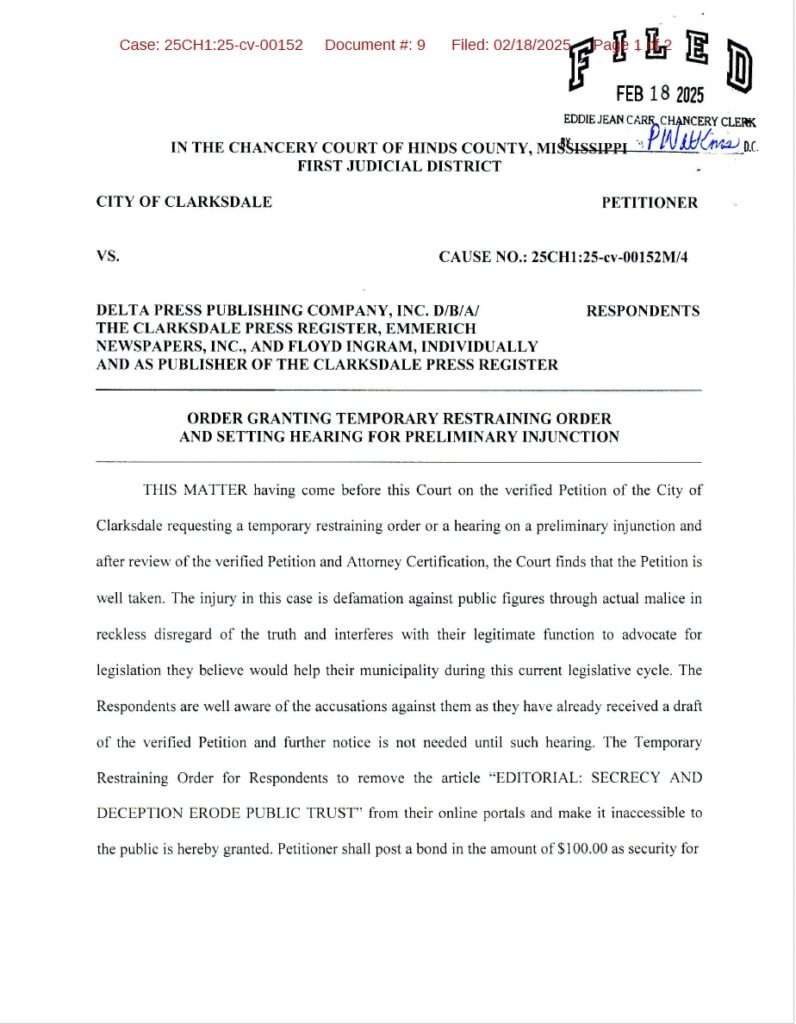
Court Orders Newspaper to Remove Editorial Critical of City of Clarksdale (Miss.) Officials

|

UPDATE 2/25/2025: The City has backed down and dropped the case.

I was traveling yesterday (and I'm continuing the trip today), so I didn't have the time to put something of my own together on this, but I highly recommend this thread from Adam Steinbaugh (FIRE). The opening paragraph:

Wow: The City of Clarksdale, Mississippi, got a court order yesterday directing a newspaper to delete an editorial criticizing city officials -- without a hearing. Here's the TRO issuing the prior restraint: …

I will add one possibly clarifying detail: Many courts have in recent decades allowed anti-libel injunctions requiring the removal of material after it has been found to be libelous after trial (or after a default judgment), and barring the reposting of the specific statements found to be libelous. But the First Amendment continues to forbid pre-trial injunctions, and especially "ex parte" ones such as this one, which were issued without even a preliminary adversary hearing. And that's true even if the order is issued after the article is published; under modern First Amendment law, a "prior restraint" is one issued prior to a trial on the merits, rather than prior to publication:

The special vice of a prior restraint is that communication will be suppressed … before an adequate determination that it is unprotected by the First Amendment.

That, though, is just one of the many apparent defects of this injunction; read Steinbaugh's thread for much more.

Religion and the Law

One More First Amendment Case to Watch

|

Another First Amendment case that the Court will consider this Friday, but on the religion side, is Apache Stronghold v. United States (briefs at the link); here's the question presented:

For centuries, Western Apaches have centered their worship on a small sacred site in Arizona called Chí'chil Biłdagoteel, or Oak Flat. Oak Flat is the Apaches' direct corridor to the Creator and the locus of sacred ceremonies that cannot take place elsewhere. The government has long protected Apache rituals there. But because copper was discovered beneath Oak Flat, the government decided to transfer the site to Respondent Resolution Copper for a mine that will undisputedly destroy Oak Flat—swallowing it in a massive crater and ending sacred Apache rituals forever.

Petitioner challenged this decision under the Religious Freedom Restoration Act and the Free Exercise Clause. In a fractured en banc ruling cobbled together from two separate 6-5 majorities, the Ninth Circuit rejected both claims. Although the court acknowledged that destroying Oak Flat would "literally prevent" the Apaches from engaging in religious exercise, it nevertheless concluded that doing so would not "substantially burden" their religious exercise under RFRA, relying on this Court's pre-RFRA decision in Lyng v. Northwest Indian Cemetery Protective Association, 485 U.S. 439 (1988). And while the majority acknowledged that singling out Oak Flat for destruction is "plainly not 'generally applicable,'" it rejected the free-exercise claim "for the same reasons"—no substantial burden.

The question presented is:

Whether the government "substantially burdens" religious exercise under RFRA, or must satisfy heightened scrutiny under the Free Exercise Clause, when it singles out a sacred site for complete physical destruction, ending specific religious rituals forever.

Prof. Stephanie Barclay (Georgetown) and Matthew Krauter also have an interesting forthcoming article in the University of Pennsylvania Law Review, The Untold Story of the Proto-Smith Era: Justice O'Connor's Papers and the Court's Free Exercise Revolution, that bears on this case and on the religious exemption debate more broadly:

Read More

Politics

Harlan Virtual Supreme Court Semifinalists

Twenty-two teams of high school students presented oral arguments on Free Speech Coalition v. Paxton.

|

The topic for the 13th Annual Harlan InstituteVirtual Supreme Court competition is Free Speech Coalition v. Paxton. Twenty-two teams of high school students presented oral arguments in the semifinal round. The teams were superb. Truly, these high school students could compete in any law school moot court competition. The Round of 8 will be held the week of February 24, 2025.

Semifinal Match #1

Team #20133 v. Team #20604

Semifinal Match #2
https://www.youtube.com/watch?v=hxrKEJBvctc

Read More

Free Speech

Two Free Speech/Gender Identity/Sexual Orientation Cert. Petitions that the Court Will Consider Friday

|

[1.] In L.M. v. Town of Middleborough (briefs at link, if you're interested), the question presented is:

L.M. is a student whose public school promoted the viewpoint that sex and gender are limitless, based on personal identity, and have no biological foundation. The school invited students to voice their support for this view. But L.M. disagreed and responded by wearing a t-shirt to class that said "There are only two genders." After the school censored him, he wore a protest t-shirt that said "There are [censored] genders." Despite no past or present disruption, the school district prohibited both t-shirts.

The district court upheld this censorship based on the rights-of-others prong in Tinker v. Des Moines Independent Community School District, 393 U.S. 503 (1969). The First Circuit affirmed based on Tinker's substantial-disruption prong, though it said L.M.'s t-shirts likely failed the rights-of-others prong too, applying a novel test for ideological speech alleged to demean characteristics of personal identity.

The First Circuit's novel legal standard and analysis conflicts with this Court's decisions and those of ten other circuits in a multitude of ways. The question presented is:

Read More

More