

The Volokh Conspiracy

Mostly law professors | Sometimes contrarian | Often libertarian | Always independent | Est. 2002

The Volokh Conspiracy

Donald Trump

Yet Another Federal Court Rules Against Trump in an Alien Enemies Act Case

The Southern District of New York rules Trump invoked the Act illegally, because there is no "invasion" or "predatory incursion."

|

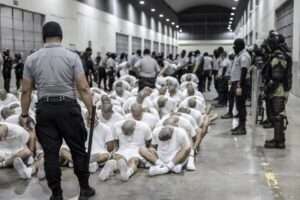
A prison guard transfers deportees from the U.S., alleged to be Venezuelan gang members, to the Terrorism Confinement Center in Tecoluca, El Salvador. Mar. 16, 2025 (El Salvador Presidential Press Office)


Another day, another federal court ruling against Trump in an Alien Enemies Act case. The Alien Enemies Act of 1798 (AEA) can only be used to detain and deport immigrants in the event of a declared war, or an "invasion" or "predatory incursion" perpetrated by a "foreign nation or government." The Trump Administration has been trying to use the AEA as a tool to deport Venezuelan migrants without due process, by claiming they are members of the Tren de Aragua drug gang. Today, Judge Alvin Hellerstein of the Southern District of New York issued a decision ruling that Trump's invocation of the AEA is illegal. It follows similar rulings by district courts in Texas and Colorado, and by Judge Karen LeCraft Henderson of the D.C. Circuit. Multiple earlier court decisions have reached the same conclusion with respect to the meaning of "invasion" in the Constitution.

Like previous AEA decisions, Judge Hellerstein ruled against Trump because there is no "invasion" or "predatory incursion":

A statute should be interpreted as to its plain meaning at the time of its adoption, in the context of the events of that time….

In 1798, the United States was engaged in an undeclared war with France. See David McCullough, John Adams, at 499-505 (2001). Their respective navies fought each other at sea. Id. at 499. The American government feared incursions by the French in the territories west of the Appalachian Mountains….

An "invasion," as used in the AEA, was understood as a "[h]ostile entrance upon the right or possessions of another" or a "hostile encroachment," such as when "William the Conqueror invaded England." Samuel Johnson, Invasion, A Dictionary of the English Language (4th ed. 1773). Another dictionary defined "invasion" as a "hostile entrance into the possession of another; particularly the entrance of a hostile army into a country for the purpose of conquest or plunder, or the attack of a military force." Noah Webster, Invasion, American Dictionary of the English Language (1828). The Constitution itself uses the term "invasion" on three occasions, all of which occur within the context of military action by a foreign state against the territorial integrity of the United States. Specifically, Section 8 of Article I of the Constitution provides Congress with the power to "call[] forth the Militia to execute the Laws of the Union, suppress Insurrections and repel Invasion," Section 9 of Article I, also known as the "Suspension Clause," bars the suspension of the habeas writ, "unless when in Cases of Rebellion or Invasion the public Safety may require it," and Section 4 of Article IV, also known as the "Invasion Clause," provides that the federal government "shall protect [the states] against Invasion…."

In a similar vein, an "incursion" was understood to mean an "[a]ttack" or "[i]nvasion without conquest." Samuel Johnson, Incursion, A Dictionary of the English Language (4th ed. 1773). And early cases used the term "predatory incursion" to refer to military-like conflicts waged by an Indian tribe or a foreign nation-state, as opposed to civil immigration violations. See, e.g., Huidekoper's Lessee v. Douglass, 7 U.S. 1, 7 (1805) (referring to a measure intended to "repel the predatory incursions of the Indians" as an antidote to an Indian war)….

I would put less emphasis on dictionary definitions and more on the use of these terms, in context, in the AEA and the Constitution. But Judge Hellerstein is right about the bottom line, here. I have defended the view that "invasion" requires a military attack, in more detail in my previous writings on the meaning of the term in the AEA and the Constitution.

Like earlier AEA rulings, Judge Hellerstein also rejected the claim that the invocation of the statute is a "political question" not subject to judicial review. He also ruled the administration illegally denied migrants detained under the statute due process and certified a class action challenging their deportation:

This nation was founded on the "self-evident" truths "that all men are created equal, that they are endowed by their Creator with certain unalienable Rights, [and] that among these are Life, Liberty and the pursuit of Happiness." Declaration of Independence, at ¶ 2 (1776). Our Constitution embodies these truths, in a limited government of enumerated powers, in its system of checks and balances separating the executive, legislative and judicial branches, and in its guarantee that neither citizen nor alien be "deprived of life, liberty, or property, without due process of law." U.S. Const. amend. V; see Plyler v. Doe, 457 U.S. 202, 210-12 (1982) (extending these protections to aliens).

Yet, in March 2025, more than 200 aliens were removed from this country to El Salvador's Terrorism Confinement Center ("CECOT"), with faint hope of process or return. The sweep for removal is ongoing, extending to the litigants in this case and others, thwarted only by order of this and other federal courts. The destination, El Salvador, a country paid to take our aliens, is neither the country from which the aliens came, nor to which they wish to be removed. But they are taken there, and there to remain, indefinitely, in a notoriously evil jail, unable to communicate with counsel, family or friends….

The Court grants Petitioners' motion for a preliminary injunction against removal. This Opinion gives the reasons. It discusses the whole of the AEA, and shows that the Presidential Proclamation, in mandating removal without due process, contradicts the AEA. The Opinion goes on to discuss the requirements of notice and hearing under both the AEA and the Constitution.

I have previously explained why Trump's AEA deportations violate the Due Process Clause of the Fifth Amendment.

Litigation over these issues will continue. But, as I noted last week, there is a growing judicial consensus that Trump's invocation of the AEA is illegal, covering both conservative and liberal judges.
Free Speech

Are Employment Lawyers Disclosing the Reputational Risks of Litigation to Their Clients?

|

From Monday's decision by Judge Woods in Hui v. Federal Reserve Bank of N.Y. (S.D.N.Y.):

On April 30, 2025, Plaintiff filed an application to seal this case in its entirety. One distinguishing facet of the American legal system is its commitment to public access to the trial process. This legacy of "open justice" is as old as America itself. Because the plaintiff has not overcome the strong presumption to public access that attaches to judicial documents—including the complaint and the existence of the case itself—the motion to seal the case is DENIED….

Plaintiff sued in September 2024, claiming defendants had fired him based on his being Chinese-American and on his complaining about discrimination. According to the Complaint, his being of Chinese extraction (he came to the U.S. in 1990, at age 14, and has been a "proud United States citizen since 1995") led defendants to suspect him—with no evidence—of "somehow spying and/or acting as an agent for the Chinese government." On April 16, 2025, after some discovery disputes (which led to a judicial decision), the case settled. But on April 30, 2025, Plaintiff sought to seal the case, citing "'severe reputational damage' due to the public access [to case filings], which he asserts has resulted in 'deep personal and family financial difficulty.'"

But the court refused to seal the case:

Read More

Free Speech

No Dragon, No Pseudonymity, No Nothin'

|

From Magistrate Judge Ray Kent's order yesterday in Doe No. 2 v. County of Clinton (W.D. Mich.), the case that I first blogged about because of the dragon logo:

This is a civil rights action brought by a former inmate of the Clinton County Jail  …. On April 28, 2025, the Court entered an order striking Plaintiff's complaint containing a dragon cartoon logo and directing Plaintiff to file an amended complaint by May 5, 2025. This matter is presently before the Court on Plaintiff's motion for leave to proceed under a pseudonym. For the following reasons, the Court will deny Plaintiff's motion….

Plaintiff alleges that, on March 22, 2024, Plaintiff was arrested for allegedly drinking while on bond and was detained in the Clinton County Jail (CCJ). "[A]lmost immediately" upon booking, Plaintiff began vomiting and showing unidentified "consistent, and objective signs of medical distress." At Plaintiff's bond hearing of March 28, 2024, the District Court ordered that Plaintiff be released from custody due to Plaintiff's "health distress." Plaintiff was then taken to the University of Michigan Sparrow Clinton Hospital, where she was admitted for treatment….

"It is a general rule that a complaint must state the names of the parties." A plaintiff is permitted to proceed anonymously only in exceptional circumstances that justify an exception to the general rule. This is because naming the parties to litigation is more than a mere formality; "First Amendment guarantees are implicated when a court decides to restrict public scrutiny of judicial proceedings." Indeed, "[i]dentifying the parties to the proceeding is an important dimension of publicness. The people have a right to know who is using their courts." …

Read More

Politics

Third Circuit: No Establishment Clause Violation in School Lessons on Islam

|

From Hilsenrath v. School District of the Chathams, decided yesterday by the Third Circuit (Judge Thomas Hardiman, joined by Judge Arianna Freeman):

During the 2016–2017 school year, C.H. was a seventh-grade student at Chatham Middle School. He was enrolled in a mandatory World Cultures and Geography class taught in part by long-term substitute Christine Jakowski. The class canvassed world regions to help students "gain a greater sense of the world around them" and "become active and informed global citizens." Many resources for the class, such as "calendars, handouts, assignment and project directions, and grading guidelines," were located on Google Classroom.

The class was organized into seven units, six of which focused on a different region of the world. Within each of these units, students explored the history and culture of the highlighted region, which sometimes included studying its predominant religion. During the Latin America unit, students learned about Christianity. And in the East Asia unit, students viewed PowerPoint slides and videos about Buddhism and Hinduism. The curriculum implemented state standards, including that students will be able to "[c]ompare and contrast the tenets of various world religions."

Students encountered Islam during two class periods within the "Middle East and North Africa" (MENA) unit, both taught by Ms. Jakowski. The first lesson was presented through a set of PowerPoint slides entitled "Teaching Critical Thinking[:] Making Generalizations with Content." That presentation instructed students that "[a] generalization is a broad, universal statement of understanding based on specific facts and data" and cautioned that "[s]ome are valid" and "others are invalid or faulty." To test students' understanding, the final slide directed them to identify generalizations in a hyperlinked YouTube video and to label them either "valid or faulty."

That five-minute video, entitled "Intro to Islam," contains images and written text. Instead of a voiceover, the video features background music and Arabic chants. The first half of the video alternates between quotations from the Quran and a series of questions and answers about Islam, including:

  • "What is Islam?" "Faith of divine guidance for Humanity, based on peace, spirituality and the oneness of God."
  • "Who is Allah?" "Allah is the one God who created the heavens and the earth, who has no equal and is all powerful."
  • "Who is Muhammad (S)?" "Muhammad (Peace be upon him) is the last & final Messenger of God. God gave him the Noble Quran."
  • "What is the Noble Quran?" "Divine revelation sent to Muhammad (S) last Prophet of Allah. A Perfect guide for Humanity."
  • "What does history say about Islam?" "Muslims created a tradition of unsurpassable splendor, scientific thought and timeless art."

After about two minutes, the video turns to a discussion of "Islamic Art and Architecture," as well as other Muslim contributions to society. Finally, text on the last substantive slide reads "May God help us all find the true faith, Islam … Ameen."

Read More

Civil Procedure

Illinois Act Protecting "Lawful Reproductive or Gender Affirming Care" Doesn't Shield World Prof. Ass'n for Transgender Health (WPATH) from Subpoena

|

From M.H. v. Adams, decided Friday by Magistrate Judge Keri L. Holleb Hotaling (N.D. Ill.):

In the wake of Dobbs v. Jackson Women's Health Organization (2022), Illinois enacted the Lawful Health Care Activity Act to ensure "that Illinois would remain a beacon of hope and an island for reproductive justice for all who seek it" and that "[a] medical decision should be made between a patient and their doctor—no one else." The Act "[s]hields individuals in Illinois from subpoenas, summons, or extraditions related to lawful reproductive or gender affirming care in Illinois" and "[r]equires courts in Illinois to apply Illinois law in cases involving reproductive health care."

In a case of first impression in federal court involving the Act, the World Professional Association for Transgender Health ("WPATH"), an Illinois non-profit organization, invokes the Act and raises other arguments in response to a third-party subpoena … issued to it by the Director of the Idaho Department of Health and Welfare … relating to M.H. v. Smith et al., C.A. No. 22-409 (D. Idaho) ("the Underlying Action"). The Underlying Action involves two transgender Idahoans who sued directors of two Idaho departments of government challenging an Idaho Medicaid policy and state law that exclude coverage and/or the use of state funds for certain healthcare or procedures for transgender individuals. The plaintiffs in the Underlying Action rely upon WPATH's promulgated standards of care for the treatment and health of transgender and gender diverse people to support their claims that the Idaho policy and law operate to deny them healthcare that is medically necessary.

WPATH moved to quash the subpoena, but the court concluded that the Act did not protect WPATH here:

Read More

Politics

TROLP Has Published My 2024 Jurist of the Year Address

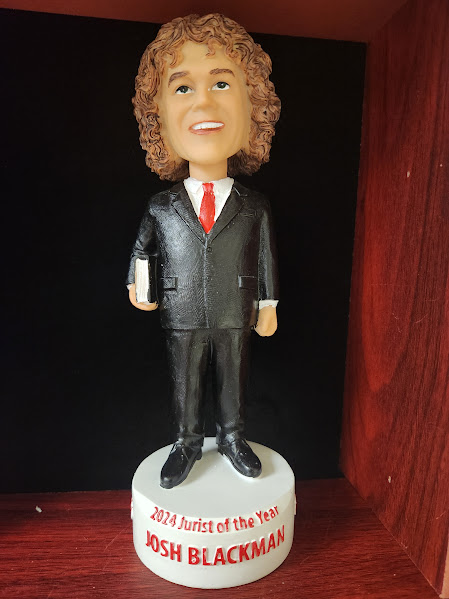
I offer five tips on how you can get a TROLP bobblehead.

|

In April of 2024, I was deeply honored when the Texas Review of Law & Politics selected me as the jurist of the year. I uploaded audio of my remarks here. TROLP has now published my essay. Here is the abstract:

Let's do a survey of the 25 TROLP jurists of the year who came before me. There were two Supreme Court Justices: Scalia and Thomas. There were ten lower-court federal judges: Jones, Starr, Smith, Owen, Garwood, Pryor, Willett, O'Connor, Elrod, and Ho. There were four Senators: Cornyn, Lee, Cruz, and Cotton. There were three Solicitors General: Olson, Coleman, Clement. There were two Attorneys General: Meese and Abbott. There was only one law professor who was jurist of the year: Lino Graglia, a giant in the law, who received the award when he was eighty years old.

Then there's me. I'm not a judge, and I don't consider myself a jurist. I've never held any appointed or elected governmental position. I am not, nor have I ever been, an "officer of the United States." I've never argued a case before the Supreme Court, or any appellate court for that matter. I did not attend and do not teach at an elite law school. To quote another classic piece of American pop culture, Sesame Street, "One of these things is not like the other." Relatedly, I think my TROLP bobblehead is the first one with curly hair.

So, why am I up here? I'm still not entirely sure. But I'd like to use my brief time at this podium to convey a message: this can be you. If I can be up here, so can you. To state the issue more bluntly, I don't want to be the only one up here. I want each and every one of you to find your path to this stage. As I'll explain, it will not be easy. There will be many forces pushing back against you. There is no glidepath to getting your very own bobblehead. But I am ready to help. Indeed, I try by word and deed to model the behavior it takes to get up here. If you'll indulge me, let me offer five tips.

I hope these remarks are helpful to future jurists of the year.

Artificial Intelligence

No Preliminary Injunction for Yale MBA Student Suing Over Discipline for Alleged Use of AI on Exam

|

From today's decision by Judge Sarah Russell (D. Conn.) in Rignol v. Yale Univ. (a case I first wrote about when Rignol's attempt to sue pseudonymously was rejected):

Plaintiff Thierry Rignol is an entrepreneur and investor who enrolled as a part-time graduate student at the Yale School of Management ("SOM") in 2023 as a member of the class of 2025. After a teaching assistant flagged one of his exams in the spring of 2024, SOM administrators conducted an investigation to determine whether Rignol violated examination rules by using generative artificial intelligence ("AI"). In the course of its investigation, SOM determined that Rignol was not forthcoming during the investigation and did use AI; SOM penalized Rignol by issuing him an F in the course and suspending him from classes for one year.

Rignol subsequently sought a preliminary injunction that would reinstate him as a student in good standing at SOM such that he could graduate with his classmates in the class of 2025 this spring. Because I conclude that Rignol has failed to make the threshold showing of irreparable harm, I deny Rignol's motion for a preliminary injunction…

Here is an excerpt from the court's long and detailed account of the factual allegations:

Thierry Rignol is an entrepreneur and investor. In his LinkedIn profile, which Defendants attach to their memorandum, Rignol describes himself as the founder of a "technology driven real estate and hospitality company" headquartered in Mexico and operating throughout the Americas. Rignol's profile says his firm had 28 full-time workers as of the end of 2020. In addition to managing his own firm, Rignol serves as a director on the boards of several private enterprises. Rignol is a French national authorized to live and work in the United States on an investor visa.

Rignol, by the way, had also run for the French Parliament in 2017, and continues to have "political aspirations."

Read More

Campus Free Speech

Nearly $2M Award Upheld for Former College Tennis Coach Who Sued Over Rumor of Improper Sexual Relationship with Player

|

Holzgrafe, a former Quincy University tennis coach, sued former Quincy tennis player Lozier, related to a rumor that Holzgrafe had "a sexual relationship with another tennis player he coached." A jury awarded Holzgrafe "$2,000,000 in general damages, $40,000 in special damages, and $874,000 in punitive damages." Friday's decision by Judge Sue Myerscough in Holzgrafe v. Lozier largely upheld the verdict:

The Court reviews the evidence in the light most favorable to the nonmoving party at this stage. The evidence at trial established Defendant was a student at Quincy University in 2017. Prior to being a student at the University, Defendant developed a relationship with the Plaintiff, who was a tennis coach, from their interactions at various tennis camps. Defendant decided to attend Quincy University and play for the Plaintiff who was the head coach of both the men's and women's teams in 2017.

By 2017, Plaintiff's and the Defendant's relationship had soured. This friction was due in part to Defendant not playing in various tennis matches. In addition, Defendant believed Plaintiff was angry with him about the injury of his girlfriend, Abby Moore, who was also on the women's tennis team. Ms. Moore broke her ankle while practicing on a basketball court with the Defendant.

In April 2017, various rumors were circulating about the tennis program and especially Plaintiff, who was the head coach. Defendant admittedly spoke to another tennis team member, Danyil Vayser, who Defendant testified told him a rumor about the Plaintiff and another tennis player, specifically that Plaintiff had had sex with a female tennis player ("Jane Doe") while on spring break.

After this conversation, Defendant repeated this information to two people, his mother, Cindy Lozier, and his girlfriend, Abby Moore. Defendant testified that his mother told him to "keep his mouth shut" and that Abby said she wouldn't tell anybody else. However, Cindy Lozier called the University and reported the rumor.

This was not the first time Mrs. Lozier had called Quincy University. Rather, she called on at least two occasions previously when there were issues with her son. One occasion involved Defendant having a problem with his roommate. Mrs. Lozier called again when she could not locate the Defendant, her son, for approximately 3 hours and had the director of safety and security locate him. The Director of Safety and Security, Sam Lathrop, did so and told Defendant to call his mother.

Read More

Unenumerated Rights

Compelled Head-Shaving of Mental Patient With Severe Head Lice Infestation Violated Constitution

|

From In the Matter of the Necessity for the Hospitalization of Lila B., decided Friday by the Alaska Supreme Court (in an opinion by Chief Justice Maassen):

A woman with a severe head-lice infestation was detained at a psychiatric hospital while she awaited evaluation for a mental health commitment. The superior court issued an order authorizing hospital staff to shave the woman's head without her consent. On appeal, the woman argues that involuntary head-shaving is a significant infringement upon a patient's fundamental rights and should require a heightened showing from the State.

We hold that before the State may shave the head of a nonconsenting patient in its care, it must demonstrate by clear and convincing evidence that head-shaving is the least restrictive means of advancing a compelling government interest. Because the State failed to meet that heightened standard in this case, we vacate the order authorizing the involuntary head-shaving….

A police officer detained Lila B. on an emergency basis for a mental health evaluation and transported her to a correctional center. Several days later the Department of Corrections petitioned for an order authorizing Lila's hospitalization for evaluation pursuant to AS 47.30.710. A superior court master issued the order, and after another three days Lila was transferred to the Alaska Psychiatric Institute (API) for evaluation.

API staff saw that Lila was suffering from a severe infestation of head lice, and they decided she should stay in the hospital admissions area until the infestation could be treated. Staff members encouraged her to let them apply a permethrin shampoo treatment to her hair, which was heavily matted. She responded that allowing them to touch or treat her hair would violate her religious beliefs, though she did not specify a belief system. After failing to secure her cooperation, API staff decided they would have to shave her head before she could be admitted to a hospital unit. [After an emergency court hearing,] hospital staff shaved Lila's head….

Read More

Politics

Today in Supreme Court History: May 5, 1992

|

5/5/1992: The 27th Amendment is ratified. It was initially proposed in 1789.

No law, varying the compensation for the services of the Senators and Representatives, shall take effect, until an election of Representatives shall have intervened.

New Article: Forcibly Sweeping Section 3 Up To The Supreme Court

My personal account of the Section 3 litigation.

|

We are now 100 days into the Trump Administration. As best as I can tell, there has been zero litigation over whether Section 3 of the Fourteenth Amendment disqualifies Trump from the presidency. During the Joint Session of Congress on January 6, 2025, there were zero objections raised based on Section 3. Yet, it is hard to believe that about fifteen months ago, the Supreme Court was being asked to disqualify Trump from the ballot.

As regular readers of this blog will recall, Seth Barrett Tillman and I were actively engaged in the process to disqualify Trump between 2021 and 2024. I discuss many of the things we did during this time in a new article for the Mississippi Law Journal's symposium issue on the Fourteenth Amendment.

Here is the abstract of Forcibly Sweeping Section 3 Up To The Supreme Court:

In the wake of January 6, 2021 a two-year lawfare campaign was waged to prevent Donald Trump from being re-elected president. That movement reached its pinnacle on December 19, 2023, when the Colorado Supreme Court ruled that Section 3 of the Fourteenth Amendment disqualified Donald Trump from the presidency. But less than three months later, on March 3, 2024, the United States Supreme Court unanimously reversed the state court. President Trump was re-elected, and certified on January 6, 2025.

This Article is not intended to explain the nuances of Section 3, summarize all of the litigation, or even analyze how the Supreme Court decided the case. Rather, this Article is somewhat personal in nature. It tells my own experience in the Section 3 litigation, from January 6, 2021, through January 6, 2025. This Article, I hope, will encapsulate the role that I played in this process with my friend and colleague Seth Barrett Tillman.

Seth also contributed to this symposium issue. His article is titled, Some Personal Reflections on the Recent Litigation Involving Section Three of the Fourteenth Amendment. Here is a snippet from the introduction:

What follows is not specifically an attempt to reargue the merits of disputes between my interlocutors and myself [which were debated during the recent Section 3 ballot-access Trump-related cases], but an attempt to explain my personal experience in attempting to debate a set of intellectual points—points which I had developed since circa 2007 and refined in cooperation with Professor Blackman since 2017. Although I make no claim to objectivity among competing views, I hope to show that traditional academic and professional norms remain worthy aspirational goals, even where unmet.

Looking back, this paper is not so much about Section 3 of Amendment XIV and recent ballot-access Trump-related litigation. Rather, it is more about the decline in civility and aspirational standards within the polity, the courts, and legal academia.

And another snippet from the conclusion:

It is said that at the negotiations at Appomattox Courthouse—Lee and Grant were both frank and civil during the course of discussing the surrender of Lee's Army of Northern Virginia. Afterwards, Grant sent food to Lee to feed his (and, then, their) nation's former enemy soldiers. Celebrations for Grant's soldiers came only later—not while Lee's soldiers remained present. Again, in ending active hostilities, the first step towards national reconciliation was frank and civil discourse.

I do not think our present and future is or will be as difficult as was Grant and Lee's. But we too have to think about national reconciliation. It seems to me that the first steps in that direction involve frank and civil discussion, absent hyperbole, and absent name calling. If federal judges, state judges, and legal academics are not up to that task, then that is just another institutional and cultural problem crying out for reform and renewal.

Likewise, our domestic law schools are supported by taxes, tuition, and donations. If universities and academics only further burden American society by casting aside our free speech traditions and actively engage in just another front in our culture wars, then wider society might very well choose to withhold support. Perhaps this process has already begun?

Often Seth and I publish together, but for this symposium, it was useful to publish separately. The Section 3 litigation is not something we will soon forget, even if others would rather not recall what they tried to do.

Free Speech

Court Holds Anti-DEI Executive Orders Don't Facially Violate First Amendment

|

Some short excerpts from Friday's long decision by Judge Timothy Kelly (D.D.C.) in National Urban League v. Trump:

After taking office this January, President Trump promptly issued three executive orders addressing diversity, equity, and inclusion. Some provisions are internal to the government, directing Executive Branch officials to create certain lists or produce certain reports to advise the President. Others reach into the private sector—for example, by requiring grantees and contractors to certify that they do not operate DEI programs that violate federal antidiscrimination law. And still others straddle the line by directing agencies to terminate some federal grants and contracts, an intra-governmental directive that affects other entities.

Plaintiffs are three nonprofit organizations that incorporate DEI into their work. They also contract with and receive funding from several federal agencies. Concerned that President Trump's executive orders will prevent them from fulfilling their organizational missions, Plaintiffs sued to enjoin a host of agencies and officials from enforcing the orders. They moved for a preliminary injunction over a week later, arguing that eight provisions of the orders are unconstitutional under the First or Fifth Amendment—or both. More specifically, Plaintiffs contend that the challenged provisions are impermissibly vague, chill protected speech, and amount to unlawful viewpoint discrimination.

But Plaintiffs have not shown that they are likely to succeed on any of those claims, so the extraordinary relief of a preliminary injunction is unwarranted. For half the challenged provisions, Plaintiffs fail to establish a prerequisite to success on the merits: standing. Presidential directives to subordinates that inflict no concrete harm on private parties—or at least not on these parties—do not present a justiciable case or controversy. And for the remaining provisions, Plaintiffs' constitutional claims falter for various reasons. Two throughlines explain most of them. The government need not subsidize the exercise of constitutional rights to avoid infringing them, and the Constitution does not provide a right to violate federal antidiscrimination law. And those pressure points are even harder to overcome for Plaintiffs, who bring facial rather than as-applied challenges.

The motion before the Court is not about whether DEI policies, however defined in a given context, are good public policy. Nor is it about whether specific DEI initiatives comply with antidiscrimination law. Instead, it is about whether Plaintiffs have shown that they are entitled to a preliminary injunction prohibiting enforcement of the executive orders at issue. Because they are not likely to prevail on the merits, the Court will deny the motion.

The court begins by summarizing the Executive Orders:

Read More

Separation of Powers

America First Legal Foundation v. Chief Justice John Roberts

A FOIA lawsuit that seeks executive branch control over the Judicial Conference of the United States and Administrative Office of the United States.

|

Last month, with relatively little fanfare, the America First Legal Foundation filed suit against Chief Justice John Roberts, in his capacity as the presiding officer of the Judicial Conference of the United States, and Robert J. Conrad, Director of the Administrative Office of the U.S. Courts. The suit is nominally seeking to enforce a document request under the Freedom of Information Act (FOIA), but substantively raises broad separation-of-powers claims.

The suit was prompted by the refusal of the Judicial Conference and Administrative Office to respond to AFLF's FOIA requests for copies of communication with the offices of Senator Sheldon Whitehouse and Representative Hank Johnson, two legislators who have worked overtime to stir up ethical allegations against sitting Supreme Court justices. The Judicial Conference and Administrative Office rebuffed the requests on the grounds that each are exempt from FOIA.

The basis for AFLF's suit is that the Judicial Conference and Administrative Office are not part of the judiciary, but are instead executive branch agencies subject to FOIA. According to AFLF, neither entity is a "court," and insofar as each has other responsibilities, including the promulgation of rules governing federal courts and responding to Congressional inquiries, each is an "agency" under FOIA. It further claims that insofar as the Chief Justice is able to appoint members of Judicial Conference committees "then he must be acting as an agency head, subjecting the Judicial Conference to the FOIA." (Cf. Art. II, section 2, which authorizes Congress to delegate authority to appoint inferior officers to "the Courts of Law.")

The suit does not merely seek fulfillment of the FOIA requests. It seeks to have the Judicial Conference and Administrative Office declared "independent agencies within the executive branch." It further suggests, but does not allege, that the President should have the power to appoint and remove the Presiding Officer of the Judicial Conference and the Director of the Administrative Office.

Free Speech

Judge Easterbrook: Public Universities Should Have Free Hand in Restricting Professors' Teaching

|

From Seventh Circuit Judge Frank Easterbrook's opinion concerning the denial of rehearing en banc in Kilborn v. Amiridis (see this post for the panel decision, which took a contrary view):

"It is the business of a university to provide that atmosphere which is most conducive to speculation, experiment and creation. It is an atmosphere in which there prevail the four essential freedoms of a university—to determine for itself on academic grounds who may teach, what may be taught, how it shall be taught, and who may be admitted to study." Sweezy v. New Hampshire (1957) (Frankfurter & Harlan, JJ., concurring) (quoting from an academic report). Sweezy introduced the idea of academic freedom to the pages of the United States Reports. Although a majority did not state clearly who possesses that freedom, the views of Justices Frankfurter and Harlan have persuaded many other federal judges that the university itself is entitled to freedom from outside control, even if a faculty member seeks to enlist the aid of non-academic governmental actors. See, e.g., Webb v. Ball State University (7th Cir. 1999); Wozniak v. Adesida (7th Cir. 2019); Urofsky v. Gilmore (4th Cir. 2000) (en banc).

A university's ability to evaluate and respond to faculty members' speech is essential to the educational enterprise. Think of tenure: A university assesses a professor's quality of research and writing (and choice of subject matter) and necessarily makes decisions based on the content and viewpoint of speech. A chemist who writes excellent political commentary but neglects scientific data and analysis can't expect tenure. A biologist who devotes his career to elaborating the ideas of T.D. Lysenko can't expect tenure.

Think of teaching: Every university assigns subjects (a professor of philology can't insist on teaching political theory) and approaches (a professor of evolutionary biology who has experienced a religious conversion can't denounce Darwin and embrace creationism). A university may demand that exams cover given topics and be graded on a curve. Successful professors receive raises and timeservers do not—though "success" depends on speech that occurs in class and in scholarly journals. And so on. Evaluation of every teacher's speech is an essential part of academic administration, and deans rather than jurors should resolve disputes about these matters.

Read More

More


