The Volokh Conspiracy

Mostly law professors | Sometimes contrarian | Often libertarian | Always independent | Est. 2002

The Volokh Conspiracy

Donald Trump

Morning Consult Poll Indicates Judicial Invalidation of Trump's Tariffs is Popular

The poll finds 55% approve and only 30% disapprove of the recent ruling against his IEEPA tariffs.

|

NA

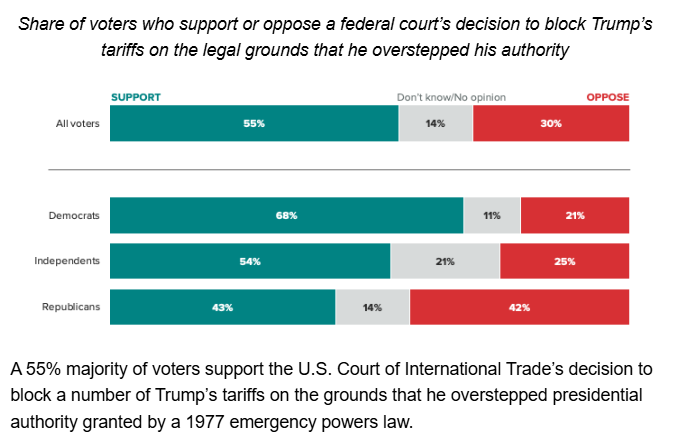
A new Morning Consult poll indicates that the recent Court of International Trade decision striking down Donald Trump's "Liberation Day" and other IEEPA tariffs in a case brought by the Liberty Justice Center and myself, enjoys broad public support. According to the poll, 55% approve of the ruling, while only 30% disapprove.

Morning Consult

Large majorities of both Democrats and independents support the CIT decision, while Republicans are almost equally divided. This result is consistent with other survey data showing that the tariffs themselves are highly unpopular.

The People are with us! Yay!

The popularity of the CIT decision says little about its correctness. I've long been skeptical of "popular constitutionalism" and have written extensively about the dangers of political ignorance.  I advocate many unpopular views, and am not one to argue that vox populi is vox dei. Far from it!

Obviously, I believe the CIT decision was right, and appellate courts should affirm it. But it isn't right merely because most of the public agrees with it.

Still, popularity can be helpful. At the margin, wavering judges may be more willing to strike down a major presidential policy initiative if they think doing so will be popular, and their ruling will enjoy strong political support. And if, as many fear, the Trump Administration is considering systematically defying court orders (as it has already to an extent done in some immigration cases), it will be less likely to do so in the case of popular rulings, and less likely to get away with it if they try.

Come Into Litigation Warrior Pose: Ninth Circuit Strikes Down Restriction on Teaching Yoga in San Diego Shoreline Parks or Beaches

|

Thanks, ChatGPT!


From today's decision by Ninth Circuit Judge Holly Thomas, joined by Chief Judge Mary Murguia and Judge Gabriel Sanchez, in Hubbard v. City of San Diego:

The City of San Diego prohibits teaching yoga to four or more persons at any of the City's shoreline parks or beaches…. [But t]eaching yoga is protected speech. The City's prohibition on teaching yoga in shoreline parks is content based and fails strict scrutiny….

[T]he First Amendment protects teaching yoga. "An individual's right to speak is implicated when information he or she possesses is subjected to 'restraints on the way in which the information' [is] disseminated." And the First Amendment's protections for speech encompass situations where a teacher's "speech to [students] imparts a 'specific skill' or communicates advice derived from 'specialized knowledge.'" Pac. Coast Horseshoeing Sch., Inc. v. Kirchmeyer (9th Cir. 2020) (quoting Holder v. Humanitarian L. Project (2010)) (discussing vocational training).

Because the Ordinance targets teaching yoga, it plainly implicates Hubbard and Baack's First Amendment right to speak. The practice and philosophy of yoga "date back thousands of years," deriving "from ancient Hindu scriptures." The practice of yoga "teaches students to attain spiritual fulfillment through control of the mind and body." A person who teaches yoga is communicating and disseminating information about this philosophy and practice through speech and expressive movements. Like vocational training classes, Hubbard's and Baack's classes aim to impart a specific skill and communicate advice derived from specialized knowledge. {Indeed, the act of teaching is protected speech even if the subject matter lacks philosophical value. "Most of what we say to one another lacks 'religious, political, scientific, educational, journalistic, historical, or artistic value' (let alone serious value), but it is still sheltered from government regulation."} …

Read More

Donald Trump

Michael McConnell on the Tariff Cases and their Significance

A leading conservative legal scholar explains why striking down Trump's IEEPA tariffs is vital to protecting the separation of powers.

|

President Donald Trump signs two executive orders on April 2 instituting tariffs
President Donald Trump signed two executive orders on April 2 instituting tariffs on a wide range of countries. ( Andrew Leyden/ZUMAPRESS/Newscom)


Stanford law professor, leading conservative constitutional law scholar, and former federal judge Michael McConnell has an excellent New York Times op ed on the cases challenging Trump's tariffs, and their significance. An excerpt:

Are President Trump's "Liberation Day" tariffs on, or are they off? And, more important, will legal challenges to these levies put the brakes on the seizure by presidents of both parties of ever-increasing unilateral power?

Two federal courts recently ruled that Mr. Trump lacks authority to impose them, but a specialized federal court with authority over tariff cases, the Court of Appeals for the Federal Circuit, paused the enforcement of those decisions, ordering lawyers to submit legal briefs before a hearing on Monday. One or both cases are likely to land at the Supreme Court in short order.

Understandably, most of the commentary has focused on the practical ramifications for the president's trade negotiations and the American economy. But the cases may be even more important for the future of a fundamental component of the Constitution's architecture: the separation of powers, intended by the founders to prevent any of the government's three branches from becoming all powerful.

The tariff litigation is shaping up as the biggest separation-of-powers controversy since the steel seizure case in 1952. There, President Harry Truman assumed control over the nation's steel mills to ensure the continued supply of armaments needed for the Korean War. The Supreme Court rebuffed Truman, establishing the principle that, even in an emergency, the president cannot take upon himself powers that are granted neither by the Constitution nor by congressional statute….

It is clear that the president has no inherent constitutional authority to set or change tariffs or any other taxes. That authority is expressly given to Congress in the first clause of Article I, Section 8, of the Constitution. And it is also clear that Congress has not expressly delegated any power to the president to impose tariffs on his own say-so.

The question is whether vague language in a 50-year-old statute, the International Economic Emergency Powers Act of 1977, gives the president the tariff-setting power…

The statute makes no mention of tariffs or other taxes, and before Mr. Trump, no president ever interpreted it to include such a power.

But the statute does empower the president to regulate the import of "any property in which any foreign country or a national thereof has any interest by any person." This is the language the Trump administration points to in support of his "Liberation Day" tariffs.

Is that right?

The answer to this question will reverberate far beyond the issue of tariffs, because the federal statute books abound with vaguely worded laws that, if broadly interpreted, could empower Mr. Trump and future presidents to take upon themselves extensive powers never intentionally delegated by Congress. If the courts uphold the Trump tariffs, it will be a major step toward a presidency that does whatever the president wishes to do.

I made similar and related points in my recent Atlantic article about the Court of International Trade ruling in the case against the Liberation Day tariffs filed by the Liberty Justice Center and myself on behalf of five small businesses harmed by the tariffs.

Prof. McConnell is coauthor of an important amicus brief filed in our case, on behalf of a bipartisan group of prominent legal scholars and former government officials. We are very grateful for his support, and that of the others who joined the brief.

Should Universities Treat Discrimination against Zionists as Discrimination against Jews?

|

One response David L. Bernstein and I have received to our article on campus antisemitism and free speech is that we conflate antizionism with antisemitism. I think that is a misreading of our article; we discuss where University should do with regard to complaints about antisemitism without adjudicating whether the complaints are valid. We think that speech should be protected regardless of whether it is antisemitic, and disruptive, violent, harassing, and other illicit forms of protest should be punished regardless of whether it is antisemitic. So in most of the controversies that have arisen, the question of whether the speech or conduct is "really" antisemitic is not terribly relevant to our thesis.

However, the issue does arise when a student or professor is accused of illegal discrimination against Zionists. "Zionist" is an ideological position, and while university rules may prohibit ideological discrimination, and in some cases ideological discrimination at state universities may violate the First Amendment, Title VI does not prohibit discrimination against Zionists, as such.

Title VI does prohibit discrimination against Jews, and the question then arises as to whether discrimination that is claimed to be discrimination against Zionists can or should be deemed to be discrimination against Jews.

"Zionist" can sometimes serve as a proxy for "Jew." For example, when someone talks about the "Zionist-controlled media," or refers to Jewish students on campus as "Zios," or speaks of "Zionists" exaggerating the Holocaust, invoking classic antisemitism, the fact that they substitute "Zionists" for Jews does not make the statements any less antisemitic. A student who tells his friend, "I feel like punching a Zionist today" and then punches the first student he sees wearing a kippah can't get around a charge of antisemitic violence because he used the word Zionist instead of Jew.

A more complicated issue is whether Zionism is so closely connected to perceptions of Jewishness that for the purposes of antidiscrimination law discrimination against Zionists should be deemed to be discrimination against Jews.

If it were a matter of first impression, I would be inclined to say no. Banning discrimination against Jews does not ban discrimination against things that are associated with Jews.
That is not, however, how courts have treated the issue of sexual orientation discrimination. Several state courts and agencies have been confronted with the question of whether discriminating against people seeking services for same-sex weddings amounts to discrimination based on sexual orientation. To my knowledge, every court or agency that has addressed the issue has found that it does.

In other words, imagine the father of one of the two brides in an upcoming same-sex wedding tries to hire a photographer for the wedding. The father is not gay, and the photographer does not have a policy of discriminating against gay customers, and indeed did a photoshoot for the daughter a few months earlier, knowing that she was gay.

Even though the customer is not gay, and even though the photographer only objects to working on same-sex weddings for ideological reasons, courts and agencies have held that the photographer is guilty of discrimination based on sexual orientation. To the extent they have discussed the issue, the relevant judges have explained that same-sex marriage is so closely tied to gay identity that discriminating against those associated with same-sex marriage is sexual orientation discrimination. And that is true even though not all gay people desire marriage, and some are ideologically opposed to it.

Analogously, imagine a student group on campus that has a "no Zionist" policy. The group claims not to discriminate against Jews, and even has a few anti-Zionist Jewish members. Given the apparent consensus regarding same-sex marriage, it would seem that discrimination against Zionists amounts to discrimination against Jews because Zionism is so closely associated with Jews. And that would be true even though some Jews are ideologically opposed to Israel, and even though the group is admits other could prove that it admits other Jews.

It also seems inevitable that a student group that bans Zionists will discriminate against Jews in being much more likely to ask potential Jewish members if they are Zionists than to ask others. Students at encampments such as UCLA's not surprisingly singled out visible Jews, such as Jews wearing yarmulkes, to grill about their views regarding Israel before allowing them to traverse campus.

Imagine a campus group that says that they don't discriminate against gays, but only against those who favor same-sex marriage. Or a campus group in the south of the early 1970s that announced that it does not discriminate against black members, but does ban those who favor racial integration. Campus officials would have good reason to suspect that these policies would result in discrimination against gay or or black students, respectively.

So while it may seem a simple matter to separate discrimination based on ethnicity (being Jewish) from discrimination based on an ideological position ("Zionist") that the overwhelmingly majority of the group hold and that is closely associated with that group, in practice it's not nearly so clear-cut.

Free Speech

Reporters Aren't Exempt from Ordinance Forbidding Presence in City Park from 10 pm to 6 am

|

From today's decision in State v. Bliss (N.C. Ct. App.), written by Judge Jeffery Carpenter and joined by Judges Julee Flood and Michael Stading:

Defendants were journalists for The Asheville Blade, a newspaper. The Asheville Blade is known for criticizing the Asheville Police Department's methods of clearing homeless encampments and corresponding protests. On 19 December 2021, a multi-day protest began in Aston Park …, a public park owned and operated by the City of Asheville …. Section 12-41 of the City Code (the "Park Curfew") provides that … "All public parks … shall be closed to the general public between the hours of 10:00 p.m. and 6:00 a.m." …. The purpose of the protest was to demand that the city allow "sanctuary camping" in the Park for the local homeless population….

On 25 December 2021, Defendants were at the Park….. Shortly after 10:00 p.m., officers began dismantling protestors' tents and artwork. Officers also instructed everyone in the Park, including Defendants, to vacate the Park. Officers told Defendants they could continue reporting from outside the Park. Defendants, however, did not leave the Park and around 10:30 p.m., following additional requests by officers to vacate the Park, officers arrested Defendants for second-degree trespass….

Defendants were found guilty, and sentenced to "a $100 fine plus court costs." They appealed, but the appellate court rejected their First Amendment claims:

Read More

Free Speech

Setting the Wayback Machine to 1995: "Cheap Speech and What It Will Do": A Rosy Future

|

[This is an excerpt from my 1995 Yale Law Journal article "Cheap Speech and What It Will Do," written for a symposium called "Emerging Media Technology and the First Amendment.) Thirty years later, I thought I'd serialize the piece here, to see what I may have gotten right—and what I got wrong.]

[I]f the discussion in Parts I and II is correct, the new technologies will change the speech market much more dramatically than we've seen so far. Today's First Amendment law evolved in a media world that had particular characteristics. A relatively few established outlets carried most of the speech that mattered. Extremist speakers had fairly little access to the public. The main news sources—TV programs and newspapers—provided a mix of ostensibly nonpartisan information about a variety of topics. The limited set of sources gave people a more or less common base of information from which to argue. These underlying characteristics are, in my view, more significant than the ones discussed in the last few paragraphs. If they change, what consequences will this have for First Amendment law?

Let me begin my answer with the good news.

Existing First Amendment doctrine is founded on some rather idealized premises. "[T]he best test of truth is the power of the thought to get itself accepted in the competition of the market." "[T]he fitting remedy for evil counsels is good ones." People who are offended by speech may "effectively avoid further bombardment of their sensibilities simply by averting their eyes."

These premises may often be true, but sometimes they simply aren't. Sometimes the supporters of a thought have millions of dollars, while opponents are too poor to compete effectively. Some markets are monopolized by one speaker, for instance a single cable system.  Good counsels from poor speakers may often not be an adequate remedy for evil ones from richer, louder speakers.  And Justice Stevens had a point: "To say that one may avoid further offense by turning off the radio when he hears indecent language is like saying that the remedy for an assault is to run away after the first blow."  Unless offense is simply constitutionally irrelevant (in which case the possibility of averting one's eyes or ears shouldn't matter), once the words are heard the injury is complete.

Read More

LGBT

Texas Legislature Bans LGBT Student Clubs in K-12 Schools, Violating the Constitution and Federal Law

Signaling legislative contempt, one sponsor called the student groups "sex clubs." But in targeting the content of student speech the bill probably infringes First Amendment free speech rights and tramples the Equal Access Act of 1984

|

On Saturday, the Texas legislature gave final approval to Senate Bill 12, an expansion of Texas' anti-DEI policy for public and charter schools that supporters have hailed as a "Bill of Parental Rights."

Among many controversial provisions, the bill contains an especially legally dubious one that categorically bans certain student clubs that legislators disapprove.  After noting that a public or charter school may in general "authorize or sponsor" student groups, S.B. 12 carves out a solitary exception: "A school district or open-enrollment charter school may not authorize or sponsor a student club based on sexual orientation or gender identity." Sec. 33.0815(b).

The bill's chief sponsor initially likened these LGBT student groups to "sex clubs," but later apologized for that characterization. Both supporters and critics of the bill interpret the provision to prohibit student clubs that focus on the subject matter of sexual orientation or gender identity (SOGI), rather than as barring clubs whose membership is confined to students of a certain sexual orientation or gender identity. By state law, as applied, only those student groups focusing on SOGI issues could never be "authorized." Presumably, they would be prohibited from meeting on school premises, as approved student groups may do.

If this interpretation is correct, S.B. 12 likely infringes the constitutional free speech rights of students and violates federal law if applied to exclude students groups devoted the subject of SOGI.. Let's consider each of these in turn.

(1) S.B. 12 and the First Amendment

By allowing schools generally to authorize and sponsor student clubs, the legislature is allowing schools to create what's known as a limited public forum. Under that First Amendment doctrine, if a school allows student groups, it cannot discriminate on the basis of the content of the group's speech unless the restriction is narrowly tailored to serve a compelling state interest.  That's true even if that content is opposed on moral or religious grounds by administrators, other students, some parents, the local community, or legislators.

As applied, S.B. 12 would discriminate on the basis of subject matter--the subjects of sexual orientation and gender identity--addressed by student groups. It singles them out for disfavored treatment.  Texas has not identified a compelling interest in forbidding student discussion of homosexuality or transgender issues.  Legislator opposition to discussion of SOGI or student advocacy of equal rights is not a compelling interest.  Nor is legislators' desire to keep students in the dark about SOGI, or to keep gay and transgender students in the closet.  Even if these interests were compelling, Texas would have a difficult time showing how a total ban on LGBT student groups narrowly serves them.

Elsewhere, in a section of the bill prohibiting "instruction, guidance, activities, or programming" regarding sexual orientation and gender identity, the bill cautions that the section "may not be construed to limit a student's ability to engage in speech or expressive conduct protected by the First Amendment to the United States Constitution or by Section 8, Article I, Texas Constitution," provided the speech "does not result in material disruption to school activities." Sec. 28.0043(b)(1).

But this constitutional avoidance provision does not save the constitutionality of the ban on LGBT student clubs.  First, it applies only to the section prohibiting SOGI instruction, not to the one banning student clubs.  Second, as applied, the student club ban would prohibit what the Constitution requires in a limited public forum: equal treatment based on the content of the group's speech. There's no saving construction plausibly available here.

(2) S.B. 12 and the Equal Access Act

Beyond the First Amendment, S.B. 12 appears to violate the Equal Access Act of 1984. That federal law provides:

It shall be unlawful for any public secondary school which receives Federal financial assistance and which has a limited open forum to deny equal access or a fair opportunity to, or discriminate against any students who wish to conduct a meeting within that limited open forum on the basis of the religious, political, philosophical, or other content of the speech at such meetings.

20 U.S,. Code Sec. 4071. Under the law, the school creates a limited open forum "whenever such school grants an offering to or opportunity for one or more noncurriculum related student groups to meet on school premises during noninstructional time." If even one noncurricular student group is permitted to meet, all such student groups must be treated equally.

Congress passed the Equal Access Act at the urging of conservatives who quite rightly wanted religious student groups to be able to meet on public school grounds just as other groups could. But the law was quickly and successfully used by student gay-straight alliances to challenge bans on gay student groups.  In Texas, despite deep hostility, these groups have flourished in middle schools and high schools for decades.

S.B. 12 mandates the very unequal treatment this hostility could not achieve. It would deny access based on the "religious, political, philosophical, or other content of the speech" by LGBT student groups.

(3) Alternatives for state regulation of student activities

States may, of course, address disruptive student behavior and even some problematic student speech on campus through means that violate neither the Constitution nor federal law.

States may prohibit student conduct (sexual or otherwise) on campus that is illegal or inappropriate. But that is not what S.B. 12 does. As applied to exclude LGBT student groups, it targets their speech.

States may also prohibit student speech (a) that is constitutionally unprotected (like obscenity or threats) or (b) that is reasonably forecast to cause material disruption to the school's educational mission.  Student discussion of homosexuality and gender dysphoria, and advocacy of equality for gay and transgender people, are fully protected by the First Amendment. Yet S.B. 12 makes no effort to tie its categorical discrimination against student clubs discussing SOGI to any acknowledged limitation on student speech.

Schools may also impose reasonable time, place, and manner restrictions on student speech that are content neutral and don't discriminate among student clubs.  A school could require that student groups meet only at certain noninstructional hours of the school day or in certain classrooms on campus, for example.  But again, S.B. 12 is not such a restriction.  LGBT student groups, and they alone, are forbidden at all times and all places within the school.

For more than 50 years now, courts have repeatedly affirmed the right of LGBT student clubs to meet on campus and to be treated equally with other student led groups. By giving its approval to S.B. 12, the Texas legislature failed its legal and constitutional obligation to uphold their rights.


A Test University Officials Should Use in Enforcing Conduct Rules for Protests

Would a white supremacist group be allowed to engage in this conduct? If not, no group should be allowed.

|

As a VC commenter points out, universities in the past have often been tolerant of illicit behavior by student protestors, at least so long as they were protesting for lefty causes like Black Lives Matter or action on climate change. So why should David L. Bernstein and I insist that anti-encampment and anti-disruption rules be strictly enforced for anti-Israel demonstrators?

The answer is that universities have not been ideologically neutral in what behaviors they allow. Universities back in the day allowed anti-apartheid encampments to persist, despite the encampments violating school rules. Is there any reasonable possibility they would have similarly permitted pro-apartheid encampments? Universities have been loathe to even permit satirical affirmative action bake sales, even when the organizers did not violate any university rules and were engaged in First Amendment-protected activity.

So here's what David L. and I conclude: The basic question university officials should ask themselves is this: if a group of student white supremacists was engaging in this behavior, are there existing rules that could be enforced and therefore would be enforced to stop them? If the answer is yes, then the exact same level of enforcement should be brought to bear against anti-Israel (or any other) protestors. This is not because such protestors are necessarily akin to white supremacists, but because a university should not be enforcing (or not enforcing) its rules based on the ideological proclivities of the students breaking the rules.

Two David Bernsteins on Free Speech and Antisemitism

|

My friend David L. Bernstein, author of the all-too-prescient Woke Antisemitism, and I have a new article about to be published in the Harvard Journal of Law & Public Policy's online forum Per Curiam, "Supporting Free Speech and Countering Antisemitism on American College Campuses." David L. is not an attorney, and the piece is a bit different from standard law review fare.

While we cite relevant caselaw, the article is primarily an attempt to answer this question: "You believe in freedom of speech. You also think that Jewish university students should be protected from discrimination. What should you advocate universities do about campus antisemitism in the post-10/7 climate?"

It turns out that our perspective is broadly consistent with the state of First Amendment and Title VI law. To the extent it isn't or it's unclear, we believe the law should move in the direction we advocate, but absent legal constraints universities should pursue the relevant policies regardless. I will probably blog a few excerpts over the next week.

Here is the abstract:

This article addresses what university leaders should do about the surge of antisemitism on American college campuses following Hamas's October 7, 2023 atrocities from the perspective of committed free speech liberals—who both happen to be named David Bernstein—who also wish to protect the civil rights of Jewish students.

The authors first note that many antisemitic incidents on campus have involved vandalism, assault, and disruptive and illegal protests (e.g., building occupations and illicit encampments) and other acts that violate content-neutral regulations. While the perpetrators of these acts have often defended themselves as engaging in freedom of expression, these acts can and should be punished without infringing free speech.

Similarly, while faculty should be free to advocate anti-Israel positions, even extremist ones, universities must draw the line when such advocacy turns into discrimination against individuals with ties to Israel or with "Zionist" political positions, or when a professor participates in the BDS movement's boycott guidelines in ways that conflict with university policy or the law.

The article also tackles "harder" cases, where offensive speech, such as pro-Hamas chants and extremist anti-Zionist rhetoric, tests the limits of free expression. The authors argue that universities should protect such speech, in part because of liberal principle, and in part because of the pragmatic judgment that in long-run Jews thrive where liberalism, including free speech liberalism, thrives.

On the other hand, universities may not enforce double standards in speech regulation, exemplified by Harvard and the University of Pennsylvania's tolerance of antisemitic rhetoric while punishing other offensive speech. The authors agree that the proper solution to such double standards is to protect speech across-the-board, though they disagree on the proper strategy with regard to universities that insist on enforcing double standards.

The article concludes that universities must consistently apply content-neutral rules, maintain institutional neutrality, and protect both free speech and nondiscrimination to create an environment where Jewish students and others can thrive. By disentangling speech from unlawful conduct and addressing administrative hypocrisy, the authors offer a nuanced liberal framework for resolving these campus challenges.

Free Speech

Setting the Wayback Machine to 1995: "Cheap Speech and What It Will Do": A Few Words About the New Media and the First Amendment: Existing Flashpoints

|

[This is an excerpt from my 1995 Yale Law Journal article "Cheap Speech and What It Will Do," written for a symposium called "Emerging Media Technology and the First Amendment.) Thirty years later, I thought I'd serialize the piece here, to see what I may have gotten right—and what I got wrong.]

The proto-infobahn of today—the Internet, bulletin boards, and various commercial services—has already generated quite a few First Amendment controversies. Professor Anne Branscomb has ably summarized many of them in another Essay in this Symposium.

Some of these may only be transplants of conventional questions into a new but essentially similar environment. For instance, there's already a lively debate about the propriety of regulating sexually harassing speech;  harassing speech on electronic bulletin boards should just be a special case of this. The mens rea requirements imposed by the Supreme Court on libel actions may be adequate for protecting bulletin board operators from liability for messages whose contents they had no way of knowing.  Likewise, the advent of electronic communications may change how child pornography is distributed,  but I don't see how it would change the rules relating to child pornography.

Other conflicts, though, may well require changes to existing doctrine, because they reflect ways in which the new media genuinely differ from the old. The law of speech is premised on certain (often unspoken) assumptions about the way the speech market operates. If these assumptions aren't valid for new technologies, the law may have to evolve to reflect the changes.

Read More

Free Speech

4th Cir.: Civil Service Reform Act May Have "Been So Undermined" That District Courts Should Take Over Federal Employee Lawsuits

"Because Congress intended for the Civil Service Reform Act to strip district courts of jurisdiction only if federal employees were otherwise able to receive adequate and independent review of their claims, we vacate and remand to the district court to consider whether the text, structure, and purpose of the Civil Service Reform Act has been so undermined that the jurisdiction stripping scheme no longer controls"

|

An excerpt from today's long Fourth Circuit decision in Nat'l Ass'n of Immig. Judges v. Owen (Judge Nicole Berner, joined by Judges Pamela Harris and Toby Heytens):

The National Association of Immigration Judges brought this [First Amendment] challenge to an employee policy that requires immigration judges to obtain permission before speaking publicly on issues relating to immigration…. The district court dismissed the case …, concluding that the policy could only be challenged through the administrative procedures established by the Civil Service Reform Act…. When a federal employee seeks relief from an action covered by the Civil Service Reform Act, she is required to comply with the prescribed scheme of administrative and judicial review and may not generally bring an initial claim in federal court. Constitutional challenges and pre-enforcement challenges are no exception.

When the Civil Service Reform Act functions as designed, we agree with the district court that the National Association of Immigration Judges would be required to bring its case through its administrative scheme.

It is not clear, however, that the Civil Service Reform Act is currently so functioning. The Civil Service Reform Act requires a strong and independent Merit Systems Protections Board and Special Counsel. That foundational principle, that functioning and independent bodies would receive, review, and decide in the first instance challenges to adverse personnel actions affecting covered federal employees, has recently been called into question. Because Congress intended for the Civil Service Reform Act to strip district courts of jurisdiction only if federal employees were otherwise able to receive adequate and independent review of their claims, we vacate and remand to the district court to consider whether the text, structure, and purpose of the Civil Service Reform Act has been so undermined that the jurisdiction stripping scheme no longer controls….

Read More

Tariffs

Does the Smoot-Hawley Act Justify the Trump Tariffs? No, Says Philip Zelikow

|

My Hoover Institution colleague Philip Zelikow was kind enough to pass this along; he is an emeritus history professor at the University of Virginia, but also a lawyer:

On June 1, Yale's Jed Rubenfeld published an essay on The Free Press criticizing the recent legal ruling on Trump's tariffs. "The Judges Got It Wrong: Trump's Tariffs Are Legal." The subtitle adds: "The words of a 100-year-old law are clear, says Jed Rubenfeld. So why didn't Trump's lawyers mention it?" Professor Rubenfeld is referring to broad empowering language in a section of the infamous Smoot-Hawley act of 1930 that allowed a president to impose tariffs of up to 50% on countries that burdened U.S. commerce.

There is a straightforward answer to the question of why Trump's lawyers didn't mention this. Well, no one cites it because this part of Smoot-Hawley was superseded long ago. The issue has never been litigated because this section has never been used to impose a tariff. The office of the U.S. Trade Representative presumably knows this.

Professor Rubenfeld had staked out a position on the legality of the tariffs right away, on April 7 (also on The Free Press), arguing that the tariffs were probably legal. He now wishes to offer this argument for why he wasn't mistaken in that initial judgment.

The legal standard for a superseding statute (also called 'implied repeal') is well known. There are two situations. The first is "irreconcilable conflict." The second situation, as the Supreme Court explained in Posadas v. National City Bank, 296 U.S. 497 (1936), is "if the later act covers the whole subject of the earlier one and is clearly intended as a substitute, it will operate similarly as a repeal of the earlier act." 296 U.S. at 503.

The original Smoot-Hawley language that Rubenfeld cites was in section 338(d) of the Tariff Act of 1930 [19 U.S.C. §1338(d)], which granted the President this broad tariff power if a foreign country "places any burden or disadvantage upon the commerce of the United States." Similar language had been used in the Fordney-McCumber tariff act of 1922.

This particular section was effectively repealed and superseded by section 252 of the Trade Expansion Act of 1962. (One can quibble about the effect of the 1934 Reciprocal Trade Act, but no need.)

Read More

Tariffs

Does the Smoot-Hawley Act Justify the Trump Tariffs? Probably Yes, Says Jed Rubenfeld

Probably yes, says Jed Rubenfeld; no, says Philip Zelikow.

|

Sunday, Prof. Jed Rubenfeld (Yale) published an article called The Judges Got It Wrong: Trump's Tariffs Are Legal in The Free Press; here's an excerpt, though you can read the whole thing—and you can read Philip Zelikow's response here:

Legally speaking, the key holding in both cases is that Trump's tariffs are not authorized by the statute his executive orders invoked—the International Emergency Economic Powers Act (IEEPA). The IEEPA allows the president to "regulate" the "importation" of foreign goods in certain emergency circumstances. According to both courts, the phrase "regulate… importation" is too generic to serve as statutory authority for Trump's tariffs. If Congress had intended to give the president the power to impose tariffs of up to 50 percent on countries all over the world in response to what the president believes is unfair discrimination against U.S. commerce, Congress would have said so explicitly.

That's not a crazy position. But both courts—and, it seems, the administration's lawyers—have overlooked something important.

Congress has expressly and precisely given the president the power to impose worldwide tariffs of up to 50 percent on countries he finds to be discriminating against U.S. commerce. Congress didn't do so in the IEEPA, but it did in the Tariff Act of 1930, also called the Smoot-Hawley Tariff Act.According to a provision in that 1930 statute titled "duties to Offset Commercial Disadvantages":

Whenever the President shall find as a fact that any foreign country places any burden or disadvantage upon the commerce of the United States [through any discrimination in duties or regulations], he shall, when he finds that the public interest will be served thereby, by proclamation specify and declare such new or additional rate or rates of duty as he shall determine will offset such burden or disadvantage, not to exceed 50 per cent… on any products of… such foreign country.

Okay, apparently no president has ever invoked this statutory provision and imposed a tariff under it, and admittedly the name "Smoot Hawley" is not exactly covered in glory these days. But the provision quoted above remains in the United States Code, unrepealed and unamended, and appears to fit Trump's trade policy like a glove. In his China tariffs, Trump temporarily exceeded the 50 percent limit, before bringing them down to below that threshold. Everywhere else, he has never exceeded that limit….

Politics

Seventh Circuit Refuses to "Strike" District Court's Accusations of Lawyer's Ethical Violation

|

Thursday's decision in Dotson v. Faulkner (Judge Frank Easterbrook, joined by Judges Michael Brennan and Doris Pryor) stems from a lawsuit by a woman who was forced into sex (and at one point choked unconscious) by a prison guard. The guard (Faulkner) was sentenced to prison, and the woman (Dotson) sued the guard and prison officials. "The district court granted summary judgment in favor of [the officials], ruling that none of them knew or had reason to suspect that Faulkner posed a danger to prisoners," and Dotson didn't appeal that; but here's what happened with the lawsuit against Faulkner:

Faulkner did not answer the complaint. The district court entered a default and held a hearing to determine damages. Dotson contended that the assaults reduced her expected income and would require long-term medical expenses. She sought damages to cover these losses, plus pain and suffering; she also requested punitive damages. The district judge awarded $1 million for pain and suffering plus $3 million in punitive damages but found the proof of other loss insufficient.

Although represented by counsel (Joseph W. Seifert of Milwaukee), Dotson did not introduce any evidence about her anticipated future income—either how much she would have expected to make in the absence of Faulkner's crimes, or how they affected her earning capacity. Counsel did proffer an expert report estimating the expenses that Dotson would incur for mental-health care, but the expert did not testify and the report was not authenticated. Nor did the report reduce future outlays to present value. The district judge generously gave Seifert 14 days after the hearing to fix those problems.

Instead of having the expert authenticate her report through an affidavit or a declaration under 28 U.S.C. § 1746, Seifert drafted, and the expert signed, a document that did not satisfy either option. It was not sworn before a notary, and it did not meet the statute, which requires language in substantially this form: "I declare (or certify, verify, or state) under penalty of perjury under the laws of the United States of America that the foregoing is true and correct. Executed on (date)." The document that Seifert drafted for the expert says that it is "under penalty of perjury" but does not declare that the report's substance "is true and correct". The judge could not fathom why Seifert failed to copy the statutory words or use a notary. The judge concluded that the document did not comply substantially with § 1746.

Read More

More