The Volokh Conspiracy

Mostly law professors | Sometimes contrarian | Often libertarian | Always independent | Est. 2002

The Volokh Conspiracy

Free Speech

#TheyLied Lawsuits Alleging False Title IX Complaints: Defamation and Malicious Prosecution

"Malicious prosecution," which covers the bringing of civil and administrative quasi-judicial complaints and not just criminal complaints, becomes especially relevant given a recent Colorado Supreme Court decision limiting defamation claims.

|

Say Devon goes to some government body and accuses Pat of committing a crime: maybe rape, or theft, or fraud, or whatever else. Pat wants to sue Devon, claiming these allegations are factually false.

It turns out there are two possible tort theories for Pat to use, each with its own constraints. The most well-known is defamation, the theory being that Devon said something about Pat that was false.

But the other is "malicious prosecution," the theory being that Devon brought about a government action against Pat, based on something false. Confusingly, the term extends both to bringing about criminal proceedings (what we normally view as "prosecution") and bringing about civil proceedings. (Sometimes, the latter is called wrongful use of civil proceedings or some such, but often it's just called malicious prosecution.)

In some ways, malicious prosecution claims are harder to bring. But in another important way, they are available even when defamation claims aren't. That's becoming potentially quite important for lawsuits that stem from Title IX proceedings, as we'll see below.

Defamation: To begin with, defamation generally consists of (to oversimplify)

  1. making a false statement of fact,
  2. that one knew or should have known was false,
  3. that isn't privileged,
  4. and that tends to cause reputational harm.

To give a classic example, say Devon publicly accuses Pat of a crime and Pat sues for defamation. If Pat can prove the statement is knowingly or negligently false, then Pat would generally be able to prevail.

But say that Devon brought the accusation not in public, but to the police, to a prosecutor, to a court, or to an administrative agency. That sort of accusation may well be privileged, and thus potentially protected from defamation liability. Such privileges comes in two varieties:

Read More

The Worst Libertarian Argument for Large-Scale Immigration to the US

If immigration reduces social trust, that's a bad thing, even if it leads to smaller government.

|

Some opponents of liberal immigration fear that immigrants will cause the US to have a bigger welfare state. This would occur because the immigrants would be more likely to be on government assistance, would bring political attitudes from less libertarian societies, or both.

Libertarian proponents of immigration have several responses to this fear. One such response is that large immigrant populations tend to reduce the size of the welfare state. Immigrants, after all, are different in a variety of ways--appearance, culture, religion, etc-- from the native-born. Given natural in-group preferences, the native-born therefore tend to be suspicious of newcomers.

This suspicion manifests itself as a decline in social trust. A lack of social trust, in turn, makes people less likely to want to vote for big spending programs as a matter of social solidarity. In other words, you are less likely to vote in line with social solidarity if there is less social solidarity, and immigration leads to less social solidarity.

To my mind, this is a terrible argument. There was a time when I was younger and more of a single-minded libertarian that it likely would have appealed to me; anything that reduces the size of the state, I would have thought, is a good thing.

But now I'm older, not necessarily wiser, but perhaps a bit more conservative in a non-ideological sense. I'm also less enamored of "libertarianism uber alles" and more of a milquetoast classical liberal and concerned with living in a good society, not just one that has less government.

In a good society, people have social trust that manifests itself in behavior. They volunteer, they help their neighbors, they care about their communities. And if they think big government is a manifestation of social trust/solidarity, they will vote for big government.

I think big government tends to be corrosive of community and pits people who might otherwise get along against each other in a scramble for political rents. I also think that many government programs are wasteful and often counter-productive, and I'm sympathetic to the notion that they often are rights-violative as well.

I wish I could persuade my fellow citizens that this were true; that live and let live, voluntary and charitable associations, and so on, are the true mark of social cohesion and caring about your neighbor. But if I and others can't, I'd rather live in a society where there is a strong degree of social solidarity and a large government than in a society where people oppose government programs out of nativisim, suspicion, and hostility to their neighbors. So if mass immigration actually reduces social trust, that's a mark against, not for, mass immigration, even if it also reduces the size and scope of government.

Free Speech

"Protecting Reputation Is Not Enough to Overcome Public Access" to Court Records

A lawyer tried to seal a copy of an earlier judge's order that had made certain claims about the lawyer.

|

From the July 11 decision in Lask v. Fallon, by Magistrate Judge James Wicks (E.D.N.Y.):

Following resolution of this case, Plaintiff now seeks to seal a docket entry of an otherwise public record—a court decision issued by the Hon. Loretta Preska in an unrelated case that was filed in this case in support of an earlier motion to dismiss…. [T]his is [the third] attempt to remove or seal this document from the court record…. And in this case, three times is not a charm and must be denied (again).

In this latest motion, Plaintiff moved for the identical relief that was before the Hon. Judge Rachel P. Kovner, which was denied. In relevant part, Judge Kovner wrote:

The challenged order, submitted as an exhibit in support of defendant Fallon's motion to dismiss, easily qualifies as a judicial document…. '[T]he general and deeply rooted rule is that the presumptive right of access is afforded strong weight when applied to documents that play a central role in determining litigants' substantive rights—conduct at the heart of Article III.' … And … to the extent plaintiff asserts a privacy interest, '[t]he fact that a document has been publicly available weighs against restricting public access to it.'

But that's not all. That first application to seal was filed only after Judge Kovner denied Plaintiff's motion to strike the document from the docket. Since those two rulings, only two circumstances changed, namely, the parties consented to the undersigned [Magistrate Judge] for all purposes … and the case settled. Plaintiff argues now that the case is resolved and that the documents requested to be sealed are "not part of the adjudicative process in this case" and so, the motion to seal should now be granted. For the reasons that follow, Plaintiff's Motion to Seal is DENIED….

Read More

Politics

"Plaintiff Simply Wants to Erase Any Evidence That He Initiated a Case," but "Plaintiff Cannot Unring a Bell"

"Furthermore, the Court is not in the business of scouring and removing data from GovInfo.gov, PACERMonitor, CaseText, and Justia" (which is what the Plaintiff had requested).

|

From Magistrate Judge Anthony Patti (E.D. Mich.) Report and Recommendation in Lopez v. Chase, just adopted Thursday by Judge Shalina Kumar (quite correctly, I think):

Seven months [after filing this pro se case], Plaintiff filed three successive motions, all aiming to erase his case from the court docket in some fashion…. [A]ll three of Plaintiff's motions seek to seal this case, and order third parties to cease any publication or dissemination thereof. The Court should deny all three motions.

Unlike information merely exchanged between the parties, "[t]he public has a strong interest in obtaining the information contained in the court record." There is a "strong presumption" in favor of open court records. The party seeking to seal records before the court has the burden of overcoming that presumption and "[t]he burden is a heavier one than for a protective order [as]: 'Only the most compelling reasons can justify non-disclosure of judicial records.'" …

Here, Plaintiff does not overcome the strong presumption against sealing records in civil cases. He requests sealing the case "due to concerns about privacy, security, and the potential for misuse of sensitive information." He further states that the risk of harm includes potential for identify theft, fraudulent use of personal details, reputational damage, and "physical security risks if sensitive information is misused." There is simply not enough information provided to meet Plaintiff's burden. This case has been closed for almost a year, and the documents which are apparently of concern to Plaintiff have been in the public record since that time. Moreover, it is Plaintiff himself who filed the documents in the public record, so this is not a situation where Plaintiff is timely objecting to private information being filed by an adversary.

Read More

Politics

The Three Real Questions That Come After Overruling Employment Division v. Smith

What is a "religion"? When is a religious belief "sincere"? When is a burden on religion "substantial"?

|

Fulton v. City of Philadelphia is about four years old. Yet, the Court seems no closer to deciding whether to overrule Employment Division v. Smith. Of course, three Justices were ready to do so in Fulton. But Justices Barrett and Kavanaugh had some questions about what would replace Smith. I honestly can't even remember what those questions were. And I'm not sure how much they even matter. I think those questions were mostly filler--Barrett and Kavanaugh had to say something because they were unwilling to overrule Smith. If those questions were really so important, there should have been some subsequent writings to address the point. There haven't been. Indeed Mahmoud went out of its way to avoid talking about Smith. I suspect that Barrett and Kavanaugh are content with Tandon, and now Mahmoud, which make it very unlikely that Smith will need to be revisited.

But, a lot of people still care about Smith. Religious liberty groups bring a steady stream of "Overrule Smith" cert petitions. So far, they've been denied. Sooner or later one of these cases may get a fourth vote for cert. And there is some hard work ahead for the Court.

Here, I will sketch three significant questions that would come after overruling Smith. Each of these questions is premised on a completely predictable outcome: once people realize that the Free Exercise Clause allows them to obtain exemptions from neutral laws, they will suddenly discover that their free exercise of religion is being substantially burdened.

To make things simpler, presume that the answers to each of these three questions will require the Court to change pre-existing doctrine. In other words, by overruling Smith, the Court can establish a new test for strict scrutiny. The Court would not simply restore Sherbert v. Verner or adopt the RFRA standard. This test can give the government a bit more leeway. In my view, many--but not all--of these views can be reconciled with existing doctrine. But this presumption will make the thought experiment simpler.

Many of these issues are discussed in my co-authored article on abortion and religious liberty. I think the moment for these sorts of free exercise claims under state RFRAs have largely petered out. The ability to obtain abortion drugs through the mails has made it unnecessary to raise these sorts of time-consuming and difficult free exercise claims.

Here are the three questions.

Question #1: What is a "religion"?

In Smith, Justice Scalia worried that the Sherbert test allowed every person to become a law unto himself. In other words, a person could gain an exemption from the law by dressing up his political, philosophical, or moral views in the garb of religion. Smith had a religious claim to using a controlled substance, but other people who like to use the same substance may not have the same religious bona fides. For the Free Exercise Clause to be triggered, there has to be religion. What, then, is religion? In most cases, this issue is fairly straightforward. Well-established faiths that have been around for a long time--especially those in existence when the First Amendment was framed--would be religions.

The harder cases would involve new, or recent, faiths. This inquiry blends into the sincerity inquiry. Is this religion an actual religion, established for religious reasons? Or was this religion manufactured for the purpose of gaining exemptions from the law? For example, what if a drug dealer establishes the Church of the Holy Marijuana Leaf, and ordained all of his dealers as ministers?

There is an even harder question lurking under the surface: what about a group that calls itself religious, but rejects all of the traditional indicias of religion. For example, the organization rejects the idea of any higher power, has no rituals, imposes no actual obligations, and so on. Perhaps the organization professes some sort of moral code, but that code has no grounding in anything that traditionally would be understood as religious. If you can tell, I keep using the word tradition. Is there a "history and tradition" approach to deciding what is a religion? Would we consider how the Framers of the First Amendment would have understood a religion? I don't have an answer to these questions here, I am simply raising them.

Question #2: When is a religious belief "sincere"?

It is something of a myth that courts will not probe sincerity. They do. Courts will not determine what the articles of a particular faith are. But they will determine whether a person sincerely adheres to those articles. Historically, these sorts of inquiries are rare. Most people who bring Free Exercise claims in court are presumed sincere. But there are some extreme cases. For example, what happens when a person who is drafted suddenly becomes a Quaker? Or, more commonly, what about prisoners who suddenly discover their Jewish faith as a way to obtain (healthier) Kosher food?

I suppose it is possible to simply measure how long a person has held a particular belief. Or perhaps you can discount a religious belief that was born at a convenient time, such as following the draft or incarceration. But I'm not a fan of these standards. People can find faith during difficult times--there are no atheists in the foxhole, as the saying goes. Why should a person be punished for reaching out to a higher power during difficult times?

In the past, I've written about another way to test sincerity. And this inquiry blurs into the first question about what is a religion. Historically, religions have mandated certain actions, while prohibiting other actions. And a member of that religion should follow at least some of those mandates and prohibitions, because of that religion. Stated differently, is there something you will do because of religion, even if you would otherwise abstain from doing; and is there something you abstain from doing because of religion, even if you would otherwise do it? In my view, if you can identify at least one regular act that fits under either rubric, you have cleared the sincerity threshold. And I say regular to avoid opportunistic claims. You can't simply do something once or for a limited duration. Moreover, if the person stops acting based his beliefs, the exemption should be rescinded.

This bar is not a particularly high. But if a professed religion does not in any way affect how you would otherwise behave, it is more difficult to test whether a religious belief is sincere. In other words, if your religion is merely a facsimile of your personal beliefs, and there is no delta between your religion and your own philosophy, it is harder to establish that there is a religious belief at all--at least a religious exercise that would be cognizable under the Free Exercise Clause.

I freely admit there is a risk with probing sincerity. This sort of inquiry can be weaponized, and exclude worthy claims from protection. That is why I would make the bar very low.

Question #3: When is a burden on religion "substantial"?

In free speech law, the courts will routinely measure the burden on expression. Larger burdens on speech require more more narrow tailoring. But in the context of religion, I'm not sure how much work the word "substantial" plays. Banning a practice seems substantial, but what about making the practice more difficult? What if a state banned ritual Kosher slaughter by requiring that animals must be stunned? This law would certainly make it harder to obtain kosher food, but the food could still be imported from other jurisdictions at a higher cost. Is this burden substantial? Consider anther example. I do not weak a yarmulka in public, though I wear one in synagogue. What if the government passed a law that prohibited wearing religious symbols in government buildings. Could a person who would not otherwise wear a yarmulka in a government building claim a burden that is substantial? I suppose the burden could be described at a high level of abstraction, but is it really substantial?

This third inquiry blurs with the first two questions. Even if a person has a sincerely held belief in certain aspects of a religion, I think the claimant would have to show that the law in question is in fact substantially burdening that particular facet of religion.

It is also worthwhile to consider the facts from Hobby Lobby. Under the ACA, the failure to cover all of the forms of emergency contraception would result in an annual penalty of $2,000 per employee. If we apply the logic of NFIB, there is no actual mandate, but instead a penalty for not purchasing insurance. Justice Alito's majority opinion found that paying the $2,000 penalty was not a viable alternative, as the plaintiffs had "religious reasons for providing health-insurance coverage for their employees." In other words, the employers would still have their religious exercise burdened. But one can imagine a different set of facts where a person of faith could pay a nominal penalty to avoid a mandate that violates their religious exercise. Let's say the penalty in Hobby Lobby was $2 per employee. Would that burden be substantial?

***

I think these are the sorts of difficult questions that the Court would have to wrestle with if Smith were overruled. These are not pleasant questions, because they would likely result in certain people not being able to claim protection under strict scrutiny. People do not like their religion being called not a religion, do not like having their religious beliefs being called insincere, and do not wish to measure how much their religion is being burdened.

I remember well the outrage my posts from 2022 occasioned. Maybe that is reason enough why Justices Barrett and Kavanaugh will leave things as they are. But I do not favor such reasoning based on outcomes. If Smith is wrong as an originalist matter, it should not stand. RFRA has proven that strict scrutiny is a viable method of deciding cases. And the Court could always use a slightly-less-strict scrutiny--based on some of the considerations above--to weed out invalid claims.


AI in Court

"Any Lawyer Unaware That [Generative AI Research] Is Playing with Fire Is Living in a Cloud"

|

From In re Martin, decided yesterday by Bankruptcy Judge Michael Slade (N.D. Ill.):

While I appreciate Mr. Nield's and Semrad's remorse and candor [in their response to my order to show cause], I find that they both violated Federal Rule of Bankruptcy Procedure 9011 [by] {filing a brief containing fake quotations and nonexistent authority manufactured by artificial intelligence}. I further find that a modest, joint-and-several sanction of $5,500, paid to the Clerk of the Bankruptcy Court, along with a requirement that Mr. Nield and another senior Semrad attorney attend an upcoming course on the dangers of AI scheduled for the National Conference of Bankruptcy Judges (NCBJ) annual meeting in September, is the least harsh sanction that will appropriately address counsel's conduct and deter future, similar misconduct from them and others….

The first reason I issue sanctions stems from Mr. Nield's claim of ignorance—he asserts he didn't know the use of AI in general and ChatGPT in particular could result in citations to fake cases. Mr. Nield disputes the court's statement in Wadsworth v. Walmart Inc. (D. Wyo. 2025) that it is "well-known in the legal community that AI resources generate fake cases." Indeed, Mr. Nield aggressively chides that assertion, positing that "in making that statement, the Wadsworth court cited no study, law school journal article, survey of attorneys, or any source to support this blanket conclusion."

I find Mr. Nield's position troubling. At this point, to be blunt, any lawyer unaware that using generative AI platforms to do legal research is playing with fire is living in a cloud. This has been a hot topic in the legal profession since at least 2023, exemplified by the fact that Chief Justice John G. Roberts, Jr. devoted his 2023 annual Year-End Report on the Federal Judiciary (in which he "speak[s] to a major issue relevant to the whole federal court system," Report at 2) to the risks of using AI in the legal profession, including hallucinated case citations.6 To put it mildly, "[t]he use of non-existent case citations and fake legal authority generated by artificial intelligence programs has been the topic of many published legal opinions and scholarly articles as of late."7 At this point there are many published cases on the issue—while only a sampling are cited in this opinion, all but one were issued before June 2, 2025, when Mr. Nield filed the offending reply. See, e.g., Jaclyn Diaz, A Recent High-Profile Case of AI Hallucination Serves as a Stark Warning, NPR Illinois (July 10, 2025, 12:49 PM) ("There have been a host of high-profile cases where the use of generative AI has gone wrong for lawyers and others filing legal cases …. It has become a familiar trend in courtrooms across the U.S."). The Sedona Conference wrote on the topic in 2023. Newspapers, magazines, and other well-known online sources have been publicizing the problem for at least two years. And on January 1, 2025, the Illinois Supreme Court issued a "Supreme Court Policy on Artificial Intelligence" requiring practitioners in this state to "thoroughly review" any content generated by AI.

Read More

Free Speech

Court Strikes Down Tennessee Law Banning "Recruit[ing]" Pregnant Minors to Get Abortions, Including Legal Out-of-State Abortions

|

From Sixth Circuit Judge Julia Gibbons, sitting by designation on M.D. Tenn., in today's Welty v. Dunaway:

[A Tennessee law, § 39-15-201,] makes it a crime to "intentionally recruit[ ] … a pregnant unemancipated minor" in Tennessee "for the purpose of" obtaining an abortion that would be illegal in Tennessee. But § 39-15-201 does not merely bar recruitment of minors to facilitate illegal abortions in Tennessee; it bars recruitment of minors to facilitate abortions "regardless" of where the procedure occurs. In other words, the law prohibits recruiting an out-of-state abortion that is entirely legal in that state, so long as it would be illegal in Tennessee….

Section 39-15-201 contains a few exceptions, including one for "the provision of a medical diagnosis or consultation regarding pregnancy care of an unemancipated minor," as long as that consultation does not involve an actual attempt to terminate the pregnancy or arranging for travel to do so. The statute also exempts four classes of individuals: a pregnant minor's parent or legal guardian; a person who has obtained consent from such parent or guardian; common carriers transporting passengers in the ordinary course of business; and emergency medical personnel acting within the course of their duties. The statute contains no exception, however, for family members besides parents or guardians—an unemancipated minor's aunt or uncle, adult sibling, or grandparent could be prosecuted for "recruiting" the minor to procure an abortion….

The court concluded that "recruiting" including persuasion:

The ordinary meaning of "recruit," while broad, is sufficiently clear "to give ordinary people fair notice of the criminalized conduct." Certain speech is almost certainty prohibited recruitment under the provision: for example, a pregnant minor's 20-year-old sister, hoping to persuade her younger sister to obtain an abortion, says, "if I were in your shoes, I would get an abortion" and then tells her where to obtain an out-of-state abortion.

And, given this, the court concluded that the prohibition was unconstitutional:

Read More

Alien Enemies Act

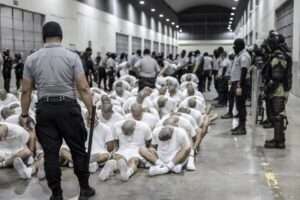
Trump's Alien Enemies Act Deportees Sent Back to Venezuela in Shameful Hostage Deal [Updated]

After being ilegally deported and imprisoned in El Salvador, they will now be sent back to the oppressive regime they fled in the first place, in exchange for ten Americans detained by the Venezuelan government.

|

A prison guard transfers Alien Enemies Act deportees from the U.S., alleged to be Venezuelan gang members, to the Terrorism Confinement Center in Tecoluca, El Salvador. Mar. 16, 2025. (El Salvador Presidential Press Office)


Some 252 Venezuelans illegally deported by the Trump Administration to imprisonment in El Salvador have now been sent back to Venezuela, in exchange for the release of ten Americans detained by the Venezuelan government. Trump had invoked the Alien Enemies Act of 1798 to do the deportations.

This is a bad deal on many levels: It incentivizes further hostage-taking by Venezuela, it returns people who fled oppression back to the very same regime that oppressed them, and it certainly does not stop the administration's illegal and unjust invocation of the Alien Enemies Act.

I've said it before (e.g. - here and here), and I will say it again: hostage exchanges are a terrible idea, because they incentivize more hostage-taking. This deal is likely to incentivize Venezuela's socialist dictatorship to seize more Americans.

In one way, this deal is actually worse than the usual hostage exchange, where a democratic state sends captured terrorists or other operatives back to a terrorist group like Hamas or an authoritarian regime like Russia. Here, the men we are sending back are innocent people who fled an oppressive government, now being forcibly returned to it. Despite the administration's claims they were members of the Tren de Aragua drug gang, there is virtually no evidence this is so, and most have never been charged or convicted of any crime. Some are actually dissidents and regime opponents who face likely persecution upon their return. Even those not specifically targeted by the government will be consigned to what may well be lifelong and oppression and poverty under a brutal regime whose depredations have triggered the biggest refugee crisis in the history of the Western Hemisphere.

There was a time when conservative Republicans would have condemned efforts to return victims of socialism to their oppressors. No longer. But it remains unjust, nonetheless.

I suppose one can argue this is less bad than other hostage exchanges because, unlike, say, released Hamas terrorists or Russian covert operatives, it is highly unlikely the Venezuelans sent back under this deal will go on to harm the US. That is true precisely because the Trump Administration is lying about their supposed gang affiliations! It's a valid point. But not nearly enough to justify this sordid deal, or the illegal deportations leading up to it.

The deal also further reveals what has been clear for some time: the Trump administration lied in court when it claimed the Venezuelans deported to El Salvador were under Salvadoran control, and the US had no way to get them out. In reality, they were detained solely at US behest, and the Salvadorans released them as soon as the US asked. This has been clear for a long time, but is now even more so. Courts should take note, and reject similar administration assertions with respect to any other migrants deported to imprisonment in El Salvador, now or in the future.

The deal also will not put an end to Trump's illegal use of the AEA as a tool for peacetime deportation. Litigation over his further attempts to deport people under the Act is ongoing in multiple federal courts, and several have already ruled against them. For the reasons why these deportations illegal, see the Fifth Circuit amicus brief in W.M.M. v. Trump that I coauthored on behalf of the Brennan Center, the Cato Institute, legal scholar John Dehn, and myself. See also my earlier writings on the AEA  here, here, here, and here.

To briefly summarize, the key point is that AEA may be invoked only in the event of a declared war or "invasion" or "predatory incursion" by a foreign nation or government against U.S. territory, and no such thing has happened here. In addition, Trump's AEA deportations to imprisonment in El Salvador are also blatant violations of the Due Process Clause of the Fifth Amendment.

UPDATE: I suppose I should emphasize I am not suggesting these Venezuelans should have been kept in imprisonment in El Salvador. Rather, they should never have been deported in the first place, and once illegally deported and imprisoned, should have been returned to the US. They also deserve compensation for their illegal imprisonment and resulting pain and suffering.

UPDATE #2: In a court filing today, the Trump Administration claims that Venezuelan dictator Nicolas Maduro has agreed to allow the Venezuelan migrants returned to his control under this deal to go back to the US if 1) a court orders it, 2) the US government is willing to "facilitate" their return, and 3) the person in question agrees. We will see if this is actually true or not, and if so whether the admnistration actually does the necessary "facilitation." Given the awful track records of these parties, there is reason to suspect that the administration, the Maduro regime, or both, may be lying again.

No Special Counsel for the Epstein Suicide Investigation

It would be a terrible idea to appoint a special counsel to investigate the Jeffrey Epstein suicide and scandal.

|

President Donald Trump has had an extraordinary first six months in office. To mention just a few of the great things he has done: (1) President Trump bombed Iran to prevent the most terrorist-friendly nation in the world from getting a nuclear bomb; (2) he then ended the Israeli-Iranian war in 12 days, and stopped a war from starting between two nuclear-armed powers, Pakistan and India, which is a lot more than President Obama ever did to win a Nobel Peace Prize; (3) he has eliminated what had been a torrent of illegal aliens entering the U.S. by crossing the Mexican-American border, which President Biden had allowed; (4) he cut taxes by 4.5 trillion dollars from 2025 through 2034; (5) he is succeeding where even President Reagan failed in eliminating the unconstitutional Department of Education; (6) his Justice Department appears to have persuaded six Supreme Court Justices to recognize that there can't be "independent agencies" in the sense of agencies exercising executive power that are independent of control by the elected executive, agencies that have plagued us since 1935; (7) he has taken on the Deep State by firing more than 50,000 civil service employees as of today; (8) he is already, in his second term, beginning to nominate excellent new federal judges, such as Jennifer Mascott, whom he intends to nominate to the Third Circuit; (9) his Justice Department has persuaded the Supreme Court to end nationwide injunctions; and (10) he has gotten rid of thousands of regulations hampering the oil and gas industries and most other private sector businesses as well.

Given these genuinely important policy decisions—even his opponents will agree that they are important—and others that are currently being considered, the flare-up over the Jeffrey Epstein files is a pointless distraction. Epstein committed suicide in prison six years ago. Jeffrey Epstein is dead and deservedly so. His principal partner in crime, Ghislane Maxwell, was sentenced to twenty years in federal prison, which means she will be in jail until she is 81 years old. President Trump's Attorney General Pam Bondi, who I think is an excellent and experienced prosecutor, has investigated the Epstein matter and found (1) no client list of powerful people that Epstein and Maxwell had worked with; and (2) no evidence that Epstein was murdered six years ago rather than having committed suicide.

There is no reason to doubt Attorney General Bondi's findings. If there had been any evidence that Donald Trump was an Epstein client, would President Biden's Justice Department and FBI have kept it quiet, with no disclosure or leak?

Nor would appointing a Special Counsel help matters. First, as a legal matter the Justice Department's regulation providing for the appointment of Special Counsels is unconstitutional, as Gary Lawson and I explained in Why the Appointment of Robert Mueller Was Unlawful, 95 Notre Dame Law Review 87 (2019).

Second, as Justice Scalia observed in Morrison v. Olson (1988), appointment of Special Counsels is awful policy. With a Special Counsel, an extraordinary amount of money and lawyerly attention gets focused on one matter to the exclusion of other legal criminal claims that might be brought that are much more meritorious. As Justice Scalia noted,

Read More

Politics

Short Circuit: An inexhaustive weekly compendium of rulings from the federal courts of appeal

Longboat Key condos, protective sweeps, and wrong-door raids.

|

Please enjoy the latest edition of Short Circuit, a weekly feature written by a bunch of people at the Institute for Justice.

CA7 friends: The Short Circuit team is heading to downtown Chicago on Sunday, August 17 for a live recording of the podcast on the eve of the Seventh Circuit Judicial Conference. Come watch Sarah Konsky of UChicago Law and Christopher Keleher of Keleher Appellate Law hash things out with us. Click here to learn more.

New on the Short Circuit podcast: What's the difference between legit multi-level marketing and illegit pyramid schemes? Sometimes it's hard to tell.

  1. Accused 9/11 co-conspirators have been in pretrial proceedings before a military commission in Guantanamo Bay for more than two decades. Gov't offers them a plea deal that will spare them the death penalty. The co-conspirators take the deal. Sec'y of Defense: Takesies backsies! Military Judge: No takesies backsies! D.C. Circuit (over a vehement 75-page dissent): Mandamused!
  2. Citizen journalist films open garage at a Secret Service building. Two agents order him to stop and, when he refuses to identify himself, slap cuffs on him. A third agent shows up and tells the others the man is allowed to film. The man sues for violations of his First and Fourth Amendment rights. D.C. Circuit: But he brought Bivens claims so you know how that goes.
  3. Maine voters, upset with the construction of an energy-transmission line through the state that would connect Canadian electricity to Massachusetts, try to stop the project. When that fails, they propose a ballot initiative to use eminent domain to seize the assets of the two Maine corporations building the line. When that fails, they propose a ballot initiative to prohibit American corporations from contributing to ballot initiatives if they have more than 5% foreign ownership. That passes and the two corporations sue. First Circuit: And the law should be preliminarily enjoined. Silencing corporations with 95% American ownership isn't narrowly tailored to preventing foreign influence in Maine elections. Read More

Religion and the Law

Court Blocks Washington Requirement that Clergy Report Child Abuse, Even Learned from Confessions

|

From today's opinion by Judge David G. Estudillo (W.D. Wash.) in Etienne v. Ferguson:

At present, Washington clergy who learn of child abuse or neglect while acting within their official supervisory capacity are required to report such abuse to public authorities. Only information obtained "as a result of a privileged communication" is exempted from this mandatory reporting requirement. Effective July 27, 2025, however, Washington law [SB 5375] will require clergy to report child abuse or neglect regardless of how they learn about such information…. The Court concludes Plaintiffs are likely to succeed on the merits of their Free Exercise Clause challenge ….

There is no question that SB 5375 burdens Plaintiffs' free exercise of religion. In situations where Plaintiffs hear confessions related to child abuse or neglect, SB 5375 places them in the position of either complying with the requirements of their faith or violating the law. In this way, the statute "affirmatively compels them, under threat of criminal sanction, to perform acts undeniably at odds with fundamental tenets of their religious beliefs."

[The law must therefore be judged under the "strict scrutiny" test unless it is neutral and generally applicable.-EV] [A] law is "not neutral and generally applicable, and therefore trigger[s] strict scrutiny … [if it] treat[s] any comparable secular activity more favorably than religious exercise." Tandon v. Newsom (2021)….

SB 5375 modifies existing law solely to make members of the clergy mandatory reporters with respect to child abuse or neglect. However, other groups of adults who may learn about child abuse are not required to report. Parents and caregivers, for example, are not mandatory reporters.

Moreover, the Washington legislature passed Substitute House Bill 1171 ("SHB 1171")—"AN ACT Relating to exempting attorney higher education employees from mandated reporting of child abuse and neglect as it relates to information gained in the course of providing legal representation to a client"—around the same time as it passed SB 5375….The twin passage of SHB 1171 and SB 5375 appears to be a textbook example of "permitting secular conduct that undermines the government's asserted interests in a similar way" to religious conduct that is regulated. The government interest at issue in both statutes—protecting children from abuse and neglect—is the same. Nevertheless, one law eliminates the privilege for clergy while the other expands the privileges available to secular professionals. "The underinclusion is substantial, not inconsequential" here.

Read More

What To Make Of The Leak From The Judicial Conference?

|

Margot Cleveland at The Federalist obtained a copy of a memorandum prepared by the Judicial Conference of the United States. This group includes the Chief Justice of the United States, the Chief Judges of the Federal Courts of Appeals, as well as certain district court judges. Margot did not reveal who authored the memorandum.

To be clear, I have no love for the Judicial Conference. I think they completely botched the judicial reassignment policy. And these august judges haven't said a peep about Judge Pauline Newman's stealth impeachment. Still, I am profoundly troubled by leaks. I don't like leaks from the Supreme Court. And I don't like leaks from other judicial bodies. The deliberations of the judicial conference should more transparent. Trying to figure out what is going on resembles Kremlinology. But as things stand now, they aren't transparent. Cleveland does not say how she got the document. I imagine it would have had to come from a judge, or perhaps someone on a judge's staff. No matter how you slice it, this leak is bad.

I suppose if I am being consistent, I should call on the presiding officer of the entity that had the leak to resign. But I repeat myself.

Now, onto the substance. Here is how Cleveland describes the memorandum:

During the week of March 11, 2025, members of the Judicial Conference met in Washington, D.C., for the first of its two regular meetings. . . .

In a memorandum obtained exclusively by The Federalist, a member of the Judicial Conference summarized the March meeting, including a "working breakfast" at which Justice Roberts spoke. According to the memorandum, "District of the District of Columbia Chief Judge James Boasberg next raised his colleagues' concerns that the Administration would disregard rulings of federal courts leading to a constitutional crisis."

"Chief Justice Roberts expressed hope that would not happen and in turn no constitutional crisis would materialize," according to the memorandum. The summary of the working breakfast added that Chief Justice Roberts noted that "his interactions with the President have been civil and respectful, such as the President thanking him at the state of the union address for administering the oath."

I have a few tentative observations.

First, I find it fascinating that Chief Justice Roberts relayed his conversation from the State of the Union. If I had to guess, Trump exchanged these kind words during the pleasantries as he entered the Chamber. But, as readers recall, Chief Justice Roberts bolted out of the chamber after Trump finished speaking. And Justice Barrett gave Trump a sideways glance after shaking his hand.

Second, I find it even more fascinating that Roberts is serving as a voice of reason, pushing back at the notion that he doesn't think Trump will ignore court orders. Roberts did flag this issue in his end-of-year message, but he is at least giving Trump some space.

Third, it seems clear that Judges like Boasberg lost trust in Trump, before any cases were assigned to him. And that lack of trust pervaded his Saturday emergency TRO hearing, where he ordered planes to turn around. If Boasberg followed a presumption of regularity, he would not have issued such an order.

Margot suggests this memorandum reveals bias on the part of Judge Boasberg and others. I suspect this report will give rise to a motion to recuse. I would like to see the full memorandum. And perhaps in the interest of full disclosure, Judge Boasberg should reveal his position here.

Politics

"At Times, Filings by Pro Se Litigants and Attorneys Alike Are Wholly Nonsensical, but Pointing That Out" Doesn't Justify Recusal

|

Words of wisdom from Judge Jennifer Dorsey (D. Nev.) last week in Naessens v. Breslin:

[The self-represented plaintiff] takes issue with an order of mine in an unrelated case calling a pro se plaintiff's filings "wholly nonsensical" and argues that such language "suggests an undue predisposition against unrepresented parties."

Naessens … fails to show that I treated him or his allegations unfairly because of his pro se status. At times, filings by pro se litigants and attorneys alike are wholly nonsensical, but pointing that out does not supply a legal basis for recusal….

More