The Volokh Conspiracy

Mostly law professors | Sometimes contrarian | Often libertarian | Always independent | Est. 2002

The Volokh Conspiracy

asylum

Fourth Circuit Rules Performing Forced Labor as a Cook for a Terrorist Organization Does Not Count as "Material Support" for Terrorism that Precludes a Migrant From Getting Asylum

The 2-1 ruling got the right result, but not entirely for the right reason.

|

NA

It has been understandably obscured by other news. But, on September 2, in Ozurumba v. Bondi, the US Court of Appeals for the Fourth Circuit ruled that performing forced labor for a terrorist organization does not qualify as "material support"for terrorism barring a migrant from applying for asylum in the United States.

The 2-1 decision broke with a 2018 ruling by the Justice Department Board of Immigration Appeals, in Matter of A-C-M, which held that even "de minimis" forced labor for a terrorist organization qualifies as material support (regular federal courts are not bound by BIA precedents). A-C-M may be the worst modern judicial decision I have seen issued in over twenty years as a legal scholar. So I am glad the Fourth Circuit ruled a different way. But I fear the majority opinion by Judge Andrew Wynn didn't pick up on the best rationale for that result.

As the Fourth Circuit recounts in detail, Izuchukwu Ozurumba, a Nigerian migrant seeking asylum, had - some years earlier -  taken a job as a seemingly innocuous cook. When he discovered that the job actually involved preparing meals for leaders of a Nigerian terrorist insurgent group - the Unknown Gunmen - he tried to quit. But members of the terrorist group forced him to stay, on pain of death. He worked without pay for several more months until he was able to escape.

Judge Wynn's majority opinion argues at length that Ozurumba's cooking wasn't significant enough or closely enough connected to acts of terrorism to qualify as "material support." In dissent, Judge Julius Richardson argues that cooking is indeed material support, because the terrorists need to be fed in order to carry out their heinous acts; he quotes the famous adage that "an army marches on its stomach."  I think Judge Wynn, overall, has the better of this debate, and he is certainly right to reject the de minimis standard adopted by the BIA in A-C-W. But both sides in this exchange have some reasonable points.

What both mostly neglect is that there is a much easier and more compelling basis for resolving this case: forced labor cannot qualify as "material support," no matter how valuable it was to the terrorists, because "material support" must be a voluntary act. As I explained in a 2021 article about the A-C-W case:

In the asylum context, providing "material support" to terrorists should be an at least somewhat voluntary activity. Slave labor surely does not qualify.

A slave laborer forced to work for terrorists is not a threat to American security, nor can she said to be a true supporter of the terrorist organization. Read in context, the word "support" should be interpreted as something akin to "willingly aid," not accidentally and surely not by performing forced labor.

The majority cited an earlier 2016 BIA decision holding that the "material support" statute does not include an exception for "duress." That ruling, too, is egregiously wrong (though less so, since it involved a far less extreme degree of coercion), and should have been overruled (as the Board had the power to do). Moreover, slavery backed by the threat of death, goes well beyond mere ordinary duress. If nothing else, equating slave labor with material support for terrorism is precluded by the longstanding canon against absurdity in legal interpretation, a rule that even most strictly textualist judges, such as the late Justice Antonin Scalia, adhere to.

The point of the "material support" rule is to keep out potentially dangerous terrorists. Slave laborers are not such terrorists; they are their victims. If anything, they are less likely to sympathize with the terrorists than people who have never had any contact with terrorist groups at all.

As noted in my 2021 article, this is an important issue affecting a substantial number of people. Tragically, a good many terrorist groups use forced labor. ISIS was a particularly notorious example. Categorically excluding all of these victims of terrorism from eligibility for asylum is perverse.

The Fourth Circuit majority avoided the duress issue, because it is not clear whether an earlier 2012 Fourth Circuit decision holding there is no "duress" exception to the relevant statute is still binding after the end of Chevron deference to executive branch agency interpretations of law (the previous ruling was based on such deference). Judge Richardson in his dissent indicates he agrees with the view that there is no duress exception at all.

The 2012 ruling involved a less severe form of duress than actual slave labor; the migrant in that case was allowed to leave, if he wanted to, though he would have had to give up his home to the terrorists if he refused to help them. Thus, the current panel should have distinguished it. In any event, the idea that there is no duress exception at all to this law is so egregiously ridiculous that the agency view did not deserve any deference even under Chevron (which required such deference only if the agency's view was "reasonable").

Some legal issues are genuinely difficult. This one just simply isn't. The idea that performing slave labor for a terrorist organization on pain of death qualifies as "material support" for terrorism is simultaneously cruel and absurd.  It's distressing that some jurists keep getting it wrong.

UPDATE: It's worth nothing that, if people performing forced labor for terrorist organizations qualify as providing "support" for terrorism, then by the same logic, many Holocaust survivors must be considered as providing "support" for the Nazis. After all, many of them were forced to work as slave laborers!

A Note on Toleration -- Religious and Political

A brief reflection in light of yesterday's assassination and the political moment.

|

At times like this it is worth considering and reflecting upon the history and principles of religious toleration. We often lost sight of just how demanding and challenging calls for religious toleration were in prior times.

Religious toleration was not about being nice to people with different customs or holidays, let alone approving or affirming them, but something far more profound. At heart, religious toleration was about sharing civic space with those who disagreed profoundly about the most fundamental questions of human nature and morality, who rejected divinity and truth, who spread heresy and threatened the eternal damnation of immortal souls. For a religious people, the stakes could not have been higher, and yet toleration was called for.

It may be hard to fully comprehend what principles of religious toleration demanded, but it matters. If a religious adherent could be asked to tolerate those of another faith--those who are, by definition, profoundly wrong--we should be able to tolerate those who disagree about mere matters of politics or policy.  Indeed, even if--or especially if--politics has supplanted religion for many people, toleration is essential for a free, diverse, and democratic republic to survive.

Ezra Klein on Charlie Kirk (Updated)

"Charlie Kirk Was Practicing Politics the Right Way"

|

From Ezra Klein's column in today's New York Times:

The foundation of a free society is the ability to participate in politics without fear of violence. To lose that is to risk losing everything. Charlie Kirk — and his family — just lost everything. As a country, we came a step closer to losing everything, too. . . .

You can dislike much of what Kirk believed and the following statement is still true: Kirk was practicing politics in exactly the right way. He was showing up to campuses and talking with anyone who would talk to him. He was one of the era's most effective practitioners of persuasion. When the left thought its hold on the hearts and minds of college students was nearly absolute, Kirk showed up again and again to break it. Slowly, then all at once, he did. College-age voters shifted sharply right in the 2024 election.

That was not all Kirk's doing, but he was central in laying the groundwork for it. I did not know Kirk and I am not the right person to eulogize him. But I envied what he built. A taste for disagreement is a virtue in a democracy. Liberalism could use more of his moxie and fearlessness. In the inaugural episode of his podcast, Gov. Gavin Newsom of California hosted Kirk, admitting that his son was a huge fan. What a testament to Kirk's project. . . .

Kirk and I were on different sides of most political arguments. We were on the same side on the continued possibility of American politics. It is supposed to be an argument, not a war; it is supposed to be won with words, not ended through bullets. I wanted Kirk to be safe for his sake, but I also wanted him to be safe for mine, and for the sake of our larger shared project. The same is true for Shapiro, for Hoffman, for Hortman, for Thompson, for Trump, for Pelosi, for Whitmer. We are all safe, or none of us are.

As they say, read the whole thing.

UPDATE: Most of the critical responses to Klein's piece I've seen focus on the substance of Kirk's politics. In this regard I think they miss the point. That said, there is an argument that insofar as Kirk embraced and advanced an illiberal agenda that threatens democracy and (ultimately) the civic discourse in which Kirk was participating. This piece by Nick Catoggio makes that point. I am unconvinced--for the same reason I reject the argument that one need not tolerate the intolerant--but it is a serious view.

Anti-Semitism

"Are You a Jew? … Are You a Zionist?"

Federal judge allows "pattern or practice" claim of discrimination against Jews by coffee shop to go forward.

|

From yesterday's decision by Judge Susan Illston in U.S. v. Harara:

For purposes of this motion to dismiss, the Court treats as true the factual allegations as stated in plaintiff's complaint and draws all reasonable inferences in plaintiff's favor….

The Jerusalem Coffee House [which Harara owns] is a business establishment open to the general public. The coffee house is located on the premises of the East Bay Community Space, "which regularly hosts events that are open to the general public for exhibition or entertainment …."

According to the complaint, on June 10, 2024, Michael Radice—who is Jewish—went to the East Bay Community Space "for the purpose of viewing the establishment for a fundraising event for his organization." Radice was wearing a dark blue baseball cap with a light blue Star of David and white Hebrew lettering. As he approached the community space from the side where the coffee house is located, a man sitting at a table in front of the coffee house asked, "Are you a Jew?" Radice answered in the affirmative. The man then asked, "Are you a Zionist?" Radice declined to respond.

The complaint alleges that "[t]he man then began shouting numerous accusations at Mr. Radice, including that he was complicit in Israel's military actions in the Gaza Strip following the October 7, 2023 Hamas attacks and guilty of 'killing children.'" As Radice began to walk away, the man stood up and asked, "Where are you going?" The complaint alleges, "Mr. Radice saw another man, whom he later learned was Harara, walk out of the coffee house and speak to the man, and the two went inside."

Read More

Free Speech

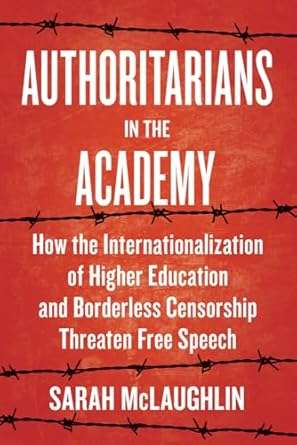
"Authoritarians in the Academy": The National Security Law and the Shuttering of Academic Freedom in Hong Kong

|

Timing is everything. As I explain in my book Authoritarians in the Academy: How the Internationalization of Higher Education and Borderless Censorship Threaten Free Speech, the overlap in 2020 of the Zoomification of society due to COVID-19 restrictions with the passage of Hong Kong's national security law created a speech and privacy nightmare for higher education.

On June 30, 2020, Beijing enforced the national security law in Hong Kong, targeting alleged acts of separatism, subversion, terrorism and collusion with foreign countries. It was a vaguely-worded legislative weapon handed to authorities to crush the city's vibrant democracy and protest movements. But it did even more than that. The law was also explicitly written to apply to acts committed "outside the region by a person who is not a permanent resident of the region."

That means anyone, anywhere in the world, at any time, can violate this law.

For the hundreds of thousands of students moving to and from mainland China or Hong Kong and foreign campuses, to the academics who study the region, and for those with family in the city, it created a cloud of fear. They already had to contend with the possibility of violating the law with even anodyne political statements and facing arrest when stepping foot in the region. But with everything in higher education taking place online during the pandemic's early days, from classroom discussions to political debates among friends, the risk that offending statements could be surveilled and catalogued rose skyrocketed.

And as I document in my book, even American campuses were not immune to the law's shadow.

In today's excerpt from the book, though, I'd like to detail the effects of the laws within Hong Kong's education system itself, as a primer on how swiftly such laws can wholesale silence dissent.

Read More

Politics

9/11/2001 in Staten Island, New York

My annual remembrance of September 11, 2001.

|

I post this essay every year in honor of September 11th, 2001 (see 2010201120122013201420152016201720182019202020212022, 2023, 2024).

Every generation has a defining moment. For my generation, it was 9/11/2001.

Here are my memories of 9/11/2001. It was a Tuesday.

I was a Senior at Staten Island Technical High School, which is about 20 miles from ground zero. We were about 1 week into the school year. I was sitting in Ms. Endriss's 2nd Period A.P. Political Science class. We were going over some NYC Public School discipline policy, and discussing what kinds of weapons were forbidden in schools (brass knuckles were a no-no). A student walked into the classroom late. He had heard a rumor that a Cessna airplane had hit the World Trade Center. A girl in my class exclaimed that her father worked in the World Trade Center. I could see the look of fear in her eyes, even though none of us had any clue what was going on. She wanted to call her dad. I was the only student in the class with a cell phone, which I promptly gave her. The call did not go through–he worked on one of the upper floors of the tower, and passed away.

We finished second period, apprehensively. I logged onto a computer, and attempted to check the news. I recall one friend told me to check MTV.com for news. At that point, the reports were unclear, and no one knew what was going on. We proceeded to 3rd period A.P. Calculus with Mr. Curry. At that point, someone told us that it was not a Cessna, but in fact a passenger jet. We were all getting nervous, and didn't quite know what was going on. Later in class, a student came into the class and said a second plane had crashed into the other tower. We also heard that there was an explosion at the Pentagon. At that point, we knew it was not an accident.

I remember leaving the class (something I never did) and walked up to the library where I knew there was a T.V. Just as I arrived in the library, I saw the first tower collapse. I watched it live. I was stunned and could not believe what was happening before my eyes. I grabbed my cellphone to call home, and almost immediately after the tower collapsed, I lost all service. I was not able to call my mom in Staten Island, though I could call my dad who was working in Long Island. Long distance calls seemed to work, but local calls were not working. I remember my dad told me that this was a life-changing event, and he had no idea what would happen. I heard some rumors on TV that there were 15 planes that were hijacked, and unaccounted for in the skies.

By lunch time, the school guidance counselor set up a conference room where students could go to talk. I remember seeing student after student who had a family member or friend who worked in the World Trade Center or in Manhattan. A large number of firefighters and police officers reside in Staten Island. Tragically, many of the emergency responders who perished were from Staten Island. What could we even tell those students?

After that, the day become a blur. I remember hearing that the second tower had collapsed, though I did not see it.  I remember watching the entire United States Congress sing God Bless America on the steps of the Capitol. I had never been so afraid in my life. Later that night, I took a bus home. The New York City public buses were still running, and I remember the driver was not collecting fares.  On the bus, people were talking about the imminent war (against whom,  no one knew) and the imminent draft. Some were saying that students were exempt from the draft.

The next morning, September 12, 2001, I woke up and smelled this horrible smell. The air had this pungent odor, that reminded me of burned flesh at a BBQ. I went to school that morning, and attendance was low. In all of my classes, we were talking about war. I asked whether the US would need to use nuclear weapons. My teacher explained that carpet bombing–a phrase I had never heard of–could wreak plenty of damage in Afghanistan. Later that week students began making sandwiches for the relief workers, and collecting goods to donate to the relief effort.

From Staten Island, I could see the smoldering Ground Zero. It was surreal. The skyline looked so very empty. To this day, whenever I look at the Skyline, a sight I had seen thousands of times, I have the most bizarre feeling. Additionally, whenever we saw an airplane fly overhead, we all freaked out. This lasted for months.

For days, weeks, and months after 9/11, people in Staten Island were waiting for their loved ones to come home. Many patients were alive, but were so badly burned that they could not be identified. People prayed that these unnamed patients would soon come home. One woman whose husband was a firefighter waited outside her home every single night for months. She eventually put a candle in her window every night. Later, she put a memorial lamp in her window. He never came home. Others were simply waiting for remains of their loved ones to be returned. Many were never identified.

I ordered a gas mask from eBay, which I kept in my car, fearing a biological weapon attack on New York City. I remember I tried it on once and I almost suffocated. I wanted to order some Cipro for an anthrax attack, but I could not locate any.

It is hard to encapsulate what a New Yorker went through on 9/11. Thinking back on that day, when I was just 17 years old, I realized that I had to grow up awfully quick. It was a new world we were living in.

Never forget. Ever.

On Charlie Kirk's Assassination

Every time a controversial speaker steps foot on a college campus, there is a risk.

|

In 2018, I was protested at the CUNY Law School. Thankfully, the students did not engage in any acts of physical violence, but I was well aware that things could have turned south quickly. Immediately after the event, I went home to see my parents in Staten Island. My mom and dad were mortified at what happened to me. They were concerned for my physical safety. They implored me to never speak at another law school again.

You can gather I did not heed their advice. I decided, for better or worse, that the messages I bring to other schools are very important, and there would be a significant loss were I to stand down. Still, every time I step foot on a campus,  I realize there is a risk. I fully recognize that most law schools lack sufficient resources to protect me as a speaker. Some schools require visitors to check in at a reception desk. Others do not. Virtually no schools have any sort of security checks at the door. I am not (yet) at the level where I need to bring my own security detail. I am truly at the mercy of whatever students decide to do.

This realization flashed before my eyes as I learned the tragic news of Charlie Kirk's assassination. Kirk became one of the most influential conservatives in America. To his credit, he traveled across the country, and was willing to engage and debate on some of the most contentious issues in society. And by all accounts, it seems that Kirk's controversial views led to his assassination.

One response to his craven killing would be to cower, and stop speaking on controversial issues. That surely is the path of least resistance, and I would not begrudge someone who takes that path. Another response is to resolve to speak more boldly about that which matters the most.

It is easy enough for people who are not on the speaking circuit to opine on how to proceed. (Much like people who have never written anything longer than anonymous comments feel qualified to attack regular bloggers.) But these people aren't the ones who have to wake up at the crack of dawn, board a crowded flight, rent a car in some foreign city, show up at an event where you are vulnerable and exposed, and then try to get some sleep at a generic hotel. The lifestyle of a public speaker may seem glamorous, but it is not. And now, with Kirk's assassination, the cost of public speaking becomes even greater.

I think FedSoc speakers, and other fellow travelers, will need to give more thought to security and safety.

I already have a host of events scheduled this semester, which I don't plan to cancel. Long-time readers may have observed that I no longer post my travel schedule in advance. I stopped doing so after the CUNY protest, so I would not make it easier for protesters to plan.

Noem v. Perdomo Is Grants Pass Redux

Can the government criminalize the state of being?

|

I continue to mull over Noem v. Perdomo. This case is different from recent emergency docket orders, which typically involve questions about administrative law and presidential power. Noem considers a more traditional constitutional dispute about the Fourth Amendment. In recent years, the Court has granted very few Fourth Amendment petitions. There is one case this year about the emergency-aid exception. So perhaps it is unusual for the Supreme Court to jump back into the CrimPro fray on the emergency docket.

But taking a step back, Noem may just represent where the current Court is on matters of criminal procedure. We have seen the Justices pivot to the right on a number of issues. But so far, the Fourth Amendment has not been affected. The last big Fourth Amendment case, Carpenter, was decided in 2018, while Justice Kennedy was still on the Court!

Where is the Roberts Court now on these issues? I think the most useful analogue to understand Noem may actually be City of Grants Pass v. Johnson. That case involved the Eighth Amendment, but the issues are related: can the state prohibit the "status" of being homeless? To be sure, the majority, per Justice Gorsuch, narrowly ruled that it was the conduct of camping that was bring criminalized. But I think Justice Sotomayor's dissent made the compelling point that people without homes have to sleep somewhere, and the state's law makes it a crime to simply be. As I put it, No homeless in the park.

The analogy between Grants Pass and Noem is apt. Under federal law, the mere status of being in the country illegally is an offense--not criminal, but the distinction doesn't matter here. There is no respite from this offense, which exists wherever an alien might be found--including while working. Justice Kavanaugh writes:

The interests of individuals who are illegally in the country in avoiding being stopped by law enforcement for questioning is ultimately an interest in evading the law. That is not an especially weighty legal interest.

I think what Justice Kavanaugh is saying here, is that the Fourth Amendment "reasonableness" inquiry must be different when the federal government is enforcing immigration laws. The fact that simply being illegal is itself an evasion of the law grants the government greater leeway in detaining suspected illegal aliens to check their immigration status. Two of the factors being considered are the person's apparent race or ethnicity, and whether they spoke Spanish with an accent. The government can consider these factors in the immigration context, even if they could not be considered in more routine law enforcement stops.

Mike Dorf wrote a post titled, "Working While Brown is the New Driving While Black." The title is provocative, to be sure, but I think it masks how the analysis here differs. A highway patrol officer should not consider a person's race, ethnicity, or language, when looking for traffic offenses, because none of those characteristics are themselves indicia of breaking traffic laws law. By contrast, factors like race, ethnicity, and language, combined with other factors, could be indicia of the person being in the United States in violation of immigration laws.

I do not think the Court is prepared to challenge longstanding precedents about racial profiling in traditional law enforcement contexts. To return to Dorf's post, a black person has every right to drive without being unlawfully detained based on their race. By contrast, according to Justice Kavanaugh, an illegal alien--or at least a person very likely to be an illegal alien--has no such right to not be detained. As Justice Kavanaugh explains, their interest in not being stopped is not "weighty."

Like in Grants Pass, Justice Sotomayor is in dissent pointing out the difficulties for people who lack the right to simply exist in their community--whether the homeless or illegal aliens. I think she effectively makes the policy argument, but the majority sees it differently.

Big picture, Justice Kavanaugh is signaling that the Court will allow the executive branch leeway to enforce federal immigration laws, even if past administrations failed to take these steps.

I highlighted this passage in my post yesterday:

To be sure, I recognize and fully appreciate that many (not all, but many) illegal immigrants come to the UnitedStates to escape poverty and the lack of freedom and opportunities in their home countries, and to make better lives for themselves and their families. And I understand that they may feel somewhat misled by the varying U. S.approaches to immigration enforcement over the last few decades. But the fact remains that, under the laws passedby Congress and the President, they are acting illegally by remaining in the United States—at least unless Congress and the President choose some other legislative approach tolegalize some or all of those individuals now illegally present in the country. And by illegally immigrating into and remaining in the country, they are not only violating the immigration laws, but also jumping in front of those noncitizens who follow the rules and wait in line to immigrate into the United States through the legal immigration process.

I think this passage, in a nutshell, summarizes how the Court will approach immigration cases. Justice Kavanaugh is at his best when he is explaining novel concepts that the Court hasn't yet gotten around to. Stay tuned till a case like this reaches the merits docket.

The Racial Identity of Sephardic and Mizrahi Jews

|

An interesting new report was published about non-Ashkenazi Jewish communities in the US, focusing on Persian Jews in the Los Angeles area, Syrian Jews in Brooklyn, Bukharan Jews in Queens, and Sephardic Jews in South Florida. Naturally, I was especially interested in the section about how these Jews interact with American racial classifications:

Sephardic Jews themselves have varied perspectives on US racial and ethnic categories. When asked, some Sephardic Jews identify as white, others as Asian, Black, Hispanic, and Middle Eastern, but many reject US racial and ethnic categories altogether because these classifications do not reflect their experiences in their countries of origin nor represent their self-understanding.

The overwhelming majority of our interviewees—Syrian, Bukharian, Hispanic, Persian, and other Jews from the MENA (Middle East and North Africa) region—told us they do not identify with the category of Jews of color.

In my own experience talking to Jews from Israel from non-Ashkenazi backgrounds who immigrate to the US, they are bewildered when they arrive by the classification boxes they are expected to check. Their personal identities are some combination of Israeli, Jewish, country of recent origin (Iraqi, Yemenite, Bulgaria, etc), and Mizrahi. An sometimes they have very strong sub-identities with those categories (e.g., eighth generation Israeli, national-religious Jewish, Kurdish Iraqi). But when they come to the US, they are expected to choose an identity ("Hispanic," "White," "Asian,") that does not even overlap with their personal identities.

It will be interesting to see how the Biden administration's promulgation of a new MENA (Middle East and North African) classification affects American Jewish identity. My short editorial comment is that a classification that includes Israeli Jews, Egyptian Copts, Lebanese Shi'ites, Turkish Sunnis, Iraqi Chaldeans, and much more isn't a very coherent category. To a significant extent it's meant to be a proxy for Arab Americans or Muslim Americans, but a very large percentage of the cohort is either not Arab, not Muslim, or neither.

Second Amendment Roundup: 2nd Circuit Upholds Connecticut's Semiautomatic Firearm Ban

The court substitutes an “unusually dangerous” test for Heller’s “dangerous and unusual” test.

|

In National Association for Gun Rights v. Lamont, the Second Circuit decided that a Second Amendment challenge to Connecticut's ban on many semiautomatic firearms does not have a likelihood of success.  The court assumed that possession of the firearms is constitutionally protected per Bruen's textual step 1, but held that the ban is consistent with our Nation's historical tradition of firearm regulation under step 2.  That conclusion is in blatant conflict with Heller's holding that arms that are in common use are protected by the Second Amendment and may not be banned.

Connecticut defines "assault weapon" to include a semiauto centerfire rifle that accepts a detachable magazine and one "military-style" feature, a .22 rimfire rifle with two such features, a list of firearms based on make and model, and an "other" category which applies to a pistol with a stabilizing brace.  The feature of the pistol grip is supposedly for "spray[ing] … a large number of bullets … without having to aim," which would actually mean fewer hits.  If that is true, why do single-shot rifles and even airguns, including those used in the Olympics, have similar pistol grips?  Check out the precision Feinwerkbau air rifles here.

A "telescoping stock" supposedly makes a rifle "easier to conceal," even though it still meets the minimum overall length for rifles.  Flash suppressors allegedly "help shooters avoid detection," but in reality reduce blinding in low-light conditions, such as home defense at night.  Such are the usual clichés that bear no relation to reality, as I've explained in detail in America's Rifle.

Plaintiffs brought a facial challenge but provided no evidence for many of the law's provisions, and thus could not show that no set of circumstances existed under which the entire statute would be valid under the Salerno rule.  The court thus focused on the law as applied to AR-15 type rifles, a .300 Blackout "other" firearm, and magazines with a capacity of over ten rounds.  Following Supreme Court precedent, the distinction between facial and as-applied challenges "goes to the breadth of the remedy employed by the court, not what must be pleaded in a complaint." See Citizens United v. Fed. Election Comm'n (2010).

The court thus decided that it could "consider partial invalidation … when evaluating facial challenges," adding that it "accept[ed] Plaintiffs' theory that we may consider their challenge as limited to the portions of the statutes restricting possession of their desired firearms and magazines and proceed to consider the constitutionality of only those specific sections of the statutes."

The court quoted U.S. v. Miller (1939) as holding "that the sorts of weapons protected were those 'in common use at the time,'" to which D.C. v. Heller (2008) added that limitations on Second Amendment protections for certain types of arms are "fairly supported by the historical tradition of prohibiting the carrying of 'dangerous and unusual weapons.'"  The court then proceeds blatantly to reject that test.  While "assuming arguendo that the desired firearms and magazines are 'typically possessed' and 'in common use," for lawful purposes, the court states, they may nonetheless be banned if they are "unusually dangerous," a term never used by the Supreme Court.

Under Heller, once it is clear that the arms that are banned are in common use, that ends the matter – the ban is unconstitutional.  D.C. argued that handguns are used in most violent crimes, including mass shootings, and are unnecessary for self-defense.  D.C.'s amicus Violence Policy Center recounted such tragedies, noting, "In the recent Virginia Tech shooting, a single student with two handguns discharged over 170 rounds in nine minutes, killing 32 people and wounding 25 more."  Heller rejected those arguments and held that handguns are in common use for self-defense by American citizens, and they – not the government – get to decide their preferred arms.

Bruen repeated that holding and added that a ban on carrying handguns was not justified by proper historical analogues.  Bruen also reflected: "While the historical analogies here and in Heller are relatively simple to draw, other cases implicating unprecedented societal concerns or dramatic technological changes may require a more nuanced approach."  (Emphasis added.)  Heller's common-use test applicable to arms-ban cases, and Bruen's text-history test applicable to carry-ban cases, are simple to follow and are not the "other cases" that are subject to "a more nuanced approach" based on "unprecedented societal concerns or dramatic technological changes."  Such "concerns" and "changes" have no application to the tests that Heller and Bruen have decided.  For a detailed analysis, see Mark W. Smith, What Part of "In Common Use" Don't You Understand? How Courts Have Defied Heller in Arms-Ban Cases—Again, JLPP (2023).

That leaves Connecticut's ban on firearms and magazines that are not "dangerous and unusual" (i.e., in common use) unconstitutional.  Heller, Bruen (5 times), and Rahimi consistently used the term "dangerous and unusual," as did James Wilson and other treatise writers quoted by the Court.  The term "dangerous or unusual" appears only when the Court quoted Blackstone, who wrote that "riding or going armed with dangerous or unusual weapons, is a crime against the public peace, by terrifying the good people of the land." That described the offense of an affray, which requires riding or going armed to terrorize others, not mere possession of any type of arm.

Departing from the Supreme Court's clear statements, the court asserts that "both the conjunctive and disjunctive formulations were traditionally understood as meaning 'unusually dangerous.'"  For that it cites nothing more than the declaration of non-lawyer, history professor Saul Cornell.  Doubling down, Judge Nathan states in his concurring opinion, joined by the other two panel judges: "It would seem a serious subversion of our commitment to history to enshrine a conjunctive test based on the Heller opinion's possible misquote of Blackstone."  So Supreme Court "misquotes" must be corrected by a supposed expert witness.

"Unusually dangerous," the court continues, identifies weapons that legislators presume "are not used or intended to be used for lawful purposes," contrary to the actual use and intended use by millions of Americans.  The overwhelming actual use of AR-15 rifles is target shooting, and their intended use for countless Americans includes self-defense.

The court repeats the Fourth Circuit's characterization in Snope v. Brown of Heller's common-use test as a "trivial counting exercise" that would sanction protection for "the W54 nuclear warhead" if it became popular before the government could ban it.  As Justice Thomas wrote dissenting from denial of cert in Snope, "To fend off the fantastical threat of Americans lobbing nuclear warheads at one another, the Fourth Circuit has allowed the very real threat of the government depriving Americans of the rifle that they most favor for protecting themselves and their families."

The court finds that "assault weapons" represent "dramatic technological changes," ignoring that semiautomatic rifles that use detachable magazines have been commonly possessed since the turn of the twentieth century.  Heller characterized the argument as "bordering on the frivolous, that only those arms in existence in the 18th century are protected by the Second Amendment," which "extends, prima facie, to all instruments that constitute bearable arms, even those that were not in existence at the time of the founding."  Heller's common-use test already accounts for technological changes by ensuring that the Second Amendment's protection extends to all firearms that are in common use at the time a court conducts the "in common use" analysis.

While historically "mass murders … involved the use of multiple people and multiple weapons," the court continues, the banned firearms allow "a single gunman carrying out a mass murder in seconds."  Heller rejected such arguments in invalidating the handgun ban.  And it goes without saying that there are few limits to the depravity that may occur regardless of the type of weapon.  One arsonist murdered 87 people at the Happy Land Nightclub in the Bronx in 1990.  Mass stabbings occur in countries that ban firearms, e.g., Japan's 2016 Sagamihara massacre in which a knife wielder murdered 19 people and injured 26.

The court states that "the AR-15 is more lethal … than ordinary handguns," but it is no more lethal than the semiautomatic Ruger Mini-14 which, the court concedes, Connecticut does not ban.  Both rifles are available in the .223 Remington cartridge, which the court fantastically claims "exacts serious injuries tantamount to being shot 'with a Coke can.'" Seriously?  That round is not even powerful enough for deer hunting!

The court further asserts that "the AR-15, unlike an ordinary handgun, has features that actually limit its usefulness for self-defense."  It's supposedly "more difficult to use," although many find a rifle easier to use than a handgun.  Recall that the District of Columbia and its amici argued in Heller that rifles are more suitable for self-defense than handguns.  And Heller held that the people, not the state, get to decide what to use for self-defense.

The court next moves on to the following dramatic claim about historical "comparators": "Like the weapons regulated by the challenged statutes, dirk and Bowie knives were technological advancements over ordinary defensive arms because they were designed 'expressly for fighting,' with longer blades, crossguards to protect fighters' hands, and clip points to facilitate cutting or stabbing adversaries."  Technological advancements?  Medieval daggers and other edged weapons had those features and more.  A visit to the arms and armor collection at the Museum of Art in Philadelphia brings that technology to life.

Moreover, the court ignores Bruen's contrast between medieval lances and daggers as follows: "In the medieval period, '[a]lmost everyone carried a knife or a dagger in his belt.' … While these knives were used by knights in warfare, '[c]ivilians wore them for self-protection,' among other things…. Respondents point to no evidence suggesting the Statute [of Northampton] applied to the smaller medieval weapons that strike us as most analogous to modern handguns."

As the court concedes, the antebellum states that regulated edged weapons mostly only banned concealed carry.  The court partially quotes Aymette v. State (Tenn. 1840), that "[t]he Legislature … ha[d] a right to prohibit the wearing or keeping [of] weapons dangerous to the peace and safety of the citizens…." But the court deleted the rest of the sentence adding "and which are not usual in civilized warfare, or would not contribute to the common defence." Aymette thus upheld the right to keep the very kinds of "military-style" arms that the court says can be banned.

The court also cites Cockrum v. State (Tex. 1859), which rejected a constitutional challenge to a law imposing higher penalties for murder committed with a Bowie knife or dagger.  Far from supporting a possession ban, Cockrum stated, "The right to carry a bowie-knife for lawful defense is secured."  Nor does the court's position  find support in State v. Workman (W. Va. 1891), which opined that the "arms referred to in the [second] amendment" are "the weapons of warfare to be used by the militia."

The court concludes that it joins "the First, Fourth, Seventh, Ninth, and D.C. Circuits (every Circuit to address the question) in approving restrictions on assault weapons and large capacity magazines."  That's because most states don't ban such arms and the courts in those states thus do not have occasion to opine thereon.  All the more reason for the Supreme Court to take up this issue, as Justice Kavanaugh suggested when cert was denied in Snope, stating that "this Court should and presumably will address the AR-15 issue soon, in the next Term or two."


 

Tariffs

Supreme Court Will Hear Our Case Challenging Trump's Tariffs - and Two Other Related Cases

The cases will be considered on an accelerated schedule.

|

NA

Today, the Supreme Court decided to review V.O.S. Selections, Inc. v. Trump, our case challenging President Trump's "Liberation Day" tariffs. The case was filed by the Liberty Justice Center and myself on behalf of five small businesses harmed by the tariffs. It is consolidated with a similar suit filed by twelve state governments, led by the state of Oregon. Both challenge massive tariffs Trump has imposed using his supposed authority under the International Emergency Economic Powers Act of 1977 (IEEPA), and both will now be heard on the same accelerated schedule. The Supreme Court also decided to hear Learning Resources v. Trump, a case challenging many of the same tariffs, filed by two importers in a different federal court.

We, the twelve states, and the Learning Resources plaintiffs all prevailed in the lower courts, and I hope the Supreme Court will also recognize the IEEPA tariffs are illegal for a variety of reasons. Fundamentally, these cases come down to whether the president has virtually unlimited power to impose taxes in the form of tariffs on the American people, much like an absolute monarch. The Framers of the Constitution deliberately denied the executive the kind of unbridled tax authority claimed by power-grabbing English kings, like Charles I.

The Court's order is short. For convenience, I reprint it here in full:

LEARNING RESOURCES, INC., ET AL. V. TRUMP, PRESIDENT OF U.S., ET AL. [24-1287]
TRUMP, PRESIDENT OF U.S., ET AL. V. V.O.S. SELECTIONS, INC., ET AL. [25-250]

The petition for a writ of certiorari before judgment in No. 24-1287 is granted. The motion to expedite and the petition for a writ of certiorari in No. 25-250 are granted. The cases are consolidated, and a total of one hour is allotted for oral argument. Respondents in No. 24-1287 and petitioners in No. 25-250 shall file an opening brief on the merits on or before Friday, September 19, 2025. Any amicus curiae briefs in support or in support of neither party shall be filed on or before Tuesday, September 23, 2025. Petitioners in No. 24-1287 and respondents in No. 25-250 shall file response briefs on the merits on or before Monday, October 20, 2025. Any amicus curiae briefs in support shall be filed on or before Friday, October 24, 2025. A reply brief shall be filed by Thursday, October 30, 2025. The cases will be set for argument in the first week of the November 2025 argument session.

The Liberty Justice Center has issued a statement about the order, which I reprint below. No one will be surprised that I agree with it! Here it is:

Today, the Supreme Court granted the government's expedited request for Supreme Court review (writ of certiorari) in V.O.S. Selections, Inc. v. Trump, agreeing to review whether the Trump Administration's "Liberation Day" tariffs exceed the President's legal and constitutional authority. Given the importance of the issues and the need for a prompt resolution, the Liberty Justice Center agreed to the government's request.

The Liberty Justice Center, along with legal scholar Ilya Somin, filed this case on April 14 in the U.S. Court of International Trade (CIT) on behalf of five American small businesses harmed by the tariffs. The CIT held that the International Emergency Economic Powers Act, or IEEPA, does not give the President unlimited unilateral authority to impose tariffs on the American people whenever he wants, at whatever level he wants, for whatever countries and products he wants, and for as long as he wants.

The government appealed to the U.S. Court of Appeals for the Federal Circuit, where the Liberty Justice Center was joined by leading appellate lawyers and constitutional scholars, Judge Michael W. McConnell and Neal Katyal. And on August 29, in a 7–4 decision, the Federal Circuit affirmed the CIT's decision, holding that IEEPA does not authorize the President's so-called "Liberation Day" tariffs. The Supreme Court will now decide whether to affirm those rulings.

Recognizing the urgency of the matter, the Supreme Court has now set this case on an expedited schedule, with oral argument to take place the first week of November.

"We are confident that the Supreme Court, like the CIT and the Federal Circuit, will recognize that the President does not have unilateral tariff power under IEEPA," said Jeffrey Schwab, Senior Counsel and Director of Litigation at the Liberty Justice Center. "Congress, not the President alone, has the constitutional power to impose tariffs."

The issues in the case are covered in much greater detail in our various legal filings (see the Liberty Justice Center site for a compilation), and in my earlier writings about this litigation.

Free Speech

Ninth Circuit Blocks Default Restrictions on "Like Counts" for Minors' Social Media Accounts, Upholds Default of "Private Mode"

|

From today's panel opinion in Netchoice, LLC v. Bonta, by Ninth Circuit Judge Ryan D. Nelson, joined by Judges Michael Daly Hawkins and William A. Fletcher:

Addressing the growing concern that our youth are becoming addicted to social media, California passed a law regulating how internet platforms allow minors to access personalized recommendation algorithms. NetChoice sued, arguing that the law violates the First Amendment. The district court preliminarily enjoined some provisions but largely left the law in place. NetChoice appeals the district court's denial of injunctive relief. With one exception, we affirm the district court.

There's a lot going on there, and some of the analysis turns on procedural or remedial features of the case, but here's a substantive First Amendment analysis as to one facet of the law:

NetChoice also raises an as-applied challenge to the Act's requirement that minors' accounts operate with certain default settings, which can be turned off by a parent. Two such default settings are at issue: (1) that covered platforms cannot show minors the number of likes or other feedback on a post; and (2) that minors' accounts must be on "private mode" ….

We disagree that the whole Act is content based, but agree that the like-count provision itself is….

Read More

Free Speech

Sixth Circuit Judges on Restrictions on Parents' School Board Meeting Comments

|

From today's concurrence by Sixth Circuit Judge Amul Thapar and Eric Murphy in Moms for Liberty v. Wilson County Bd. of Ed. You can read the panel opinion by Judge Jane Stranch, which is also joined by the other two judges, here. But there's a lot of procedural detail in the panel opinion, so I thought I'd focus on the simpler concurrence, which represents the view of a majority of the panel members, and lays out the constitutional issues (and briefly explains the procedural ones at the end):

For parents, few things matter more than their children's education. But when a group of moms began voicing concerns to their local Tennessee school board, they discovered that their input wasn't welcome. They now challenge the set of policies that restricted the tone, content, and format of their remarks. While I agree with the majority that the moms are not entitled to a preliminary injunction, I write separately to emphasize the troubling nature of the Board's rules.

Start with the Board's policy of cutting off "abusive" comments. The Board offers no guidance to distinguish "abusive" comments from critical or insulting ones. That distinction matters because the First Amendment prevents the government from discriminating against a speaker based on her viewpoint—regardless of whether that view is offensive or polite. When the Board bars offensive remarks but not flattering ones, it necessarily picks and chooses between opposing perspectives. This act of selection arguably makes the abusive-speech restriction an "egregious form of content discrimination" that is "presumed to be unconstitutional."

Put another way, the Board can't implement the equivalent of a "happy-talk" requirement that forces speakers to make their remarks "grammatically palatable to the most squeamish among us." In a free society, after all, the listener—not the government—decides whether remarks are worthwhile. And the price of that freedom is often unkind, offensive, or insulting speech.

Read More

Religion and the Law

Excluding Religious School That "Forfeited a Girls' Playoff Basketball Game to Avoid Playing a Team with a Transgender Athlete" Violated Free Exercise Clause

So the Second Circuit held today, concluding that the facts surrounding this particular exclusion showed hostility to religion, and not just the neutral application of generally applicable rules.

|

From today's decision by Second Circuit Judge Michael Park, joined by Judges Richard Wesley and Richard Sullivan, in Mid Vermont Christian School v. Saunders:

Mid Vermont Christian School forfeited a girls' playoff basketball game to avoid playing a team with a transgender athlete. The school believes that forcing girls to compete against biological males would affirm that those males are females, in violation of its religious beliefs. In response to the forfeit, the Vermont Principals' Association ("VPA") expelled the school from all state-sponsored extracurricular activities….

We conclude that Plaintiffs are likely to succeed in showing that the VPA's expulsion of Mid Vermont was not neutral because it displayed hostility toward the school's religious beliefs; Plaintiffs are therefore likely to prevail on their Free Exercise claim….

"At its heart, the Free Exercise Clause of the First Amendment protects the ability of those who hold religious beliefs of all kinds to live out their faiths in daily life through the performance of religious acts." It "guarantees to all Americans the right to believe and profess whatever religious doctrine they desire, even doctrines out of favor with a majority of fellow citizens."

Of course, the protections afforded under the First Amendment are not limitless. The Supreme Court has recognized that the Free Exercise Clause "does not relieve an individual of the obligation to comply with a valid and neutral law of general applicability." Nonetheless, even under a neutral law of general applicability, the government still "fails to act neutrally when it proceeds in a manner intolerant of religious beliefs." The First Amendment, in other words, guarantees not only that our laws be neutrally drafted, but that they subsequently "be applied in a manner that is neutral toward religion." … A plaintiff may therefore "prove a free exercise violation by showing that 'official expressions of hostility' to religion accompany" actions taken by the government to enforce its laws, and in such cases courts may set aside the adverse results of tainted enforcement proceedings "without further inquiry." …

Read More

Free Speech

Oklahoma AG on the First Amendment and Drag Shows

Such drag shows are protected unless they fit within the (fairly narrow) category of obscenity, which is limited to certain material that depicts sexual conduct (not just cross-dressing).

|

From Opinion No. 2025-13, released Aug. 29:

  1. Is a performance by an individual dressed in drag included in the definitions of "obscene material" in title 21, section 1024.1?
  2. Is a performance by an individual dressed in drag included in the definitions of "adult performance" in title 21, section 1024.6(A)(1) (Supp.2025)?
  3. Does a performance by an individual dressed in drag, in view of a minor in a public place, violate the provisions of title 21, section 1024.6(B)(1) (Supp.2025)?
  4. Is a performance by an individual dressed in drag protected speech under the First Amendment? If so, under what circumstances can said speech be regulated by the state or other political subdivisions? …

The answer to all four questions depends upon whether the drag performance contains "obscene material" …. The definition of "adult performance" … requires the performance to contain "obscene material." For a performance to be prohibited by section 1024.6(B)(1), it likewise must also contain "obscene material." Finally, the performance is not protected by the First Amendment to the extent it contains "obscene material." Miller v. California (1973). As a result, a drag performance violates Oklahoma law only if it contains "obscene material." …

Under Oklahoma law, "obscene material" includes any representation, performance, depiction, or description of sexual conduct that meets three criteria: (a) it is patently offensive as judged by the average person applying contemporary community standards; (b) it appeals to prurient interest in sex as its dominant theme; and (c) it lacks serious literary, artistic, educational, political, or scientific value when taken as a whole.

Importantly, the definition of "obscene material" as established by the Miller test and adopted in Oklahoma first requires the performance to contain "sexual conduct." Oklahoma's statutory definition of "sexual conduct" comprises the following acts: sexual intercourse, oral or anal sodomy, masturbation, sadomasochistic abuse, excretion in a sexual context, and exhibiting genitals or pubic areas {[and, e]ffective November 1, 2025, "acts of sexual activity with an animal" and "exhibiting genitalia, breast, or pubic area for the purpose of the sexual stimulation of the viewer"}.

Read More

More