I wrote earlier today about a Title IX lawsuit against a university by a student who had been accused by a classmate of rape; had been exonerated by the university; but continued to be publicly accused, including by the co-presidents of a student group called "Preventing Sexual Assault." The court allowed the Title IX claim to go forward, on the theory that the continued accusations may themselves have constituted sexual harassment of the student, and that the university may not have done enough to prevent the consequent harm to the student's educational opportunities.
The student, who sued as a John Doe, had also sued the co-presidents of the student group for defamation, and had named them in the Complaint. As a general matter, most (though not all) courts let Title IX plaintiffs who claim to have been falsely accused of sexual assault sue as Does. A common theory is that the underlying Title IX proceedings are supposed to be confidential, so lawsuits over Title IX should be as well. Most courts do not allow defamation plaintiffs to sue pseudonymously, including in cases stemming from campus sexual assault accusations (see Doe v. Doe(4th Cir. 2023)), at least when they sue just for defamation. (Query what the right result is when, as here, the plaintiffs sue both under Title IX and for defamation.)
But here the question was about the naming of the defendant student group co-presidents. The plaintiff originally sued them by name, but three months later the parties agreed to have those defendants pseudonymized, and the court approved that (without any detailed explanation). Here's an excerpt from their motion:
Both Defendants take pride in their work on behalf of men and women victimized by conduct ranging from sexual assault to catcalling. They stand accused in this case of defamation committed with malice against the Plaintiff, a very serious allegation indeed. Both Defendants just graduated from the University of Maryland, College Park. Defendant Two is still job hunting in her field. Defendant Three secured a job in her chosen field of public relations. Defendant Three, who has a less common name than many, was shocked to discover that a Google search of her name yields as the fifth entry, pleadings in this case. For Defendant Two, she shares her name with others with many online entries. Defendant Two is concerned that could change as the case progresses.
For both, however, searches on Google, PACER, Judiciary Case Search, etc. are all standard practices for many employers. They are at the beginning of their professional careers. They are greatly concerned about the potential impact on future employers because of these serious allegations which they absolutely reject. Defendant Two, in point of fact, defends these allegations in that she was simply uninvolved—distinct from Defendant Three who defends these allegations as simply wrong or grossly conflated….
On June 28, 2018, Raymond Moreira, a United States citizen residing in Florida, uploaded two videos to the YouTube channel "Ingles Marcos." The videos are titled[, in English translation, roughly] … "Latam Airlines sexual abuse of a child under 6 years old." In these videos, Mr. Moreira interviews his six-year-old son, who describes alleged sexual abuse he experienced at the hands of one of LATAM's employees while traveling as an unaccompanied minor from Brazil to Florida on May 3, 2018, to May 4, 2018.
In July 2018, TAM (LATAM's wholly owned Brazilian subsidiary) sued GBIL ("Google Brasil") (Google's wholly owned Brazilian subsidiary) in Brazil…. [T]he Superior Court of Justice in Brazil [entered a] … "Global Removal Order" … applicable worldwide.
Google has restricted access to the videos in Brazil…. [But] Google requests … that LATAM be enjoined from any conduct in the United States or Brazil to enforce the Global Removal Order in the United States….
[A.] The court issued a preliminary injunction, partly because it found Google was "likely to succeed on the merits of its claim under section 230 of the Communications Decency Act because this provision immunizes providers of interactive computer services from liability arising from content created by third parties":
[T]he Global Removal Order would hold Google liable as the "publisher or speaker" of the information provided by Mr. Moreira. In Google LLC v Equustek Solutions, Inc. (N.D. Cal. 2017), the court held that a Canadian order requiring Google to take down websites from its global search results "treats Google as a publisher because the order would impose liability for failing to remove third-party content from its search results." The Court finds that the Equustek court's reasoning applies with full force here…. "[R]emoving content is something publishers do, and to impose liability on the basis of such conduct necessarily involves treating the liable party as a publisher of the content it failed to remove." ….
[B.] It also rested the preliminary injunction in part on a conclusion that "any enforcement of the Global Removal Order in the United States would violate the [SPEECH] Act":
Legal scholar Cass Sunstein and economic policy commentator Noah Smith haven't become libertarians - but they take a more favorable view of that ideology than before. This evolution might prefigure a potential alliance between libertarians and "abundance" liberals.
Two prominent left-liberals who have spent much of their careers critiquing libertarianism recently wrote pieces indicating they now think they have underrated libertarian ideas. Harvard law Prof. Cass Sunstein and economic policy commentator Noah Smith are major figures in their respective fields, and their posts highlight potential points of convergence between libertarians and important elements of the political left.
Once upon a time, I regarded Hayek, Ludwig von Mises, and the Austrians — and also Robert Nozick, Murray Rothbard, and the libertarians — with respect and admiration, but in important ways as adversaries.
They were not (I thought) on my team. I no longer think that. I think that they are on my team, or (much better), that I am on their team. Among other things, they saw something crucial about a foundation of the liberal tradition: freedom from fear…..
I like Hayek a lot less ambivalently than I once did, and von Mises, who once seemed to me a crude and irascible precursor of Hayek, now seems to me to be (mostly) a shining star (and sometimes fun, not least because of his crudeness and irascibility). The reason is simple: They were apostles of freedom. They believed in freedom from fear…
Hayek and the Mont Pelerins (and Posner and Epstein) seemed to be fighting old battles, and in important ways to be wrong. With respect to authoritarianism and tyranny, and the power of the state, of course they were right; but still, those battles seemed old.
But those battles never were old. In important ways, Hayek and the Mont Pelerins (and Posner and Epstein, and Becker and Stigler) were right.
Sunstein doesn't quite spell out here what he means by "freedom from fear." But the freedom from fear the libertarian thinkers he cites espoused is freedom from fear of the powers of overweening government. What has led Sunstein to conclude that this fear is more relevant than he previously thought? He again doesn't explain in any detail. But I think it may be the rise of illiberal right-wing nationalism in the US and Europe, which makes it likely that state power can be used in ways much more dangerous than Sunstein previously thought might occur in Western democracies.
In a 2024 article, Alex Nowrasteh and I explain why right-wing nationalist statism poses many of the same types of dangers as the left-wing socialist variety. Of course, Hayek and von Mises were well aware of this, themselves. They left Austria to escape the rise of fascism there and in Germany (Mises was an opponent of the Nazi regime, and also an Austrian Jew). Hayek's classic essay "Why I am Not a Conservative" highlights the dangers of nationalist statism, dangers he and Mises learned of through painful personal experience.
The rise of right-wing illiberalism may not be the only reason for Sunstein's increased sympathy for libertarianism. In recent years, he has also become more skeptical of the kinds of technocratic government interventions that he previously championed with fewer reservations. For example, his excellent 2020 book Too Much Information: Understanding What You Don't Want to Know is a critique of the dangers of excessive government-mandated warnings and information disclosures (see my review here). His more recent restatement of the principles of liberalism contains a lot of points libertarians can readily agree with.
Here's an excerpt from Smith's April essay entitled "I Owe the Libertarians an Apology":
I definitely don't think libertarianism is the best political-economic philosophy possible, or the best one that exists in the world today. I have not become a libertarian, nor do I expect to.
But I feel like I owe libertarians an apology, for severely underrating their ideology. I was so focused on its theoretical flaws that I ignored its political importance. I concentrated only on the marginal benefits that might be achieved by building on our economic system's libertarian foundation, ignoring the inframarginal losses that would happen were that foundation to crumble. I had only a hazy, poor understanding of the historical context in which libertarianism emerged, and of the limitations of libertarianism's most prominent critics.
The most obvious thing that has prompted me to make this apology is Donald Trump's disastrous tariff policy….
The size and breadth of Trump's tariffs came as a shock to me. I never imagined that a U.S. leader would have such a deeply broken view of how trade works, or would willfully inflict such harm on the American people. But I should have known it was possible. I should have studied the historical example of Juan Peron, whose Trump-style policies of protectionism and fiscal profligacy combined to knock Argentina out of the ranks of the rich nations. I should have studied the failure of "import substitution" policies in the 1950s and 1960s. I should have known more about the political context that produced Smoot-Hawley in the U.S.
I should also have realized that as right-leaning ideologies go, American libertarianism was always highly unusual. I had lived in Japan, where the political right is protectionist, industrialist, and sometimes crony-capitalist. I should have realized that this was the norm for right-leaning parties around the world, and that the American right's Reaganite embrace of free markets and free trade was the anomaly. That, in turn, should have given me a warning of what would happen if libertarianism fell in America.
The rise of Trump and similar right-wing statists elsewhere has led Smith to have a greater appreciation of libertarianism's superiority to other non-left ideologies. He may not like libertarianism. But the alternatives are worse.
Smith also now recognizes some merit to libertarian critiques of left-wing economic policy:
I'd be lying if I said that Trump's madness is the only thing that made me feel more sympathy for libertarianism. Over the past decade, I've seen the excesses of progressive economic ideology more clearly than I ever did as a graduate student.
On the crucial issue of housing, I've seen anti-market ideas weaponized to trick people into thinking that allowing new market housing raises rents via "gentrification", when in fact it lowers rents, just as an Econ 101 textbook would predict. I've seen progressives pooh-pooh the idea of supply and demand as "trickle-down", even as cities that build more supply have generally succeeded in reducing rents. I've seen them decry new housing construction because it puts money in the pockets of developers. And I've seen progressives push rent control as an alternative, even though it ultimately reduces supply and creates artificial scarcity…
On macroeconomic policy, I've seen progressives push relentlessly for stimulative policies to push up labor demand, even as inflation brought down Joe Biden's presidency and government infrastructure programs turned into make-work programs that built nothing.
Neither Smith nor Sunstein has become a full-blown libertarian. Far from it. But they both have greater appreciation than before for the need to impose tighter limits on a variety of government powers, including those relevant to economic policy.
I won't go into detail here. But I see similar tendencies among a number of prominent left-liberal intellectuals associated with what many now call "abundance" liberalism. People like Jerusalem Demsas, Matt Yglesias, Kelsey Piper, Catherine Rampell, Derek Thompson, Ezra Klein, and others. Like Sunstein and Smith, these thinkers appreciate the value of Econ 101, prioritize growth over redistribution, understand the threat posed by the statist illiberal right, and recognize that government power - at least in many areas - needs to be more tightly constrained than most modern left-liberals previously acknowledged.
There is also potential agreement between this camp and libertarians on a range of important specific issues, most notably trade, immigration, civil liberties, nuclear power, and housing deregulation (all or most of these thinkers are big supporters of the cross-ideological YIMBY movement). My work on exclusionary zoning with Josh Braver is a small example of the kind of issue-specific cooperation that might be achieved. We also have obvious common enemies in the form of the nationalist right and the socialist far left.
For their part, libertarians should recognize that, in this era, the biggest threats to liberty in the US and much of the world come not from the "woke" left (though the latter is still problematic), but from the nationalist right. I wrote about this in the Dispatch last year (see also my article on how to update and improve libertarianism). But the second Trump administration has made the case far better than I could have, with its massive trade wars, draconian immigration policies, attacks on free speech, government control of business, and more.
The currently dominant forces on the political right are, to put it mildly, not our friends. We must therefore seek new allies elsewhere. People like Smith, Sunstein, and the abundance liberals seem like a good place to start.
An excerpt from the very long Doe 1 v. Lamb, decided Tuesday by the Appellate Court of Connecticut, in an opinion by Judge Nina Elgo, joined by Judges Robert Clark and Dawne Westbrook:
This civil action concerns the criminal conduct of the defendant Christopher Lamb, who, utilizing Internet services and computer devices provided by the defendant [Lamb's mother], hacked into the personal accounts of and harassed and exploited a number of innocent victims….
The record, viewed in the light most favorable to the plaintiffs as the nonmoving parties, reveals the following …. In the winter of 2012, Lamb, then twenty years of age, moved back home to live with the defendant and his stepfather in the town of Brooklyn. Having failed out of college, Lamb was, by his own account, "[r]eally depressed," and he attempted suicide.
Lamb "had way too much time" on his hands and, by some point in 2013, had "figured out" that he could break into people's social media and cloud accounts because it was "exciting …." … Lamb would then harvest any compromising or otherwise explicit photographs, using those images as leverage to convince young women to send him more photographs. He conducted all of these activities through the Internet service provided by the defendant, and using an Internet protocol address (IP address) that, ultimately, was identified by the police as the origination of his criminal activity….
Although Lamb did not sell any of the images that he obtained, he did broadly distribute them directly to the parents, friends, employers, schoolteachers, and other contacts of the victims. Lamb estimated that he hacked between seventy and one hundred individuals and obtained sexual images from approximately twenty or twenty-five of them. All of this criminal activity was done through the Internet connection and devices that were provided to Lamb by the defendant, and which were completely under her control.
From Friday's decision by Judge Paula Xinis (D. Md.) in Doe v. Univ. of Md, College Park (for more detail on the factual allegations, see pp. 4-12, and for more on two claims that were dismissed, see pp. 21-23):
In October 2020, University of Maryland student Jane Roe … alleged that John Doe …, the plaintiff here, and another student had sexually assaulted her in separate incidents on the same morning. Following an investigation, the University concluded that Doe was not responsible for any wrongdoing. Nevertheless, Roe and others embarked on a months-long public campaign to brand Doe a rapist and to exclude him from campus activities. Doe now asserts that the University's failure to address this hostile, sex-based campaign violated Title IX….
[T]he persistent pattern of publicly identifying [Doe] as Roe's "rapist" which led to his removal from Club Lacrosse, constitutes harassment directed at his sex. "Sexual harassment" includes "sex-specific language that is aimed to humiliate, ridicule, or intimidate." Plainly, a reasonable juror could conclude that persistent public pronouncements that Doe is a "rapist," a "sexual predator" and "dangerous to girls on campus," is language aimed at his sex and his sexual conduct.
{In determining whether Doe had been harassed based on his sex, a reasonable juror could also consider the source of the comments. The PSA [a student-run organization called Preventing Sexual Assault] was the on-campus support group for female victims of sexual violence perpetrated by male community members. For instance, during the on-campus "Slut Walk," PSA members carried signs stating "Tell men not to rape" and "Pussy grabs back." From this, a reasonable juror could infer that the PSA Presidents' public campaign to brand Doe a "rapist" drew on the same sex-specific framing embodied in PSA's slogans and was consistent with the organization's broader sex-based mission.}
Indeed, such language is no less based on sex than the insults that supported the sexual-harassment claim in Feminist Majority Found. v. Hurley (4th Cir. 2018). There, female members of a women's rights organization opposed the authorization of male-only fraternities. In response, the university's all-male rugby team and their supporters "expressed—in offensive terms—strong criticism" of the plaintiffs. This included a drive-by shout of "Fuck the feminists!," chants glorifying the rape of women; and a barrage of on-campus Yik Yak posts referring to female students as "femicunts, feminazis, cunts, bitches, hoes, and dikes." Even though the misconduct in Hurley consisted entirely of speech celebrating sexual violence against women and name-calling aimed at female promiscuity, neither the district court nor the Fourth Circuit hesitated to conclude that this verbal vitriol constituted "conduct on the basis of sex." See Hurley ("Indeed, the Complaint portrays repeated instances of UMW students targeting and harassing Feminists United members with threats and other sex-based hostility. Those harassing activities were reported to the University on multiple occasions over many months.").
The Court reaches the same conclusion. To hold otherwise would defy logic and common sense in light of Hurley. Harassment based on sex is no more or less actionable when men call women "bitches" and "hoes" than when women brand men "rapists" and "sexual predators." Accordingly, whether the conduct amounts to sex-based harassment remains a question for the jury to decide, and on this record a reasonable juror could so conclude. Indeed, even the University classifies "Non-Consensual Sexual Penetration," i.e., rape, as sex-based "Prohibited Conduct." Because rape is inherently sex-based, persistent and unfounded branding of a man as a "rapist" cannot be easily dismissed as anything other than sex-based harassment.
I just read Judge Timothy Savage's opinion dismissing Professor Amy Wax's discrimination counts in her lawsuit against the University of Pennsylvania. One of Professor Wax's arguments was that Penn applied different disciplinary standards to her speech, which the university deemed racist, than to antisemitic speech by other Penn faculty and employees.
Judge Savage rejects this aspect of her claim for a variety of reasons, one of which I found pretty shocking, to wit: Judge Savage argues that the professors and other Penn employees Wax compares herself to "were not antisemitic; they were critical of Israel's treatment of Palestinians."
Put aside the issue of whether these statements were in fact antisemitic in a way comparable to the racism charges leveled against Wax. Most of them had nothing to do with criticism of "Israel's treatment of the Palestinians."
(1) Professor Ann Norton faced no discipline after denying that Hamas committed sexual violence against Israelis on October 7, and also after tweeting that "Young Jews" are persuaded that "they are always already victims."
(2) Professor Huda Fakhreddin endorsed the view that Israelis [civilians] are "legitimate military targets", and brought antisemitic speakers to campus, and not only faced no discipline, but was assigned to teach a class "Resistance from PreIslamic Arabia to Palestine."
(3) Professor Ahmad Almallah, a Palestinian poet and artist in residence and lecturer at Penn, led a rally in Philadelphia where he chanted "There is only one solution: intifada revolution," and faced no discipline.
(4) Penn declined to sanction employee Dwayne Booth, an employee of Penn for posting cartoons depicting Jews as Nazis drinking the blood of Palestinians.
(5) A Penn librarian received no discipline for posting "I love Hamas."
(6) Penn Health employee Ibrahim Kobeissi faced no discipline after denying sexual assault by Hamas on October 7, suggesting Netanyahu orchestrated October 7, and referring to members of Congress as "retards" for supporting Israel.
Federal judges are not in an especially good position to be referees as to whether such sentiments reflect antisemitism or not, though, like the comments that led to Wax's discipline, they certainly are offensive to a large body of Penn constituents. On the other hand, they did not directly concern internal Penn matters or Penn students, as Wax's comments did.
But my point is not whether the parallels alleged by Wax are valid in a legal sense in a discrimination claim.
Rather, I want to emphasize the oddity of Judge Savage's blanket description of these comments as merely "critical of Israel's treatment of the Palestinians." That's just wrong.
I suppose of few of the items above could, interpreted generously, be seen in that light, even if, e.g., depicting Israelis as drinking Palestinian blood isn't exactly either contributing to rational debate nor showing concern for reusing traditional antisemitic imagery.
But saying that young Jews are brainwashed into thinking they are victims, denying undeniable (!) sexual violence by Hamas on October 7, expressing support for Hamas, expressing approval of targeting Israeli civilians… none of those constitute criticism of Israel's actions vis a vis Palestinians.
I find this particularly interesting, because it reflects something I see on social media all the time.
Person A: Malevolent Jews, playing their traditional role of undermining all humane values, are supporting the modern child-sacrificing Moloch, the State of Israel.
Person B: That's well-beyond the realm of reasonable debate and into blatant antisemitism.
Person C: Stop trying to censor Person A for criticizing Israeli treatment of Palestinians.
In other words, it's not that much criticism of Israel is not antisemitic, it's that any claim that a statement that is in any way related to Israel is antisemitic is immediately dismissed, i.e., that no statement that is at least indirectly targeted at Israel can be antisemitic.
So it's not that Judge Savage's bizarre dismissal of Wax's allegations as only being about Israel's treatment of Palestinians, despite in some cases neither Israel nor Palestinians being mentioned, is unusual, it's that I expect more from a federal judge than from Twitter trolls.
Justice Kennedy has been off the Court for about seven years. His new memoir will be released on October 14. Last year it was reported that the memoir would be a two-volume set, but now it seems to have been whittled down to a single 352-page tome. I imagine the publisher took this step to recoup whatever advance they paid some years ago.
I have very mixed feelings about this book. One the one hand, I am truly curious how Justice Kennedy--long the center of the Court--decided cases. On the other hand, I truly don't care. Nothing he says will have any bearing on the direction of constitutional law, and for that I am grateful. Justice Barrett wrote a pithy book called Listening to the Law, which explains how she tries to figure out the objective meaning of the Constitution. Justice Kennedy's book may as well be called The Law Listened To Me, as his personal proclivities determined what code governed us all.
Nina Totenberg interviewed Kennedy. She wrote that the book was "very interesting," unlike many other books by Justices that are "sigh, pretty boring." (I think Totenberg would place Justice Barrett's new book in that category.) What makes the book interesting is that it is not really about "law" in the formal sense. Those niceties were never very important for Justice Kennedy. From what I can tell, the book describes a philosopher king who tried to grapple with very difficult conceptual issues, and came to settlements that he thought were best. That sounds like a fascinating book, if it wasn't so horrifying that one person wielded this power for decades, and apparently still lacks the self-awareness to see why that arrangement is problematic.
So far, the press has focused mostly on Justice Kennedy's treatment of the same-sex marriage case, Obergefell v. Hodges. But I don't think you can separate Obergefell from the two decades of cases that came before: Romer v. Evans, Lawrence v. Texas, and United States v. Windsor. By the time 2015 rolled around, Justice Kennedy had laid all the foundation that was necessary to recognize a right of same-sex marriage in the Constitution.
All along, Justice Scalia warned that this outcome was near-inevitable. In Lawrence, Justice O'Connor insisted the case was not about same-sex marriage. Justice Kennedy offered a similar, weaker warning in Windsor, but no one actually believed him. Almost immediately after Windsor, lower courts began to invalidate marriage laws.
This history is well-known. But to hear the events from the mind of Justice Kennedy, he was simply a free-thinking spirit who saw what the Framers of the Fourteenth Amendment could not: that because children of gay parents were being demeaned, the Constitution must protect a right of same-sex marriage.
I'm serializing my forthcoming Emory Law Journal article titled Addiction to Constitutionally Protected Activity: Speech, Press, and Religion. In my earlier posts, I argued that concerns about psychological addiction can't justify restrictions that interfere with behavior presumptively protected by the Free Exercise Clause. If I am correct, this suggests that they likewise can't justify restrictions with behavior presumptively protected by the Free Speech or Press Clause, which includes most aspects of social media and video game interface design.
[* * *]
As the Court held, "what is good for First Amendment rights of speech"—in the sense of what would justify restricting free speech rights—"must be good for First Amendment rights of religion as well."[62] And, conversely, the Court concluded, if a restriction on religious behavior can't be justified by a desire to protect people, a similar restriction on speech generally can't be, either.[63]
But beyond this, I think most of the arguments against allowing regulations aimed at preventing "addiction to religion" also apply largely equally to regulations aimed at preventing addiction to other First Amendment activities, such as to viewing material on social media or to playing video games. Here, I will discuss how this applies to adults; in later posts, I'll discuss, among other things, how it applies to children.
Addiction in traditional media and new
Certain features of social media or video games may be harmful for some people, and may be psychologically difficult for them to abandon despite that harm. But they are also enjoyable for other people, indeed probably for most consumers of such expression. And because those features are protected by the First Amendment, it must take a lot—more than just general assertions of supposed addiction and dopamine hits—to justify restricting people's access to those features, whether through legislation, regulation, or the threat of tort liability.
Consider, for instance, some of the supposedly "addictive features" that have formed the basis for regulating, or litigating against, social media platforms and video games:
Friday evening, the Court decided Department of State v. AIDS Vaccine Advocacy Coalition. This is the second time this case with this name has come to the Supreme Court. In the earlier iteration, the Court partially ruled against the Trump Administration. This time, the case concerned whether plaintiffs can bring a suit to enforce the Impoundment Control Act (ICA) through the Administrative Procedure Act (APA). By a (likely) 6-3 vote, the Court found that the ICA (likely) precludes suits under the APA. Justice Kagan wrote an eight-page dissent, joined by Justices Sotomayor and Jackson.
The Court offered a few sentences of reasoning, which I suppose is an improvement over past practices. Then again, if Justice Kagan could muster a detailed dissent, the majority could have mustered something more in depth.
Kagan, once again, complains about the emergency docket process:
As even that much suggests, this case is not a likely candidate for a grant of emergency relief. Per usual on our emergency docket, we have had to consider this applicationon a short fuse—less than three weeks. We have done so with scant briefing, no oral argument, and no opportunity to deliberate in conference. Because of how this case came to us, we likewise do not have the benefit of a pertinent court of appeals decision, much less a set of decisions expressing different views. In a few weeks' time—when we turn to our regular docket—we will decide cases of far less import with far more process and reflection.
Justice Kagan makes two familiar criticisms: "scant" briefing and lack of oral arguments.
But Justice Kagan peels back the curtain a bit, and reveals something that I don't think has been acknowledged before: the Justices did not even have the opportunity to deliberate in conference. The Court publishes the calendar of when regular conferences are scheduled. And those conferences are not held over the summer break. The Court will soon hold the long conference, which will be the first official conference since the end of last term.
I had assumed, perhaps wrongly, that the Justices hold ad hoc conferences for emergency petitions. Presumably, the Justices could announce how they will vote on an application, a majority opinion could be assigned, as well as the dissent. Maybe such conferences could be done in person, or remotely for Justices who are traveling. But Justice Kagan tells us that there was no conference for this case. And I have to think that other emergency applications likewise did not have a conference.
Why can't the Court hold an emergency conference? A one-hour Zoom call could allow each Justice to express his or her view, and a majority could coalesce around a line of reasoning. I have to imagine there are memos circulated between the Justices. And perhaps some Justices do chat with each other (such as the members of the dissent). Does the Chief Justice just circulate an order that others are supposed to join? Kagan explains that there is no opportunity for all of the Justices to hash out a fast-moving case. Even if there is no time to convene oral argument, there should be time to convene a conference.
Who is to blame here? For once, I think the blame actually would fall with the Chief Justice Roberts. As the presiding officer, Roberts could convene a conference on short notice. But Roberts didn't call such a conference, even after Kagan complained there was no conference in her (draft) dissent. For all we know, Justices Kagan, Sotomayor, and Jackson have repeatedly called for conferences, and Roberts rebuffed those requests--thus leading Kagan to peel back the curtain in her dissent.
There may be other ways to assign the blame. Justice Barrett has been barnstorming the country recently to promote her book. Could this promotional travels have inhibited her from participating in a conference? Who knows? But Kagan threw down the gauntlet. And scrutinizing Barrett's travel schedule is now fair game. Justices Sotomayor and Jackson likewise have been promoting their books, but I have to imagine that they would have promptly attended the conference clamored for in their dissent.
What is the solution? Well, I think Proposal #3 from my article, Bilateral Judicial Reform, would be helpful: "Mandate that the Supreme Court remains in session year-round, with at least one public sitting for oral argument and one conference per calendar month."
I explained:
Proposal #3 would eliminate the current October-June schedule. In-stead, the Justices would remain in session year-round. Each month, the Jus-tices would hold at least one public sitting for oral argument, which would entail at least one conference to vote on the argued cases. This proposal has several virtues. The Justices would no longer feel compelled to rush out a decision argued in April by the end of June, solely to meet some artificial vacation-induced deadline. This proposal would also allow the Court to grant cert petitions year-round and avoid the dead pool that is the long conference. This proposal can be implemented by the Court on its own or through Congress.
If there are regularly scheduled oral arguments and conferences, it would be easy enough to slot emergency cases into those sessions.
This calendar would make it harder for a third of the Court to travel the country to sell their books. Good. Their job is to decide cases, not sell books.
Proposal #2 from my article is probably my most popular one: "Impose statutory caps for outside income earned through book royalties, advances, and other similar business dealings." This rule would obviate many other problems. Justice who are not incentivized to sell their books will travel less.
"The Court is of the tentative opinion that the ABA should no longer have the final say on whether a law school’s graduates are eligible to sit for the Texas bar exam and become licensed to practice law in Texas."
On September 26, 2025, the Supreme Court of Texas issued a momentous order. The Justices likely signaled that the ABA will no longer have the "final say" on accreditation.
After further consideration of the matter, including review of the many helpful comments received, the Court is of the tentative opinion that the ABA should no longer have the final say on whether a law school's graduates are eligible to sit for the Texas bar exam and become licensed to practice law in Texas.
In April, the Supreme Court of Texas requested comments on whether to "reduce or end" the reliance on the American Bar Association's Section on Legal Education. I organized a symposium with the Civitas Institute, offering some contrary viewpoints. I also submitted a comment to the Court. The vast majority of the Deans of Texas Law Schools opposed the change, offering what I thought was a fairly weak defense of the ABA. Kudos to UT Dean Bobby Chesney for not joining the crowd, and offering a nuanced take on the ABA. Apparently, the Supreme Court of Texas did not find all of the other deans persuasive. [Update: Dean Bobby Ahdieh at Texas A&M did not join the letter with the other Texas deans, but also did not submit a public letter of his own to SCOTX.
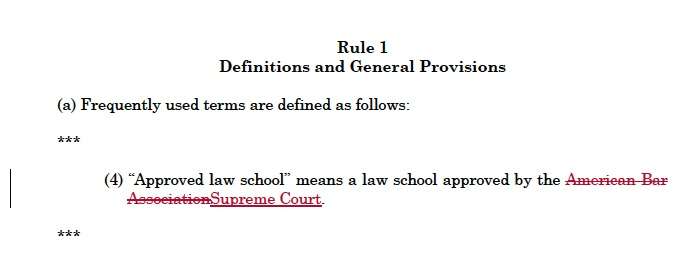
The Court how now proposed a single change to Rule 1 of the Rules Governing Admission to the Bar of Texas: the Supreme Court of Texas, and not the American Bar Association would accredit law schools.
The Court has requested comments by December 1, 2025, and announced the amendment will likely take effect on January 1, 2026.
The Court invites public comments on the proposed amendments. Comments should be submitted in writing to rulescomments@txcourts.gov by December 1, 2025.
The Court will issue an order finalizing the amendments after the close of the comment period. The Court expects the amendments to take effect on January 1, 2026.
I think the phrasing here is significant. Consider how the prior order specifically listed the law school deans before the public:
The Court invites comments on this topic from the Texas Board of Law Examiners, the Texas law school deans, the bar, and the public.
With respect, I think this order lists the relevant constituencies backwards. The Supreme Court's authority to regulate the legal profession is premised on serving the public interest. And the interests of law school deans, in particular, are not always consonant with the public interest.
It is the public that should weigh in on how this change affects the public.
The Court offered several points to guide the comment process.
First, the primary objection of the law deans was that removing the ABA's role would affect portability. In other words, graduates of Texas law schools would not be able to sit for bar exams in other states. I think the Deans care less about graduates of foreign law schools sitting for the Texas bar. This concern would be raised more by law firms.
Commenters and other interested parties are advised that the Court, in reasserting its authority over the approval of law schools:
a. intends to preserve the portability of Texas law-school degrees into other states and to preserve the portability of out-of-state law-school degrees into Texas;
It is not clear how portability will be preserved, but SCOTX is moving forward.
Second, another objection was that even if the ABA is removed as the sole accreditor, law schools will still opt to voluntarily maintain ABA accreditation. This two-tier accreditation could lead to duplicative and burdensome work. Texas explains there will not be "additional" burdens.
b. does not intend to impose additional accreditation, compliance, or administrative burdens on currently approved law schools, which need not take any additional action in order to remain approved law schools in Texas;
Third, for schools that are already ABA accredited, Texas will offer "ideologically neutral criteria" to maintain accreditation. Say farewell to DEI mandates to teach "cross-cultural competency" and similar topics. More pressingly, accreditation will be premised on neutral output measures, such as bar passage and employment statistics. Seth Chandler offered a metrics-based approach in his Civitas essay.
c. intends to provide stability, certainty, and flexibility to currently approved law schools by guaranteeing ongoing approval to schools that satisfy a set of simple, objective, and ideologically neutral criteria (such as bar exam passage rate) using metrics no more onerous than those currently required by the ABA;
Fourth, Texas law schools that opt out of ABA accreditation could maintain Texas accreditation. There may be Texas law schools that decide to go down this path. Cutting the ABA's expensive mandates could help improve actual student outcomes.
d. will not consider the fact that a law school loses ABA accreditation to be sufficient grounds for removal of the school from Texas's list of approved schools;
Fifth, schools in other states that are not ABA accredited will be able to opt in to the Texas list.
e. intends to develop, in consultation with the Texas Board of Law Examiners, a deliberative approach to requests from law schools not currently accredited by the ABA that wish to be added to Texas's list;
Sixth, the Court lists all of the law schools currently accredited by the ABA, and says they are now "approved by the Court as satisfying the law study requirements for admission to the Texas Bar." No further work needs to be taken. Graduates of those schools can be admitted to the Texas bar.
f. does not anticipate immediate changes to the current list of approved law schools; and
Seventh, there are currently efforts by Florida, Texas, and other states to create alternative multi-state accrediting agencies. I think the Trump Department of Education will gladly certify these bodies, thus further weakening the ABA's authority.
g. may consider, in the future, returning to greater reliance on a multistate accrediting entity other than the ABA should a suitable entity become available.
It is difficult to explain how significant this order is. In the span of a few pages, the Texas Supreme Court demonstrated what many of us realized years ago: states do not need the ABA as an accreditor. The ABA only has itself to blame. Rather than realizing what time it was, and focusing on its core function, the organization continued its mission creep, and squandered its credibility.
I suspect Florida, Ohio, and other states to follow suit.
I have helped to organize a panel at the Federalist Society National Convention on the future of the ABA. It could not be more timely. And I intend to submit a comment to SCOTX by December.
Jane Doe, a former Planned Parenthood employee, is suing Planned Parenthood for race discrimination (and some related employment claims). Usually, employment claims are brought in the plaintiff's own name, at least unless there's some highly personal element (such as alleged sexual assault) that's part of the case.
But Doe asked to be pseudonymous—and was allowed to be pseudonymous—simply on the basis that her having worked at Planned Parenthood might expose her to criminal attack. On this theory, anyone who worked for an abortion clinic would likewise be entitled to pseudonymity in any case in which such employment would be disclosed. In principle, the same would be true as to any other occupation where there appears to be some general risk of violence due to public hostility—or for that matter any case where the person's political or religious views might expose them to some such general risk. And the judge just granted the motion (Doe v. Planned Parenthood of Illinois(N.D. Ill.)).
That strikes me as not right: As I've argued (citing various precedents),
Public access to information about civil cases "serves to promote trustworthiness of the judicial process, to curb judicial abuses, and to provide the public with a more complete understanding of the judicial system, including a better perception of fairness." This access "protects the public's ability to oversee and monitor the workings of the Judicial Branch," and the Judiciary's "institutional integrity." "Any step that withdraws an element of the judicial process from public view makes the ensuing decision look more like a fiat and requires rigorous justification."
And this applies to the names of the parties as well. "[A]nonymous litigation" thus "runs contrary to the rights of the public to have open judicial proceedings and to know who is using court facilities and procedures funded by public taxes." "Identifying the parties to the proceeding is an important dimension of publicness. The people have a right to know who is using their courts."
Party names often offer the best clue for discovering further information about the case. Consider journalists who write about civil litigation. Without party names, they are limited to what they can glean from the filings and what the pseudonymous parties' lawyers are willing to reveal.