The Volokh Conspiracy

Mostly law professors | Sometimes contrarian | Often libertarian | Always independent | Est. 2002

The Volokh Conspiracy

Crisis on the Right as Heritage Foundation President Roberts Seems to Go Groyper

|

As Jewish Insider reports:

Heritage Foundation President Kevin Roberts doubled down on the influential conservative group's support for Tucker Carlson, who has been leaning into increasingly explicit antisemitism and opposition to Israel on his podcast, and expressed unwillingness to "cancel" neo-Nazi influencer Nick Fuentes….

He said the group would "always defend our friends against the slander of bad actors who serve someone else's agenda. That includes Tucker Carlson, who remains — and as I have said before — always will be a close friend of the Heritage Foundation."

Roberts rejected those criticizing Carlson as a "venomous coalition" and said that "their attempt to cancel him will fail."

This and related rhetoric is bad enough, but I was especially struck by this:

When it serves the interest of the United States to cooperate with Israel and other allies, we should do so with partnerships on security, intelligence and technology. But when it doesn't, conservatives should feel no obligation to reflexively support any foreign government, no matter how loud the pressure becomes from the globalist class or from their mouthpieces in Washington…

I'm not one who thinks that "globalist" is always, or even often, a code word for Jews. I once did an informal study of the use of globalist in a major Trumpy publication, and I found that the vast majority of people it deemed "globalist" were not Jews.

However… in this particular case, the sort of folks the populist right typically accuses of being "globalist" with regard to foreign policy, the mainstream US foreign policy establishment, is hardly known for arguing that the US should "reflexively" support Israel. Indeed, they will natter on and on about how the US has to pressure, get tough with, crack down on, etc. Israel, and counteract its "intransigence."

So who are these "globalists" who supposedly want the US to reflexively support Israel? It's pretty hard not to read the line as "no matter how loud the pressure becomes from the globalist class [Jews] or from their mouthpieces in Washington [AIPAC]."

I'd be more inclined to give Roberts the benefit of the doubt if he hadn't also tweeted this today: "Thank you, Jon Haidt, for reminding everyone @Heritage yesterday that tech tycoons like Leonid Radvinsky and Solomon Friedman are profiting to the tune of millions by preying on America's young men and women. We are proud to be in this fight with you. It is time to arrest, prosecute, and convict the sick perverts behind OnlyFans and PornHub." 

Radvinsky owns Only Fans. Friedman shares ownership and control of PornHub with Rocco Meliambro and Fady Mansour through Ethical Capital Partners. Maybe it's just a coincidence that Roberts only cited the two owners with Jewish-sounding names, and he's not appealing to the common antisemitic trope that the pornography industry is dominated by Jews. Maybe.

I hope the Heritage Foundation Board of Trustees is planning an emergency meeting about this.

If you have access to X, you can watch Roberts' video statement at this link.

What Did A Young John Roberts Contribute To Chief Justice Rehnquist's Opinion In Dames & Moore v. Regan?

Probably not very much.

|

Way back in 2014, I wrote about a very special clerk tree. A young John Roberts clerked for Chief Justice Rehnquist in 1981 when Dames & Moore v. Regan was decided. And a young William Rehnquist clerked for Justice Jackson in 1952 when Youngstown was decided. The linkage of those Justices, and cases, seemed profound. In Bank Markazi, Chief Justice Roberts corrected Justice Ginsburg's account of Dames & Moore.

(Roberts's co-clerks were Dean C. Colson and Robert B. Knauss.)

For some time, I wondered what Roberts actually contributed to the Dames & Moore decision.

In 2017, I emailed Lyle Denniston about the drafting of the opinion. He sent back a fairly detailed response, which I have uploaded here. In a follow-up email, Lyle said that Roberts likely had "minimal" input on the opinion in light of the time pressures.

In a new story, Joan Biskupic writes that Roberts "helped produce" the majority opinion in Dames & Moore. She adds, "Working with Roberts and two other clerks, Rehnquist produced the first draft within two days and sent it around to the other justices that Friday."

Is there anything in the papers to show exactly what Roberts did to produce the first draft? I haven't seen it.

Biskupic also focuses on a weird tangent story. She writes that "Roberts himself was in the last frantic days of his clerkship and trying to study for an upcoming bar exam."

The July bar exam is held at the end of the month. (I read that it was July 29, 1981, but I cannot confirm that date.) Were Supreme Court clerks, scrambling to wrap up the end of the Supreme Court term, really studying for the bar in June and early July? Roberts sat for the D.C. Bar exam, which historically was known as one of the easiest in the country. Roberts is also a genius. Would he seriously be distracted from the most important job of his career for a pass-fail exam?

I can guess why Biskupic went down that road:

For his part, Roberts tried to catch up on his studies for the bar exam that month and prepare for a job in the Reagan administration beginning in August.

His study partner for the District of Columbia bar exam happened to be a fellow clerk, from the Brennan chambers that term: [Michael] McConnell, now the lead counsel suing Trump over the tariffs.

Were Michael McConnell and John Roberts really studying together for the bar before the term concluded?

Dames & Moore was argued on June 24. Chief Justice Burger made the assignment to Rehnquist, and circulated this memo:

"To 'get the show on the road' Bill Rehnquist has agreed to get an opinion in our hands by noon Sunday, next – if not before."

Right on schedule, Rehnquist delivered the draft on Sunday, June 28. And the opinion was announced on July 2.

For whatever it is worth, that period was very busy. On June 25, Rehnquist delivered the Court's majority opinion in Rostker v. Goldberg. Haig v. Agee was decided on June 29, 1981. On July 1, the Court decided a pair of CrimPro decisions: Robbins v. California and NY v. Belton. On July 2, the final day of the term, the same day as Dames & Moore, came the fractured decision in Metromedia v. City of San Diego.

The Voting Rights Act Asymmetry Comes For Staten Island

The VRA allow Democrats to challenge Republican districts, but does not allow Republicans to challenge Democratic districts.

|

I have described the Voting Rights Act as asymmetrical. As a practical matter, the law provides a bonus to Democrats, and penalizes Republicans. The VRA is no longer trying to stop actual racial discrimination. In most cases, the VRA operates in the South where Republican legislatures try to create as many Republican districts as possible. But the VRA has little impact in the North where Democratic legislatures try to create as many Democratic districts as possible.

Alas, enter Mark Elias.

The Eleventh Congressional District in New York covers Staten Island (my hometown) and parts of Brooklyn. The Eleventh District is represented by Nicole Malliotakis, the only Republican member in New York City.

The Elias Law Group has filedstate Voting Rights Act challenge, arguing that the Eleventh District "provides Black and Latino Staten Islanders less opportunity than other members of the electorate to elect a representative of their choice." The upshot here is clear: Democrat voters are asking the court to eliminate a Republican district in New York City. There is no credible allegation that the overwhelmingly-Democratic New York legislature drew this map to dilute the votes of Black and Hispanic voters. Rather, this district was drawn as part of a series of messy political compromises. And even after those compromises, in which Republicans were almost gerrymandered out of the existence, the VRA can empower a court to eliminate that sole district to further help Democrats.

This is where the law is: in a district where Democratic voters cannot elect a Democrat, they can bring a VRA claim, even in an overwhelmingly democratic state where there is not even a scintilla of evidence of racial discrimination. But in a district where Republican voters cannot elect a Republican in an overwhelmingly republican state, they cannot bring a VRA claim.

This sort of asymmetry should not stand. Callais, hopefully, will put an end to this madness for the federal VRA. And as Rick Hasen pointed out, a ruling for Louisiana would also impact state VRAs.

Free Speech

School's "Interest in Teaching Racial Sensitivity Is Not Sufficient" to Justify Punishing Student's "Free Expression Off-Campus"

So holds the Second Circuit: "Tying a student speaker's constitutional right to free expression solely to the reaction that speech garners from upset or angry listeners cannot be squared with [First Amendment] principles."

|

From Leroy v. Livingston Manor Central School District, decided today by Judge Barrington Parker joined by Judge Beth Robinson (disclosure: I argued in the case on behalf of amici Center for Individual Rights and myself):

Leroy was disciplined by his school after he took a picture with his friends and posted it on social media while outside of his school campus and after school hours. He thought his post, which showed a picture of his friend kneeling on his neck with the caption "Cops got another," was a joke, but he quickly realized others viewed it as an insensitive comment on the murder of George Floyd. He removed his post after a few minutes, but not before another student took a screenshot, which she reposted on other social media platforms…. After public outcry, in-school discussions, student demonstrations and a school investigation, the school superintendent suspended Leroy and barred him from participating in various school activities for the remainder of the school year.

The court concluded that Leroy's speech was protected against discipline by the First Amendment; here's a short excerpt from the long majority opinion:

[T]he school's decision to punish Leroy was motivated, at least in part, by the fact that "the perception of those images, what it depicts, is racist in nature," and the hope that "from this experience … [Leroy] has learned some valuable lessons that will serve him better down the road." …

But as in Mahanoy Area School Dist. v. B.L. (2021), the strength of the school's interest in preventing certain kinds of speech—there, vulgarity, and here, racially insensitive speech—"is weakened considerably by the fact that [Leroy] spoke outside the school on [his] own time." Also, as in Mahanoy, Leroy "spoke under circumstances where the school did not stand in loco parentis," and "the school has presented no evidence of any general effort to [prevent such speech] outside the classroom." These facts convince us that Livingston Manor's interest in teaching racial sensitivity is not sufficient to overcome Leroy's interest in free expression off-campus.

Read More

Free Speech

Gender Queer, Libel by Implication, and "Truth Is Not a Complete Defense of Defamation"

|

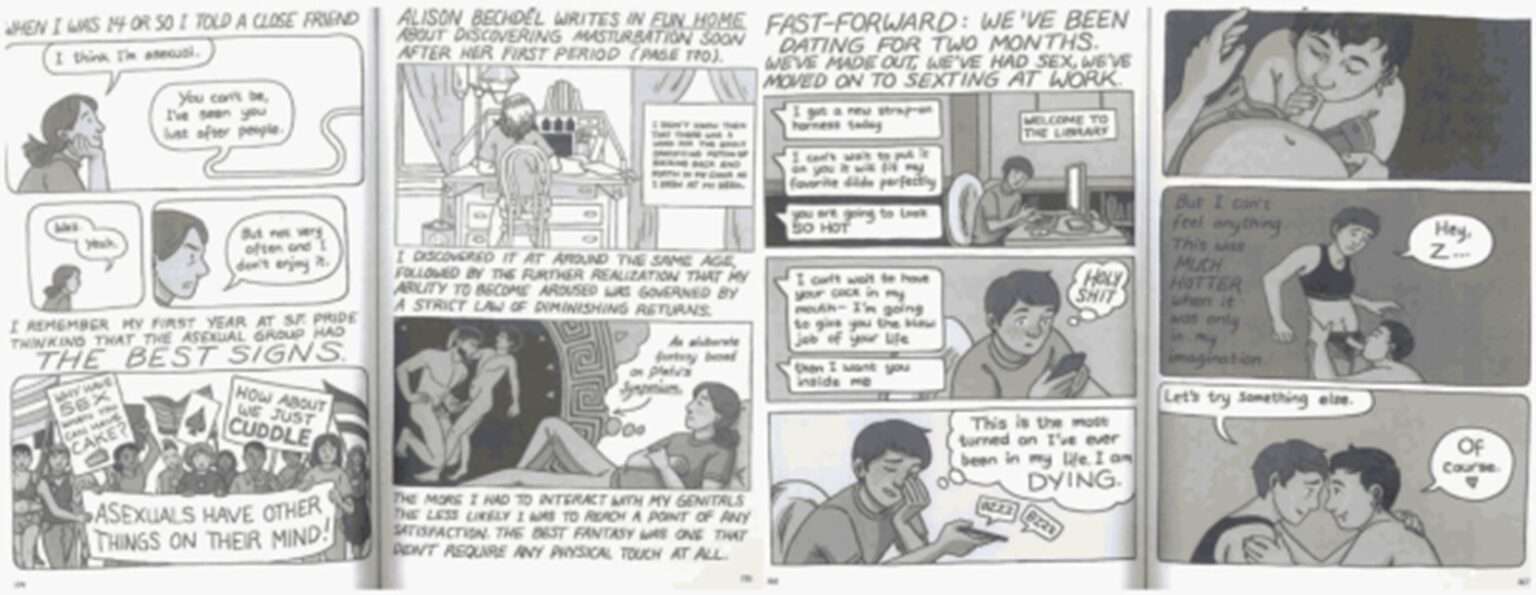
Galdos-Shapiro, a school teacher in Great Barrington (Mass.), was questioned and briefly detained in her classroom by the police over her having at her desk a copy of Gender Queer, which she had available to share with students. She sued police officials, and Judge Mark Mastroianni allowed her First and Fourth Amendment claims to go forward (Galdos-Shapiro v. Town of Great Barrington); the analysis there (see yesterday's post) is quite plausible, since the book isn't obscene, and in any event the relevant state obscenity laws excludes educational uses. The opinion doesn't include the objected-to illustrations from the book, but you can see copies of what appear to be the most controversial illustrations from a different opinion, here and here.

But the court also allowed her defamation claim to go forward as well, based on a press release that read:

On December 8, 2023 [t]he Great Barrington Police Department received a complaint from a person who witnessed what they perceived to be concerning illustrations in a book that was provided to students by a teacher at W.E.B. Dubois Middle School. The illustration provided by the witness depicted animated characters performing sexual acts on each other. Because this complaint was made directly to the police department, we are obligated and have a duty to examine the complaint further. Thanks to our established relationship with the school, we were able to carefully work together to investigate this situation. This involved immediate notification of the Superintendent and Principal of the middle school.

Because we were only provided a single image of the illustration, it was important to identify and examine the material that was reported to us. Working together, it was decided that the department would send an officer toward the end of the day in plain cloth[e]s to be escorted to the classroom and to see if the book containing the illustration could be located. After a brief conversation with the teacher, the officer was advised that the book in question was not there and could not be accounted for at that time. The officer advised the principal and teacher, that we were not there to investigate the subject matter of any books. As a procedure in sensitive or complex investigations, the police notified the District Attorney's Office.

Once the necessary information was gathered, it was determined that it is a matter to be managed within the Berkshire Hills Regional School District. The Great Barrington Police Department is dedicated to the safety of all people, especially children, and we take all complaints seriously….

Here's the court's reasoning on the defamation question:

Read More

Free Speech

Calling Teacher "Bully," "Lunatic," "Woke," "God Complex," and "White Savior" Is Opinion and Thus Not Defamation

|

Yesterday's Wisconsin Court of Appeals decision in MacCudden v. Johnson (Justice Joseph Donald, joined by Justice Maxine White), involved a former high school English teacher (MacCudden); at the time of the statements, she had resigned from the school district, but hadn't updated her LinkedIn profile.

Johnson received a screenshot from a friend of a portion of MacCudden's LinkedIn profile, which Johnson subsequently posted on social media. Johnson's post included the portion of MacCudden's LinkedIn profile which stated that she worked as a "Social Justice Coordinator" circled in red and Johnson wrote, "[w]hy the hell am I paying for a 'Social Justice Coordinator' in my school district?" Johnson further stated, "[t]his is just what @mtschools needs; more woke, white women w/ a god complex. Thank you, white savior."

Later, Johnson added, "[i]f [MacCudden] really wants to promote equity, perhaps she should forfeit her job to a person of color?" Johnson also replied to a social media user that:

Teachers who educate are paid a fraction of what these DEI "specialists" earn. Parents know these woke lunatics are bullies. They are bullying you into silence and compliance.

Good teachers should earn more, get support & feel safe. Partner with us and let's put kids first.

The court concluded that these statements weren't actionable defamation:

Read More

Free Speech

Emory University Senate Open Expression Committee Opinion on "Termination of Professor Due to Charlie Kirk-Related Speech"

|

From the opinion released Oct. 21, 2025:

In the wake of the assassination of Charlie Kirk, an Emory professor posted certain comments about the assassination on social media—first writing "Good riddance," and then writing that they "[didn't] feel bad" about the assassination and that Kirk "seem[ed] like a disgusting individual." The Emory administration, characterizing these comments as celebrating and inciting violence, terminated the professor.

The Committee for Open Expression finds that most of the reasons given by Emory for the termination are inconsistent with Emory's Open Expression Policy (Policy 8.14).

  • Inconsistency with Emory's values cannot itself be a reason for termination.
  • People's mere distress that an Emory professor can make such statements cannot itself be a reason for termination.
  • The Open Expression Policy cannot justify bowing to outsiders' efforts to put pressure on Emory to fire the professor by making threats to other members of the Emory Community.
  • Patients' and parents'/students' distrust cannot justify termination when it is not based on actual patient care or the content of teaching.
  • Violation of Emory's Social Media Guidelines cannot be the basis for termination, because these guidelines do not present themselves as being mandatory; and if they did, a termination cannot be based on the failure to provide a disclaimer in a context like this one, where a disclaimer would serve no useful purpose.

Read More

Gender Identity

DOJ Subpoena to Gender Medicine Telehealth Provider Quashed, but Record Not Sealed

|

From Judge Jamal Whitehead (W.D. Wash.) in Queerdoc, PLLC v. U.S. Dep't of Justice:

On January 20, 2025, President Trump issued Executive Order 14168, "Defending Women from Gender Ideology Extremism and Restoring Biological Truth to the Federal Government." The order declared it "the policy of the United States to recognize two sexes, male and female," stated these sexes are "not changeable," and characterized "gender ideology" and "gender identity" as a "false claim."

The following week, President Trump issued Executive Order 14187, "Protecting Children from Chemical and Surgical Mutilation." 90 Fed. Reg. 8771. This order characterized gender-affirming medical care as "the maiming and sterilizing of a growing number of impressionable young children" and declared it "a stain on our Nation's history" that "must end." The order directed DOJ to "prioritize investigations and take appropriate action to end deception of consumers, fraud, and violations of the Food, Drug, and Cosmetic Act."

On April 22, 2025, Attorney General Pamela Bondi issued a memorandum titled "Preventing the Mutilation of American Children." The memorandum promised that DOJ would "act decisively to protect our children and hold accountable those who mutilate them under the guise of care" and directed the Consumer Protection Branch of DOJ's Civil Division to "undertake appropriate investigations of any violations of the Food, Drug, and Cosmetic Act by manufacturers and distributors engaged in misbranding by making false claims about the on- or off-label use of puberty blockers, sex hormones, or any other drug used to facilitate a child's so-called 'gender transition.'"

On June 11, 2025, DOJ's Civil Division issued a memorandum stating it would "use all available resources to prioritize investigations of doctors, hospitals, pharmaceutical companies, and other appropriate entities" consistent with the Executive Orders and Attorney General's directives. The Civil Division memo identified two investigative priorities: (1) "possible violations of the Food, Drug, and Cosmetic Act and other laws" related to medications used in gender-affirming care, and (2) False Claims Act violations by providers who "evade state bans on gender dysphoria treatments by knowingly submitting claims to Medicaid with false diagnosis codes."

That same day, DOJ served QueerDoc with an administrative subpoena under Section 248 of the Health Insurance Portability & Accountability Act of 1996 (HIPAA), which authorizes subpoenas to aid "[i]n any investigation of … a Federal health care offense."

Read More

Bork Lecture at FedSoc National Convention Will Include Panel of Judges To Address Antisemitism

A fitting update to the rising tide of antisemitism on the left and the right.

|

Following up from my post last night, I am pleased to report that the Bork Lecture at the FedSoc National Convention will focus on antisemitism:

In 1987, Howard G. Crane — then-Managing Partner of Kirkland & Ellis and a self-described "liberal Democrat" — testified in support of Judge Robert Bork's nomination to the U.S. Supreme Court, describing Judge Bork as "a person without prejudice against any group." Crane, who was Jewish, explained that Judge Bork, as a young law firm associate, persuaded his firm to eliminate its ban on Jewish attorneys, resulting in Bork's firm hiring Crane.

In memory of Judge Bork's commitment to religious respect and his rejection of anti-Semitism, Hon. Judge Roy Altman (U.S. District Court for the Southern District of Florida) will moderate a discussion with judges from different faith traditions about the crucial importance of the American tradition of religious respect and tolerance in the U.S. constitutional order, including their personal experiences with interfaith dialogue.

The judges will discuss how First Amendment values — such as respect for free speech and for free exercise of religion — can provide a roadmap for preserving Western values under assault by anti-Semitism and other forms of religious intolerance.

Featuring:

Hon. Lisa Branch, United States Court of Appeals, Eleventh Circuit
Hon. Ray Gruender, United States Court of Appeals, Eighth Circuit
Hon. Andrew Oldham, United States Court of Appeals, Fifth Circuit
Hon. Martha Pacold, United States District Court, Northern District of Illinois
Hon. Lee Rudofsky, United States District Court, Eastern District of Arkansas
Hon. David R. Stras, United States Court of Appeals, Eighth Circuit
Hon. Amul R. Thapar, United States Court of Appeals, Sixth Circuit
Hon. Evan Young, Texas Supreme Court
Moderator: Hon. Roy Kalman Altman, United States District Court, Southern District of Florida

Congratulations to Judge Altman and all of the other members of the panel. This event could not be more timely.

Tariffs

"How Unprecedented Are Trump's 'Emergency Tariffs'"?

|

My Hoover colleague Philip Zelikow, who is involved in the tariff litigation, passed this blog post along to me, and it struck me as very interesting. The author, Alan Wm. Wolff,

was the U.S. Department of Treasury's international trade lawyer from 1969 to March 1971, in which capacity he drafted President Nixon's Import Surcharge Proclamation 4074 of August 17, 1971 and defended this import surcharge at the GATT in September 1971 as counsel with the U.S. delegation. He later served as Deputy General Counsel and General Counsel at the Office of the Special Representative for Trade Negotiations from 1973 to 1977 and as Deputy Special Trade Representative from 1977 to 1979 with the rank of Ambassador. In the Nixon and Ford Administrations, he was the chief drafter for the administration of the Trade Act of 1974, the country's basic trade statute.

An excerpt:

When President Donald Trump imposed his so-called reciprocal tariffs on pretty much all products from all countries this year, he said he was responding to a national emergency due to the nation's trade deficit. He claimed as authority for his actions the International Emergency Economic Powers Act (IEEPA). The lower courts have ruled against the tariffs, finding that Congress had not delegated to the president sufficient authority to impose them. Their decisions are being appealed to the Supreme Court, with oral argument scheduled for November 5.

Only once before has a president imposed a blanket tariff as an emergency measure. President Richard Nixon declared a balance of payments emergency and imposed a 10 percent import surcharge in 1971. It was upheld by an appellate court in 1975 in the case of Yoshida International, Inc. v. United States. It is universally assumed, including by the lower courts in the current case, that Nixon used the Trading with the Enemy Act (TWEA)—the nearly identical predecessor authority to IEEPA—for the 1971 import surcharge.

However, this reading of history is wrong: Nixon did not claim emergency authority for the measure under TWEA. Nixon claimed authority to impose sanctions under trade agreement laws for the tariffs he put into place.

Read More

"Before This Court, Artificial Intelligence Is Optional. Actual Intelligence Is Mandatory"

|

Words from Magistrate Judge Jason Robertson (E.D. Okla.) in last week's Mattox v. Product Innovations Research, LLC. A bit of background:

Plaintiffs' counsel submitted [eleven] pleadings containing fabricated case citations, erroneous citations, quotations of nonexistent law, and misstatements of law. The filings ranged from summary-judgment briefing, to motions in limine, and even a sanctions motion. The pattern was not inadvertent, and it was not harmless. The Court values trust among advocates, but trust must be earned through verification. In this case, filings were trusted, but never verified, and the results speak for themselves.

The court imposed $6K in punitive sanctions on the lawyers, and also required them to compensate the other side for >$23K in attorney fees.

More