
Religious Employment and Title VII: Part 3—Resolving an Enduring Circuit Split
A textualist reading of the Title VII religious employer exemption resolves a long-running circuit split.

A textualist reading of the Title VII religious employer exemption resolves a long-running circuit split.
A textualist interpretation of Section 702 shows that the exemption applies when a religious employer confines employment to people who fit the employer's religious observances, practices, and beliefs.
Understanding Title VII as a law designed to advance both liberty and equality helps to illuminate the statute's religious employer exemption.

"The [eventually released personnel] records contain no negative performance reviews, but they do contain three anonymous complaints. Those complaints accused Grossenbach of 'creat[ing] a hostile environment for transgender and LGBTQ students' in connection with his SaveCFSD activities [allegedly referring solely to Grossenbach's outside-class political activity -EV], among other things."
"The Defendants intentionally or recklessly invited public critique and scrutiny over Plaintiff's title as an exorcist by repeatedly asserting that the Plaintiff is not an exorcist."

This result is unsurprising, and was predicted by most analysts, including myself.
"Allah does not forget, however. This is how people earn their final place in the [h]ereafter."
"The Supreme Court has recently confirmed that the Free Exercise Clause does not prohibit a state from providing 'a strictly secular education in its public schools'"—and, the court held, that extends to California charter schools and their parental "home-based direct instruction approved by the school and coordinated, evaluated, and supervised by state-certified teachers."
So the Second Circuit held today, concluding that the facts surrounding this particular exclusion showed hostility to religion, and not just the neutral application of generally applicable rules.
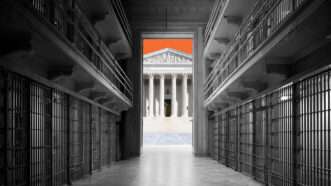
The Supreme Court will hear Landor v. Louisiana Department of Corrections and Public Safety this fall.
Over the past two decades, scores of business owners across the nation have sought to refuse services for same-sex weddings, an SMU Law School study finds

The mayor abandoned the plan after it aroused strong political resistance and threats of litigation.

St. Catherine’s Monastery has been continuously inhabited for over 1,500 years. An Egyptian court ruling ended the monastery's longstanding separation from the government.

"How do Defendant's letters interfere with Plaintiffs' authority or ability to administer Oklahoma's public schools?"
Courts don't need to stretch the ministerial exception to cover every case.
Does the First Amendment freedom of expressive association protect religious hiring?
Does the church-autonomy doctrine extend to hiring decisions outside the ministerial exception?
A textualist solution to controversies over religious hiring.
An important church–state question likely headed to the Supreme Court.
After a public outcry, the scheduled vote on the plan to use eminent domain has been postponed indefinitely. If the Town of Toms River does try to condemn the church, there is likely to be a major legal battle.
The Third Circuit held that such organizations may raise religious exemption claims, though it declined to decide (at this stage of the litigation) whether the claim would prevail on the facts of this case.
Celebrate your independence with a subscription to Reason magazine, your most trusted source of honest, insightful news and analysis.




