
Texas Tech's Vague Restrictions Show You Don't Have To Ban Speech To Silence It
If someone is uncertain enough about meaning, they will censor themselves first.

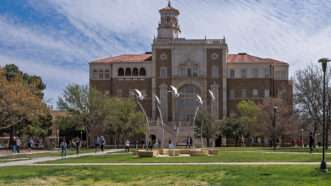
If someone is uncertain enough about meaning, they will censor themselves first.
As to James' discrimination claim, "James, who was on disciplinary probation leading up to the suspension, admits that Columbia suspended students involved in the encampment and fails to identify another student, who was also on disciplinary probation, whom Columbia declined to discipline."
"[Students] reported that the course content did not align with its description in the course catalog; that the course was poorly organized and 'essentially was a stream of consciousness conversation' about Dr. Chavis's personal issues; and that Dr. Chavis humiliated certain students because of, for example, their race and fraternity affiliation."
Public records obtained by City Journal show the Center for the Defense of Academic Freedom has taken a bizarrely censorial approach to its mission.

FIRE's data suggest that the range of opinions at American universities is far too narrow.
The lawsuit asks the court to (among many other things) "Rescind and award to the United States restitution of all grant payments made to UCLA during the time of UCLA’s noncompliance with Title VI."
The student sued seeking to undo the reprimand and report to the bar, but a federal court concluded that this particular remedy is barred by state sovereign immunity under the Eleventh Amendment/
According to plaintiff, “[Prof.] Harner believed Plaintiff’s planned zine project [class assignment] was on ‘the issue of ‘trans’ people sexually assaulting others in prison,’ a topic Harner found ‘so many issues with.’”
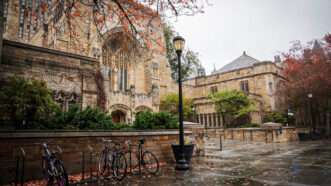
The Ivy League school released a self-critical report this week.
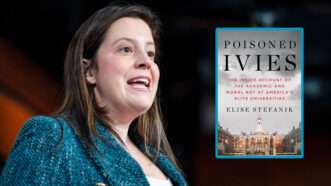
What is a greater rejection of America's founding ideals than an overreaching government trampling the First Amendment?
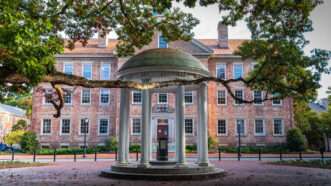
Free speech lawyers say UNC violated North Carolina’s institutional neutrality law.
"In essence, the plaintiffs argue that every time a Jew or Jewish organization contributes to (in this instance) a public university and that university, acting under established policy, disciplines a student who advocates for, in this instance, 'particularly Palestinian" policies, the simultaneous presence of the contribution and the discipline creates a plausible inference of a conspiracy between the contributor and the university to punish the "particularly Palestinian' advocate."
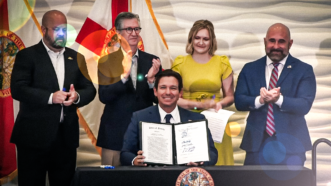
A new Florida law would allow state leaders to designate certain groups as terror organizations.
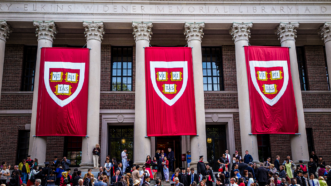
The Trump administration wants its federal funding back from Harvard, alleging the Ivy League university did "nothing" about campus antisemitism.
SUNY Fredonia philosophy professor had been barred from campus over podcast questioning illegality and immorality of adult-child sexual contact; a federal court has just allowed his First Amendment claim to go forward.
So holds a court, reversing student Guy Christensen's "disenrollment." The student also wrote, responding to the murder of two Israeli embassy employees in D.C. outside the Capital Jewish Museum, "I do not condemn the elimination of those two Zionist officials."
An Eleventh Circuit panel concludes (by a 2-1 vote) that this is likely the right result.
The appeals court ruled that administrators violated Stuart Reges' First Amendment rights when they investigated and threatened to punish him for constitutionally protected speech.
"[I]n the public university setting, student disagreement with a professor's academic speech on an issue of public concern cannot alter the Pickering analysis in the government's favor."
Sarah McLaughlin reveals how foreign governments pressure American universities through speech codes and satellite campuses, and examines the broader threat international authoritarianism poses to free expression.
One claim is that CMU's Chief Diversity Officer illegally recorded meeting with student and the accused professor—and then apparently "asserted her Fifth Amendment rights when ... asked her if she did so or if she had a pattern or practice of recording student meetings, without their consent, in the scope of her duties."
"The [eventually released personnel] records contain no negative performance reviews, but they do contain three anonymous complaints. Those complaints accused Grossenbach of 'creat[ing] a hostile environment for transgender and LGBTQ students' in connection with his SaveCFSD activities [allegedly referring solely to Grossenbach's outside-class political activity -EV], among other things."

I coauthored the article with four other legal scholars from across the political spectrum.
Dr. Wolf von Laer and Sean Themea join Nick Gillespie to discuss how Kirk’s murder is reshaping student activism and where libertarian ideas fit in today’s campus climate.
Celebrate your independence with a subscription to Reason magazine, your most trusted source of honest, insightful news and analysis.




