

Bureaucracy, Labor, & Tariffs: How Government Is Making BLTs More Expensive
The BLT—a delicious celebration of the power of markets—exemplifies political attacks on the free movement of goods and people.
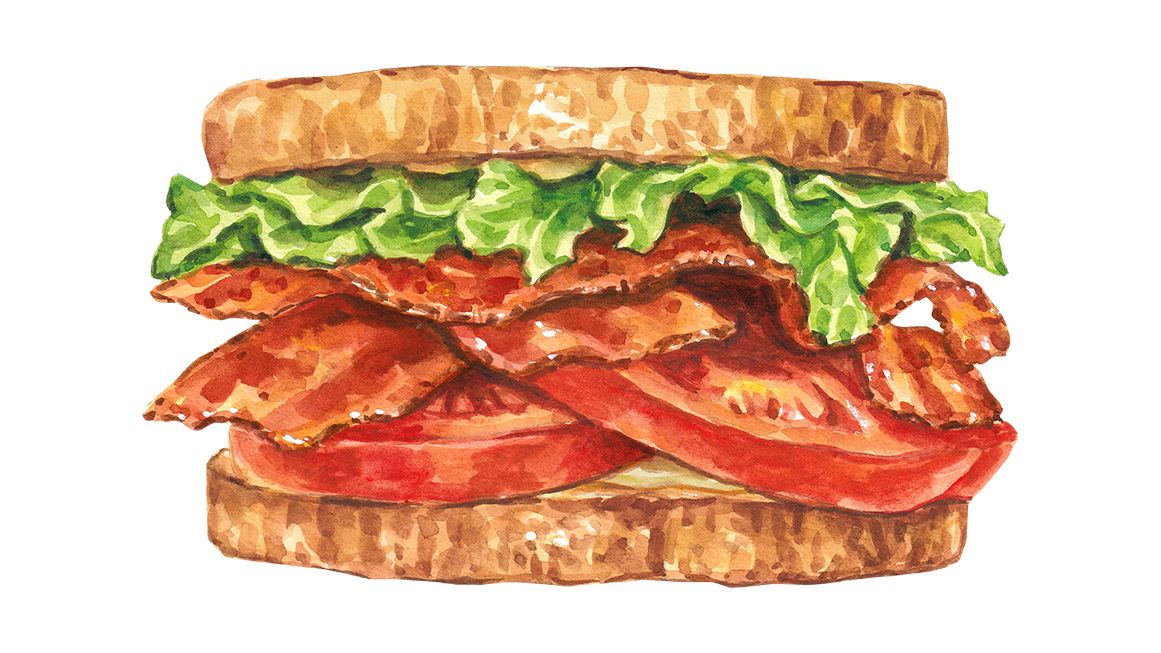
Life might be like a box of chocolates, but the economy? It's more like a sandwich.
Whether we're talking about a club, a Reuben, or a hoagie, every sandwich is the result of supply chains that stretch across the country and around the world. Final assembly takes place at the deli counter—or in your kitchen, if you prefer the DIY version—but those layers of meat, bread, and veggies depend on hundreds of people working to sow, irrigate, feed, reap, slaughter, knead, package, and ship. Economist Leonard Read famously observed that no one on Earth is capable of single-handedly making a pencil. A sandwich might be slightly less complex (no mining involved), but it would still take untold hours of labor on a fairly large farm to put one together entirely from scratch.
And when it comes to sandwiches, there is none better than the BLT. You may disagree, but you'd be wrong.
There are more complex sandwiches, more ornate sandwiches, and certainly sandwiches that wind together more expansive supply chains. But as with a great cocktail, the key to the BLT's perfection is its simplicity and structure. Every bite is a whole greater than the sum of its rather mundane parts—the salty, smoky bacon bouncing off the tomato's sweet acidity, and the crunch of the lettuce resonating between a pair of perfectly toasted slices of bread.
James Beard, the 20th century American chef so revered that the country's top culinary award is now named after him, once said that the key to a good sandwich is a "divine mix of flavors and textures." He was talking about the BLT's upscale cousin, the chicken club, but the point stands.
Not merely a culinary wonder, a BLT is a remarkably condensed product of specialization: industrial pork production, modern farming technology, refrigeration, and logistics. Hundreds of people in many fields—including some in literal fieldsin Mexico and Arizona—helped to put that sandwich on your plate. Every bite of a BLT is a delicious celebration of the power of markets to fill our lives with everyday wonders.
The BLT is also, I regret to inform you, under attack.
No politician or bureaucrat has openly declared war on the BLT, of course. There is no Starbucks cup or Bud Light ad to feign outrage over. There is no moral panic surrounding crispy bacon, no partisan lines dividing the tomato from the lettuce. For that we can be thankful.
Instead, the BLT has become collateral damage in a series of other policy maneuvers. From well-intentioned animal welfare efforts to nakedly protectionist tariffs, from immigration restrictions to industrial policy, governments are clamping down on the free movement of goods and people that produce the bounties of capitalism, as exemplified by the BLT.
My favorite sandwich is not the only or greatest victim of those efforts. Nevertheless, this perfect pile of delicatessen delight has a story to tell.
Bacon
As he was campaigning for a return to the White House, President Donald Trump briefly zeroed in on the rising price of bacon to illustrate what was wrong with Democratic Party governance.
"When you look at the costs of groceries, the cost of bacon, where it went up four and five times," Trump said in Asheville, North Carolina, in August 2024, "I don't order bacon anymore. It's too expensive."
It's hard to believe that anything might be too expensive for Trump's well-known tastes, but the man did have a point. During the Biden administration, inflation was hot, but the price of bacon was sizzling. An average pound of bacon cost $5.83 in January 2021, according to the federal Bureau of Labor Statistics (BLS), before rising to a peak of $7.60 per pound in October 2022—a 30 percent increase.
Obviously, you can't have a BLT without bacon. It's the savory showman. The lead guitar. The whole reason we're here—even if any real sandwich connoisseur knows that the tomato is the key to the combination—is that bacon is delicious. You don't have to feel guilty about it. Evolution wired our brains to crave protein and salt. Piles of money have been spent on engineering that slice of pork so it crisps up in just the right way. We never had a chance.
The average American eats 18 pounds of bacon every year. That's roughly the weight of a car tire. At the current average price of $6.82 per pound, that's about $122 for a year's supply. Still a great deal, in terms of pure masticatory bliss, but less amazing than it used to be.
The major factor in the rising price of bacon is the rising cost of raising pigs. And the main culprit in pigflation is a new rule adopted by voters in California, even though the state only produces a scant 0.1 percent of the country's hogs.
In 2018, Californians approved Proposition 12 by a wide margin, thus updating an existing animal welfare law to require more space for chickens, calves, and hogs. Farms worldwide that do not meet the new requirements cannot sell their meat in California, and the law allows state regulators to inspect facilities outside California's borders to ensure compliance. Largely, that means eyeing Iowa, which supplies more than one-third of America's pork.
The law raises complicated ethical and federalist questions. How much space should be afforded to an animal being raised so that it can be slaughtered? Any answer, including the ones offered by Proposition 12, is arbitrary. Even as someone who cares about animal welfare, I don't have a good answer.
We did get an answer to the federalism question, but it is also a somewhat unsatisfying one. In a 5–4 ruling in 2023, the U.S. Supreme Court rejected the notion that Proposition 12 violates the Commerce Clause. While the Constitution gives Congress the power to regulate interstate commerce, that does not mean states are prohibited from regulating the goods that cross their boundaries, Justice Neil Gorsuch wrote in the majority opinion. Furthermore, courts are not the place to settle disagreements that require balancing the economic costs of the new law against the "moral and health interests" that it is meant to serve, he added.
"Some might reasonably find one set of concerns more compelling. Others might fairly disagree. How should we settle that dispute? The competing goods are incommensurable. Your guess is as good as ours," Gorsuch wrote. "More accurately, your guess is better than ours. In a functioning democracy, policy choices like those usually belong to the people and their elected representatives."
(The pork industry may yet pull a trump card, as it is lobbying Congress to pass a federal standard that would effectively invalidate California's rule.)
While it may be moral and constitutional, there is little doubt that Proposition 12 also raised prices. Complying with California's rules would raise production costs across the board by about 9 percent, according to the National Pork Producers Council. Refusing to comply with the rules means being unable to sell pork in California, which represents about 13 percent of America's pork-eating market.
Whether you believe the tradeoff of higher prices for improved animal welfare standards is worthwhile will depend on your personal moral compass. And the amount of flexibility in your household budget. And how badly you're craving bacon right now.
Regardless, Proposition 12 clearly demonstrates how state policy, even when well-intentioned, carries costs.
Lettuce
It is always tempting to overlook lettuce.
In other sandwiches, that might be forgivable. In a BLT, however, the lettuce is given equal billing and a place on the marquee. The green, leafy stuff is not filler. It is the backbone of the sandwich, the drummer who maintains a crisp rhythm and balances the haughtiness of its companions.
Remove the lettuce, and the bread will be muddled by the tomato. The whole structure collapses into a soggy mess.
A wide variety of lettuces are out there. For salad, an oaky arugula or delicate butter lettuce is often a better choice. In a sandwich—and especially in a BLT—the crunch factor is key. That means the classics rule the day: iceberg or romaine.
If you're eating that sort of lettuce in the United States, there's a good chance it was grown in Yuma County, Arizona, the self-proclaimed "lettuce capital of the world."
The Yuma Valley is a broad, green ribbon across the Arizona desert. It contains more than 180,000 acres of farmland, all fed by the Colorado River as it trickles over the last few miles before the Mexican border, and it is responsible for a staggering amount of vegetable production. Everything from melons to broccoli and cauliflower to kale is farmed there. But the main crop in the Yuma Valley is lettuce—iceberg lettuce in particular. More than half a billion heads of iceberg lettuce are grown there annually, and the Arizona Farm Bureau claims that 90 percent of the leafy greens eaten in the U.S. and Canada get their start in Yuma.
That robust agricultural ecosystem grows from factors both ancient and modern. Thousands of years of periodic floods and droughts built up the layers of fertile soil on the valley's floor. Some of the sediment that nurtured your iceberg lettuce was likely washed downstream from the Grand Canyon, on the opposite side of the state, according to the Yuma Fresh Vegetable Association. Today, GPS-guided tractors and automated sprinklers help produce greater crop yields with less waste of precious water.
Much of the labor, however, is still done by hand—and often by immigrants.
Upwards of 20,000 workers fill the fields of Yuma every day, and many of them come across the border from Mexico to do the work.
They do that despite Yuma becoming a major front in the Trump administration's war on immigration. A 107-mile section of Trump's infamous border wall was constructed in Yuma County from 2019 to 2021. As part of the One Big Beautiful Bill Act, passed by Congress last year, the federal government is now funding an $800 million upgrade that will add hundreds of miles of new barriers and a new "smart wall" of cameras and other surveillance technology.
The farmworkers in Yuma are here legally—most of them on H-2A visas that allow seasonal workers into the country. But the border crossings in Yuma, which farmworkers must pass through at the start and end of every shift, are now militarized. In July, the Trump administration declared a National Defense Area in and around Yuma, allowing military personnel to detain migrants who lack the proper documentation.
The effort is obviously not only targeting illegal immigrants. Permanent residents and visa holders who do not carry their immigration paperwork with them are now subject to being arrested and fined, thanks to the Trump administration's reactivation of a 1952 law. More than 100 citations, which can carry fines up to $5,000, were issued last year, according to a review by the Arizona Mirror. All of them were issued in Yuma.
Making it harder for Yuma's workforce to get to their jobs has obvious downstream consequences. Yuma saw a sharp decline in its growth rate last year, according to Census Bureau data. That will worsen the region's preexisting shortage of agricultural workers.
The Trump administration is aware that its immigration policies are hurting the labor market for American farms. In October, the Department of Labor warned that a "current and imminent labor shortage" on American farms "presents a sufficient risk of supply shock-induced food shortages." The shortage is being caused by the administration's crackdown on undocumented workers, "who previously cycled in and out of the U.S. through a porous border," but are now being kept out or choosing not to try to enter the country in the first place.
Secretary of Agriculture Brooke Rollins has defended the Trump administration's policies as helping to "move the workforce towards automation and 100 percent American participation."
That doesn't seem to be happening. America's agricultural workforce has shrunk since Trump took office—partly a result of the deportations, but also likely due to workers simply deciding it's not worth the hassle or risk to obtain the necessary paperwork. In that same October report, the Department of Labor said there was "a persistent and systemic lack of sufficient numbers of qualified, eligible, and interested American workers to perform the kinds of work that agricultural employers demand."
Automation has done wonders for American agricultural production, but some of the work still needs to be done by hand. Limiting the supply of lechugueros who can work in Yuma (and elsewhere) will not create more jobs for Americans. It only makes the would-be workers worse off, creates shortages that farmers will struggle to fill, and, yes, puts more unnecessary barriers between Americans and an essential sandwich ingredient.
Tomato
Bright and flavorful, the tomato is the queen of the produce section.
Her reign is a popular one: Americans ate 28.7 pounds per capita of fresh and processed tomatoes last year, according to the U.S. Department of Agriculture. The potato is the only vegetable consumed in greater quantities.
Yes, vegetable. Many a culinary pedant is quick to point out that, actually, the tomato is a fruit. They're only half right, because tomatoes are both.
Botanically, a tomato isa fruit. Technically, a berry—like peppers, bananas, grapes, cucumbers, and all the other fleshy fruits that develop from a flower and contain seeds. But politically, a tomato is a vegetable, thanks to the Supreme Court and one of America's least memorable presidents.
The year: 1893. The issue: John Nix & Co., one of the largest produce sellers in New York City, is trying to avoid paying tariffs. The Tariff Act of 1883, which was passed by Congress (what a novel idea) and signed by President Chester A. Arthur, imposed a 10 percent tariff on imported vegetables. There was no tariff on imported fruit. You can probably see where this is going.
When the case got to the Supreme Court, the justices ruled unanimously that tomatoes were vegetables and therefore subject to the tariffs. Even though dictionaries define fruit as "the juicy, pulpy products of certain plants, covering and containing the seed," wrote Justice Horace Gray, "these definitions do not tend to show that tomatoes are 'fruit,' as distinguished from 'vegetables,' in common speech, or within the meaning of the tariff act."
Basically: The Supreme Court decided that if people commonly think of a tomato as a vegetable, that's good enough for government work. John Nix had to pay the tariff.
Fruit or vegetable, a good tomato is crucial to a BLT, where the sweetness and acidity provide a cool splash of flavor that's the perfect counterweight to the saltiness of the bacon. The tomato is the bassist who fills the gaps to complete the harmony. You can have a fine BLT with burned bacon or slightly wilted lettuce, but a bad tomato throws the whole thing off. Here, size matters. Carve a thick slice from the center of a big beefsteak tomato, large enough to cover the whole footprint of the sandwich.
Unfortunately, the tomato is also the most persecuted element of the BLT. Bacon and lettuce might be indirect collateral damage of government policies aimed at animal welfare and immigration enforcement. But higher tomato prices are not an unintended consequence—the government is deliberately trying to make tomatoes more expensive.
Unlike a lot of government policies, this one is pretty effective. As of April, tomato prices had increased by a staggering 39.7 percent over the past 12 months, according to the BLS. That means tomato prices have risen significantly faster than overall inflation—which climbed by 3.8 percent over the past year—and food prices as a whole. Even gas prices, which get a lot more attention, climbed "only" 28.4 percent in the past year.
As in the 1890s, this is all about tariffs.
Starting in 1996, the U.S. allowed tariff-free imports of tomatoes from Mexico. That was great news for American tomato eaters, because Mexican tomatoes are regarded as some of the tastiest in the world. Also, longer growing seasons in Mexico meant that Americans had access to fresh tomatoes for larger portions of the year.
If you stop taxing something, you'll get more of it. In the 30 years that the Tomato Suspension Agreement was in place, American tomato imports more than tripled—and nearly all of them came from Mexico.
Last year, Trump killed that trade deal. At the time, the White House framed the change as a victory for "American farmers, growers, and business owners." Experts in the produce industry, however, warned that consumers would be paying the price.
Sure enough, we're paying it. With the trade agreement dead, imported tomatoes are once again subject to tariffs of more than 17 percent—the same duty that was in place before 1996. Unsurprisingly, the price of fresh tomatoes is skyrocketing. A pound of tomatoes cost an average of $2.69 in April, according to the BLS' latest Consumer Price Index report. Terminating the trade deal might help some American tomato farmers, but American-grown tomatoes are overwhelmingly processed into sauces, pastes, and other products rather than sold fresh.
Floridian tomatoes are also widely regarded as lower-quality than those grown in Mexico. Food critic Craig Claiborne once described them in The New York Times as "tasteless, hideous, and repulsive." Nicola Twilley, host of the Gastropod podcast, attributes the problem to farmers who "accidentally bred out all the deliciousness" of American tomatoes in a quest to increase crop yields and disease resistance. Life is full of tradeoffs.
On the other side of the ledger, imported tomatoes generated more than $3.6 billion in economic output in the United States in 2024, according to a study done at Texas A&M University. That includes nearly $2 billion in retail and $428 million in the transportation sector. The same study calculated that tomato imports support more than 46,000 full- and part-time jobs in America.
Getting a tomato from Sinaloa to your kitchen involves a lot of work. Looking at only one narrow slice of the tomato market means missing the bigger, juicier picture.
Everything Else
Piling bacon atop lettuce and tomatoes doesn't make a sandwich. That's a salad.
Before this combination can evolve into its final, most delicious form, it needs one more thing: a performance space. A stage in the form of a slab of rich, doughy bread—sourdough is best, but a hearty wheat can do the trick too—sliced thick and toasted just enough to form a supportive exoskeleton while retaining its distinctive tangy flavor and chewiness.
Don't skip that last step. A BLT made on untoasted bread is like The Three Stooges without Curly or Pink Floyd without Roger Waters. It still is what it says it is. It's fine. But the value of the missing piece becomes all the more obvious in its absence.
There's no excuse for skipping that crucial, final detail, because toasters are plentiful and affordable in America today.
Beware the politicians who wish that were not true—like Vice President J.D. Vance.
While campaigning in 2024, Vance argued that "a million cheap knockoff toasters aren't worth the price of a single American manufacturing job."
It's the sort of cheap applause line that isn't meant to be examined too closely. Still, it reflects an alternate reality that right-wing populists believe would be better for the country—one where America imports fewer things and makes more basic goods here.
Some Americans might prefer to work in a toaster factory instead of whatever job they have now. But the supposed decline in American manufacturing is often wildly overstated. Today's manufacturing workers are likely to be building cars or advanced computers—jobs that pay better than piecing together basic kitchen appliances. That's one of the reasons the average wage for manufacturing workers (excluding managers) has doubled since 1999, outpacing inflation.
For consumers, the tradeoff is even better. Despite the Trump administration's tariffs driving prices higher, it's easy to find a new toaster for well under $50. The average hourly wage in America is now about $37, so a little more than one hour of work buys a piece of equipment that will get your bread to the perfect texture for building that BLT.
What would happen if we took Vance's rhetoric to its logical conclusion and banned foreign-made toasters? Writing in The Atlantic a few years ago, former Mitt Romney economic policy adviser Oren Cass claimed that American-made toasters might cost a few dollars more: $33 instead of $30 at the low end of the scale.
In reality, an American-made toaster would probably cost much more. That's according to Ed Gresser, a former assistant U.S. trade representative who is now vice president and director for trade and global markets for the Progressive Policy Institute. Gresser examined toasters made in other wealthy, developed countries, such as Italy, Japan, and the United Kingdom. At the lowest end, those toasters retail for around $250. Some would be significantly pricier.
Vance wants a world where fewer Americans have a toaster in their kitchen, and where those who do paid a much higher price to buy one. A sad world where more BLTs are eaten on soggy, softened bread incapable of withstanding an onslaught of tomatoey ooze and bacon grease. A place where Americans are forced to settle for merely adequate sandwiches rather than those elevated to their most artistic and tasteful state.
Government by populist applause lines and for protectionist schemes will never improve on what the market has provided. The bacon gets marginally more expensive, the tomatoes slightly less tasty, the bread suboptimal.
And since a sandwich is a compact microcosm of an economy, what's true for the BLT would be true in other—and more important—parts of the world.
This article originally appeared in print under the headline "Bureaucracy, Labor & Tariffs."




