

Colombia's New President Wants More U.S. Military Help Fighting Cartels
Abelardo de la Espriella campaigned on shooting down drug planes and boats in Colombia. Twenty-five years of U.S.-funded counternarcotics suggests it won't matter
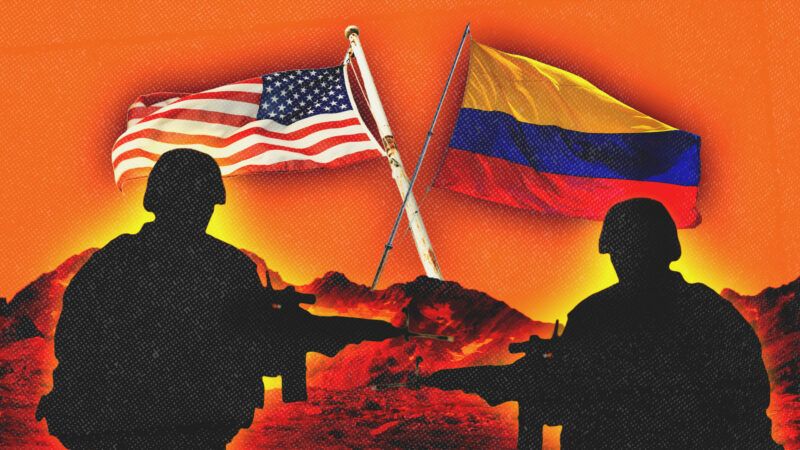
The Trump administration is expanding the footprint of its war on drugs in Latin America.
On Wednesday, Defense Secretary Pete Hegseth announced that Colombia would join the "Shield of the Americas" initiative. When the multinational security coalition of the U.S. and Latin American countries formed in March, President Donald Trump said the group was united by a commitment to use "lethal military force to destroy the sinister cartels and terrorist networks once and for all."
Hegseth said members of the Shield, a.k.a. the Americas Counter Cartel Coalition, will take "concrete steps—sometimes risky steps, courageous steps—in partnership" toward its goal of "dismantling the drug cartels that threaten safety, security and sovereignty in the Western Hemisphere."
To date, at least 19 countries in the region have signed on to the coalition, including the Dominican Republic, Trinidad and Tobago, and Ecuador, which have all had citizens killed by the Trump administration's extrajudicial maritime strikes, according to the Washington Office on Latin America, a human rights research and advocacy organization.
Colombia's entry into the group came at the request of its new president, Abelardo de la Espriella, who on the campaign trail promised to use the "air force, the army, and the police" to neutralize every plane and boat "loaded with drugs that leaves Colombia." Moments after taking office last week, the new president doubled down, pledging to "relentlessly defeat narcoterrorism and every criminal organization that threatens Colombia's freedom," according to The Wall Street Journal.
He has wasted no time fulfilling his promise. On Sunday, Colombian forces killed four members of the former Revolutionary Armed Forces of Colombia and two members of Colombia's largest drug cartel in two military operations across the country, according to the Miami Herald.
In a way, Espriella is simply continuing the same failed policies as his predecessors. Since the launch of Plan Colombia in 2000—a counternarcotics initiative to train, equip, and assist the Colombian military financed by the U.S.—America has given Colombia billions in foreign aid, with minimal results.
Last September, the Trump administration found Colombia had "failed demonstrably to meet its drug control obligations." It certified it as a "major drug transit" and one of the "major illicit drug producing countries," a designation it has carried for over 40 years. Cocaine production in Colombia has reached record levels, "nearly nine times what United Nations researchers say was produced in 2012," reports The Wall Street Journal.
Clearly, using the military to fight drug trafficking has never been particularly effective, both for the U.S. and other nations in the hemisphere.
In 2025, Ecuador—which has waged a yearslong war against cartels using the military—recorded the highest number of violent deaths in its history, according to Latinoamérica21. Yet, the flow of illegal drugs continues unabated. About 70 percent of the cocaine produced in Colombia and Peru now moves through Ecuador's ports, according to The Guardian. The country also plays a central role in importing, processing, and redistributing precursors for synthetic opioids.
The security coalition has yet to yield real dividends for Ecuador's security, but it has come at real cost to its citizens.
In January, the CIA targeted multiple Ecuadorian fishing boats near the Galápagos Islands as part of a "covert action" separate from the boat strikes by Southern Command, according to The Washington Post. The CIA strikes resulted in the disappearance of eight Ecuadorian nationals and were part of the agency's expanded presence in Latin America, sanctioned by Trump. In March, a military strike conducted as part of a joint operation between the U.S. and Ecuadorian forces destroyed a dairy farm in rural San Martín, destroying cows instead of cocaine, according to The New York Times.
Despite Hegseth's bravado and the odious manner in which the Trump administration celebrates its military strikes on fishing boats, its approach has done nothing but increase the body count in Latin America while having a negligible effect on drugs flowing into the United States.
Evidently, Colombia is yet to learn its lesson about militarizing the war on drugs, even after decades of interdiction and prohibition failing.




